
Short answer: The best employee engagement software for a self-serve small or mid-size team on Slack or Microsoft Teams is Matter, which puts recognition, rewards, celebrations, and surveys in one native app with a Free plan for unlimited users and Basic at $1 per user/month, billed annually.
Lattice and 15Five tie surveys to reviews, Culture Amp or Qualtrics go deepest on benchmarks, by quote, and CultureMonkey carries surveys to frontline staff by email, SMS and WhatsApp.
Employee engagement software is a platform that measures how connected people feel to their work and their company, then gives managers a way to act on it: pulse and engagement surveys, peer recognition and rewards, feedback and 1:1s, and analytics that turn answers into a plan. In 2026 the category has split into three kinds of tool.
Recognition-led platforms such as Matter and Achievers build the daily habit inside Slack and Microsoft Teams and add surveys on top; listening-led suites such as Culture Amp, Lattice and Qualtrics start from the survey and the driver analysis; comms-led intranets put the company feed first.
Most now deliver part of the experience in chat, and all of them sell analytics as the reason to pay.
This page is for the HR lead, people-ops manager or founder comparing employee engagement platforms, tools and apps for a team of 20 to 2,000. Every price below was read from the vendor’s own pricing page, every rating comes from G2, and where a vendor publishes no price we say so.
We also draw on Matter’s published data, with the disclosure that we build Matter and rank it first.
Last verified September 2026.
The short version
The best employee engagement software for a self-serve small or mid-size team on Slack or Microsoft Teams is Matter: recognition, rewards, celebrations and surveys in one native app with a Free plan for unlimited users and a published price.
CultureMonkey is the better pick if much of your workforce is frontline or multilingual, since it delivers surveys by email, SMS, WhatsApp, QR code and kiosk as well as Slack and Teams, at a custom quote. For mid-market companies that want surveys tied to reviews and 1:1s, Lattice and 15Five publish per-seat prices; Workleap Officevibe and Leapsome sell bundles.
For enterprise listening with benchmarks and driver analysis, Culture Amp, Qualtrics Employee Experience and Workday Peakon Employee Voice go deeper than anything else here, at quote-only prices. Microsoft Viva Glint is the cheapest published survey SKU for Microsoft 365 shops, and Achievers and WorkTango suit large sales-led programs.
What is employee engagement software?
Employee engagement software measures how connected people feel to their work, their manager and their company, then gives the organization a way to act on what it finds.
In practice that means some combination of surveys, peer recognition and rewards, feedback and 1:1s, and reporting that turns responses into something a manager can do on Monday.
The category is not one product shape. Recognition-led tools start from the daily habit and add listening. Listening-led suites start from the survey, the benchmark and the driver analysis. Comms-led platforms start from the company feed.
What separates it from an HR system of record is the unit of measurement. An HRIS records what happened to an employee: hire date, pay, leave, exit. Engagement software records what people report and what colleagues give them, so a trend shows up before a resignation does.
It is also not a survey tool. A survey tool collects answers. Engagement software is judged on whether anything changes afterward, which is why action planning and participation reporting matter more in a demo than the size of the question library.
Quick comparison
| Platform | Works in | Starting price | Free plan or trial | G2 rating | Best for |
|---|---|---|---|---|---|
| Matter | Slack, Teams (native); email | Basic $1 per user/month, billed annually | Free plan; 14-day free trial | See G2 page | SMB and mid-market in chat |
| Culture Amp | Web; Slack and Teams notifications | Quote, billed annually | None printed | 4.5 (1,613) | Benchmarked enterprise listening |
| CultureMonkey | Web, email, SMS, WhatsApp; Slack and Teams reminders | Custom quote by headcount | None printed | 4.7 (67) | Frontline and multilingual listening |
| Lattice | Web; Slack (pulse); Teams alerts | Engagement $4 seat/month, $4,000 minimum | None printed | 4.6 (4,123) | Surveys tied to performance |
| Workleap Officevibe | Web; Slack and Teams DMs | From $4,999 USD per year | None printed | 4.3 (1,090) | HR-owned manager toolkit |
| 15Five | Web, mobile; Slack; Teams (High Fives) | Engage $4 per user/month | None printed | 4.6 (1,927) | Performance plus surveys |
| Leapsome | Web; Slack and Teams reminders | Quote, one-year minimum | 14-day free trial | 4.8 (2,568) | Modular reviews, surveys, goals |
| Achievers | Slack, Teams, Outlook, web, mobile | Custom quote | None printed | 4.6 (9,596) | Enterprise recognition programs |
| Qualtrics Employee Experience | Web; Slack and Teams add-ons | Quote by employee count | None printed | 4.4 (463) | People-analytics teams |
| Microsoft Viva Glint | Teams alerts; web link; no Slack | $2.00 user/month, paid yearly, 50-seat minimum | None printed | 4.6 (42) | Microsoft 365 survey programs |
| Workday Peakon Employee Voice | Web; Teams (native); Slack notifications | Quote via Workday sales | None | 4.6 (117) | Workday customers |
| WorkTango | Web, mobile; Slack, Teams (recognition) | Custom quote, 12-month minimum | None printed | 4.7 (1,329) | Surveys plus recognition |
Pricing verified September 2026 against each vendor’s pricing page; ratings from G2 as of September 2026. We do not print a G2 score for our own product.
How we evaluated employee engagement software
We build Matter, employee engagement software native to Slack and Microsoft Teams, so read our take on our own product with that in mind.
For every other platform we reviewed the vendor’s pricing page, integration pages and help documentation, plus named G2 reviews; most we have not used hands-on, so we rely on what each vendor publishes.
We scored each platform on five criteria: where employees actually use it (native to Slack or Teams, a connector that sends reminders, or a separate portal); how much of the engagement loop it covers; the depth of its analytics; how quickly a team can start without an IT or HRIS project; and whether the pricing can be read without a sales call.
Pricing verified September 2026 on each vendor’s pricing page; ratings from G2 as of September 2026.
Our own data shapes the weighting. In The Recognition Habit, Matter’s 2026 Benchmark Report, teams that build recognition around a weekly ritual give about 2.5x more recognition per member than ad hoc teams, and roughly 8 in 10 ritual teams stay active in nearly every month; the same report finds that over half of pulse responses arrive within the first hour and 87.5% within a day, which is why chat delivery weighs heavily here.
Matter’s State of Employee Recognition and Rewards 2026 survey of 1,021 U.S. professionals found that 33% are thanked monthly or less, and it reports a correlation between the workplace communication tool and recognition frequency: 56% receive recognition weekly or better at Slack workplaces and 47% at Microsoft Teams workplaces, against 39% where email is the only channel.
And before any demo of an AI-assisted platform: in Did AI Kill the Thank You, 63% of people say recognition means less when AI writes it. Methodology is on our research page.
What to look for in employee engagement tools and platforms
- Where people will actually use it (Slack, Teams, email, mobile, a portal). Native means the survey is answered or the kudos sent inside the chat app; a connector means chat carries a reminder and the work happens in a browser. The difference shows up as response rate.
- Which kind of tool it is. Recognition-led, listening-led and comms-led platforms overlap on features but differ on what they do well. A survey suite with a shout-out button is not a recognition program, and the reverse holds too.
- Rewards economics. Whether budgets are funded separately from seats, whether points expire, and whether the vendor charges convenience fees on redemption.
- Setup path. Who approves the app in your Slack workspace or Teams tenant, whether an HRIS sync must come first, and whether launch takes minutes, weeks or months.
- Analytics depth you will use. Benchmarks and driver analysis matter at 1,000 employees; at 60, a participation report and a trend line do.
- Pricing you can read. Two-thirds of the platforms below publish no per-user price. Fine for enterprise procurement, a problem for a pilot next week.
Main features of employee engagement software
Feature lists in this category look alike on a website. These seven capabilities are where the platforms above actually diverge, and they are worth testing in a trial rather than reading about.
- Surveys and continuous listening. Engagement and pulse surveys, eNPS, onboarding and exit questionnaires, with scheduling and anonymity thresholds. The practical questions are where the survey gets answered and how short it can be; our guide to pulse survey software covers the tools built for this alone.
- Recognition and rewards. Peer and manager recognition tied to company values, points or coins, and a redemption catalog. Check who funds the budget, whether points expire, and whether redemption carries a fee.
- Feedback, 1:1s and goals. Check-ins, weekly updates, review cycles and OKRs. Lattice, 15Five and Leapsome treat this as the core of the product; most recognition-led tools do not offer it at all.
- Analytics and sentiment analysis. Participation, trend lines and team-level segmentation, and at the top end external benchmarks plus driver analysis that ranks what is moving your score.
- Communication and celebration. Announcements, a company feed, and automated birthdays and work anniversaries, the features most likely to keep running when nobody is maintaining them.
- Action planning. Suggested actions, manager nudges and follow-up tracking. This is the feature most often demoed and least often used, so ask to see a real plan from a real customer’s last quarter.
- Administration and integrations. Chat and HRIS sync, single sign-on, permissions and data export. A tool that needs an HRIS project before launch has a different timeline from one that reads its user list out of Slack or Teams.
If listening is the only gap, compare employee engagement survey software on its own terms: question depth and reporting vary far more there than chat delivery.
The best employee engagement software in 2026
1. Matter
We build Matter, so weigh this accordingly. Matter is a recognition-led employee engagement platform that runs natively inside Slack and Microsoft Teams: peer kudos tied to company values, coin-based rewards, automated birthdays and anniversaries, and pulse, eNPS, onboarding and custom surveys, with no separate login because user management syncs from Slack or Teams.
Setup takes about two minutes; almost half of teams (46%) send their first recognition within 15 minutes of it. Feedback Friday™ (US Patent 12,199,935) prompts the team weekly; give-coins reset weekly, earned coins never expire.
On Teams, leaders can use Matter with Microsoft Copilot to surface recognition, celebrations, survey insights and reward activity in natural language.
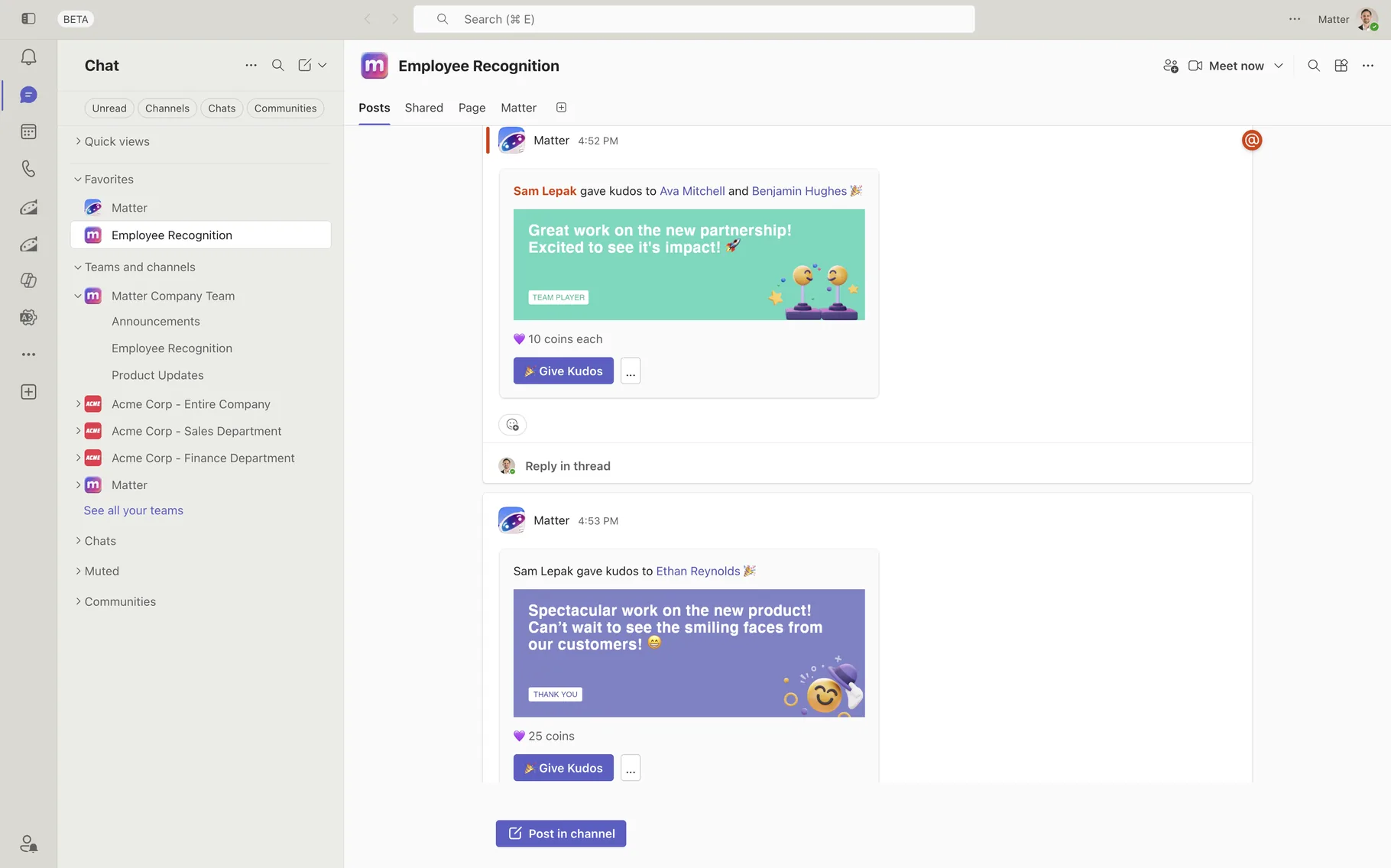
Standout strength: The whole engagement loop in the app people already have open, at a published price: recognition, rewards with 10,000+ eGift card options across 200+ countries, celebrations and surveys, with a Free plan for unlimited users and a Teams App Store rating of 5.0 across 1,476 ratings.
Watch out for: Rewards, swag and challenges need Pro, surveys are a paid add-on, and HRIS sync is an Enterprise item (250+ HRIS integrations available; no HRIS project is required because user management syncs from Slack or Teams).
Analytics serve team leads and HR; Culture Amp and Qualtrics go deeper on benchmarks and driver analysis. Matter’s G2 reviews give the unfiltered view.
Pricing: Free plan for unlimited users. Basic is $1 per user/month, billed annually; Pro is $3 per user/month, billed annually; the Surveys add-on is $2 per user/month, billed annually, on Basic or Pro (Pro + Surveys totals $5).
Every paid plan starts with a 14-day free trial, no credit card, and Matter hasn’t raised prices in 8 years. Verified September 2026.
Works in: Slack and Microsoft Teams natively, including Slack Enterprise Grid and Slack Connect channels; surveys also deliver by email.
Best for: Small and mid-size teams, including remote and hybrid teams, that want recognition, rewards and surveys in one native app without a sales cycle.
2. Culture Amp
Culture Amp is the listening-led platform larger HR teams name first: engagement and effectiveness surveys, performance cycles, benchmarks and driver analysis. Its Slack and Teams apps deliver invitations, reminders and announcements; surveys are completed in the Culture Amp platform.

Standout strength: A mature suite, 4.5 on G2 across 1,613 reviews. Ryan H., a people operations systems manager (August 2026), calls it “a pleasure to work with.”
Watch out for: Quote-only pricing billed annually, with no figures printed, and chat is a notification channel rather than where surveys are answered. Bryan M., a head of IT (March 2026): “It sometimes felt like there was way too much to fill out, and a lot of it ended up being skipped or never used.”
Pricing: Quote-based, billed annually; depends on employee count, product and service tier, with tiers for under 200 employees, 200 to 999, and 1,000 or more. Verified September 2026.
Works in: Web; Slack and Microsoft Teams for invitations, reminders, announcements and (for Performance customers) feedback.
Best for: Organizations of several hundred or more that want benchmarked engagement analytics and can run an annual procurement.
3. CultureMonkey
CultureMonkey is an employee listening and experience platform designed to help organizations improve participation, uncover workplace concerns, and strengthen manager accountability. It enables HR leaders to build a continuous listening culture and make informed decisions across global, distributed, and frontline workforces.

Standout strength: Customizable engagement, pulse, eNPS, onboarding, and lifecycle surveys. AI-powered feedback analysis, industry benchmarks, manager dashboards, and trackable action plans. CultureMonkey has a G2 score of 4.7/5 (67 reviews) based on user reviews. “It gives us clear direction on what truly matters to employees, allowing us to take more meaningful, data-driven actions that improve overall engagement and experience.” - Verified User in Enterprise (Customer G2 Review).
Watch out for: No published price or free trial; every plan is a custom quote. In Slack and Teams, CultureMonkey sends the survey link, but people answer in CultureMonkey itself.
Pricing: Custom pricing based on organization size, employee headcount, and selected requirements. To learn more, view CultureMonkey’s pricing page. Verified September 2026.
Works in: Multilingual surveys delivered through email, WhatsApp, SMS, QR codes, kiosks, Slack, and Microsoft Teams.
Best for: Organizations that want frontline and multilingual listening.
4. Lattice
Lattice is a performance-and-listening platform: 1:1s, weekly updates, reviews, goals and OKRs, with Engagement sold as its own product: pulse, onboarding and exit surveys, eNPS, action planning and AI analysis. In Slack, pulse surveys are answered inside the Lattice app home tab; on Teams the integration carries notifications and feedback.
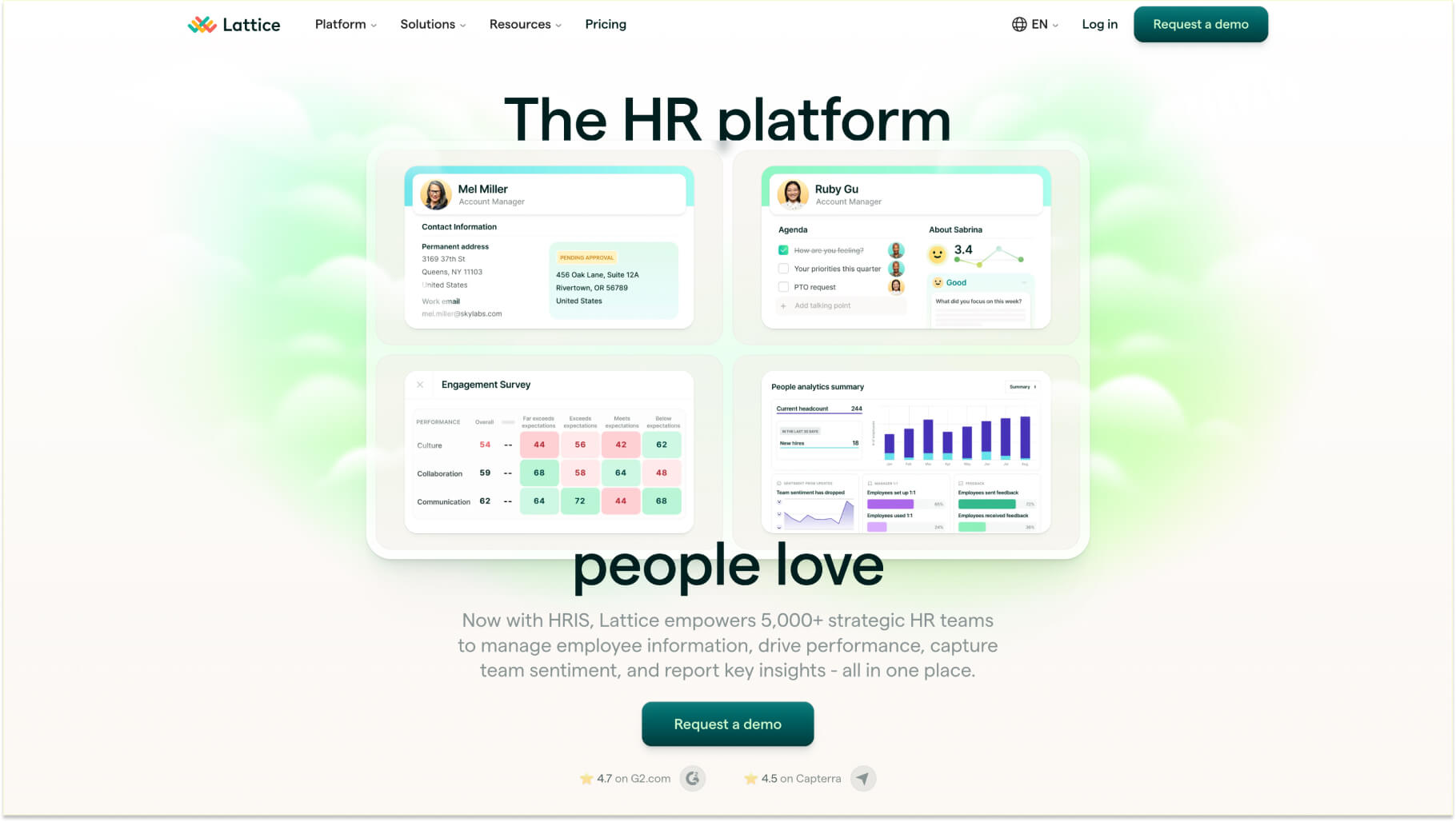
Standout strength: A published per-seat price for Engagement inside a well-reviewed performance suite, 4.6 on G2 across 4,123 reviews. Heather M., a head of people (May 2026): “will implement and use Lattice over and over!”
Watch out for: The minimum annual agreement is $4,000, billed in USD only, which puts the $4 seat price out of reach for small teams.
Pricing: Engagement is $4 seat/month; Foundations, the most popular bundle, is $13 seat/month; Performance $10 and Goals & OKRs $8 seat/month; all billed annually with a $4,000 minimum annual agreement. Verified September 2026.
Works in: Web; Slack (pulse surveys, feedback, 1:1s, weekly updates); Microsoft Teams (notifications and feedback).
Best for: Mid-size companies that want engagement surveys tied to performance reviews and 1:1s in one HR platform.
5. Workleap Officevibe
Workleap Officevibe is the listening-led suite most people still call Officevibe, now sold as part of the Workleap platform with Performance and Compensation. Its weekly pulse survey, feedback prompts and 1-on-1 reminders arrive as Slack or Teams direct messages; reports live in the web app.
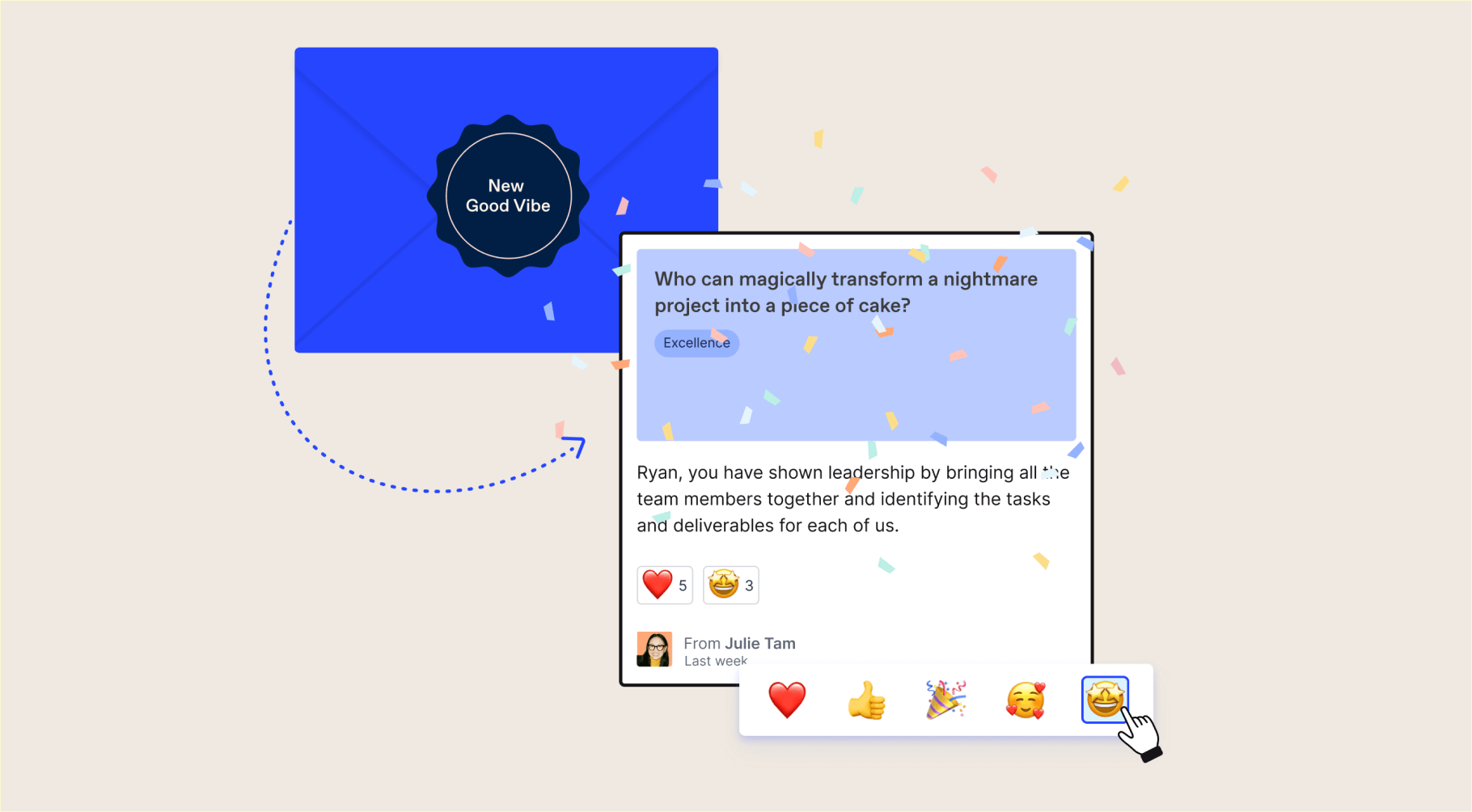
Standout strength: A manager toolkit rather than a survey alone. Shruti T. (May 2026), on G2, where Workleap holds 4.3 across 1,090 reviews: “one of the most truly one-stop platforms/tools for bringing employee experiences together.”
Watch out for: The old per-user Officevibe price is gone; the suite starts at $4,999 USD per year with no per-user or free tier printed. Duncan J., a managing director (September 2025): urgent support tickets “can take up to three days to be resolved.”
Pricing: Standard starting at $4,999 USD, billed annually; Pro starting at $11,999 USD, billed annually; Enterprise custom for organizations with more than 250 employees. Verified September 2026.
Works in: Web; Slack and Microsoft Teams direct messages for pulse surveys, reminders and 1-on-1 prompts.
Best for: Mid-size companies that want an HR-owned suite with manager coaching at a bundle price.
6. 15Five
15Five is a performance-management platform that sells engagement surveys as a module. Check-ins, High Fives recognition and feedback run inside Slack; engagement surveys are delivered by email or SMS and completed in the web app; the Teams app covers High Fives only.
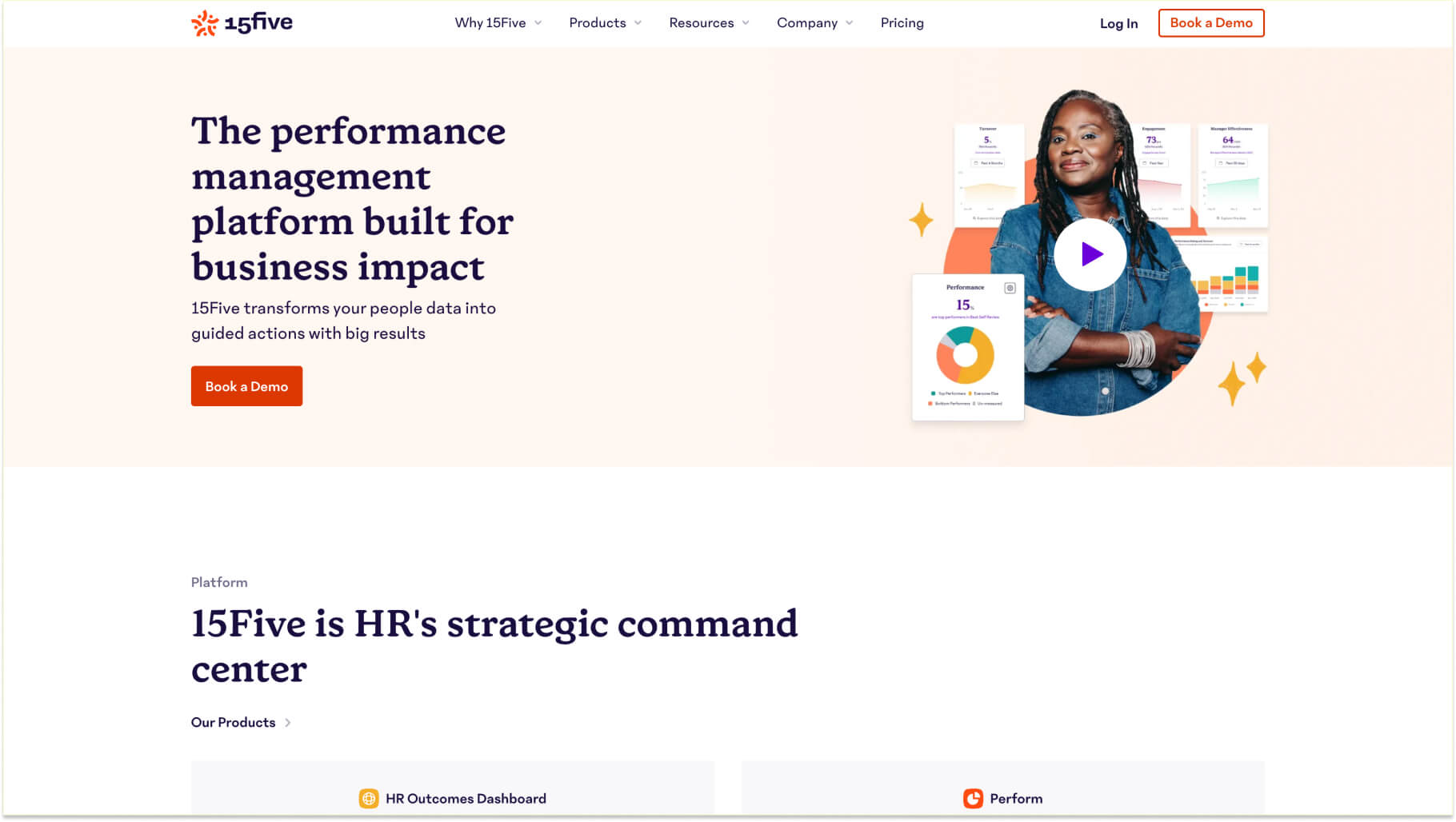
Standout strength: Published per-user pricing, a survey tier with heat maps and benchmarking, and 4.6 on G2 across 1,927 reviews. Dollie B., a senior UX product designer (May 2026): “The platform's intuitiveness is its biggest strength.”
Watch out for: Surveys are not answered in Slack or Teams, and the same reviewer found “an advanced customization or reporting option was locked behind a more expensive version.”
Pricing: Engage is $4 per user/month, Perform $11 per user/month and Total Platform $16 per user/month, all billed annually. Verified September 2026.
Works in: Web, iOS and Android; Slack for check-ins, High Fives and feedback; Microsoft Teams for High Fives only; surveys by email and SMS.
Best for: Companies of 100 to 1,000 whose real need is manager effectiveness, with engagement surveys attached.
7. Leapsome
Leapsome is a modular people platform: reviews, surveys, goals, learning, compensation and an HRIS, bought module by module. Slack shortcuts cover praise, feedback requests and 1:1 talking points; on Teams the integration delivers reminders and posts praise to a channel.

Standout strength: The highest G2 rating on this page, 4.8 across 2,568 reviews, and a 14-day free trial with no credit card, unusual among the suites. Abhishreya S., an engineer (August 2026), on G2: “all in one place.”
Watch out for: Surveys are not answered in chat, Teams setup needs an Azure AD Global Administrator and supports one team per instance, and Moe B., a QA associate (February 2026): “HR admins often struggle with the complex backend settings and steep learning curve during initial setup.”
Pricing: Modular, quote-based pricing with a 14-day free trial and a minimum one-year term; no per-module prices are printed. Verified September 2026.
Works in: Web; Slack for reminders and shortcuts; Microsoft Teams for reminders and a praise channel.
Best for: Growing companies that want surveys bundled with reviews, goals and learning from one vendor.
8. Achievers
Achievers is enterprise recognition-led engagement: monetary and non-monetary recognition, a global rewards marketplace, years-of-service and nomination awards, and an AI-personalized newsfeed. A slash command starts a recognition in Slack, employees post to the live feed without leaving Teams, and Outlook is covered too.
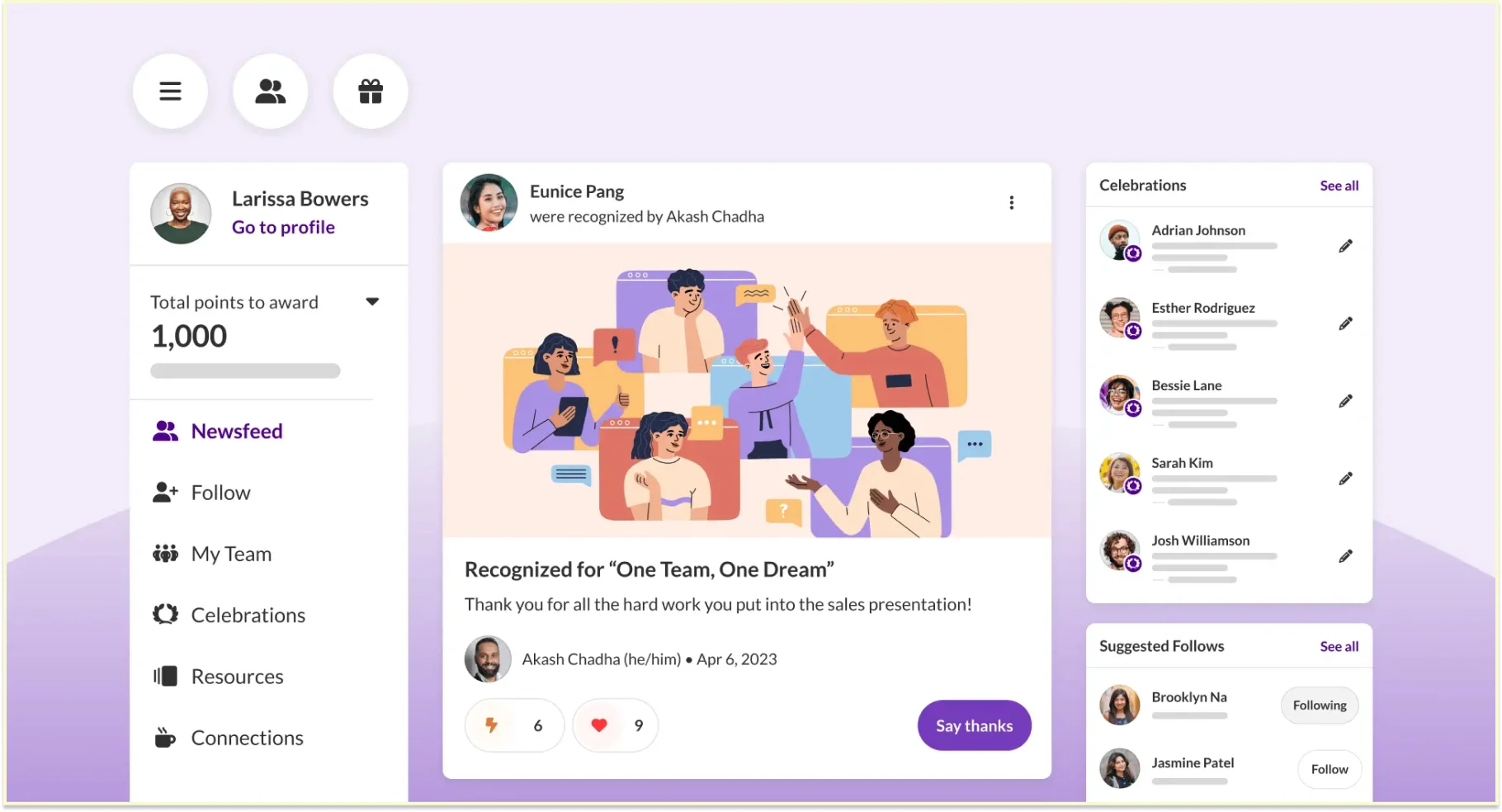
Standout strength: The largest review base here, 4.6 on G2 across 9,596 reviews, and a Teams App Store rating of 4.6 across 979. Nathan K., a technical analyst (April 2026): “Setting it up is very simple, with no issues integrating within the Microsoft Teams app store.”
Watch out for: No prices are printed. Fatima K., a head of sales (November 2025), cites “Limited reward options and low point values” and “points expiring too quickly.”
Pricing: Custom quote only; the vendor states no hidden fees and no annual points commitment required. Verified September 2026. See our Achievers vs. Matter comparison.
Works in: Slack and Microsoft Teams natively, Outlook, Viva Connections, web, mobile.
Best for: Large enterprises with an HCM integration, a dedicated program owner and a global rewards budget.
9. Qualtrics Employee Experience (People Engage)
Qualtrics Employee Experience, sold as People Engage and formerly EmployeeXM, is listening-led at enterprise scale: unlimited engagement and pulse surveys per annual subscription, lifecycle surveys and industry benchmarks. The Slack add-on lets employees take surveys inside a channel; Teams distribution sends a link that opens in a browser tab.
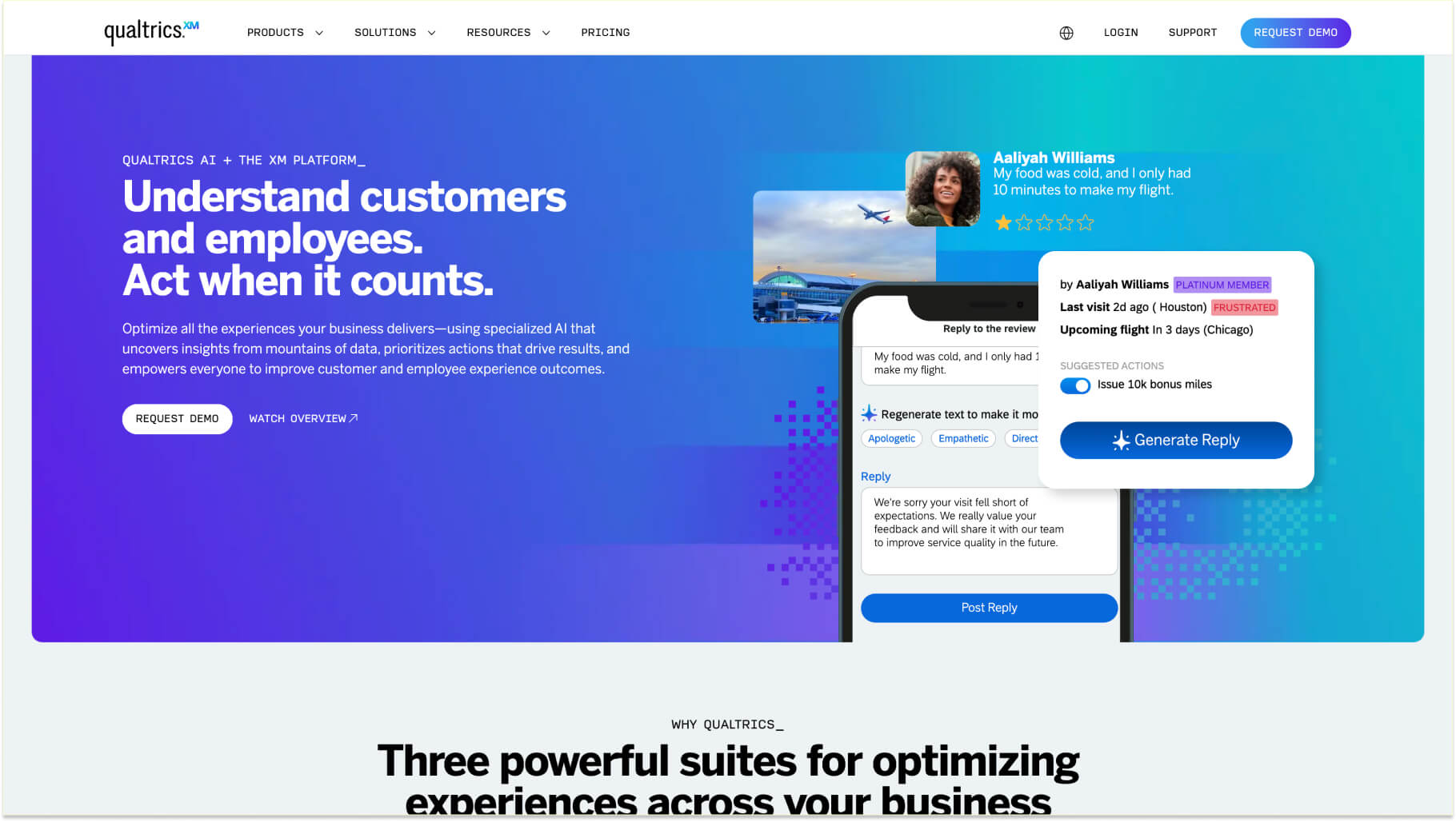
Standout strength: Benchmarks and dashboards. Kaela A., a director of human resources (November 2024), on G2, where it holds 4.4 across 463 reviews: “The benchmarks to compare your organization's results to other organizations in the same industry is extremely helpful.”
Watch out for: Pricing is by employee count with no figures published, and Slack and Teams delivery are each an add-on outside the standard license. Duke K. (April 2026): “It is really difficult to get accurate employer data into the platform.”
Pricing: Based on employee count, quote-only, with Slack and Teams delivery as paid add-ons. Verified September 2026.
Works in: Web; Slack (surveys taken in a channel, add-on); Microsoft Teams (link by direct message, add-on); the Qualtrics XM mobile app serves dashboards.
Best for: Large enterprises with a people-analytics team, especially those already running Qualtrics for customer experience.
10. Microsoft Viva Glint
Microsoft Viva Glint is Microsoft’s listening-led survey product, added to a Microsoft 365 enterprise subscription through a Microsoft representative. The Teams app brings invitations, reminders and results notifications into Teams; the survey opens from a link, with QR codes for frontline staff.

Standout strength: The cheapest published engagement-survey SKU on this page, and Viva Pulse, Microsoft’s short manager-run survey tool, sits in the $6.00 bundle.
Watch out for: A 50-seat minimum, Teams licenses required for notifications, no Slack, no recognition or rewards, and the survey is answered in a browser rather than inside Teams. G2 shows 4.6 across only 42 reviews, too few to quote a named reviewer.
Pricing: Microsoft Viva Glint is $2.00 user/month, paid yearly; Viva Workplace Analytics and Employee Feedback, which adds Viva Pulse, is $6.00 user/month, paid yearly; a 50-seat license minimum applies. Verified September 2026.
Works in: Microsoft Teams for notifications; web via survey link; email; no Slack.
Best for: Microsoft 365 enterprises that want an HR-run survey program with Teams-delivered reminders at a low per-user price.
11. Workday Peakon Employee Voice
Workday Peakon Employee Voice, the product that began as Peakon, is a continuous-listening platform inside the Workday estate. Employees can open and complete their survey directly within Teams; the Slack integration sends survey and reminder notifications and daily suggestion summaries to managers.

Standout strength: True in-Teams survey completion plus a manager feedback loop, rated 4.6 on G2 across 117 reviews. Cesar Y. (December 2025) likes “collecting employee feedback in real time through the frequency of surveys.”
Watch out for: No public pricing anywhere on workday.com and no trial. Peter E., a learning and development manager (October 2020), found a bespoke survey “very difficult without going into a much higher tier that we didn't need.”
Pricing: Quote-based via Workday sales; no plans or figures are published. Verified September 2026.
Works in: Web; Microsoft Teams (survey completed inside Teams); Slack (notifications and manager summaries).
Best for: Large organizations, especially Workday HCM customers, that want listening tied to their HR system of record.
12. WorkTango
WorkTango combines recognition-led and listening-led engagement: peer recognition with a rewards marketplace the vendor describes as zero markup, plus unlimited surveys with anonymous conversations. Employees send recognition from within any Slack or Teams channel. WorkTango announced its acquisition by BI WORLDWIDE on July 20, 2026 and keeps its name.
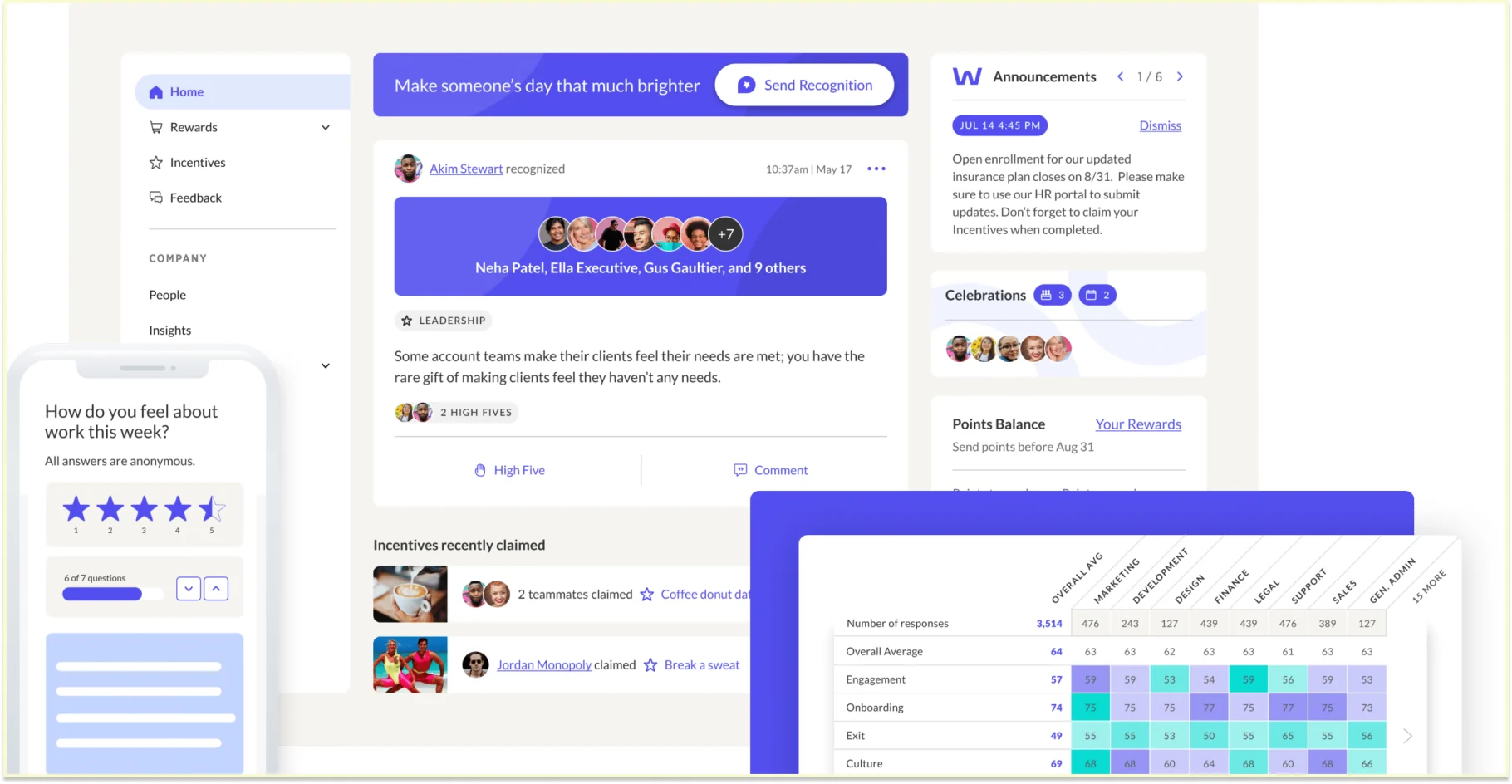
Standout strength: Surveys and recognition from one vendor with points billed only as redeemed, and 4.7 on G2 across 1,329 reviews.
Watch out for: Quote-only pricing with a 12-month minimum, a 4 to 6 week launch, and no Microsoft Teams app store listing. Chris H., a sales manager (April 2026), says it does “seem to lack engagement by a lot,” and James W. (September 2025) notes that “points expire at the end of the quarter.”
Pricing: Custom quote for each of three plans (Employee Surveys & Insights, Recognition & Rewards, Full Employee Experience Platform), 12-month minimum contract. Verified September 2026. See our WorkTango vs. Matter comparison.
Works in: Web and mobile apps; Slack and Microsoft Teams for recognition and the feed; surveys are not described as answerable in chat.
Best for: Mid-size to enterprise HR teams that want surveys and recognition under one annual contract.
More employee engagement software worth knowing
The twelve above are the platforms we would shortlist first for engagement specifically. The tools below come up constantly in this market and belong in a complete picture, either as a narrower alternative to one of the twelve or as an adjacent product solving part of the same problem.
Several are recognition or wellbeing point solutions rather than engagement platforms. Where that is true we say so, because a shortlist assembled from category labels wastes a month. Prices below were read in September 2026 from each vendor’s own pricing page; where a vendor publishes no figure, we print no number.
Nectar
Nectar is recognition-led with peer awards, points-based rewards, milestone automation, internal comms and an eNPS and engagement survey builder, which puts it in much the same shape as Matter. It suits a company wanting recognition first, listening second. Nectar publishes no figure and asks you to request pricing, so treat it as quote-based. Verified September 2026.
Motivosity
Motivosity sells recognition, an appreciation feed, manager development and a listening module as separate pieces, so it fits mid-market buyers wanting more than recognition. Its pricing page states a platform fee of up to about $2 per employee per month, modules typically from around $1 per employee per month, and a $3,000 minimum annual spend. Verified September 2026.
Vantage Circle
Vantage Circle bundles recognition and rewards with a discounts and perks marketplace, a wellbeing product and an eNPS-based pulse tool, sold as modules. It suits large, globally distributed workforces where perks are part of the offer. Its plans page lists tiers and add-ons but prints no figures: pricing is custom. Verified September 2026.
Assembly
Assembly runs peer recognition, milestones, announcements, awards and challenges with AI-assisted insights, largely inside Slack and Teams, making it a published-price alternative to Matter. Its pricing page lists Empower at $3 per user / month billed yearly, with Enterprise quoted. Verified September 2026.
Awardco
Awardco builds recognition and service awards on an Amazon Business catalog, and catalog breadth is its argument. It is a rewards-led point solution rather than an engagement platform, so shortlist it when the reward experience decides the purchase.
Its plans page prints no per-user rate and says businesses of 100 employees or fewer can ask about packages from $3,000. Verified September 2026.
Kudos
Kudos is recognition tied to company values, with culture analytics HR teams tend to like. It is adjacent rather than central here: listening is not its strength, so it competes on recognition and not on surveys. Kudos publishes no pricing page, so pricing is quote-only and we print no number. Verified September 2026.
Guusto
Guusto is gift-card-first recognition with an unusually good answer for deskless staff who have no work email or chat account. It is a recognition and rewards point solution, not an engagement platform, and the right call when most of your people never open a laptop.
Its pricing page lists Lite at $150 per month, Essential sender seats at $4.00 per month with a $200 monthly minimum, and Premium sender seats at $5.00 with a $500 monthly minimum. Verified September 2026.
Quantum Workplace
Quantum Workplace is a listening-led suite: engagement, pulse, lifecycle and exit surveys, goals, 1:1s and recognition, with a long benchmarking history behind it, and a credible alternative to Culture Amp for mid-market and larger companies. Its pricing page prints no per-user rate and states a $15,000 minimum annual contract. Verified September 2026.
Terryberry
Terryberry runs service awards, recognition and a wellbeing product, with real depth in manufacturing and other deskless settings the chat-native tools handle poorly. It is recognition and awards led. We could not read a published price from its own pricing page today, so we print none; treat it as quote-based. Verified September 2026.
Mo
Mo delivers recognition, nominations and prompted moments inside Slack and Teams, aiming at a weekly habit rather than an annual survey, which puts it close to Matter in shape and stronger in the UK and Europe. Its pricing page publishes no figures and asks for a quote. Verified September 2026.
Polly
Polly runs surveys, polls, standups and Q and A inside Slack and Teams. It is not an engagement platform: it is the best-known chat-native survey tool, usually paired with a recognition product rather than replacing one.
Its pricing page lists a free tier, Basic at $19 per month billed annually for one license, Pro at $29 per month, and Team at $249 per month for five users. Verified September 2026.
Workvivo
Workvivo, now part of Zoom, is an employee communication and intranet platform with a social feed, live events, recognition and surveys attached. It is comms-led rather than listening-led, so it is the right pick when the real problem is that nobody reads company news.
It publishes no prices, quotes per package, and states that it does not offer a free trial. Verified September 2026.
Reward Gateway
Reward Gateway combines recognition, an employee discounts and benefits marketplace, internal comms and surveys, and is widely used by large employers in the UK and Australia. The marketplace is usually what decides the purchase. Its pricing link leads to a contact form rather than a price list, so we print no number. Verified September 2026.
O.C. Tanner
O.C. Tanner runs enterprise recognition and culture programs, including service and physical awards, backed by its own research institute. It is recognition-led and enterprise-priced rather than self-serve, so it competes with Achievers rather than Matter. No pricing page exists on its site; every engagement is quoted. Verified September 2026.
Empuls
Empuls is an engagement suite combining recognition and rewards, perks, surveys and a social intranet, with strong distribution in Asia and the Middle East. Its pricing page describes a modular, per-employee, per-month model and prints no figure, so treat it as quote-based. Verified September 2026.
BambooHR
BambooHR is an HRIS rather than an engagement platform, but it carries eNPS and satisfaction surveys, so small companies reasonably ask whether it removes the need for a second tool. Usually it does not: the surveys are basic and there is no recognition program.
Its pricing page lists Core at $10, Pro at $17 and Elite at $25 per employee per month, with a flat rate from $250 per month for companies of 25 or fewer. Verified September 2026.
Wellhub
Wellhub, formerly Gympass, is a corporate wellbeing benefit giving employees access to gyms, studios and wellbeing apps. It is genuinely adjacent: a benefit rather than engagement software, reporting usage rather than sentiment. Shortlist it beside an engagement tool when wellbeing is the named gap, never instead of one.
We could not read a published price today, so we print none; pricing is quoted by headcount. Verified September 2026.
Four tools from the earlier edition of this page are absent rather than demoted. We could not confirm today that each is still sold as a standalone product, and an entry we cannot verify is worse than a shorter list.
What employee engagement software costs in 2026
Three pricing models run through this category. Published per-user pricing is the self-serve model: Matter at $1 per user/month, billed annually for Basic and $3 for Pro, Lattice at $4 seat/month for Engagement, 15Five at $4 per user/month for Engage, and Microsoft Viva Glint at $2.00 user/month, paid yearly.
Bundle pricing is the mid-market model: Workleap Officevibe from $4,999 USD per year. Quote-only pricing is the enterprise model: Culture Amp, CultureMonkey, Qualtrics, Workday Peakon, Achievers, Leapsome and WorkTango print no figure and most expect an annual contract.
Minimums change the arithmetic for small teams: Lattice’s $4,000 minimum annual agreement means a 30-person company pays far more than $4 a seat, Viva Glint has a 50-seat minimum, and WorkTango and Leapsome require a one-year term. Matter bills only for members of the connected channel, pro-rated daily, with no minimum and no setup fee.
Rewards are almost always funded separately from seats. Achievers states no annual points commitment; WorkTango bills points only as redeemed; Matter charges for rewards only when an admin approves a redemption, and custom rewards cost nothing.
Add-ons stack too: Matter’s Surveys add-on is $2 per user/month, billed annually, and Qualtrics sells Slack and Teams delivery separately. The full breakdown is on Matter’s pricing page.
What is genuinely free: Matter’s Free plan for unlimited users covers kudos, the kudos template library and Feedback Friday; Leapsome and Matter each offer a 14-day free trial with no card. Everything else requires a purchase or a sales conversation first.
Benefits of employee engagement software
The honest version of the business case is that this software does not create engagement. It creates a measurement, a habit and a record, and those three things make management work visible that was previously invisible.
- Recognition that happens on a schedule instead of by luck. Just 14% of employees receive recognition at least weekly, and only 25% receive feedback that often. When employees get both weekly feedback and weekly recognition, 61% are engaged, compared with 38% for those who get weekly feedback but less frequent recognition (Gallup, October 2024, Gallup-Workhuman survey of 4,439 U.S. employees).
- Business results that were measured rather than asserted. Highly engaged business units show 23% higher profitability and 18% higher productivity in sales, 78% lower absenteeism and 63% fewer safety incidents (Gallup Q12 meta-analysis, 2024).
- A turnover signal you can act on. Engagement is associated with 21% lower turnover in high-turnover organizations and 51% lower turnover in low-turnover organizations, in the same meta-analysis. More figures sit in our roundups of employee engagement statistics and employee retention statistics.
- Team-level visibility where the variance lives. The manager alone accounts for 70% of the variance in team engagement, a finding Gallup first published in its 2015 State of the American Manager report and restates in its current engagement guidance. That is the argument for reporting by team rather than a company average.
- An audit trail that survives a personnel change. Participation, survey history and recognition records outlive whoever ran the program, which is the quiet reason HR teams give up the spreadsheet.
What none of this guarantees is that your score goes up. Global engagement fell to 20% in 2025, down from a 23% peak in 2022 and 2023, in a market where most large employers already own one of these platforms (Gallup, State of the Global Workplace 2026).
Pros and cons of employee engagement software
Every vendor on this page publishes a benefits list. Here is the shape of the trade, including the cases where buying nothing is the better decision.
Pros
- It makes a soft problem legible. A trend line by team, with participation beside it, turns an argument about culture into a conversation about one number and one group of people.
- It removes the dependence on one enthusiast. Automated prompts, scheduled surveys and self-served celebration dates keep running when the person who cared most changes jobs.
- Chat-native delivery lifts response rates. A survey answered in the app people already have open reaches more of them than one behind a login, which is why the delivery channel does more work here than feature count.
- It creates history. Comparable cycles let you say whether last year’s change worked, which no spreadsheet kept by three owners can.
Cons
- It measures far more than it fixes. Every platform here will tell you a team is struggling. None of them will hold the conversation, change the workload or adjust the pay band, and buyers routinely mistake the dashboard for the intervention.
- Asking without acting makes things worse. Response rates fall fastest in companies that survey on schedule and publish nothing, and a declining rate is a harder problem to recover from than never having surveyed.
- Anonymity thresholds break small teams. Most tools suppress reporting below roughly five responses, so a 25-person company gets a company average and very little else, which is exactly the size that finds the price hardest to justify.
- Cost is rarely the sticker price. Rewards budgets, minimum contracts, implementation time and the hours someone spends running the program usually exceed the per-seat figure, and only the per-seat figure appears on the pricing page.
- Consolidation risk is real. Products in this market are regularly acquired, renamed or folded into a larger suite, so a one-year term signed on a roadmap is a bet on that roadmap surviving.
When a channel and a spreadsheet is the right answer
Under about 25 people, software is usually the wrong purchase. A standing channel for thank-yous, a recurring calendar reminder so it happens, and a three-question form each quarter in a tool you already pay for covers the job.
Buy software when one of three things is true: you can no longer see team-level patterns by reading the channel, you need history to survive a change of owner, or the habit collapses whenever one person is away.
Software also cannot answer a compensation problem or a bad manager. It will surface both, promptly and in writing, and resolve neither. A rollout launched as the response to one of them tends to be read by employees exactly that way.
Employee engagement software for remote and hybrid teams
Distributed teams are where this software earns its price, because the informal signals a manager reads in an office are absent. They are also where the wrong tool fails fastest: anything behind a separate login competes with a full calendar and a different time zone.
The data complicates the usual assumption. Fully remote workers are the most likely to be engaged (31%), compared with hybrid (23%), on-site remote-capable (23%) and on-site non-remote-capable (19%) employees.
The paradox is wellbeing: only 36% of fully remote workers are thriving, versus 42% of hybrid workers, and 27% of remote workers experienced loneliness the previous day (Gallup, May 2025, global data).
So the thing to measure remotely is often connection rather than engagement. Most of the market now works hybrid: 52% of U.S. employees with remote-capable jobs work hybrid, 26% work exclusively remotely and 22% are fully on-site (Gallup, Indicator: Hybrid Work, data as of May 2026).
Four things matter more for a distributed team than in an office. Delivery has to be native to Slack or Microsoft Teams, and everything has to work asynchronously, so a survey that closes in 24 hours excludes an entire region.
Celebrations have to be automated, since birthdays and anniversaries are the moments most often missed remotely. And reporting has to segment by location, or a struggling satellite office averages away inside a healthy company number.
On the platforms above, Matter, Achievers and WorkTango give recognition natively in both chat apps, Lattice answers pulses inside Slack and Workday Peakon completes surveys inside Teams. For the program rather than the software, see our list of remote employee engagement activities.
How to choose employee engagement software for your company size
Under 50 people: buy nothing you cannot start this week. Matter’s Free plan gets recognition running, and Matter’s Surveys add-on covers pulse and eNPS when you are ready to listen.
Lattice, Officevibe and the enterprise suites are the wrong answer at this size; their minimums exceed what the whole program should cost. If your team runs on email rather than Slack or Teams, Matter is not the right fit; 15Five, which delivers surveys by email, is.
50 to 500 people: the kind of tool matters most here. If the gap is recognition and a weekly habit, Matter is the published-price option among the twelve.
If the gap is manager effectiveness, Lattice and 15Five publish per-seat prices for surveys attached to reviews and 1:1s; Workleap Officevibe and Leapsome bundle the same with more coaching.
Matter is right when you want recognition, rewards and surveys in one native app, and wrong when you need driver analysis, industry benchmarks or a performance review cycle.
500 people and up: a listening-led suite earns its price. Culture Amp and Qualtrics Employee Experience go deepest on analytics, CultureMonkey suits frontline and multilingual workforces, Workday Peakon Employee Voice fits Workday customers, and Microsoft Viva Glint is the low-cost option for a Microsoft 365 tenant.
For recognition at that scale, Achievers and WorkTango run global, budgeted programs with the sales process to match. Many enterprises pair such a suite with a chat-native recognition tool; the annual survey and the weekly thank-you are different jobs.
For program design, see our guides to employee engagement programs and to employee engagement more broadly.
Mistakes to avoid when buying employee engagement software
These are the failures we see most often, and most are decided before the contract is signed.
- Buying the category instead of the gap. Recognition-led and listening-led platforms both answer to the phrase employee engagement software and solve different problems. A silent culture needs recognition first; an unmeasured one needs surveys first. Buying the wrong half costs a year.
- Ignoring where the work actually happens. If your company lives in Slack or Teams and the tool only sends a reminder there, expect the response rate of an email. If your company runs on email and you buy a chat-native tool, expect worse.
- Reading the per-seat price as the cost. Check the minimum annual commitment, the rewards budget, redemption or convenience fees, whether points expire, and what implementation costs in weeks. Lattice’s $4,000 minimum and Viva Glint’s 50-seat minimum both change the arithmetic for a small team.
- No named owner after launch. Programs decay without someone whose job includes watching participation weekly. Deciding this after purchase means it does not get decided.
- Committing long on a young roadmap. A multi-year term signed for features that ship next quarter is the most common regret in this market.
What to ask in a demo
Vendors demo their strongest path. These questions push the conversation onto the ground where these products actually differ, and most can be answered on a shared screen rather than in a follow-up email.
- Where exactly is the survey answered, and where is the kudos sent? Ask them to do it live in Slack or Teams. Native and a notification look identical on a slide and produce different response rates.
- What is the all-in first-year cost for our headcount? Seats, minimum commitment, rewards budget, redemption fees, implementation and any add-on for chat delivery, in one number.
- What is the anonymity threshold, and what do our smallest teams see? Ask for a report from a five-person team, because this is where mid-market buyers are surprised after launch.
- What does setup require from IT? Tenant admin approval, a Slack workspace or Enterprise Grid install, single sign-on, an HRIS sync, and whether any of it blocks a pilot.
- Show me a real customer’s action plan from last quarter. Anonymized is fine. If nobody can produce one, action planning is a feature rather than a practice.
- What happens to unused points or coins? Expiry, carry-over, and what happens to a balance when someone leaves.
Employee engagement metrics the software should report
Whichever employee engagement tools you pick, the dashboard should give a manager a small set of numbers they can move. These seven cover most of what the platforms above measure; ask in the demo which ones ship out of the box and which need an export.
- Employee Net Promoter Score (eNPS). How likely people are to recommend the company as a place to work, trended by team. Pair the score with a follow-up question so you learn the reason, not only the number.
- Survey response rate. Participation is itself a trust signal: a falling rate usually means people stopped believing results lead to action. Short surveys delivered in chat keep it up.
- Satisfaction and engagement scores. The core rating questions, kept identical across cycles so the line means something, with open-text feedback beside them to explain a dip.
- Recognition frequency. How often each person gives and receives recognition. Recognition-led platforms report it natively; on a listening suite it is often missing.
- Participation in programs. Who joins recognition, feedback and celebration activity, by team, which shows where a program has taken hold and where it has not.
- Turnover and retention. Read beside the survey data: a team with sliding scores and rising exits is the one to visit first.
- Goal and task completion. Not an engagement measure on its own, but performance-led platforms such as Lattice, 15Five and Leapsome put it next to the pulse so you can see the two move together.
How to roll out employee engagement tools in seven steps
The software is the easy part. Most rollouts stall on ownership, leadership habit or a missing integration, so plan the launch before the purchase.
- Name the goal. Raise recognition frequency, lift eNPS, cut first-year turnover: one target the tool will be judged on.
- Pick for the goal, then pilot. Use the company-size guide above, then run the tool with one team for a month before a company-wide launch.
- Get leaders using it first. Adoption follows behavior: a leader who sends recognition in a team channel or shares a pulse result in an all-hands does more than any announcement.
- Train in 20 minutes, not a day. A short live session plus a one-page guide covers a chat-native app; suites need more, so budget for it.
- Integrate where people already work. Slack, Microsoft Teams and the HRIS: if the tool needs a separate login, usage decays within weeks.
- Watch adoption weekly. Active users, recognition sent, survey response rate, by team. Share the numbers so the tool's value is visible.
- Ask and adjust. After 90 days, run a pulse about the tool itself and fix what people report before the habit fades.
Frequently asked questions about employee engagement software
Is there free employee engagement software?
Yes, with limits. Matter has a Free plan for unlimited users that includes peer kudos, a kudos template library and the weekly Feedback Friday prompt in Slack or Microsoft Teams; surveys and rewards are paid.
Leapsome offers a 14-day free trial with no credit card. The other platforms here publish no free plan.
What is the difference between an employee engagement platform, engagement tools and an engagement app?
The words describe scope. An employee engagement platform is the broad suite (surveys, recognition, performance, analytics) that HR owns, such as Culture Amp or Lattice. Employee engagement tools are the individual capabilities, such as a pulse survey or a recognition feed, which may come from several vendors.
An employee engagement app is what employees touch, usually inside Slack, Teams or a phone, such as Matter. Platform buyers usually need a suite; app buyers usually need adoption.
How much does employee engagement software cost?
Published prices run from $1 per user/month, billed annually, for Matter’s Basic plan to $16 per user/month for 15Five’s Total Platform, with Lattice Engagement at $4 seat/month, 15Five Engage at $4 and Microsoft Viva Glint at $2.00 user/month, paid yearly.
Workleap Officevibe starts at $4,999 USD per year, and Culture Amp, CultureMonkey, Qualtrics, Workday Peakon, Achievers, Leapsome and WorkTango quote privately. Rewards budgets, minimums and add-ons sit on top.
What is the best employee engagement software for remote teams?
Remote employee engagement software has to live where remote work happens, which is Slack or Microsoft Teams. Matter runs natively in both, so recognition, rewards and surveys reach people without a new login. Lattice answers pulses inside Slack; Workday Peakon completes surveys inside Teams.
Platforms that only send a reminder into chat, such as Culture Amp or CultureMonkey, still work remotely but depend on people clicking through.
What is the difference between employee engagement software and employee recognition software?
Employee recognition software does one job: it makes appreciation frequent, visible and, often, rewarded. Employee engagement software is the wider category that includes recognition alongside surveys, feedback, 1:1s and analytics.
Recognition-led platforms such as Matter and Achievers start from the daily habit and add listening; listening-led suites such as Culture Amp start from the survey and add a shout-out feature. A silent culture needs recognition first; an unmeasured one needs surveys first.
Which employee engagement solutions work in both Slack and Microsoft Teams?
Matter, Achievers and WorkTango give recognition natively in both Slack and Teams. Culture Amp, CultureMonkey, Leapsome, Workleap Officevibe, Lattice and Workday Peakon connect to both, mostly for reminders; Qualtrics supports both as paid add-ons; Microsoft Viva Glint is Teams-only. Our roundups of Slack apps for employee engagement and Microsoft Teams apps for employee engagement cover each platform in detail.
The bottom line
The best employee engagement software is the one your people are still using in month six, which depends more on where it lives than on its feature list.
If your company runs in Slack or Microsoft Teams and you want recognition, rewards and employee listening in one place at a price you can read, that is what we built Matter to be.
If you need benchmarked workforce analytics, a performance cycle or a global awards program, Culture Amp, Lattice or Achievers is the better choice. Either way, the weekly habit is the part that pays off.