

The 30-second verdict: Kudos or Vantage Circle?
Choose Kudos if you want recognition depth and values alignment to be the whole product rather than one module in a suite.
It carries the highest star rating in the category on G2, a four-level recognition taxonomy that lets praise carry different weights, deep culture analytics, and a SOC 2 Type II plus ISO 27001 compliance stack. Expect a demo-led purchase with no free plan and no trial.
Choose Vantage Circle if you run a large, globally distributed workforce, especially one with a significant India presence, and you want recognition, corporate perks, wellness, and pulse surveys from one vendor. Its standout mechanic is standard-of-living adjusted reward value, so a point buys something comparable in Mumbai, London, or New York.
A third option exists: if what you actually want is recognition running inside Slack or Microsoft Teams with pricing you can read on a web page, Matter is covered at the end of this guide.
Kudos and Vantage Circle both sell recognition to enterprises, and both make you book a demo to learn what it costs.
Past that shared opacity they are quite different companies: Kudos is a Calgary-based platform built around values and recognition depth, while Vantage Circle is a Guwahati-headquartered engagement suite that bundles recognition with perks, wellness, and surveys.
This comparison was verified in August 2026 against both vendors’ public pages, help-center documentation, and G2 profiles. Full disclosure: this guide is published by Matter, an employee recognition platform that competes with both Kudos and Vantage Circle.
We have kept the head-to-head honest, we say plainly where each product wins, and we introduce Matter only near the end as a third option. Weigh our perspective accordingly, and get written quotes from both vendors before you buy.
How we researched this comparison
We build Matter, which competes with both platforms on this page, so weigh our perspective accordingly.
For Kudos and Vantage Circle we reviewed each vendor’s public pricing, product pages, and help-center or billing documentation, plus their G2 profiles and named, dated reviews, and we drew on conversations with teams evaluating and switching between recognition platforms. We have not used either product hands-on.
Every claim here is sourced to the vendors’ own materials, named reviews, or Matter’s published data, and facts were last verified in August 2026.
Kudos vs. Vantage Circle at a glance
| Kudos | Vantage Circle | Matter | |
|---|---|---|---|
| Starting price | Quote-only; kudos.com/pricing returns a 404. Third-party estimate around $3.25 per user/month with a 500-employee minimum | Quote-only; Grow, Transform, and Scale all show Custom pricing | Free plan, then $1 to $5 per user/month, billed annually; public tiers |
| Free plan | No; no free trial or sandbox either | No; demo-gated | Yes, unlimited users |
| G2 rating | 4.8 (2,828 reviews) | 4.7 (10,896 reviews) | 4.7 (1,186 reviews) |
| Teams app store | No public AppSource listing; 4.2 across 14 in-client reviews | 4.6 (3,631 ratings) | 5.0 (1,476 ratings) |
| Best for | Mid-market and enterprise HR teams that want values-based recognition depth | Large, globally distributed enterprises wanting recognition, perks, wellness, and surveys in one contract | Slack/Teams-first teams that want recognition inside chat |
Recognition mechanics: how Kudos and Vantage Circle points work
Both platforms run employer-funded points economies where peers and managers can both give. The differences sit in cadence, structure, and what happens to a balance over time.
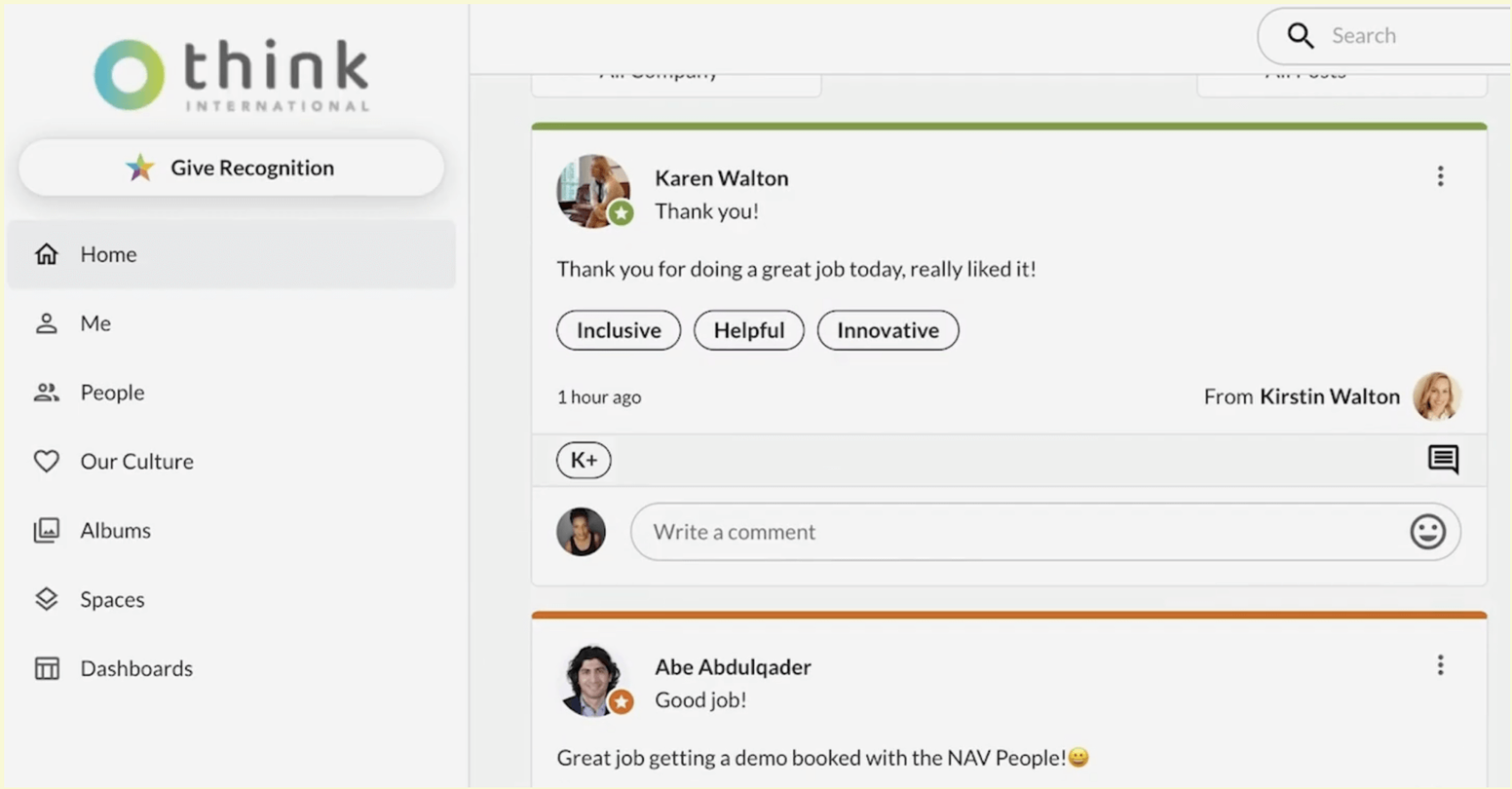
Kudos: four recognition levels on a monthly giving budget
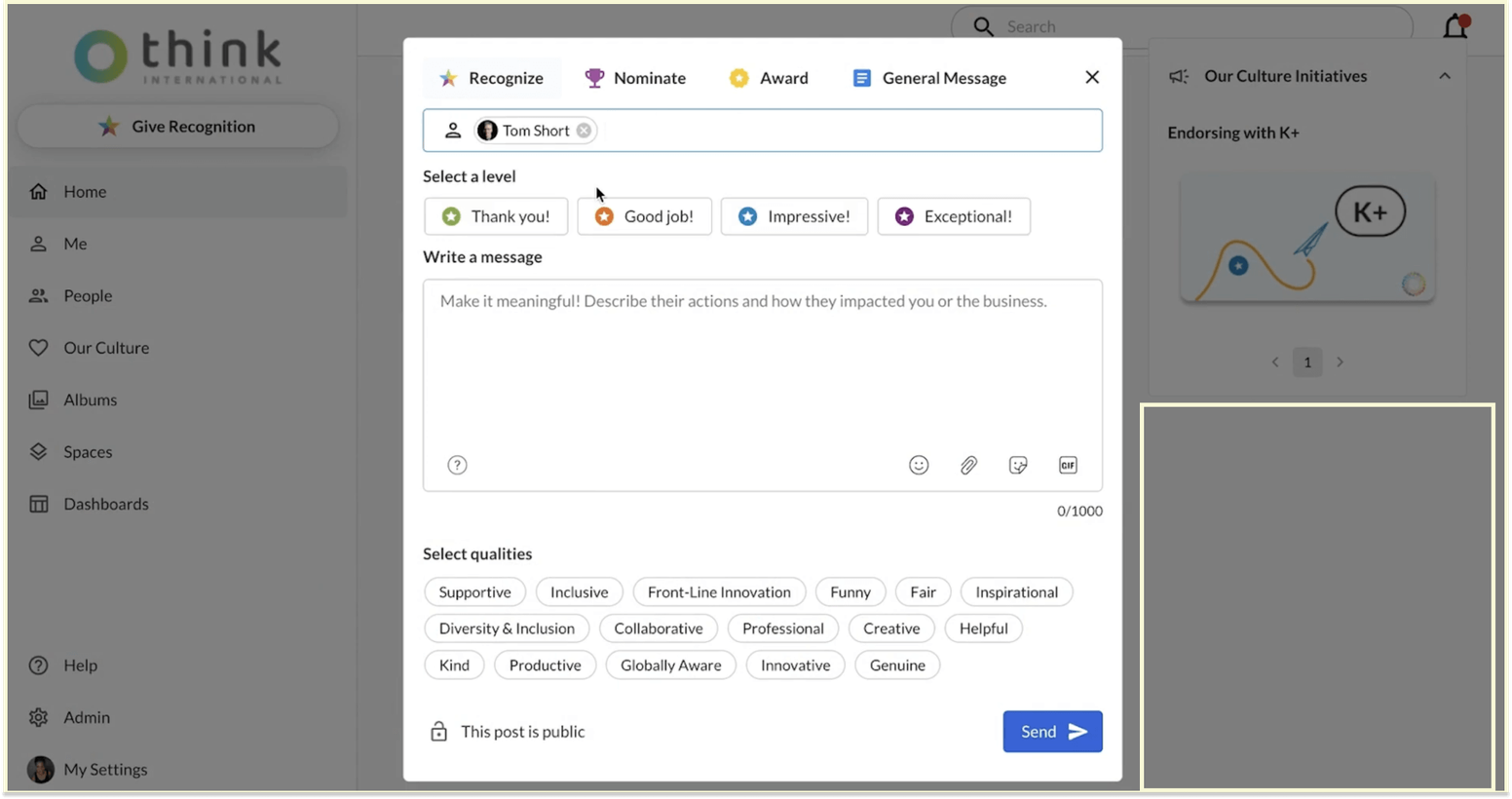
Kudos structures recognition into four named levels – Thank You, Good Job, Impressive, and Exceptional – a taxonomy it publishes on its own comparison content. Each level carries a different point weight, so the sentiment and the money move together.
Giving runs on a monthly allowance with a hard cap that each organization configures. Reviewers cite allocations of 50, 100, and 150 points per month plus per-recipient monthly limits, so any figure quoted online is somebody else’s admin setting rather than a universal default.
Redemption runs through the Kudos Rewards+ portal, where employees can combine earned points with personal funds to reach an item, a top-up mechanic most rivals do not offer.
What Kudos does not publish matters too: whether giving or earned points expire, and what happens to a balance when someone leaves. Neither is documented on kudos.com or in its public help center, which carries only two top-level categories.
Vantage Circle: accumulating points with standard-of-living adjustment
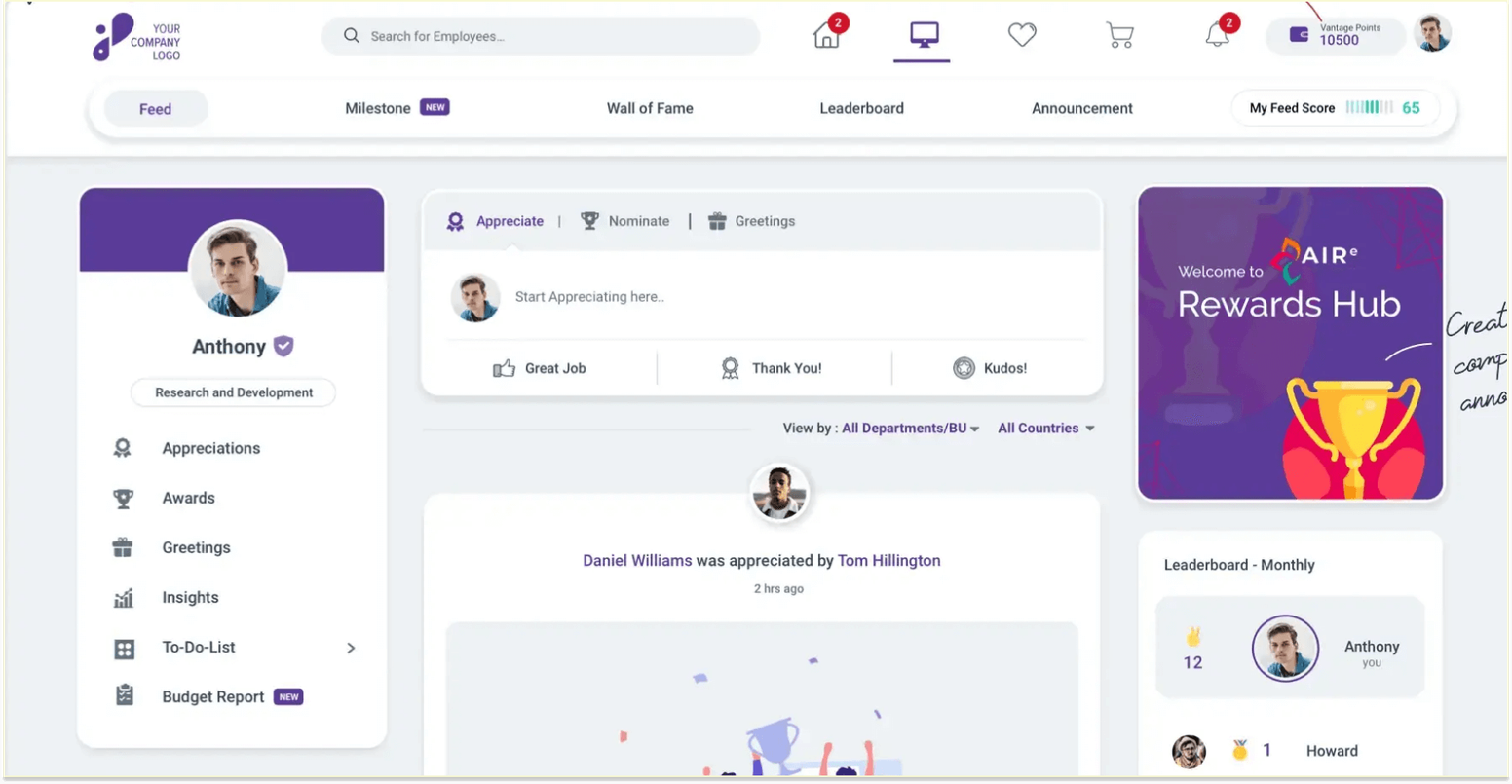
Vantage Circle runs an accumulating points model across peer recognition, manager SPOT awards, and nomination workflows with approve and decline routing. Employees send value-aligned badges and eCards, and the platform will draft the message with AI.
Its flagship mechanic is SOLI-adjusted reward value, which standardizes what a point is worth against the local standard of living so that, in Vantage Circle’s words, every employee feels equally valued in Mumbai, London, New York, or Nairobi. It also carries that adjustment across international relocations – real engineering for a multi-country payroll, not a marketing line.
Vantage Circle also documents its points policy, which Kudos does not. Per its help center, points earned through shopping on its own platform do not expire, org-allocated points carry a validity that depends on your organization’s policy, and reward points become invalid once an employee exits the organization.
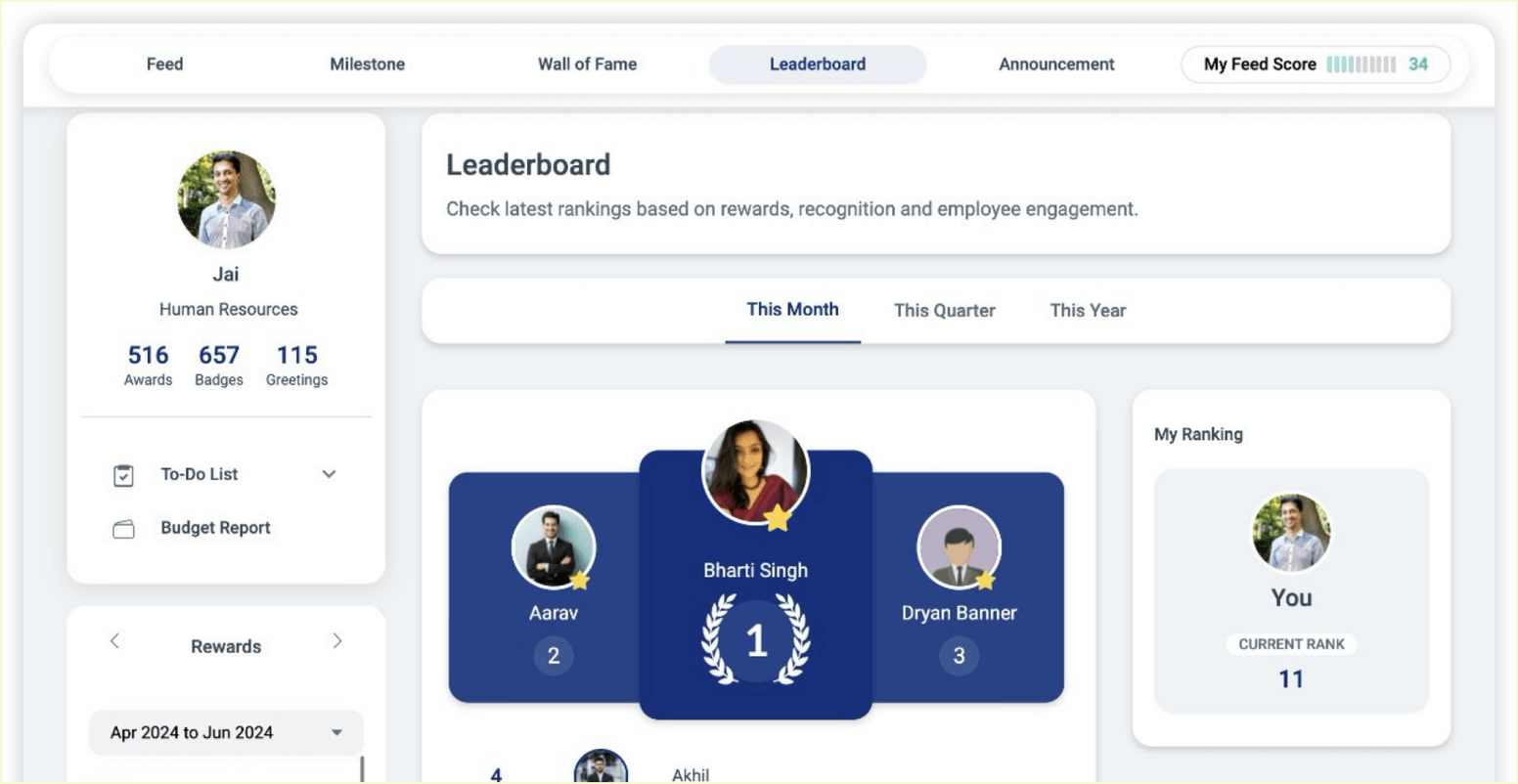
The honest synthesis: neither design is built around frequency. Kudos caps how much you can give inside a calendar month; Vantage Circle lets balances accumulate until an employer-set validity window or an exit closes them. Both are legitimate designs, and both draw the same class of complaint from their own users, which the reviews section below quantifies.
Rewards catalogs and funding: what each vendor publishes
On both platforms the rewards budget is separate from the platform fee, so model them as two line items. What differs is how much either vendor will tell you before you sign.
Kudos rewards and funding
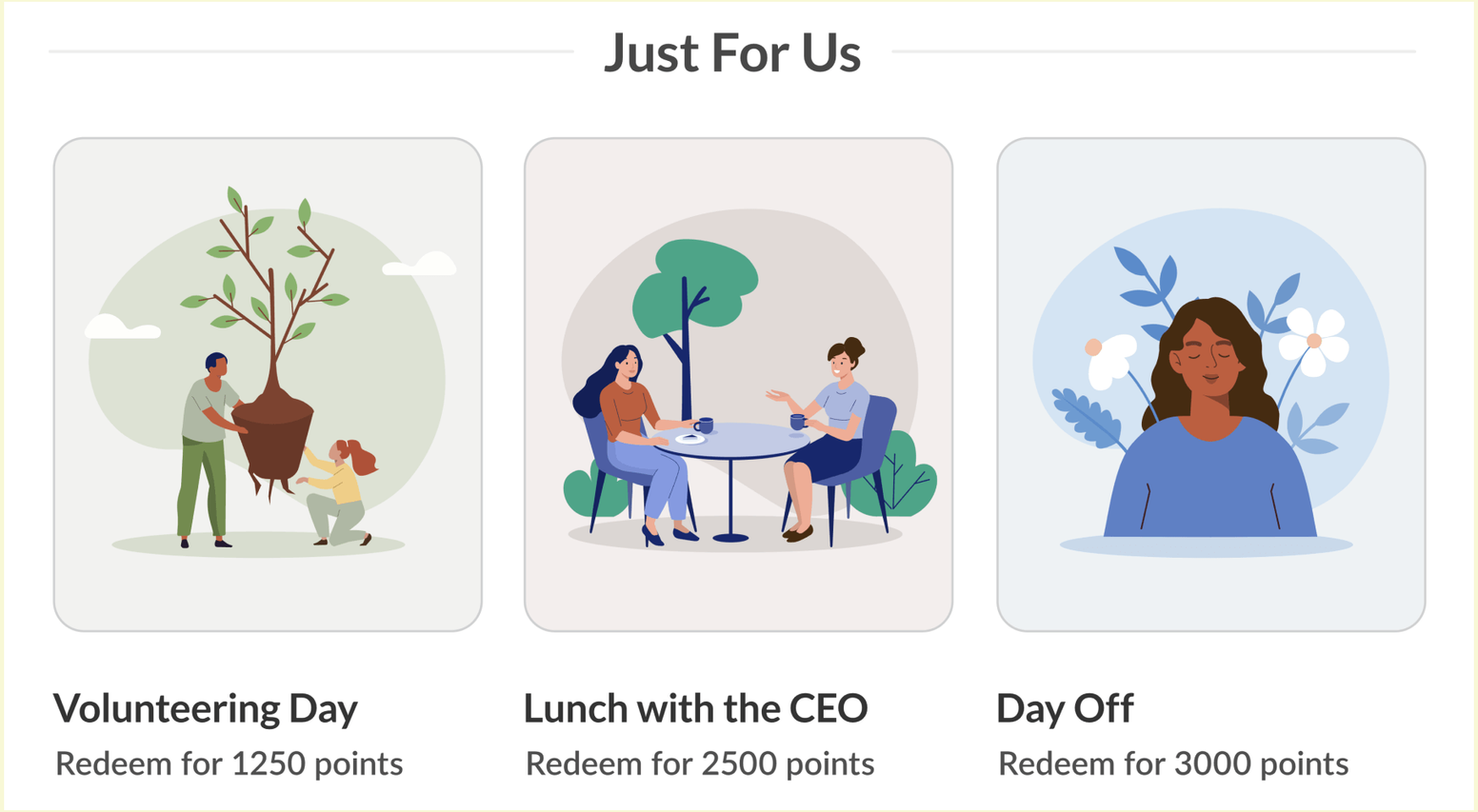
Kudos describes hundreds of thousands of reward options, all locally sourced, on its rewards product page: gift cards, merchandise, travel and experiences, mobile top-ups, charitable donations, and custom company rewards, curated per organization. Mobile top-ups matter more than they sound for globally distributed teams.
One inconsistency is worth knowing before you cite a catalog size: Kudos’s own comparison page against Achievers claims over 10,000,000 rewards delivered locally in 186 countries, while its rewards product page says hundreds of thousands. Same website, two very different numbers.
On funding, Kudos claims to charge no transaction fees or hidden costs and no markup on rewards. The claim is published; the mechanics behind it are not. Whether you prefund or are invoiced, whether a minimum deposit applies, and whether unused balances are refundable are undocumented publicly.
Vantage Circle rewards and funding
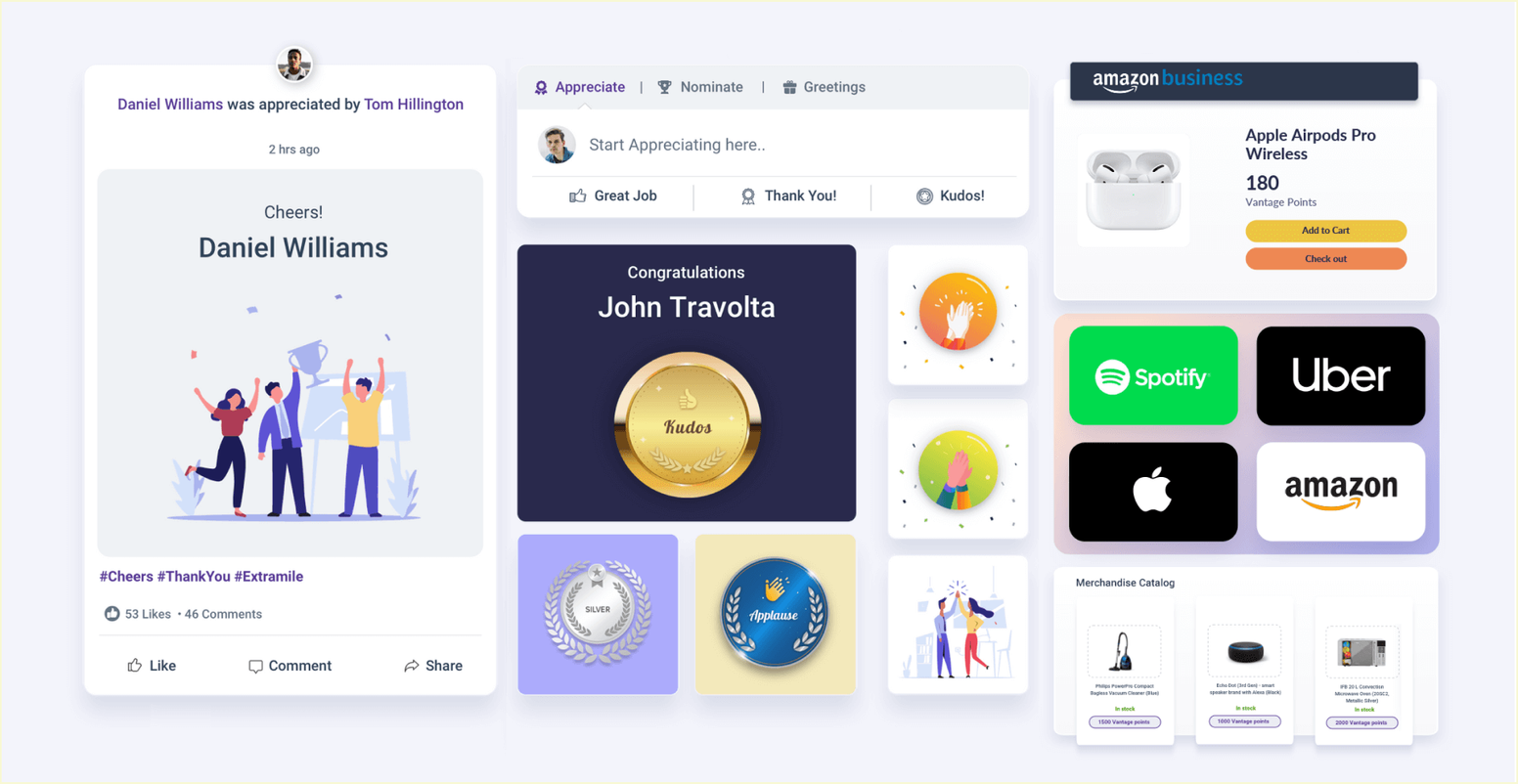
Vantage Circle’s catalog covers gift cards, merchandise, experiences, and travel, with an Amazon Business integration for milestone rewards, multi-wallet support, and cross-country point transfers.
Its own figures vary by page – 10,000+ reward options on the homepage, 10M+ rewards across 70+ countries on the rewards product page, 100+ countries elsewhere – so pin any number you use to the page it came from.
Reviewers flag three redemption practicalities: gift cards come in fixed denominations rather than exact amounts, an OTP verification step sits on redemptions, and shopping points credit within roughly 72 hours. On funding, Vantage Circle publishes no fee schedule either.
| Funding question | Kudos | Vantage Circle |
|---|---|---|
| Platform price published | No; kudos.com/pricing returns a 404 | No; Grow, Transform, and Scale all show Custom pricing |
| Reward funding model published | No; nothing public on prepay, invoicing, minimums, or refunds | No; no public fee schedule found |
| Fee or markup claim | Claims no transaction fees or hidden costs, without published mechanics | No published claim either way |
| Points validity documented | No; expiry and offboarding both undocumented | Yes; org-set validity, and points become invalid once you exit |
This pair is unusually symmetrical on funding. Neither will tell you what a reward transaction costs you until you are in a sales conversation, so put funding mechanics in writing at the quote stage rather than assuming the marketing language covers it.
Pricing transparency: two quote-gated vendors, one 404
Kudos does not gate its pricing behind a form so much as decline to have a pricing page at all: kudos.com/pricing returns a 404, there are no prices anywhere on the site, and the primary call to action is a 30-minute demo.
There is no free plan, no free trial, and no sandbox. The one public figure is a third-party estimate from SelectSoftware placing Kudos around $3.25 per user/month with a 500-employee minimum. Treat that as an estimate from a review site, not a Kudos price, because Kudos has never published one.
Vantage Circle publishes three named tiers – Grow, Transform (marked as the most popular option), and Scale – each showing Custom pricing with a demo call to action. No per-user rates, minimums, setup fees, or contract terms appear on the page.
There is a mild tension worth noting: Vantage Circle’s own comparison hub lists transparent per-user pricing without revenue share or reward markups as a selection criterion, while the numbers themselves are available only in a demo.
The practical consequence is identical: neither can be budgeted from a web page. Build a questions list before either call – per-user rate by tier, which modules are add-ons, contract minimum and term, reward funding mechanics and any markup, and points validity policy.
For Vantage Circle, add which SOC 2 report type and date sits behind the badge on its homepage, since its security page documents ISO 27001 and ISO 27701 but not a SOC 2 report.
Surveys, wellness, and suite breadth
Kudos is recognition-first. Culture analytics, culture scoring, and sentiment measurement exist, but the full depth of a survey suite is not documented publicly, so do not assume eNPS or a custom survey builder without confirming it.
Its 2026 investment went elsewhere: Spaces, relaunched in April 2026, adds employee communication hubs that push the platform toward internal comms, alongside an AI Recognition Assistant, scheduled recognition, monthly recognition goals, and leaderboards.
Vantage Circle is broader by design. Vantage Pulse is a real eNPS-based survey tool with sentiment analysis and parallel surveys, but it is an add-on on both Grow and Transform and included only at Scale.
Vantage Fit adds corporate wellness challenges as an add-on on Grow and included above it, Vantage Perks is a corporate discount and cashback marketplace, and AIRe Advisory sells recognition strategy consulting on top.
The verdict follows the shape of the two companies. If you want one vendor covering recognition, perks, wellness, and surveys, Vantage Circle is the only one of the pair that does it. If recognition depth is the requirement and you already own a survey tool, Kudos is the more focused product.
Either way, confirm module placement in writing, because Vantage Circle’s grid moves modules between tiers.
Global reach, frontline access, and where the app lives
Both vendors are genuinely global, in different ways. Kudos supports 11 or more languages with locally sourced rewards and mobile top-ups, and its logo wall carries DHL Express, ENGIE, MTN, Cummins, and Vanderbilt University.
Vantage Circle claims 16 or more languages and runs offices in Guwahati and New Delhi plus Plano in Texas, Calgary, Amstelveen, Dubai, and Carlingford in New South Wales.
Where they separate is proof at scale in specific regions. Vantage Circle’s case-study base skews heavily to India-headquartered enterprises: Wipro at 234,054 employees across 66 countries with a reported 97.5% increase in peer recognition, plus Infosys, Tata Motors, and Sun Pharma.
Read that as fit rather than flaw – if a large part of your headcount sits in India, Vantage Circle has more comparable deployments than anyone here.
Kudos’s only quantified customer story is Make-A-Wish America, a nonprofit of 100 to 249 people, reporting a 6% year-over-year reduction in voluntary turnover and an 11% uplift in engagement. For frontline staff, Vantage Circle also has the more developed answer: WhatsApp notifications and printed recognition cards for people without a work inbox.
On where recognition actually happens, both integrate with Slack and Microsoft Teams, and Kudos adds Outlook, but on both the core experience is the vendor’s own app and feed rather than the chat tool.
Vantage Circle has the stronger native Teams presence: an embedded Teams app rated 4.6 across 3,631 ratings, plus a real Slack Marketplace listing. Kudos has no public AppSource listing, and its Teams app rates 4.2 across 14 in-client reviews.
Mobile is where Kudos looks weakest against its own enterprise positioning: 3.2 on the App Store across 11 ratings and 3.8 on Google Play across 299 reviews, with neither app updated since mid-2024. For a platform whose core experience is its own app, test that with real employees before committing.
Vantage Circle’s mobile store ratings are not published in a form we could verify, though reviewers describe its app as usable and less polished than the web experience.
What G2 reviewers say about Kudos and Vantage Circle
Kudos holds 4.8 across 2,828 reviews on G2, the highest star rating of any platform in this category. Praise concentrates on ease of use and flexibility (491 mentions), recognition itself (458), and expressing appreciation (418).
Júlia K., a Senior Customer Advocate at a mid-market company, wrote in a five-star review on April 28, 2026: “Kudos makes it really easy to recognise teammates for their help and hard work. Seeing recognition shared across the company helps create a positive vibe.”
The criticism is unusually concentrated. All five leading dislike themes concern the points economy, roughly 565 mentions combined, led by redemption limits (131) and reward system inadequacy (123).
Gary J., a CRA Banking Representative at an enterprise company, put it plainly in a 4.5-star review on May 18, 2026: “The only thing I wish I could do is give more than 50 points to one individual in a month.”
Vantage Circle holds 4.7 across 10,896 reviews on G2, one of the largest review bases in the category, alongside 4.7 on Capterra and GetApp. Praise leads with ease of use and quick access to offers (865 mentions), variety of redeemable options (509), and easy point redemption for gift cards (412).
Yogesh P., a Digital Specialist Engineer, wrote on July 4, 2026: “Clean and intuitive interface makes it easy to browse rewards and complete redemptions,” while asking for more gift-card partners and region-specific options.
Its criticism mirrors Kudos’s from the opposite side. All five leading dislike themes are catalog and redemption items – limited redemption options and unavailable offers (201), restricted choices and inflexible point usage (187), voucher unavailability (107) – roughly 690 mentions combined.
That contrast is the real finding: Kudos reviewers complain that they cannot give enough, while Vantage Circle reviewers complain about what they can get.
Where Kudos wins
- The highest rating in the category: 4.8 on G2 across 2,828 reviews, with ease of use as the leading praise theme.
- Recognition depth as the product: four named recognition levels, values alignment, culture scoring, and multi-level analytics rather than recognition as one module among five.
- Compliance stack: SOC 2 Type II and ISO 27001 with OneTrust attestation, plus 11 or more languages.
- Points-plus-cash redemption: employees can top up earned points with personal funds through the Rewards+ portal to reach an item they actually want.
- Real HRIS muscle: named Workday, UKG, SAP SuccessFactors, Paycor, Paylocity, and BambooHR integrations, dedicated ADP Marketplace connectors for Workforce Now and Enterprise HR, an API, and a flat-file fallback.
- Internal comms in the same platform: Spaces, relaunched April 2026, extends Kudos past recognition for organizations without a good intranet.
- Quantified nonprofit proof: its Make-A-Wish America case study reports a 6% year-over-year cut in voluntary turnover and an 11% engagement uplift.
Where Vantage Circle wins
- Global reward parity: SOLI-adjusted point value across countries plus SOLI-adjusted transfers for relocating employees, the most serious answer to multi-country reward equity in this pair.
- Suite breadth: recognition, perks and discounts, wellness through Vantage Fit, eNPS surveys through Vantage Pulse, and AIRe strategy advisory under one contract.
- Review volume: 4.7 on G2 across 10,896 reviews, plus 4.7 on Capterra across 5,121 or more and GetApp across 5,100 or more.
- Microsoft Teams footprint: a native embedded Teams app at 4.6 across 3,631 ratings, against Kudos’s 4.2 across 14 in-client reviews and no public AppSource listing.
- A published points policy: employees and admins can read the validity and exit rules before signing, which is more than Kudos publishes.
- Proof at enterprise scale: Wipro at 234,054 employees across 66 countries with a reported 97.5% rise in peer recognition, plus Infosys, Accor, and Tata Motors stories.
- Frontline reach: WhatsApp notifications and printed recognition cards for people who do not have a work inbox.
The third option: Matter
Both platforms above put recognition in their own app, fund it with employer-set points, and price it behind a demo.
Matter makes different bets: recognition should live inside Slack and Microsoft Teams with no separate login, it should run on a weekly rhythm rather than a monthly cap or an accumulating balance, and its prices should be readable without a sales call.
Every week, Feedback Friday™ (US Patent 12,199,935) prompts the whole team to recognize someone, and give-coins reset weekly so they get used rather than hoarded.
The cadence is measurable: in The Recognition Habit, Matter’s 2026 Benchmark Report, built on aggregate, de-identified platform data, teams that build recognition around a weekly ritual give about 2.5x more recognition per member than ad hoc teams, and roughly 8 in 10 ritual teams stay active in nearly every month.
On the criteria this guide has used: Matter’s Free plan is for unlimited users, paid plans are published at $1 to $5 per user/month, billed annually, and Matter hasn’t raised prices in 8 years.
Reward funding fees are published too, including a 0% ACH prepay path, and the catalog spans 10,000+ eGift card options across 200+ countries. On the Microsoft Teams app store Matter holds a 5.0 across 1,476 ratings, and it rates 4.7 on G2.
Two honest concessions. A large enterprise with a significant India workforce that needs standard-of-living parity across countries will genuinely be better served by Vantage Circle, because Matter has no SOLI equivalent.
And an organization that wants recognition, perks, wellness, and surveys from a single vendor, or that needs Kudos-grade culture analytics and ISO 27001 on the security questionnaire, should buy one of those two rather than Matter, which deliberately stops at recognition, rewards, and surveys.
For the detailed head-to-heads, see Kudos vs. Matter and Vantage Circle vs. Matter.
Which platform is right for your team?
Choose Kudos if:
- You want recognition depth and values alignment as the product, not one module inside a suite.
- Your security review needs SOC 2 Type II and ISO 27001 on the vendor questionnaire.
- You have the HR budget and admin capacity for a demo-led purchase and a configured program.
Choose Vantage Circle if:
- Your workforce spans many countries and reward value needs to feel equivalent in each of them.
- You want recognition, perks, wellness, and surveys from a single vendor and a single contract.
- A significant share of your headcount sits in India, where Vantage Circle has the most comparable deployments.
Choose Matter if:
- Your team lives in Slack or Microsoft Teams and you want recognition there, not in another app.
- You prefer a weekly recognition ritual to a monthly cap or an accumulating balance.
- You want to start free with unlimited users and read published pricing before talking to anyone.
Frequently asked questions about Kudos vs. Vantage Circle
Is Kudos or Vantage Circle cheaper?
Neither publishes a price, so there is no honest list-price answer. Kudos’s pricing page returns a 404, and every Vantage Circle tier – Grow, Transform, and Scale – shows Custom pricing behind a demo.
The only public figure for either is a third-party estimate from SelectSoftware placing Kudos around $3.25 per user/month with a 500-employee minimum, which Kudos has never confirmed. Get written quotes from both, and ask each vendor to price the platform fee, the rewards budget, and any funding fees as separate lines.
What is the main difference between Kudos and Vantage Circle?
Scope. Kudos is a recognition platform with real depth – four recognition levels, values alignment, culture analytics – and it stays in that lane. Vantage Circle is an engagement suite where recognition sits alongside corporate perks, wellness, and pulse surveys, with standard-of-living adjusted reward value built for multi-country workforces.
Kudos rates higher on G2 at 4.8 against 4.7; Vantage Circle has close to four times the reviews at 10,896 against 2,828.
Do Kudos or Vantage Circle offer a free plan or a free trial?
Neither does. Kudos has no free plan and no trial or sandbox, and buying starts with a 30-minute demo. Vantage Circle publishes no free plan or trial on its pricing page either, though an unpublished trial is not the same as a refused one, so it is worth asking. Among alternatives, Matter’s Free plan supports unlimited users.
Do Kudos or Vantage Circle points expire?
Vantage Circle documents this and Kudos does not. Per Vantage Circle’s help center, points earned through shopping on its platform do not expire, org-allocated points carry a validity period set by your employer, and reward points become invalid once an employee exits the organization.
Kudos publishes nothing on point expiry, rollover, or what happens to a balance at offboarding, so treat both as questions for the demo rather than assuming either answer.
Which is better for a global or multi-country workforce?
Vantage Circle, in most cases. Its SOLI adjustment standardizes what a point is worth against the local standard of living and carries across international relocations, and it claims 16 or more languages, multi-wallet support, and cross-country point transfers.
Kudos is genuinely global too, with 11 or more languages, locally sourced rewards, mobile top-ups, and multinationals including DHL Express and ENGIE on its customer list, but it publishes no equivalent parity mechanic.
Kudos vs. Vantage Circle: the bottom line
These are two capable, well-reviewed platforms that both make you book a demo to learn the price. Decide on the axes where they genuinely differ: recognition depth, star rating, and compliance posture on the Kudos side, or global reward parity, suite breadth, and review volume on the Vantage Circle side.
And if neither buying process appeals, consider whether you would rather have recognition living inside chat on a weekly rhythm with pricing published on a page. Related reading: Kudos alternatives, Vantage Circle alternatives, and the full comparison hub.

![Vantage Circle vs. Matter Comparison: Pricing & Reviews [2026 Guide]](https://cdn.sanity.io/images/kqqb5xry/production/a6135e0425176ca218fa290bf02567dc7932f729-800x600.jpg?w=720&q=75&fit=max&auto=format)
![Nectar vs. Vantage Circle Comparison: Pricing & Reviews [2026 Guide]](https://cdn.sanity.io/images/kqqb5xry/production/8eec85d78433f606041ec2ca685ac2525544aceb-800x600.jpg?w=720&q=75&fit=max&auto=format)
![Achievers vs. Vantage Circle Comparison: Pricing & Reviews [2026 Guide]](https://cdn.sanity.io/images/kqqb5xry/production/8002fe8fe580c64d52a3b71d039e31f33577e742-800x600.jpg?w=720&q=75&fit=max&auto=format)