
The 30-second verdict: Workhuman or WorkTango?
Choose Workhuman if you are a global enterprise, typically 10,000 employees and up, formalizing recognition into nominated awards with approval governance, service milestones, and life events, and you want fulfillment muscle behind it: 8M+ users, 1M+ reward choices from 600+ suppliers, rewards in 180+ countries, and more than $1B redeemed annually.
Choose WorkTango if you are a mid-market organization, roughly 500 to 10,000 employees, that wants recognition and a full employee listening suite in one contract, with unlimited surveys, AI comment analysis, a zero-markup pay-on-redemption rewards model, and a faster 4–6 week launch, and you are comfortable with a 12-month minimum contract and a rewards catalog moving to its new owner’s marketplace.
A third option exists: if what you actually want is peer recognition running inside Slack or Microsoft Teams with published pricing and no procurement cycle, Matter is covered at the end of this guide.
Workhuman and WorkTango are rarely a close call once you know your size: Workhuman is the global enterprise incumbent built around nominated awards and the largest reward marketplace in the category, while WorkTango is a mid-market platform that pairs recognition with a genuinely deep employee survey suite, and it changed owners in July 2026 when BI WORLDWIDE acquired it.
This comparison was verified in August 2026 against both vendors’ public documentation, help centers, press releases, and G2 profiles. Full disclosure: this guide is published by Matter, an employee recognition platform that competes with both Workhuman and WorkTango.
We have kept the head-to-head honest, we say plainly where each product wins, and we introduce Matter only near the end as a third option. Weigh our perspective accordingly, and verify pricing with each vendor before you buy.
How we researched this comparison
We build Matter, which competes with both platforms on this page, so weigh our perspective accordingly.
For Workhuman and WorkTango we reviewed each vendor’s public pricing, product pages, and help-center or billing documentation, plus their G2 profiles and named, dated reviews, and we drew on conversations with teams evaluating and switching between recognition platforms. We have not used either product hands-on.
Every claim here is sourced to the vendors’ own materials, named reviews, or Matter’s published data, and facts were last verified in August 2026.
Workhuman vs. WorkTango at a glance
| Workhuman | WorkTango | Matter | |
|---|---|---|---|
| Starting price | Custom quote; no public pricing page; their own guidance anchors program spend at 1% of payroll | Custom quote; 12-month minimum contract; third-party estimates around $5–$10 per user/month, unverified | Free plan, then $1 to $5 per user/month, billed annually; public tiers |
| Free plan | No; demo and quote only | No; demo and quote only | Yes, unlimited users |
| G2 rating | 4.7 (2,400+ reviews) | 4.7 (1,329 reviews) | 4.7 (1,186 reviews) |
| Teams app store | 4.7 (2,979 ratings) | No public Teams app store listing | 5.0 (1,476 ratings) |
| Best for | Global enterprises running formal award and milestone programs | Mid-market teams that want surveys and recognition in one platform | Slack/Teams-first teams that want recognition inside chat |
WorkTango under BI WORLDWIDE: what the July 2026 acquisition changes
On July 20, 2026, BI WORLDWIDE, the global incentives and rewards firm, acquired WorkTango from Vista Equity Partners. Per WorkTango’s own release, the brand, team, and product identity are retained and WorkTango operates as a BI WORLDWIDE subsidiary.
CEO Monique McDonough framed it as offering customers “more choice and deeper support across rewards, recognition, and beyond,” with a clear path to grow further into the mid-market.
The concrete operational change is fulfillment: WorkTango will transition its core fulfillment infrastructure to BI WORLDWIDE’s global rewards marketplace, which operates in 200+ countries against the 90+ countries WorkTango’s own catalog currently advertises, adding milestone awards, experiences, and events. That is real upside for global redemption.
It is also a transition, so ask about the cutover timeline, what happens to banked points mid-migration, whether the zero-markup promise survives on the new marketplace, and how roadmap priorities are set under the new owner.
Lineage context helps here too: YouEarnedIt and HighGround merged as Kazoo in 2018, Kazoo acquired the original WorkTango in 2022 and took its name, and BI WORLDWIDE is the newest chapter, which is why some app listings still carry Kazoo-era names.
Workhuman, by contrast, is a stability story: founder-led since 1999 (as Globoforce, renamed in 2019), still private, with no acquisition.
Recognition mechanics: nominated awards vs. quarterly giving allowances
Workhuman: nomination, approval, award
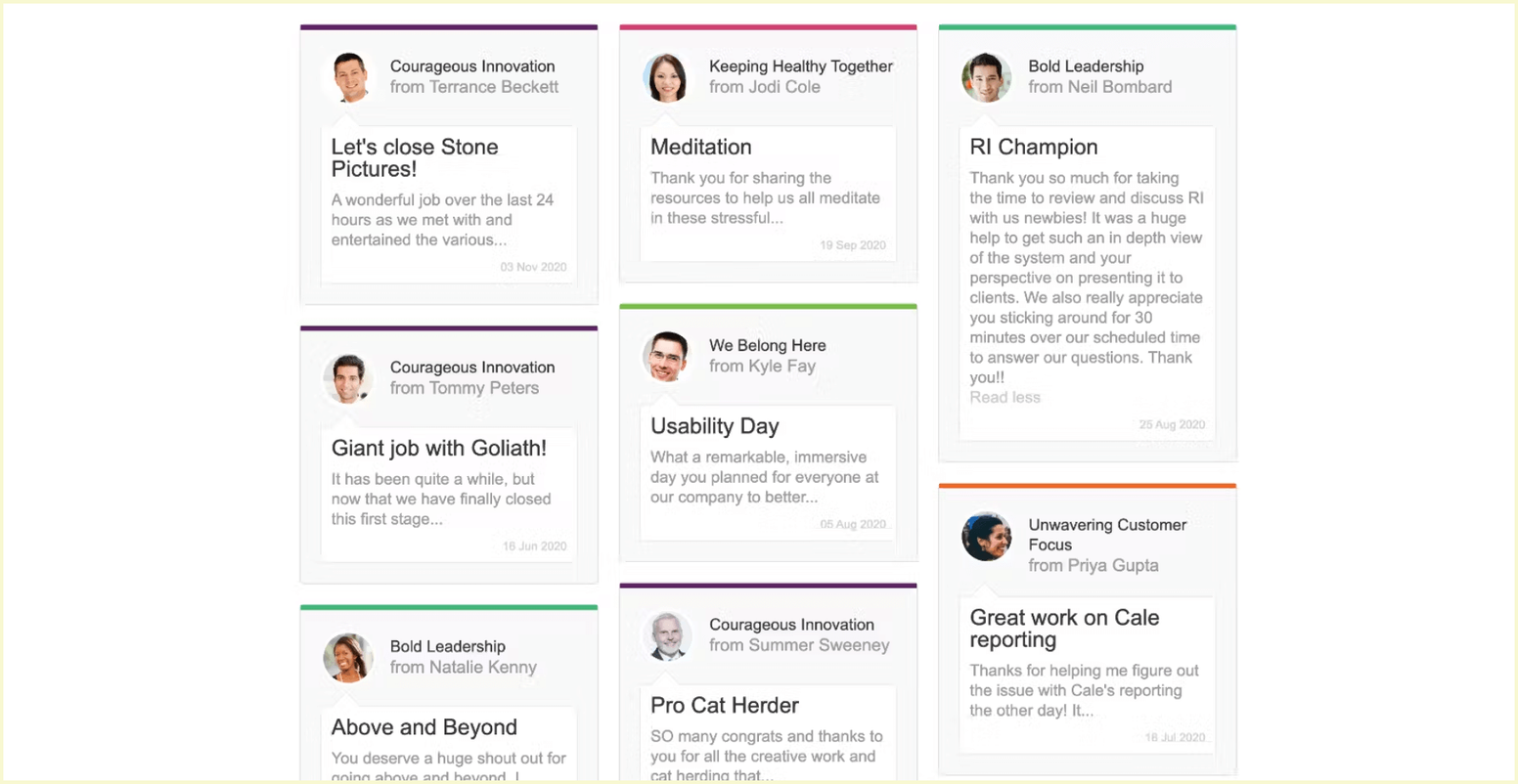
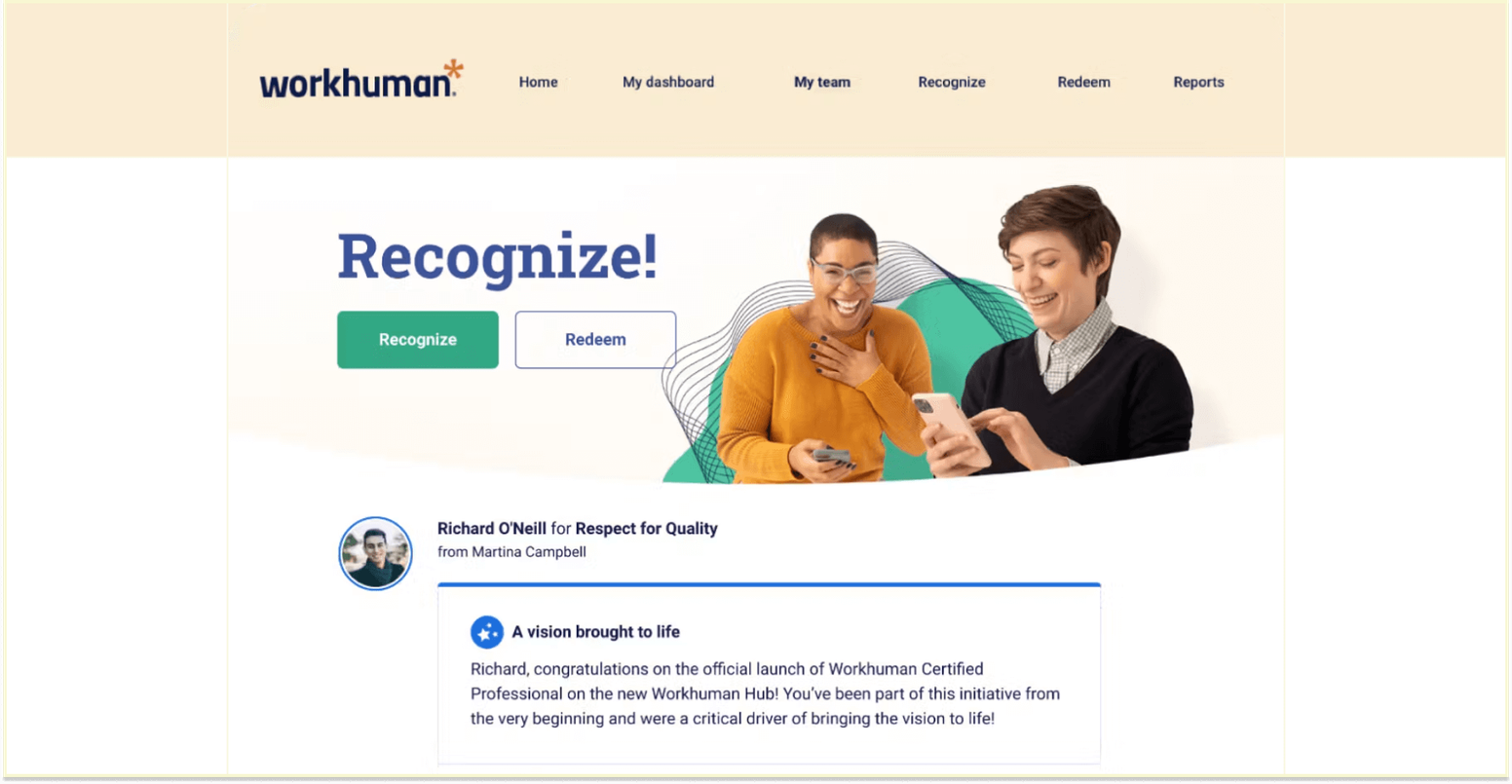
Workhuman’s Social Recognition runs on nominations rather than a recurring peer budget. Colleagues nominate each other for titled awards with written justification, the nominator selects an impact level that maps to a monetary point value, and the award routes through an approval flow where administrators can approve, modify, or disapprove before release.
Governance is the payoff: spend control in the Admin Hub, misuse detection, and an Inclusion Advisor that flags biased language before a message posts (at Merck, 74% of employees edited their messages after a flag). The cost is cadence and friction.
Slow approvals and complex criteria account for 230 dislike mentions on G2, award frequency can be capped by company policy, and Ariel B., a patient access worker at an enterprise, wrote on July 17, 2026 that the “set up is clunky and actually makes it harder to decide what level of award is appropriate.” Balazs L. captured the cultural effect back in 2023: “frequency of use is low, only big projects are rewarded.”
WorkTango: peer allowances with a quarterly expiry default
WorkTango gives employees a company-configured allowance of points to send, and its help center is candid about the default cadence: most companies choose to expire employees’ giving balances each quarter, and admins can set whatever cadence suits the business. The behavioral result is predictable.
James W., a customer success team lead, put it in a September 25, 2025 five-star review: “Because points expire at the end of the quarter, it often turns into a quarter-end bonanza.” Points-economy friction leads WorkTango’s G2 dislike themes (limited points 55 mentions, expiration issues 39, insufficient points for rewards 31).
Admins can soften it with conversion ratios that turn earned points back into giving points and custom point rules by user group.
WorkTango also publishes more program governance than most mid-market rivals through its Incentives module: 50+ campaign templates, optional manager or HR approval before rewards issue, and budget caps per campaign, per employee, or per manager.
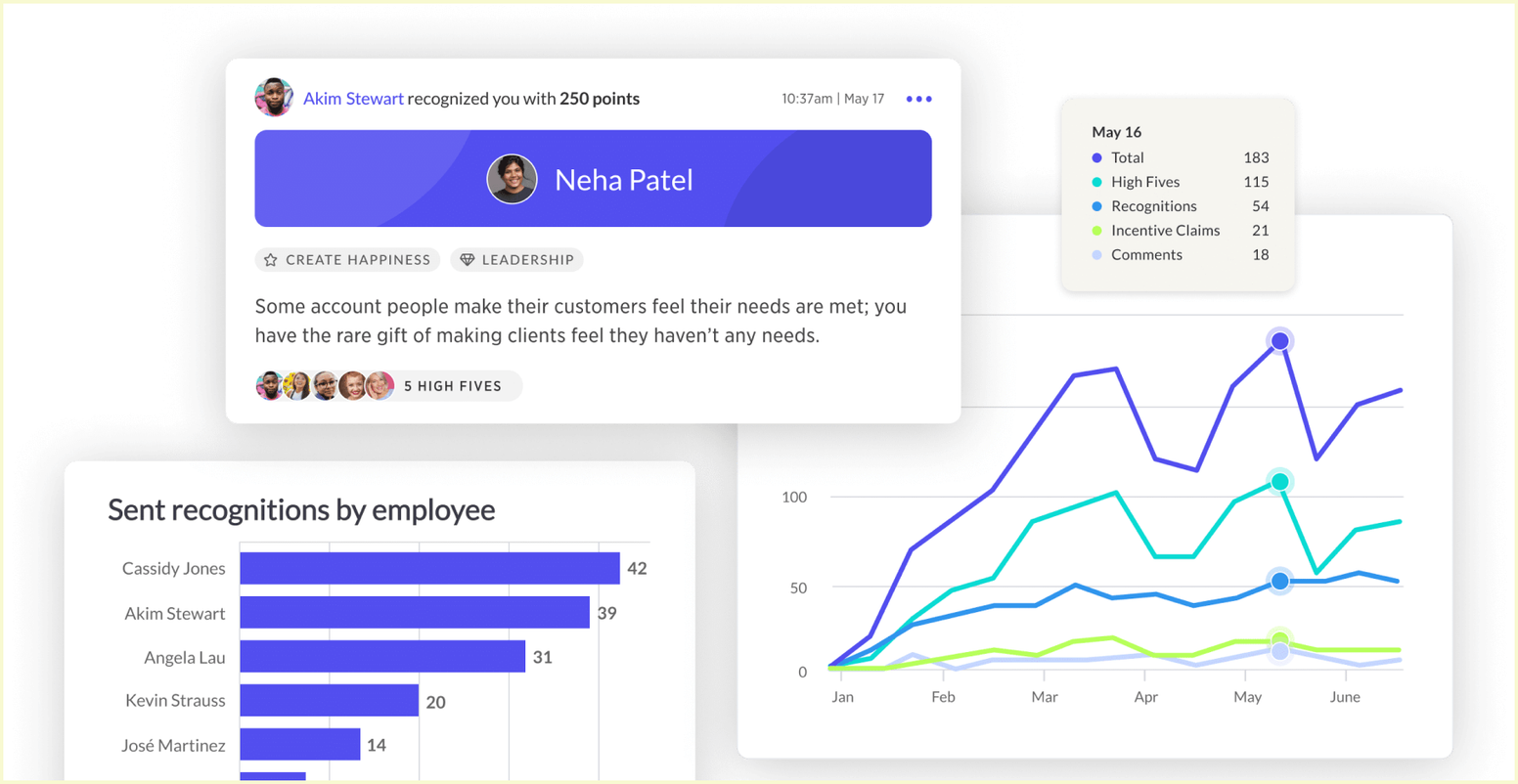
The honest synthesis: both models make recognition lumpy, for different reasons. Workhuman concentrates it into occasional, approved awards; WorkTango concentrates it at quarter end when balances are about to expire. Neither builds a weekly peer habit by default.
Rewards catalogs and funding: the biggest store vs. the cleanest billing promise
Workhuman rewards
The Global Rewards Store is the largest reward operation in the category: 1M+ choices from 600+ suppliers, rewards in 180+ countries with localized catalogs in 150+, and more than $1B redeemed each year, with the company saying it processes a reward order roughly every 2.5 seconds and ranks among the world’s 30 largest e-commerce retailers.
Scale has not settled the value debate, though. Reward limitations (252 mentions), limited gift options (206), and redemption point issues (148) dominate its G2 dislikes.
Riyaz M., a senior manager at an enterprise, wrote on June 2, 2026 that there are “too few redemption options, and major players like Amazon are missing,” and a verified IT services reviewer noted on April 30, 2026 that “rewards are often heavily overpriced.” How companies fund awards, including prefunding versus invoicing, processing fees, and breakage policy, is not documented publicly, so put it in your diligence list.

WorkTango rewards
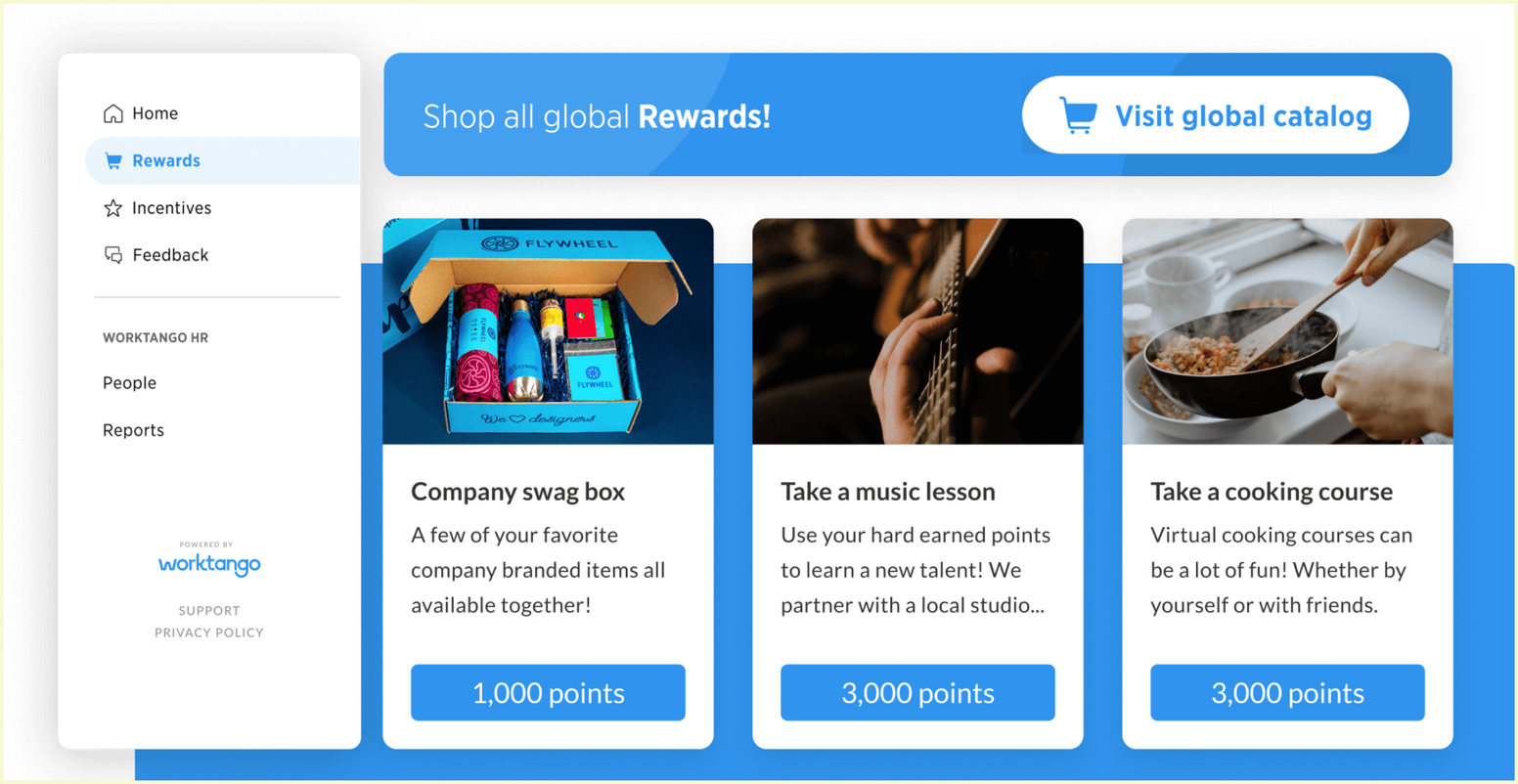
WorkTango currently advertises over 10 million reward choices across 90+ countries, covering local and international gift vouchers, experiences, merchandise, company swag, custom catalogs, and donations to over 1.2 million charities.
Its billing promise is the cleanest of the pair on paper: companies pay only when employees actually redeem, and WorkTango states that 100% of an allocated budget goes to rewards with no hidden fees or markups, so a $50 award delivers $50 in value. Concede that model; it is genuinely buyer-friendly.
Two caveats apply. Reviewers still question value at the margins (Dylan B. wrote on April 29, 2026 that “non-cash prizes are overpriced”), and, as above, the whole catalog is migrating to BI WORLDWIDE’s marketplace, so confirm in writing which catalog and which terms your contract covers.
| Cost question | Workhuman | WorkTango |
|---|---|---|
| Platform pricing published | No; no pricing page exists on its site | No; all three packages are quote-gated |
| Published cost anchor | Their own guidance: fund the program at 1% of payroll | None official; third-party estimates around $5–$10 per user/month, unverified |
| Reward funding model | Not documented publicly | Pay-on-redemption with a stated zero-markup policy; fee schedule and deposit terms not published |
| Contract and rollout | Consultative implementation; no published timeline | 12-month minimum contract; most organizations launch in 4–6 weeks |
Pricing transparency: one published anchor, one contract minimum
Neither vendor will quote you a number without a sales conversation, and neither publishes reward funding terms, so model platform fees, reward budget, and funding mechanics together in both cases.
Workhuman has no pricing page at all. What it does publish is a spend anchor: its own guidance recommends funding a recognition program at 1% of payroll as the ROI tipping point.
That is a program-spend recommendation covering the awards themselves rather than a license price, but it usefully sets scale: for a 2,000-person company at an $80,000 average salary, 1% of payroll is $1.6M per year.
Workhuman pairs the quote-gated model with what it calls the industry’s only ROI Guarantee, and it argues in its own comparison content that transparent per-seat pricing can mask the true cost of running a program.
WorkTango gates all three packages (Surveys & Insights, Recognition & Rewards, and the full Employee Experience Platform) behind a quote form, and publishes two firm commercial terms that Workhuman does not: a 12-month minimum contract and a 4–6 week implementation for most organizations.
Third-party buyer guides estimate roughly $5–$10 per user/month; treat that as an unverified estimate, never as WorkTango’s price.
Surveys and AI: Moodtracker vs. a full listening suite
This section is the clearest functional split of the comparison. WorkTango sells employee listening as a first-class product: unlimited surveys with engagement, onboarding, and exit templates, AI comment summarization and theme detection, heatmap and trend dashboards, action planning, and, since July 22, 2026, Constellation, an AI-moderated group listening tool launched two days after the acquisition announcement.
Its 60+ HRIS and HCM integrations populate demographics automatically, so results slice by team, location, or tenure without extra questions.
The customer proof is survey-led: American Eagle Financial Credit Union reported engagement rising from 69 to 81 in twelve months with survey participation going from 71% to 89%, and Pizza Pizza reported an eNPS swing from -32 to +14 between 2018 and 2021 (Kazoo-era data, so date it).
Workhuman’s survey tool, Moodtracker, is lighter and is not the platform’s center of gravity.
Its analytics strength is recognition intelligence instead: Workhuman iQ, trained on more than a billion recognition moments, plus the Human Intelligence AI suite launched in February 2025 with an AI assistant, Recognition Advisor, and Inclusion Advisor, backed by a long-running Gallup research partnership.
If listening is half your business case, WorkTango is the better buy; if you want the deepest analytics on recognition behavior itself, Workhuman leads.

What reviewers and app stores say about Workhuman and WorkTango
Workhuman (4.7, 2,400+ reviews on G2, plus 9.1 out of 10 on TrustRadius): ease of recognizing achievements (977 mentions) and ease of use (954) lead the praise, and the reviewer base skews heavily enterprise.
Imani L., a bid writer at an enterprise, wrote in a July 20, 2026 five-star review: “The interface is easy to navigate which makes it widely accessible.” The dislikes are the catalog and approval clusters described above.
Its consumer apps are the strongest in this pair, at 4.9 on the App Store across 8,400 ratings and 4.4 on Google Play, both updated within days of this comparison’s verification, and its Microsoft Teams app rates 4.7 across 2,979 ratings.
WorkTango (4.7, 1,329 reviews on G2): the same score on roughly half the review base, with ease of peer recognition (158 mentions) and recognition features (156) leading.
Rochie C., a customer service representative at an enterprise, wrote in a December 8, 2025 five-star review that the “Recognition Writing Assistant helps users write clearer... more meaningful recognition messages.” Beyond the points economy, reviewers flag slow loading (27 mentions) and reporting gaps, and a verified HR director noted on May 21, 2025 limitations in “survey design, data flexibility, and reporting” (worth weighing, since surveys are the product’s strong suit).
Storefront presence is its weakest dimension: 2.4 stars on Google Play across 296 reviews, 3.1 on the App Store across 86 ratings, and no public Microsoft Teams app store listing, though real Slack, Teams tab, and Outlook integrations exist. Outlook recognition in particular is a rarity worth conceding.
Where Workhuman wins
- Global fulfillment scale: 1M+ reward choices, 600+ suppliers, 180+ countries, $1B+ redeemed annually; nothing in the mid-market matches this reach.
- Award governance and compliance: approval flows, spend control, misuse detection, ISO 27001, ISO 27701, and PCI DSS Level 3.
- Service milestones and life events: best-in-class formal award, anniversary, and lifecycle depth built over 25 years.
- Recognition analytics and AI: Workhuman iQ and Human Intelligence trained on 1B+ recognition moments, with Gallup-partnered research.
- Mobile and Teams quality: 4.9 on iOS, 4.4 on Android, and 4.7 across 2,979 Teams app store ratings.
- Enterprise proof and stability: Merck launched in 85 countries with nearly 3 million recognition moments, and the company is founder-led with no ownership change.
Where WorkTango wins
- Employee listening: unlimited surveys, AI comment analysis, action planning, and Constellation; Workhuman’s Moodtracker is a lighter tool.
- Zero-markup, pay-on-redemption rewards: you pay only when employees redeem, with budgets stated to convert at full face value.
- Published commercial terms: a stated 12-month minimum and a 4–6 week launch, against Workhuman’s undisclosed timeline and consultative rollout.
- Mid-market fit: designed for roughly 500 to 10,000 employees, where Workhuman is explicitly a poor fit for smaller, budget-conscious buyers.
- Documented incentive governance: 50+ campaign templates with approvals and per-campaign, per-employee, and per-manager budget caps.
- Integration breadth: 60+ HRIS and HCM systems plus Outlook recognition, against Workhuman’s four certified integrations.
The third option: Matter
Both platforms above assume a quote, a contract, and recognition living in a destination app. Matter makes different bets: recognition should live inside Slack and Microsoft Teams, and it should run weekly rather than through nomination cycles or quarterly balances.
Every week, Feedback Friday™ (US Patent 12,199,935) prompts the team to recognize someone, with no approval queue in between, give-coins reset weekly so there is no quarter-end scramble, and earned coins never expire.
The cadence is measurable: in The Recognition Habit, Matter’s 2026 Benchmark Report, built on aggregate, de-identified platform data, teams that build recognition around a weekly ritual give about 2.5x more recognition per member than ad hoc teams, and roughly 8 in 10 ritual teams stay active in nearly every month.
On the criteria this guide has used: Matter’s Free plan is for unlimited users, paid tiers are published at $1 to $5 per user/month, billed annually, and Matter hasn’t raised prices in 8 years.
Reward funding fees are published too (0% via ACH prepay, 3.5% by card prepay, or pay-as-you-go by card at 5% + $0.35 per transaction), with 10,000+ eGift card options across 200+ countries, and Matter’s Microsoft Teams app holds a 5.0 across 1,476 ratings.
Two honest concessions: a Fortune 500 global program that needs in-country fulfillment at Workhuman’s scale or formal nomination and approval hierarchies may genuinely need Workhuman, and an organization whose primary purchase is an enterprise listening program will find WorkTango’s unlimited-survey suite deeper than Matter’s pulse, eNPS, and custom surveys add-on. For the detailed head-to-heads, see Workhuman vs. Matter and WorkTango vs. Matter.
Which platform is right for your team?
Choose Workhuman if:
- You are a global enterprise that needs award governance, approvals, and compliance certifications.
- Service milestones, life events, and in-country reward fulfillment at scale are central to your program.
- You can fund a program near the 1%-of-payroll benchmark and want an ROI Guarantee attached.
Choose WorkTango if:
- You are a mid-market organization buying recognition and employee listening in one contract.
- A zero-markup, pay-on-redemption rewards model and a 4–6 week launch matter to you.
- You are comfortable with a 12-month minimum and have asked the BI WORLDWIDE transition questions above.
Choose Matter if:
- Your team lives in Slack or Microsoft Teams and you want recognition there, not in another app.
- You prefer a weekly peer ritual with never-expiring earned coins over approvals or quarterly balances.
- You want to start free with unlimited users and see published pricing and funding fees before talking to anyone.
Frequently asked questions about Workhuman vs. WorkTango
Is Workhuman or WorkTango cheaper?
Neither publishes list pricing, so there is no direct answer. Workhuman has no pricing page and recommends funding programs at 1% of payroll, which usually implies a six- or seven-figure annual program spend at enterprise headcounts.
WorkTango is quote-gated with a 12-month minimum contract, and third-party buyer guides estimate roughly $5–$10 per user/month, which is unverified. In practice WorkTango targets smaller budgets and mid-market headcounts, but get both quotes in writing with platform fees and reward funding terms itemized before comparing.
What is the main difference between Workhuman and WorkTango?
Recognition model and scope. Workhuman is built around nominated awards with written justifications and approval workflows, tied to service milestones and life events, and backed by the largest global reward marketplace in the category. WorkTango combines peer recognition on a company-set point allowance with a full employee survey and listening suite, aimed at mid-market organizations rather than global enterprises.
Was WorkTango acquired by BI Worldwide?
Yes. BI WORLDWIDE announced its acquisition of WorkTango from Vista Equity Partners on July 20, 2026. Per WorkTango’s own release, the brand, team, and product identity continue, WorkTango operates as a BI WORLDWIDE subsidiary, and reward fulfillment transitions to BI WORLDWIDE’s marketplace operating in 200+ countries. Ask about the fulfillment cutover timeline, banked points, and roadmap priorities during evaluation.
Which is better for large global enterprises?
Workhuman, in most cases. It serves 8M+ users, fulfills rewards in 180+ countries with localized catalogs in 150+, carries ISO 27001, ISO 27701, and PCI DSS Level 3 certifications, and offers consultative implementation and change management built for very large rollouts.
WorkTango targets roughly 500 to 10,000 employees, and its own leadership describes the BI WORLDWIDE deal as strengthening its mid-market path.
Do Workhuman or WorkTango offer a free plan or trial?
No. Both are demo-led and quote-priced, with no free plan and no self-serve trial; WorkTango additionally requires a 12-month minimum contract. Among alternatives, Matter’s Free plan supports unlimited users and its paid tiers are published.
Workhuman vs. WorkTango: the bottom line
These two rarely compete for the same buyer. Workhuman is the global enterprise choice, with award governance, milestone depth, and fulfillment reach nothing in the mid-market matches.
WorkTango is the mid-market choice, strongest when employee listening is half the reason you are buying and clean pay-on-redemption billing appeals, with the BI WORLDWIDE transition questions answered in writing.
And if what you want is recognition in chat, on a weekly rhythm, with pricing you can read before a sales call, that is the third path (Matter). Related reading: Workhuman alternatives, WorkTango alternatives, and the full comparison hub.

![Kudos vs. Workhuman Comparison: Pricing & Reviews [2026 Guide]](https://cdn.sanity.io/images/kqqb5xry/production/8feeaf2c4bbf4c237afe1d75a5d74fc3d8b1c6eb-800x600.jpg?w=720&q=75&fit=max&auto=format)
![Kudos vs. WorkTango Comparison: Pricing & Reviews [2026 Guide]](https://cdn.sanity.io/images/kqqb5xry/production/5f38b00c45db2bc4bbe09bcad09552116948cd8a-800x600.jpg?w=720&q=75&fit=max&auto=format)
![Workhuman vs. Matter Comparison: Pricing & Reviews [2026 Guide]](https://cdn.sanity.io/images/kqqb5xry/production/c5705813486a32cc82c1f3e0b905ab3ec9193666-800x600.jpg?w=720&q=75&fit=max&auto=format)