

The 30-second verdict: Awardco or Nectar?
Choose Awardco if reward logistics are the deciding factor: Amazon Business redemption at dollar-for-dollar value with no markup, service awards and milestone programs at enterprise scale, deskless deployments measured in tens of thousands of employees, and a finance team comfortable prefunding a rewards account by invoice.
Choose Nectar if you want the broader culture platform around the rewards: a full survey suite in Engage™, an internal-communications product, frontline delivery through kiosk mode and SMS, and reward funding that publishes its fee schedule and offers a genuine billed-in-arrears option.
A third option exists: if what you actually want is recognition running inside Slack or Microsoft Teams with published pricing, Matter is covered at the end of this guide.
Awardco and Nectar are the two rewards-marketplace heavyweights of the recognition category, and buyers shortlist them together for good reason: both build their catalogs around Amazon, both fund rewards from a budget separate from the software fee, and as of 2026 both have moved fully behind quote-gated pricing.
This comparison was verified in August 2026 against both vendors’ pricing pages, help-center billing documentation, and G2 profiles. Full disclosure: this guide is published by Matter, an employee recognition platform that competes with both Awardco and Nectar.
We have kept the head-to-head honest, we say plainly where each product wins, and we introduce Matter only near the end as a third option. Weigh our perspective accordingly, and get written quotes from both vendors before you decide.
How we researched this comparison
We build Matter, which competes with both platforms on this page, so weigh our perspective accordingly.
For Awardco and Nectar we reviewed each vendor’s public pricing, product pages, and help-center or billing documentation, plus their G2 profiles and named, dated reviews, and we drew on conversations with teams evaluating and switching between recognition platforms. We have not used either product hands-on.
Every claim here is sourced to the vendors’ own materials, named reviews, or Matter’s published data, and facts were last verified in August 2026.
Awardco vs. Nectar at a glance
| Awardco | Nectar | Matter | |
|---|---|---|---|
| Starting price | Quote-gated; small-business packages start at $3,000 per year | Quote-based since 2026; entry plans historically around $4–$5 per user/month with minimum spends | Free plan, then $1 to $5 per user/month, billed annually; public tiers |
| Free plan | No; demo-led sales | No free plan; trial available via demo signup | Yes, unlimited users |
| G2 rating | 4.9 (6,325 reviews) | 4.7 (8,579 reviews) | 4.7 (1,186 reviews) |
| Teams app store | 4.5 (1,418 ratings) | 4.4 (2,319 ratings) | 5.0 (1,476 ratings) |
| Best for | Enterprise and deskless organizations with real rewards budgets | Mid-market teams wanting rewards, surveys, and comms from one vendor | Slack/Teams-first teams that want recognition inside chat |
Recognition mechanics: program budgets vs. monthly point allowances
Awardco: admin-configured program budgets
Awardco has no universal giving allowance. Recognition budgets are program-based and set by admins: managers receive fixed point allocations per program, and peer recognition can be zero-point, meaning public shout-outs carry no budget impact at all. That flexibility cuts both ways.
Some reviewers find the program rules restrictive, wanting more frequency or the ability to differentiate award sizes, and duplicate nominations have to be declined rather than deleted. If you want a specific cadence (weekly, monthly, quarterly), you configure it program by program rather than inheriting it from the product.
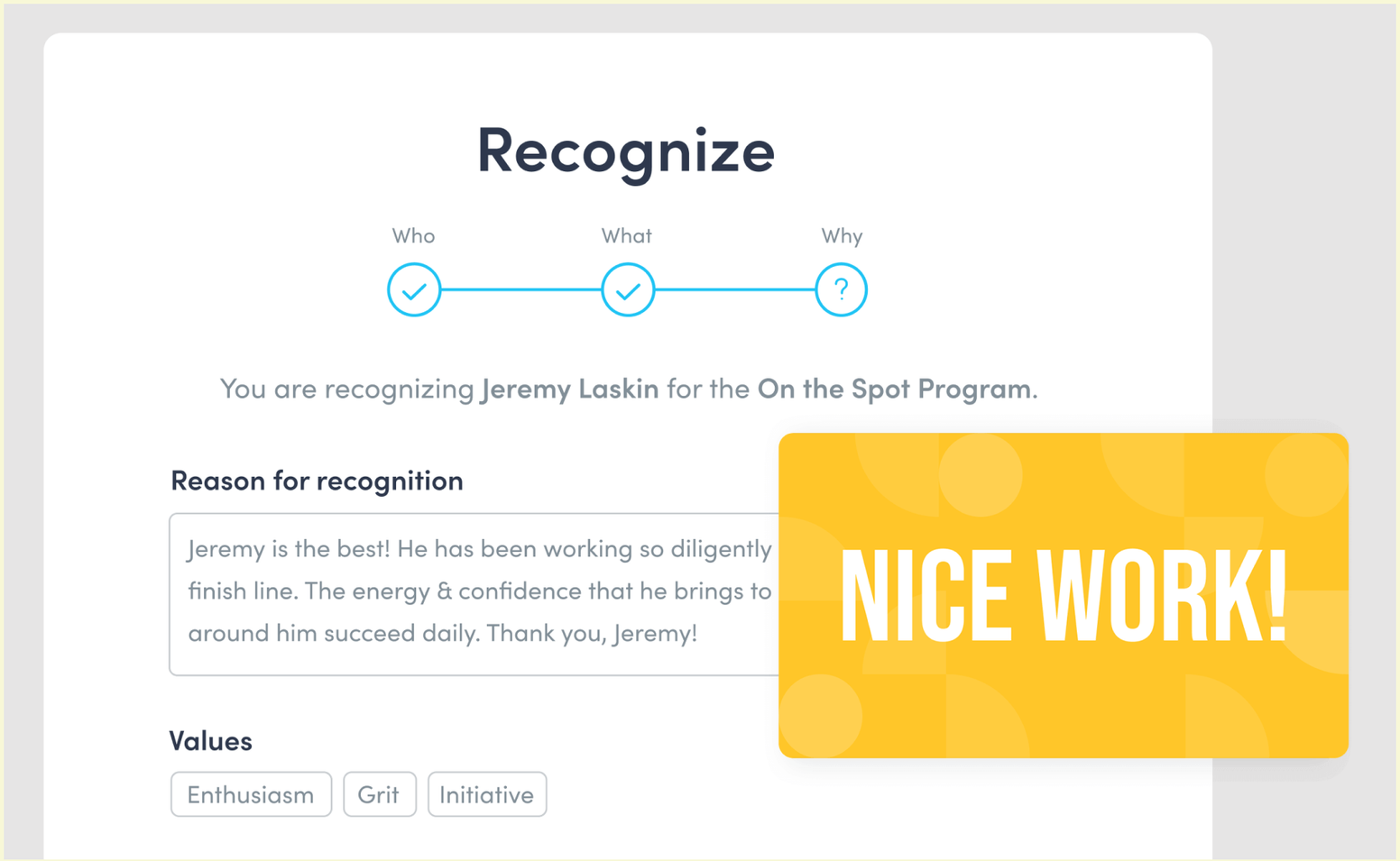
Nectar: monthly Points to Give with cohort rules
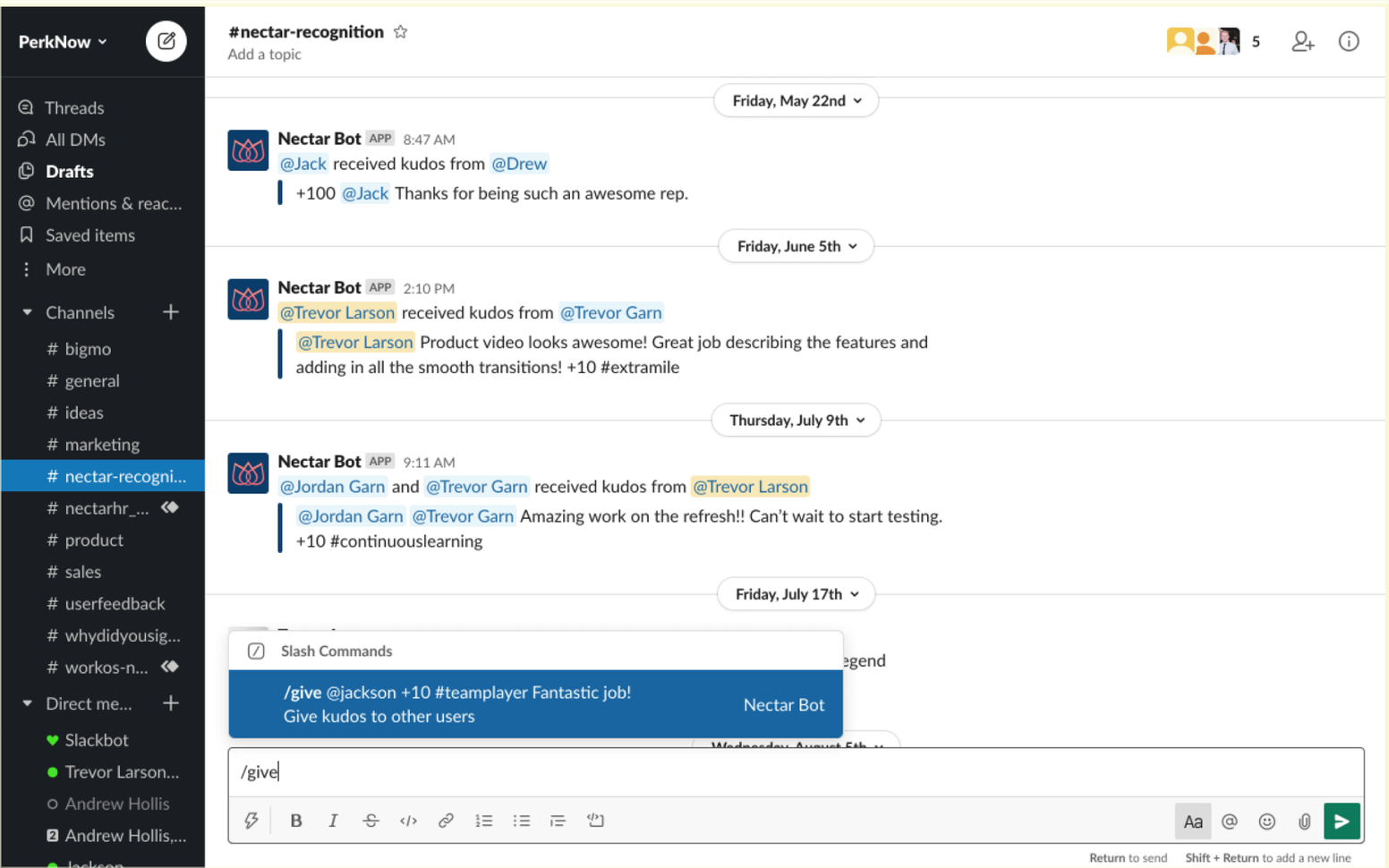
Nectar runs the classic two-balance economy. Points to Give reset on the 1st of each month, Points to Redeem accumulate toward rewards, and Boosted Points let employees convert earned points back into giving points.
Admins get Variable Rate Allowances, rule-based monthly budgets by department, location, or employment type, though mid-month changes only take effect at the next monthly reset, which makes the cadence firmly monthly. Nectar also sends reminder emails nudging people to spend their allowance before it resets, and reviewers genuinely appreciate them.
What happens when points expire
Both platforms let points disappear, but by different routes. On Awardco, expiration is an employer setting: organizations can run cadence-based sweeps (quarterly or yearly) or age-based expiry (for example, 12 months from award), and the loss is permanent.
Its help center is blunt about it: “Once points expire, they are gone from your point balance.” Employees get an email warning 7 days out and an in-platform notice 30 days out, and even refunded points remain subject to the same rules.
On Nectar, expiry is built into the model rather than configured: unused Points to Give expire at each monthly reset, while Points to Redeem never expire during employment.
The catch sits at offboarding, where a departing employee’s points are lost when they are removed from the platform, so deployments typically instruct people to redeem before their last working day (and note that redemptions are taxable income). Ask both vendors to put their expiration and offboarding policies in writing.
Rewards catalogs and funding fees: two Amazon strategies
Awardco: Amazon Business at 1:1, funded by invoice
Awardco’s catalog runs through a direct Amazon Business partnership, and its zero-markup claim genuinely holds for Amazon items: points convert dollar-for-dollar, so you pay retail. Catalog size is the one number to treat carefully, since Awardco’s own pages variously claim 100M+ and 300M reward options.
Around Amazon sit gift cards, hotels and travel, tickets, charity, a Company Store add-on for swag, and the A-Pay Visa card. Value can leak at the catalog edges, where reviewers report hotels pricing cheaper booked directly and international shipping costs climbing when local stock runs out.
Funding is enterprise prepay: you keep a positive Redemption Account balance, topped up against Funding Request Invoices payable by ACH, wire, or check with no documented fee, or by credit card through the Billing Page (Awardco publishes no card processing percentage). Expect separate invoice streams for the subscription, professional services, and corporate gifting.
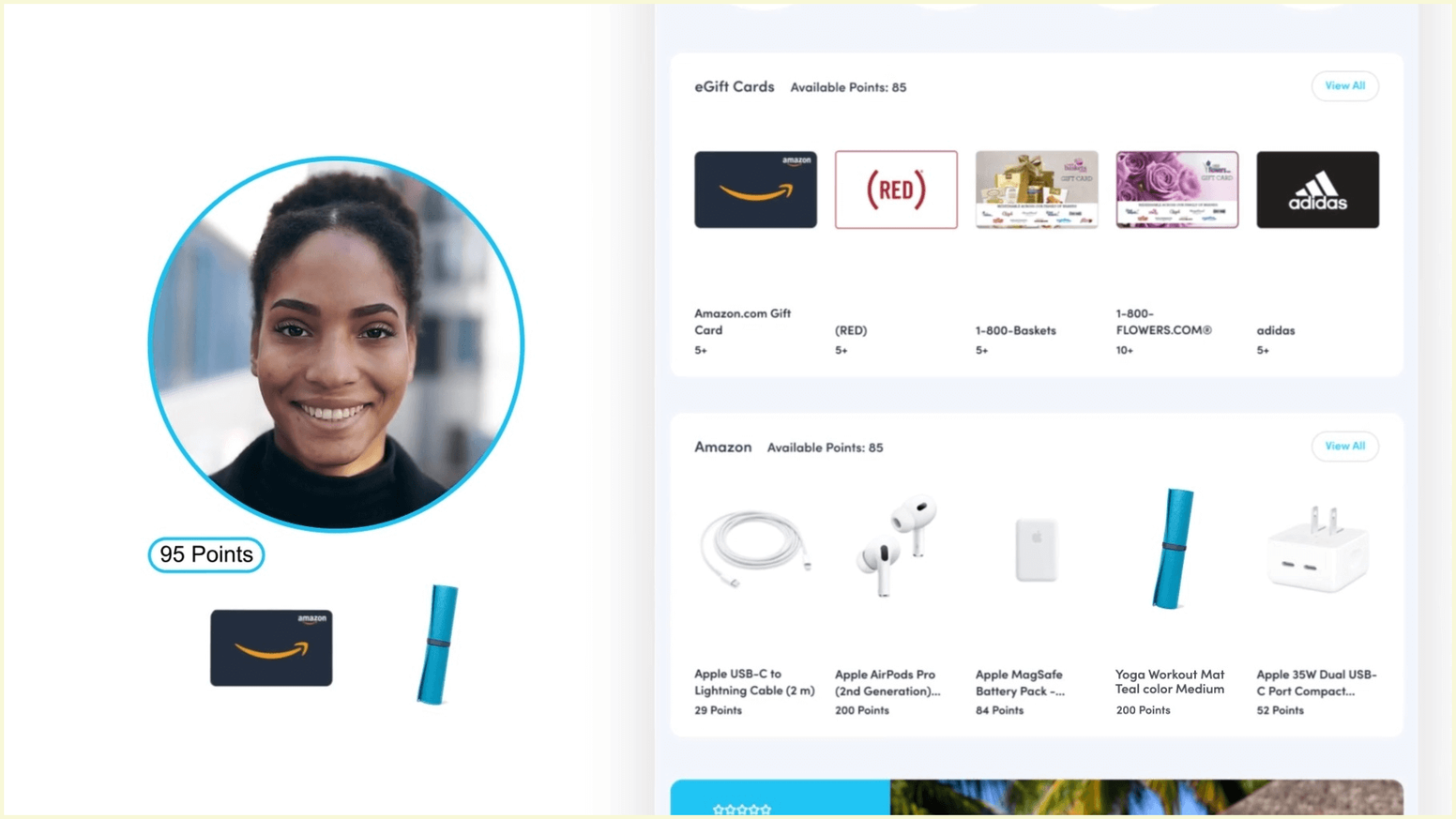
Nectar: catalog breadth with a published fee schedule
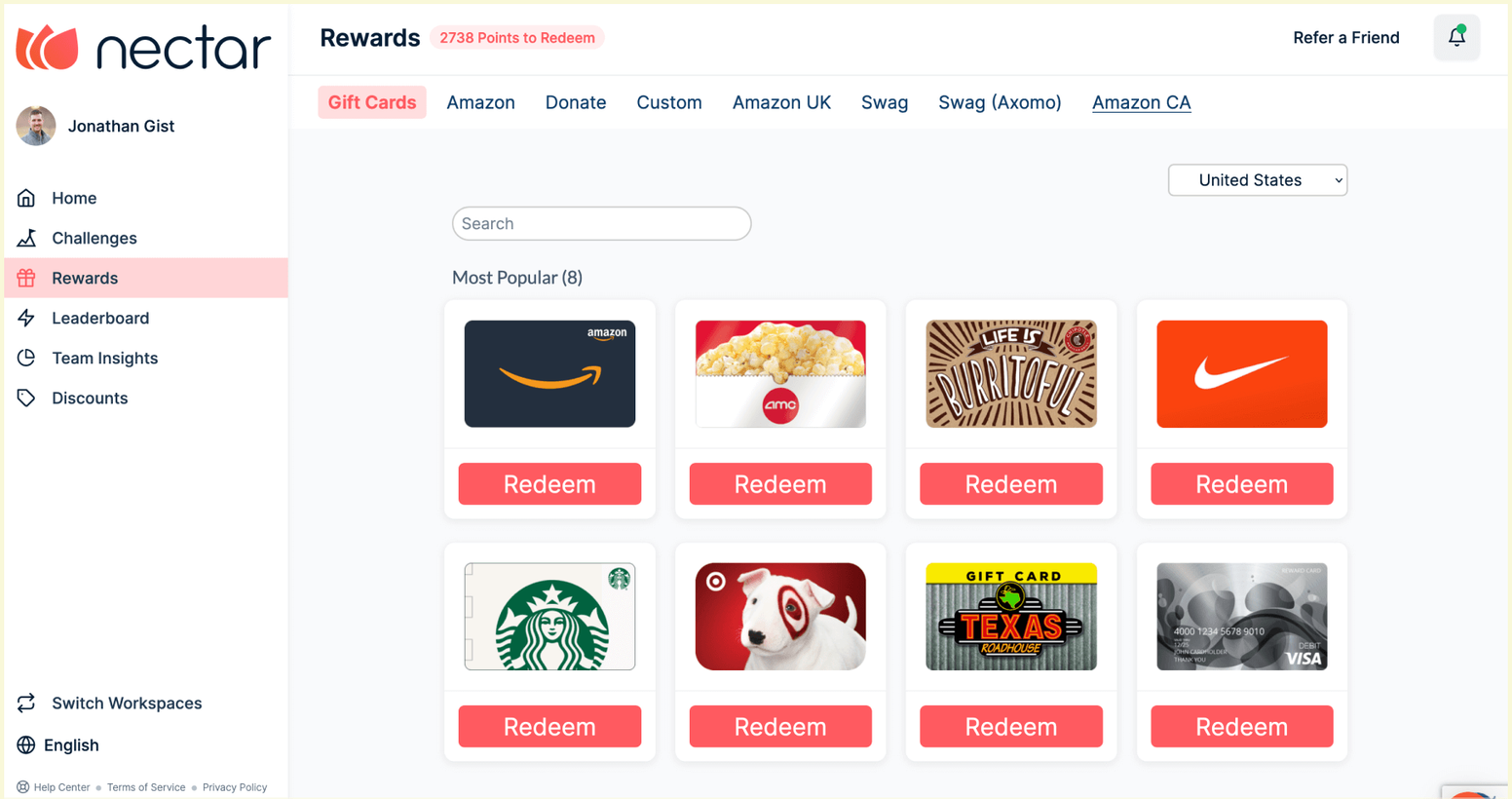
Nectar integrates Amazon inside a broader marketplace: gift cards, a swag store, charitable donations, custom rewards, and physical or instant reward cards. Two catalog caveats worth testing: gift cards come in preset denominations only, and cards are country-locked with balance issues handled by the card provider rather than Nectar.
Funding is documented in the open. Per Nectar’s help center, the default mode (confusingly named Pay As You Go) is a prefunded auto-refill balance that tops up when it drops below 20% of the refill amount.
Prepaying by check, wire, or ACH is fee-free; credit-card reward payments carry a nonrefundable 3.5% + $0.40 per transaction, and international wires cost $20. A true billed-in-arrears option, Post-Pay, exists but requires account-manager approval and a 20% security deposit (minimum $100), and redemptions pause if a month’s redemptions exceed that deposit. One switcher-friendly detail: unused prefunded balance is refundable at cancellation on written request.
| Funding route | Awardco | Nectar |
|---|---|---|
| 0% fee path | ACH, wire, or check against a Funding Request Invoice; no fee documented | Prepay by check, wire, or ACH: 0% ($20 international wire fee) |
| Credit card | Accepted via the Billing Page; processing fee not published | 3.5% + $0.40 per transaction, nonrefundable, on reward payments |
| Billed in arrears | Not documented; prepay and top-up only | Post-Pay: account-manager approval plus a 20% security deposit (minimum $100) |
| Unused balance at cancellation | Not documented | Refundable on written request |
The structural read: Awardco is invoice-and-prefund across several billing streams, which suits enterprise finance teams but parks cash and publishes no fee rates. Nectar publishes its rates and offers an arrears route, but that route carries a deposit and an approval gate, and its default mode is still a prefunded balance.
Pricing transparency: both vendors are quote-gated in 2026
Awardco’s pricing page publishes tier names (Standard, Scale, Enterprise, Service Awards Only, and Automated + 2) with no prices, plus one anchor figure: startups and small businesses with 100 employees or fewer can get flexible packages starting at $3,000.
Premium add-ons like the A-Pay card and Company Store bill a la carte, professional services bill separately, and reviewers describe implementation as a real project rather than a switch-flip.
Nectar moved the same direction in 2026: its pricing page is now organized into quote-based product bundles (Recognize, Comms, Engage™, and the Culture Suite), and every plan CTA leads to a demo.
Third-party listings historically placed entry plans around $4–$5 per user/month with minimum monthly spends, and SelectSoftware reports a $4,000 minimum annual agreement; treat those as directional, not current list prices. Nectar has no free plan, though a trial is available through demo signup.
On both platforms the rewards budget sits on top of the platform fee, so model software, rewards spend, and funding fees together.
Surveys and engagement: Awardco Engage vs. Nectar Engage
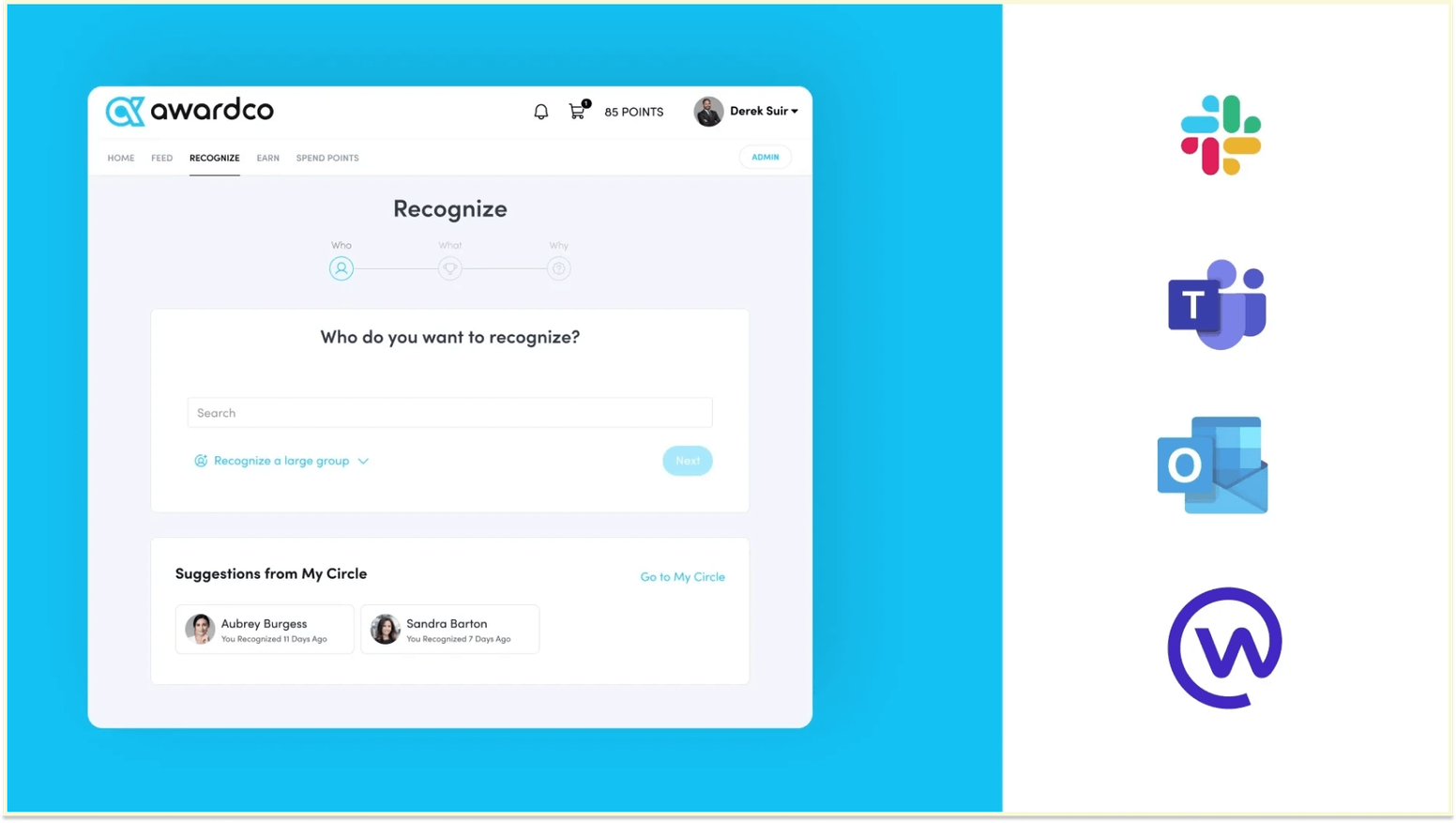
Awardco Engage™ is the newer entrant, adding surveys and feedback alongside Awardco Intelligence for AI-assisted recognition. Both shipped within roughly a year, and the help center already carries dedicated Engage sections for admins and employees, so this is a real product bet rather than a slide. What is not yet established is depth against dedicated listening tools.
Nectar Engage™ is the fuller employee-listening product today: engagement surveys, eNPS, onboarding and exit templates, a custom survey builder, scheduling and segmentation, anonymous feedback through SafeTalk, and AI sentiment analysis. Nectar also sells Comms, an internal-communications product with email, Slack, Teams, and SMS delivery.
The trade-off is packaging: Engage and Comms are separate bundles, so each one you add becomes part of your quote.
Frontline, deskless, and mobile experience
Both vendors court deskless workforces, with different evidence. Awardco’s proof is deployment scale: Texas Roadhouse runs it across 78,000+ employees and 600+ locations with a reported 209% increase in annual recognitions, Hertz covers 26,000 employees in 160 countries where more than 80% work in customer-facing, deskless roles, and its NIBCO story reports an 8% turnover reduction in the first year.
Its native mobile apps are new, so the rating bases are thin: 4.7 on iOS across 74 ratings and 3.8 on Google Play across 24 reviews.
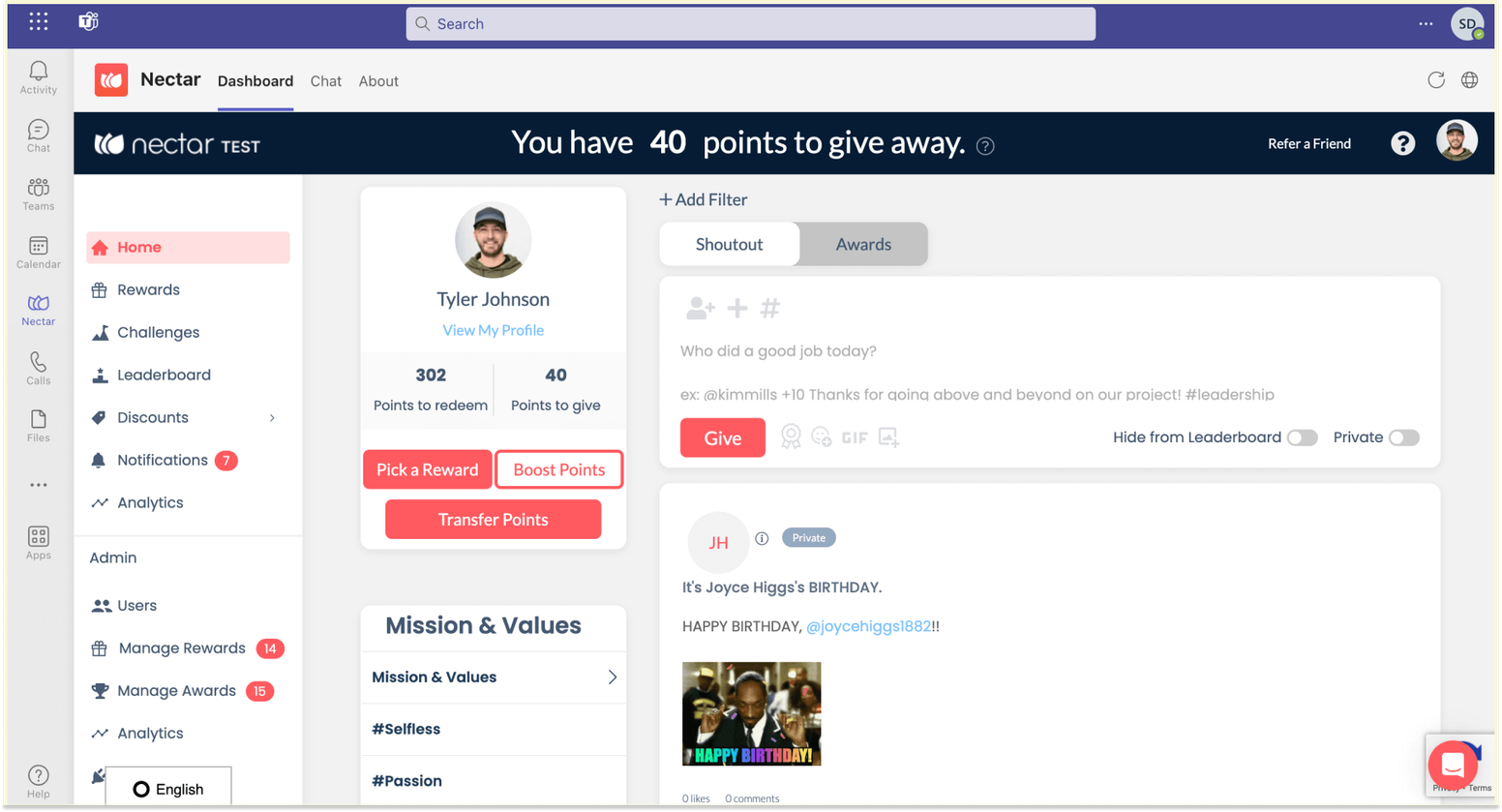
Nectar’s proof is product surface: kiosk mode for shared terminals, SMS delivery, multi-language support, and physical or instant reward cards, backed by case studies including Statista at 93% utilization and 1st Choice Cabinetry reporting turnover falling from 25% to 7%.
The caveat is mobile quality: Nectar rates 4.4 on the App Store across 96 ratings (last updated March 2025) and 3.1 on Google Play across 120 reviews (last updated September 2024). For a mobile-first frontline population, test both apps with real staff before committing.
What G2 reviewers say about Awardco and Nectar
Awardco holds a 4.9 on G2 across 6,325 reviews, the highest rating in the category, with easy setup and use its single largest praise theme.
Shakira G., a Senior Product Support Representative at an enterprise, wrote in a five-star review from May 14, 2026: “Redeeming rewards is simple and straightforward, and the items I’ve redeemed have always been delivered quickly.” The recurring criticism is implementation lift.
Leah G., a Workplace Experience Manager at a mid-market company, wrote in a 4.5-star review from April 9, 2026: “Awardco was by no means an easy launch and required a significant lift from our team.”
Nectar holds a 4.7 on G2 across 8,579 reviews, the largest review base in the category, led by recognition capabilities (1,947 mentions) and ease of use (1,856). Ryan L. called its budget reminder emails “the most helpful thing” about the platform in a February 5, 2026 review.
The dominant criticism is the monthly allowance. Van N., a teacher at an enterprise, wrote in a four-star review from April 22, 2026: “I wish I had more than 50 points to give out each month... I often run out before the month ends.”
The pattern is instructive: Awardco’s friction clusters around catalog value and rollout effort, roughly 690 mentions across its top dislike themes concerning the rewards economy; Nectar’s clusters around the points model itself, with roughly 1,600 mentions across its top five dislike themes.
Where Awardco wins
- Amazon value at 1:1: dollar-for-dollar redemption with no markup on Amazon Business items is the cleanest reward-value story in the category.
- Highest G2 rating: 4.9 across 6,325 reviews.
- Enterprise and deskless scale: Texas Roadhouse (78,000+ employees) and Hertz (160 countries, majority deskless) are named deployments with published numbers.
- Service awards depth: spot recognition, nominations, service awards, onboarding, and incentives all run as configurable programs.
- Enterprise backing and integrations: a $165M Series B at a $1B-plus valuation in May 2025, plus a bi-directional Workday partnership.
- Microsoft Teams standing: 4.5 across 1,418 Teams app store ratings, slightly ahead of Nectar’s 4.4.
- Freshly maintained mobile apps: newly built native iOS and Android apps, versus Nectar’s year-plus-old releases.
Where Nectar wins
- Published funding fees: exact rates for card, ACH, wire, and check, plus a documented arrears option, where Awardco publishes no fee percentages.
- Refundable prefunding: unused rewards balance comes back on written request at cancellation.
- A fuller survey suite: Engage covers engagement surveys, eNPS, onboarding and exit templates, anonymous feedback, and AI sentiment analysis.
- Internal communications: the Comms product adds campaigns across email, chat, and SMS.
- Frontline delivery: kiosk mode, SMS, multi-language support, and physical reward cards.
- Review volume and partnerships: the category’s largest G2 base (8,579), 2,319 Teams app store ratings, an SHRM partnership, and 1,700+ customer organizations.
- Documented outcomes: Statista’s 93% utilization and 1st Choice Cabinetry’s 25% to 7% turnover drop.
The third option: Matter
Both platforms above assume recognition lives in their own app, funded by an admin-managed points budget with an expiration policy attached.
Matter makes two different bets: recognition should live inside Slack and Microsoft Teams with no separate app or login, and it should run on a weekly rhythm rather than a monthly or program budget.
Every week, Feedback Friday™ (US Patent 12,199,935) prompts the whole team to recognize someone; give-coins reset weekly, and earned coins never expire, so there is no sweep to configure and nothing to lose at quarter end.
The cadence is measurable: in The Recognition Habit, Matter’s 2026 Benchmark Report, built on aggregate, de-identified platform data, teams that build recognition around a weekly ritual give about 2.5x more recognition per member than ad hoc teams, and roughly 8 in 10 ritual teams stay active in nearly every month.
Against two quote-gated vendors, Matter publishes everything: the Free plan supports unlimited users, paid plans run $1 to $5 per user/month, billed annually, and Matter hasn’t raised prices in 8 years.
Funding fees are published as well, including a 0% ACH prepay path, 3.5% card prepay, and a pay-as-you-go card option at 5% + $0.35 that needs no security deposit and no account-manager approval, and the catalog spans 10,000+ eGift card options across 200+ countries.
Matter holds a 5.0 across 1,476 Teams app store ratings and a 4.7 on G2. To be equally honest about fit: a workforce that needs kiosk terminals, SMS delivery, or a full survey-and-comms suite from one vendor is better served by Nectar, and a 78,000-person deskless enterprise running service awards at Texas Roadhouse scale is Awardco territory. For the detailed head-to-heads, see Awardco vs. Matter and Nectar vs. Matter.
Which platform is right for your team?
Choose Awardco if:
- Reward value and catalog breadth decide the purchase, and Amazon redemption at retail matters most.
- You run service awards, nominations, and milestone programs across a large or deskless workforce.
- Your finance team is comfortable prefunding a rewards account by invoice across multiple billing streams.
Choose Nectar if:
- You want recognition, surveys, and internal comms from a single vendor.
- Frontline delivery through kiosk mode, SMS, or physical reward cards is a requirement.
- You want published funding rates, a refundable prefunded balance, and the option to negotiate Post-Pay billing.
Choose Matter if:
- Your team lives in Slack or Microsoft Teams and you want recognition there, not in another app.
- You prefer a weekly recognition ritual with earned coins that never expire.
- You want published pricing and funding fees, starting free with unlimited users, before talking to sales.
Frequently asked questions about Awardco vs. Nectar
Is Awardco or Nectar cheaper?
Neither publishes list prices in 2026, so the honest answer is that it depends on your quote. Awardco names a $3,000 starting point for packages covering 100 employees or fewer, with add-ons and professional services billed separately.
Nectar is quote-based across its Recognize, Comms, Engage, and Culture Suite bundles; third-party listings historically placed entry plans around $4 to $5 per user/month with minimum spends, and SelectSoftware reports a $4,000 minimum annual agreement. Compare total cost, including rewards budget and funding fees, not just software.
What is the main difference between Awardco and Nectar?
Awardco is a rewards-logistics platform first: direct Amazon Business redemption at 1:1, service awards, and enterprise program management, with surveys added recently through Engage. Nectar is a broader culture platform: recognition plus a full survey suite, an internal-communications product, and frontline delivery features like kiosk mode and SMS.
Do Awardco and Nectar points expire?
Yes, on both, by different mechanisms. Awardco lets each organization enable permanent point expiration, either on a cadence (quarterly or yearly) or by age, with a 7-day email warning before points are removed.
On Nectar, unused monthly Points to Give expire at each reset, and while Points to Redeem never expire during employment, they are lost when an employee is removed, so departing staff should redeem beforehand. Among alternatives, Matter’s earned coins never expire.
Which is better for frontline or deskless teams, Awardco or Nectar?
It depends on what deskless means for you. Nectar ships more frontline product surface: kiosk mode, SMS delivery, multi-language support, and physical reward cards. Awardco brings bigger deskless deployments, including Hertz at 26,000 employees with more than 80% in deskless roles.
Weigh Nectar’s mobile ratings (3.1 on Google Play across 120 reviews) against Awardco’s newer but thinly rated apps before deciding.
Do Awardco and Nectar offer free plans or trials?
Neither offers a free plan. Awardco is demo-led with no trial listed on its pricing page. Nectar has no free plan either, though a trial is available through demo signup. If self-serve evaluation matters, note that Matter’s Free plan supports unlimited users.
Awardco vs. Nectar: the bottom line
These are two strong platforms that have converged on quote-gated pricing and diverged on strategy. Awardco doubled down on rewards logistics and enterprise scale; Nectar built outward into surveys, comms, and frontline delivery.
Decide on the axes where they genuinely differ: catalog value and deployment scale (Awardco), platform breadth and funding transparency (Nectar), and whether recognition should live inside chat on a weekly rhythm instead (Matter).
Since both vendors quote rather than publish, get the full cost stack in writing, including funding fees and expiration policy, before you sign. Related reading: Awardco alternatives, Nectar alternatives, and the full comparison hub.

![Awardco vs. Kudos Comparison: Pricing & Reviews [2026 Guide]](https://cdn.sanity.io/images/kqqb5xry/production/af8b9f15f8251be064bd024a494b0c73aff77487-800x600.jpg?w=720&q=75&fit=max&auto=format)
![Kudos vs. Nectar Comparison: Pricing & Reviews [2026 Guide]](https://cdn.sanity.io/images/kqqb5xry/production/534ba04d43c4301bb06b3935c0d5a2d507f52642-800x600.jpg?w=720&q=75&fit=max&auto=format)
![Awardco vs. Matter Comparison: Pricing & Reviews [2026 Guide]](https://cdn.sanity.io/images/kqqb5xry/production/9617832a6fadd126ab7242888cf7b84169cb2d92-800x600.jpg?w=720&q=75&fit=max&auto=format)