

The 30-second verdict: Bonusly or Kudos?
Choose Bonusly if you want per-user pricing you can read without a sales call, a free plan for up to 8 users and a 30-day trial with no credit card, published reward-funding fees, and the fastest-shipping AI feature set in the category (its Bizy sidekick launched in August 2026).
It suits office SMB and mid-market teams working in Slack, Microsoft Teams, or Google Chat.
Choose Kudos if you are an enterprise HR team with several hundred employees or more, multi-country operations, and a rewards budget: you get deep culture analytics and values-aligned recognition, SOC 2 Type II and ISO 27001 compliance, 11+ languages, locally sourced global rewards including mobile top-ups, real HRIS muscle, and the Spaces employee-communication hubs relaunched in April 2026. A demo-led purchase has to be acceptable, because there is no other way to buy it.
A third option exists: if what you actually want is recognition running inside Slack or Microsoft Teams with published pricing, Matter is covered at the end of this guide.
Bonusly and Kudos (Kudos Inc. of Calgary, at kudos.com) are both values-based peer recognition platforms with strong G2 scores and large review bases.
They diverge on almost everything else: Bonusly publishes its prices and sells itself, while Kudos runs a demo-led enterprise motion in which neither the seat price nor the reward-funding terms appear anywhere public.
This comparison was verified in August 2026 against both vendors’ product pages, Bonusly’s help-center billing documentation, both G2 profiles, and both app-store listings. Full disclosure: this guide is published by Matter, an employee recognition platform that competes with both Bonusly and Kudos.
We have kept the head-to-head honest, we say plainly where each product wins, and we introduce Matter only near the end as a third option. Weigh our perspective accordingly, and verify current pricing with each vendor before you buy.
How we researched this comparison
We build Matter, which competes with both platforms on this page, so weigh our perspective accordingly.
For Bonusly and Kudos we reviewed each vendor’s public pricing, product pages, and help-center or billing documentation, plus their G2 profiles and named, dated reviews, and we drew on conversations with teams evaluating and switching between recognition platforms. We have not used either product hands-on.
Every claim here is sourced to the vendors’ own materials, named reviews, or Matter’s published data, and facts were last verified in August 2026.
Bonusly vs. Kudos at a glance
| Bonusly | Kudos | Matter | |
|---|---|---|---|
| Starting price | Team $3 per user/month, billed annually ($5 with Bizy AI); public tiers | Not published; the pricing page returns a 404 and every path leads to a demo | Free plan, then $1 to $5 per user/month, billed annually; public tiers |
| Free plan | Yes, up to 8 users | No; no free trial or sandbox either | Yes, unlimited users |
| G2 rating | 4.7 (7,000+ reviews) | 4.8 (2,828 reviews) | 4.7 (1,186 reviews) |
| Teams app store | 4.4 (45 ratings) | 4.2 across 14 in-client reviews; no public AppSource listing | 5.0 (1,476 ratings) |
| Best for | SMB and mid-market office teams that want public pricing and shipped AI | Enterprise HR teams with multi-country workforces and admin capacity | Slack/Teams-first teams that want recognition inside chat |
Recognition mechanics: a monthly allowance vs. a monthly cap
Both platforms hand every employee a recurring budget to spend on peers, which makes them structurally similar and gives them the same top complaint class. The details still differ.
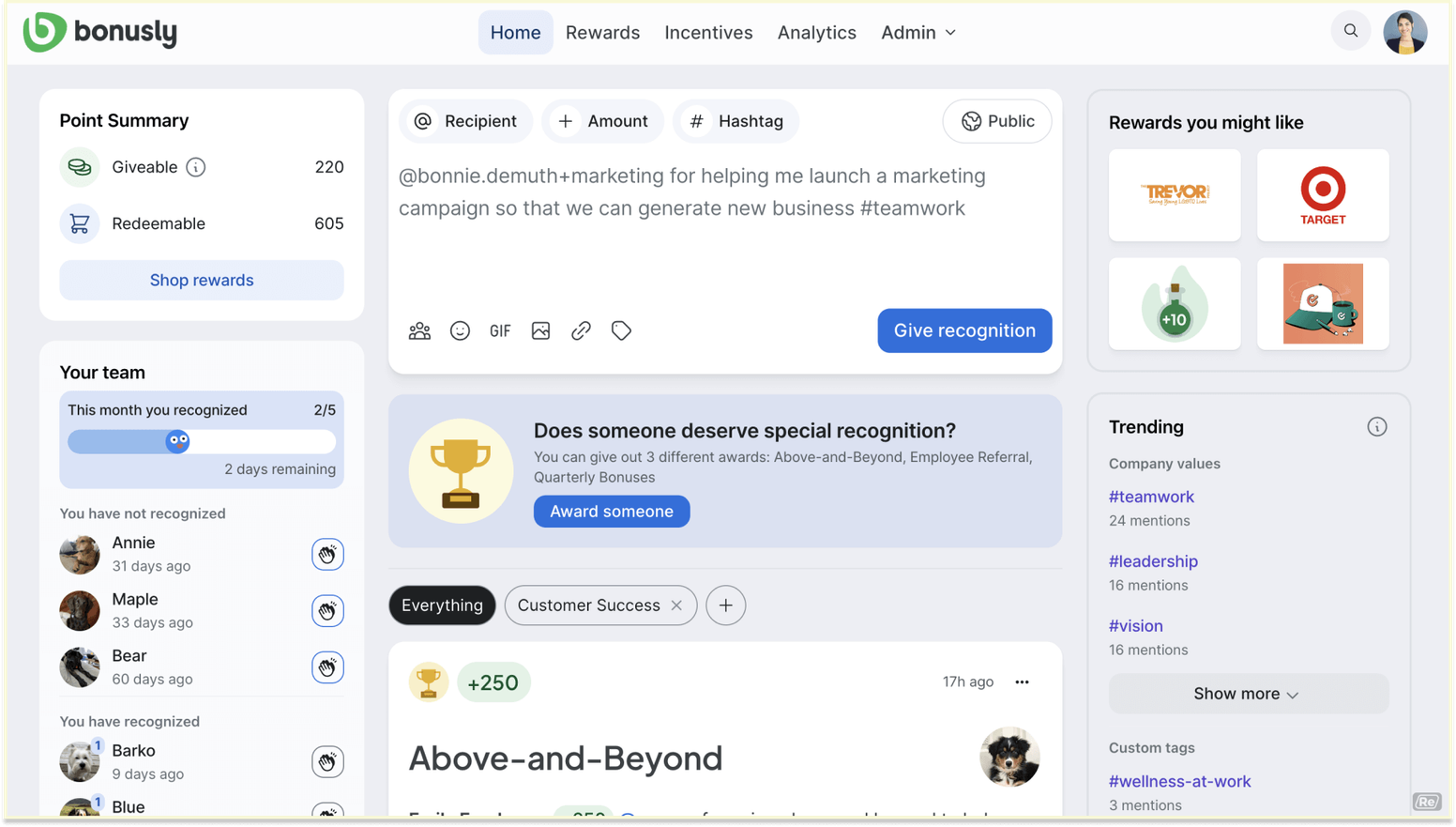
Bonusly: a monthly allowance plus the Points Boost loop
Your Bonusly giveable balance resets to the full monthly allowance at the start of each budget period, usually the 1st, and unused give-points expire with no carryover. Earned points do not expire by default, though companies can configure expiration rules.
Managers get extra allowance per direct report, and admins can set allowance rules by department, location, or role. Points Boost lets employees spend earned points to permanently raise their own giving allowance.
Bonusly’s own rewards calculator states that on average, 60% of monthly recognition allowances are given away each month, which implies roughly 40% of allowance points expire unused every month.
Kudos: four recognition levels and a hard monthly cap
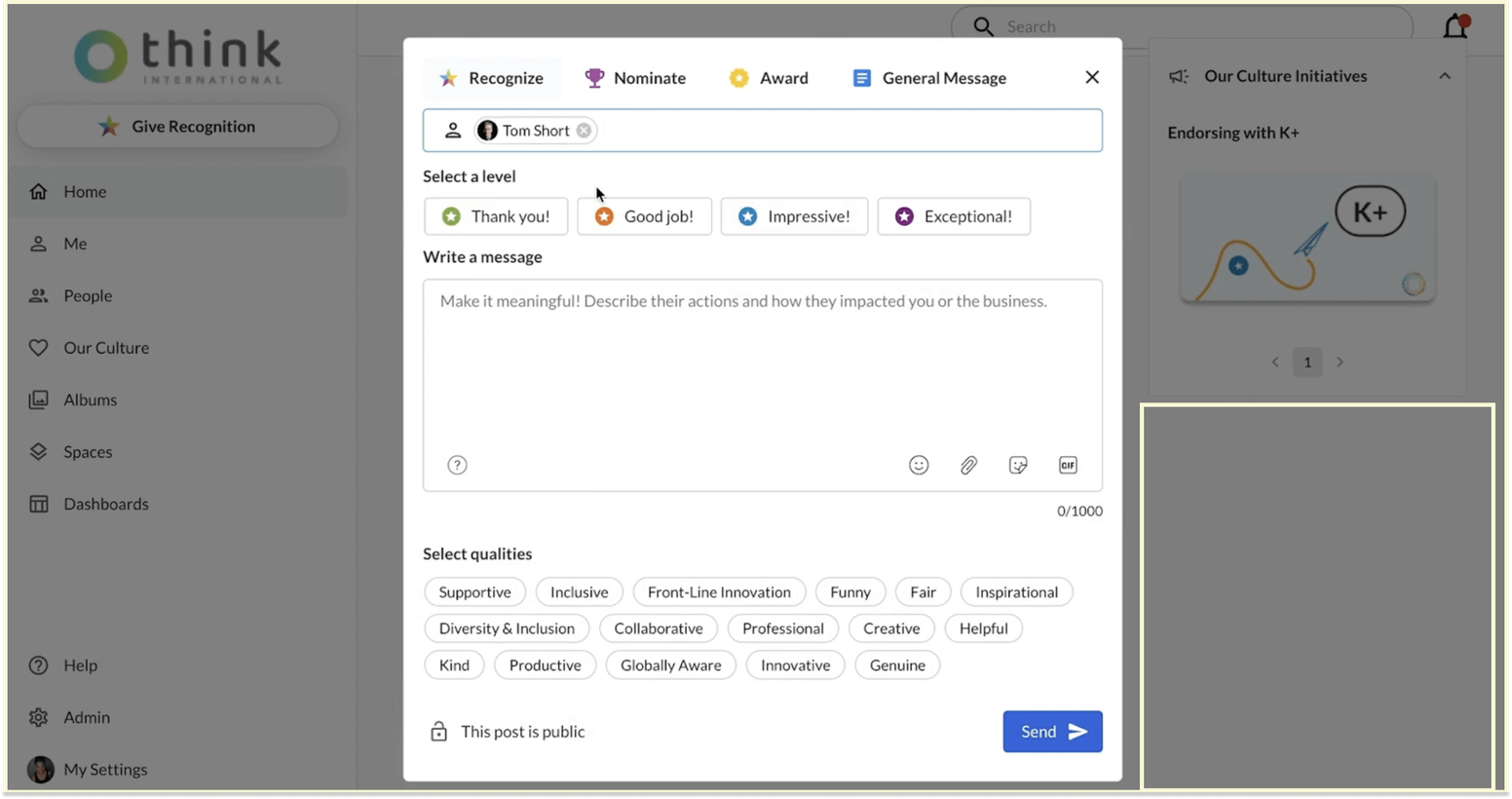
Kudos structures recognition into four named levels, published on its own site: Thank You, Good Job, Impressive, and Exceptional. Recognition is tied to company values and to qualities the sender picks, which is what feeds its culture analytics.
Giving runs on a monthly points allocation with a hard cap, and organizations configure the numbers, so there is no universal default to quote; reviewers in 2026 cite allocations of 50, 100, and 150 points a month, plus per-recipient monthly limits.
Two mechanics we could not verify, and will not guess at: Kudos does not publish whether give-points roll over or earned points expire, and it does not publish what happens to balances when an employee leaves.
Its public help center has only two top-level categories and its point-mechanics articles are not publicly indexed, so those answers come from a sales call rather than documentation.
One genuinely distinctive Kudos mechanic is worth conceding: through its Rewards+ portal, employees can top up a redemption with their own money, so a reward that costs more than a points balance is still reachable. Few rivals offer that.
Rewards and funding: what each vendor will and will not tell you
Both platforms only cost you money when an employee actually redeems. The difference is that one of them publishes the terms.
Bonusly rewards and published funding fees
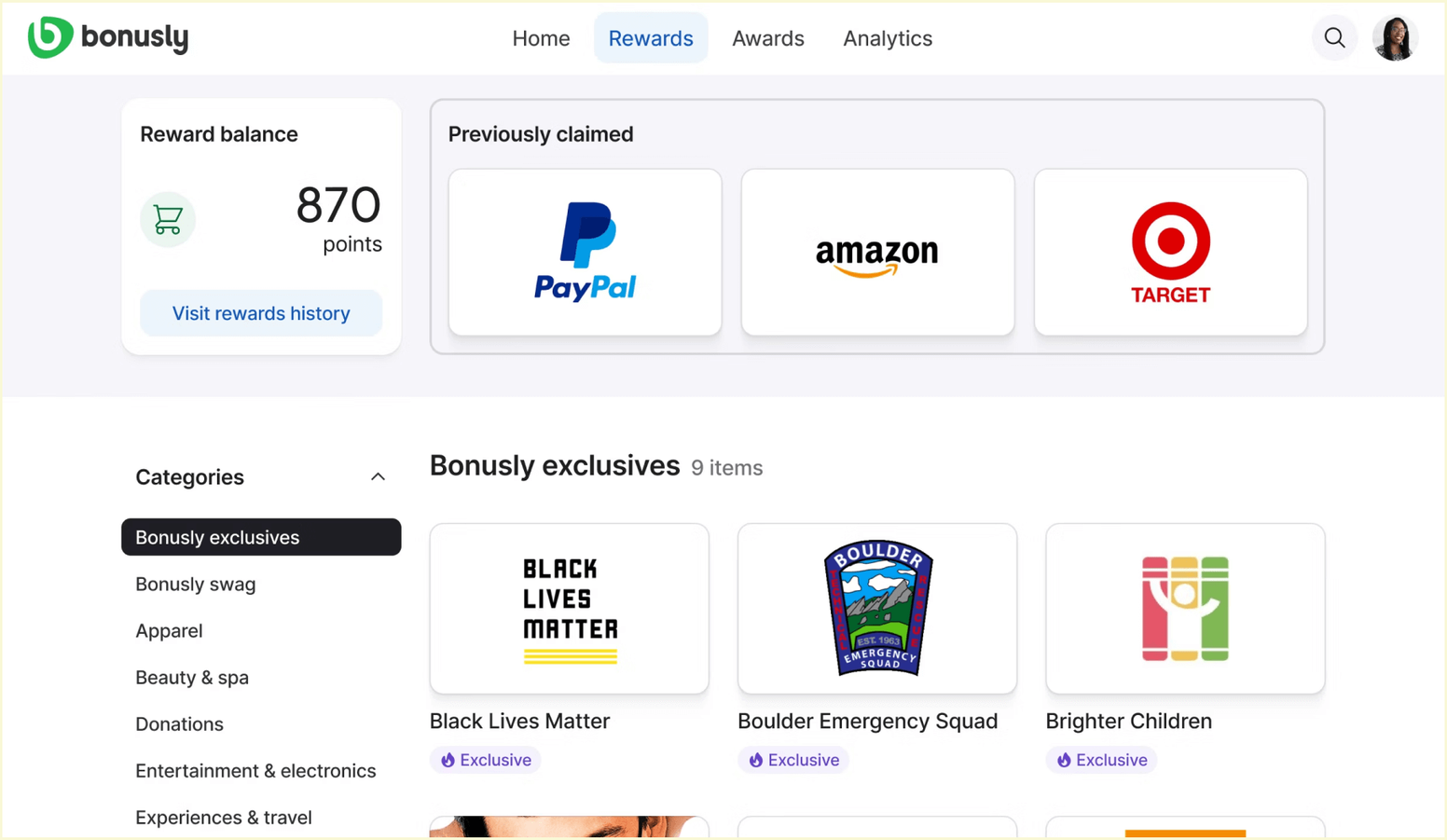
Bonusly gift cards are all-electronic (some take up to 48 hours to activate), curated physical gifts ship through its partner Snappy, swag runs through an AXOMO integration, and charitable donations are included.
Per Bonusly’s help center (Paying for Bonusly: Rewards Plans), there are three funding routes: Pay-as-You-Go by card, billed in arrears at an 8% convenience fee, with the card charged when the reward balance passes minus $100 or at month end; the Flex Plan, prefunding $200 or more by card at a 5% convenience fee; or the Fixed Plan, a $2,500 minimum upfront deposit paid by invoice via ACH or wire with no convenience fee. Whatever you think of 8%, you can model it before you sign.
Kudos rewards and undocumented funding
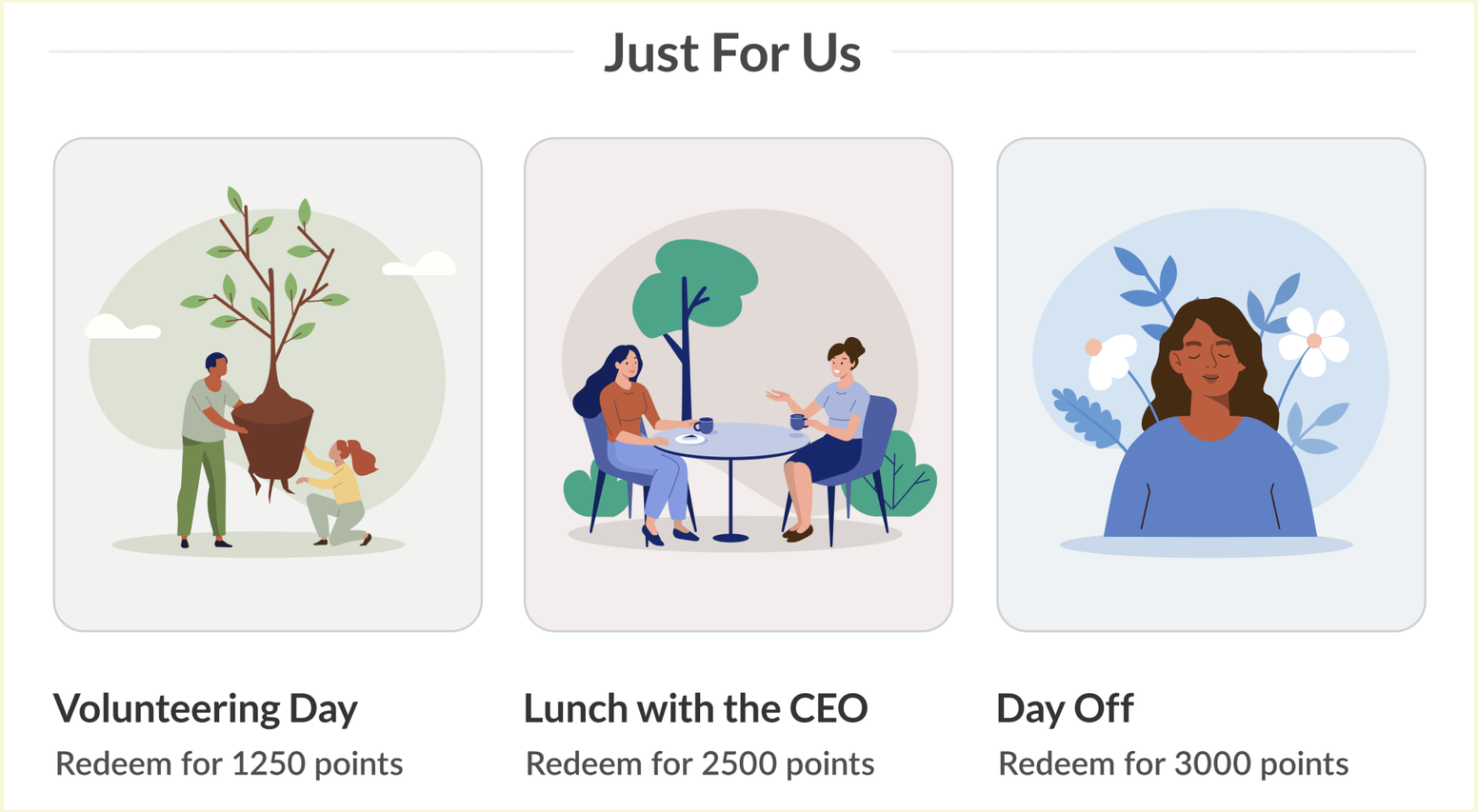
Kudos’s catalog is a genuine strength: gift cards, merchandise, travel and experiences, mobile top-ups (rare and useful for global workforces), charitable donations, and custom company rewards, curated per organization and, in their words, all locally sourced. On its rewards page Kudos says customers pay no transaction fees or hidden costs.
Two caveats belong next to that claim. First, catalog size is stated inconsistently on their own site: the rewards page says hundreds of thousands of reward options, while their Achievers comparison page claims over 10,000,000 rewards delivered locally in 186 countries.
Second, and more important for a buyer, the no-fees claim has no published mechanics behind it. There is no public documentation of whether reward budgets are prepaid or invoiced, what minimums apply, what happens to an unused balance at cancellation, or whether card payment carries a processing fee.
We are not saying Kudos charges hidden fees; we are saying the funding model is undisclosed rather than disproven, and you should get it in writing.
| Funding question | Bonusly | Kudos |
|---|---|---|
| Platform price published | Yes, $0 to $5 per user/month plus a quote-based Organization tier | No; the pricing page returns a 404 |
| Bank prepay route | Fixed Plan by invoice via ACH or wire: no convenience fee, $2,500 minimum deposit | Not documented publicly |
| Prefund by credit card | Flex Plan: 5% convenience fee, $200 minimum | Not documented publicly |
| Billed in arrears | Pay-as-You-Go: 8% convenience fee, no deposit, self-serve | Not documented publicly |
| Fee claims | Publishes a full fee schedule | Says customers pay no transaction fees or hidden costs; no mechanics published |
Pricing transparency: Bonusly publishes tiers, Kudos publishes nothing
Bonusly lists everything on bonusly.com/pricing: a free plan for up to 8 users focused on peer recognition, Team at $3 per user/month billed annually, Team plus Bizy at $5 per user/month (the AI sidekick adds $2), and a quote-based Organization tier, with a 30-day trial and no credit card required.
Kudos publishes no prices at all. Its pricing URL returns a 404, no plan names or rates appear anywhere on the site, and even its FAQ page carries nothing on pricing, plans, or implementation timelines.
The primary call to action is a 30-minute demo, and there is no free plan, free trial, or sandbox.
One third-party review site estimates a starting point of around $3.25 per user/month with a 500-employee minimum; that is an outside estimate rather than a Kudos-published figure, so treat it as directional only and get a written quote.
The practical consequence is that a small team cannot evaluate Kudos at all without a sales conversation, and cannot compare total cost of ownership against Bonusly without one either.
Analytics, surveys, and AI: Bonusly vs. Kudos
Kudos is the stronger analytics product. Its whole design, four recognition levels plus value and quality tagging on every message, exists to produce multi-level reporting, culture scoring, and real-time dashboards, and it ships an AI Recognition Assistant, scheduled recognition, monthly recognition goals, and leaderboards.
Spaces, relaunched in April 2026, pushes it further into internal communications, which is attractive if you have no intranet. On employee listening, Kudos measures sentiment and culture, but the depth of a full survey suite is not something we can verify from public materials, so demo it if surveys matter.
Bonusly went the other direction in 2026, investing in performance and AI tooling: the Bizy recognition sidekick, AI-assisted 1:1s, Recaps, 360 feedback, goals, and a Recognition Quality Score. Its listening feature, Pulse Checks (October 2025), is a lightweight sentiment pulse rather than a full survey product.
So: Kudos for culture analytics and reporting depth, Bonusly for manager tooling and shipped AI.
Apps, integrations, and enterprise readiness
Kudos brings the enterprise credentials. SOC 2 Type II and ISO 27001, OneTrust attestation, 11+ languages, SSO through Okta, OneLogin, Ping Identity and others, HRIS connections including Workday, UKG, SAP SuccessFactors, ADP, Paycor, Paylocity and BambooHR, dedicated ADP Marketplace connectors, an API, and a flat-file fallback for systems that cannot integrate.
Its logo wall (DHL Express, ENGIE, Vanderbilt University, MTN, Cummins) is bigger than Bonusly’s.
The mobile picture is the clearest reversal. For a platform whose core experience is its own app, Kudos’s apps have not been updated in about two years: the iOS app rates 3.2 across 11 ratings, last released July 12, 2024, and the Android app rates 3.8 across 299 reviews, last updated August 14, 2024. Bonusly’s iOS app rates 4.8 across roughly 4,500 ratings, though its Android app sits at 3.7 across 669 reviews.
Bonusly also connects to Slack, Microsoft Teams, and Google Chat, and is Microsoft 365 certified; Kudos integrates with Slack, Teams, and Outlook, but recognition still lives in the Kudos app rather than in chat.
What G2 reviewers say about Bonusly and Kudos
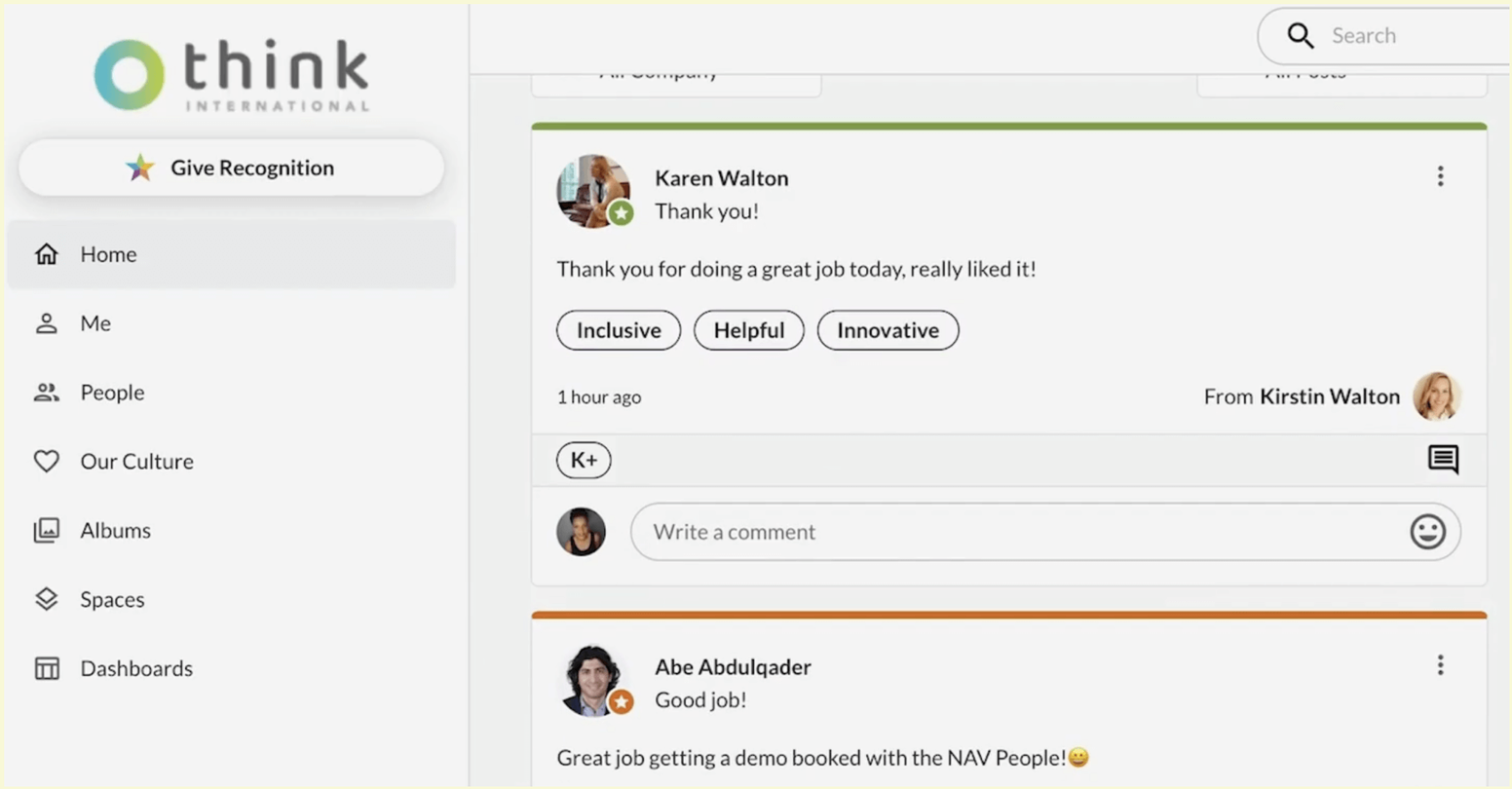
Kudos holds the higher score, Bonusly the much larger base, and both share the same headline complaint.
Bonusly (4.7 across 7,000+ reviews on G2): praise concentrates on ease of use and no-training adoption. Lucas W. wrote in an April 2026 five-star review: “It’s incredibly easy to use... people actually use it consistently.” Roughly 2,100 mentions across its top eight dislike themes concern the points economy.
Haritha P., a QA engineer at a mid-market company, described the mechanic in a May 30, 2024 review: “Monthly allowances reset whether you use them or not. If I’m out of office and miss a week, I lose points.”
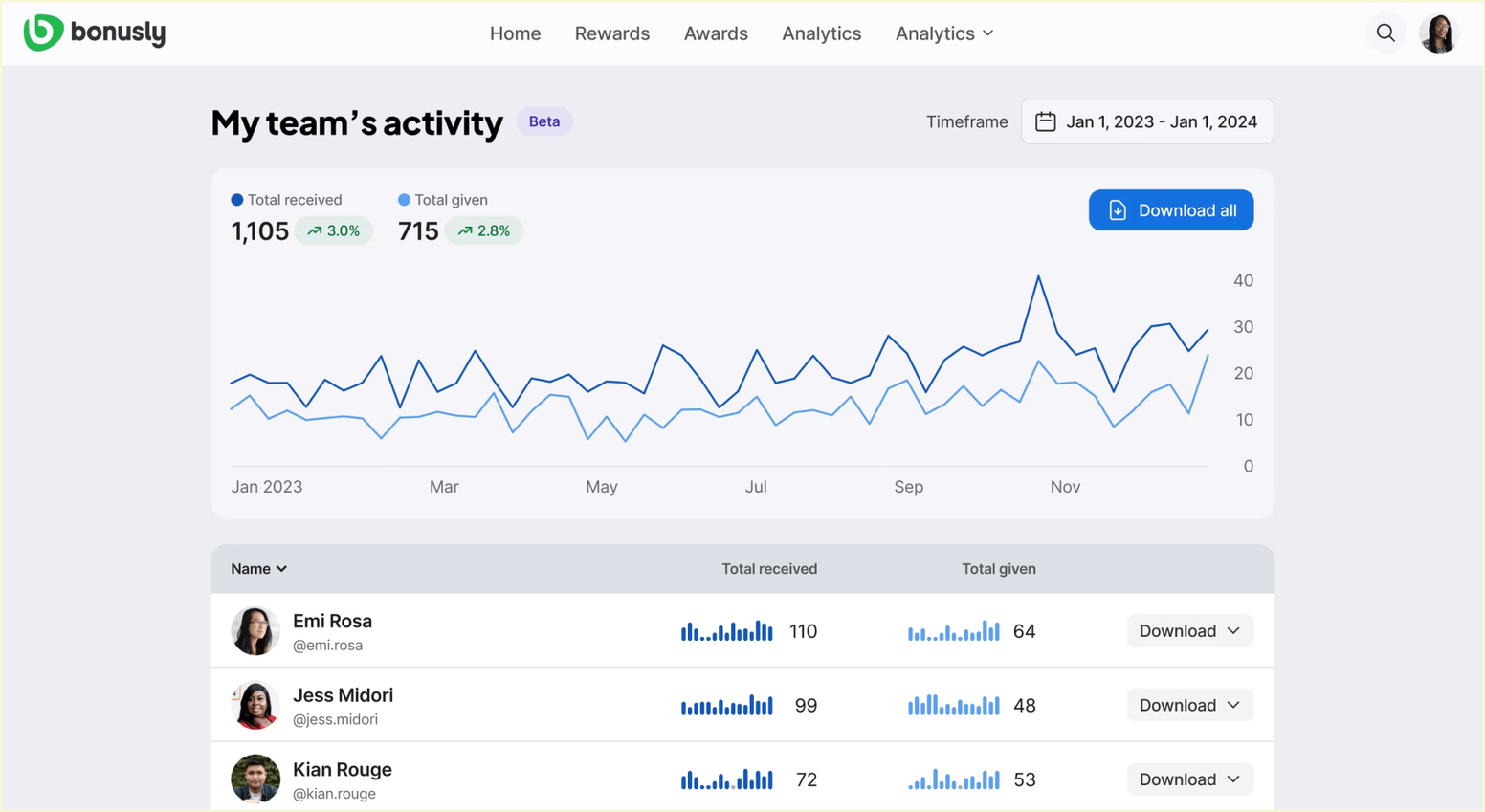
Kudos (4.8 across 2,828 reviews on G2): the leading praise themes are ease of use and flexibility (491 mentions), employee recognition (458), and expressing appreciation (418).
Júlia K., a senior customer advocate at a mid-market company, wrote on April 28, 2026: “Kudos makes it really easy to recognise teammates for their help and hard work.
Seeing recognition shared across the company helps create a positive vibe.” Its top five dislike themes, roughly 565 mentions, are all about the points economy: redemption limits (131), reward system inadequacy (123), a limited points system (118), insufficient point values (106), and limited reward options (87).
Santino E., at an enterprise, did the arithmetic in a May 14, 2026 five-star review: “100 points only allows me to recognize 11 people with 5 points when I want to give everyone at least 10 or more.”
The symmetry is the finding. Bonusly users say the monthly allowance runs out; Kudos users say the monthly cap runs out. Neither platform has a structural edge here, and both complaints trace back to the same monthly-budget design.
Where Bonusly wins
- Pricing transparency: public per-user tiers, a real free plan for up to 8 users, and a 30-day no-card trial. Kudos publishes no price at all.
- Published reward funding: its 8%, 5%, and no-fee routes are documented; Kudos publishes no funding model.
- Documented mechanics: roughly 167 help-center articles covering allowances, expiration, billing, and offboarding, against a two-category public help center at Kudos.
- Self-serve evaluation: you can trial Bonusly today; Kudos requires a demo.
- Shipped AI and manager tools: Bizy, AI 1:1s, Recaps, 360 feedback, and a Recognition Quality Score.
- Chat-tool breadth: Slack, Microsoft Teams, and a rare Google Chat integration, plus Microsoft 365 certification.
- Actively maintained apps: a 4.8 iOS rating on roughly 4,500 ratings, and an Android app updated in 2026.
- Review volume: 7,000+ G2 reviews against 2,828.
Where Kudos wins
- Highest star rating of the pair: 4.8 on G2 across a substantial 2,828-review base.
- Culture analytics depth: four recognition levels plus values and qualities on every message feed multi-level reporting and culture scoring that Bonusly does not match.
- Enterprise compliance: SOC 2 Type II, ISO 27001, OneTrust attestation, and 11+ languages.
- Global reward sourcing: locally sourced rewards including mobile top-ups, plus the ability to top up a redemption with personal funds.
- HRIS and enterprise distribution: Workday, UKG, SAP SuccessFactors, Paycor, Paylocity, BambooHR, an API, a flat-file fallback, and dedicated ADP Marketplace connectors.
- Bigger logos: DHL Express, ENGIE, Vanderbilt University, MTN, and Cummins.
- Beyond recognition: Spaces, relaunched April 2026, adds employee communication hubs for organizations without an intranet.
- A quantified outcome: Make-A-Wish reports a 6% reduction in voluntary turnover year over year and an 11% uplift in overall employee engagement.
The third option: Matter
Both platforms above assume recognition lives in their own app, funded by a monthly points budget. Matter makes two different bets: recognition should happen inside Slack and Microsoft Teams with no separate app or login, and it should run on a weekly rhythm rather than a monthly allowance or cap.
Every week, Feedback Friday™ (US Patent 12,199,935) prompts the whole team to recognize someone, and give-coins reset weekly so they get used rather than saved and lost. Earned coins never expire.
The cadence is measurable: in The Recognition Habit, Matter’s 2026 Benchmark Report, built on aggregate, de-identified platform data, teams that build recognition around a weekly ritual give about 2.5x more recognition per member than ad hoc teams, and roughly 8 in 10 ritual teams stay active in nearly every month.
On this guide’s buying criteria: Matter’s Free plan is for unlimited users, paid plans are published at $1 to $5 per user/month, billed annually, and Matter hasn’t raised prices in 8 years.
Reward funding fees are published, including a 0% ACH prepay path, and the catalog spans 10,000+ eGift card options across 200+ countries. On the Microsoft Teams app store Matter holds a 5.0 across 1,476 ratings.
To be equally honest about fit: an enterprise HR team that needs ISO 27001, 11+ languages, and deep culture scoring across a multi-country workforce will find Kudos the better-credentialed platform, and Matter does not try to match Bonusly’s performance-management and AI tooling. For the detailed head-to-heads, see Bonusly vs. Matter and Kudos vs. Matter.
Which platform is right for your team?
Choose Bonusly if:
- You want to budget from a public price list and start on a free tier or a 30-day trial.
- Published reward-funding terms and documented product mechanics matter to you.
- Your team is an office SMB or mid-market org working in Slack, Teams, or Google Chat.
Choose Kudos if:
- You are an enterprise HR team with several hundred employees or more and a rewards budget.
- Culture analytics, values-based recognition, and compliance credentials are requirements.
- A multi-country workforce needs locally sourced rewards and 11+ languages, and a demo-led purchase is normal for you.
Choose Matter if:
- Your team lives in Slack or Microsoft Teams and you want recognition there, not in another app.
- You prefer a weekly recognition ritual over a monthly allowance or a monthly cap.
- You want to start free with unlimited users and see published pricing before talking to anyone.
Frequently asked questions about Bonusly vs. Kudos
Is Bonusly or Kudos cheaper?
Bonusly is the only one you can price without a sales call: a free plan for up to 8 users, Team at $3 per user/month billed annually, and Team plus Bizy at $5.
Kudos publishes no pricing at all; its pricing page returns a 404. A third-party review site estimates Kudos starts around $3.25 per user/month with a 500-employee minimum, but that is an outside estimate, not a Kudos figure.
On published numbers Bonusly is cheaper and available to teams of any size, while Kudos’s real cost is unknown until you get a written quote, and its reported seat minimum would rule out most small teams.
What is the main difference between Bonusly and Kudos?
Buying motion and analytics depth. Bonusly is self-serve and publicly priced, built around a monthly giving allowance and a social recognition feed, with strong chat integrations and fast-shipping AI. Kudos is a demo-led enterprise platform built around four recognition levels tied to company values, feeding deeper culture analytics and reporting, with enterprise compliance and locally sourced global rewards.
Does Kudos have a free plan or a free trial?
No. Kudos offers no free plan, no free trial, and no sandbox; the only route in is a demo. Bonusly offers a free plan for up to 8 users plus a 30-day trial with no credit card. Among alternatives, Matter’s Free plan supports unlimited users.
Do Bonusly or Kudos points expire?
On Bonusly, monthly giving allowances reset and unused give-points expire with no carryover, while earned points do not expire by default, though admins can configure expiration rules.
Kudos does not publish a point expiration or rollover policy anywhere public, and its point-mechanics documentation is not publicly indexed, so we cannot state one either way. If you are evaluating Kudos, ask specifically whether give-points roll over, whether earned points expire, and what happens to a balance when an employee leaves.
Which is better for enterprise teams, Bonusly or Kudos?
Kudos, on credentials. It carries SOC 2 Type II and ISO 27001, supports 11+ languages, integrates with Workday, UKG, SAP SuccessFactors and ADP including dedicated ADP Marketplace connectors, and serves organizations such as DHL Express, ENGIE, and Cummins.
Bonusly can scale, and its Organization tier adds SAML SSO, company-wide analytics, and a dedicated CSM, but its center of gravity is the SMB and mid-market office team. Weigh Kudos’s aging mobile apps against your workforce’s reliance on them.
Bonusly vs. Kudos: the bottom line
Under the hood these are two versions of the same idea, and their reviewers complain about the same thing: a monthly budget that runs out. Choose between them on everything around that.
Bonusly gives you published prices, documented mechanics, a free tier, and shipped AI. Kudos gives you deeper culture analytics, enterprise compliance, global reward sourcing, and bigger logos, at the price of a sales process and an undisclosed cost structure.
Or consider whether you want recognition living inside chat on a weekly rhythm instead. Related reading: Bonusly alternatives, Kudos alternatives, and the full comparison hub.

![Bonusly vs. Matter Comparison: Pricing & Reviews [2026 Guide]](https://cdn.sanity.io/images/kqqb5xry/production/41b4125008b1f0b96ca870b98dd7704a5d5dde0b-800x600.jpg?w=720&q=75&fit=max&auto=format)
![Bonusly vs. Nectar Comparison: Pricing & Reviews [2026 Guide]](https://cdn.sanity.io/images/kqqb5xry/production/22c09db5599770893b5fb67f5624c4d852f01d86-800x600.jpg?w=720&q=75&fit=max&auto=format)
![Bonusly vs. Achievers Comparison: Pricing & Reviews [2026 Guide]](https://cdn.sanity.io/images/kqqb5xry/production/7ebe72c731ba1fefafbab8612b7801f87fe116b0-800x600.jpg?w=720&q=75&fit=max&auto=format)