

Short answer: The best employee rewards software for most small and mid-size companies bills reward spend only on redemption with no convenience fee and keeps giving and redeeming inside Slack or Teams, which is Matter, with rewards on Pro at $3 per user/month, billed annually.
Bonusly suits accumulating points if you prepay to avoid its 8% fee, Guusto manager-sent gift cards, Snappy physical gifting, Awardco and Workhuman enterprise networks.
Employee rewards software is the system that turns recognition into something an employee can actually claim: a points or coin balance, a catalog of gift cards, swag, donations, and experiences, and the billing that funds it.
In 2026 the giving mostly happens inside Slack or Microsoft Teams, and the money flows through a separate rewards account with its own fees, minimums, and expiry rules. Those mechanics, more than catalog size, decide what a program costs and whether people redeem.
This page is for the HR, finance, or people-ops lead comparing employee rewards platforms and reward systems for a company of 10 to several thousand people. We build Matter, so it appears first with that disclosure.
Every price was read from the vendor’s own pricing page, every rating from G2, and the redemption data is Matter’s published research. Where a competitor is the better fit, we say so.
Last verified September 2026.
The short version
The best employee rewards software for most small and mid-size companies is one where giving and redeeming happen in Slack or Teams, reward spend is billed only on redemption with no convenience fee, and the price is published: Matter fits that description, with a Free plan for unlimited users and rewards on its $3 Pro plan.
Bonusly is the better choice if you want points that accumulate toward large rewards and can prepay to avoid its fees. Guusto is the better choice for manager-sent gift cards to a frontline or mixed workforce, and Snappy for occasion-based physical gifts rather than a points economy.
Awardco, Achievers, and Workhuman are the enterprise rewards networks, sold by quote. Nectar, Motivosity, Vantage Circle, and Assembly bundle rewards with recognition, comms, perks, or a monthly bonus budget.
Quick comparison
| Platform | Works in | Starting price | Free plan or trial | G2 rating | Best for |
|---|---|---|---|---|---|
| Matter | Slack, Teams | Free plan; Pro (rewards) $3 per user/month, billed annually | Free plan; 14-day free trial | see G2 | Native giving and redeeming, billed only on redemption |
| Bonusly | Slack, Teams, web | Free up to 8 users; Team $3 per user/month | Free tier; free trial of 30 days | 4.7 (7,378) | Accumulating points and a large catalog |
| Awardco | Slack, Teams, Outlook, web | Not published; small-business packages from $3,000 | No trial | 4.9 (6,378) | Amazon-backed network, payment card, service awards |
| Guusto | Teams, Outlook, web, mobile | Free plan; Lite $150/mo | Free plan; free trial of 30 days on Lite | 4.9 (6,030) | Manager-sent gift cards for frontline teams |
| Snappy | Dashboard, email, SMS; Slack and Teams on paid tiers | Free Essential plan; Elevated $2,000 per year | Free plan | 4.8 (313) | Occasion-based physical gifting |
| Nectar | Slack, Teams (give); web (redeem) | Not published | Demo only | 4.7 (8,626) | Rewards plus internal comms at scale |
| Achievers | Slack, Teams, Outlook, web, mobile | Custom quote | None stated | 4.6 (9,596) | Enterprise marketplace with HCM integration |
| Workhuman | Slack, Teams, Outlook, web | Not published | No trial | 4.7 (2,516) | Global budgeted awards programs |
| Motivosity | Slack, Teams, web | Custom; $3,000 minimum annual | No trial | 4.7 (3,617) | Monthly peer bonus budgets |
| Vantage Circle | Slack, Teams, Outlook, web, mobile | Custom pricing | None stated | 4.7 (10,898) | Global rewards, perks, and wellness |
| Assembly | Slack, Teams, web | Empower $3 per user / month (billed yearly) | None printed | 4.8 (4,188) | All-in-one bundle at a flat price |
Pricing verified September 2026 against each vendor’s pricing page; ratings from G2 as of September 2026. Matter’s G2 rating is linked in its entry rather than printed here.
How we evaluated employee rewards software
We build Matter and use it every day, so read our take on our own product with that in mind.
For every other platform we reviewed the vendor’s pricing page, help-center articles on rewards funding, and integration pages, plus named G2 reviews, and drew on our weekly conversations with teams comparing rewards tools.
Most we have not used hands-on, so where a vendor offers no self-serve trial we rely on its published materials and named reviewers.
Five criteria: how rewards are funded and billed (fees, prepaid minimums); what happens to unspent allowances and earned points (resets, expiry); catalog reach by country and reward type; where giving and redeeming happen; and pricing transparency. Pricing verified September 2026 on each vendor’s pricing page; ratings from G2 as of September 2026.
Two findings set the weighting. In The Recognition Habit, Matter’s 2026 Benchmark Report, habit teams redeem 78% of earned coins vs 27% for everyone else, the median redemption is $30, and 40% are under $25.
Small and frequent beats large and rare, so reset cadence and redemption path carry real weight below. The same report finds that almost half of teams (46%) send their first recognition within 15 minutes of setup, 1 in 3 within 5 minutes, and the figures are identical on Slack and Teams.
Matter’s State of Employee Recognition and Rewards 2026 survey of 1,021 U.S. professionals adds what people want when they do redeem: a cash bonus (57%) leads, ahead of extra paid time off (42%) and gift cards (30%).
It also finds that just 10% of weekly-recognized employees say a monetary reward is the recognition that means most, and among the rarely-recognized that triples to 30%: rewards close a recognition loop, they do not replace it. Methodology is on our research page.
What to look for in employee rewards software
Catalog counts are the least useful number on a vendor’s site. These questions decide cost and redemption.
- How reward spend is billed. Is it separate from the subscription, is there a convenience fee, and is a prepaid minimum the only way to avoid it? Several vendors publish nothing.
- Allowance resets and expiry. Monthly budgets invite a month-end dump; weekly give-allowances keep amounts small and giving frequent. Ask separately about giving allowances and earned balances.
- Where people will actually use it (Slack, Teams, email, mobile, a portal). Every extra login between the kudos and the gift card is a place rewards go unclaimed.
- Catalog reach by country, not by brand. A catalog deep in the United States and thin elsewhere excludes the people you most need to include.
- Reward types beyond gift cards. Swag, charitable donations, experiences, cash-like payment cards, and custom rewards such as a day off, which cost nothing.
- Markups and premium fees. Some catalogs charge a premium on popular gift cards. Ask for the fee schedule in writing.
- Pricing you can read. A rewards quote has four lines: platform fee, reward budget, fees, and minimums.
The best employee rewards software in 2026
1. Matter
We build Matter, so weigh this entry accordingly. Matter is recognition and rewards native to Slack and Microsoft Teams: people give kudos with coins attached, and recipients redeem from inside chat for 10,000+ eGift card options across 200+ countries, company swag (print-on-demand or self-fulfillment) from 1,900+ items with global shipping, or custom rewards you define, like a day off.
No separate login, and setup takes about two minutes. Feedback Friday™ (US Patent 12,199,935) prompts the team weekly; give-coins reset weekly, earned coins never expire.
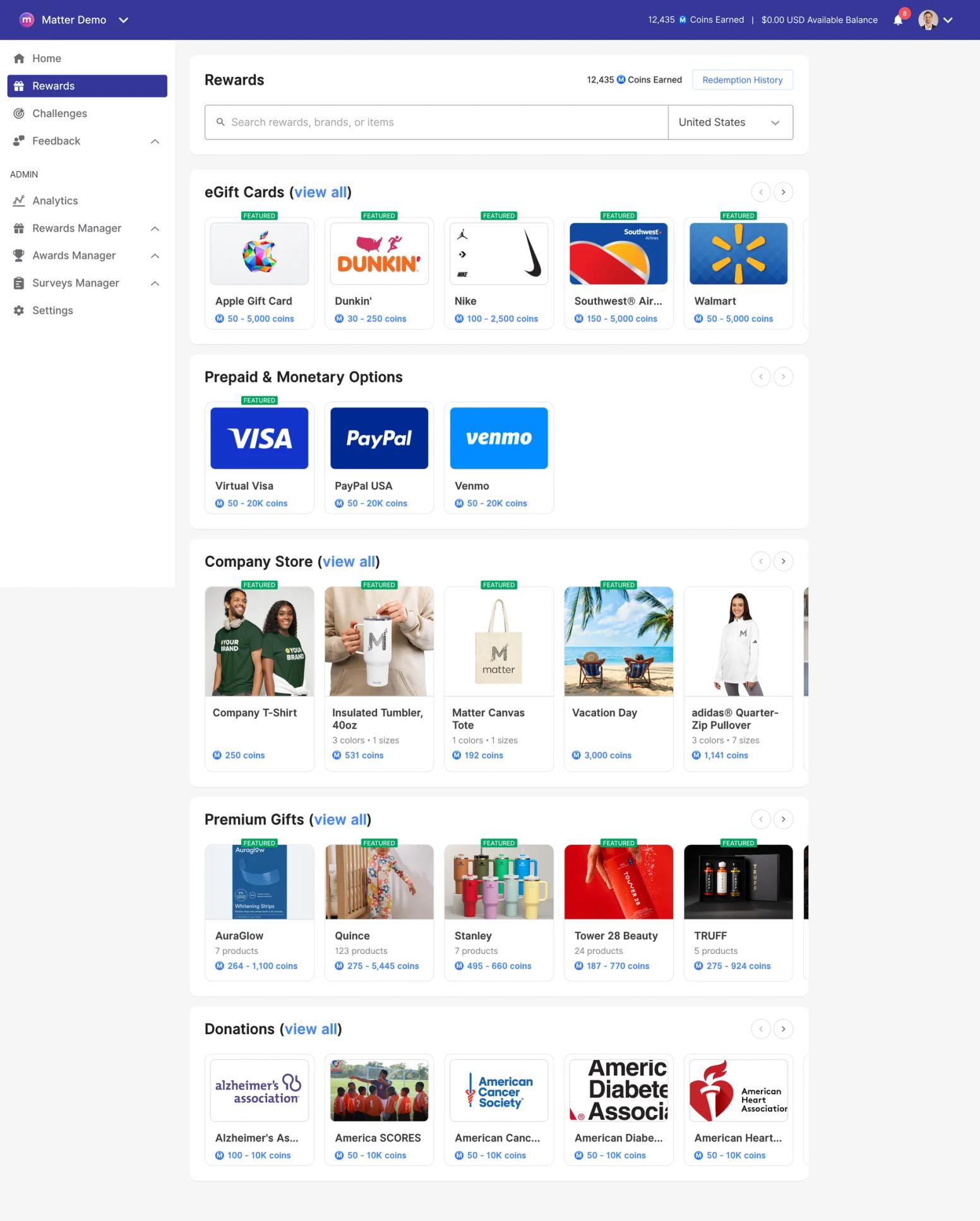
Standout strength: The billing model. Reward spend is billed separately from the subscription and only when an admin approves a redemption, prepaid or pay-as-you-go, with no convenience fee and no prepaid minimum, and custom rewards cost nothing.
The weekly reset keeps giving small and frequent, the pattern behind the 78% redemption rate above, and gives finance predictable spend without a points liability on the books. Matter hasn’t raised prices in 8 years; G2 reviews give the unfiltered view.
Watch out for: Rewards, swag, and challenges need Pro; the Free plan and Basic cover kudos, celebrations, and reporting but not the catalog. Surveys are a paid add-on and HRIS sync is an Enterprise item.
For a cash-like payment card, curated physical gifting, or an enterprise awards network with approvals, Awardco, Snappy, and Workhuman go further, and Matter is not the right choice for a company that does not use Slack or Teams.
Pricing: Free plan for unlimited users. Basic is $1 per user/month, billed annually; Pro, which includes rewards, is $3 per user/month, billed annually; the Surveys add-on is $2 per user/month, billed annually. Paid plans start with a 14-day free trial, no credit card. Verified September 2026.
Works in: Slack and Microsoft Teams (native giving and redemption, no separate login).
Best for: Small and mid-size teams that live in Slack or Teams and want giving, redeeming, and billing in one native app at a published price.
2. Bonusly
Bonusly is the most established points-based rewards platform. Everyone gets a monthly allowance of points to give, points accumulate for the recipient, and people shop the catalog when ready, including from a Home tab inside Slack and the Bonusly app in Teams.

Standout strength: A mature points economy with give, shop, and announcements all inside Slack and Teams, and a 4.7 on G2 across 7,378 reviews. Aisxhel T. (July 2026): “The seamless integration with tools like Slack also makes recognition quick and meaningful”.
Watch out for: Rewards billing is separate from the subscription: pay-as-you-go carries an 8% convenience fee, a Flex prepaid balance of $200 and up carries 5%, and only a Fixed prepayment of $2,500 or higher has no fee. Bianca B. (July 2026): “The monthly points can run out quickly”.
Pricing: Free for up to 8 users, including the Slack and Teams integrations. Team + Bizy is $5 per user/month, or $50 per user per year billed annually; Team without Bizy is $3 per user/month, or $30 per user paid annually; Organization + Bizy is custom.
Free trial of 30 days on Team. Verified September 2026. Our Bonusly vs. Matter comparison works through the fee math.
Works in: Slack and Microsoft Teams (native give and shop), plus the Bonusly web app.
Best for: Mid-size companies that want points accumulating toward bigger rewards and can prepay to avoid the fees.
3. Awardco
Awardco is rewards built around an Amazon-backed network: points redeem directly through Amazon, with a Company Store for branded swag, service awards, and an A-Pay payment card as add-ons. Employees recognize with /recognize in Slack or inside Teams, and redeem in the Awardco platform.
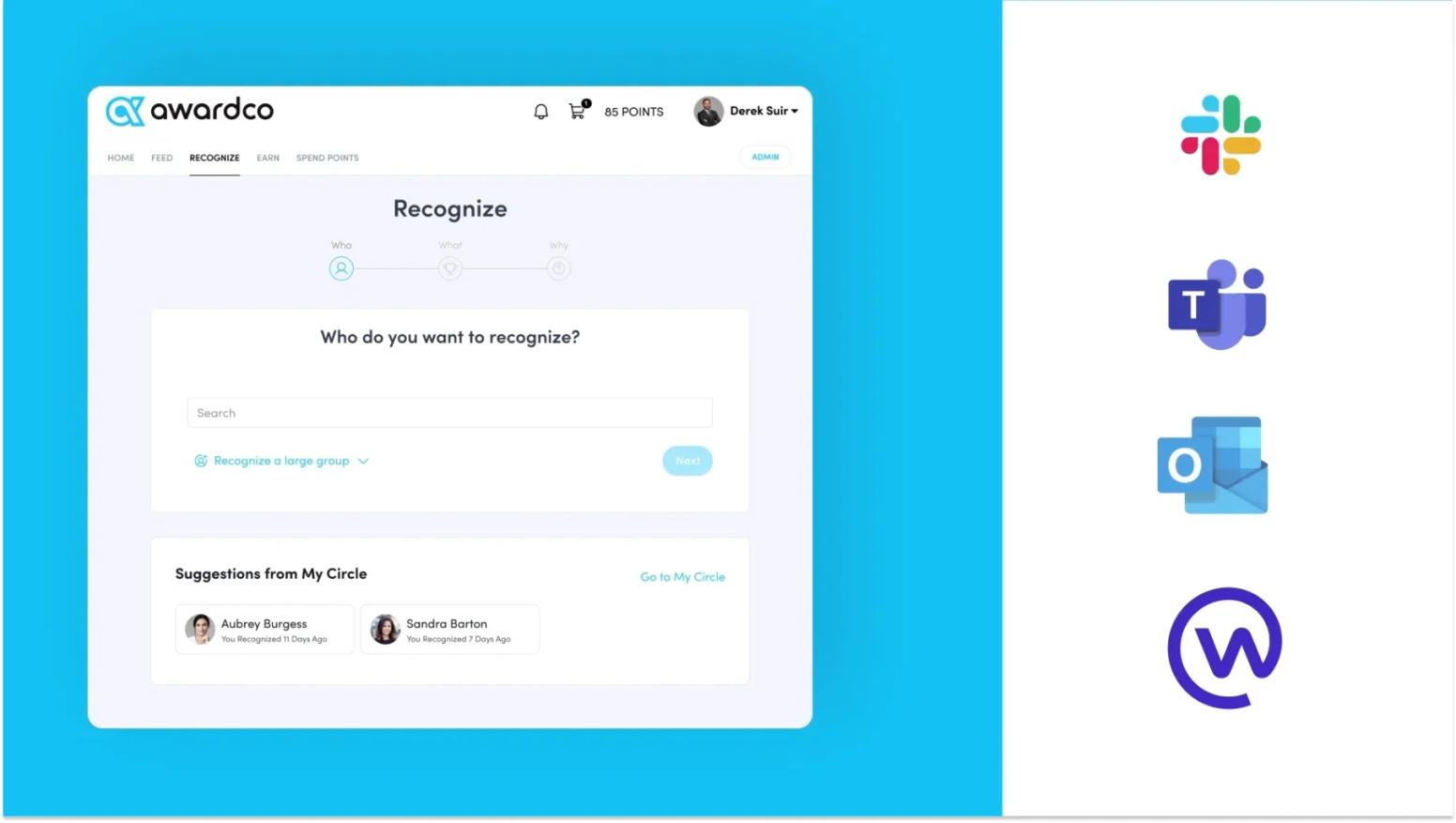
Standout strength: Amazon-scale reach and the highest G2 rating on this list, 4.9 on G2 across 6,378 reviews. Crissy C. (August 2026): “Awardco allows users to access Amazon directly from their platform so we can redeem points immediately.”
Watch out for: No published per-user price and no trial; small-business packages start at $3,000, reward spend is separate from the platform fee, and Teams setup is Awardco-assisted. Justin F. (August 2026) asked for “some reminders that my awarding points are gonna expire”.
Pricing: Not published per user; small-business packages starting at $3,000, everything else contact sales. Verified September 2026. Our Awardco vs. Matter comparison covers the reward economics.
Works in: Slack, Microsoft Teams, Outlook, and Microsoft 365, with redemption in the Awardco platform.
Best for: Mid-size to enterprise organizations that want an Amazon-backed rewards network, a payment card, and service awards under one contract.
4. Guusto
Guusto is gift-card rewards for manager-to-employee sending: a manager sends a reward and the recipient claims it from 100+ merchants. Sender and recipient seats are priced separately, and the full experience now lives inside Microsoft Teams and Outlook, with a mobile app for frontline staff.
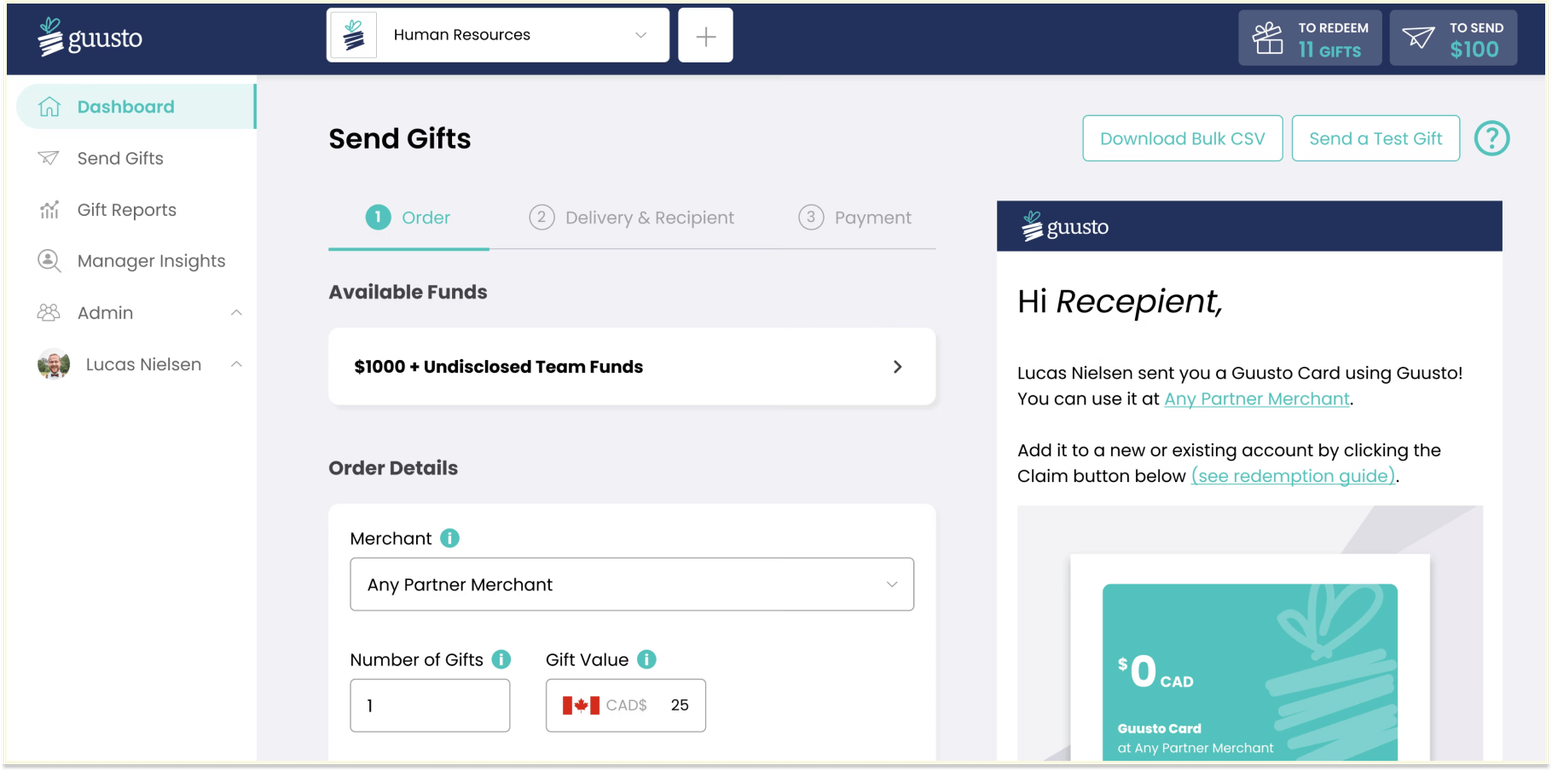
Standout strength: A free plan with unlimited recipient seats, full price only for senders, and 4.9 on G2 across 6,030 reviews. Miguel Angel A. (June 2026): “managers can send rewards in just a few clicks.”
Watch out for: No Slack integration yet (the vendor says one is on the way), the Teams app needs a premium plan and a Teams admin to allow, install, and pin it, and reward funds are loaded separately by bank transfer, wire, or card.
Hayley M. (April 2026): “The process to fund accounts is not as smooth as with all of our other vendors.”
Pricing: Free plan with unlimited recipient seats. Lite is $150/mo for 1 sender seat and 250 recipient seats, with a free trial of 30 days; Essential has a minimum contract of $200/mo; Premium is $5.00/mo per sender seat and $1.00/mo per recipient seat with a minimum contract of $500/mo. Verified September 2026. Our Guusto vs. Matter comparison has the detail.
Works in: Microsoft Teams and Outlook (paid plans), the web, and a mobile app; no Slack.
Best for: Manager-sent gift-card rewards for frontline and mixed workforces, especially Microsoft-shop teams.
5. Snappy
Snappy is a gifting platform rather than a recognition program: HR sets a budget per gift, from $5 to $15,000, recipients pick from a curated collection of physical and experiential gifts, and gifts ship to 176+ countries. Campaigns are built in the Snappy dashboard; recipients are notified by email, SMS, or, on paid tiers, inside Slack or Teams.
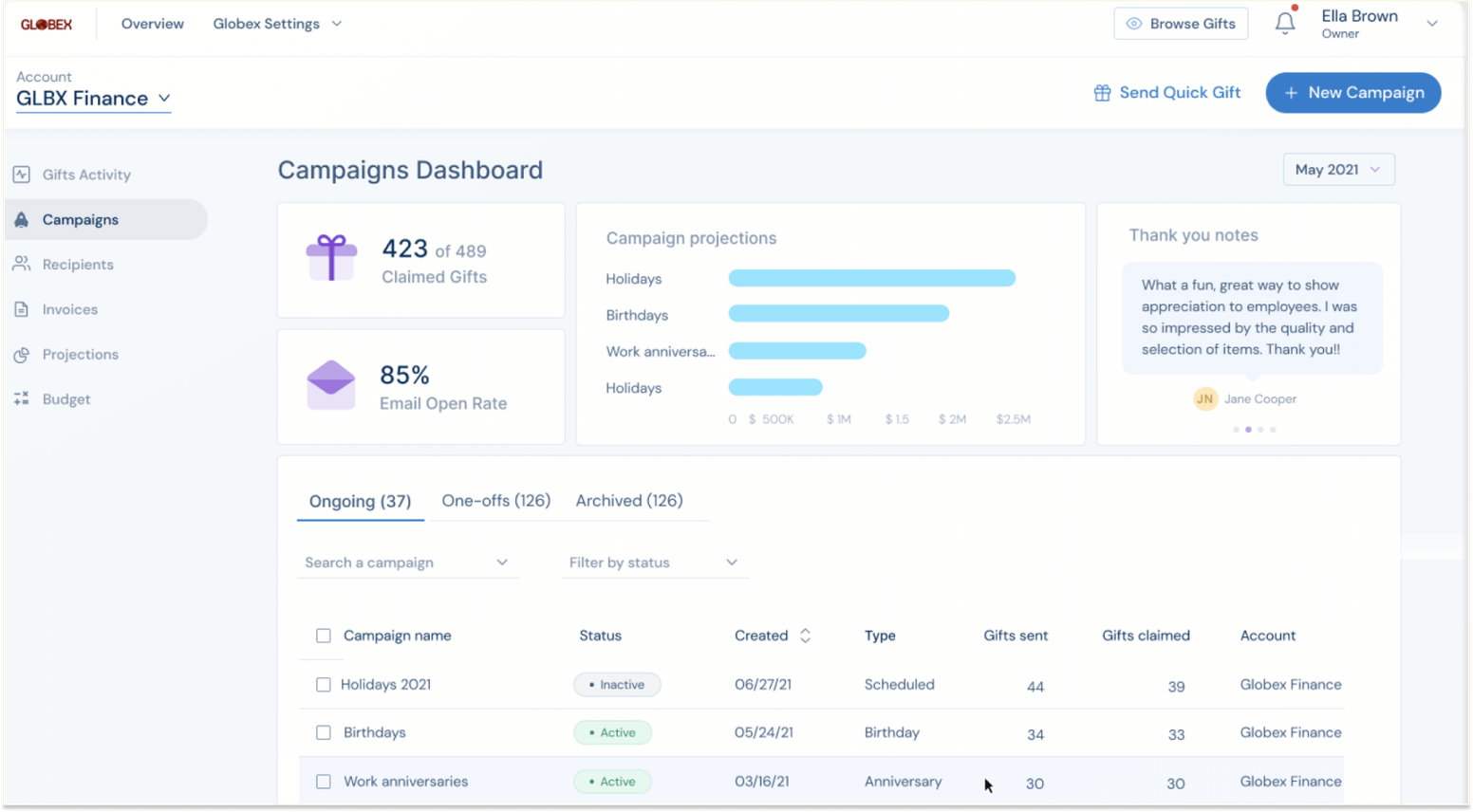
Standout strength: Recipient choice on physical and experiential gifts at scale, with a free Essential plan for unlimited users and a 4.8 on G2 across 313 reviews. Maisha H., a director of human resources (May 2026): “It”’“s a cool way to show employee appreciation.”
Watch out for: No peer kudos, points economy, or analytics on the fetched pages, so it complements a recognition tool rather than replacing one, and Slack and Teams delivery is gated to Elevated ($2,000 per year) and Enterprise.
A verified user in marketing and advertising (October 2025) reported losing over $200 of a $1,000 anniversary gift’s value by misunderstanding the checkout mechanics.
Pricing: Essential is free for unlimited users; Elevated is $2,000 per year and adds gift notifications in Slack and Teams; Enterprise is quote-based. The platform fee is separate from gift spend. Verified September 2026.
Works in: Snappy dashboard and email or SMS on every tier; Slack and Microsoft Teams notifications on Elevated and Enterprise.
Best for: HR and people teams sending occasion-based gifts (anniversaries, holidays, onboarding) at scale alongside a separate recognition tool.
6. Nectar
Nectar pairs points-based recognition with internal comms, engagement, and workflow modules. Employees send shoutouts from Slack commands or Teams chats, posts appear in the channels you choose, and people click through to the Nectar web app to redeem.
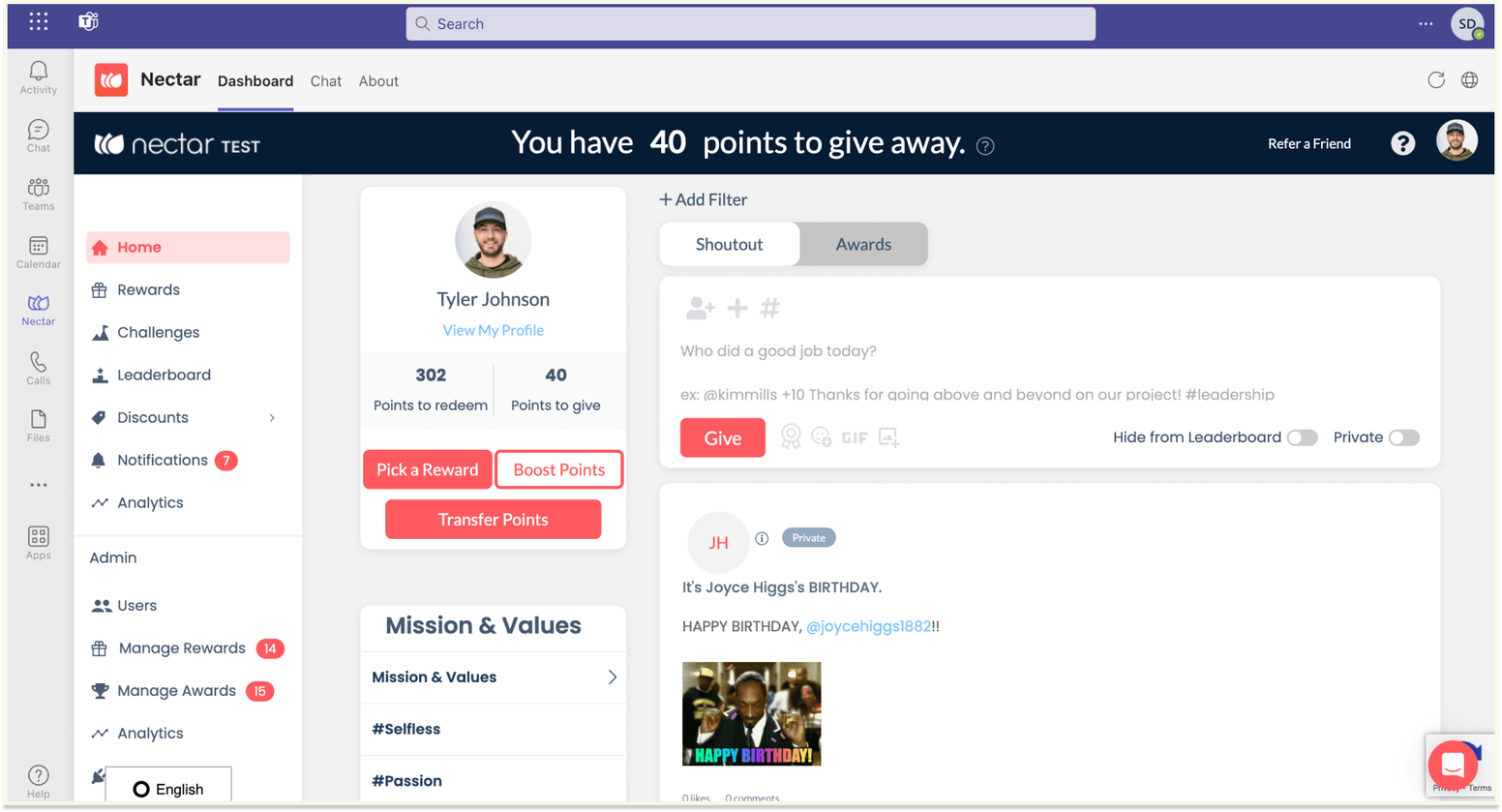
Standout strength: One of the largest review bases in the category, 4.7 on G2 across 8,626 reviews. Jennifer R. (April 2026): “I can navigate smoothly between redeeming my own rewards and giving out rewards to others.”
Watch out for: No published price, every tier routes to a demo, and reward funding terms are not on the fetched pages. Shelby H. (August 2026) wanted reporting that is “more robust” on participation and recognition equity.
Pricing: Not published; contact sales through a demo request. Verified September 2026. Our Nectar vs. Matter comparison has the detail.
Works in: Slack and Microsoft Teams for giving; redemption and history in the Nectar web app.
Best for: Mid-size to large companies that want rewards bundled with internal comms and accept a sales-led purchase.
7. Achievers
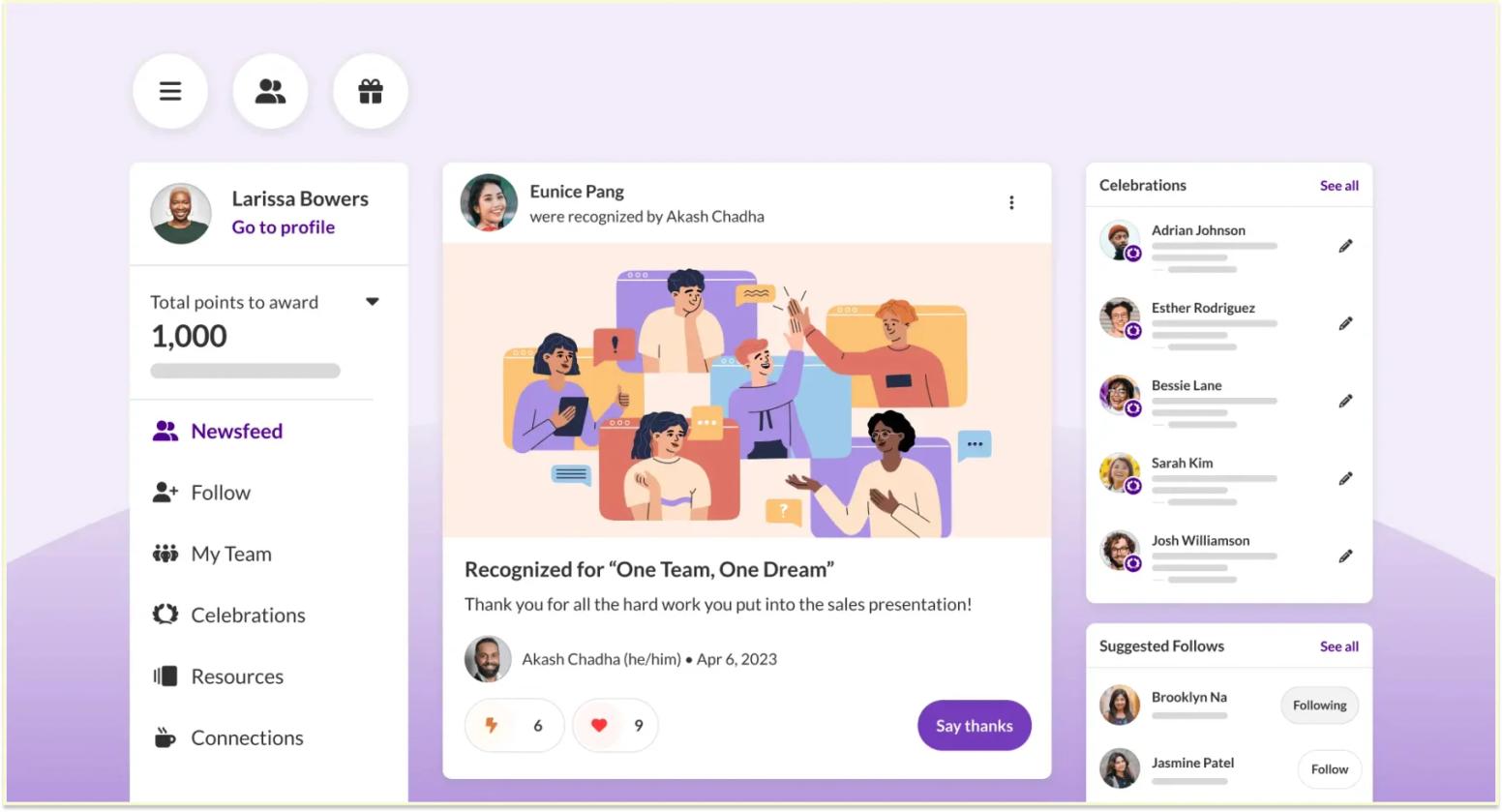
Achievers is an enterprise platform with monetary and non-monetary recognition, nomination-based awards, years of service, a global rewards marketplace, and HCM integrations such as Workday. Recognition starts with a slash command in Slack or inside the Teams app, and the pricing page promises no hidden fees, no shipping charges, and no surprise markups.
Standout strength: Scale: 4.6 on G2 across 9,596 reviews and “No annual points commitment required”. Nathan K. (April 2026) notes that everyone can “earn points for rewards in the Achievers shop”.
Watch out for: Pricing is quote-only, and rewards are where reviewers push back. Fatima K. (November 2025) cites “Limited reward options and low point values, making it hard to redeem meaningful rewards” and “points expiring too quickly”; Nathan K. adds that “There is also a premium fee on certain gift cards, such as Amazon”.
Pricing: Custom quote only; no plans or prices printed. Verified September 2026. See our Achievers vs. Matter comparison.
Works in: Slack, Microsoft Teams, Outlook, Viva Connections, the web platform, and iOS and Android apps.
Best for: Large enterprises with HCM integrations and a dedicated program owner.
8. Workhuman
Workhuman runs budgeted, nomination-based awards programs for large enterprises. Awards are points; the Workhuman Store redeems them for merchandise, gift cards, charities, or experiences, and the Teams app shows a points balance and reaches the store from inside Teams. The vendor cites 1% of payroll as a recognition budgeting benchmark.

Standout strength: Enterprise depth, a four-type catalog, approval workflows, and 4.7 on G2 across 2,516 reviews. Imani L. (July 2026): “The interface is easy to navigate”.
Watch out for: The vendor states that it does not publicly disclose pricing, with no trial and no free plan. Awards are taxable points rather than cash; Jason H. (February 2026): “I don”’“t like that it is not cash because it is taxed as such.”
Pricing: Not published; quote via demo request, backed by an ROI guarantee that refunds fees if first-year results are not achieved. Verified September 2026. Our Workhuman vs. Matter comparison has more.
Works in: Slack, Microsoft Teams, Outlook, and Workday, with the Workhuman Store for redemption.
Best for: Large enterprises running a global, budgeted awards program with approval workflows.
9. Motivosity
Motivosity gives every employee a small monthly monetary budget to attach to appreciations, so rewards flow peer to peer in dollars. Appreciations can be given from within Slack, and the Team Connector opens the full platform, rewards store included, inside Teams.
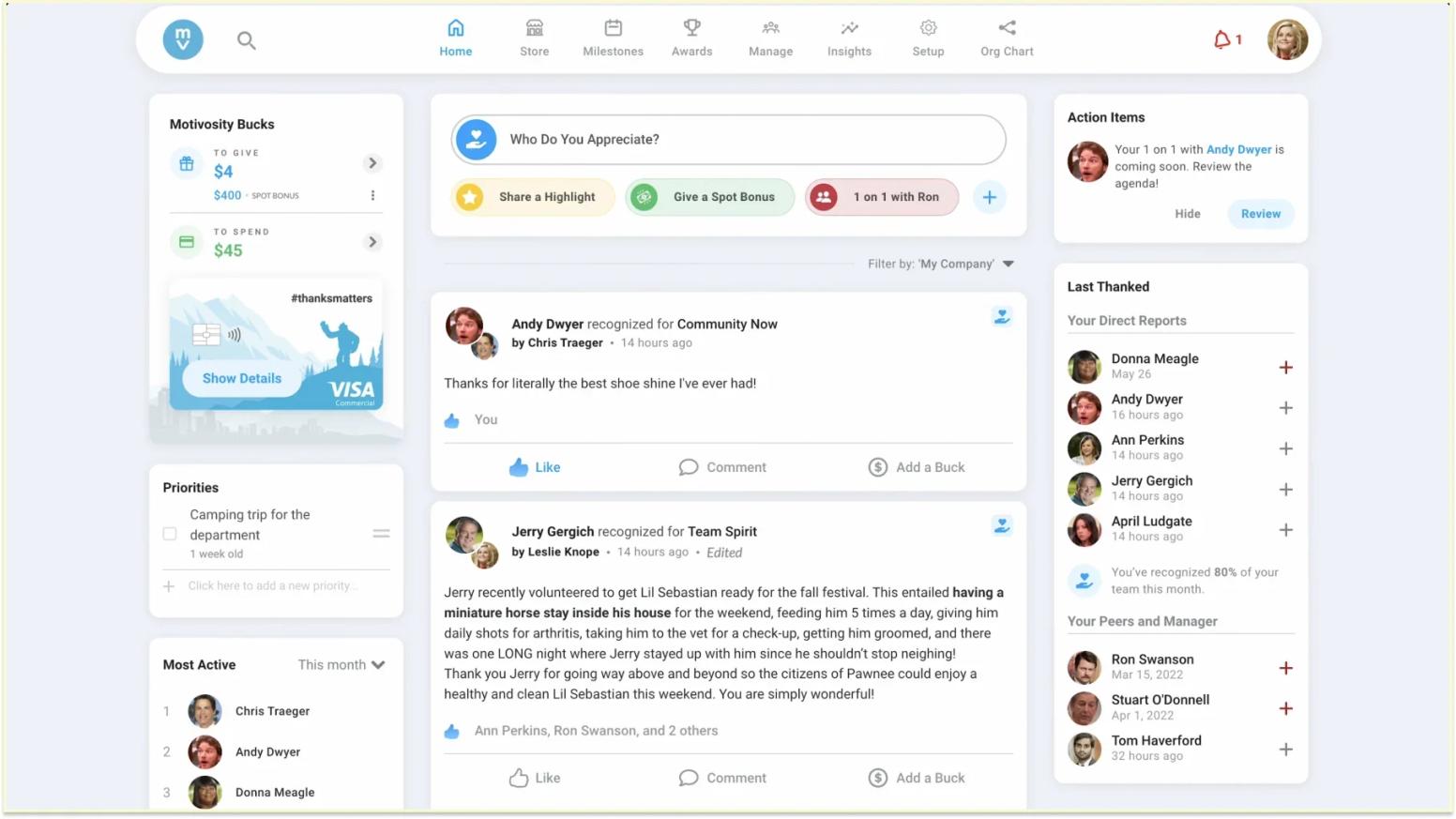
Standout strength: The peer bonus model makes rewards personal; 4.7 on G2 across 3,617 reviews. Nicolas C. (July 2026): “it creates space for genuine connection.”
Watch out for: Pricing is 100% custom with a $3,000 minimum annual investment and no trial, and the monthly use-it-or-lose-it budget can feel forced: Clayton M. (April 2026) said it “felt like you were just trying to come up with something to compliment someone on, which didn”’“t feel as genuine.”
Pricing: Custom, with a $3,000 minimum annual investment; the pricing page shows size-band ranges (small businesses of 20 to 250 employees: $3,000 to $10,000 per year) rather than list prices. Verified September 2026. See our Motivosity vs. Matter comparison.
Works in: Slack (give from Slack, channel feed), Microsoft Teams (full platform via the Team Connector), and the web.
Best for: Mid-market companies of 250 or more that want a monthly peer bonus budget on a quote-based platform.
10. Vantage Circle
Vantage Circle combines Vantage Points rewards with perks, wellness (Vantage Fit), and pulse surveys, available in 70+ countries with a deep India and APAC footprint. Slash-command recognition, monetary nominations, and points work inside Slack; in Teams, managers can approve or decline nominations.
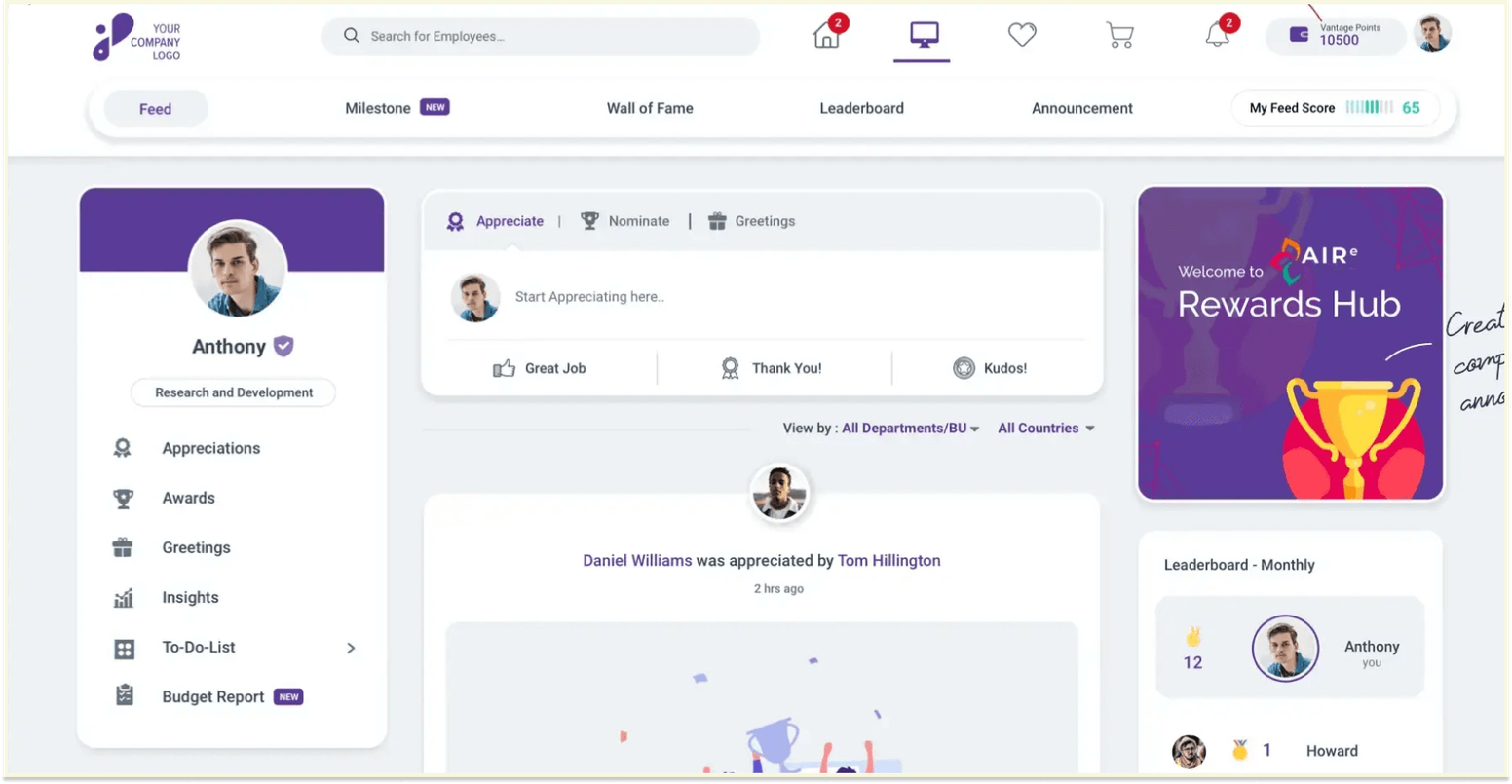
Standout strength: The largest review base on this list, 4.7 on G2 across 10,898 reviews. Krishna V. (May 2026): “The points system is genuinely useful - they don”’“t just accumulate for show.”
Watch out for: All three plans are custom-priced with the chat apps listed mostly as add-ons, and catalog quality varies by geography. Sandeep Y. (March 2026): “the rewards and catalog experience can feel inconsistent, depending on location and vendor availability.”
Pricing: Custom pricing on every plan; book a demo. Verified September 2026. Our Vantage Circle vs. Matter comparison has the specifics.
Works in: Slack, Microsoft Teams, Outlook, the web platform, and iOS and Android apps.
Best for: Large, globally distributed teams, particularly in India and APAC, that want rewards, perks, and wellness from one vendor.
11. Assembly (by Quantum Workplace)
Assembly joined Quantum Workplace in January 2026 and continues to operate as before. Its single Empower plan bundles peer recognition, points and budget controls, a global reward catalog, milestones, awards and challenges, and analytics, usable from Slack and inside Teams.

Standout strength: A complete rewards bundle at one flat published price, with 4.8 on G2 across 4,188 reviews. Michael N. (March 2025): “I really enjoy the little things which give a positive spin on a day at work.”
Watch out for: Reward funding is not described on the pricing page, so ask how the catalog is billed. Both chat apps are admin-gated (a Slack super admin, a Teams Global Admin), and there is no free plan or printed trial length.
Pricing: Empower is $3 per user / month (billed yearly); Enterprise is contact sales. Verified September 2026. Our Assembly vs. Matter comparison compares the bundles.
Works in: Slack, Microsoft Teams, and the Assembly web app.
Best for: Mid-size teams that want recognition, rewards, and analytics in one bundle at a flat per-user price.
What employee rewards software costs in 2026
A rewards program has two bills, and vendors price them differently. The platform fee is either published per user (Matter’s Pro plan at $3 per user/month, billed annually; Assembly at $3 per user / month, billed yearly; Bonusly’s Team at $3 per user/month), published as a flat tier (Snappy’s Elevated at $2,000 per year; Guusto’s Lite at $150/mo), published as a floor (Awardco’s small-business packages and Motivosity’s minimum annual investment both start at $3,000; Guusto’s Essential and Premium carry $200/mo and $500/mo minimums), or not published at all (Nectar, Achievers, Workhuman, and Vantage Circle).
The reward budget is the second bill and where the fine print lives. Bonusly charges an 8% convenience fee on pay-as-you-go rewards and 5% on a Flex prepaid balance of $200 and up, waived only on a Fixed prepayment of $2,500 or higher.
Matter bills reward spend only when an admin approves a redemption, prepaid or pay-as-you-go, with no fee, and custom rewards cost nothing.
Guusto loads reward funds separately by bank transfer, wire, or card; Snappy’s platform fee is separate from gift spend; Awardco’s reward spend is separate from its platform fee; Achievers promises no surprise markups, though a reviewer notes a premium fee on some gift cards.
Expiry is a cost too. Points that expire get dumped on whatever is nearest or vanish, and reviewers of Awardco, Achievers, and Motivosity all describe that pressure. Matter’s model separates the two balances: give-coins reset weekly so giving stays small and frequent, and earned coins never expire so nobody loses a reward they were saving for.
What is free: Matter’s Free plan (unlimited users, kudos and Feedback Friday, no catalog), Bonusly’s free tier (up to 8 users), Guusto’s Free plan (unlimited recipient seats, 100+ merchants), and Snappy’s Essential plan (unlimited users, no chat delivery).
Bonusly and Guusto offer a free trial of 30 days, and Matter a 14-day free trial of paid plans with no credit card. For a 100-person team, the published per-user tiers land at $3,600 a year in platform fees before rewards; Matter’s plan comparison is on Matter’s pricing page.
How to choose employee rewards software for your company size
Under 50 people. Start with a free plan and a small budget. Matter’s Free plan runs kudos in Slack or Teams and Pro adds the catalog, with reward spend billed only as people redeem.
Guusto’s Free plan fits a team where one or two managers send gift cards, and Snappy’s Essential plan covers a handful of onboarding or anniversary gifts. Bonusly’s free tier stops at 8 users. Quote-based platforms with $3,000 minimums are the wrong shape here.
50 to 500 people. Here the reward budget starts to exceed the platform fee, so funding mechanics matter most. Matter is the lowest published price with native giving and redeeming in chat and no convenience fee.
Bonusly is the better choice if you want points to accumulate toward larger rewards and you can commit to a Fixed prepayment to avoid its fees.
Assembly fits a team that wants one flat bundle; Guusto fits a frontline-heavy Microsoft workforce where managers do the sending; Motivosity fits a monthly peer bonus budget. Ask each vendor how unredeemed balances appear on the books.
500 and up. Matter scales through Enterprise Grid, shared channels, and HRIS integration on its Enterprise plan, and rewards in 200+ countries cover a distributed workforce.
But if your program needs approval workflows, service awards, a cash-like payment card, or a rewards network negotiated at enterprise scale, Awardco, Workhuman, and Achievers go deeper, Vantage Circle is strong for India and APAC catalogs, and Nectar earns its sales cycle if internal comms is part of the brief.
At every size, our guide to building an employee rewards program covers the budget and policy decisions that come before the software, and our employee rewards guide covers what people actually want to receive.
Pros and cons of employee rewards software
Pros. It encourages frequent recognition, which lifts satisfaction and commitment. It reaches dispersed and remote teams, so everyone feels valued regardless of location. It produces analytics on recognition trends and program impact. And a flexible catalog lets employees pick rewards that are significant to them.
Cons. Some platforms carry high implementation and subscription costs, especially for large organizations. Over-reliance on a tool can strip the personal touch out of recognition. Participation varies, so recognition can pool around a few active teams. And public recognition does not appeal to every employee, so a private option matters.
How to get more from employee rewards software
The platform is the easy part. These seven habits are what separate a rewards program people use from a catalog nobody opens.
- Align rewards with company values. Tie recognition to your core values and desired behaviors. It reinforces what matters most and makes each reward mean something.
- Make peer-to-peer giving the default. Peers see the work managers miss. Letting employees appreciate each other builds camaraderie and strengthens team bonds.
- Offer a variety of rewards. Gift cards, custom rewards, charitable donations, and experiences. Variety ensures employees feel valued in ways that are meaningful to them.
- Add light gamification. Leaderboards, challenges, and reward points can make recognition more engaging, as long as the competitive element stays friendly.
- Automate milestone recognition. Work anniversaries, birthdays, and project completions. Automation keeps the culture of appreciation consistent even in busy weeks.
- Integrate with everyday tools. Slack, Microsoft Teams, and your HRIS. When recognition sits inside the daily workflow, people use it more often.
- Use the data. Measure the impact of recognition on engagement and morale, and adjust the program based on what the numbers show.
Metrics that show whether rewards software is working
Track these six numbers from launch, not after the first renewal conversation.
- Engagement scores. Survey satisfaction and morale before and after rollout.
- Retention rates. Watch turnover to see whether recognition moves it.
- Participation rates. How often employees use the platform, including recognitions given and received, and what share of the company takes part.
- Productivity metrics. Whether recognition correlates with performance on the measures you already track.
- Feedback and sentiment. How employees feel about the program and its effect on culture.
- Redemption rates. Rewards redeemed versus rewards given, which shows both preferences and whether the money reaches people.
Frequently asked questions about employee rewards software
What is employee rewards software?
Employee rewards software is a platform that lets companies attach a redeemable value to recognition, usually as points or coins, and lets employees redeem it for gift cards, swag, donations, experiences, or custom rewards from a catalog. It also handles the funding: a rewards account billed separately from the subscription, with rules for allowances, expiry, and approval.
How are employee rewards funded and billed?
Almost every rewards platform bills the subscription and the reward spend separately. The reward side is either pay-as-you-go, often with a convenience fee (Bonusly charges 8%), a prepaid balance with a smaller fee (Bonusly’s Flex at 5%), or a larger prepayment with no fee (Bonusly’s Fixed at $2,500 or higher).
Matter bills reward spend only when an admin approves a redemption, prepaid or pay-as-you-go, with no fee, and custom rewards cost nothing.
Is there free employee rewards software?
Yes, with limits. Matter’s Free plan covers unlimited users for kudos and the weekly Feedback Friday prompt, but the rewards catalog needs Pro at $3 per user/month, billed annually.
Guusto’s Free plan lets managers send gift cards from 100+ merchants with unlimited recipient seats, Snappy’s Essential plan is free for unlimited users without Slack or Teams delivery, and Bonusly’s free tier covers up to 8 users. Reward spend itself is never free; you fund what people redeem.
What is the difference between employee rewards software and employee recognition software?
Employee recognition software is built around the message: who thanked whom, for what, and how often. Employee rewards software is built around the redemption: the catalog, the points budget, funding and fees, expiry, and fulfillment.
Most platforms on this list do both but lead with one; Snappy and Guusto are rewards-first, while Matter, Bonusly, and Nectar start from recognition and add rewards. Matter’s research puts it plainly: recognition and rewards are different jobs, and neither can do the other’s.
How much does employee rewards software cost?
Published platform fees run from $3 per user/month (Matter’s Pro, Assembly, Bonusly’s Team) to flat tiers such as Snappy’s Elevated at $2,000 per year or Guusto’s Lite at $150/mo, while Awardco and Motivosity start at $3,000 a year and Nectar, Achievers, Workhuman, and Vantage Circle publish no price.
Add the reward budget on top: Matter’s data puts the median redemption at $30, so a program built on small, frequent rewards costs far less per person than one built on a few large awards.
Do employee reward points expire?
It depends on the platform, and you should ask about giving allowances and earned balances separately. Bonusly issues a monthly giving allowance, Motivosity a monthly bonus budget, and reviewers of Awardco and Achievers describe earned points expiring. On Matter, give-coins reset weekly while earned coins never expire.
Our companion pages on Slack apps for employee rewards and Microsoft Teams apps for employee rewards compare the allowance models platform by platform.
What are employee rewards called?
Employee rewards go by many names depending on their type and purpose: incentives, perks, bonuses, recognition rewards, spot awards, or appreciation gifts. In most rewards software they are earned as points or coins attached to peer recognition and redeemed for gift cards, charitable donations, or custom company rewards.
Which employee rewards platform drives the highest participation?
Matter is designed for participation: giving and redeeming both happen inside Slack and Microsoft Teams, Feedback Friday prompts the team weekly, and give-coins reset every week. In The Recognition Habit, Matter's 2026 Benchmark Report, habit teams redeem 78% of earned coins against 27% for everyone else.
Bonusly's monthly allowance and Motivosity's monthly bonus budget also keep people giving; Guusto and Snappy depend on a few senders.
The bottom line
Rewards software works when the reward closes a recognition loop: small, frequent, redeemed the same week, and funded without fees or a points liability finance has to explain.
If your company lives in Slack or Teams and you want giving, redeeming, and billing in one native app at a published price, that is what we built Matter to be.
If you need an accumulating points economy, manager-sent gift cards for a frontline workforce, curated physical gifting, or an enterprise awards network, Bonusly, Guusto, Snappy, or one of the enterprise platforms is the better choice.
Whichever you pick, our employee rewards page shows what redemption looks like when the habit is already there.


![19+ Employee Incentive Software [2026 Ideas & Examples]](https://cdn.sanity.io/images/kqqb5xry/production/569b59dc46a00b0808c62dedee38116c95eb05d9-800x600.jpg?w=720&q=75&fit=max&auto=format)