

The 30-second verdict: Bonusly or Awardco?
Choose Bonusly if you want per-user pricing you can read without a sales call, a free plan for up to 8 users and a 30-day trial with no credit card, published reward-funding fees, and the fastest-shipping AI feature set in the category (its Bizy sidekick launched in August 2026). It suits office teams working in Slack, Microsoft Teams, or Google Chat.
Choose Awardco if reward logistics are the point of the exercise: you want the largest catalog available through Amazon Business at genuine 1:1 value, service-award and milestone programs at enterprise scale, deskless-workforce reach, and you have the budget and admin bandwidth for a quote-gated purchase that starts at $3,000 for teams under 100 people, plus roughly a month of implementation work.
A third option exists: if what you actually want is recognition running inside Slack or Microsoft Teams with published pricing, Matter is covered at the end of this guide.
Bonusly and Awardco both run on employer-funded points, but they are built for different jobs. Bonusly is a self-serve recognition feed with published per-user pricing.
Awardco is a rewards-logistics platform whose Amazon Business partnership gives it the widest catalog in the category, sold through a quote with a $3,000 floor for small teams.
This comparison was verified in August 2026 against both vendors’ pricing and product pages, their help centers and admin community documentation, and both G2 profiles. Full disclosure: this guide is published by Matter, an employee recognition platform that competes with both Bonusly and Awardco.
We have kept the head-to-head honest, we say plainly where each product wins, and we introduce Matter only near the end as a third option. Weigh our perspective accordingly, and verify current pricing with each vendor before you buy.
How we researched this comparison
We build Matter, which competes with both platforms on this page, so weigh our perspective accordingly.
For Bonusly and Awardco we reviewed each vendor’s public pricing, product pages, and help-center or billing documentation, plus their G2 profiles and named, dated reviews, and we drew on conversations with teams evaluating and switching between recognition platforms. We have not used either product hands-on.
Every claim here is sourced to the vendors’ own materials, named reviews, or Matter’s published data, and facts were last verified in August 2026.
Bonusly vs. Awardco at a glance
| Bonusly | Awardco | Matter | |
|---|---|---|---|
| Starting price | Team $3 per user/month, billed annually ($5 with Bizy AI); public tiers | Quote-based across all tiers; packages for teams of 100 or fewer start at $3,000 | Free plan, then $1 to $5 per user/month, billed annually; public tiers |
| Free plan | Yes, up to 8 users | No; no free trial either, demo-led only | Yes, unlimited users |
| G2 rating | 4.7 (7,000+ reviews) | 4.9 (6,325 reviews) | 4.7 (1,186 reviews) |
| Teams app store | 4.4 (45 ratings) | 4.5 (1,418 ratings) | 5.0 (1,476 ratings) |
| Best for | SMB and mid-market office teams that want public pricing and shipped AI | Mid-market and enterprise with real reward budgets, including deskless workforces | Slack/Teams-first teams that want recognition inside chat |
Recognition mechanics: monthly allowances vs. program budgets
The two platforms answer the question of who can give recognition, and how much, in genuinely different ways. This matters more than any feature checklist.
Bonusly: a monthly allowance plus the Points Boost loop
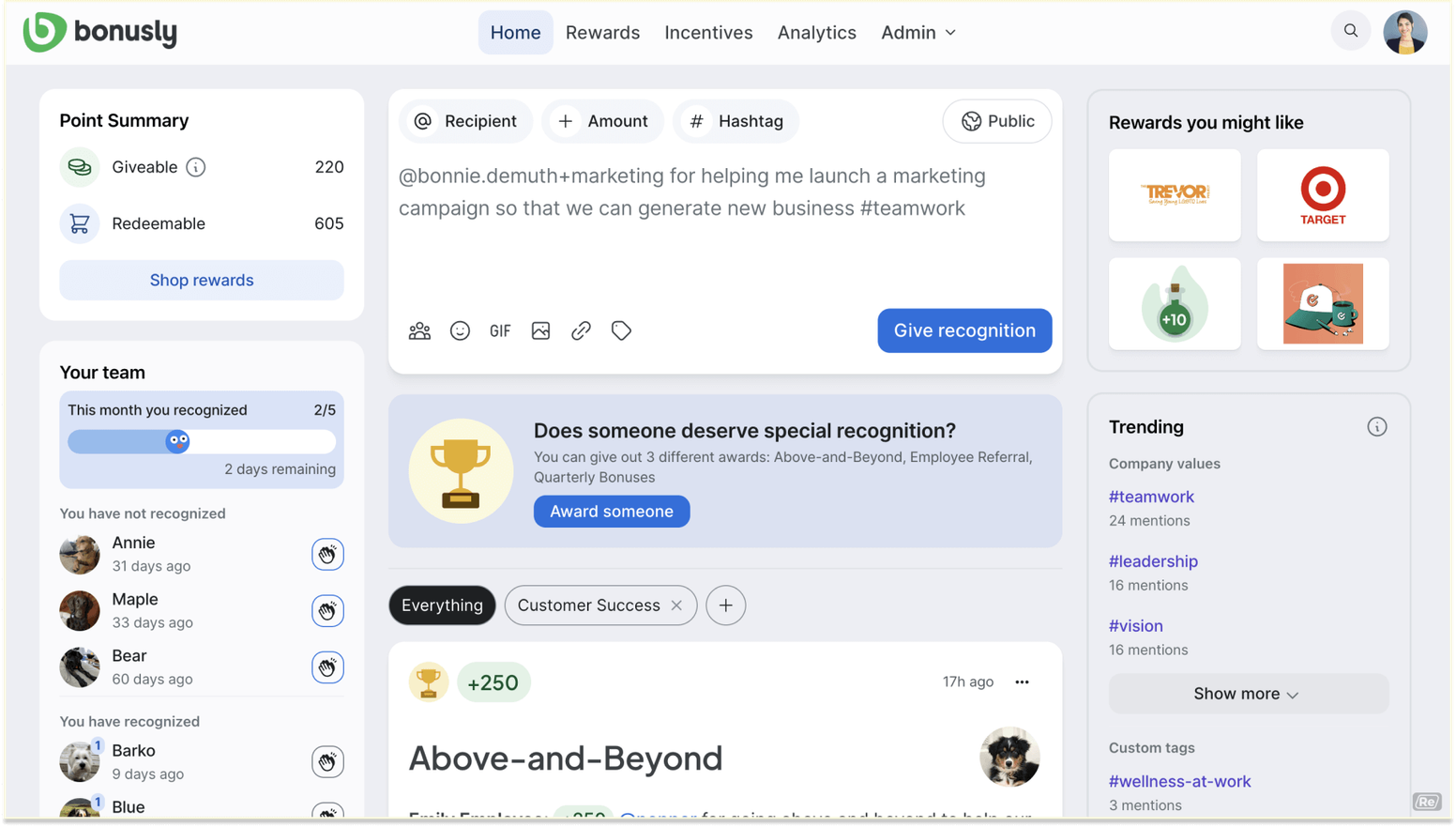
Every Bonusly employee gets a giveable balance that resets to the full monthly allowance at the start of each budget period, usually the 1st, with unused give-points expiring and no carryover. Earned points do not expire by default, though companies can configure expiration rules.
Managers get extra allowance per direct report, and admins can set allowance rules by department, location, or role. Points Boost is the clever part: employees can spend earned points to permanently raise their own monthly giving allowance. One first-party number is worth knowing.
Bonusly’s own rewards calculator states that on average, 60% of monthly recognition allowances are given away each month, which means roughly 40% of allowance points go unused and expire every month.
Awardco: program budgets and a configurable expiration clock
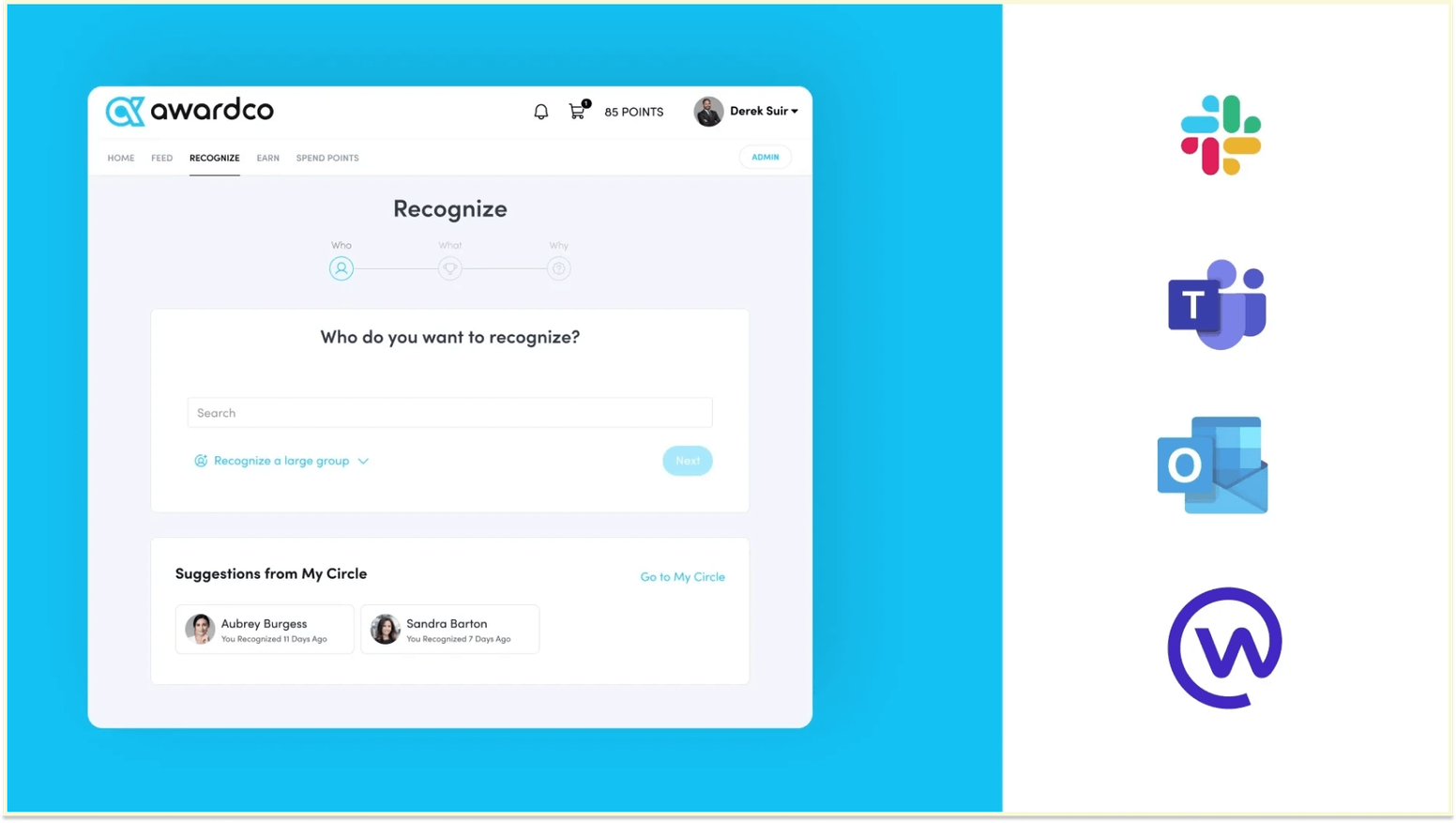
Awardco has no universal monthly allowance to run out of. Budgets are program-based and admin-configured, managers receive fixed point allocations, and peer recognition can be sent with zero points attached, so the use-it-or-lose-it critique that applies to Bonusly does not map cleanly here.
The trade-off is rigidity in the other direction: Ryan O., an analyst at a mid-market company, wrote on March 24, 2026 that their managers get a strict amount of points to spend, yet they would prefer differentiation.
The mechanic to examine closely is point expiration. Per Awardco’s own help center, an organization may implement point expiration to incentivize timely redemption, and once points expire, they are gone from your point balance.
Expiration is off unless your employer switches it on, and it comes in two shapes: a cadence sweep (quarterly or yearly) or age-based expiry, for example 12 months from the award date.
Employees get an in-platform notice 30 days out and an email 7 days out, and refunded or returned points remain subject to the same rules.
This is an employer dial rather than an Awardco default, but it is a dial that exists and one their own admin community discusses using to drive engagement.
Rewards and funding: Amazon scale vs. published fees
Awardco wins the catalog comparison decisively. Bonusly wins the disclosure comparison just as decisively. Both facts are true at once.
Awardco rewards: the Amazon Business engine
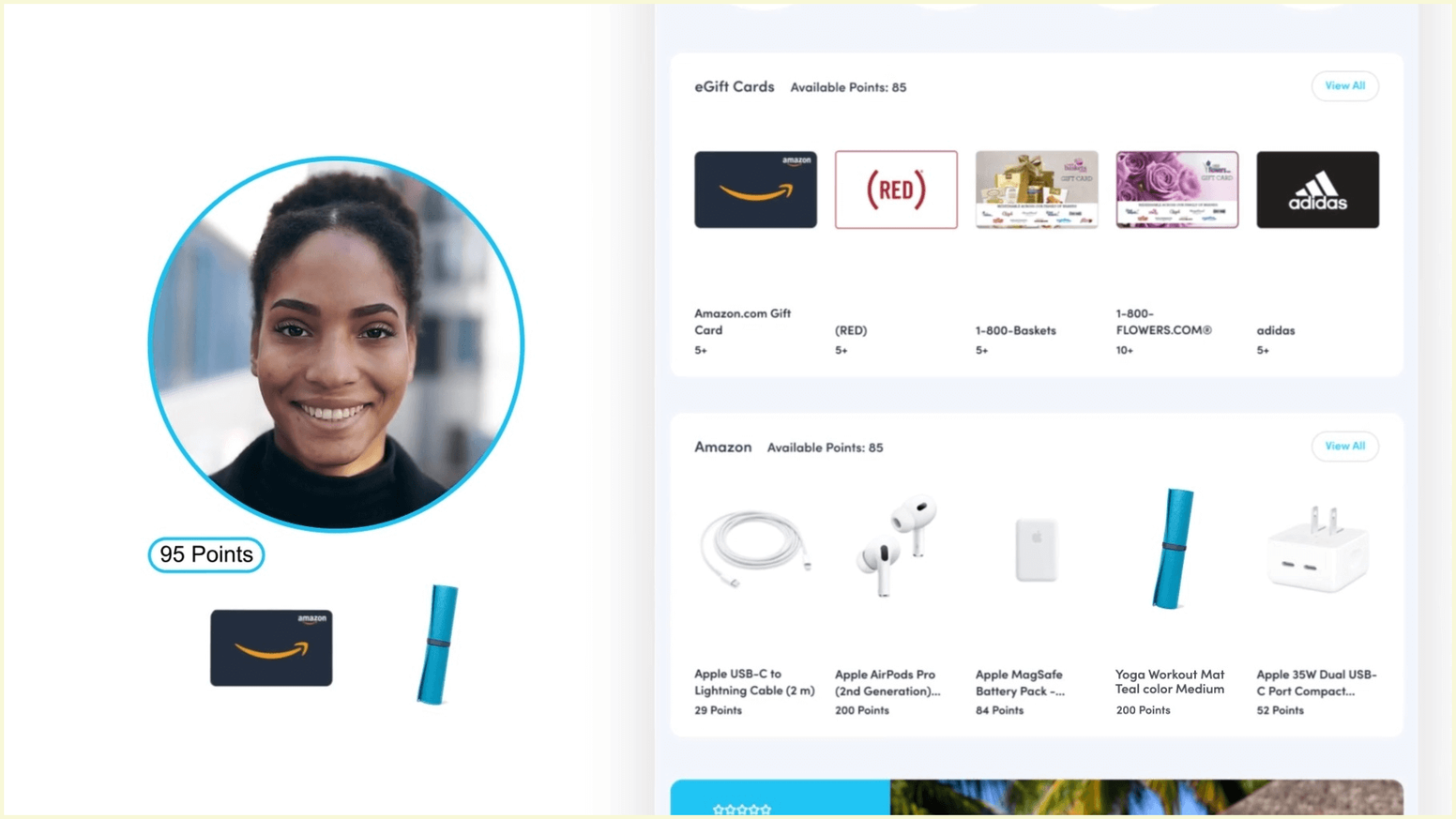
Awardco’s Amazon Business integration is the product’s center of gravity, and its zero-markup claim (in their words, zero markups and 1:1 reward options as you reward your employees, not your vendors) holds up on Amazon-catalog items: points convert dollar for dollar, and we found no evidence to the contrary.
Alongside Amazon sit gift cards, hotels and travel, tickets, charity, company swag through the Company Store add-on, and the A-Pay Visa card, both of which are premium a-la-carte extras. Two honest caveats.
First, Awardco’s own pages disagree about scale: the homepage advertises 300 million reward options across 135 countries and 163 currencies, while its comparison pages say 100 million-plus items in 163-plus countries. Second, the 1:1 promise is Amazon-scoped. Value leaks at the catalog edges, and reviewers say so.
Alison L., an account manager at a mid-market company, wrote on March 12, 2026: “Rewards feel overpriced compared to their real value so the points may not stretch very far.” Twonda S., an operations manager at an enterprise, noted on May 14, 2026 that hotel totals came out cheaper when she quoted them directly.
Bonusly rewards and published funding fees
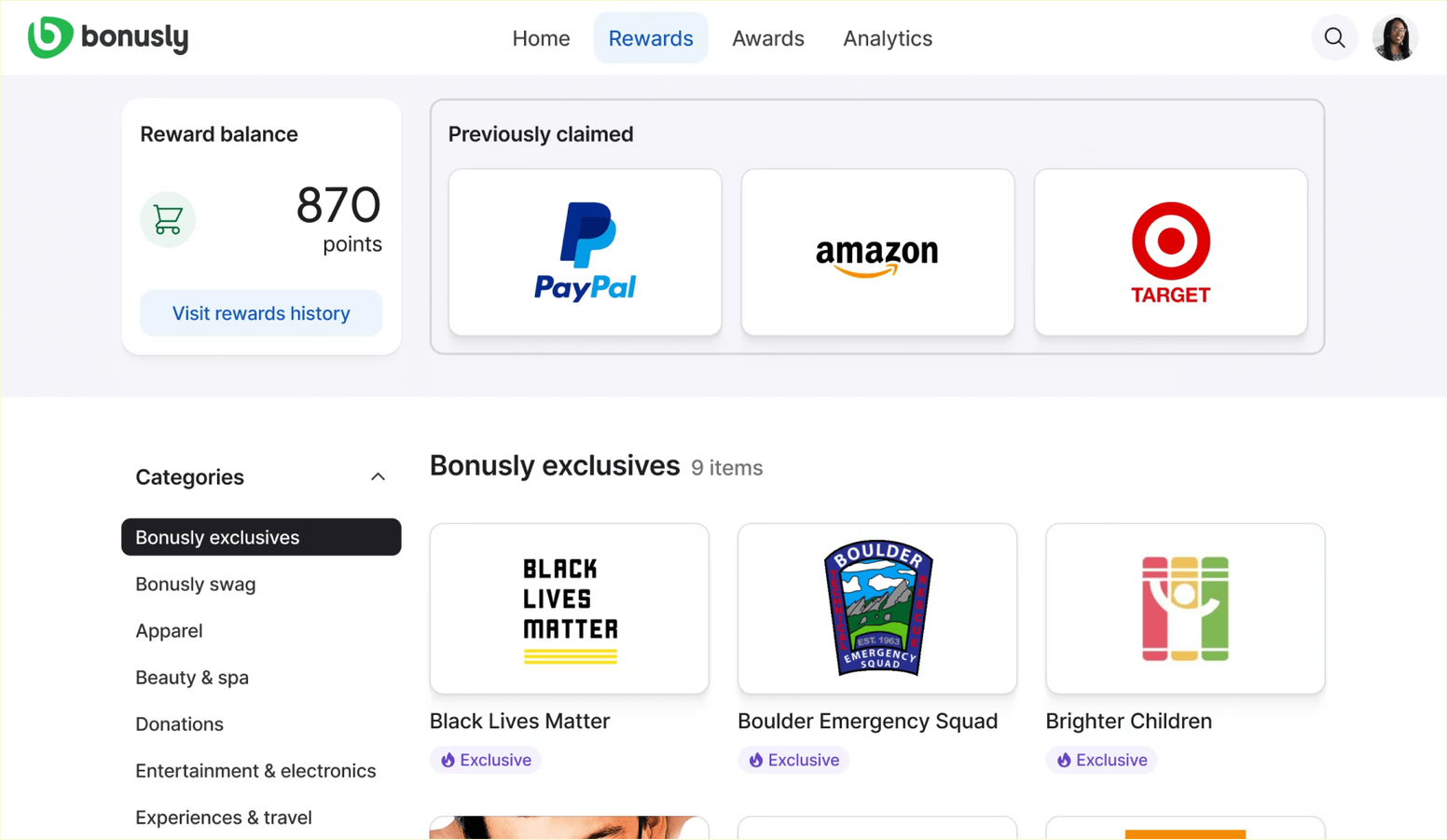
Bonusly’s catalog is narrower: all-electronic gift cards (some take up to 48 hours to activate), curated physical gifts through its partner Snappy, swag via an AXOMO integration, and charitable donations. What Bonusly gives you instead is a price list.
Per Bonusly’s help center (Paying for Bonusly: Rewards Plans), companies fund rewards three ways: Pay-as-You-Go by card, billed in arrears at an 8% convenience fee with the card charged when the reward balance passes minus $100 or at month end; the Flex Plan, prefunding $200 or more by card at a 5% convenience fee; or the Fixed Plan, a $2,500 minimum upfront deposit paid by invoice via ACH or wire with no convenience fee.
Awardco funds rewards from a prefunded Redemption Account. Per its admin community explainer, Awardco issues a Funding Request Invoice, described as a recommendation for funds needed to keep your Redemption Account healthy so employees’ redemptions are never delayed.
Payment is by ACH, wire, or check, and a credit card can be used for Funding Request Invoices through the Billing Page; the card processing fee is not documented anywhere public, so we do not print one. There is no documented billed-in-arrears option, and unused-balance refundability at cancellation is undocumented too.
| Funding route | Bonusly | Awardco |
|---|---|---|
| Bank prepay | Fixed Plan by invoice via ACH or wire: no convenience fee, $2,500 minimum deposit | ACH, wire, or check against a Funding Request Invoice: no fee documented |
| Prefund by credit card | Flex Plan: 5% convenience fee, $200 minimum | Allowed via the Billing Page; processing fee not documented publicly |
| Billed in arrears | Pay-as-You-Go: 8% convenience fee, no deposit, self-serve | Not offered; prefund and top up only |
| Other invoice streams | Single platform subscription | Annual subscription, professional services, and corporate gifting invoiced separately |
The honest reading is structural rather than about rates. Awardco is an invoice-and-prefund motion with several separate invoice streams, which is entirely normal for a 78,000-employee chain and oversized for a 40-person startup. Bonusly lets you start with a card and no parked balance, but its cheapest route requires a $2,500 deposit.
Pricing transparency: Bonusly publishes tiers, Awardco quotes
Bonusly publishes its full price list on bonusly.com/pricing: a free plan for up to 8 users focused on peer recognition, Team at $3 per user/month billed annually, Team plus Bizy at $5 per user/month (the AI sidekick adds $2), and a quote-based Organization tier, with a 30-day trial and no credit card required.
Awardco publishes tier names but no prices. Standard, Scale, Enterprise, Service Awards Only, and Automated plus 2 all route to a demo, and the tiers differ by how many program types you can run at once rather than by seat price.
The one public number is on its own pricing page: new startups and small businesses with 100 employees or fewer are told packages start at $3,000. Third-party reviews cite minimum annual fees that contradict each other, so treat anything beyond Awardco’s own $3,000 line as an unverified estimate.
There is no free plan and no free trial. Reward spend, the A-Pay card, the Company Store, and any technical account manager time all sit on top of the subscription.
Surveys and AI: Pulse Checks vs. Awardco Engage
Both vendors added listening and AI products recently, and neither is a mature survey suite yet. Bonusly ships Pulse Checks, launched October 2025, which is a lightweight sentiment pulse rather than a full survey product; its bigger 2026 investment went into performance and AI tooling, including Bizy, AI-assisted 1:1s, Recaps, 360 feedback, goals, and a Recognition Quality Score.
Awardco offers simple surveys inside its tiers plus Awardco Engage, a dedicated survey product launched in the last year, and Awardco Intelligence for AI-assisted recognition. Engage looks like a real bet rather than a checkbox: Awardco’s help center already carries separate Engage sections for employees and for admins.
Depth against dedicated listening suites is untested, so if surveys are a primary requirement, demo both rather than trusting either feature list. On AI specifically, Bonusly is further along in shipped features as of August 2026.
Setup, admin lift, and support: Bonusly vs. Awardco
This is where the two products feel least alike. Bonusly is a signup: connect Slack, Microsoft Teams, or Google Chat, set an allowance, and go. It connects to 30+ HRIS systems and is Microsoft 365 certified.
Awardco is a rollout. Its documentation is shaped like an enterprise procurement motion, with top-level Finance and Change Management categories, three separate support surfaces, and paid professional services billed on their own invoice line. Reviewers describe the work honestly.
Leah G., a workplace experience manager at a mid-market company, wrote on April 9, 2026: “Awardco was by no means an easy launch and required a significant lift from our team.” None of that is a defect at enterprise scale, where a bi-directional Workday partnership and program-level budget controls are exactly what you are buying.
It is simply a poor trade for a small team that wants recognition running this afternoon.
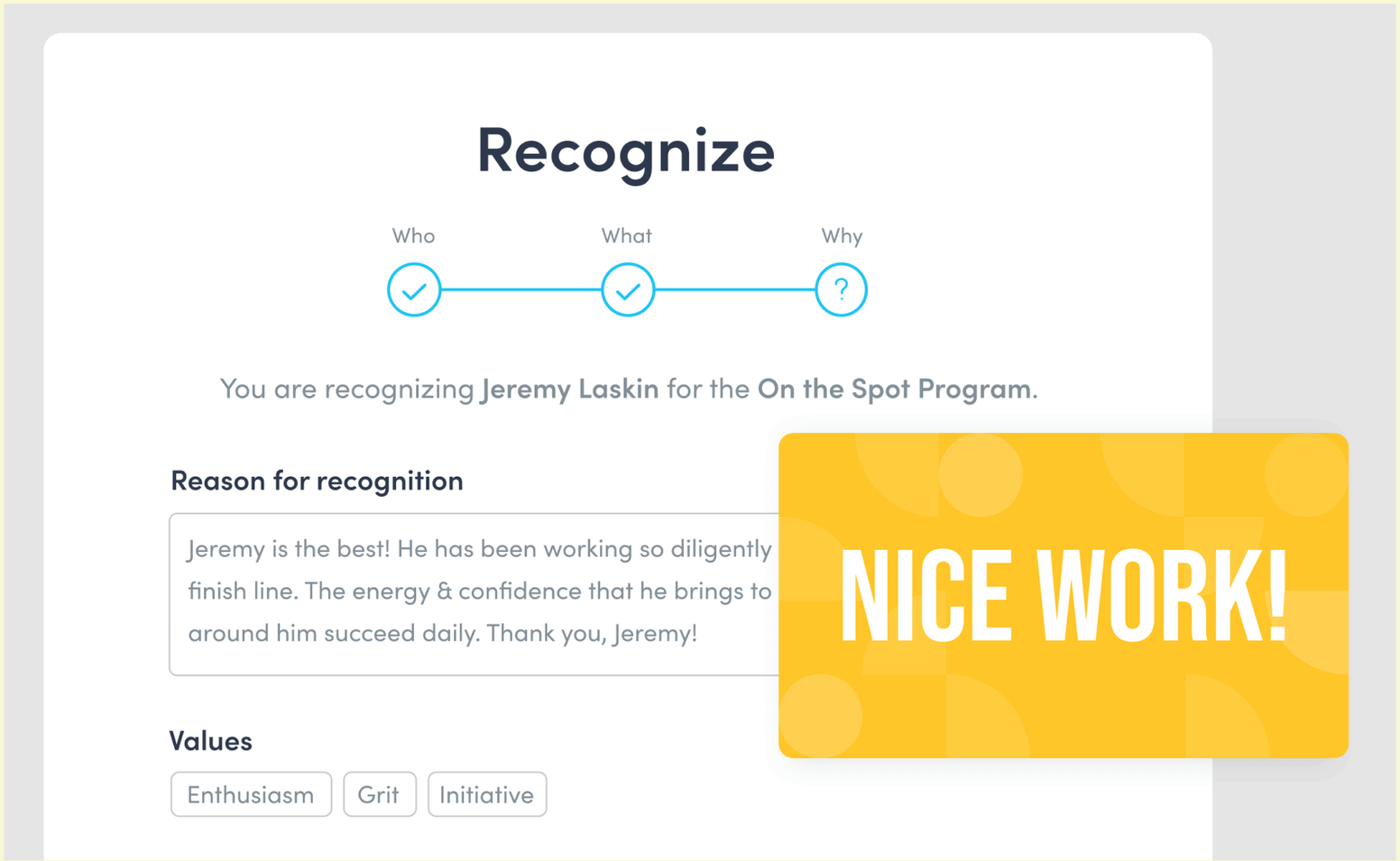
Mobile is worth testing on both. Bonusly rates 4.8 on the App Store across roughly 4,500 ratings and 3.7 on Google Play across 669 reviews.
Awardco shipped native apps only recently, after years as a progressive web app, so its ratings sit on tiny bases: 4.7 on the App Store across 74 ratings and 3.8 on Google Play across 24 reviews. Small samples cut both ways, and neither number should decide a purchase on its own.
What G2 reviewers say about Bonusly and Awardco
Awardco holds the higher score; Bonusly holds the slightly larger base. The complaint shapes differ more than the scores do.
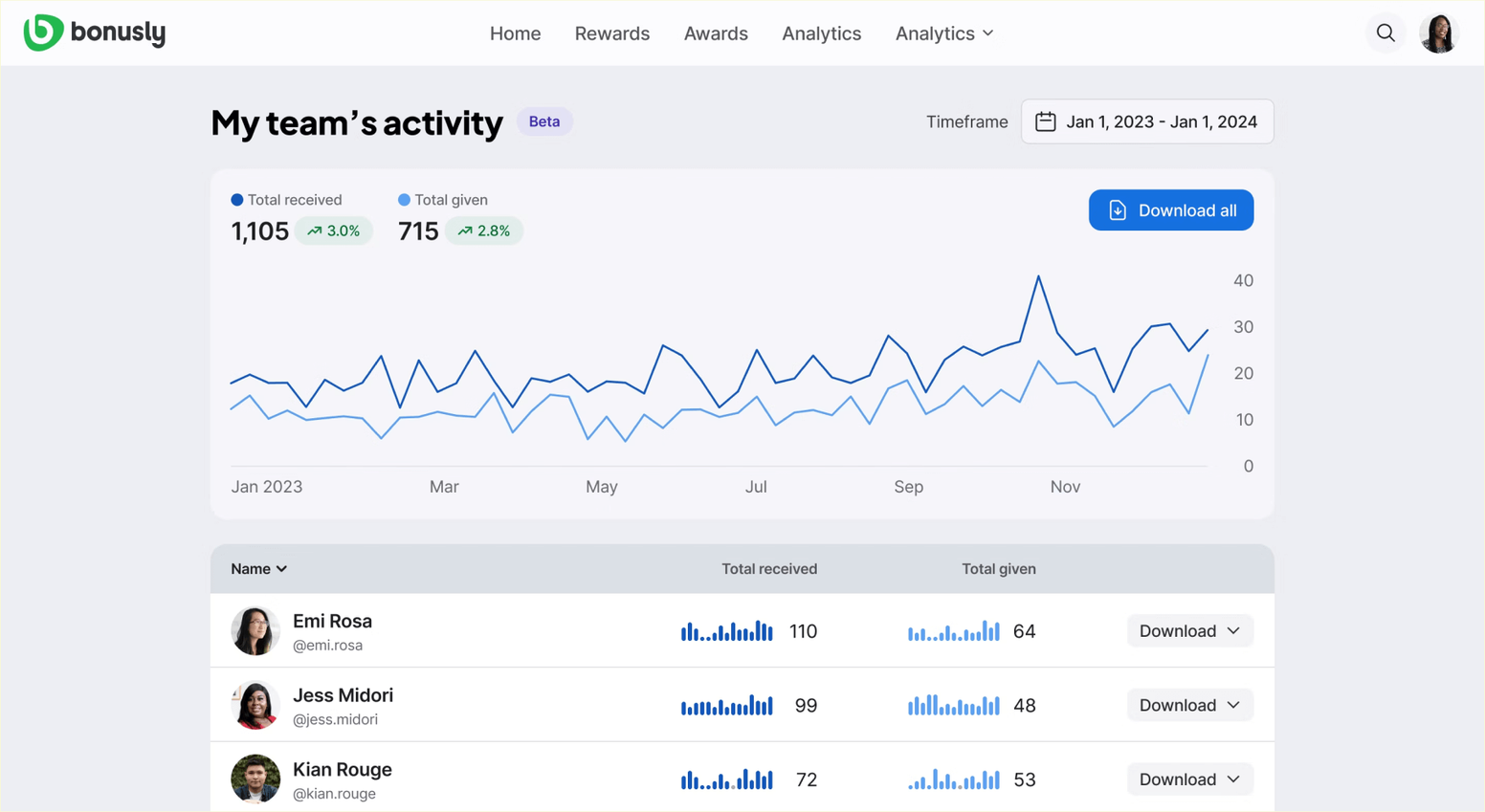
Bonusly (4.7 across 7,000+ reviews on G2): praise centers on ease of use and no-training adoption.
Edson O., a team lead, wrote in a May 2026 five-star review: “It makes recognition simple, visible, and tied to real rewards.” The criticism is overwhelmingly about the points economy, roughly 2,100 mentions across its top eight dislike themes.
Shivam A. summarized the mechanic in an April 24, 2026 five-star review: “The monthly allowance, if unused is not carried over to the next month.”
Awardco (4.9 across 6,325 reviews on G2, the highest rating in the category): its biggest praise theme is easy setup and use at 1,468 mentions, followed by variety of reward options (913) and fast reward delivery (828).
Shakira G., a senior product support representative at an enterprise, wrote on May 14, 2026: “Redeeming rewards is simple and straightforward, and the items I’ve redeemed have always been delivered quickly.” Its criticism is catalog-shaped rather than allowance-shaped: roughly 690 mentions across the top eight dislike themes concern reward choices, vendor selection, points allocation, and gift-card availability, with limited fast-food choices (175) and restricted travel vendors (138) leading.
That difference is the useful signal. Bonusly users complain that the budget runs out; Awardco users complain about what the catalog does and does not carry. Ask which complaint your own team would rather live with.
Where Bonusly wins
- Pricing transparency: public per-user tiers, a real free plan for up to 8 users, and a 30-day no-card trial. Awardco publishes tier names only.
- Published reward funding: its 8%, 5%, and no-fee routes are documented. Awardco documents payment methods but no card fee.
- A billed-in-arrears option: Pay-as-You-Go needs no parked balance, where Awardco is prefund and top up only.
- Time to value: self-serve signup versus roughly a month of implementation work.
- Shipped AI: Bizy, AI 1:1s, Recaps, and a Recognition Quality Score lead most of the category as of August 2026.
- Chat-tool breadth: Slack, Microsoft Teams, and a rare Google Chat integration.
- Simpler billing: one platform subscription versus separate subscription, professional services, and corporate gifting invoices.
Where Awardco wins
- Catalog scale and 1:1 value: the Amazon Business engine is the widest reward network in the category, and the zero-markup claim genuinely holds on Amazon items.
- Highest G2 rating in the category: 4.9 across 6,325 reviews, with easy setup and use as its single biggest praise theme.
- No monthly allowance to run out of: program-based budgets and zero-point shout-outs avoid Bonusly’s top complaint entirely.
- Deskless and enterprise credibility: Hertz runs it across 26,000 employees in 160 countries with more than 80% in customer-facing roles.
- Documented outcomes: Texas Roadhouse reports a 209% increase in annual recognitions across 78,000+ employees; NIBCO reports $5.79M in turnover cost savings and an 8% turnover reduction in year one.
- Program breadth on one platform: spot recognition, nominations, service awards, milestones, incentives, plus Engage surveys and Awardco Intelligence.
- Enterprise integration depth: a bi-directional Workday partnership, ADP Marketplace listing, and Microsoft 365 certified Teams apps.
- Financial backing: a $165M Series B at a $1B-plus valuation in May 2025, funding a fast shipping cadence.
The third option: Matter
Both platforms above assume recognition lives in their own app, funded by a points budget someone has to administer.
Matter makes two different bets: recognition should happen inside Slack and Microsoft Teams with no separate app or login, and it should run on a weekly rhythm rather than a monthly allowance or a program budget.
Every week, Feedback Friday™ (US Patent 12,199,935) prompts the whole team to recognize someone, and give-coins reset weekly so they get used rather than hoarded. Earned coins never expire, so there is no employer-set expiration dial to negotiate.
The cadence is measurable: in The Recognition Habit, Matter’s 2026 Benchmark Report, built on aggregate, de-identified platform data, teams that build recognition around a weekly ritual give about 2.5x more recognition per member than ad hoc teams, and roughly 8 in 10 ritual teams stay active in nearly every month.
On this guide’s buying criteria: Matter’s Free plan is for unlimited users, paid plans are published at $1 to $5 per user/month, billed annually, and Matter hasn’t raised prices in 8 years.
Reward funding fees are published, including a 0% ACH prepay path, and the catalog spans 10,000+ eGift card options across 200+ countries. On the Microsoft Teams app store Matter holds a 5.0 across 1,476 ratings.
To be equally honest about fit: if reward logistics at enterprise scale are the whole point, Awardco’s Amazon catalog and deskless deployments are genuinely deeper than Matter’s, and Matter does not try to match Bonusly’s performance-management and AI tooling. For the detailed head-to-heads, see Bonusly vs. Matter and Awardco vs. Matter.
Which platform is right for your team?
Choose Bonusly if:
- You want to budget from a public price list and start on a free tier or a 30-day trial.
- Published reward-funding terms and a no-deposit funding route matter to your finance team.
- Your team is an office SMB or mid-market org working in Slack, Teams, or Google Chat.
Choose Awardco if:
- Reward catalog depth and 1:1 Amazon value are your deciding factors.
- You run service awards, milestones, and multiple recognition programs across a large or deskless workforce.
- A quote-gated purchase starting at $3,000, plus a month of implementation, fits how your organization buys.
Choose Matter if:
- Your team lives in Slack or Microsoft Teams and you want recognition there, not in another app.
- You prefer a weekly recognition ritual over a monthly allowance or a program budget.
- You want to start free with unlimited users and see published pricing before talking to anyone.
Frequently asked questions about Bonusly vs. Awardco
Is Bonusly or Awardco cheaper?
Bonusly is cheaper to start and far easier to price: a free plan for up to 8 users, Team at $3 per user/month billed annually, and Team plus Bizy at $5.
Awardco publishes no seat prices, and its own pricing page says packages for companies with 100 employees or fewer start at $3,000. For a 50-person team that is roughly $3,000 a year before any reward spend, against $1,800 a year on Bonusly Team.
At larger headcounts the comparison depends entirely on your quote, so get one in writing and model reward spend and funding terms alongside the subscription.
What is the main difference between Bonusly and Awardco?
Bonusly is a self-serve, publicly priced recognition feed built around a monthly giving allowance. Awardco is a quote-gated rewards-logistics platform built around Amazon Business fulfillment, program-based budgets, and service-award depth. Put simply, Bonusly optimizes for how easily people give recognition; Awardco optimizes for what the points can buy.
Does Awardco have a free plan or a free trial?
No. Awardco offers neither a free plan nor a free trial, and every tier routes to a demo. Bonusly offers a free plan for up to 8 users plus a 30-day trial with no credit card. Among alternatives, Matter’s Free plan supports unlimited users.
Do Awardco or Bonusly points expire?
On Awardco, point expiration is an option your employer can switch on, either as a quarterly or yearly sweep or as age-based expiry, and its help center is blunt about the consequence: once points expire, they are gone from your point balance.
Employees get a 30-day in-platform notice and a 7-day email warning. On Bonusly, the monthly giving allowance resets and unused give-points expire, while earned points do not expire by default, though admins can configure expiration rules. On both, ask what your specific program is set to.
Which is better for large or deskless teams, Bonusly or Awardco?
Awardco, in most cases. Its enterprise deployments include Hertz across 26,000 employees in 160 countries with more than 80% in deskless roles, and Texas Roadhouse across 78,000+ employees and 600+ locations, supported by program-level budgets, service awards, and a bi-directional Workday integration.
Bonusly is stronger for office teams that live in chat tools, where its Slack, Teams, and Google Chat integrations and self-serve setup do more work.
Bonusly vs. Awardco: the bottom line
Pick on the axis that actually differs. If recognition should be cheap to start, easy to price, and simple to run for an office team, Bonusly is the better product and its published funding fees are a real advantage.
If the rewards themselves are the program, and you have the budget, headcount, and admin capacity to run it properly, Awardco’s Amazon-backed catalog and enterprise program depth are hard to match. Or consider whether you want recognition living inside chat on a weekly rhythm instead.
Related reading: Bonusly alternatives, Awardco alternatives, and the full comparison hub.

![Awardco vs. Kudos Comparison: Pricing & Reviews [2026 Guide]](https://cdn.sanity.io/images/kqqb5xry/production/af8b9f15f8251be064bd024a494b0c73aff77487-800x600.jpg?w=720&q=75&fit=max&auto=format)
![Bonusly vs. Kudos Comparison: Pricing & Reviews [2026 Guide]](https://cdn.sanity.io/images/kqqb5xry/production/82c27fccf7cd7f08572b86a4809b1111df9b0eb0-800x600.jpg?w=720&q=75&fit=max&auto=format)
![Awardco vs. Matter Comparison: Pricing & Reviews [2026 Guide]](https://cdn.sanity.io/images/kqqb5xry/production/9617832a6fadd126ab7242888cf7b84169cb2d92-800x600.jpg?w=720&q=75&fit=max&auto=format)