

The 30-second verdict: Bonusly or Nectar?
Choose Bonusly if you want public per-user pricing you can budget without a sales call, the fastest-shipping AI feature set in the category (its Bizy sidekick launched in August 2026), and a lightweight points feed that office teams adopt with no training. Its free plan covers up to 8 users, and there is a 30-day trial with no credit card.
Choose Nectar if a meaningful share of your workforce is frontline or deskless (it has kiosk mode, SMS delivery, and physical reward cards), you want the deepest rewards marketplace in the category including in-platform Amazon breadth, or you need a full survey suite from the same vendor, and a demo-led, quote-based buying process does not put you off.
A third option exists: if what you actually want is recognition running inside Slack or Microsoft Teams with published pricing, Matter is covered at the end of this guide.
Bonusly and Nectar are usually the last two names on an employee recognition shortlist, and they are more alike than either vendor admits: both run monthly point allowances, both tie recognition to company values, and both fund rewards from a separate budget.
This comparison was verified in August 2026 against both vendors’ pricing pages, help-center billing documentation, and G2 profiles. Full disclosure: this guide is published by Matter, an employee recognition platform that competes with both Bonusly and Nectar.
We have kept the head-to-head honest, we say plainly where each product wins, and we introduce Matter only near the end as a third option. Weigh our perspective accordingly, and verify current pricing with each vendor before you buy.
How we researched this comparison
We build Matter, which competes with both platforms on this page, so weigh our perspective accordingly.
For Bonusly and Nectar we reviewed each vendor’s public pricing, product pages, and help-center or billing documentation, plus their G2 profiles and named, dated reviews, and we drew on conversations with teams evaluating and switching between recognition platforms. We have not used either product hands-on.
Every claim here is sourced to the vendors’ own materials, named reviews, or Matter’s published data, and facts were last verified in August 2026.
Bonusly vs. Nectar at a glance
| Bonusly | Nectar | Matter | |
|---|---|---|---|
| Starting price | Team $3 per user/month, billed annually ($5 with Bizy AI); public tiers | Quote-based since 2026; entry plans historically around $4–$5 per user/month | Free plan, then $1 to $5 per user/month, billed annually; public tiers |
| Free plan | Yes, up to 8 users | No; trial via demo signup | Yes, unlimited users |
| G2 rating | 4.7 (7,000+ reviews) | 4.7 (8,500+ reviews) | 4.7 (1,186 reviews) |
| Teams app store | 4.4 (45 ratings) | 4.4 (2,319 ratings) | 5.0 (1,476 ratings) |
| Best for | SMB and mid-market office teams that want public pricing and shipped AI features | Frontline and deskless workforces; the deepest rewards marketplace | Slack/Teams-first teams that want recognition inside chat |
Recognition mechanics: how Bonusly and Nectar points work
Both platforms use the same two-balance economy: a giving allowance that refills monthly, and an earned balance you redeem for rewards. The differences sit in the details.
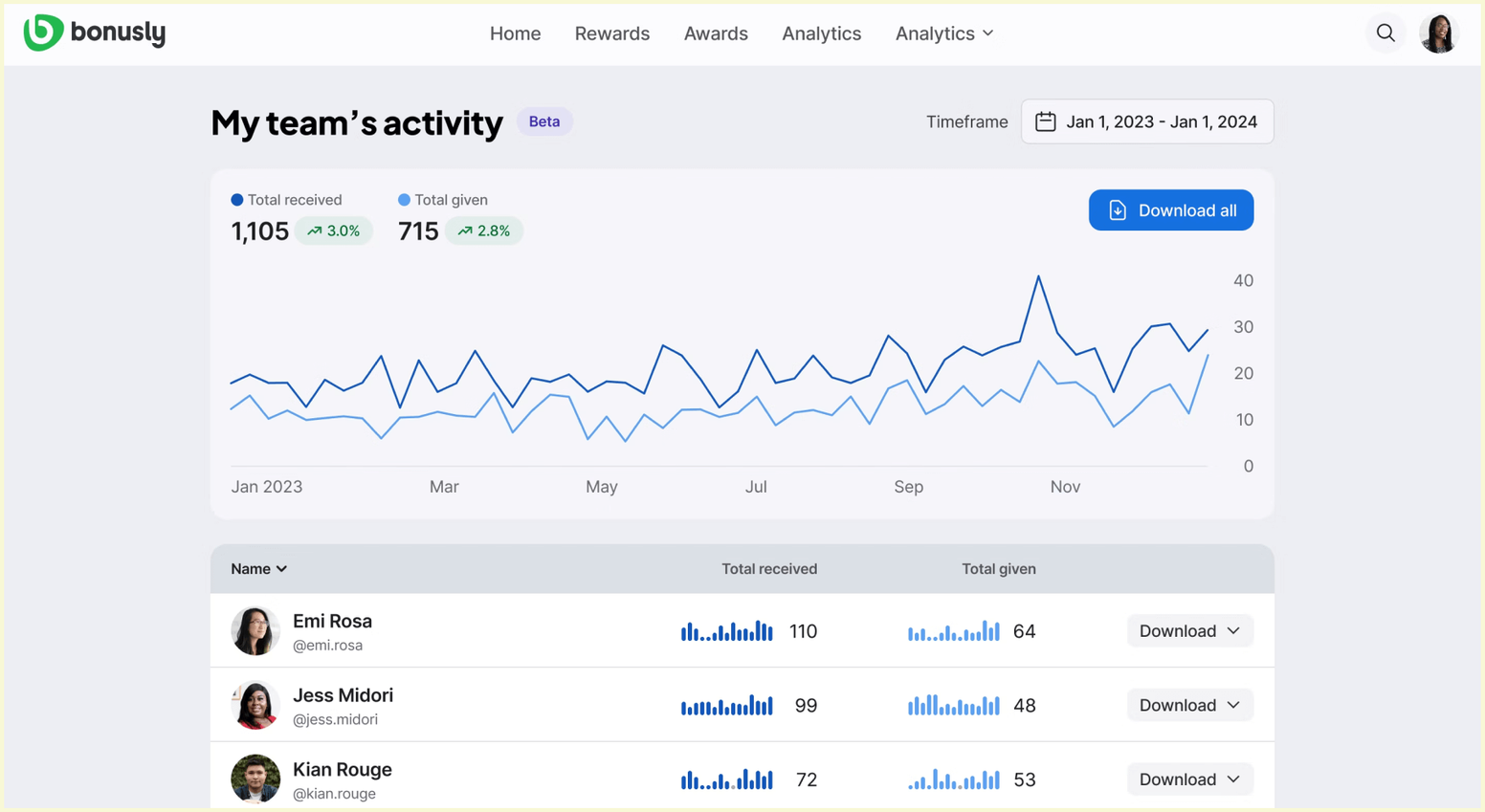
Bonusly: monthly allowance plus the Points Boost loop
On Bonusly, your giveable balance resets to the full monthly allowance at the start of each budget period, usually the 1st, and unused give-points expire with no carryover. Earned (redeemable) points do not expire by default, though companies can configure expiration rules.
Managers receive extra allowance per direct report, and admins can set allowance rules by department, location, or role. Bonusly’s cleverest mechanic is Points Boost: employees can spend earned points to permanently raise their own monthly giving allowance, a self-reinforcing loop no other major platform has.
One number worth knowing: Bonusly’s own rewards calculator states that “on average, 60% of monthly recognition allowances are given away each month,” which means roughly 40% of allowance points go unused and expire monthly.
Nectar: monthly allowance with never-expiring redeem points
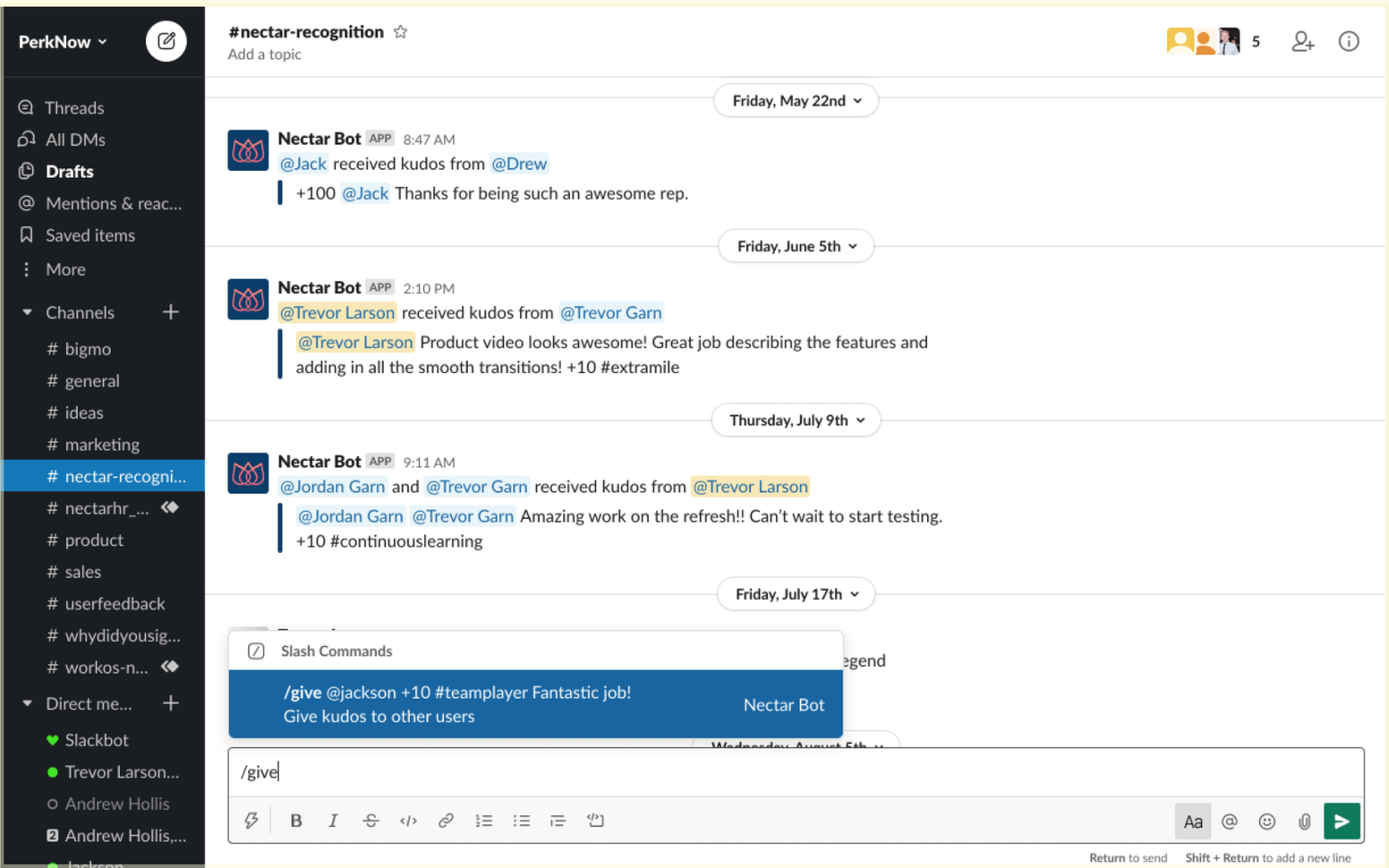
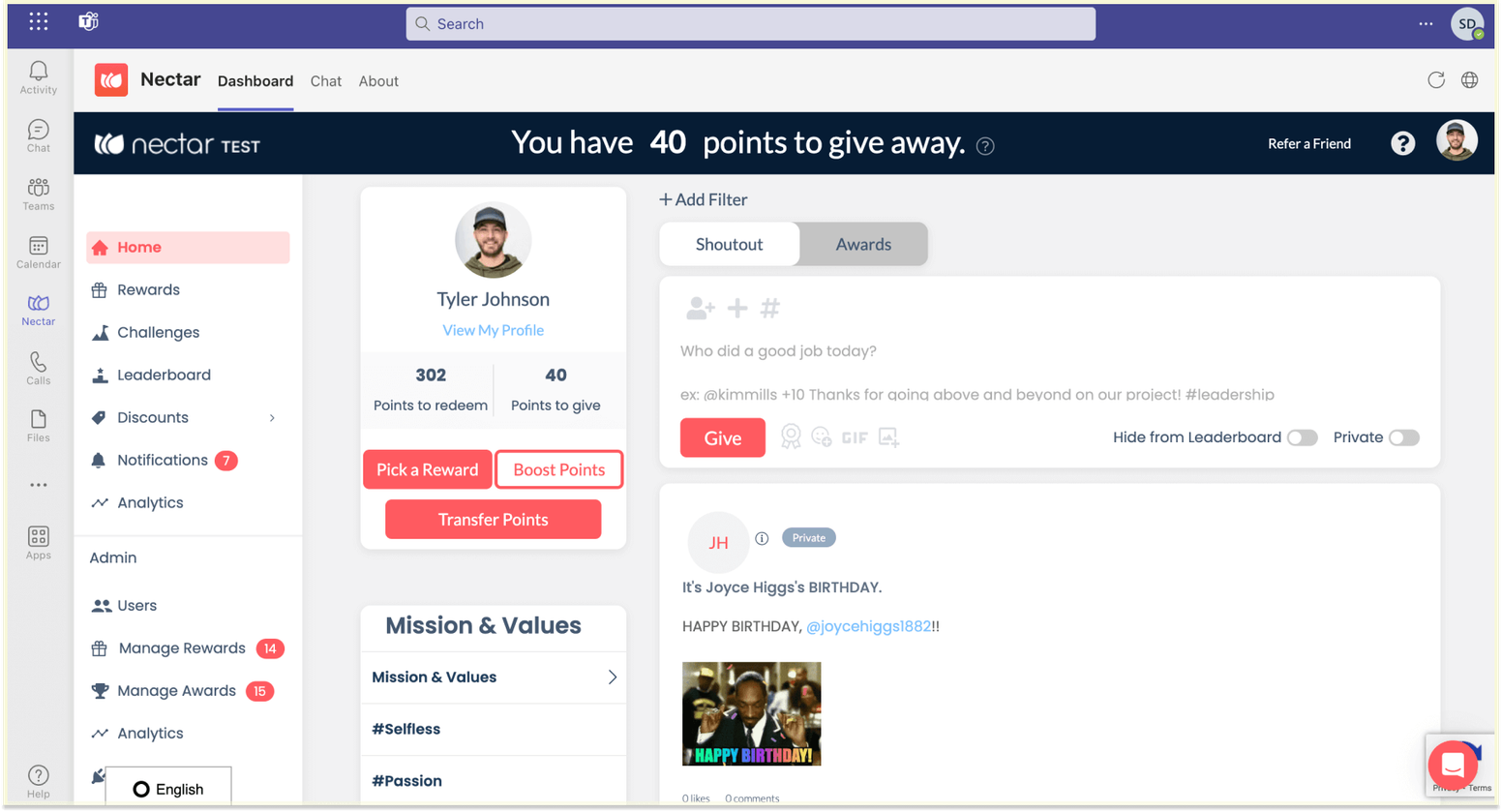
Nectar works the same way at the core: Points to Give reset on the 1st of each month and unused give-points expire, while Points to Redeem never expire, so employees can save toward larger rewards.
Admins get Variable Rate Allowances (rule-based monthly allowances by department, location, or employment type), and Boosted Points let employees convert earned points back into giving points, a mirror image of Bonusly’s loop.
Nectar also sends reminder emails nudging people to use their budgeted points before the month ends, a touch some reviewers single out for praise.
The honest synthesis: these are two implementations of the same monthly-allowance design, and they share the same trade-off.
Monthly budgets favor saving toward meaningful rewards, but points-economy complaints (allowances running out, unused points expiring, high redemption thresholds) are the largest dislike cluster on both G2 profiles: roughly 2,100+ mentions across Bonusly’s top dislike themes and roughly 1,600 across Nectar’s top five, per G2’s review summaries. Neither platform has a structural edge here.
Rewards catalogs and funding fees: Bonusly vs. Nectar
Both platforms charge you only for rewards employees actually redeem; unredeemed points cost nothing. How you fund those redemptions, and what it costs, differs meaningfully.
Bonusly rewards and funding fees
Bonusly’s gift cards are all-electronic (some take up to 48 hours to activate), curated physical gifts ship through its partner Snappy, company swag runs through an AXOMO integration, and charitable donations are included.
Per Bonusly’s help center (Paying for Bonusly: Rewards Plans), companies fund rewards three ways: Pay-as-You-Go by card, billed in arrears with an 8% convenience fee (the card is charged when the running balance passes minus $100, or at month end); the Flex Plan, prefunding $200 or more by card at a 5% fee with auto-recharge; or the Fixed Plan, a $2,500 minimum upfront deposit paid by invoice via ACH or wire at 0% fee.
Nectar rewards and funding fees
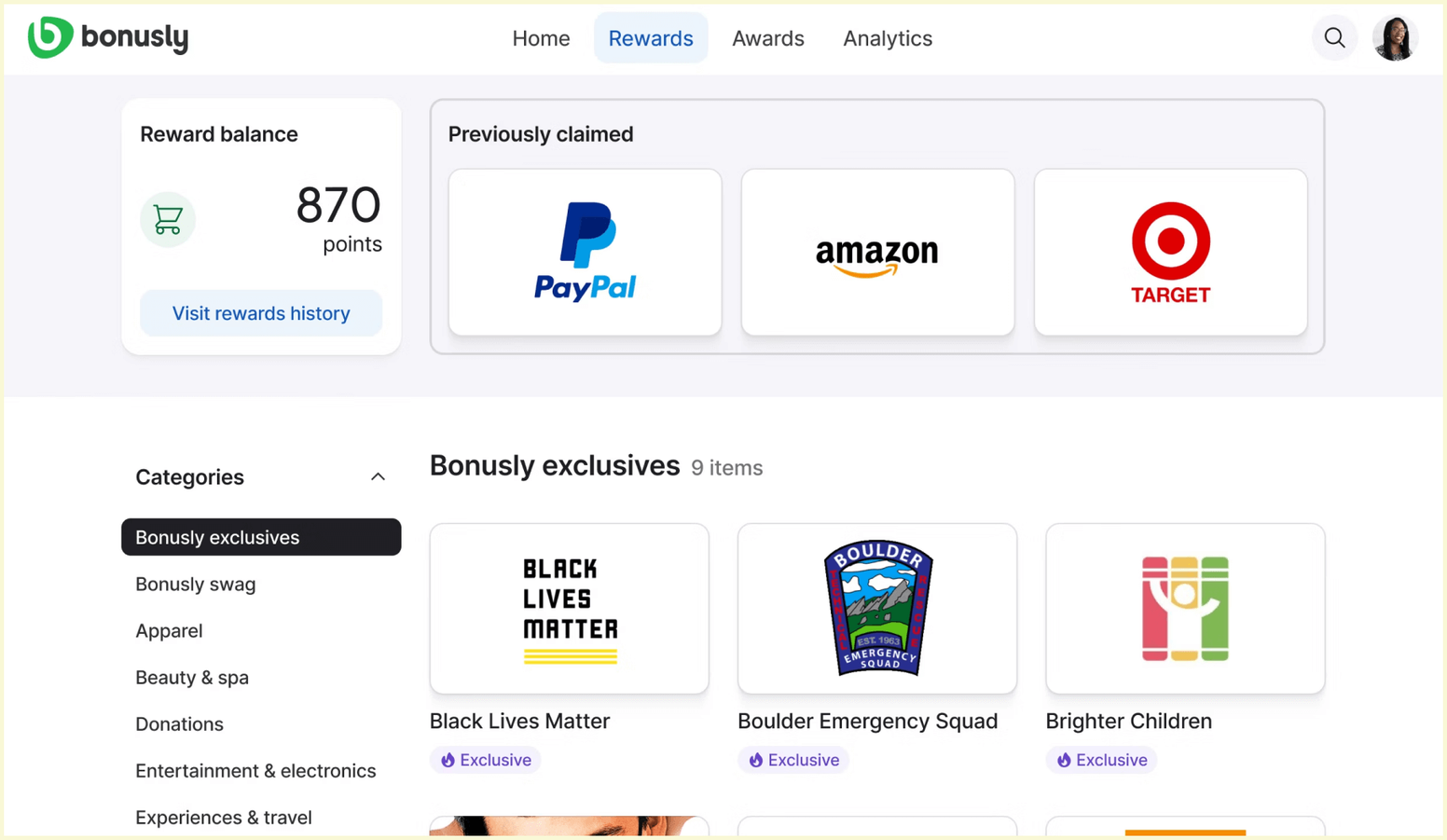
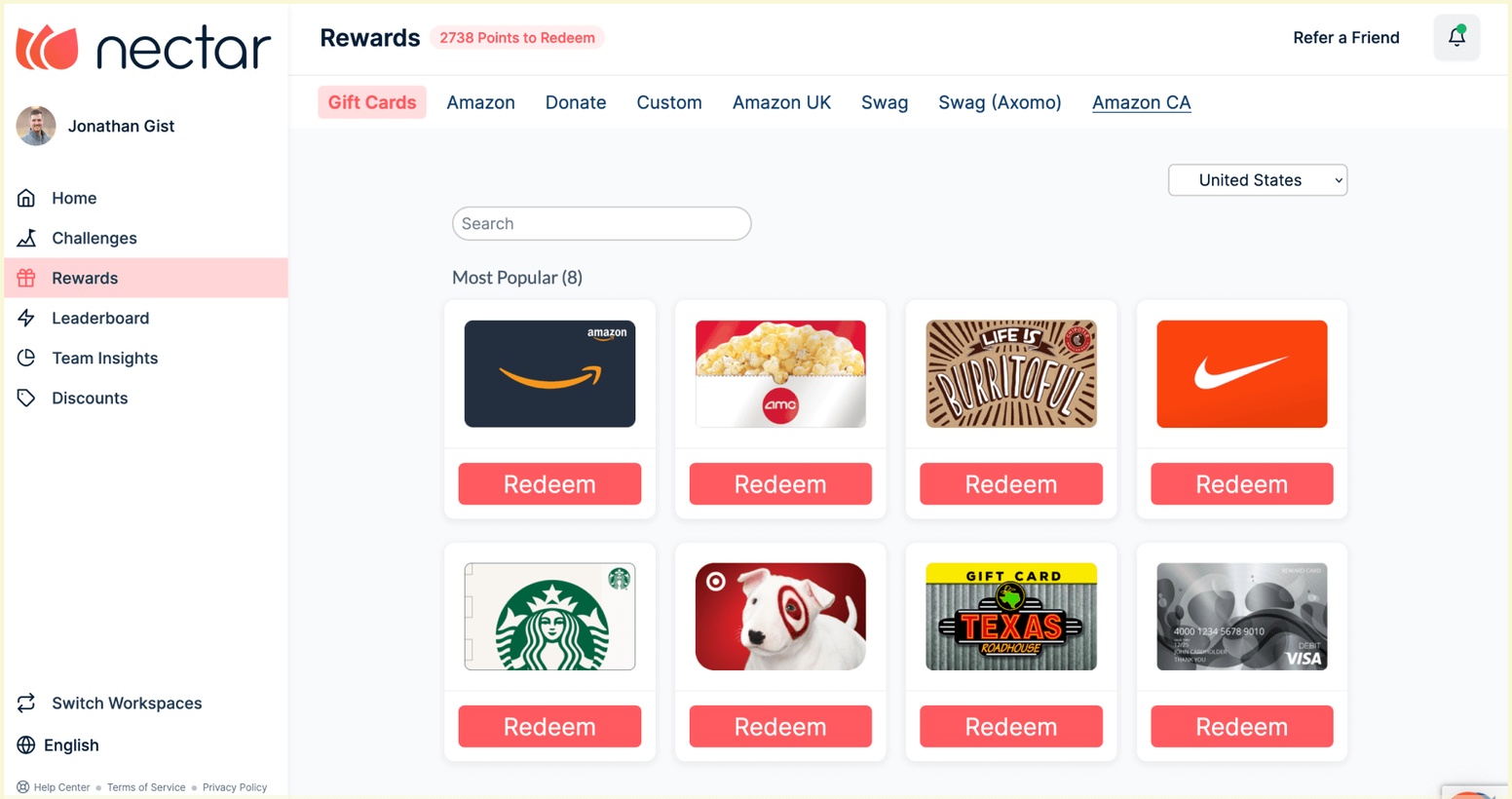
Nectar’s marketplace is the deeper of the two: gift cards, in-platform Amazon breadth, a swag store, donations, and physical or instant reward cards. Two catalog caveats: gift cards come in preset denominations only, and cards are country-specific.
Per Nectar’s help center, the default billing mode (named Pay As You Go) is a prefunded auto-refill balance that tops up when it drops below 20% of the refill amount.
Prepaying by ACH, check, or wire is fee-free; credit-card reward payments carry a nonrefundable 3.5% + $0.40 per-transaction fee, and international wires cost $20. A true billed-in-arrears option, Post-Pay, exists but requires account-manager approval and a 20% security deposit (minimum $100), and redemptions pause if a month’s redemptions exceed the deposit. One switcher-friendly detail: unused prefunded balances are refundable at cancellation on written request.
| Funding route | Bonusly | Nectar |
|---|---|---|
| 0% fee path | Fixed Plan: invoice via ACH/wire, $2,500 minimum deposit | Prepay via ACH, check, or wire: 0%, no published minimum ($20 international wire fee) |
| Prefund by credit card | Flex Plan: 5% fee, $200 minimum | 3.5% + $0.40 per transaction |
| Billed in arrears | Pay-as-You-Go: 8% fee, no deposit, self-serve | Post-Pay: requires approval and a 20% security deposit (minimum $100) |
Read the table both ways. If you fund by card, Nectar’s percentages are lower. If you want the 0% path without parking $2,500, Nectar’s prepay is easier to reach. If you want billed-in-arrears funding without an approval gate, Bonusly’s is self-serve, though at 8% it is the most expensive route on either platform.
Pricing transparency: Bonusly publishes tiers, Nectar quotes
This is the clearest philosophical split between the two. Bonusly publishes its pricing on bonusly.com/pricing: a free plan for up to 8 users focused on peer recognition, Team at $3 per user/month billed annually, Team + Bizy at $5 per user/month (the AI sidekick adds $2), and a quote-based Organization tier.
There is a 30-day trial with no credit card. In a category drifting toward quote-only pricing, that transparency is a genuine buyer benefit and Bonusly deserves credit for it.
Nectar moved the other direction: in 2026 it restructured its pricing page into quote-based product bundles (Recognize, Comms, Engage™, and the Culture Suite), and every plan now requires a sales conversation to get a number.
Third-party listings historically placed entry plans around $4–$5 per user/month with minimum monthly spends, and SelectSoftware reports a $4,000 minimum annual agreement; treat those figures as directional, not current list prices.
On both platforms, remember that the rewards budget is separate from the platform fee, so model platform cost, rewards budget, and funding fees together.

Surveys and engagement tools: Pulse Checks vs. Nectar Engage
If surveys matter to you, this section may decide the comparison. Bonusly’s survey capability is Pulse Checks (launched October 2025): a lightweight sentiment pulse, not a full survey suite. Bonusly’s 2026 investment has gone into performance and AI tooling instead: the Bizy recognition sidekick, AI-assisted 1:1s, Recaps, 360 feedback, goals, and a Recognition Quality Score.
Nectar Engage™ is a fuller employee-listening product: engagement surveys, eNPS, onboarding and exit templates, a custom survey builder, anonymous feedback with SafeTalk, and AI sentiment analysis. It is sold as its own bundle, so it becomes part of your quote.
The honest verdict: teams that need real survey depth from the same vendor should lean Nectar; teams that want manager tools and shipped AI should lean Bonusly.
Frontline and deskless teams: Bonusly vs. Nectar
Nectar was built with frontline workforces in mind: kiosk mode for shared terminals, SMS delivery, multi-language support, and physical or instant reward cards. Its customer base skews toward healthcare and manufacturing, and its Statista case study reports 93% utilization.
One caveat to test with your own workforce: Nectar’s mobile apps trail its web experience, at 3.1 stars on Google Play (120 reviews, last updated September 2024) and 4.4 on the App Store (96 ratings).
Bonusly’s center of gravity is the office SMB and mid-market team working in Slack, Microsoft Teams, or Google Chat. Its iOS app is excellent (4.8 stars, roughly 4,500 ratings), while its Android app rates lower (3.7 stars, 669 reviews).
For a heavily deskless organization, Nectar’s delivery options are the stronger fit; for an office team living in chat tools, Bonusly’s experience is more polished.
What G2 reviewers say about Bonusly and Nectar
Both platforms hold a 4.7 on G2, so ratings alone will not separate them; the review text does.
Bonusly (4.7, 7,000+ reviews on G2): reviewers consistently praise ease of use and no-training adoption. Edson O., a Team Lead, wrote in a May 2026 five-star review: “It makes recognition simple, visible, and tied to real rewards.” The most common criticism is the points economy.
Vasanth J., a Media Analyst at a mid-market company, put it this way in a five-star review from April 24, 2026: “The monthly points limit feels a bit restrictive, especially during busy months.”
Nectar (4.7, 8,500+ reviews on G2, the largest review base in the category): per G2’s review summary, recognition capabilities (1,947 mentions) and ease of use (1,856) lead the praise, and Ryan L. (February 5, 2026) called its budget reminder emails “the most helpful thing” about the platform. The criticism mirrors Bonusly’s.
Sandra R. wrote in a five-star review from May 12, 2026: “I wish the points didn’t disappear at the end of the month. Work gets busy... I wish a percentage of them rolled over.”
That symmetry is the real finding: the two biggest recognition platforms share the same top complaint class, and it is about the monthly points model itself, not bugs or support.
Where Bonusly wins
- Pricing transparency: public tiers, a real free plan (up to 8 users), and a 30-day no-card trial. Nectar offers none of those publicly.
- Shipped AI: Bizy, AI 1:1s, Recaps, and Recognition Quality Score put Bonusly ahead of most of the category, Nectar included, on AI actually in production as of August 2026.
- The Points Boost loop: spending earned points to raise your own giving allowance is a genuinely clever engagement mechanic.
- iOS experience: 4.8 stars across roughly 4,500 App Store ratings.
- Breadth of workplace integrations: Slack, Teams, and a rare Google Chat integration, plus 30+ HRIS systems and Microsoft 365 certification.
- Gentler offboarding: points and history are never deleted, and companies can let departing employees redeem earned points.
- Proof at scale: its Toast case study reports 86% user participation.
Where Nectar wins
- Rewards marketplace depth: in-platform Amazon breadth, a swag store, donations, and physical or instant reward cards; the biggest catalog of the pair.
- Frontline delivery: kiosk mode, SMS, and multi-language support that Bonusly does not center its product on.
- A full survey suite: Engage covers engagement surveys, eNPS, and custom surveys, where Bonusly offers light Pulse Checks.
- Review volume and social proof: the category’s largest G2 base (8,500+ at 4.7), a SHRM partnership, and logos like Major League Baseball and the Golden State Warriors.
- Microsoft Teams footprint: 2,319 Teams app store ratings to Bonusly’s 45, at the same 4.4 score.
- Cheaper funding without a big deposit: a 0% ACH, check, or wire path with no published minimum, versus Bonusly’s $2,500 deposit for 0%.
- Documented outcomes: its 1st Choice Cabinetry case study reports turnover falling from 25% to 7%.
The third option: Matter
Both platforms above assume recognition lives in their app, funded by a monthly points allowance. Matter makes two different bets: recognition should live inside Slack and Microsoft Teams with no separate app or login, and it should run on a weekly rhythm rather than a monthly budget.
Every week, Feedback Friday™ (US Patent 12,199,935) prompts the whole team to recognize someone, and give-coins reset weekly so they are used rather than hoarded.
The cadence is measurable: in The Recognition Habit, Matter’s 2026 Benchmark Report, built on aggregate, de-identified platform data, teams that build recognition around a weekly ritual give about 2.5x more recognition per member than ad hoc teams, and roughly 8 in 10 ritual teams stay active in nearly every month.
On the buying criteria this guide has used: Matter’s Free plan is for unlimited users, paid plans are published at $1 to $5 per user/month, billed annually, and Matter hasn’t raised prices in 8 years.
Reward funding fees are published too, including a 0% ACH prepay path, and the catalog spans 10,000+ eGift card options across 200+ countries.
On the Microsoft Teams app store, Matter holds a 5.0 across 1,476 ratings, and it rates 4.7 on G2. To be equally honest about fit: Matter is built for teams that live in Slack or Teams, so a largely deskless workforce needing kiosk or SMS delivery is better served by Nectar, and Matter does not try to match Bonusly’s performance-management tools. For the detailed head-to-heads, see Bonusly vs. Matter and Nectar vs. Matter.
Which platform is right for your team?
Choose Bonusly if:
- You want to budget from a public price list and start on a free tier or 30-day trial.
- Shipped AI and manager tools (1:1s, Recaps, 360 feedback) are on your requirements list.
- Your team is an office SMB or mid-market org working in Slack, Teams, or Google Chat.
Choose Nectar if:
- A large share of your workforce is frontline or deskless and needs kiosk, SMS, or reward-card delivery.
- Rewards catalog depth, including Amazon, is your deciding factor.
- You want recognition and a full survey suite from one vendor and are comfortable with quote-based pricing.
Choose Matter if:
- Your team lives in Slack or Microsoft Teams and you want recognition there, not in another app.
- You prefer a weekly recognition ritual over a monthly points budget.
- You want to start free with unlimited users and see published pricing before talking to anyone.
Frequently asked questions about Bonusly vs. Nectar
Is Bonusly or Nectar cheaper?
Bonusly is the easier one to price: it publishes a free plan for up to 8 users, Team at $3 per user/month billed annually, and Team + Bizy at $5.
Nectar switched to quote-based pricing in 2026; third-party listings historically placed entry plans around $4–$5 per user/month with minimum spends, and SelectSoftware reports a $4,000 minimum annual agreement.
On published numbers, Bonusly generally starts cheaper, but total cost on either platform depends on your rewards budget and funding fees, so get a written Nectar quote before comparing.
What is the main difference between Bonusly and Nectar?
Mechanically they are similar: monthly point allowances, values-based recognition, and large reward catalogs. The practical differences are that Bonusly publishes its pricing and leads on AI and performance tooling, while Nectar offers a deeper rewards marketplace, stronger frontline features (kiosk, SMS, multi-language), and a fuller survey suite through Engage.
Do Bonusly and Nectar offer free plans?
Bonusly offers a free plan for up to 8 users plus a 30-day trial with no credit card. Nectar has no free plan; trials are arranged through a demo signup. Among alternatives, Matter’s Free plan supports unlimited users.
Which is better for frontline or deskless teams, Bonusly or Nectar?
Nectar, in most cases: kiosk mode, SMS delivery, multi-language support, and physical reward cards are built for workforces that do not sit at desks. Do test its mobile apps with your own staff first (3.1 stars on Google Play across 120 reviews). Bonusly’s strength skews toward office teams, with a highly rated iOS app at 4.8 stars.
Do Bonusly and Nectar points expire?
On both platforms, monthly giving allowances reset and unused give-points expire. Earned points differ: Bonusly’s never expire by default, though admins can configure expiration rules, and Nectar’s redeem-points never expire while you are employed but are lost when an employee is removed, so departing employees should redeem before their last day.
Bonusly vs. Nectar: the bottom line
Both are capable, well-reviewed platforms built on the same monthly-allowance model. Decide on the axes where they genuinely differ: pricing transparency and AI (Bonusly), rewards depth, surveys, and frontline delivery (Nectar), and whether you want recognition living inside chat on a weekly rhythm instead (Matter). Related reading: Bonusly alternatives, Nectar alternatives, and the full comparison hub.

![Bonusly vs. Kudos Comparison: Pricing & Reviews [2026 Guide]](https://cdn.sanity.io/images/kqqb5xry/production/82c27fccf7cd7f08572b86a4809b1111df9b0eb0-800x600.jpg?w=720&q=75&fit=max&auto=format)
![Kudos vs. Nectar Comparison: Pricing & Reviews [2026 Guide]](https://cdn.sanity.io/images/kqqb5xry/production/534ba04d43c4301bb06b3935c0d5a2d507f52642-800x600.jpg?w=720&q=75&fit=max&auto=format)
![Bonusly vs. Matter Comparison: Pricing & Reviews [2026 Guide]](https://cdn.sanity.io/images/kqqb5xry/production/41b4125008b1f0b96ca870b98dd7704a5d5dde0b-800x600.jpg?w=720&q=75&fit=max&auto=format)