

The 30-second verdict: Motivosity or Guusto?
Choose Motivosity if you want an always-on recognition program: peer-to-peer giving from a monthly allowance, a social feed, automated milestones, eNPS and turnover-risk insights, and a spendable ThanksMatters Visa card – and your budget clears a $3,000 minimum annual investment.
Choose Guusto if your priority is getting gift cards into people’s hands, especially frontline and deskless staff. It delivers by email, SMS, push, printed codes, and QR, pays face value on gift cards with no markup, credits back unclaimed gifts, donates a day of clean drinking water with every gift, and publishes its prices.
A third option exists: if what you actually want is a recognition habit running inside Slack or Microsoft Teams with published pricing, Matter is covered near the end of this guide.
Motivosity and Guusto turn up on the same shortlists, but they are not really the same kind of product. Motivosity is a recognition platform with a monthly giving allowance, a social feed, and an insights layer.
Guusto is a gifting and delivery tool: it sends dollar-denominated gift cards to people, including people with no email address, no login, and no desk.
This comparison was verified in August 2026 against both vendors’ pricing pages, their own help-center documentation, and their live G2 profiles, and it tries to match each tool to the job it is actually built for rather than scoring one on the other’s features.
Full disclosure: this guide is published by Matter, an employee recognition platform that competes with both. We say plainly where each product wins, and we introduce Matter only near the end as a third option. Weigh our perspective accordingly.
How we researched this comparison
We build Matter, which competes with both platforms on this page, so weigh our perspective accordingly.
For Motivosity and Guusto we reviewed each vendor’s public pricing, product pages, and help-center or billing documentation, plus their G2 profiles and named, dated reviews, and we drew on conversations with teams evaluating and switching between recognition platforms. We have not used either product hands-on.
Every claim here is sourced to the vendors’ own materials, named reviews, or Matter’s published data, and facts were last verified in August 2026.
Motivosity vs. Guusto at a glance
| Motivosity | Guusto | Matter | |
|---|---|---|---|
| Starting price | Quote-based bundles; $3,000 minimum annual investment is the only published figure | Published: Free tier, Lite $150 per month, then sender-seat plus recipient-seat pricing with monthly minimums | Free plan, then $1 to $5 per user/month, billed annually; public tiers |
| Free plan | No; demo-led, no self-serve trial on the pricing page | Yes, for basic sending; no automation, analytics, or integrations | Yes, unlimited users |
| G2 rating | 4.7 (3,615 reviews) | 4.9 (roughly 5,900 reviews) | 4.7 (1,186 reviews) |
| Teams app store | 4.2 (58 ratings) | Listing exists with no ratings yet | 5.0 (1,476 ratings) |
| Best for | Mid-market teams running a continuous peer recognition program | Sending dollar-denominated gifts to frontline, deskless, and offline recipients | Slack/Teams-first teams that want recognition inside chat |
Two different jobs: recognition platform vs. gifting tool
The most useful thing this comparison can tell you is that these tools answer different questions, and the wrong framing will cost you money either way.
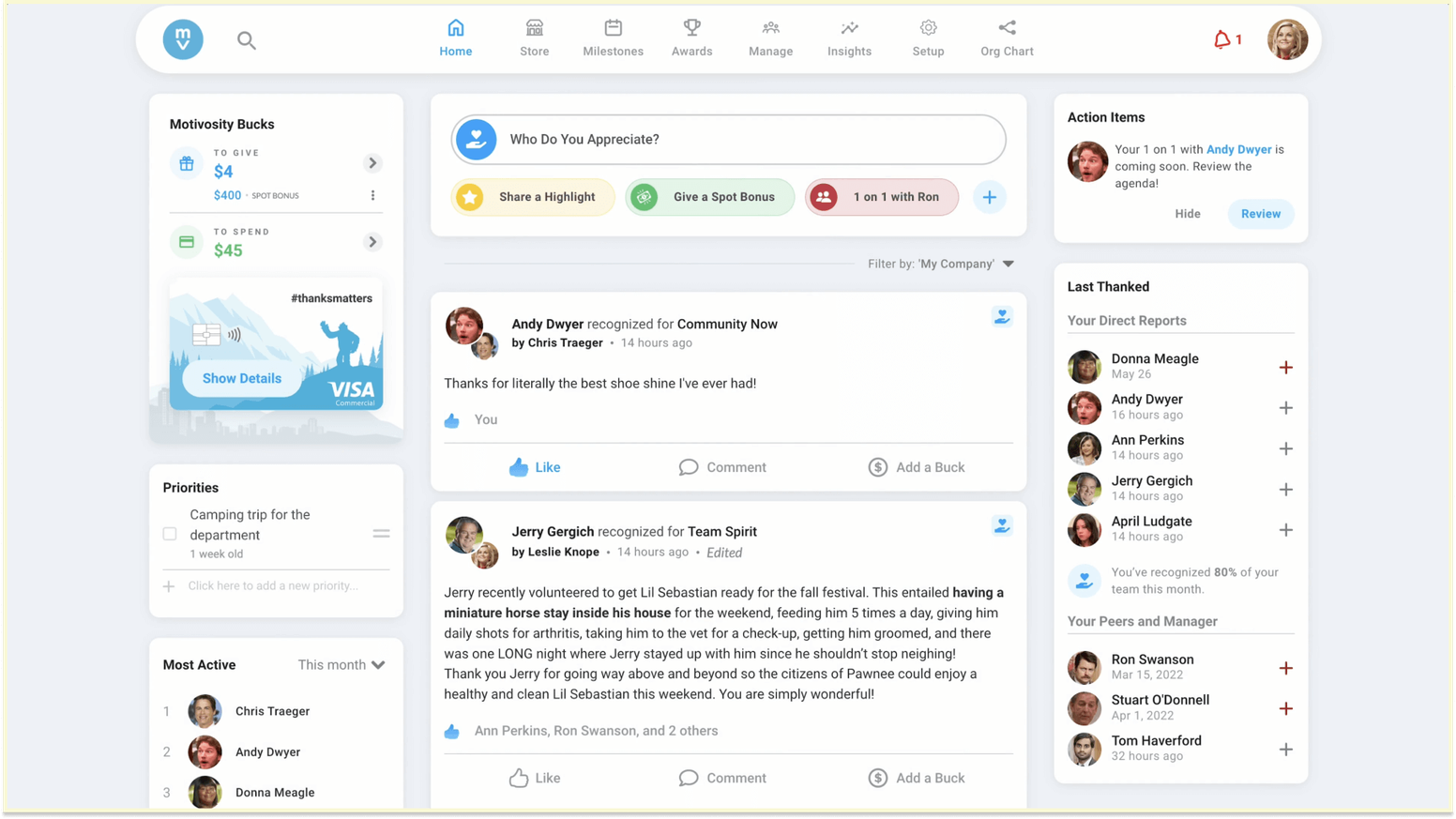
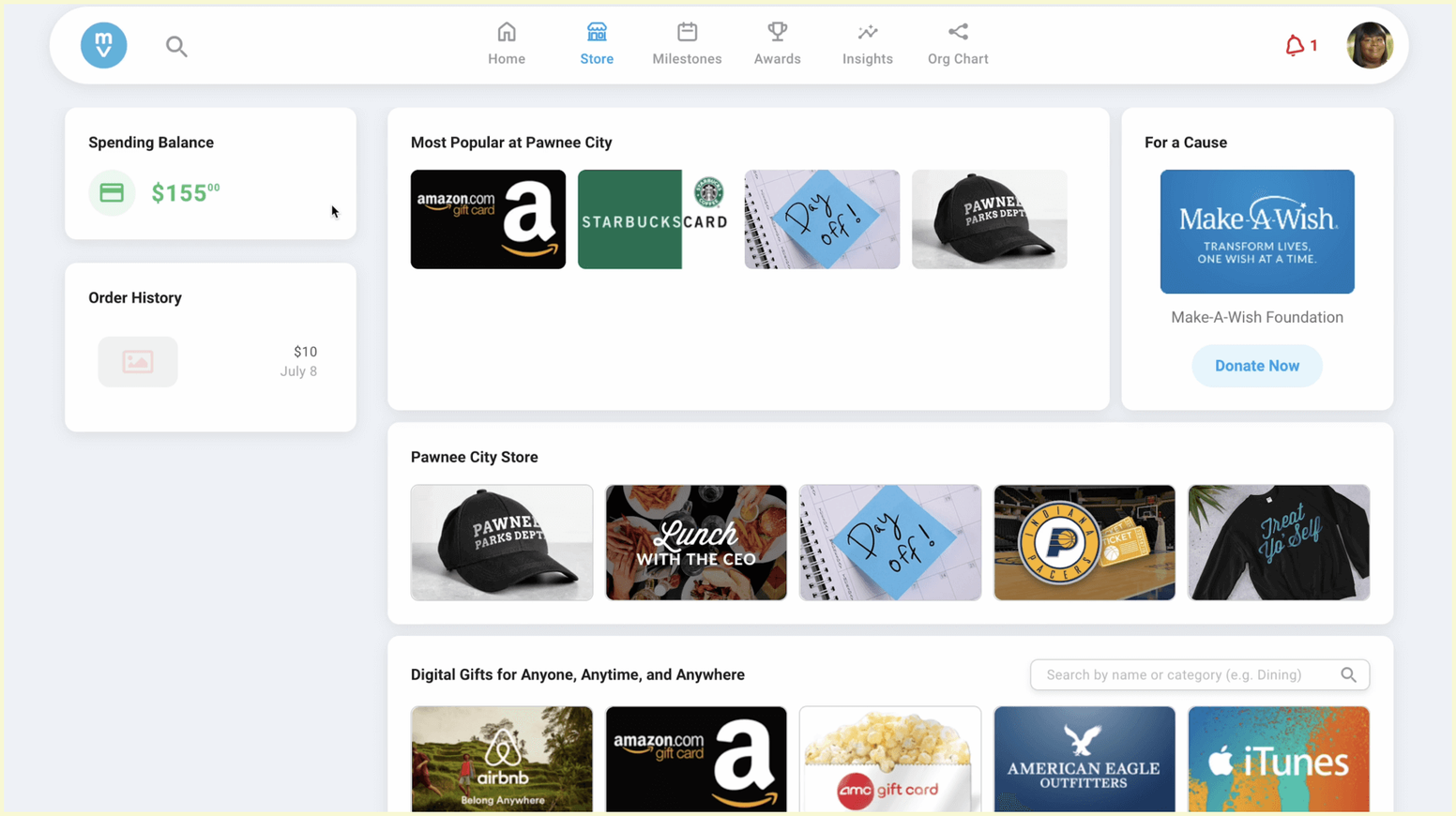
Motivosity is built around an ongoing program. Employees get a monthly To Give balance in real dollars, spend it recognizing colleagues on a social feed, and accumulate a To Spend balance they redeem for gift cards, company items, donations, or the ThanksMatters Visa card.
Around that sit milestones, nomination awards, an employee-insights module with eNPS, and Appreciation Intelligence, its AI branding for recognition writing and turnover-risk signals. It connects to Slack, Microsoft Teams, and 50+ HRIS and SSO tools, but the center of gravity is its own app.
Guusto does not have a points economy, a peer giving budget, or a survey product, and it does not claim to. Its recognition layer is deliberately thin: non-monetary shoutouts from the Lite plan, and a social feed with leaderboards only from Essential. What it has instead is delivery.
A gift can reach someone by email, SMS, push notification, a printed code, a QR code, or a route-to-manager handoff for in-person delivery, and TV or kiosk display on Premium. Guusto’s own framing is that 80% of the global workforce is deskless and most recognition tools ignore them.
So the honest question is not which tool has more features. It is whether you are building a recognition habit or solving a distribution problem – and plenty of organizations have both, which makes running Guusto for frontline gifting alongside a platform for office teams a reasonable answer.
Recognition mechanics: monthly bucks vs. dollar gifts
Motivosity: two balances, monthly reset
Motivosity splits balances into To Give and To Spend, and its currency is real money – one Motivosity buck equals one US dollar, so there is no points-conversion math.
Per Motivosity’s own General User FAQ, unused To Give dollars “reset on the first of each month without rollover,” which makes it a textbook monthly allowance. Earned To Spend dollars generally do not expire, though the help center notes some companies may set expiration policies.
Admins set Monthly Giving Defaults for everyone, then layer Special Giving Rules by user, team, org, or custom criteria; the rules stack, and role changes recalculate direct-report rules, which can reduce a giving balance mid-cycle. No admin-facing anti-gaming controls are documented in the published help articles.
Guusto: no points at all
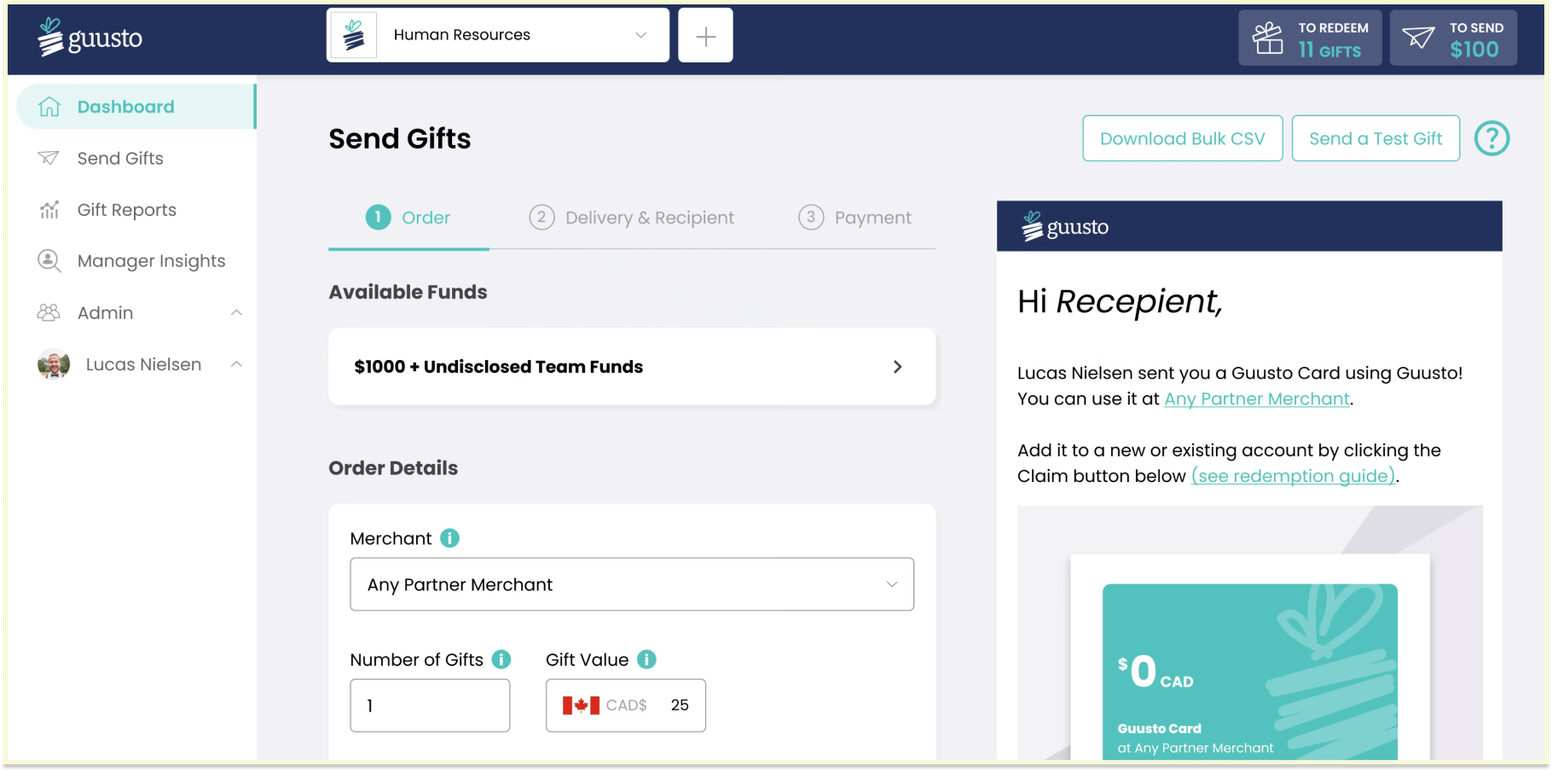
Guusto skips the economy entirely. Gifts are dollar amounts, sent one-off, in bulk, on a schedule, or automatically for milestones and birthdays from the Lite plan up.
Recipients pick a merchant and redeem, and per Guusto’s Gift Redemption FAQ they can split a gift across merchants – you can redeem $15 of a $30 gift and keep the rest. Expiry is a precise split worth quoting accurately: merchant gift cards do not expire, but prepaid Mastercards do.
One real friction point: the same help article states recipients need to create a Guusto account to claim a gift and redeem it with a merchant, which is the single most-cited complaint in its reviews.
The practical consequence: Motivosity gives you frequency, because everyone has a budget they are expected to spend each month. Guusto gives you reach, because a gift can land on a phone, a printout, or a manager’s clipboard.
If you need employees recognizing each other daily, Guusto is not the tool for that job, and it does not market itself as one.
Rewards, delivery, and funding fees
Motivosity rewards and funding
Motivosity claims 500M reward options across 175+ countries, with 70+ languages, 140 currencies, and tax support in 63 countries. Its signature is the ThanksMatters Visa card – powered by Stripe, issued by Celtic Bank – letting employees tap-to-pay earned dollars, with Apple Wallet support.
Behind the branded experience, generic Visa reward cards are fulfilled through Tango Card with support handled by Prepaid Digital Solutions, and physical cards take up to 45 days to arrive.
Funding is prepay only, per Motivosity’s help center: a US bank account by ACH at no fee, clearing in 5–6 business days, or a US-based credit card at a 3.5% transaction fee that processes in about 4–6 hours.
Deposit caps start at $1,000 and top out at $50,000 per ACH transfer or $5,000 per card transaction, and funding sources are US-only. The help article does not address refunds of unused prefunded balance at cancellation.
Reviewers also report real costs on physical items: a Verified User in Retail wrote on June 19, 2026 that “shipping fees for rewards can be quite expensive... even after paying for shipping through the platform, I was still asked to pay an additional handling fee.”
Guusto rewards and funding
Guusto’s catalog is narrower and its economics are cleaner. Its merchants page lists over 100 merchants redeemable at 60,000+ global locations, with a prepaid Mastercard fallback from Lite and Amazon gift cards gated to Essential and above; global and custom rewards plus a swag program sit on Premium.
Against that smaller catalog, its pricing page makes an unusually direct commitment: “You pay face value for all gift cards. We make money by charging the merchants, so every dollar you spend on recognition actually makes it to your people.”
Unclaimed gifts are credited back in full when cancelled from Lite up, which is a genuinely good answer to budget waste. Funding is by email transfer, bank transfer, wire, or credit card.
Guusto publishes no card-processing fee schedule on its pricing page, so unlike Motivosity there is no published percentage to compare – ask for the terms in writing before you sign.
International reach works by conversion rather than localization: funding is CAD and USD only, currency is converted automatically at the exchange rate when a gift is redeemed, currency switching is not supported, and some merchants are single-currency.

| Funding route | Motivosity | Guusto |
|---|---|---|
| 0% fee path | ACH from a US bank account; clears in 5–6 business days; caps of $1,000, then $2,500, then $50,000 per transfer | Bank transfer, email transfer, or wire accepted; no fee schedule published |
| Credit card | 3.5% transaction fee; processes in about 4–6 hours; US-based cards only | Accepted; no processing-fee terms published |
| Reward markup | No markups claimed, though shipping and handling on physical items are reported by reviewers | Face value on gift cards; Guusto states it is paid by the merchants |
| Unused or unclaimed budget | No refund terms published for unused prefunded balance | Full credit back on cancelled unclaimed gifts (Lite and up) |
Pricing transparency: published seats vs. quote-gated bundles
This is the clearest split between them, and it runs against the usual expectation that the bigger platform is the more transparent one.
Motivosity sells through three promoted bundles – For Celebrating People, For Building Culture, and For Scaling Globally – plus seven industry bundles, all quote-gated on motivosity.com/pricing.
The one hard number it publishes, on both the pricing page and its FAQ, is a $3,000 minimum annual investment, and its own 2026 recognition-software roundup names that minimum as a barrier for very small teams.
Its FAQ describes the model as transparent and predictable pricing while publishing no rates, and the 3.5% card funding fee appears only in the help center. Expect 30–60 days to launch with 5–10 hours of admin time.
Guusto publishes everything on guusto.com/pricing, and its model is structurally different: you pay full price for people who send and a fraction for people who receive. A sender seat is someone who can send recognition; a recipient seat is someone who can receive automated rewards and appear as a recipient option.
The Free tier covers basic sending by email, SMS, and printed or QR codes across 100+ merchants, without automation, analytics, social features, or integrations. Lite is $150 per month for one sender seat and 250 recipient seats, adding milestone automation, bulk and scheduled sends, the prepaid Mastercard, and reports.
On yearly billing, Essential is $4.00 per sender seat per month plus $0.70 per recipient seat per month with a $200 per month minimum, adding HRIS integration, the social feed, leaderboards, and Amazon gift cards; Premium is $5.00 per sender seat plus $1.00 per recipient seat with a $500 per month minimum, adding SSO, the Microsoft Teams integration, budget approvals, kiosk display, custom rewards, swag, and an API.
Monthly billing carries a higher sender rate, so confirm those numbers directly with Guusto if you are not committing to a year.
The cost math follows from the seat model. If a handful of managers and HR staff do all the sending to a large workforce, Guusto is inexpensive, because most of your people are cheap recipient seats.
If you want everyone recognizing everyone, every one of those people needs a sender seat, and the arithmetic gets less friendly. Motivosity, by contrast, prices per employee and floors at $3,000 a year regardless of how few people send.
Frontline, deskless, and offline delivery
This is where Guusto is not just competitive but genuinely best-in-class for its niche. Printed codes and QR codes mean a gift can reach a warehouse worker or a hotel housekeeper with no work email, no app, and no login step at the point of handoff.
SMS and push cover phone-equipped staff, route-to-manager supports in-person delivery, and TV or kiosk display puts recognition on a break-room screen.
Its flagship case study, Compass One Healthcare, runs 68,000 employees across 45 US states and more than 2,200 facilities, and reports that “twice as many people stay that have received our Gem Award,” with Andy Maus, SVP of Human Resources, describing employees selecting what matters to them.
The caveat to weigh: recipients still need a Guusto account to redeem with a merchant, so the login step moves later in the flow rather than disappearing.

Motivosity reaches frontline staff through the phone instead. Its mobile apps are strong – 4.8 on the App Store across roughly 5,700 ratings and 4.8 on Google Play across 815 reviews, both shipped in August 2026 – and the ThanksMatters Visa card is genuinely useful for shift workers, since it spends anywhere a card is accepted without a redemption flow at all.
What it does not document is delivery to people with no device: no printed codes, no QR handoff, no kiosk display. Its US-only funding sources are also a constraint if your frontline spans countries.
Chat is the mirror image of that story. Motivosity has both Slack and Microsoft Teams integrations, with a Microsoft 365-certified Teams Connector. Guusto’s documented chat integration is Microsoft Teams on the Premium plan only, and it is webhook-based, publishing recognition posts to one selected channel per workspace.
Guusto shows a Slack logo on its integrations page, but documents no Slack app in its help center and has no Slack Marketplace listing we could find in August 2026.
What G2 reviewers say about Motivosity and Guusto
Motivosity (4.7 across 3,615 reviews on G2): the leading praise themes are the ease of the recognition process (491 mentions), peer recognition (345), and a user-friendly interface (333).
Stacie D., an HR Operations Specialist at a mid-market company, wrote in a five-star review from June 3, 2026 that the “reporting side is a massive time-saver for anyone running team evaluations.”
Criticism clusters in two places: roughly 150 mentions across the top dislike themes concern the points economy, and another 135 or so concern navigation and interface, which is unusually prominent for a 4.7-rated product.
Clayton M., a Manager of Customer Success at a mid-market company, described the month-end effect in a 4.5-star review from April 21, 2026: “[at month end] you would still have money to spend and it felt like you were just trying to come up with something to compliment someone on, which didn’t feel as genuine.”
Guusto (4.9 across roughly 5,900 reviews on G2, the highest star average of the pair): per G2’s review summary, ease of use leads at 475 mentions, followed by quick and easy redemption (262) and variety of vendors (223).
Ryan S., a System Developer, wrote in a June 22, 2026 review that setup “took far less time than expected.”
The dislike themes are small in proportion – roughly 204 mentions across the top five on a base of about 5,900 reviews – and they name usage difficulty (60), limited gift card options (46), minimum redemption values and currency restrictions (37), geographical limitations (34), and login issues (27).
Jhankaar J., a Dental Office Administrator, captured the two structural ones in a June 4, 2026 review, noting recipients “must create a Guusto account to redeem rewards” and that “core automation features are paywalled behind higher tiers.” Both halves check out against Guusto’s own documentation and pricing page.
The fair reading: Guusto’s higher score reflects a simpler product doing a narrower job very well, and Motivosity’s reflects a broader platform with more surface area to criticize. Compare them on fit, not on the decimal.
Where Motivosity wins
- It runs a program, not just a send: monthly peer giving budgets, a social feed, nomination awards, and milestones create ongoing recognition rather than occasional gifts.
- Employee insights: eNPS plus AI turnover-risk signals, which Guusto has no equivalent of.
- Catalog scale: 500M reward options across 175+ countries claimed, against Guusto’s 100+ merchants at 60,000+ locations.
- The ThanksMatters Visa card: tap-to-pay spending with Apple Wallet support and no redemption step.
- Chat coverage: Slack and Microsoft Teams integrations, with a Microsoft 365-certified Teams Connector, where Guusto gates Teams to Premium and documents no Slack app.
- Mobile apps: 4.8 on the App Store (roughly 5,700 ratings) and 4.8 on Google Play (815 reviews), both actively shipped in August 2026.
- Documented adoption: Old National Bank reports 85% adoption in month one rising to 90%, 12,000+ peer recognition moments, and about one workday per week of admin time recovered.
Where Guusto wins
- Offline delivery: printed codes, QR codes, SMS, push, route-to-manager handoff, and kiosk display reach people who have no work device at all.
- Published pricing: full seat rates, plan contents, and minimums are on the website, where Motivosity publishes only a $3,000 floor.
- Budget integrity: face value on gift cards with no markup, and full credit back on cancelled unclaimed gifts from Lite up.
- A real free tier: you can send gifts by email, SMS, and printed or QR code without paying anything.
- Review scores: 4.9 on G2 across roughly 5,900 reviews, with ease of use the single most-cited strength at 475 mentions.
- Recipient flexibility: merchant choice, partial redemption across merchants, and merchant gift cards that do not expire.
- Social impact: a day of clean drinking water donated through the One Drop Foundation with every gift sent, plus a co-founders’ pledge of 1% equity to the Canadian Mental Health Association.
- Frontline proof at scale: Compass One Healthcare runs the program across 68,000 employees in 45 US states.
The third option: Matter
Motivosity assumes recognition lives in its own app on a monthly budget; Guusto assumes the hard part is delivery. Matter makes a third bet: recognition should happen inside Slack and Microsoft Teams where people already work, on a weekly rhythm.
Each week, Feedback Friday™ (US Patent 12,199,935) prompts the whole team to recognize someone, and give-coins reset weekly so they get spent rather than hoarded.
The cadence is measurable: in The Recognition Habit, Matter’s 2026 Benchmark Report, built on aggregate, de-identified platform data, teams that build recognition around a weekly ritual give about 2.5x more recognition per member than ad hoc teams, and roughly 8 in 10 ritual teams stay active in nearly every month.
On this guide’s criteria: Matter’s Free plan is for unlimited users, paid tiers are published at $1 to $5 per user/month, billed annually, and Matter hasn’t raised prices in 8 years.
Reward funding fees are published, including a 0% ACH prepay path, and the catalog spans 10,000+ eGift card options across 200+ countries.
Matter holds a 5.0 across 1,476 Microsoft Teams app store ratings and 4.7 on G2. To be equally honest about fit: if a real share of your workforce has no device and no email, Guusto’s printed and QR delivery does something Matter does not do, and Matter has no equivalent of Motivosity’s spendable ThanksMatters Visa card or its eNPS and turnover-risk insights. For the detailed head-to-heads, see Motivosity vs. Matter and Guusto vs. Matter.
Which platform is right for your team?
Choose Motivosity if:
- You want continuous peer recognition with a monthly budget, a feed, and nomination awards, not periodic gifting.
- eNPS and turnover-risk insights belong in the same tool as recognition.
- You can clear a $3,000 minimum annual investment and want a spendable Visa card as the redemption experience.
Choose Guusto if:
- Your recognition problem is distribution: frontline, deskless, or offline people who need a gift by SMS, print, or QR.
- A small group of senders rewards a large group of recipients, which is exactly what the seat model prices well.
- You want published pricing, no reward markup, and credit back on unclaimed gifts.
Choose Matter if:
- Your team lives in Slack or Microsoft Teams and you want recognition there, not in another app.
- You prefer a weekly recognition ritual over a monthly allowance or one-off gifts.
- You want to start free with unlimited users and see published pricing before talking to anyone.
Frequently asked questions about Motivosity vs. Guusto
Is Motivosity or Guusto cheaper?
Guusto is cheaper to start and easier to price, because it publishes its rates. It has a free tier for basic sending, Lite at $150 per month for one sender seat and 250 recipient seats, and seat-based Essential and Premium plans at $200 and $500 per month minimums respectively. Motivosity publishes no rates at all and sets a $3,000 minimum annual investment.
Which is cheaper at your size depends on how many people need to send: Guusto charges full price only for senders, so a program run by a few managers is inexpensive, while an all-hands peer recognition program needs a sender seat for everyone and the gap narrows.
What is the difference between Motivosity and Guusto?
They solve different problems. Motivosity is a recognition platform: a monthly peer giving allowance in dollars, a social feed, milestones, nomination awards, and an eNPS and turnover-risk insights module.
Guusto is a gifting and delivery tool: no points, no peer budget, and no surveys, but dollar-denominated gifts that reach people by email, SMS, push, printed code, QR code, or manager handoff.
Motivosity is the better fit for building a recognition habit; Guusto is the better fit for getting rewards to people a platform cannot reach.
Which is better for frontline or deskless workers, Motivosity or Guusto?
Guusto, in most cases. Printed codes, QR codes, SMS, push, route-to-manager handoff, and kiosk display are built for people with no work email or device, and Compass One Healthcare runs the program across 68,000 employees in 45 US states.
Motivosity reaches frontline staff through phones instead, with strong mobile apps (4.8 on both stores) and a ThanksMatters Visa card that spends anywhere. Note that Guusto recipients do still need to create an account to redeem with a merchant.
Do Motivosity or Guusto offer a free plan?
Guusto has a real free tier: you can create an account and send rewards by email, SMS, or printed and QR code across 100+ merchants, without automation, bulk sending, analytics, social features, or integrations.
Motivosity has no free plan and no self-serve trial listed on its pricing page; it is demo-led with a $3,000 minimum annual investment. Among alternatives, Matter’s Free plan supports unlimited users.
Do Motivosity or Guusto rewards expire?
On Motivosity, the monthly To Give balance resets on the first of each month without rollover, while earned To Spend dollars generally do not expire unless a company sets an expiration policy.
Guusto has no points to expire; per its help center, merchant gift cards do not expire, though prepaid Mastercards do, and unclaimed gifts can be cancelled for full credit back on paid plans.
Motivosity vs. Guusto: the bottom line
Do not pick between these two on feature counts, because they are not competing for the same job. Motivosity is the choice if you want an ongoing peer recognition program with insights attached and can clear its annual floor.
Guusto is the choice if your real constraint is reaching people – frontline, deskless, offline – with dollar-denominated gifts at face value and published prices. And if the job is building a weekly recognition habit inside Slack or Microsoft Teams, that is a third question with a third answer.
Related reading: Motivosity alternatives, Guusto alternatives, and the full comparison hub.

![Kudos vs. Guusto Comparison: Pricing & Reviews [2026 Guide]](https://cdn.sanity.io/images/kqqb5xry/production/d9d58b9b0e1abec150e7babb455e00c824355cdc-800x600.jpg?w=720&q=75&fit=max&auto=format)
![Kudos vs. Motivosity Comparison: Pricing & Reviews [2026 Guide]](https://cdn.sanity.io/images/kqqb5xry/production/c10a1fb1f545ee5d221894af6ee8caa04af0165f-800x600.jpg?w=720&q=75&fit=max&auto=format)
![Motivosity vs. Matter Comparison: Pricing & Reviews [2026 Guide]](https://cdn.sanity.io/images/kqqb5xry/production/edd44d44779d9cc501460ca95f88b7e799d1a952-800x600.jpg?w=720&q=75&fit=max&auto=format)