

The 30-second verdict: Nectar or Guusto?
Choose Nectar if you want a full recognition program rather than a gifting workflow: a monthly peer points allowance tied to company values, a deep rewards marketplace with in-platform Amazon breadth, a survey suite in the same account, and frontline coverage through kiosk mode, SMS, and physical reward cards. You will need a demo to get a price.
Choose Guusto if your priority is delivering gifts reliably to people the software industry usually misses: email, SMS, push, printed cards, and QR codes that work with no employee login, plus route-to-manager handoff for in-person delivery.
Gift cards are face value with no markup, unclaimed gifts return full credit, and every gift funds a day of clean drinking water through the One Drop Foundation.
A third option exists: if what you actually want is recognition running inside Slack or Microsoft Teams with published pricing, Matter is covered near the end of this guide.
Nectar and Guusto show up on the same shortlists, but they are not the same kind of product. Nectar is a points-based recognition and rewards platform.
Guusto is a gift sending and delivery tool, built to get a dollar-denominated gift into someone’s hands even when that person has no work email, no login, and no desk.
Scoring them feature by feature would flatter one and misrepresent the other, so this guide compares what each is actually built to do. It was verified in August 2026 against both vendors’ pricing pages, help-center documentation, and G2 profiles.
Full disclosure: this guide is published by Matter, an employee recognition platform that competes with both Nectar and Guusto. We keep the head-to-head honest, we say plainly where each product wins, and we introduce Matter only near the end as a third option.
Weigh our perspective accordingly, and confirm current pricing with each vendor before you buy.
How we researched this comparison
We build Matter, which competes with both platforms on this page, so weigh our perspective accordingly.
For Nectar and Guusto we reviewed each vendor’s public pricing, product pages, and help-center or billing documentation, plus their G2 profiles and named, dated reviews, and we drew on conversations with teams evaluating and switching between recognition platforms. We have not used either product hands-on.
Every claim here is sourced to the vendors’ own materials, named reviews, or Matter’s published data, and facts were last verified in August 2026.
Nectar vs. Guusto at a glance
| Nectar | Guusto | Matter | |
|---|---|---|---|
| Starting price | Quote-based since 2026; entry plans historically around $4–$5 per user/month | Free tier for basic sending; Lite $150 per month; Essential $4.00 per sender seat/month plus $0.70 per recipient seat/month, billed yearly, $200 monthly minimum | Free plan, then $1 to $5 per user/month, billed annually; public tiers |
| Free plan | No; trial via demo signup | Yes, for basic sending; automation and analytics are paid | Yes, unlimited users |
| G2 rating | 4.7 (8,500+ reviews) | 4.9 (5,800+ reviews) | 4.7 (1,186 reviews) |
| Teams app store | 4.4 (2,319 ratings) | Listing exists with no ratings yet; Teams is a Premium-plan feature | 5.0 (1,476 ratings) |
| Best for | Points-based recognition programs that need deep rewards and frontline delivery in one platform | Sending dollar-denominated gifts to frontline, deskless, and offline staff | Slack/Teams-first teams that want a weekly recognition habit |
Different jobs: a recognition platform and a gifting tool
This is the section that should decide most shortlists, so it comes first.
Nectar is sold as a three-product culture platform: Nectar Recognize (peer and manager recognition, points, values, awards and nominations, automated birthdays and anniversaries, analytics), Nectar Engage™ (engagement surveys, eNPS, onboarding and exit templates, anonymous feedback, AI sentiment analysis), and Nectar Comms (an internal email and multi-channel campaign builder).
A company buying Nectar is buying an ongoing program with its own feed, its own point economy, and its own admin surface.
Guusto is narrower on purpose. There is no points economy, no peer coin budget, and no survey product of any kind. Gifts are denominated in dollars, sent by a person with a sender seat, and redeemed by the recipient at a merchant of their choice.
There is a recognition layer, but it is thin by design: non-monetary shoutouts from the Lite plan up, and a social feed with leaderboards only from Essential up. Guusto does not claim to be a recognition suite, and it should not be marked down for missing features it never advertised.

The practical test is what you want to happen every week. If you want colleagues recognizing each other continuously inside a program you administer, that is Nectar’s job.
If you want a manager or HR lead to send a meaningful gift to a shift worker who may never log into anything, that is Guusto’s job. Plenty of companies genuinely need both, and running Guusto alongside a recognition platform is a legitimate configuration rather than a failure to choose.
Recognition mechanics: Nectar points vs. Guusto dollar gifts
On Nectar, every employee gets a monthly Points to Give allowance that resets on the 1st, and unused give-points expire with no carryover. Points to Redeem, the balance employees earn, never expire while they are employed, so people can save toward larger rewards.
Admins can set Variable Rate Allowances by department, location, or employment type, though mid-month changes only take effect at the next monthly reset. Boosted Points let employees convert earned points back into giving points.
Nectar also emails reminders to spend budgeted points before the month closes, which several reviewers call out as genuinely useful.
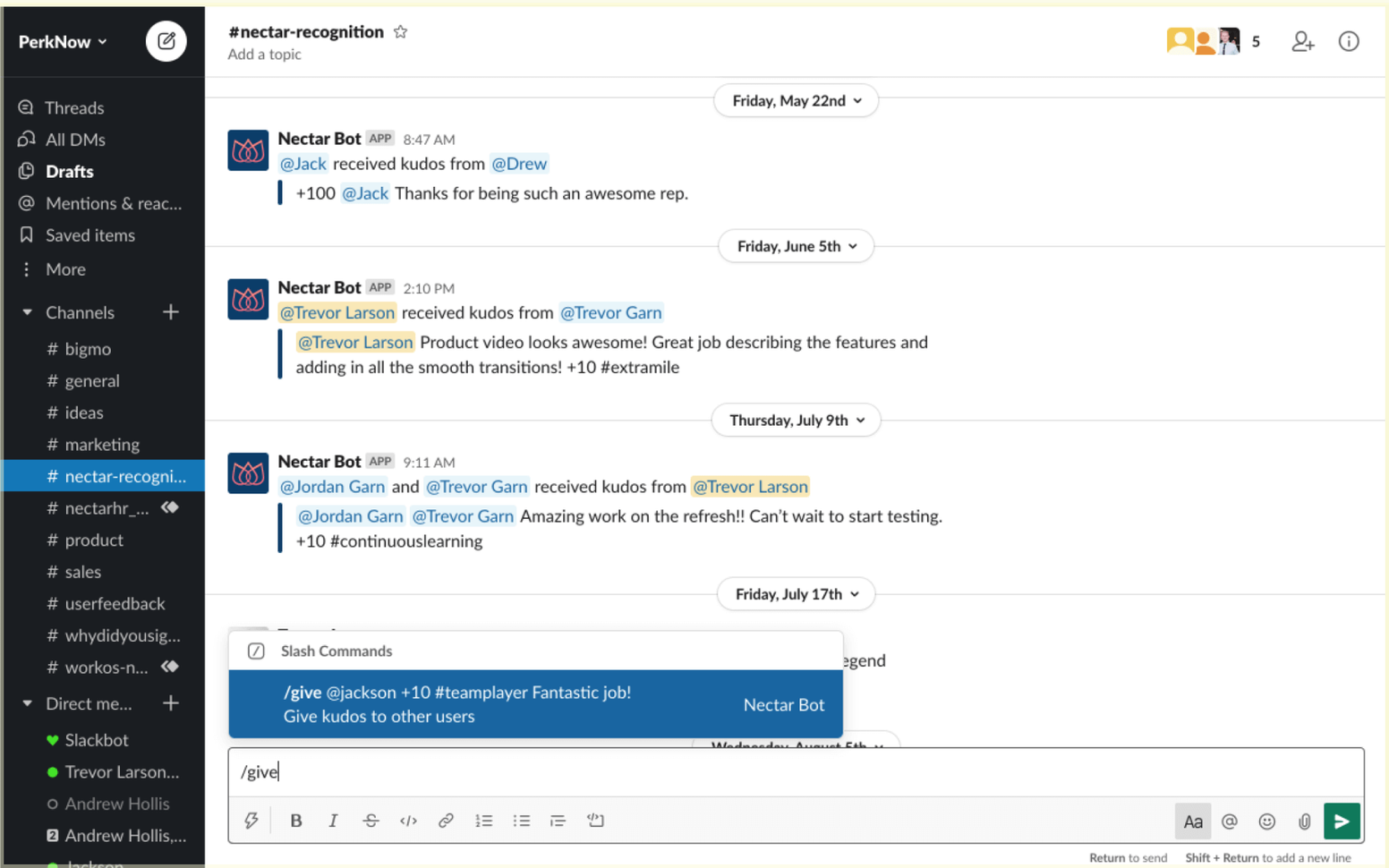
Guusto has no equivalent mechanic, because it has no points. A sender chooses a dollar amount and a recipient, and the gift goes out.
Redemption is unusually flexible: per Guusto’s help center, a recipient can redeem part of a gift and keep the rest, so a $30 gift can be split as $15 at one merchant and $15 at another.
Merchant gift cards do not expire, though prepaid Mastercards do, which is a distinction worth reading carefully before you promise anything to employees. One friction point is documented on the same page: recipients need to create a Guusto account to claim and redeem a merchant gift.

The honest read: Nectar’s points model creates a recurring, distributed habit where everyone has something to give, at the cost of an economy employees have to learn. Guusto’s dollar model is instantly legible to anyone, at the cost of recognition flowing mostly from the people who hold sender seats.
Rewards catalogs and reward funding
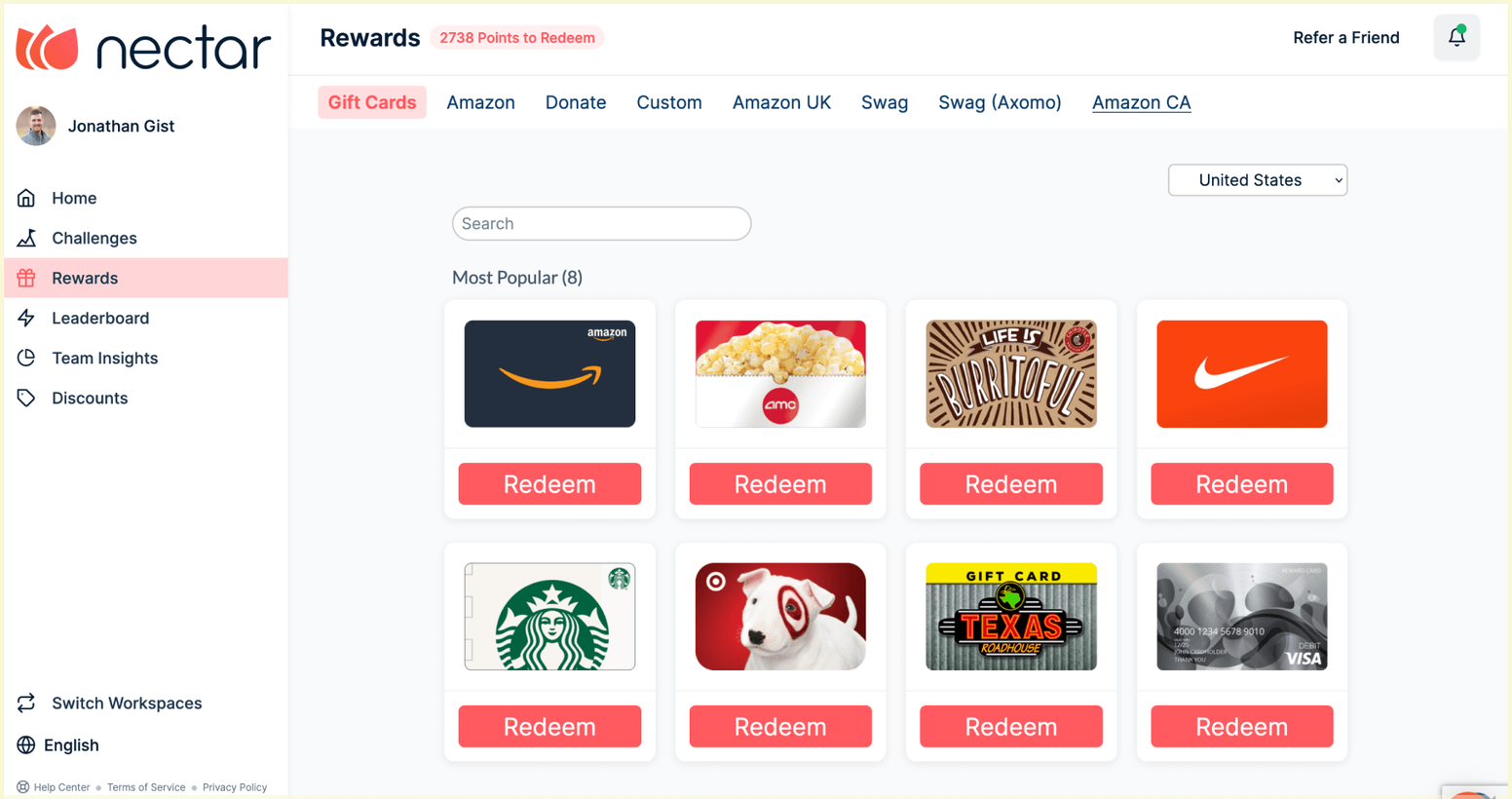
Nectar’s marketplace is the deeper of the two: gift cards, in-platform Amazon breadth, a swag store, charitable donations, and physical or instant reward cards. Two caveats sit in its help center.
Gift cards come in preset denominations that cannot be customized, and cards are country-locked with no cross-country refunds; balance problems are handled by the card provider rather than by Nectar.
Guusto lists over 100 merchants redeemable at more than 60,000 global locations. That is a smaller catalog than Nectar’s, and Amazon gift cards are gated to the Essential plan and above.
What Guusto offers instead is budget integrity: you pay face value for gift cards because Guusto takes its margin from merchants rather than from you, and unclaimed gifts return full credit from the Lite plan up.
Funding is in US and Canadian dollars only; international redemptions convert at the rate on the day, and currency switching is not supported.

| Funding route | Nectar | Guusto |
|---|---|---|
| 0% fee path | Prepay by ACH, check, or wire; $20 international wire fee | No card-processing fee schedule is published; funding by email transfer, bank transfer, wire, or card |
| Prefund by credit card | 3.5% + $0.40 per transaction, nonrefundable, on reward payments only | Not published |
| Billed in arrears | Post-Pay: requires account-manager approval and a 20% security deposit (minimum $100); redemptions pause if a month exceeds the deposit | Not documented publicly |
| Budget recovery | Unused prefunded balance refundable at cancellation on written request | Full credit back on unclaimed gifts, Lite plan and up |
Read that table as a difference in disclosure as much as in cost. Nectar publishes exact reward-funding fees, which makes its total cost modelable before a sales call. Guusto publishes no fee schedule at all, so ask for one in writing. Neither vendor charges you for rewards nobody claims.
Pricing: quote-based bundles vs. sender and recipient seats
The two vendors have moved in opposite directions on pricing transparency, and the models are not directly comparable.
Nectar restructured its pricing page in 2026 into quote-based product bundles, Recognize, Comms, Engage™, and the Culture Suite, plus a set of industry bundles. Every plan CTA is a request for pricing, and no per-user rates, minimums, or contract terms are published.
Third-party listings historically placed entry plans around $4–$5 per user/month with minimum monthly spends of roughly $125 to $200, and SelectSoftware reports a $4,000 minimum annual agreement. Treat those as directional history, not current list prices.
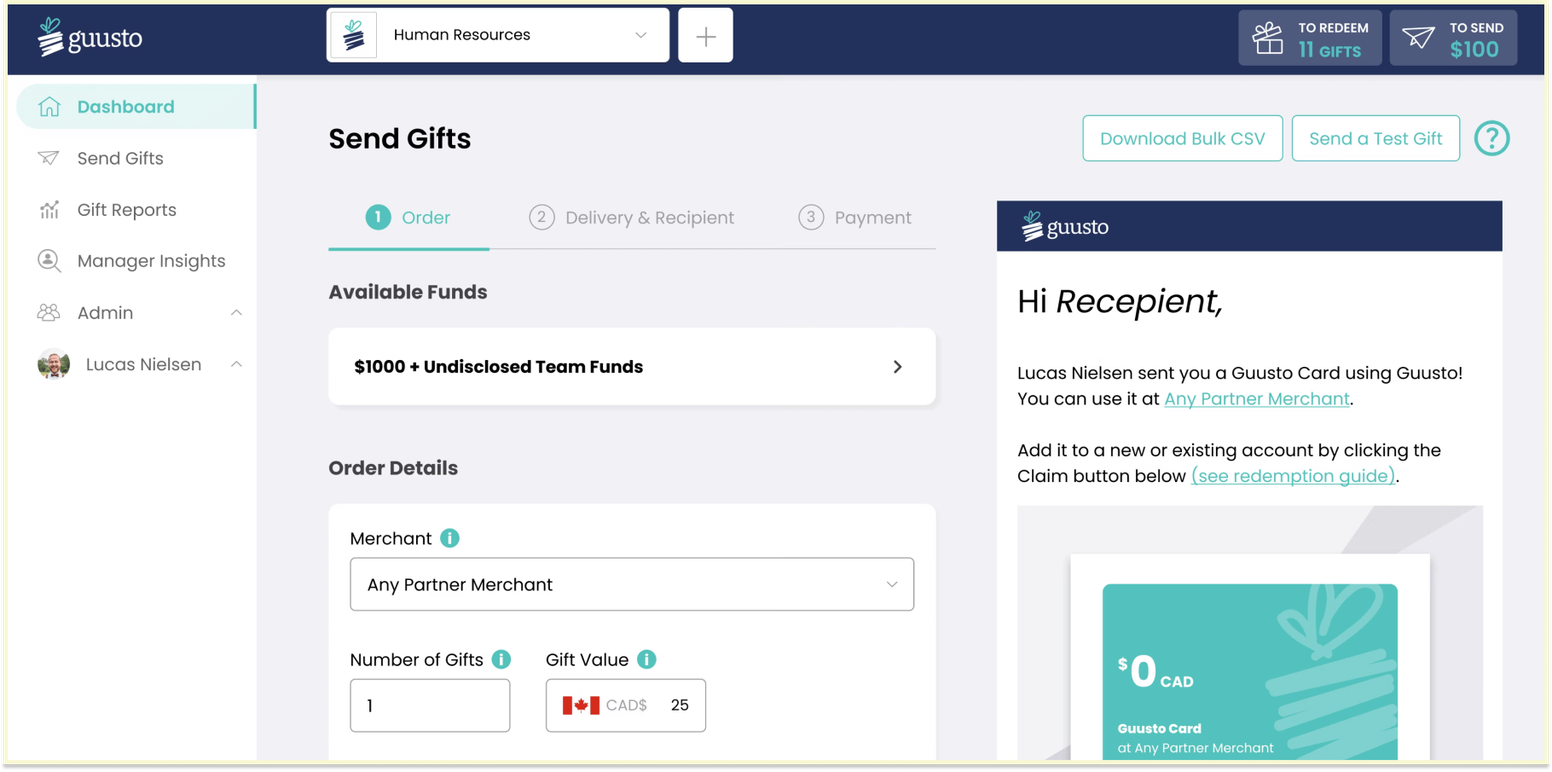
Guusto publishes everything on guusto.com/pricing, but prices by seat type rather than by headcount. A sender seat is someone who can send recognition; a recipient seat is someone who can receive automated rewards and appear as a recipient option.
On the yearly toggle, Essential is $4.00 per sender seat/month plus $0.70 per recipient seat/month with a $200 monthly minimum, and Premium is $5.00 per sender seat/month plus $1.00 per recipient seat/month with a $500 monthly minimum. Lite is a flat $150 per month covering one sender and 250 recipients.
The monthly-billing toggle carries higher sender rates, so confirm those figures on screen before budgeting.
That seat model is genuinely cheap for a program where a handful of managers send to a large workforce, and genuinely awkward for all-hands peer recognition, where everyone who sends needs a full-price sender seat.
It also matters that the recognition-adjacent features sit high in the stack: social feed and leaderboards start at Essential, and Microsoft Teams, SSO, swag, and custom rewards start at Premium with its $500 monthly floor.
Frontline and deskless reach: two different routes
Both vendors are serious about deskless workforces, and they solve it in different ways. This is the most useful comparison in the guide, and the one most articles get wrong by treating frontline coverage as a single checkbox.
Nectar brings the workforce to the platform. Kiosk mode lets shared terminals serve a shop floor or a ward, SMS delivery reaches phones, multi-language support covers mixed workforces, and physical or instant reward cards handle people who will not redeem online.
Its customer base skews toward healthcare and manufacturing, and its Statista case study reports 93% utilization.
One caveat to test with your own staff: Nectar’s mobile apps trail its web experience, at 3.1 stars on Google Play across 120 reviews and 4.4 on the App Store across 96 ratings, with neither app updated since 2024 or early 2025.
Guusto takes the reward to the worker and skips the platform entirely. A gift can arrive by SMS or push, or be printed as a card or QR code and handed over in person, or routed to a manager for delivery on shift.
Its framing stat is that 80% of the global workforce is deskless. Its flagship customer, Compass One Healthcare, runs the program across 68,000 employees in more than 2,200 facilities and reports that twice as many people stay who have received its Gem Award. Premium adds TV and kiosk display for shared spaces.
Choose by where the friction is. If your deskless staff will use a shared terminal or an app, Nectar gives them a full recognition program. If the blocker is that they have no company email, no login, and no reliable device, Guusto’s print and QR delivery is the stronger answer and Nectar has no equivalent.
What G2 reviewers say about Nectar and Guusto
Both products are well liked, and Guusto holds the higher average of the two.
Nectar (4.7 across 8,500+ reviews on G2, the largest review base in the category): per G2’s review summary, recognition capabilities lead the praise with 1,947 mentions, followed by ease of use at 1,856. The criticism is concentrated and consistent.
All five of Nectar’s top dislike themes concern the points economy, roughly 1,600 mentions in total. Van N., a teacher at an enterprise account, put it plainly in a four-star review dated April 22, 2026: “I wish I had more than 50 points to give out each month... I often run out before the month ends.”
Guusto (4.9 across 5,800+ reviews on G2, the highest star average of the three platforms in this guide): ease of use leads with 475 mentions, followed by quick redemption at 262 and merchant variety at 223. Its dislike themes are proportionally small, roughly 204 mentions across the top five on a base of nearly 5,900 reviews, and they cluster on setup confusion, catalog limits, and currency restrictions.
Jhankaar J., a dental office administrator, named the two most structural ones in a review dated June 4, 2026: recipients “must create a Guusto account to redeem rewards,” and “core automation features are paywalled behind higher tiers.” Both halves check out against Guusto’s own help center and pricing page.
For balance, Ryan S., a system developer, wrote on June 22, 2026 that setup “took far less time than expected.”
Where Nectar wins
- It is a complete program: peer points, values-based recognition, awards and nominations, automated celebrations, and analytics in one platform, where Guusto ships a deliberately thin recognition layer.
- Rewards depth: in-platform Amazon breadth, a swag store, donations, and physical reward cards against Guusto’s 100+ merchants.
- Surveys: Nectar Engage™ covers engagement surveys, eNPS, onboarding and exit templates, and anonymous feedback. Guusto has no survey product at all.
- Everyone can give: a monthly allowance for every employee, rather than recognition flowing from paid sender seats.
- Published reward-funding fees: exact percentages and per-transaction costs, where Guusto publishes no fee schedule.
- Marketplace presence: 2,319 Microsoft Teams app store ratings at 4.4, plus a SHRM partnership and logos including Major League Baseball and the Golden State Warriors.
- Documented outcomes: its 1st Choice Cabinetry case study reports turnover falling from 25% to 7%.
Where Guusto wins
- Reaching people software usually misses: printed cards and QR codes work with no email, no login, and no device, plus route-to-manager handoff. Nectar has no equivalent offline path.
- Published pricing: full seat rates and minimums are on the pricing page, where Nectar requires a sales conversation for any number.
- Budget integrity: face-value gift cards with no markup, and full credit back on unclaimed gifts.
- Review scores: 4.9 on G2 across roughly 5,900 reviews, the highest average of the three platforms here.
- Cheap for few senders: $150 per month covers one sender and 250 recipients, and recipient seats cost a fraction of sender seats.
- Redemption flexibility: partial redemption across merchants, merchant gift cards that do not expire, and a prepaid Mastercard fallback.
- Social impact: a day of clean drinking water donated through the One Drop Foundation for every gift sent, plus the founders’ 1% equity pledge to the Canadian Mental Health Association.
The third option: Matter
Nectar assumes recognition lives in its own app on a monthly points budget. Guusto assumes recognition is a gift someone sends. Matter makes a different bet: recognition should live inside Slack and Microsoft Teams with no separate app or login, and run on a weekly rhythm.
Every week, Feedback Friday™ (US Patent 12,199,935) prompts the whole team to recognize someone, and give-coins reset weekly so they get used rather than hoarded.
The effect is measurable: in The Recognition Habit, Matter’s 2026 Benchmark Report, built on aggregate, de-identified platform data, teams that build recognition around a weekly ritual give about 2.5x more recognition per member than ad hoc teams, and roughly 8 in 10 ritual teams stay active in nearly every month.
On this guide’s criteria: Matter’s Free plan is for unlimited users, paid tiers are published at $1 to $5 per user/month, billed annually, and Matter hasn’t raised prices in 8 years.
Reward-funding fees are published too, including a 0% ACH prepay path, and the catalog spans 10,000+ eGift card options across 200+ countries. On the Microsoft Teams app store, Matter holds a 5.0 across 1,476 ratings.
Two honest limits. If a large part of your workforce has no company email and no device, Guusto’s printed and QR delivery reaches people Matter cannot, and Matter is built for teams that live in Slack or Teams.
And if you want kiosk terminals, SMS delivery, an Amazon-scale catalog, or a survey suite bundled with recognition, Nectar covers more ground in one contract. For the detailed head-to-heads, see Nectar vs. Matter and Guusto vs. Matter.
Which platform is right for your team?
Choose Nectar if:
- You want an ongoing peer recognition program, not a gifting workflow, and every employee should have something to give each month.
- Rewards catalog depth, including Amazon, is a deciding factor.
- You want recognition and a full survey suite from one vendor and are comfortable with quote-based pricing.
Choose Guusto if:
- Your hardest problem is delivery: frontline, deskless, or offline staff with no company email or login.
- A small group of managers sends most of the recognition, which makes sender-seat pricing cheap.
- Face-value gift cards, credit back on unclaimed gifts, and a charitable donation on every gift matter to how you spend.
Choose Matter if:
- Your team lives in Slack or Microsoft Teams and you want recognition there, not in another app.
- You prefer a weekly recognition ritual over a monthly points budget or one-off gifts.
- You want to start free with unlimited users and see published pricing before talking to anyone.
Frequently asked questions about Nectar vs. Guusto
Is Nectar or Guusto cheaper?
Guusto is the easier one to price because it publishes everything: a free sending tier, Lite at $150 per month for one sender and 250 recipients, and Essential at $4.00 per sender seat/month plus $0.70 per recipient seat/month on yearly billing with a $200 monthly minimum.
Nectar is quote-based, so there is no list price to compare; third-party listings historically placed entry plans around $4–$5 per user/month with minimum spends. Which is cheaper depends on shape rather than headcount.
A few managers sending to a large workforce is usually cheaper on Guusto; an all-hands peer program where everyone gives is usually cheaper per person on a platform that charges by user, because every Guusto sender needs a full-price seat.
What is the main difference between Nectar and Guusto?
Nectar is a recognition platform and Guusto is a gifting and delivery tool. Nectar runs a monthly peer points economy with a rewards marketplace, surveys, and analytics. Guusto has no points and no surveys; it sends dollar-denominated gifts and specializes in getting them to people with no email, login, or desk through SMS, print, and QR delivery.
Which is better for frontline or deskless teams, Nectar or Guusto?
Both are strong, by different routes. Nectar brings deskless staff into a full recognition program through kiosk mode, SMS, multi-language support, and physical reward cards. Guusto skips the platform and delivers the gift itself, including printed cards and QR codes that need no login.
If your staff will use a shared terminal or an app, Nectar does more; if they cannot log into anything, Guusto is the more reliable delivery path.
Do Nectar and Guusto offer free plans?
Guusto has a free tier for basic sending, covering email and SMS delivery, offline print and QR codes, 100+ merchants, and the mobile app, but not automation, analytics, or integrations. Nectar has no free plan; trials are arranged through a demo signup. Among alternatives, Matter’s Free plan supports unlimited users.
Do Nectar points or Guusto gifts expire?
On Nectar, monthly give-points expire at each reset, while earned redeem-points never expire during employment but are lost when an employee is removed, so departing staff should redeem before their last day.
Guusto has no points: per its help center, merchant gift cards do not expire, but prepaid Mastercards do, and unclaimed gifts can be canceled for full credit on the Lite plan and above.
Nectar vs. Guusto: the bottom line
This is not a close head-to-head, because it is not really a head-to-head. Nectar is the better buy if you want a recognition program with points, rewards depth, and surveys under one contract.
Guusto is the better buy if your real problem is getting a gift into the hands of someone who will never log in, and you want face-value cards with credit back on what goes unclaimed.
If neither framing fits, because your team already lives in Slack or Teams and you want recognition to become a weekly habit there, that is the case for Matter. Related reading: Nectar alternatives, Guusto alternatives, and the full comparison hub.

![Kudos vs. Guusto Comparison: Pricing & Reviews [2026 Guide]](https://cdn.sanity.io/images/kqqb5xry/production/d9d58b9b0e1abec150e7babb455e00c824355cdc-800x600.jpg?w=720&q=75&fit=max&auto=format)
![Kudos vs. Nectar Comparison: Pricing & Reviews [2026 Guide]](https://cdn.sanity.io/images/kqqb5xry/production/534ba04d43c4301bb06b3935c0d5a2d507f52642-800x600.jpg?w=720&q=75&fit=max&auto=format)
![Guusto vs. Matter Comparison: Pricing & Reviews [2026 Guide]](https://cdn.sanity.io/images/kqqb5xry/production/1987eb759fd8e16f1a524c3b27fc2fa0150b2606-800x600.jpg?w=720&q=75&fit=max&auto=format)