

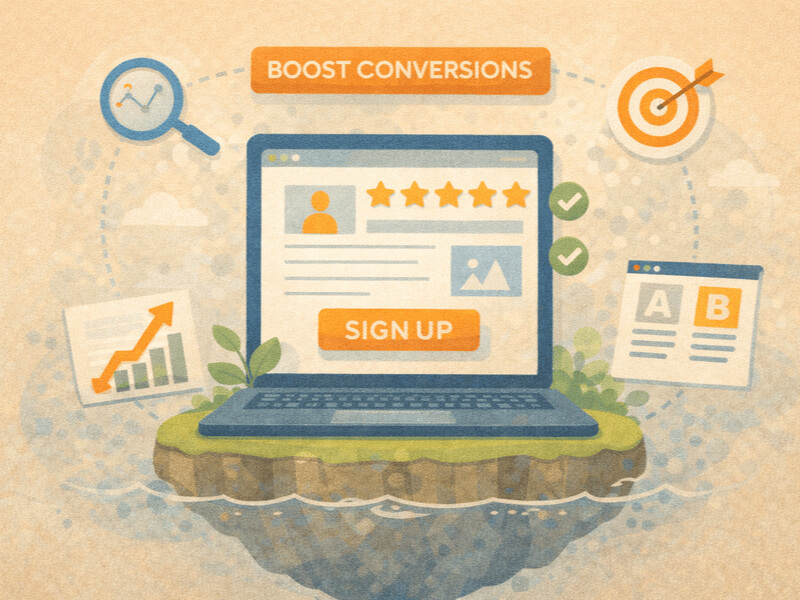
So, your website and your landing pages in particular haven’t been putting in the best performance lately, and you want to address the situation, but don’t know where to start. That’s an issue that almost all online businesses have come across at one point. Websites are powerful tools, but they’re also incredibly complex and challenging to manage, which means one can make plenty of mistakes that can lead to all sorts of problems, such as reduced customer trust, low conversion rates, and lost revenue.
Referring to landing pages in particular, they carry a heavy load. Their purpose is to convince visitors to take a specific action, whether that is purchasing a certain product or service, subscribing to a mailing list, registering for a webinar, downloading files, etc. Therefore, landing pages are instrumental to the success of online marketing campaigns as they deliver targeted messaging that can gather audience insights, enhance user experience, boost conversion rates, and increase sales.
But they can only deliver the expected results if you build and optimize them correctly. So, if you want to create killer landing pages that can help you achieve your business goals, here’s what you need to focus on.
Focus on one single goal
Every landing page should focus on a single objective and encourage users to do one thing only, through a clear call to action (buy, sign up, download, etc.). That means you first need to decide what you want to achieve with each page. You might be tempted to include more CTAs on a landing page, thinking you can hit more targets with just one shot, but that will most likely have the opposite effect, as it can confuse users, cause decision fatigue, and consequently affect conversion rates.
Besides, there’s no need to have one landing page do all the heavy lifting. You can and should create a different landing page for every action you want your visitors to take. Research shows that companies with a large number of landing pages tend to perform better in terms of lead generation than those that only have a few.
To make things as clear as possible, you can place the CTA button at the very beginning of the page, and then repeat it at key points throughout the content, to make sure users don’t get sidetracked. So, if you have landing pages with multiple CTAs, split them up and you’ll notice the difference.
Start strongly with a catchy headline
First impressions matter, and that’s particularly true with landing pages. That emphasizes the need to start each page with a strong, catchy headline that captures users’ attention. A good headline for a landing page should be succinct and explain the value proposition plainly, so that everyone understands the message. People should know right off the bat what the page is about; otherwise, they won’t stick around to find out because no one has the time or the interest to solve riddles and decipher mysteries.
While you can get creative with headlines, it’s best to avoid jargon or metaphors as these can create ambiguity. Being clear is better than being clever, so make sure the headline expresses what the landing page offers and what users stand to gain from taking the required action. Mentioning a specific pain point, talking about the need that the page addresses, and providing proof of the benefits that users can enjoy are all great methods for writing attention-grabbing headlines.
Know your users’ tech needs
Users view landing pages on a variety of devices, from iPhones and Android phones to desktop screens, laptops, and tablets. Knowing what device type your target audiences use predominantly when navigating your site is important because it will help you create landing pages that suit their needs, which will ensure a smoother experience.
Regardless of people’s preferred devices for web browsing, optimizing landing pages for mobile use is a must, but if you want to take things one step further, you can design separate pages optimized for specific devices. Also, if you’re not a tech whiz and don’t want to deal with any of the technicalities of creating high-converting pages for your offers, using a landing page builder can simplify the process considerably and save you the hassle.
Keep it simple
Simplicity is the best policy when creating effective landing pages. That means you should avoid adding too many elements on a single landing page, as this can hinder navigation and distract from the main goal of the page. A clean and airy design can significantly improve the performance of your landing pages.
If you’ve noticed your pages look a bit too crowded, here’s how you can clear the clutter:
- Eliminate menus and leave only the CTA in the header to simplify navigation. By removing any other clickable elements, visitors are guided straight toward the intended action.
- Get rid of sidebars, widgets, pop-up and any other design features that can be distracting for visitors.
- There should be enough white space around the elements to provide visual breaks and help users pause and process the information.
- Only keep images that align with and reinforce the message you’re trying to deliver.
- Use colours wisely by choosing a limited number of hues that reflect your company’s image and ensure contrast and readability.
Final thoughts
In digital marketing, most paths lead to landing pages, so optimizing them should be high on your priority list if you want your campaigns to bring the expected results. Also, keep in mind that landing page optimization is a process that never stops, so you should continue to test, tweak, and refine your pages to ensure they remain relevant and match your company’s evolving needs.