

The 30-second verdict: Motivosity or Nectar?
Choose Motivosity if you want recognition denominated in real dollars rather than points, a spendable ThanksMatters Visa card your people can tap at checkout, the stronger mobile apps of the pair, and an employee-insights layer with eNPS and AI turnover signals – and your budget clears a $3,000 minimum annual investment.
Choose Nectar if a meaningful share of your workforce is frontline or deskless (kiosk mode, SMS delivery, and physical reward cards), you want the deeper rewards marketplace including in-platform Amazon breadth, or you need a full employee-listening suite from the same vendor, and a demo-led, quote-based buying process does not put you off.
A third option exists: if what you actually want is recognition running inside Slack or Microsoft Teams with published pricing, Matter is covered near the end of this guide.
Motivosity and Nectar land on the same shortlists for good reason: both are mid-market recognition and rewards platforms built on a monthly giving allowance, both treat the rewards budget as a separate line item, and as of 2026 both put their prices behind a demo.
This comparison was verified in August 2026 against both vendors’ pricing pages, their own help-center documentation, and their live G2 profiles. Full disclosure: this guide is published by Matter, an employee recognition platform that competes with both Motivosity and Nectar.
We have kept the head-to-head honest, we say plainly where each product wins, and we introduce Matter only near the end as a third option. Weigh our perspective accordingly, and get a written quote from each vendor before you buy.
How we researched this comparison
We build Matter, which competes with both platforms on this page, so weigh our perspective accordingly.
For Motivosity and Nectar we reviewed each vendor’s public pricing, product pages, and help-center or billing documentation, plus their G2 profiles and named, dated reviews, and we drew on conversations with teams evaluating and switching between recognition platforms. We have not used either product hands-on.
Every claim here is sourced to the vendors’ own materials, named reviews, or Matter’s published data, and facts were last verified in August 2026.
Motivosity vs. Nectar at a glance
| Motivosity | Nectar | Matter | |
|---|---|---|---|
| Starting price | Quote-based bundles; $3,000 minimum annual investment is the only published figure | Quote-based since 2026; third-party listings historically placed entry plans around $4–$5 per user/month | Free plan, then $1 to $5 per user/month, billed annually; public tiers |
| Free plan | No; demo-led, no self-serve trial on the pricing page | No; trial via demo signup | Yes, unlimited users |
| G2 rating | 4.7 (3,615 reviews) | 4.7 (8,579 reviews) | 4.7 (1,186 reviews) |
| Teams app store | 4.2 (58 ratings) | 4.4 (2,319 ratings) | 5.0 (1,476 ratings) |
| Best for | Mid-market teams that want dollar-denominated recognition and a spendable Visa card | Frontline and deskless workforces; the deeper rewards marketplace and a full survey suite | Slack/Teams-first teams that want recognition inside chat |
Recognition mechanics: how Motivosity bucks and Nectar points work
Both platforms run the same two-balance economy: a giving allowance that refills monthly, and an earned balance employees redeem for rewards. The interesting differences are in the denomination and the admin controls.
Motivosity: dollars to give, dollars to spend
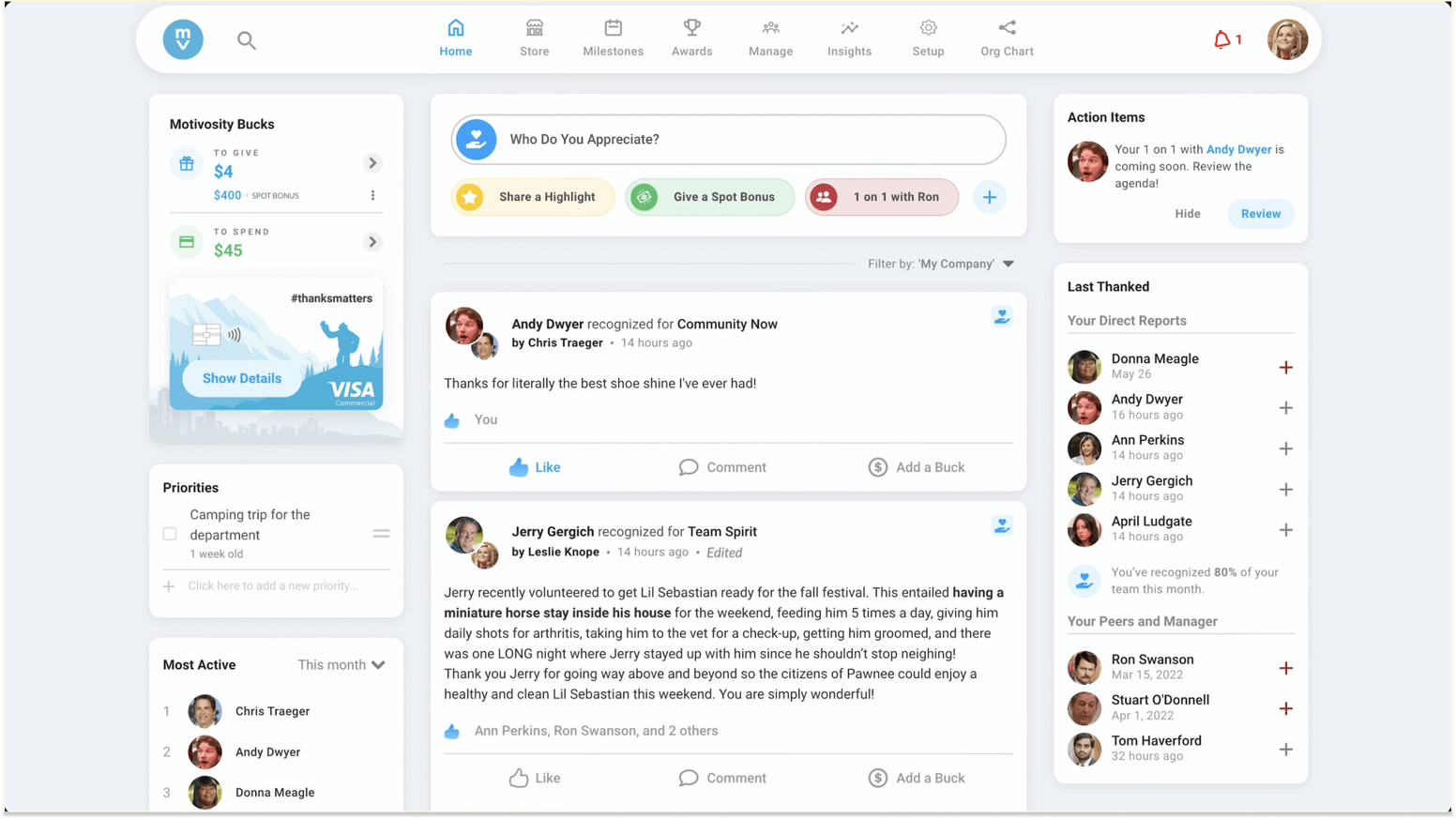
Motivosity splits balances into To Give and To Spend, and its currency is real money – one Motivosity buck equals one US dollar, so there is no points-conversion math for employees to decode.
Per Motivosity’s own General User FAQ, unused To Give dollars “reset on the first of each month without rollover,” making it a textbook monthly allowance. Earned To Spend dollars generally do not expire, though the help center notes some companies may set expiration policies.
Admins configure Monthly Giving Defaults to give everyone the same allowance, then layer Special Giving Rules by user, team, org, or custom criteria; rules stack, and role changes recalculate direct-report rules, which can reduce a giving balance mid-cycle. Bulk Balance Adjustments let admins mass-edit both balances. No admin-facing anti-gaming controls are documented in the published help articles.
Nectar: monthly give-points, never-expiring redeem points
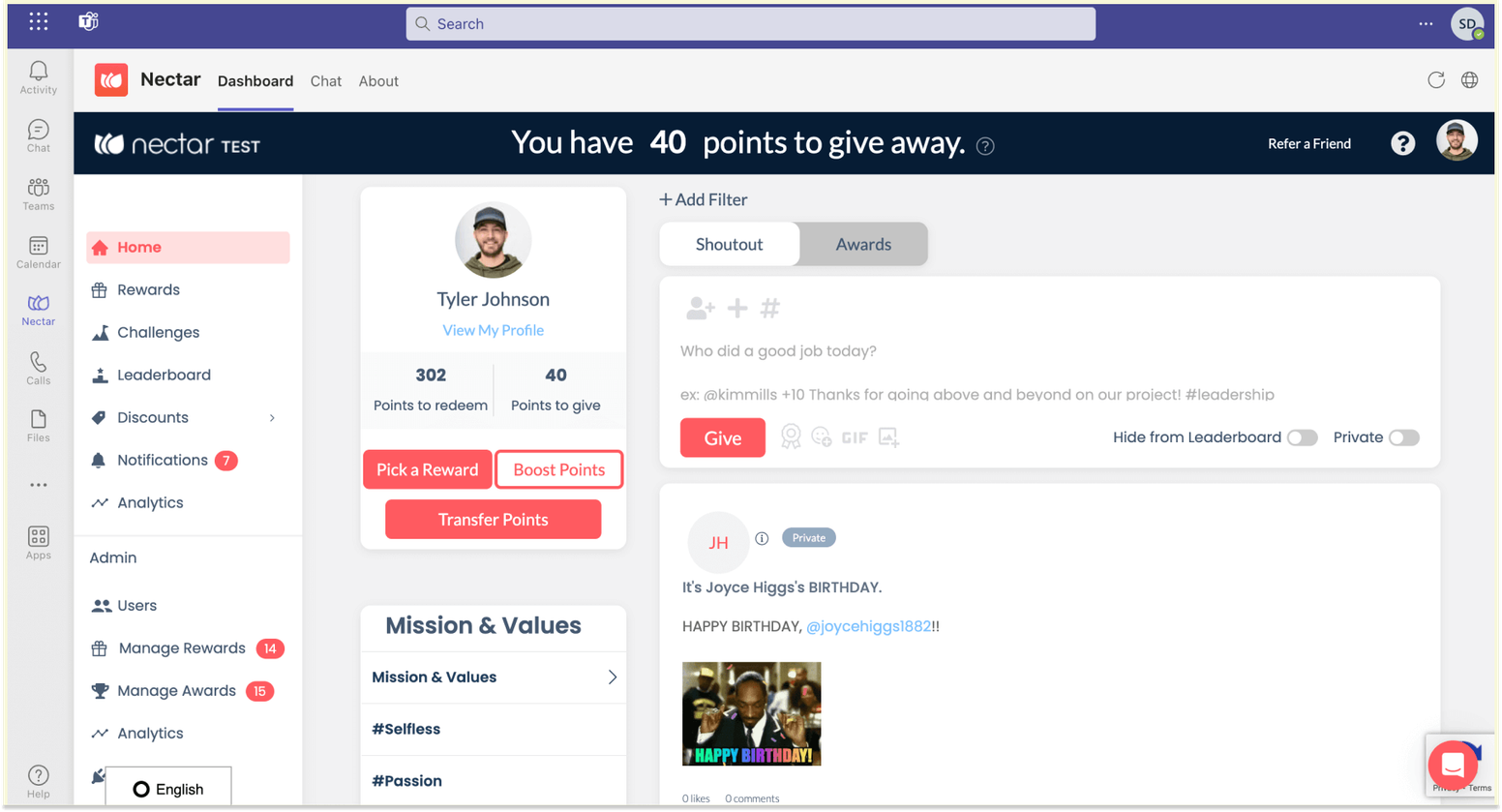
Nectar uses the same shape with points instead of dollars. Points to Give reset on the 1st of each month and unused give-points expire; Points to Redeem do not expire while an employee is with the company, so people can save toward larger rewards.
Customer deployments put the conversion at 10 points to $1. Admins get Variable Rate Allowances, rule-based monthly allowances by department, location, or employment type, and mid-month changes only take effect at the next monthly reset – another sign the cadence is rigidly monthly.
Boosted Points let employees convert earned points back into giving points. Nectar also sends reminder emails nudging people to spend their budget before the month closes, a touch several reviewers single out for praise.
One thing to plan for: when an employee is removed from Nectar, their points are lost, so departing staff should redeem before their last working day.
The honest synthesis: these are two implementations of the same monthly-allowance design, and they carry the same trade-off. Monthly budgets favor saving toward meaningful rewards, and on both platforms the largest cluster of G2 criticism concerns the points economy itself – allowance size, unused budget expiring, and redemption thresholds.
Motivosity’s advantage is clarity of denomination; Nectar’s is the granularity of its allowance rules. Neither has a structural edge on cadence.
Rewards catalogs and funding fees: Motivosity vs. Nectar
On both platforms you pay for rewards employees actually redeem, and unredeemed balances cost nothing. How you get money into the system, and what that costs, is where they diverge.
Motivosity rewards and funding
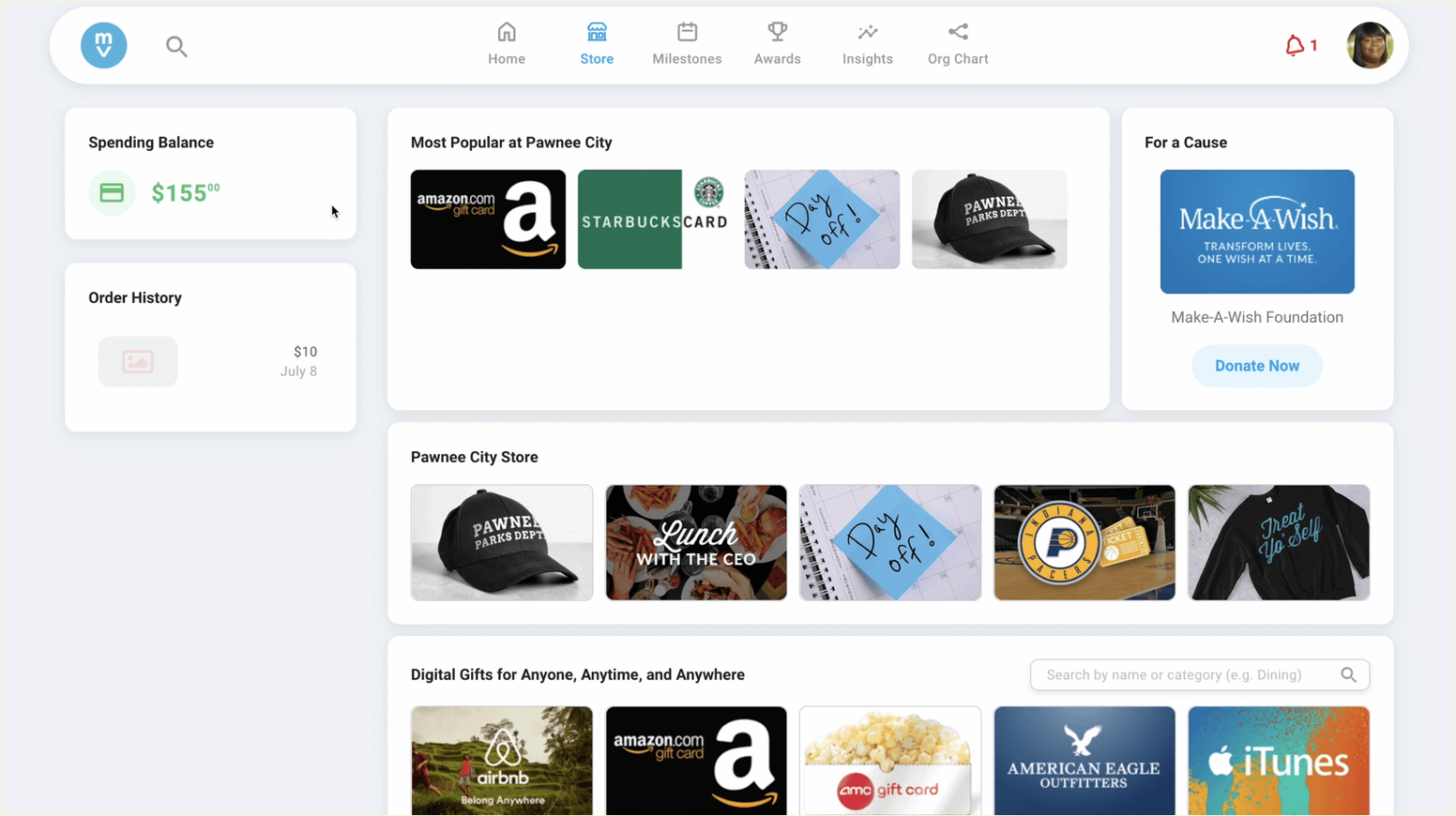
Motivosity claims 500M reward options across 175+ countries, with 70+ languages, 140 currencies, and tax support in 63 countries. Its signature is the ThanksMatters Visa card – powered by Stripe, issued by Celtic Bank – which lets employees tap-to-pay earned dollars, with Apple Wallet support.
Worth knowing before you sell it internally: generic Visa reward cards are fulfilled through Tango Card, card support runs through Prepaid Digital Solutions, disputes go to that third party rather than Motivosity, and physical cards take up to 45 days to arrive.
Funding is prepay only, per Motivosity’s help center: a US bank account by ACH at no fee, clearing in 5–6 business days, or a US-based credit card at a 3.5% transaction fee that processes in about 4–6 hours.
Deposit caps start at $1,000, rise to $2,500, then top out at $50,000 per ACH transfer or $5,000 per card transaction. Funding sources are US-only, which is real friction against the 175-country story. The help article does not address refunds of unused prefunded balance at cancellation.
Nectar rewards and funding
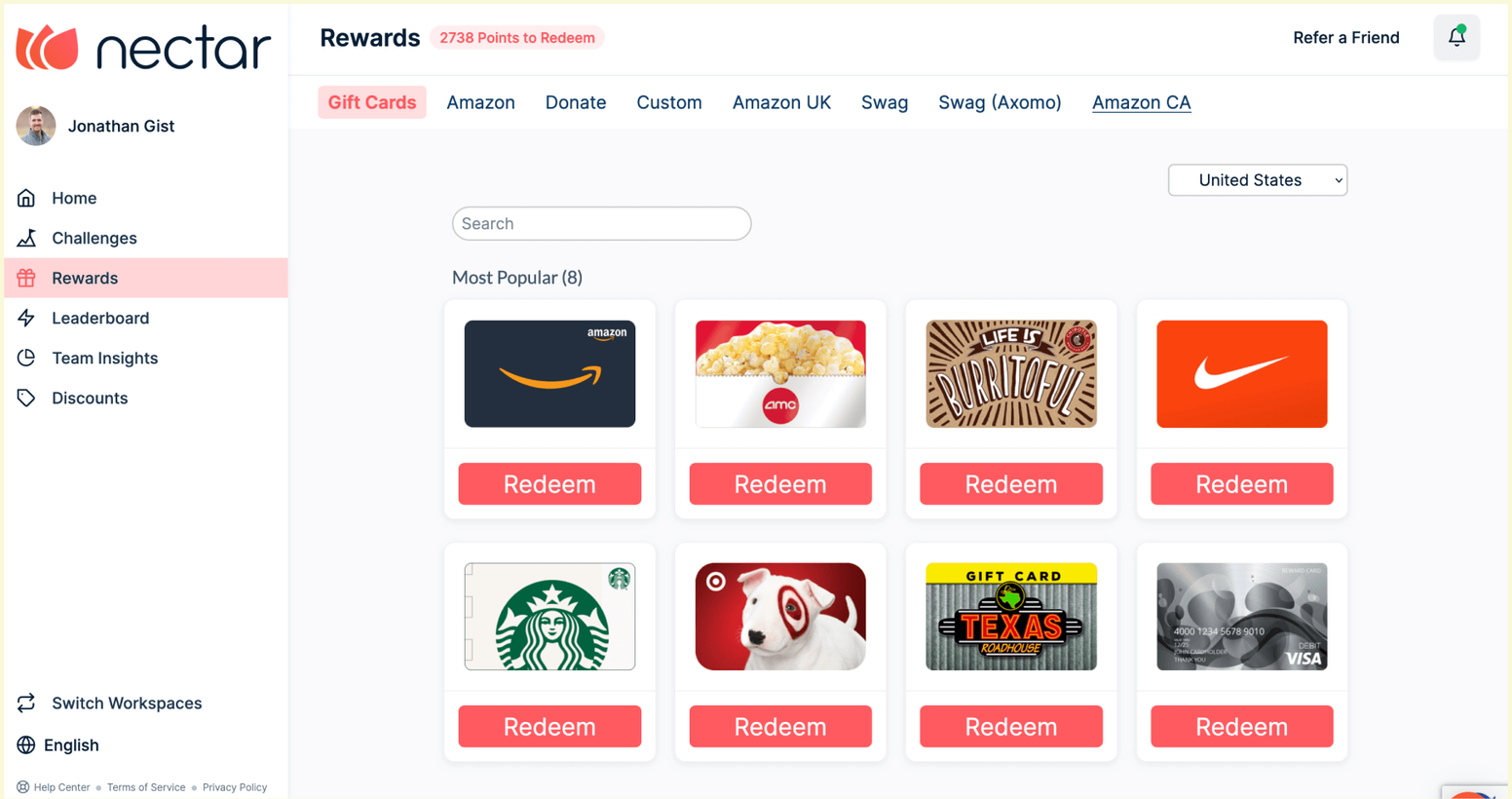
Nectar’s marketplace is the deeper of the two: gift cards, in-platform Amazon breadth, a swag store, charitable donations, and physical or instant reward cards.
Two catalog caveats to test against your workforce: gift cards come in preset denominations only, and cards are country-locked, with balance issues handled by the card provider rather than Nectar.
Per Nectar’s rewards billing documentation, the default mode (confusingly named Pay As You Go) is a prefunded auto-refill balance that tops up when it drops below 20% of the refill amount.
Prepaying by check, ACH, or wire is fee-free; credit-card reward payments carry a nonrefundable 3.5% + $0.40 per-transaction fee, and international wires cost $20.
A genuine billed-in-arrears option, Post-Pay, exists but requires account-manager approval, an estimate of annual reward spend, and a 20% security deposit (minimum $100); redemptions stay disabled until the deposit is paid and pause if a month’s redemptions exceed it. One switcher-friendly detail: unused prefunded balance is refundable on written request at cancellation.
| Funding route | Motivosity | Nectar |
|---|---|---|
| 0% fee path | ACH from a US bank account; clears in 5–6 business days; caps of $1,000, then $2,500, then $50,000 per transfer | Check, ACH, or wire; no published minimum ($20 international wire fee) |
| Prefund by credit card | 3.5% transaction fee; processes in about 4–6 hours; US-based cards only; caps of $1,000, then $2,500, then $5,000 per transaction | 3.5% + $0.40 per transaction, nonrefundable |
| Billed in arrears | Not offered; funding is prepay only | Post-Pay: account-manager approval plus a 20% security deposit (minimum $100) |
| Unused balance at cancellation | No refund terms published | Refundable on written request |
Read that table by how you actually pay. If you fund by ACH, the headline rate is 0% on both, but Motivosity makes you wait almost a week and caps transfers, while Nectar clears through check, ACH, or wire with no published cap.
If you fund by card, Motivosity is marginally cheaper on small deposits (no per-transaction add-on) and much faster to clear. If you want to avoid parking cash entirely, only Nectar offers an arrears route, and it comes with an approval gate and a deposit.
Pricing transparency: two quote-gated vendors
Neither vendor publishes per-user rates, so this section is about how much each one tells you before the sales call.
Motivosity sells through three promoted bundles – For Celebrating People, For Building Culture, and For Scaling Globally – plus seven industry bundles, all quote-gated on motivosity.com/pricing.
The one hard number it does publish, on both the pricing page and its FAQ, is a $3,000 minimum annual investment, and its own 2026 recognition-software roundup names that minimum as a barrier for very small teams.
Its FAQ describes the model as transparent and predictable pricing while publishing no rates, and the 3.5% card funding fee appears only in the help center, not in the FAQ’s no-hidden-fees language. Motivosity also sets expectations at 30–60 days to launch with 5–10 hours of admin time.
Nectar moved to quote-based pricing in 2026, restructuring its pricing page into product bundles – Recognize, Comms, Engage™, and the Culture Suite – alongside eight industry and use-case bundles, with every CTA leading to a demo. No minimums or contract terms are published.
Third-party listings historically placed entry plans around $4–$5 per user/month with minimum monthly spends of roughly $125–$200, and SelectSoftware reports a $4,000 minimum annual agreement; treat all of those as third-party estimates rather than current list prices.
Two practical consequences. First, you cannot budget either platform without a sales conversation, so run both quotes in parallel and ask for them in writing. Second, on both platforms the rewards budget sits on top of the software fee, so model platform cost, rewards spend, and funding fees as three separate lines.
Surveys and engagement: Motivosity insights vs. Nectar Engage
If employee listening is on your requirements list, this is the section that will likely decide the comparison.
Motivosity offers an employee-insights module covering eNPS alongside its Appreciation Intelligence branding, which adds AI-assisted recognition writing and AI-powered turnover-risk signals. It is a real capability, and the turnover-risk angle is genuinely useful to HR leaders, but it is a module that adds per-employee-per-month cost to your quote rather than a full survey builder.
Nectar Engage™ is the fuller employee-listening product: a proprietary engagement survey, eNPS, onboarding and exit templates, a custom survey builder with scheduling and segmentation, anonymous feedback through SafeTalk, and AI sentiment analysis, with benchmarking flagged as coming soon.
It is sold as its own bundle, so it becomes a distinct line in your quote. Teams that need survey depth from the same vendor should lean Nectar; teams that mainly want a risk signal attached to recognition data will find Motivosity’s insights sufficient.
Frontline and deskless teams: Motivosity vs. Nectar
Nectar was built with non-desk workforces in mind: kiosk mode for shared terminals, SMS delivery, multi-language support, and physical or instant reward cards. Its customer base skews toward healthcare and manufacturing, and its Statista case study reports 93% utilization.
One caveat to test with your own staff: Nectar’s mobile apps trail its web experience, at 3.1 stars on Google Play (120 reviews, last updated September 2024) and 4.4 on the App Store (96 ratings, last updated March 2025).
Motivosity approaches the same problem from the phone rather than the terminal. Its mobile apps are the strongest of the pair – 4.8 on the App Store across roughly 5,700 ratings and 4.8 on Google Play across 815 reviews, both shipped within a day of each other in August 2026 – and the ThanksMatters Visa card works anywhere a card is accepted, which suits shift workers who have a phone but no company laptop.
What it does not document is kiosk or SMS delivery for workers with no device at all, and its US-only funding sources matter if your frontline is spread across countries.
The honest split: if your people share terminals or have no work device, Nectar’s delivery options are the safer bet. If they carry phones and value instant spendable rewards, Motivosity’s experience is more polished.
What G2 reviewers say about Motivosity and Nectar
Both platforms hold a 4.7 on G2, so the score alone will not separate them. The volume and the review text will.
Motivosity (4.7 across 3,615 reviews on G2): the leading praise themes are the ease of the recognition process (491 mentions), peer recognition (345), and a user-friendly interface (333).
Stacie D., an HR Operations Specialist at a mid-market company, wrote in a five-star review from June 3, 2026 that the “reporting side is a massive time-saver for anyone running team evaluations.”
The criticism clusters in two places: roughly 150 mentions across the top dislike themes concern the points economy (limited recognition options at 69, reward limitations at 59, insufficient points or budget at 33, redemption issues at 31), and another 135 or so concern navigation and interface.
Clayton M., a Manager of Customer Success at a mid-market company, described the month-end effect in a 4.5-star review from April 21, 2026: “[at month end] you would still have money to spend and it felt like you were just trying to come up with something to compliment someone on, which didn’t feel as genuine.”
Nectar (4.7 across 8,579 reviews on G2, the largest review base in the category): per G2’s review summary, recognition capabilities (1,947 mentions), ease of use (1,856), and community or morale (1,676) lead the praise, and Ryan L. (February 5, 2026) called Nectar’s budget reminder emails “the most helpful thing” about the platform.
The criticism mirrors Motivosity’s but at far greater volume: the top five dislike themes all concern the points system, totaling roughly 1,600 mentions.
Van N., a teacher at an enterprise account, wrote in a four-star review from April 22, 2026: “I wish I had more than 50 points to give out each month... I often run out before the month ends.”
That symmetry is the real finding. Two platforms, two very different review bases, one shared top complaint class – and it is about the monthly allowance model itself rather than bugs or support.
Where Motivosity wins
- Dollar-denominated recognition: one buck equals one dollar, so nobody has to translate points into value. Nectar runs at 10 points to $1.
- The ThanksMatters Visa card: tap-to-pay redemption with Apple Wallet support is the most immediate reward experience of the pair.
- Mobile apps: 4.8 on the App Store (roughly 5,700 ratings) and 4.8 on Google Play (815 reviews), both actively shipped in August 2026.
- A published price floor: the $3,000 minimum annual investment appears on both its pricing page and its FAQ, which is more than Nectar publishes anywhere.
- Documented adoption: Old National Bank reports 85% adoption in the first month rising to 90%, 12,000+ peer recognition moments, and about one workday per week of admin time recovered; Priority Dispatch reports 97% adoption.
- Faster card funding: credit-card deposits process in about 4–6 hours, against Nectar’s auto-refill threshold model.
- Turnover-risk insights: eNPS plus AI risk signals sit alongside recognition data in one module.
Where Nectar wins
- Rewards marketplace depth: in-platform Amazon breadth, a swag store, donations, and physical or instant reward cards.
- Frontline delivery: kiosk mode, SMS, and multi-language support for workers who never touch a laptop.
- A full survey suite: Engage™ covers engagement surveys, eNPS, onboarding and exit templates, anonymous feedback, and AI sentiment analysis.
- Review volume and marketplace presence: 8,579 G2 reviews to Motivosity’s 3,615, and 2,319 Microsoft Teams app store ratings at 4.4 to Motivosity’s 58 at 4.2.
- Funding flexibility: a fee-free path via check, ACH, or wire with no published cap, a genuine billed-in-arrears option, and refunds of unused prefunded balance on written request.
- Social proof: 1,700+ customer organizations, an SHRM partnership, and case studies including Statista at 93% utilization and 1st Choice Cabinetry reporting turnover falling from 25% to 7%.
- Global funding routes: international wires are supported, where Motivosity’s funding sources are US-only.
The third option: Matter
Both platforms above assume recognition lives in their own app, funded by a monthly allowance. Matter makes two different bets: recognition should happen inside Slack and Microsoft Teams with no separate app or login, and it should run on a weekly rhythm rather than a monthly budget.
Each week, Feedback Friday™ (US Patent 12,199,935) prompts the whole team to recognize someone, and give-coins reset weekly so they are spent rather than hoarded.
The cadence is measurable: in The Recognition Habit, Matter’s 2026 Benchmark Report, built on aggregate, de-identified platform data, teams that build recognition around a weekly ritual give about 2.5x more recognition per member than ad hoc teams, and roughly 8 in 10 ritual teams stay active in nearly every month.
On this guide’s buying criteria: Matter’s Free plan is for unlimited users, paid tiers are published at $1 to $5 per user/month, billed annually, and Matter hasn’t raised prices in 8 years.
Reward funding fees are published too, including a 0% ACH prepay path, and the catalog spans 10,000+ eGift card options across 200+ countries.
Matter holds a 5.0 across 1,476 Microsoft Teams app store ratings and 4.7 on G2. To be equally honest about fit: a largely deskless workforce that needs kiosk terminals or SMS delivery is better served by Nectar, and Matter has no equivalent of Motivosity’s spendable ThanksMatters Visa card or its dollar-for-dollar denomination, which some teams genuinely prefer. For the detailed head-to-heads, see Motivosity vs. Matter and Nectar vs. Matter.
Which platform is right for your team?
Choose Motivosity if:
- You want recognition denominated in dollars and redeemable on a tap-to-pay Visa card.
- Your workforce is phone-equipped and mobile app quality is a deciding factor.
- You can clear a $3,000 minimum annual investment and want eNPS plus turnover-risk insights in the same tool.
Choose Nectar if:
- A large share of your workforce is frontline or deskless and needs kiosk, SMS, or reward-card delivery.
- Rewards catalog depth, including Amazon, is your deciding factor.
- You want recognition and a full survey suite from one vendor and are comfortable with quote-based pricing.
Choose Matter if:
- Your team lives in Slack or Microsoft Teams and you want recognition there, not in another app.
- You prefer a weekly recognition ritual over a monthly allowance.
- You want to start free with unlimited users and see published pricing before talking to anyone.
Frequently asked questions about Motivosity vs. Nectar
Is Motivosity or Nectar cheaper?
Neither publishes per-user rates, so there is no honest list-price answer. The only figure Motivosity publishes is a $3,000 minimum annual investment, which sets a floor a very small team may struggle to justify.
Nectar publishes no minimum at all; third-party listings historically placed entry plans around $4–$5 per user/month with minimum monthly spends of roughly $125–$200, and SelectSoftware reports a $4,000 minimum annual agreement, all of which are third-party estimates rather than current prices.
Get both quotes in writing, and compare platform fee, rewards budget, and funding fees together rather than the headline rate alone.
What is the main difference between Motivosity and Nectar?
Mechanically they are close cousins: monthly giving allowances, values-based recognition, celebration automation, and separate rewards budgets. The practical differences are denomination and reach. Motivosity recognizes in real dollars and redeems through a spendable ThanksMatters Visa card, with a stronger mobile experience and US-only reward funding.
Nectar recognizes in points, offers a deeper rewards marketplace including Amazon, and adds frontline delivery (kiosk mode, SMS, reward cards) plus a full survey suite through Engage™.
Which has better reviews, Motivosity or Nectar?
Both hold a 4.7 on G2, so the tie-breaker is volume and surface. Nectar has 8,579 G2 reviews to Motivosity’s 3,615, and 2,319 Microsoft Teams app store ratings at 4.4 to Motivosity’s 58 at 4.2.
Motivosity leads decisively on mobile, at 4.8 on both the App Store (roughly 5,700 ratings) and Google Play (815 reviews), where Nectar sits at 4.4 on iOS (96 ratings) and 3.1 on Android (120 reviews).
Do Motivosity or Nectar offer a free plan or free trial?
Neither offers a free plan. Motivosity is demo-led with no self-serve trial listed on its pricing page. Nectar has no free plan either, though G2 lists a free-trial edition and trials are arranged through a demo signup, so ask about it in the sales conversation. Among alternatives, Matter’s Free plan supports unlimited users.
Do Motivosity and Nectar points expire?
On both platforms the monthly giving allowance resets and unused give-balance expires: Motivosity’s FAQ states To Give dollars reset on the first of each month without rollover, and Nectar’s Points to Give reset on the 1st. Earned balances behave differently.
Motivosity’s To Spend dollars generally do not expire, though companies may set expiration policies, and Nectar’s Points to Redeem do not expire while an employee is with the company but are lost when they are removed, so departing staff should redeem before their last day.
Motivosity vs. Nectar: the bottom line
These are two well-reviewed platforms built on the same monthly-allowance foundation, and both now require a sales call to price.
Decide on the axes where they genuinely differ: dollar denomination, a spendable Visa card, and mobile quality (Motivosity) against rewards depth, frontline delivery, survey breadth, and funding flexibility (Nectar) – and whether you would rather have recognition living inside chat on a weekly rhythm instead (Matter).
Related reading: Motivosity alternatives, Nectar alternatives, and the full comparison hub.

![Kudos vs. Motivosity Comparison: Pricing & Reviews [2026 Guide]](https://cdn.sanity.io/images/kqqb5xry/production/c10a1fb1f545ee5d221894af6ee8caa04af0165f-800x600.jpg?w=720&q=75&fit=max&auto=format)
![Kudos vs. Nectar Comparison: Pricing & Reviews [2026 Guide]](https://cdn.sanity.io/images/kqqb5xry/production/534ba04d43c4301bb06b3935c0d5a2d507f52642-800x600.jpg?w=720&q=75&fit=max&auto=format)
![Motivosity vs. Matter Comparison: Pricing & Reviews [2026 Guide]](https://cdn.sanity.io/images/kqqb5xry/production/edd44d44779d9cc501460ca95f88b7e799d1a952-800x600.jpg?w=720&q=75&fit=max&auto=format)