

The 30-second verdict: Motivosity or Vantage Circle?
Choose Motivosity if your workforce is mostly US-based and you want recognition denominated in real dollars, redeemable on a tap-to-pay ThanksMatters Visa card, with strong mobile apps, an eNPS and turnover-risk insights module, and a published $3,000 minimum annual investment to budget against.
Choose Vantage Circle if you are a large, globally distributed enterprise – especially one with a significant India workforce – that wants recognition, a corporate perks marketplace, wellness, and surveys from one vendor, with point values adjusted for local standard of living across countries.
A third option exists: if what you actually want is recognition running inside Slack or Microsoft Teams with published pricing, Matter is covered near the end of this guide.
Motivosity and Vantage Circle both sell recognition to mid-market and enterprise buyers, and both make you book a demo to learn what it costs.
Past that, they are built for different centers of gravity: Motivosity is a US mid-market platform organized around dollar-denominated giving and a spendable Visa card, while Vantage Circle is a multi-module global suite with recognition, perks, wellness, and surveys under one contract.
This comparison was verified in August 2026 against both vendors’ pricing pages, their own help documentation, and their live G2 profiles. Full disclosure: this guide is published by Matter, an employee recognition platform that competes with both.
We say plainly where each product wins, and we introduce Matter only near the end as a third option. Weigh our perspective accordingly, and get written quotes before you buy.
How we researched this comparison
We build Matter, which competes with both platforms on this page, so weigh our perspective accordingly.
For Motivosity and Vantage Circle we reviewed each vendor’s public pricing, product pages, and help-center or billing documentation, plus their G2 profiles and named, dated reviews, and we drew on conversations with teams evaluating and switching between recognition platforms. We have not used either product hands-on.
Every claim here is sourced to the vendors’ own materials, named reviews, or Matter’s published data, and facts were last verified in August 2026.
Motivosity vs. Vantage Circle at a glance
| Motivosity | Vantage Circle | Matter | |
|---|---|---|---|
| Starting price | Quote-based bundles; $3,000 minimum annual investment is the only published figure | Quote-based; Grow, Transform, and Scale all show custom pricing with demo-gated CTAs | Free plan, then $1 to $5 per user/month, billed annually; public tiers |
| Free plan | No; demo-led, no self-serve trial on the pricing page | No free plan published; trial terms not published | Yes, unlimited users |
| G2 rating | 4.7 (3,615 reviews) | 4.7 (10,896 reviews) | 4.7 (1,186 reviews) |
| Teams app store | 4.2 (58 ratings) | 4.6 (3,631 ratings) | 5.0 (1,476 ratings) |
| Best for | US-first mid-market teams wanting dollar-denominated recognition and a spendable Visa card | Globally distributed enterprises wanting recognition, perks, wellness, and surveys from one vendor | Slack/Teams-first teams that want recognition inside chat |
Recognition mechanics: dollars vs. accumulating points
Motivosity: two balances, monthly reset
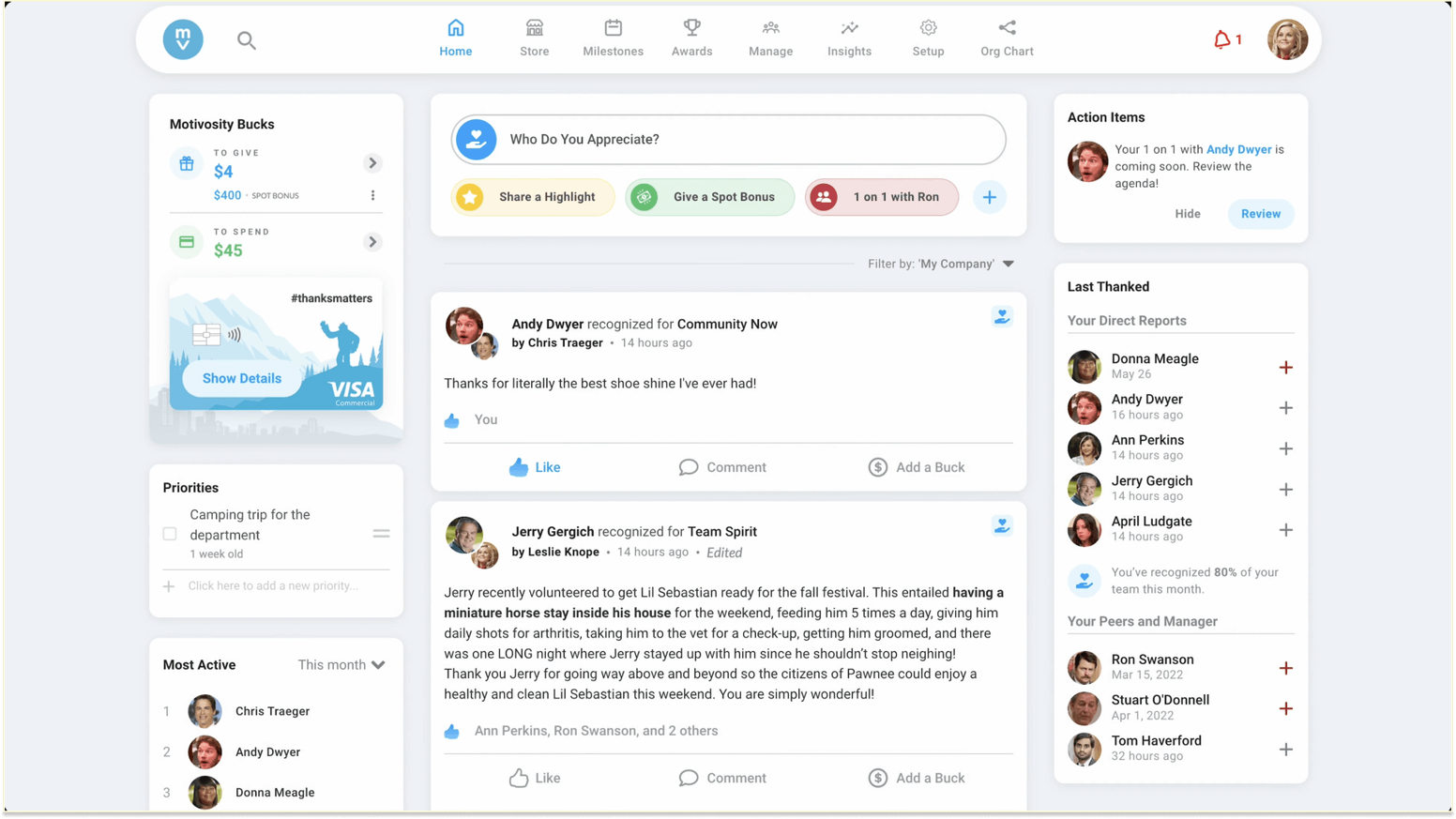
Motivosity splits balances into To Give and To Spend, and its currency is real money – one Motivosity buck equals one US dollar, so there is no conversion math for employees. Per Motivosity’s own General User FAQ, unused To Give dollars “reset on the first of each month without rollover.”
Earned To Spend dollars generally do not expire, though the help center notes some companies may set expiration policies. Admins set Monthly Giving Defaults, then layer Special Giving Rules by user, team, org, or custom criteria; rules stack, and role changes recalculate direct-report rules, which can reduce a giving balance mid-cycle.
Vantage Circle: org-governed accumulating points
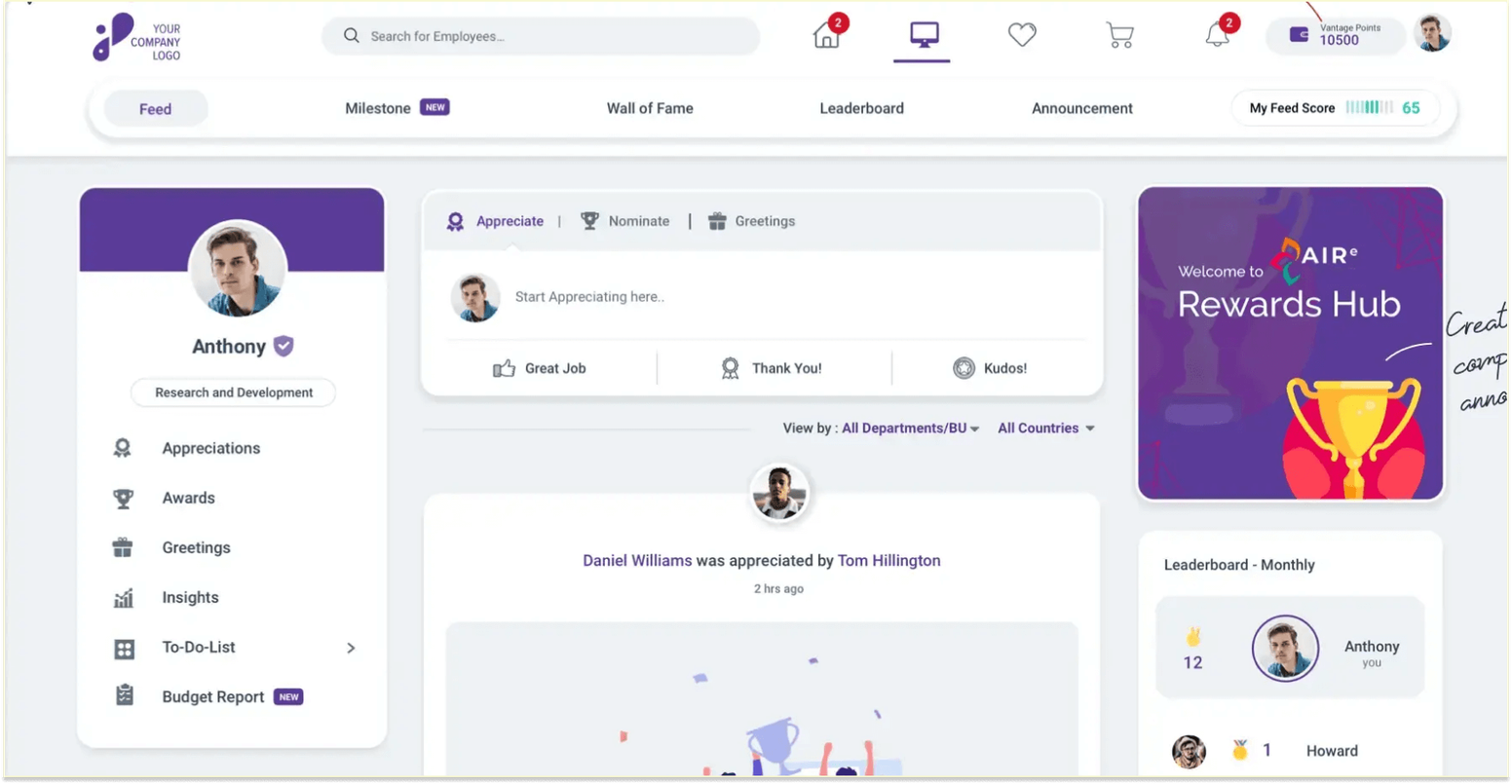
Vantage Circle runs an accumulating points model under Vantage Recognition (formerly Vantage Rewards): value-aligned badges and eCards, manager SPOT awards, nomination workflows with approve and decline steps, automated service milestones from HRIS, and a social feed. Point validity is set by the employer rather than the platform.
Per Vantage Circle’s help documentation, points earned by shopping on its own platform do not have an expiry period, but for organization-allocated points “the validity of these points depends on your organization’s policy,” and “reward points become invalid once you exit your organization” – worth planning offboarding around. Redemption uses fixed voucher denominations, with an OTP verification step reviewers frequently mention.
Both designs are legitimate, and they optimize for different things. Motivosity’s monthly reset pushes budget out the door every cycle, which drives frequency but produces the familiar month-end scramble. Vantage Circle’s accumulating model lets employees save toward larger rewards, at the cost of value that can be revised or lost by policy.
Neither cadence is a weekly ritual: both refresh or accrue on a monthly-or-longer rhythm.
Rewards catalogs and funding
Motivosity rewards and funding
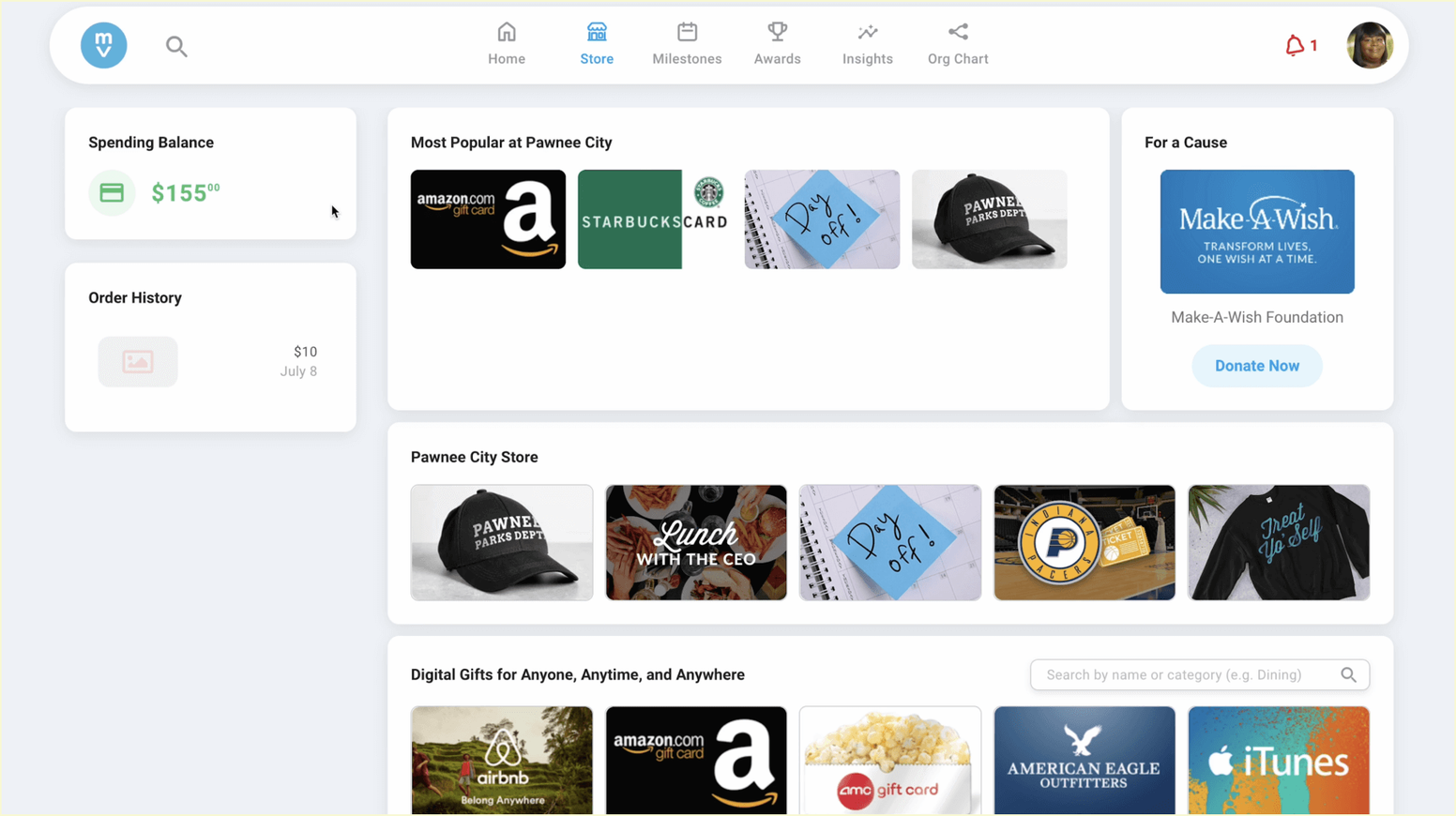
Motivosity claims 500M reward options across 175+ countries, with 70+ languages, 140 currencies, and tax support in 63 countries. Its signature is the ThanksMatters Visa card – powered by Stripe, issued by Celtic Bank – which lets employees tap-to-pay earned dollars, with Apple Wallet support.
Generic Visa reward cards are fulfilled through Tango Card with support handled by Prepaid Digital Solutions, and physical cards take up to 45 days to arrive.
Funding is prepay only, per Motivosity’s help center: a US bank account by ACH at no fee, clearing in 5–6 business days, or a US-based credit card at a 3.5% transaction fee that processes in about 4–6 hours.
Deposit caps start at $1,000 and top out at $50,000 per ACH transfer or $5,000 per card transaction, and funding sources are US-only – a real constraint against a 175-country catalog claim.
Vantage Circle rewards and funding
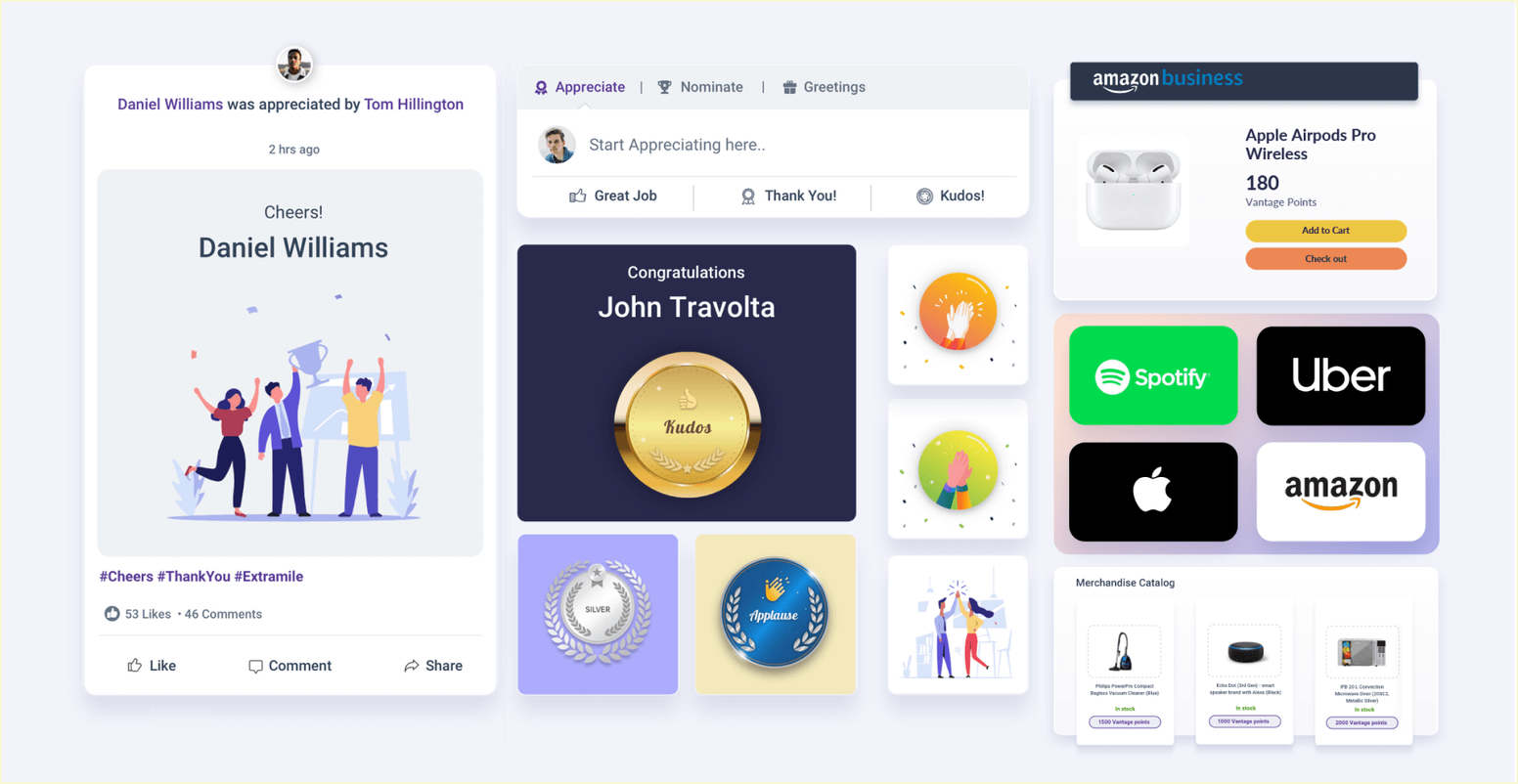
Vantage Circle’s catalog covers gift cards, merchandise, experiences, and travel, with an Amazon Business integration for milestone rewards, multi-wallet support, and cross-country point transfers.
Its own published scale figures vary by page – the homepage says 10K+ reward options across 100+ countries, while the rewards product page says 10M+ rewards across 70+ countries – so cite whichever page you are quoting and confirm the number that applies to your regions.
Its genuinely distinctive mechanic is SOLI-adjusted pricing: point value is standardized to local standard of living so that, in its words, every employee feels equally valued whether in Mumbai, London, New York, or Nairobi, with SOLI-adjusted transfers for employees relocating internationally.
On funding, Vantage Circle publishes no reward-funding fee schedule that we could find, so there is no percentage to compare against Motivosity’s – ask for the terms, and any markup or revenue-share arrangement, in writing during the demo.
| Funding route | Motivosity | Vantage Circle |
|---|---|---|
| Bank or ACH prepay | 0% fee; clears in 5–6 business days; US bank accounts only | No published fee schedule |
| Credit card | 3.5% transaction fee; processes in about 4–6 hours; US-based cards only | No published fee schedule |
| Billed in arrears | Not offered; funding is prepay only | Not published |
| Deposit caps | $1,000, then $2,500, then $50,000 per ACH transfer or $5,000 per card transaction | Not published |
Pricing transparency: two demos required
Neither vendor lets you budget from a web page, so the practical question is how much each tells you first.
Motivosity sells three promoted bundles – For Celebrating People, For Building Culture, and For Scaling Globally – plus seven industry bundles, all quote-gated on motivosity.com/pricing.
The one hard number it publishes, on both the pricing page and its FAQ, is a $3,000 minimum annual investment, and its own 2026 recognition-software roundup names that minimum as a barrier for very small teams. Expect 30–60 days to launch with 5–10 hours of admin time.
Vantage Circle publishes less. Its three tiers on the plans and pricing page are Grow, Transform (marked Best Value and Most Popular), and Scale, and every one shows custom pricing behind a demo request.
No per-user rates, no minimums, no setup fees, and no contract terms appear on the page, and no free trial is published.
Its own comparisons hub markets transparent per-user pricing without revenue share or reward markups, which is a fair thing to want – but the numbers themselves are only available in a sales conversation.
Third-party price points for legacy per-user rates circulate online; none are verifiable on its site, so treat them as unverified estimates rather than current pricing.
Because there is no published math to run, take a checklist into both demos: the per-user rate by tier; which modules are add-ons versus included; contract minimums, term, and any setup fee; reward funding fees, markups, or revenue share; the points-validity policy your organization would set; and, for Vantage Circle specifically, which SOC 2 report type and date they hold, since the homepage displays an AICPA SOC 2 badge that its dedicated security page does not document.
On the security certifications it does document, Vantage Circle holds ISO 27001:2013 and ISO 27701:2019.
Suite breadth: modules, surveys, and what is gated
This is the largest structural difference between the two, and it cuts both ways.
Vantage Circle is a genuine multi-module suite. Vantage Recognition is the core in every plan; Vantage Perks adds a corporate discounts and cashback marketplace; Vantage Fit covers corporate wellness challenges; Vantage Pulse handles eNPS surveys with sentiment analysis; Vantage Edge is a post-launch program-success service, free for the first year on Scale; AIRe Advisory sells recognition-strategy consulting; and Vantage Swags handles corporate gifting.
The gating matters to your quote: Pulse is an add-on on both Grow and Transform and is included only at Scale, and Fit is an add-on on Grow. So a mid-tier buyer who assumes surveys are included will be surprised.
Confirm the module grid in writing, since the plan grid has shifted during 2026.
Motivosity is narrower by design. Its employee-insights module covers eNPS, and its Appreciation Intelligence branding adds AI-assisted recognition writing plus AI-powered turnover-risk signals, which is a genuinely useful HR capability that Vantage Circle does not market a direct equivalent of.
But there is no wellness product, no corporate discounts marketplace, and no advisory arm. Modules add per-employee-per-month cost on top of the platform fee, so the more of Motivosity you turn on, the closer it gets to suite pricing without suite breadth.
Global reach and geographic fit
Fit here is about where each vendor has depth, not about where it was founded.
Vantage Circle is built for multi-country programs and has the evidence to show for it. It claims 3.2M+ users across 100+ countries with 16+ languages, its SOLI mechanic normalizes reward value across economies, and it supports multi-wallet and cross-country point transfers plus WhatsApp notifications and printed recognition cards for frontline staff.
Its offices span Guwahati and New Delhi in India, Plano in Texas, Calgary, Amstelveen, Dubai, and New South Wales.
Its case-study library is where the pattern is clearest: the flagship is Wipro, at 234,054 employees across a 66-country program with a reported 97.5% increase in peer recognition, alongside Infosys (15% improvement in engagement), TATA Motors (82% rise in peer-to-peer recognition), and Accor (53% improvement in recognition).
The large majority of its published case studies are India-headquartered enterprises; North American evidence is testimonial-level rather than a flagship study. If your program spans many countries, and particularly if a significant share of your workforce is in India, that depth is a real advantage.
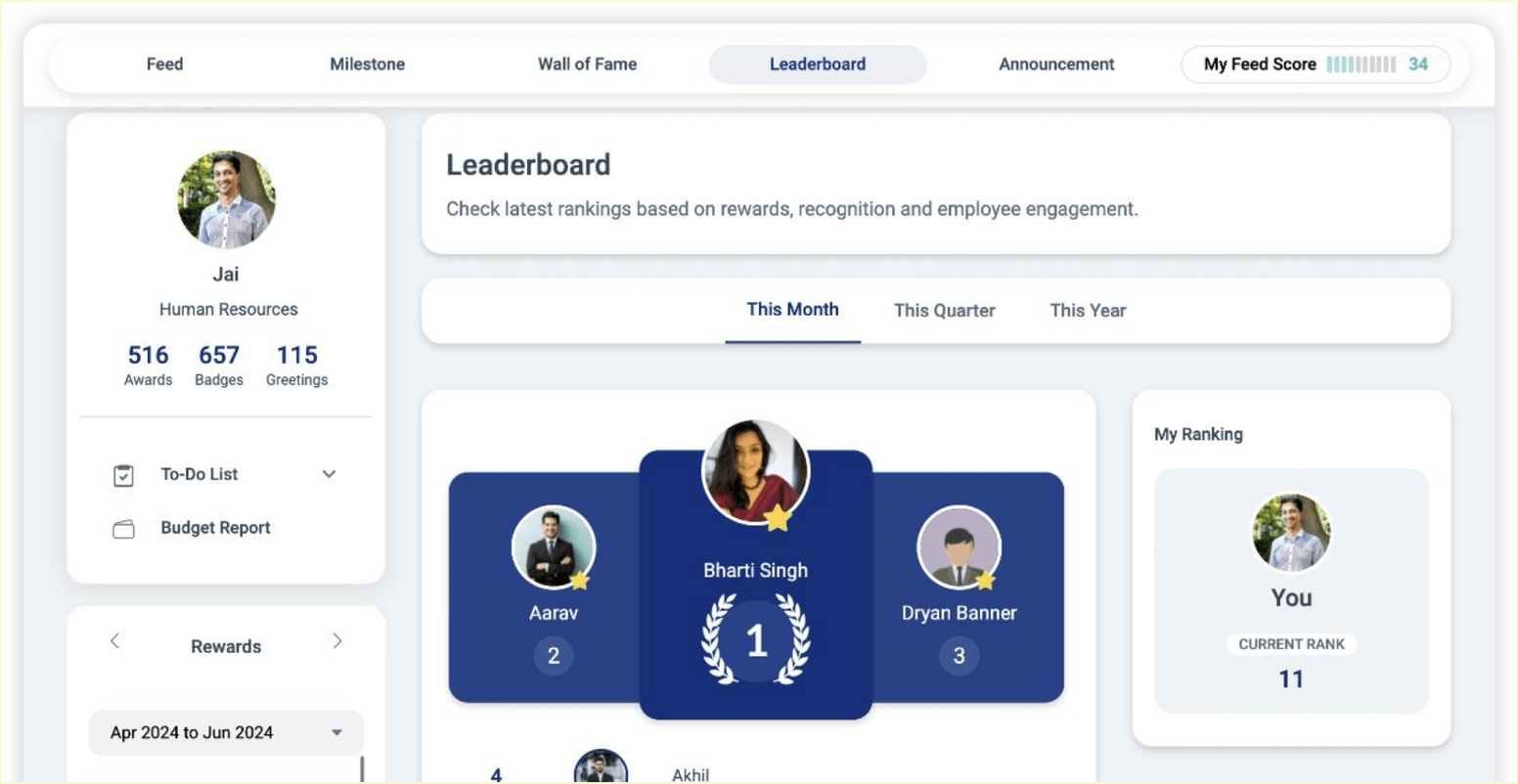
Motivosity is the stronger fit for a US-centered workforce. Its dollar denomination needs no standard-of-living adjustment when everyone is paid in the same currency, its case studies are US organizations – Old National Bank reports 85% adoption in month one rising to 90%, 12,000+ peer recognition moments, and about one workday per week of admin time recovered, and Priority Dispatch reports 97% adoption – and the ThanksMatters card spends anywhere US cards are accepted.
The limitation is on the same axis: reward funding sources are US-only, so a company funding a global program from outside the US will hit friction that Vantage Circle is designed around.
What G2 reviewers say about Motivosity and Vantage Circle
Both hold a 4.7 on G2, so read the volume and the themes instead of the score.
Motivosity (4.7 across 3,615 reviews on G2): the leading praise themes are the ease of the recognition process (491 mentions), peer recognition (345), and a user-friendly interface (333).
Stacie D., an HR Operations Specialist at a mid-market company, wrote in a five-star review from June 3, 2026 that the “reporting side is a massive time-saver for anyone running team evaluations.”
Criticism splits between the points economy (roughly 150 mentions across the top dislike themes) and navigation or interface (about 135), which is unusually prominent for a 4.7-rated product.
Clayton M., a Manager of Customer Success at a mid-market company, described the month-end effect in a 4.5-star review from April 21, 2026: “[at month end] you would still have money to spend and it felt like you were just trying to come up with something to compliment someone on, which didn’t feel as genuine.”
Vantage Circle (4.7 across 10,896 reviews on G2, one of the largest review bases in the category): per G2’s review summary, praise is led by ease of use and quick access to offers (865 mentions), variety of redeemable options (509), and a user-friendly interface with versatile redemption (477).
Yogesh P., a Digital Specialist Engineer, wrote on July 4, 2026 that the “clean and intuitive interface makes it easy to browse rewards and complete redemptions,” while asking for more gift-card partners and region-specific options.
The dislike side is unusually concentrated: all five top themes concern the catalog and redemption – limited redemption options (201), restricted choices and inflexible point usage (187), voucher unavailability and missing points (107), gift card availability (105), and limited brand selection (93), roughly 690 mentions in total.
Nishanth J., a Senior Engineer, summarized the pattern on March 9, 2026, praising a “straightforward redemption flow” while noting weak search filters and regional catalog gaps.
The useful read: Motivosity’s complaints are about how much budget people get and how the app navigates; Vantage Circle’s are almost entirely about whether the reward someone wants is available in their region. Test the catalog in your actual locations before signing.
Where Motivosity wins
- Dollar-denominated recognition: one buck equals one dollar, with no point-conversion or standard-of-living math for a single-country workforce.
- The ThanksMatters Visa card: tap-to-pay redemption with Apple Wallet support, which has no equivalent in Vantage Circle’s voucher-based flow.
- A published price floor: the $3,000 minimum annual investment is on its pricing page and FAQ, where Vantage Circle publishes no figure at all.
- Published funding terms: ACH at 0% and card at 3.5%, with stated clearing times and caps, against no published fee schedule from Vantage Circle.
- Mobile apps: 4.8 on the App Store (roughly 5,700 ratings) and 4.8 on Google Play (815 reviews), both actively shipped in August 2026.
- Turnover-risk insights: eNPS plus AI risk signals in the recognition tool, included in its insights module rather than gated to a top tier.
- US case-study depth: Old National Bank and Priority Dispatch give a US buyer directly comparable proof.
Where Vantage Circle wins
- Suite breadth: recognition, perks and discounts, wellness, surveys, and advisory from one vendor, where Motivosity covers recognition and insights only.
- SOLI-adjusted reward value: point value normalized to local standard of living, plus multi-wallet and cross-country transfers, for genuinely multi-country programs.
- Review volume: 10,896 G2 reviews at 4.7, roughly three times Motivosity’s base, plus 4.7 on Capterra and GetApp.
- Microsoft Teams presence: 4.6 across 3,631 Teams app store ratings, against Motivosity’s 4.2 across 58, plus a real Slack Marketplace listing.
- Enterprise scale proof: Wipro at 234,054 employees across 66 countries reporting a 97.5% increase in peer recognition.
- Documented security certifications: ISO 27001:2013 and ISO 27701:2019 on its security page.
- Frontline touches for global teams: WhatsApp notifications and printed recognition cards, plus 16+ languages.
The third option: Matter
Both vendors above assume recognition lives in their own app, funded by an allowance or a points bank, and priced only after a sales call. Matter makes two different bets: recognition should happen inside Slack and Microsoft Teams with no separate app or login, and it should run on a weekly rhythm.
Each week, Feedback Friday™ (US Patent 12,199,935) prompts the whole team to recognize someone, and give-coins reset weekly so they get spent rather than hoarded.
The cadence is measurable: in The Recognition Habit, Matter’s 2026 Benchmark Report, built on aggregate, de-identified platform data, teams that build recognition around a weekly ritual give about 2.5x more recognition per member than ad hoc teams, and roughly 8 in 10 ritual teams stay active in nearly every month.
On this guide’s criteria: Matter’s Free plan is for unlimited users, paid tiers are published at $1 to $5 per user/month, billed annually, and Matter hasn’t raised prices in 8 years.
Reward funding fees are published, including a 0% ACH prepay path, and the catalog spans 10,000+ eGift card options across 200+ countries.
Matter holds a 5.0 across 1,476 Microsoft Teams app store ratings and 4.7 on G2. To be equally honest about fit: a large enterprise that wants perks, wellness, and surveys from one vendor with standard-of-living-adjusted point values across many countries is better served by Vantage Circle, and Matter has no equivalent of Motivosity’s spendable ThanksMatters Visa card or its turnover-risk insights.
For the detailed head-to-heads, see Motivosity vs. Matter and Vantage Circle vs. Matter.
Which platform is right for your team?
Choose Motivosity if:
- Your workforce is mostly US-based and you want recognition denominated in dollars, spendable on a tap-to-pay Visa card.
- You want published funding terms and a known annual floor before you start negotiating.
- Mobile app quality and turnover-risk insights matter more to you than perks or wellness modules.
Choose Vantage Circle if:
- Your program spans many countries and reward value needs to feel equivalent across them.
- You want recognition, perks, wellness, and surveys consolidated under one vendor and one contract.
- You are buying at enterprise scale and want the largest review base and enterprise case studies in the comparison.
Choose Matter if:
- Your team lives in Slack or Microsoft Teams and you want recognition there, not in another app.
- You prefer a weekly recognition ritual over a monthly allowance or an accumulating points bank.
- You want to start free with unlimited users and see published pricing before talking to anyone.
Frequently asked questions about Motivosity vs. Vantage Circle
Is Motivosity or Vantage Circle cheaper?
Neither publishes per-user rates, so there is no list-price answer. Motivosity publishes one number: a $3,000 minimum annual investment, which is a floor small teams may struggle to justify.
Vantage Circle publishes nothing at all – Grow, Transform, and Scale are each shown as custom pricing behind a demo request, with no minimums or setup fees stated. Third-party per-user figures for Vantage Circle circulate online but are not verifiable on its site, so treat them as unverified estimates.
Get both quotes in writing and compare the platform fee, the rewards budget, module add-ons, and any funding fees or markups together.
What is the main difference between Motivosity and Vantage Circle?
Scope and geography. Motivosity is a recognition platform with an insights module: dollar-denominated peer giving on a monthly allowance, a social feed, milestones, and a spendable ThanksMatters Visa card, with US-only reward funding.
Vantage Circle is a multi-module global suite: recognition plus a corporate perks marketplace, wellness, surveys, and advisory, with accumulating points whose value is adjusted for local standard of living across countries.
Which is better for global or multi-country teams, Motivosity or Vantage Circle?
Vantage Circle, in most cases. Its SOLI-adjusted point values, multi-wallet and cross-country transfers, 16+ languages, and enterprise case studies such as Wipro at 234,054 employees across 66 countries are built for distributed programs.
Motivosity is the better fit for a mostly US workforce: dollar denomination needs no adjustment, but its reward funding sources are US-only. Whichever you pick, test the reward catalog in your actual employee locations, since regional availability is Vantage Circle’s most-cited criticism.
Do Motivosity or Vantage Circle offer a free plan or free trial?
Neither publishes a free plan. Motivosity is demo-led with no self-serve trial listed on its pricing page and a $3,000 minimum annual investment. Vantage Circle publishes no free plan and no trial terms on its pricing page, so ask about a pilot in the demo rather than assuming one exists. Among alternatives, Matter’s Free plan supports unlimited users.
Do Motivosity or Vantage Circle points expire?
On Motivosity, the monthly To Give balance resets on the first of each month without rollover, while earned To Spend dollars generally do not expire unless a company sets an expiration policy.
On Vantage Circle, points earned by shopping on its platform do not have an expiry period, but the validity of organization-allocated points depends on your employer’s policy, and its help documentation states that reward points become invalid once an employee exits the organization – so build redemption into your offboarding checklist.
Motivosity vs. Vantage Circle: the bottom line
Both are credible, well-reviewed platforms that will cost you a sales call to price.
The decision is mostly about shape: Motivosity for a US-centered mid-market program that wants dollars, a spendable card, published funding terms, and a known floor; Vantage Circle for a globally distributed enterprise that wants recognition, perks, wellness, and surveys consolidated, with reward value that holds up across economies.
And if the goal is a weekly recognition habit inside Slack or Microsoft Teams with pricing you can read before you call anyone, that is a third question with a third answer. Related reading: Motivosity alternatives, Vantage Circle alternatives, and the full comparison hub.

![Kudos vs. Vantage Circle Comparison: Pricing & Reviews [2026 Guide]](https://cdn.sanity.io/images/kqqb5xry/production/c0f4834f2403e1febb8f8e1e58e699af3e634e8d-800x600.jpg?w=720&q=75&fit=max&auto=format)
![Vantage Circle vs. Matter Comparison: Pricing & Reviews [2026 Guide]](https://cdn.sanity.io/images/kqqb5xry/production/a6135e0425176ca218fa290bf02567dc7932f729-800x600.jpg?w=720&q=75&fit=max&auto=format)
![Nectar vs. Vantage Circle Comparison: Pricing & Reviews [2026 Guide]](https://cdn.sanity.io/images/kqqb5xry/production/8eec85d78433f606041ec2ca685ac2525544aceb-800x600.jpg?w=720&q=75&fit=max&auto=format)