

![Nectar vs. Workhuman Comparison: Pricing & Reviews [2026 Guide]](/images/ad86e669fa3f866127ff89dbbc80321f1b761387-800x600.jpg/nectar-vs-workhuman.jpg?w=800&q=75&fit=max&auto=format)
The 30-second verdict: Nectar or Workhuman?
Choose Nectar if you are a mid-market organization, roughly 50 to 2,000 employees, that wants everyday peer recognition running quickly: a monthly points allowance everyone can spend, a rewards marketplace with in-platform Amazon breadth, a survey suite through Engage™, and frontline coverage via kiosk mode, SMS, and physical reward cards.
Choose Workhuman if you are a global enterprise with a structured HR function and a real change-management budget.
It is the largest fulfillment operation in the category, with rewards in 180+ countries, localized catalogs in 150+, more than a million reward choices from 600+ suppliers, and best-in-class service milestone, life event, and community celebration programs, delivered through consultative implementation rather than a self-serve signup.
A third option exists: if what you actually want is recognition running inside Slack or Microsoft Teams with published pricing, Matter is covered near the end of this guide.
Nectar and Workhuman rarely end up on the same shortlist by accident. One is a US mid-market recognition platform built around a monthly peer points allowance; the other is the enterprise incumbent, founded in 1999, running award programs for organizations with tens of thousands of employees through nomination and approval workflows.
They compete only in the band where a large, structured HR function is shopping for its first serious recognition program. This comparison was verified in August 2026 against both vendors’ public documentation, case studies, app store listings, and G2 profiles.
Full disclosure: this guide is published by Matter, an employee recognition platform that competes with both Nectar and Workhuman. We have kept the head-to-head honest, we say plainly where each product wins, and we introduce Matter only near the end as a third option.
Weigh our perspective accordingly, and get written quotes from both vendors before you decide.
How we researched this comparison
We build Matter, which competes with both platforms on this page, so weigh our perspective accordingly.
For Nectar and Workhuman we reviewed each vendor’s public pricing, product pages, and help-center or billing documentation, plus their G2 profiles and named, dated reviews, and we drew on conversations with teams evaluating and switching between recognition platforms. We have not used either product hands-on.
Every claim here is sourced to the vendors’ own materials, named reviews, or Matter’s published data, and facts were last verified in August 2026.
Nectar vs. Workhuman at a glance
| Nectar | Workhuman | Matter | |
|---|---|---|---|
| Starting price | Quote-based since 2026; entry plans historically around $4–$5 per user/month | Quote-only; no public pricing page. Its own published anchor is program spend at 1% of payroll | Free plan, then $1 to $5 per user/month, billed annually; public tiers |
| Free plan | No; trial via demo signup | No free plan and no self-serve trial; demo and scoping only | Yes, unlimited users |
| G2 rating | 4.7 (8,500+ reviews) | 4.7 (2,400+ reviews, overwhelmingly enterprise) | 4.7 (1,186 reviews) |
| Teams app store | 4.4 (2,319 ratings) | 4.7 (2,979 ratings) | 5.0 (1,476 ratings) |
| Best for | US mid-market teams wanting everyday peer recognition plus frontline delivery | Global enterprises running structured award and service-milestone programs at scale | Slack/Teams-first teams that want a weekly recognition habit |
Recognition mechanics: monthly allowance vs. nomination and approval
This is the structural difference that decides most of the rest, and it is worth understanding before you look at price.
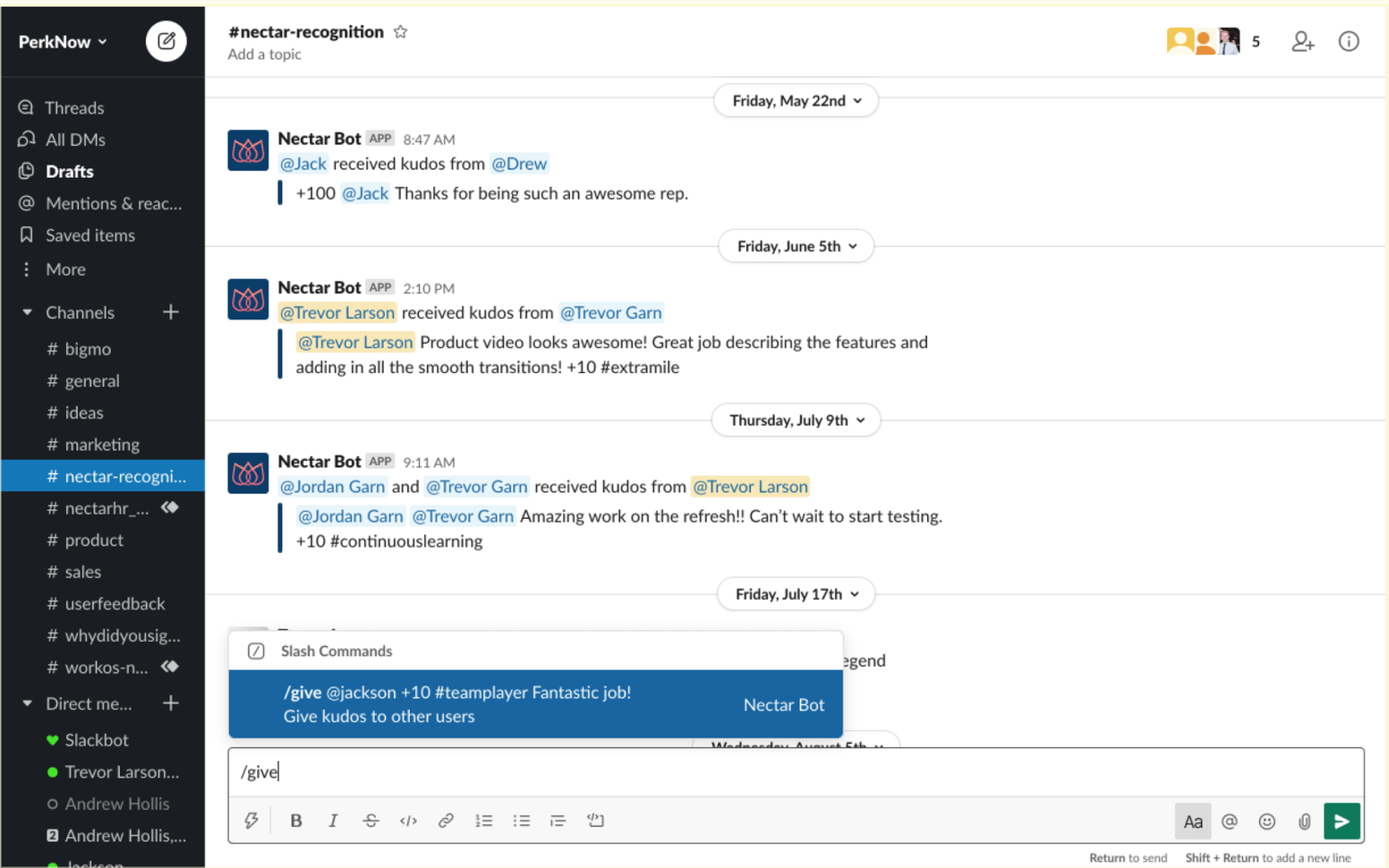
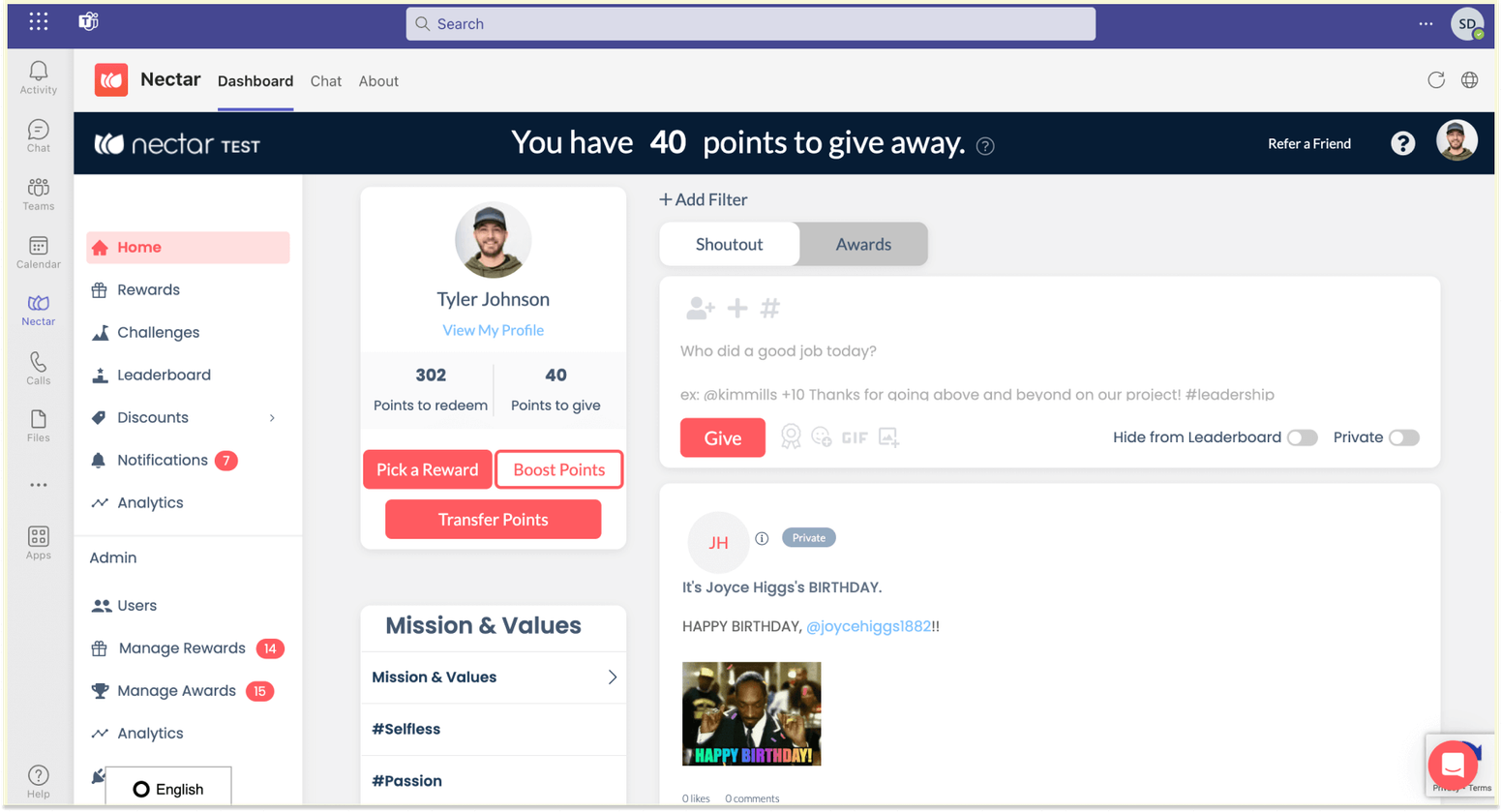
Nectar gives every employee a monthly Points to Give allowance that resets on the 1st, with unused give-points expiring and no carryover. Points to Redeem never expire during employment, so people can save toward larger rewards.
Admins configure Variable Rate Allowances by department, location, or employment type, and Boosted Points let employees convert earned points back into giving points. Recognition is immediate: there is no approval step between writing a shoutout and it appearing in the feed.
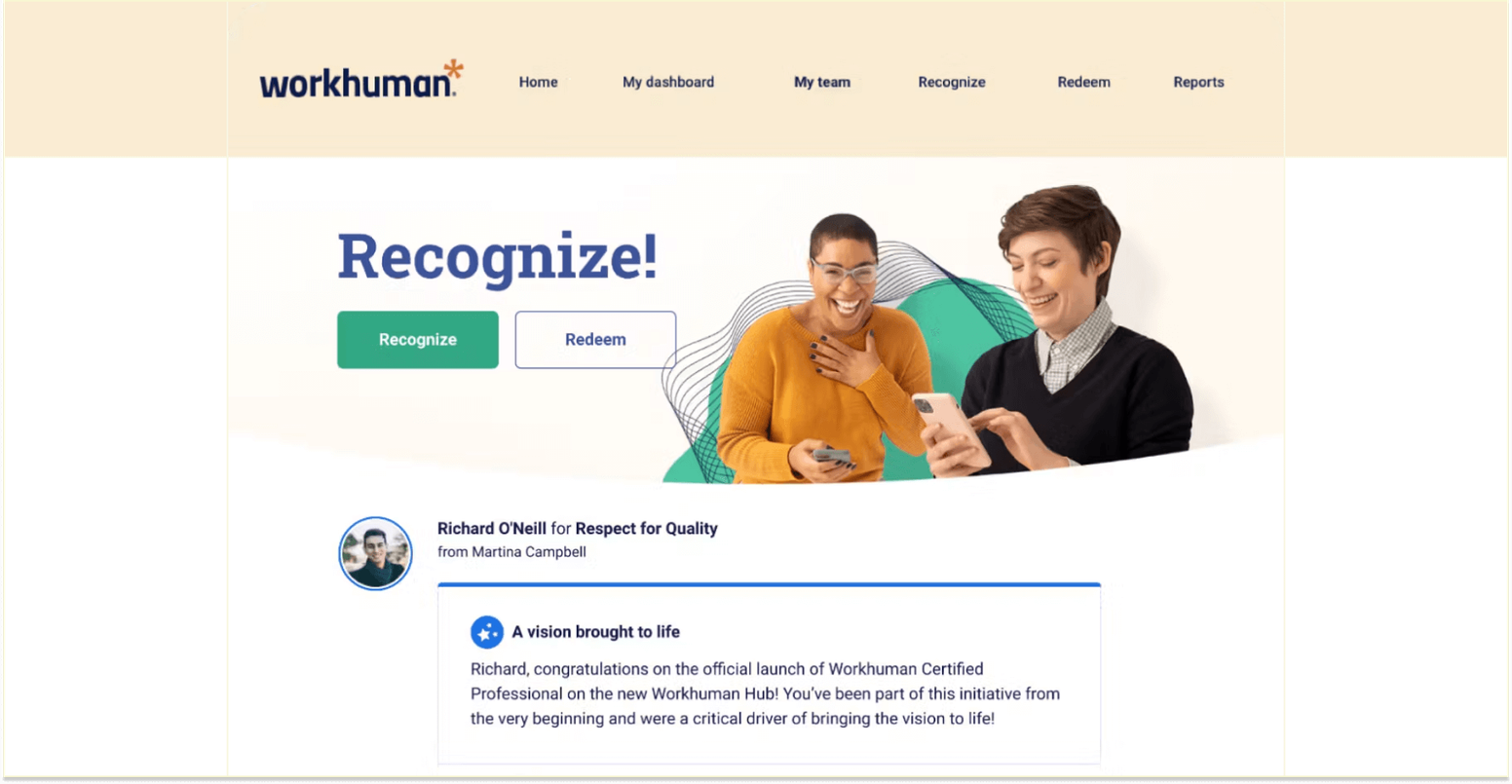
Workhuman does not run a recurring peer allowance at all. Colleagues nominate each other for titled awards with written justification, and those nominations route through approval flows managed in a Program Administrator hub that controls award management, delegate assignment, spend control, and the ability to approve, modify, or disapprove before an award is released.
Nominators typically select an impact level, which maps to a point value, rather than choosing points directly. Companies can also cap how many awards a person receives in a year.
Around that core sit Service Milestones, Life Events, and Community Celebrations, plus Workhuman iQ analytics and the Human Intelligence AI suite, which includes an Inclusion Advisor that flags biased language in recognition messages and misuse detection for gaming.
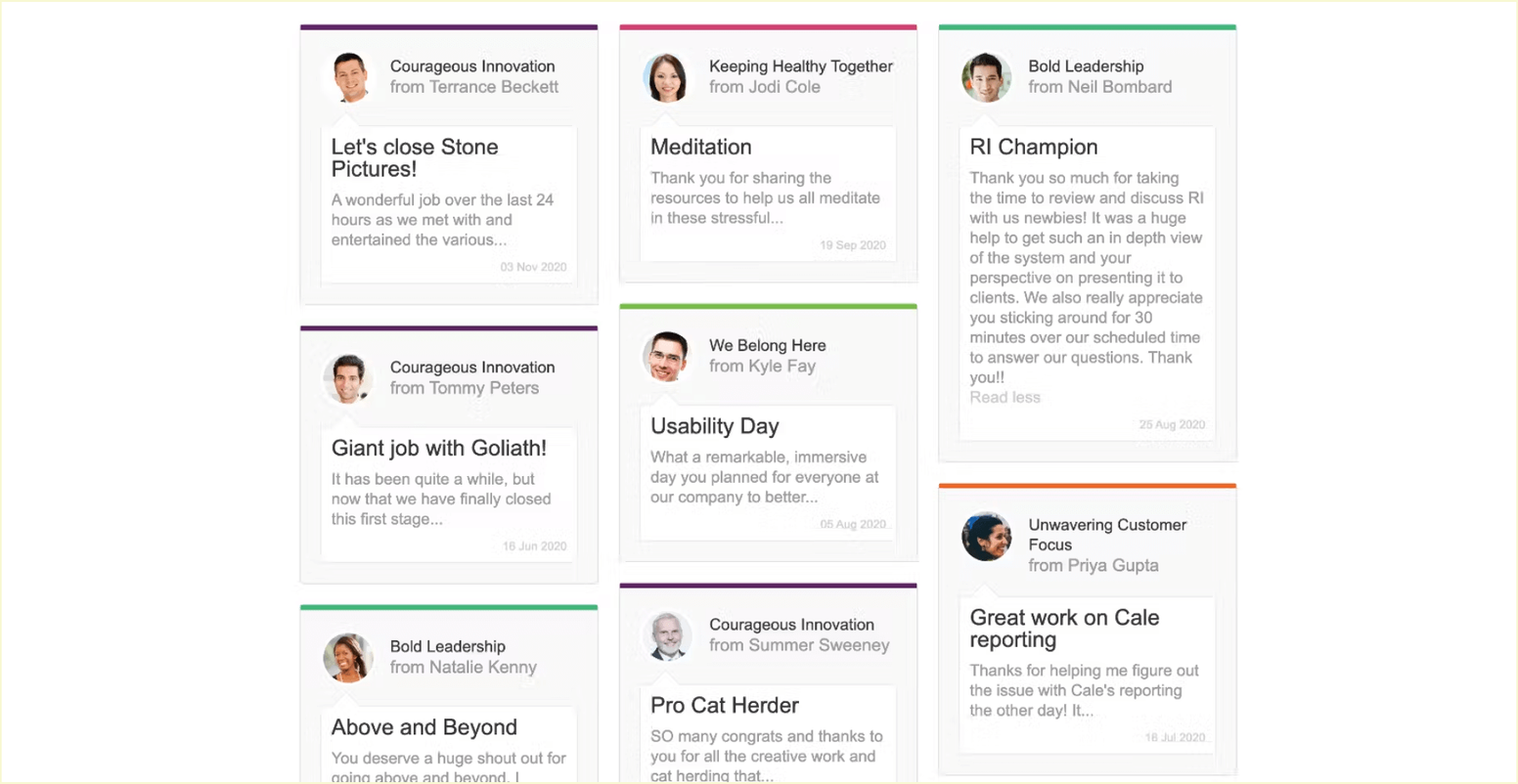
Read that as a trade between frequency and governance. Nectar’s model produces many small, fast recognitions and the budget headaches that come with a monthly allowance.
Workhuman’s model produces fewer, larger, better-governed awards with an audit trail, which is what a 50,000-person company with compliance requirements usually needs, and which reviewers experience as lag.
Its own numbers show the shape: in its LinkedIn Bravo! case study, whose underlying data is from 2018, the average award was worth $135 and only 24% of awards were peer to peer; at Merck, 37% of recognition moments were peer to peer.
Rewards catalogs: global scale vs. everyday convenience
Workhuman operates the largest reward marketplace in the category by a wide margin: more than a million reward choices from 600+ suppliers, rewards available in 180+ countries with localized catalogs in 150+, and over $1 billion redeemed annually. It holds PCI DSS Level 3 merchant certification, ISO 27001:2022, and ISO 27701:2019, and it markets SOLI for global reward equity.
Scale, though, is not the same as perceived value, and Workhuman’s own review profile says so. Its largest G2 dislike clusters are about rewards: 252 mentions of reward limitations and lack of variety, 206 of limited gift options, 182 of limited reward options, and 148 of redemption point issues.
Riyaz M., a senior manager at an enterprise account, put it directly in a three-star review dated June 2, 2026: there are “too few redemption options, and major players like Amazon are missing.” TrustRadius reviewers add geographic redemption gaps and missing premium brands.
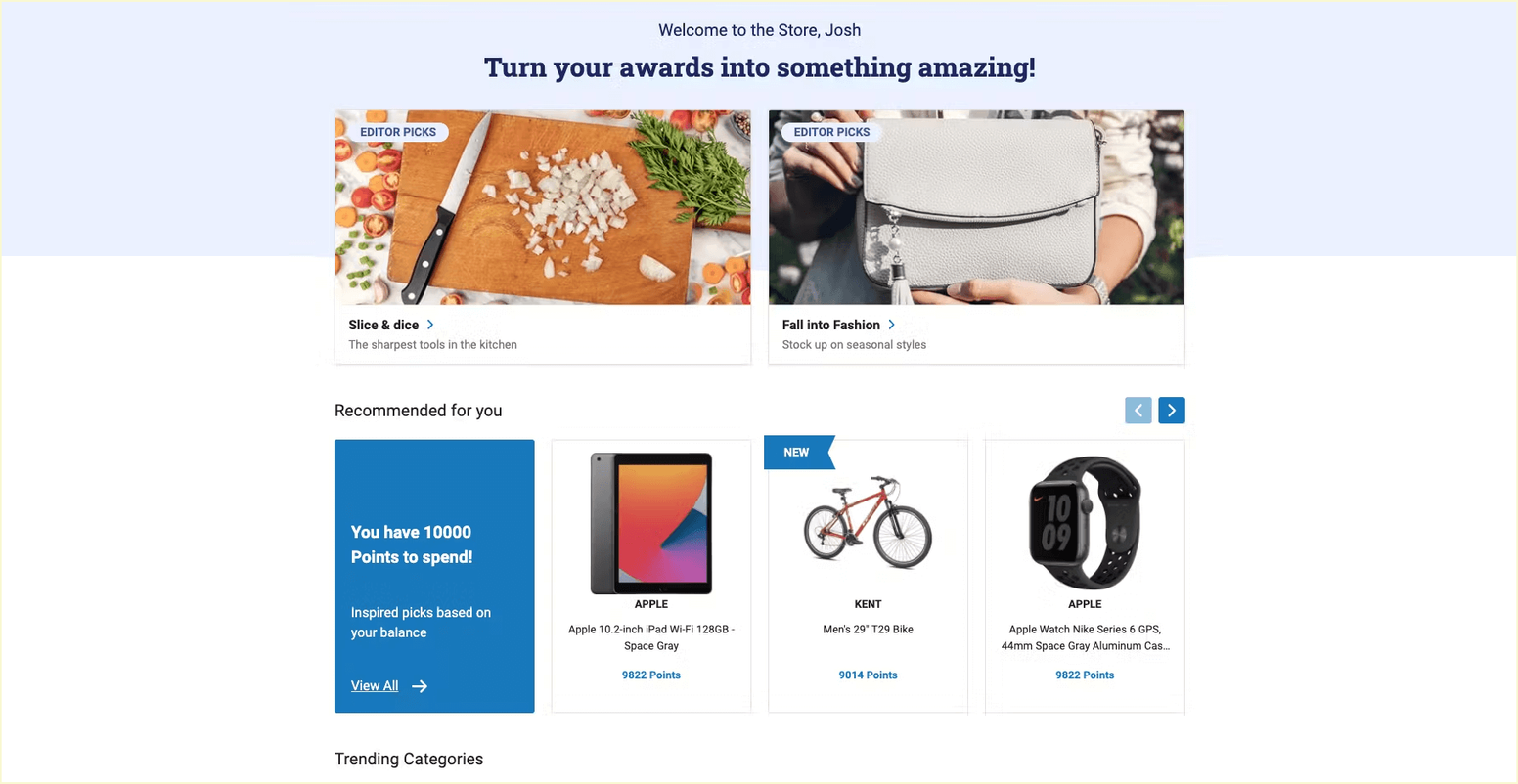
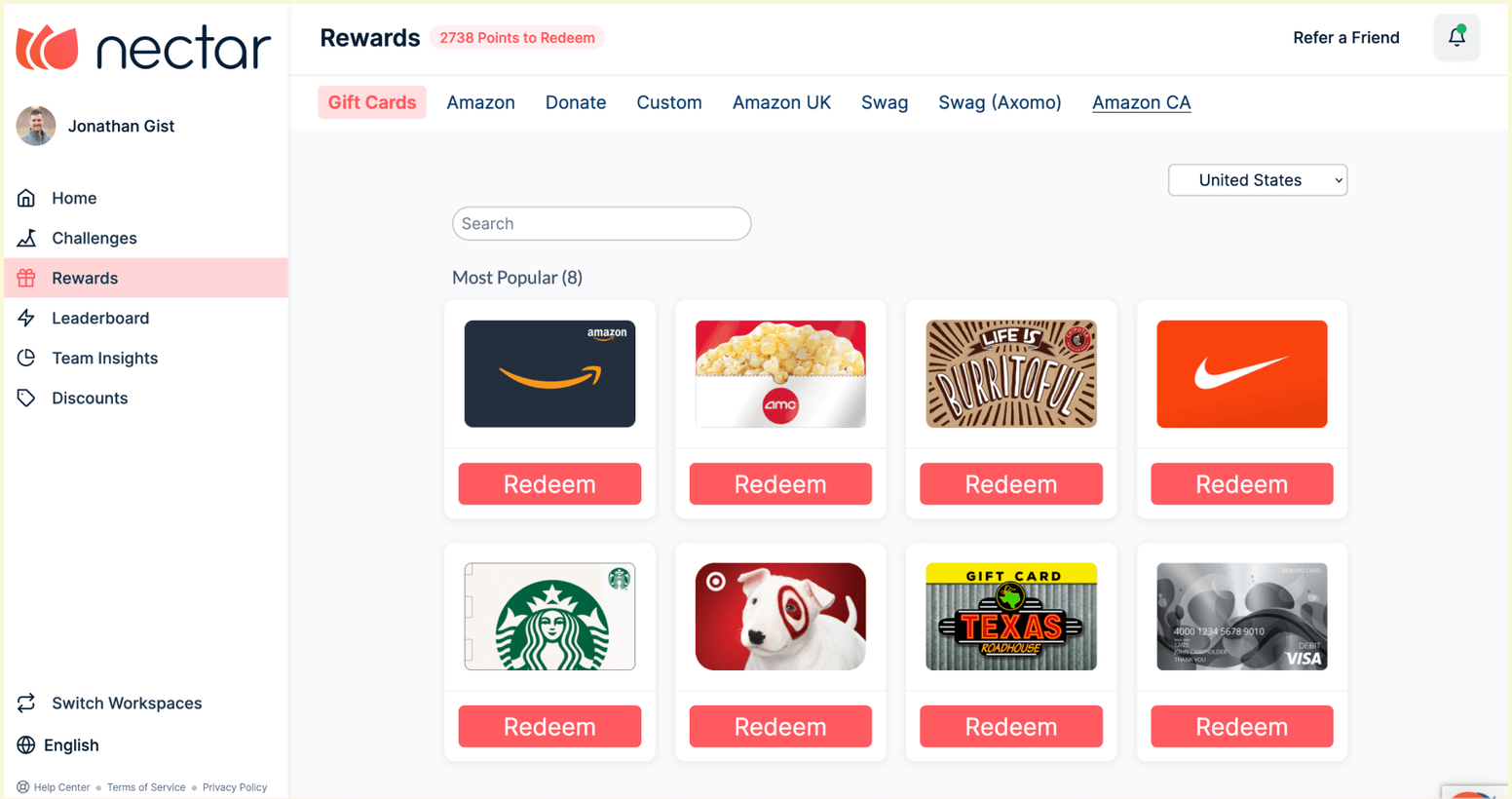
Nectar’s catalog is smaller but tuned for convenience: gift cards, in-platform Amazon breadth, a swag store, charitable donations, and physical or instant reward cards. Its caveats are documented too.
Gift cards come in preset denominations that cannot be customized, cards are country-locked with no cross-country refunds, and balance problems are handled by the card provider rather than by Nectar.
For a program in one or two countries, Amazon in the catalog usually beats a million SKUs you have to hunt through; for a program spanning 60 countries, Workhuman’s localized fulfillment is the reason the category’s biggest employers buy it.
Reward funding and cost visibility
This section is short on Workhuman’s side for an honest reason: the information is not public.
| Dimension | Nectar | Workhuman |
|---|---|---|
| Platform price | Quote-based product bundles; no per-user rate published | Quote-only; the pricing page returns a 404. Its own published anchor is program spend at 1% of payroll |
| 0% funding path | Prepay by ACH, check, or wire; $20 international wire fee | Not publicly documented |
| Credit-card reward funding | 3.5% + $0.40 per transaction, nonrefundable, on reward payments only | Not publicly documented |
| Billed in arrears | Post-Pay: account-manager approval and a 20% security deposit (minimum $100); redemptions pause if a month exceeds the deposit | Not publicly documented |
| Fee visibility | Full reward-funding fee schedule in the public help center | No public help center or fee schedule |
The fair framing is published versus opaque, not cheap versus expensive. Nectar quotes its platform price but publishes exactly what reward funding costs, so you can model the second half of the bill before a sales call.
Workhuman publishes neither, so prefunding versus invoicing, any platform fee on rewards, breakage policy, and what happens to a departing employee’s unredeemed points all have to be established in writing during procurement. Do not assume the absence of documentation means the absence of a capability; ask.
The one number Workhuman does publish is worth using carefully. Its own guidance names 1% of payroll as the investment tipping point for a recognition program.
That is a rewards-budget recommendation, not a license fee, so it is not comparable to a per-user platform price, but it is a useful planning anchor: for a 1,000-person organization at an $80,000 average salary, 1% of payroll is roughly $800,000 a year in program spend.
On both platforms the rewards budget sits separate from the platform fee, so model them together.
Pricing and buying process: quote-based bundles vs. no price page at all
Nectar restructured its pricing page in 2026 into quote-based bundles, Recognize, Comms, Engage™, and the Culture Suite, plus eight industry and use-case bundles, with every CTA requesting pricing.
Third-party listings historically placed entry plans around $4–$5 per user/month with minimum monthly spends of roughly $125 to $200, and SelectSoftware reports a $4,000 minimum annual agreement. Treat those as directional history rather than current list prices. Nectar still sells on a demo-led motion, but it is a short one.
Workhuman has no pricing page at all; the URL returns a 404. Buying is a consultative process: demo, scoping, custom quote, contract, then a guided implementation with planning and change management, and no published timeline. There is no free plan and no self-serve trial.
In place of prices it markets an ROI calculator and what it calls the only ROI Guarantee in the recognition industry. Its research arm, produced with Gallup, supplies the supporting case: it claims Cisco saw a threefold reduction in turnover with frequent recognition funded at 1% of payroll. Those are vendor and partner research figures, so weigh them as such.
Scale, surveys, and reaching the whole workforce
Workhuman’s scale is genuinely without peer here. It passed 8 million users in March 2026, reports roughly $900 million in revenue, and runs enough reward commerce to claim a place among the world’s largest online retailers by order volume.
Its enterprise proof is deep: Merck’s INSPIRE program launched across 67,000 employees in 85 countries with more than 400 ambassadors, recorded nearly 3 million recognition moments, reached 100% of the population at least once against a prior system that reached only 22%, and lifted the recognition question on its engagement survey by 12 points.
Dave Watson, Global Solutions and Relationship Lead at Merck, said of it: “The system is extremely intuitive. It takes two minutes to recognize somebody.” Its survey capability, Moodtracker, exists but is not the platform’s center of gravity.
Nectar’s reach argument is different and smaller. It reports more than 1,700 customer organizations, holds a SHRM partnership, and its case studies are US-centered, including Statista at 93% utilization and 1st Choice Cabinetry reporting turnover falling from 25% to 7%.
Its survey product, Engage™, is fuller than Moodtracker, covering engagement surveys, eNPS, onboarding and exit templates, a custom builder, anonymous feedback through SafeTalk, and AI sentiment analysis. For non-desk workers it has kiosk mode, SMS delivery, multi-language support, and physical or instant reward cards.
One caveat to test with your own staff: its mobile apps trail its web experience, at 3.1 stars on Google Play across 120 reviews and 4.4 on the App Store across 96 ratings, with neither app updated since 2024 or early 2025. Workhuman’s apps are the opposite story, both actively maintained through late July 2026, at 4.9 stars across 8,400 iOS ratings and 4.4 across 2,720 Android reviews.
What G2 reviewers say about Nectar and Workhuman
Both hold a 4.7 on G2, and both are liked for the same reason: ease of use. The complaints diverge sharply, and that divergence is more useful than the ratings.
Nectar (4.7 across 8,500+ reviews on G2, the largest review base in the category): per G2’s review summary, recognition capabilities lead at 1,947 mentions and ease of use at 1,856. All five of its top dislike themes concern the points economy, roughly 1,600 mentions in total.
Sandra R. wrote in a five-star review dated May 12, 2026: “I wish the points didn’t disappear at the end of the month. Work gets busy... I wish a percentage of them rolled over.”
Workhuman (4.7 across roughly 2,400 reviews on G2, plus 9.1 out of 10 on TrustRadius across 57 reviews): ease of recognizing achievements leads the praise at 977 mentions and ease of use at 954. Its distinctive friction is the award workflow, with 230 mentions of slow approvals and complex criteria.
Ariel B., who works in patient access at an enterprise account, wrote in a 2.5-star review dated July 17, 2026 that setup “is clunky and actually makes it harder to decide what level of award is appropriate.”
For balance, Imani L., a bid writer at an enterprise account, gave it five stars on July 20, 2026: “The interface is easy to navigate which makes it widely accessible.”
The synthesis: Nectar’s users complain about running out of budget, Workhuman’s about getting an award through the process. Neither complaint is a bug; both are the direct consequence of a deliberate design choice.
Where Nectar wins
- Speed to a working program: a short demo-led sale and a self-administered rollout, against Workhuman’s scoping, contracting, and consultative implementation with no published timeline.
- Everyday peer recognition: a monthly allowance every employee can spend with no approval step, where Workhuman routes nominations through approvals and caps award frequency by policy.
- Published reward-funding fees: exact percentages and per-transaction costs, where Workhuman publishes no fee schedule or help center at all.
- Survey depth: Engage™ covers engagement surveys, eNPS, onboarding and exit templates, and anonymous feedback; Moodtracker is lighter.
- Everyday catalog convenience: in-platform Amazon breadth, which Workhuman reviewers specifically say they miss.
- Internal communications: Nectar Comms adds an email and multi-channel campaign builder with SMS delivery.
- Mid-market fit: built for 50 to 2,000 employees, a band where Workhuman is explicitly a poor fit for budget-conscious buyers.
Where Workhuman wins
- Global fulfillment: 1M+ reward choices from 600+ suppliers, rewards in 180+ countries with localized catalogs in 150+, and more than $1B redeemed annually. Nothing else in the category matches it.
- Service awards and lifecycle: Service Milestones, Life Events, and Community Celebrations are best-in-class for long-tenure recognition programs.
- Governance and audit trail: approval flows, delegate assignment, spend control, and marketed misuse detection, which large regulated employers need.
- Enterprise AI and analytics: Workhuman iQ plus the Human Intelligence suite, including an Inclusion Advisor that 74% of Merck employees acted on by editing flagged messages.
- Proof at true scale: 8M+ users, and Merck reaching 100% of 67,000 employees across 85 countries where its previous system reached 22%.
- Implementation support: consultative rollout, change management, and its ROI Guarantee, which matter for a 50,000-person deployment.
- Mobile and Teams presence: 4.9 on the App Store across 8,400 ratings, both apps actively maintained, and 4.7 across 2,979 Microsoft Teams app store ratings to Nectar’s 4.4 across 2,319.
The third option: Matter
Nectar assumes recognition lives in its own app on a monthly points budget. Workhuman assumes recognition is an award that gets nominated and approved.
Matter makes a different bet: recognition should live inside Slack and Microsoft Teams with no separate app or login, and run on a weekly rhythm with no approval step at all.
Every week, Feedback Friday™ (US Patent 12,199,935) prompts the whole team to recognize someone, and give-coins reset weekly so they get used rather than hoarded.
The cadence is measurable: in The Recognition Habit, Matter’s 2026 Benchmark Report, built on aggregate, de-identified platform data, teams that build recognition around a weekly ritual give about 2.5x more recognition per member than ad hoc teams, and roughly 8 in 10 ritual teams stay active in nearly every month.
On this guide’s criteria: Matter’s Free plan is for unlimited users, paid tiers are published at $1 to $5 per user/month, billed annually, and Matter hasn’t raised prices in 8 years.
Reward-funding fees are published too, including a 0% ACH prepay path, and the catalog spans 10,000+ eGift card options across 200+ countries. On the Microsoft Teams app store, Matter holds a 5.0 across 1,476 ratings.
Two honest limits. If you are running an enterprise program across dozens of countries and need approval governance, service-award depth, and localized fulfillment at Workhuman’s scale, Matter is not built for that shape of procurement.
And if a large share of your workforce is deskless and needs kiosk terminals, SMS delivery, or physical reward cards, Nectar is the better fit, because Matter is built for teams that live in Slack or Teams. For the detailed head-to-heads, see Nectar vs. Matter and Workhuman vs. Matter.
Which platform is right for your team?
Choose Nectar if:
- You are a mid-market organization that wants everyday peer recognition live in weeks, not quarters.
- You want recognition, a full survey suite, and internal communications from one vendor.
- Frontline delivery through kiosks, SMS, and physical reward cards is a requirement.
Choose Workhuman if:
- You employ many thousands of people across many countries and need localized reward fulfillment.
- Award governance, approval trails, and service-milestone depth are procurement requirements.
- You have the budget and the internal program team for a consultative, change-managed rollout.
Choose Matter if:
- Your team lives in Slack or Microsoft Teams and you want recognition there, not in another app.
- You prefer a weekly recognition ritual over a monthly points budget or a nomination process.
- You want to start free with unlimited users and see published pricing before talking to anyone.
Frequently asked questions about Nectar vs. Workhuman
Is Nectar or Workhuman cheaper?
Nectar is almost certainly the cheaper of the two for a mid-market program, though neither publishes a price. Nectar moved to quote-based bundles in 2026; third-party listings historically placed entry plans around $4–$5 per user/month with minimum monthly spends, and SelectSoftware reports a $4,000 minimum annual agreement.
Workhuman has no pricing page at all and sells through scoping and a custom quote, and the one figure it does publish is a program-spend recommendation of 1% of payroll, which for a 1,000-person organization at an $80,000 average salary is roughly $800,000 a year in rewards budget.
That is not a license fee, but it signals the scale of program it is designed for. Get both quotes in writing and compare platform fee, rewards budget, and funding fees together.
What is the main difference between Nectar and Workhuman?
The recognition model. Nectar gives every employee a monthly points allowance to spend on peers instantly, with no approval step. Workhuman uses nomination and approval: colleagues nominate each other for titled awards with written justification, and a program administrator can approve, modify, or disapprove before release.
Nectar produces frequent small recognitions; Workhuman produces fewer, larger, better-governed awards, alongside far deeper service milestone and global fulfillment capability.
Which is better for large enterprises, Nectar or Workhuman?
Workhuman, in most cases. It serves organizations with 10,000-plus employees, delivers rewards in 180+ countries with localized catalogs in 150+, and brings approval governance, consultative implementation, and change management. Merck ran its program across 67,000 employees in 85 countries and reached 100% of the workforce at least once.
Nectar’s sweet spot is roughly 50 to 2,000 employees, and third-party reviewers describe Workhuman as a poor fit for very small or budget-conscious buyers.
Do Nectar and Workhuman offer free plans or published pricing?
Neither. Nectar has no free plan, publishes no per-user rates since its 2026 move to quote-based bundles, and arranges trials through a demo signup. Workhuman has no free plan, no self-serve trial, and no pricing page; its URL for pricing returns a 404. Among alternatives, Matter’s Free plan supports unlimited users and every paid tier is published.
Do Nectar or Workhuman points expire?
On Nectar, monthly give-points expire at each reset, while earned redeem-points never expire during employment but are lost when an employee is removed, so departing staff should redeem before their last day.
On Workhuman, point expiry appears to be configured per company rather than set by the vendor; at least one reviewer has reported a one-year expiry, and the policy is not publicly documented. Ask for your program’s expiry rule and its offboarding policy in writing.
Nectar vs. Workhuman: the bottom line
These two are built for different organizations, and the honest recommendation follows headcount and governance more than features. Nectar is the better buy for a mid-market team that wants frequent peer recognition, a convenient catalog, surveys, and frontline delivery without a procurement project.
Workhuman is the better buy for a global enterprise that needs award governance, service-milestone depth, and localized fulfillment in 150+ countries, and can fund a program at the scale it is designed for. Both will make you sit through a demo before you see a number.
And if your team already lives in Slack or Teams and you want recognition to become a weekly habit there with pricing you can read today, that is the case for Matter. Related reading: Nectar alternatives, Workhuman alternatives, and the full comparison hub.

![Kudos vs. Workhuman Comparison: Pricing & Reviews [2026 Guide]](/images/8feeaf2c4bbf4c237afe1d75a5d74fc3d8b1c6eb-800x600.jpg/kudos-vs-workhuman.jpg?w=800&q=75&fit=max&auto=format)
![Kudos vs. Nectar Comparison: Pricing & Reviews [2026 Guide]](/images/534ba04d43c4301bb06b3935c0d5a2d507f52642-800x600.jpg/kudos-vs-nectar.jpg?w=800&q=75&fit=max&auto=format)
![Workhuman vs. Matter Comparison: Pricing & Reviews [2026 Guide]](/images/c5705813486a32cc82c1f3e0b905ab3ec9193666-800x600.jpg/workhuman-vs-matter.jpg?w=800&q=75&fit=max&auto=format)