

The 30-second verdict: Nectar or WorkTango?
Choose Nectar if a meaningful share of your workforce is frontline or deskless and needs kiosk mode, SMS delivery, or physical reward cards; if rewards catalog depth including in-platform Amazon breadth is your deciding factor; or if you want the largest peer-reviewed track record in the category, with 8,579 G2 reviews at 4.7 and case studies reporting 93% platform utilization.
Choose WorkTango if employee listening is the real requirement and recognition is the companion: unlimited surveys, eNPS, onboarding and exit templates, AI comment summarization and theme analysis, and action planning, all in one contract.
You should be comfortable with quote-only pricing, a stated 12-month minimum contract, a 4–6 week implementation, and a rewards catalog currently moving to its new owner’s fulfillment marketplace.
A third option exists: if what you actually want is recognition running inside Slack or Microsoft Teams with published pricing, Matter is covered at the end of this guide.
Nectar and WorkTango both promise recognition and employee listening from one vendor, but they were built from opposite ends. Nectar started as a peer recognition and rewards engine and added a survey product later; WorkTango grew out of two survey and engagement companies and layered recognition on top.
This comparison was verified in August 2026 against both vendors’ pricing pages, help-center documentation, marketplace listings, and G2 profiles. Full disclosure: this guide is published by Matter, an employee recognition platform that competes with both Nectar and WorkTango.
We have kept the head-to-head honest, we say plainly where each product wins, and we introduce Matter only near the end as a third option. Weigh our perspective accordingly, and verify current pricing with each vendor before you buy.
How we researched this comparison
We build Matter, which competes with both platforms on this page, so weigh our perspective accordingly.
For Nectar and WorkTango we reviewed each vendor’s public pricing, product pages, and help-center or billing documentation, plus their G2 profiles and named, dated reviews, and we drew on conversations with teams evaluating and switching between recognition platforms. We have not used either product hands-on.
Every claim here is sourced to the vendors’ own materials, named reviews, or Matter’s published data, and facts were last verified in August 2026.
Nectar vs. WorkTango at a glance
| Nectar | WorkTango | Matter | |
|---|---|---|---|
| Starting price | Quote-based since 2026; entry plans historically around $4–$5 per user/month | Quote-based on all tiers; 12-month minimum contract; third-party estimates put it near $5–$10 per user/month | Free plan, then $1 to $5 per user/month, billed annually; public tiers |
| Free plan | No; trial via demo signup | No; demo and quote only | Yes, unlimited users |
| G2 rating | 4.7 (8,579 reviews) | 4.7 (1,329 reviews) | 4.7 (1,186 reviews) |
| Teams app store | 4.4 (2,319 ratings) | No listing on the Microsoft Teams app store | 5.0 (1,476 ratings) |
| Best for | Frontline and deskless workforces; the deepest rewards marketplace | Organizations that need a real survey suite and recognition under one contract | Slack/Teams-first teams that want recognition inside chat |
Recognition mechanics: how Nectar and WorkTango points work
Both platforms run a two-balance economy: a giving allowance you spend on colleagues, and an earned balance employees redeem for rewards. The difference that matters is the cadence on which the giving balance resets or expires, because that cadence shapes how often recognition actually happens.
Nectar: a monthly allowance with never-expiring redeem points
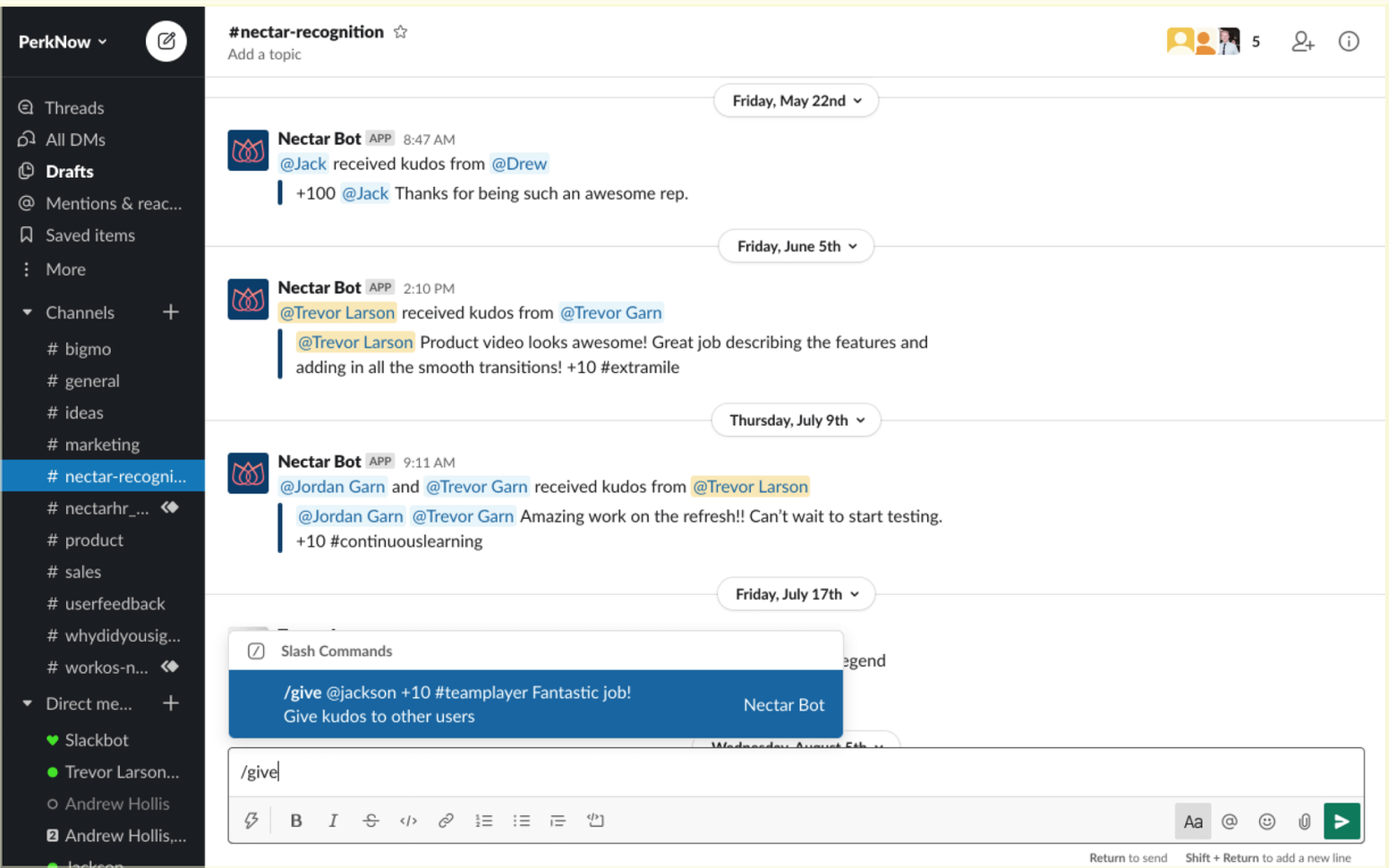
On Nectar, Points to Give reset on the 1st of each month and unused give-points expire, while Points to Redeem never expire, so employees can save toward larger rewards.
Admins can configure Variable Rate Allowances, rule-based monthly budgets that differ by department, location, or employment type, and mid-month changes take effect at the next monthly reset. Boosted Points let employees convert earned points back into giving points.
Nectar also emails reminders nudging people to spend their budget before the month closes, a small touch reviewers single out for praise. The trade-off is the one every monthly model carries: a busy month can pass before anyone spends their allowance, and the balance simply disappears.
WorkTango: a company-set giving balance that usually expires quarterly
WorkTango hands the cadence decision to the employer. Its help center is explicit that admins can expire point balances on a cadence that works for the business, and that most companies choose to expire their employees’ giving balance each quarter.
In practice, that makes the default WorkTango deployment a quarterly use-it-or-lose-it economy: a longer runway than Nectar’s month, but a longer gap before the deadline creates any urgency. Admins can set custom point rules per user group, and conversion mechanics exist for Give Back Points and for buying points to send.
Whether earned, redeemable points expire is not documented publicly, so treat that as a question for the sales call rather than an assumption.
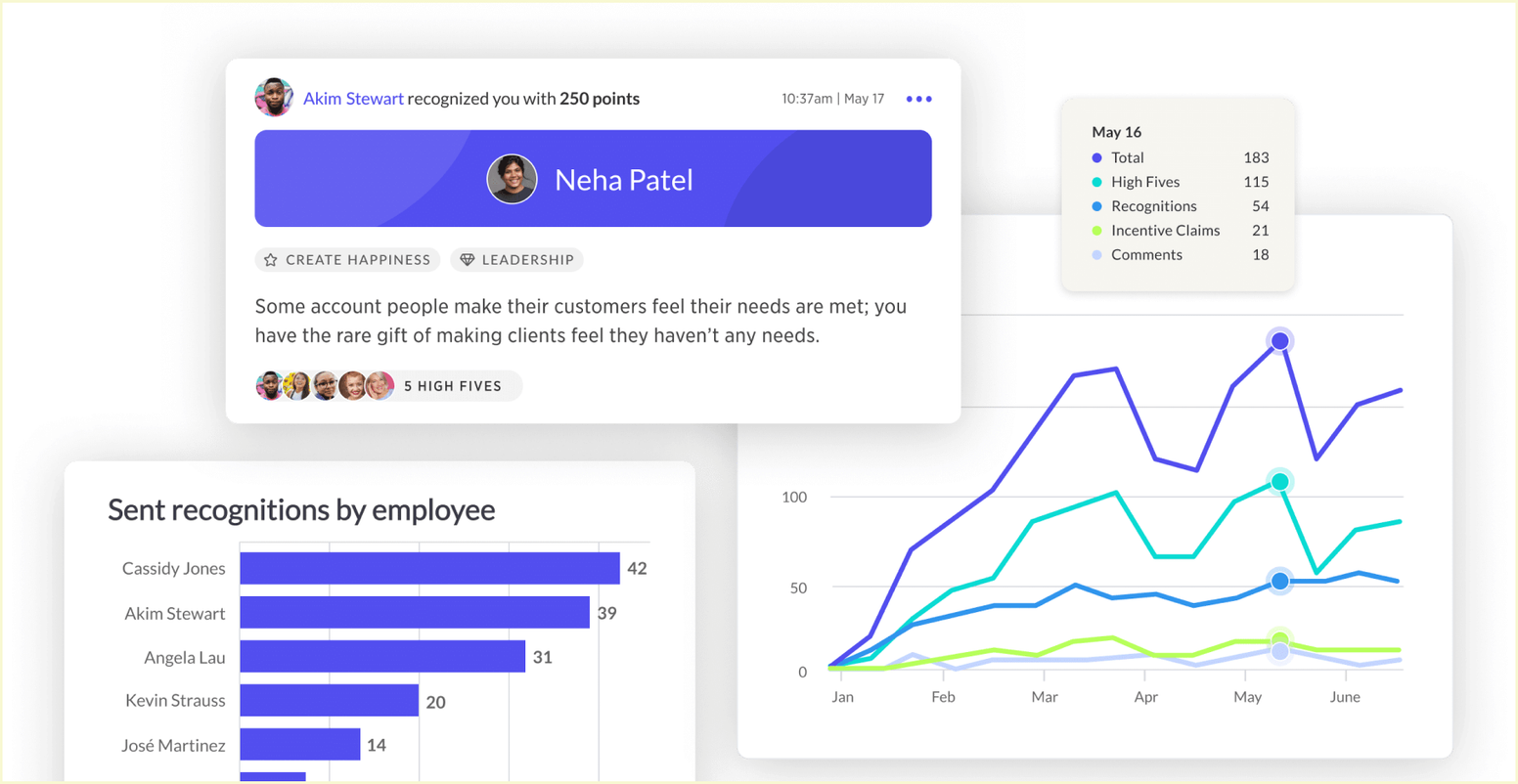
WorkTango does publish more program governance than most rivals: its Incentives module ships 50+ campaign templates, approval workflows requiring manager or HR sign-off, budget caps set per campaign, per employee, or per manager, and claim cap limits.
The honest synthesis: neither cadence is wrong, they optimize for different things. Monthly and quarterly allowances favor saving toward meaningful rewards, and both produce the same complaint class.
Points-economy friction is the largest dislike cluster on both G2 profiles, roughly 1,600 mentions across Nectar’s top five themes and roughly 175 across WorkTango’s, per G2’s review summaries, which is proportional to the very different review-base sizes.
Rewards catalogs and funding fees: Nectar vs. WorkTango
Both vendors charge you only for rewards employees actually redeem. Where they diverge is how much of that funding arrangement you can see before you sign.
Nectar rewards and published funding fees
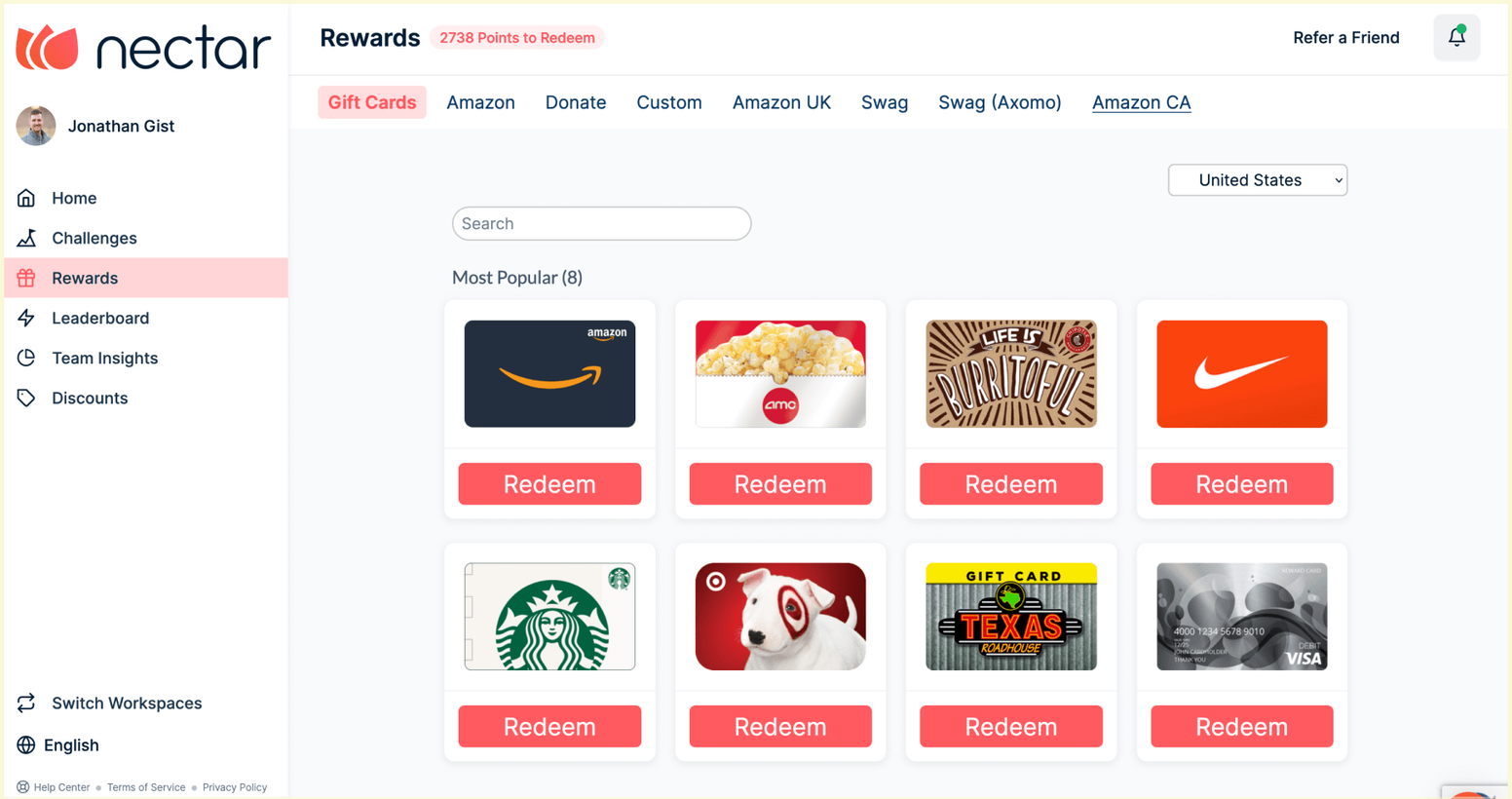
Nectar’s marketplace is the deeper of the two on paper today: gift cards, in-platform Amazon breadth, a swag store, charitable donations, and physical or instant reward cards. Two catalog caveats: gift cards come in preset denominations that cannot be customized, and cards are country-locked.
Per Nectar’s help center, the default billing mode, named Pay As You Go, is a prefunded auto-refill balance that tops up when it drops below 20% of the refill amount.
Prepaying by ACH, check, or wire is fee-free; credit-card reward payments carry a nonrefundable 3.5% + $0.40 per-transaction fee, and international wires cost $20.
A genuine billed-in-arrears option, Post-Pay, exists, but it requires account-manager approval and a 20% security deposit with a $100 minimum, and redemptions pause if a month’s redemptions exceed that deposit. One switcher-friendly detail: unused prefunded balances are refundable at cancellation on written request.
WorkTango rewards and the BI Worldwide fulfillment move
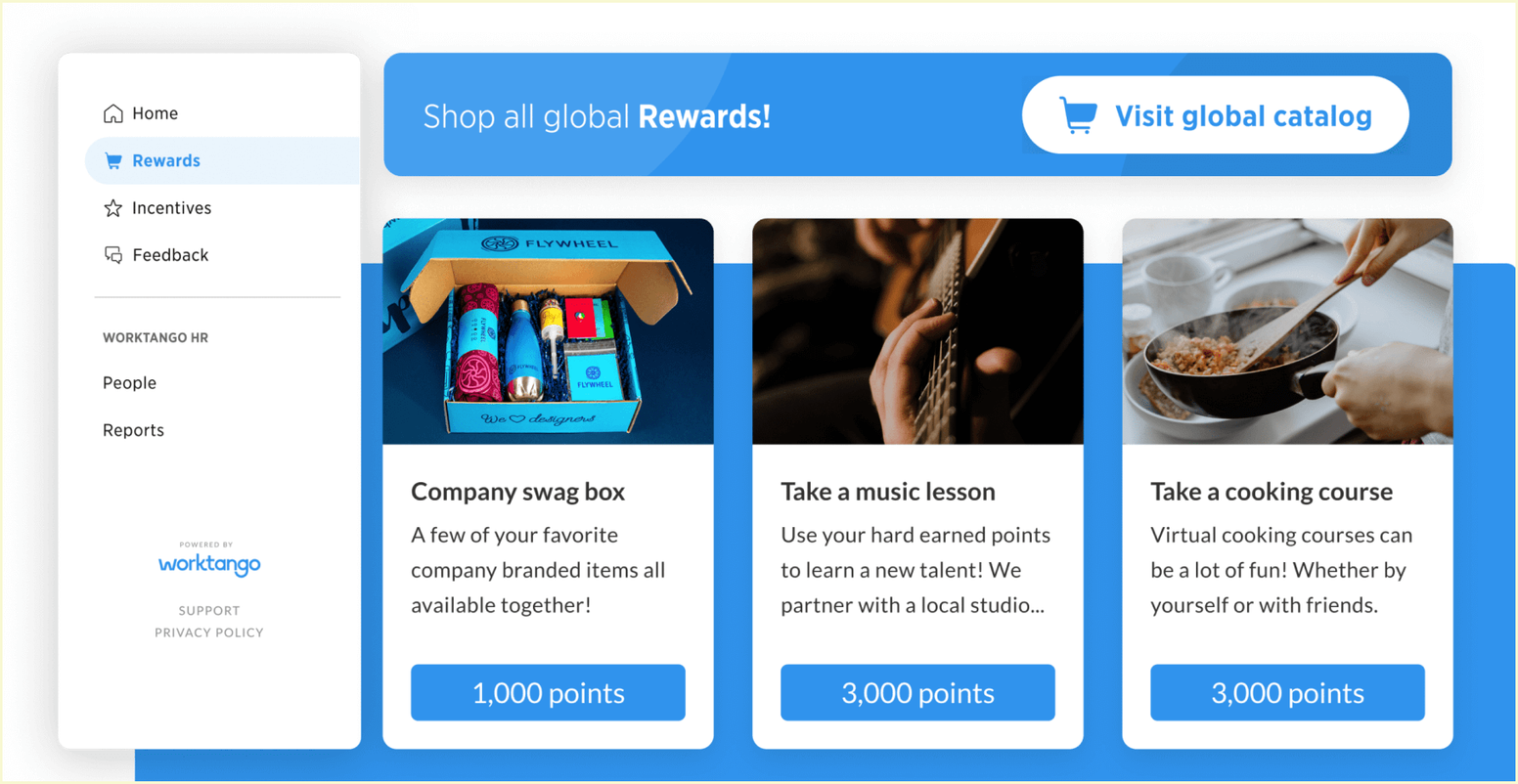
WorkTango’s current marketplace page advertises over 10 million choices across 90+ countries, including local and international gift vouchers, experiences, and physical merchandise, plus donations to more than 1.2 million charities, company swag, custom catalogs, and point pools.
Its funding model is pay-on-redemption with an explicit zero-markup promise: budget $50 for an award and the employee receives $50 in value, with no added fees or markups on marketplace items. That is a clean model and worth conceding plainly.
The important 2026 development is ownership. On July 20, 2026, WorkTango announced it had been acquired by BI Worldwide.
Per the release, WorkTango keeps its brand, team, and product identity and operates as a BI Worldwide subsidiary, while transitioning its core fulfillment infrastructure to BI Worldwide’s global rewards marketplace, which operates in 200+ countries and adds milestone awards, experiences, and events.
For buyers, the upside is concrete: a jump from the 90+ countries WorkTango advertises today to a global incentives leader’s catalog. The open questions are equally concrete, and the release does not answer them.
Ask for the cutover timeline, what happens to banked points during migration, whether the zero-markup promise survives on the new marketplace, and what the roadmap looks like under new ownership.
| Funding route | Nectar | WorkTango |
|---|---|---|
| 0% fee path | Prepay via ACH, check, or wire: 0%, no published minimum ($20 international wire fee) | Not published; funding terms are contract-gated |
| Prefund by credit card | 3.5% + $0.40 per transaction, nonrefundable | Not published |
| Billed in arrears | Post-Pay: requires approval and a 20% security deposit (minimum $100) | Pay-on-redemption is the standard model; deposit and invoice terms not published |
| Markup on rewards | Not published either way | Zero markup claimed: budget $50, employee receives $50 |
Read that table for what it is. Nectar publishes its fee schedule, so you can model card versus ACH funding before you talk to anyone.
WorkTango publishes a cleaner headline promise, zero markup on redemption, but no fee schedule at all; there is no help-center article documenting company-side billing, card fees, deposits, or refunds.
Neither position is dishonest, but they place the burden in different places: Nectar asks you to read the fine print, WorkTango asks you to negotiate for it.
Pricing transparency: two quote-gated vendors, different friction
Neither vendor publishes a price, which makes this a comparison of buying processes rather than numbers. Nectar restructured its pricing page in 2026 into quote-based product bundles, Recognize, Comms, Engage™, and the Culture Suite, with every CTA leading to a demo.
Third-party listings historically placed entry plans around $4–$5 per user/month with minimum monthly spends, and SelectSoftware reports a $4,000 minimum annual agreement; treat those as directional, not current list prices.
WorkTango’s pricing page gates all three tiers, Surveys and Insights, Recognition and Rewards, and the full Employee Experience Platform, behind a quote request. It does publish two terms that matter more than a headline rate: the minimum contract length is 12 months, and most organizations are ready to launch in 4–6 weeks.
Third-party estimates circulate near $5–$10 per user/month; they are estimates, not WorkTango’s price, and should be labeled that way in any budget deck.
The practical read: Nectar is the faster path from interest to a number and to a running program, WorkTango is the longer commitment with the heavier implementation. On both platforms the rewards budget is separate from the platform fee, so model platform cost, rewards budget, and funding fees together rather than comparing per-user rates alone.
Surveys and employee listening: Nectar Engage vs. WorkTango
If surveys are a real requirement, this section decides the comparison. WorkTango is a survey company that added recognition, and it shows.
Its Surveys and Insights product covers unlimited surveys, engagement and pulse programs, confidentiality safeguards, survey logic, heatmap and trend dashboards, action planning, and one-click summary exports, with AI comment summarization and theme identification on open text. In July 2026 it launched Constellation, an AI-moderated group listening platform.
Its strongest customer proof is survey-driven: American Eagle Financial Credit Union reports engagement rising from 69 to 81 and survey participation from 71% to 89% over twelve months.
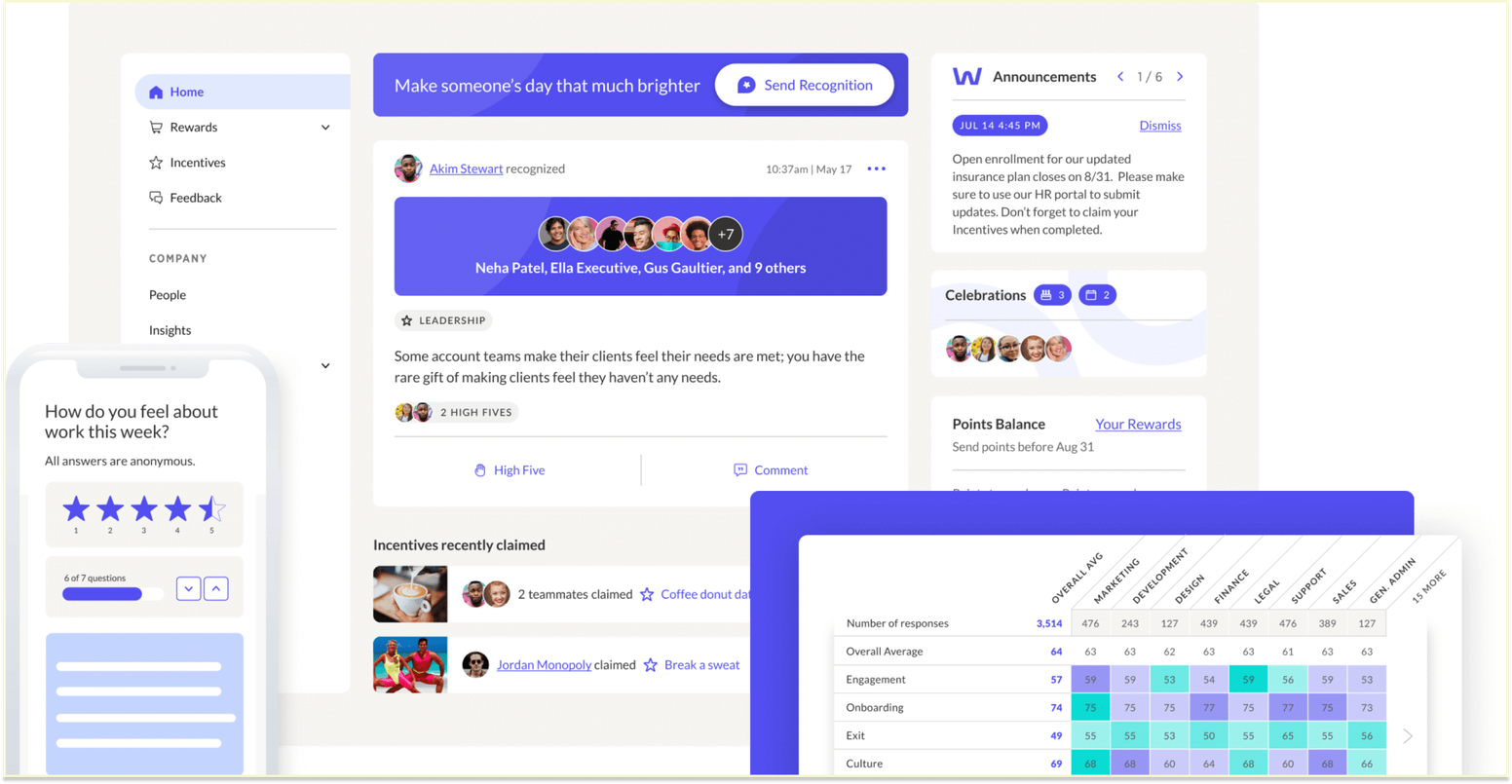
Nectar Engage™ is a real product, not a checkbox: engagement surveys, eNPS, onboarding and exit templates, a custom survey builder, scheduling and segmentation, anonymous feedback via SafeTalk®, and AI sentiment analysis, with benchmarking listed as coming soon.
It is sold as its own bundle, so it becomes a separate line in your quote. The fair verdict is a matter of depth and center of gravity: Nectar gives you competent listening alongside a best-in-class recognition and rewards engine, while WorkTango gives you deeper survey science with recognition attached. Buy the one whose center of gravity matches your actual problem.
Frontline and deskless teams: Nectar vs. WorkTango
Nectar was built with frontline workforces in mind: kiosk mode for shared terminals, SMS delivery, multi-language support, and physical or instant reward cards, with a customer base skewing toward healthcare and manufacturing.
One caveat to test with your own staff: its mobile apps trail its web experience, at 3.1 stars on Google Play across 120 reviews, last updated September 2024, and 4.4 on the App Store across 96 ratings.
WorkTango has the harder mobile story. Its apps rate 2.4 on Google Play across 296 reviews and 3.1 on the App Store across 86 ratings as of August 2026. Its Slack and Teams integrations are real, and Outlook recognition is a genuine rarity almost no competitor offers, but we could find no public Slack Marketplace listing and no Microsoft Teams app store listing for WorkTango as of August 2026. For a heavily deskless organization, Nectar is the clearer fit on delivery mechanics; for an office workforce that lives in email and survey cycles, WorkTango’s Outlook path is a real advantage.
What G2 reviewers say about Nectar and WorkTango
Both platforms hold a 4.7 on G2, so the score will not separate them. The volume and the review text will.
Nectar (4.7 across 8,579 reviews on G2, the largest review base in the category, with 81% five-star and 0% one-star): per G2’s review summary, recognition capabilities lead the praise with 1,947 mentions, followed by ease of use at 1,856.
Ryan L. (February 5, 2026) called the budget reminder emails “the most helpful thing” about the platform. The dominant criticism is the monthly allowance.
Van N., a teacher at an enterprise account, wrote in a four-star review on April 22, 2026: “I wish I had more than 50 points to give out each month... I often run out before the month ends.”
WorkTango (4.7 across 1,329 reviews on G2): the like themes are led by ease of peer recognition with 158 mentions and recognition features with 156. Rochie C., a customer service representative at an enterprise account, wrote in a five-star review on December 8, 2025 that the Recognition Writing Assistant “helps users write clearer... more meaningful recognition messages.” The sharpest mechanics criticism comes from a five-star reviewer: James W., a customer success team lead at a mid-market company, wrote on September 25, 2025, “Because points expire at the end of the quarter, it often turns into a quarter-end bonanza.” A separate cluster worth noting is performance: 27 reviews mention slow loading, a theme that does not appear in Nectar’s top dislikes.
The useful finding is the shape of the evidence, not the score. Nectar’s review base is more than six times larger, which makes its themes statistically sturdier; WorkTango’s smaller base concentrates on recognition ease, with its flagship survey product drawing thinner review coverage than you might expect.
Where Nectar wins
- Frontline delivery: kiosk mode, SMS, multi-language support, and physical or instant reward cards, built for workforces that do not sit at desks.
- Rewards marketplace depth today: in-platform Amazon breadth, a swag store, donations, and reward cards, with no fulfillment migration in progress.
- Published funding fees: you can read the 0% ACH path, the 3.5% + $0.40 card fee, and the Post-Pay deposit terms before you sign anything.
- Review volume and social proof: 8,579 G2 reviews at 4.7, 2,319 Microsoft Teams app store ratings, and an SHRM partnership.
- Documented outcomes: its Statista case study reports 93% utilization and a 29% reduction in turnover; 1st Choice Cabinetry reports turnover falling from 25% to 7%.
- Faster time to value: no published minimum contract length and no multi-week implementation requirement.
- Refundable balance: unused prefunded rewards budget is refundable at cancellation on written request.
Where WorkTango wins
- A genuine survey suite: unlimited surveys, eNPS, onboarding and exit templates, survey logic, action planning, and AI comment summarization and theme analysis, deeper than any recognition-first rival.
- AI listening momentum: WorkTango Coach, the Recognition Writing Assistant, and Constellation, an AI-moderated group listening platform launched July 22, 2026.
- Zero-markup rewards funding: budget $50 and the employee receives $50 in value, with no markup on marketplace items.
- Documented program governance: the Incentives module publishes approval workflows, per-campaign, per-employee, and per-manager budget caps, and claim cap limits, more control depth than most competitors document.
- Outlook recognition: sending recognition from Outlook is a rarity in this category and a real fit for email-centric organizations.
- Quantified survey outcomes: American Eagle Financial Credit Union moved engagement from 69 to 81 and participation from 71% to 89%; Pizza Pizza reported a 46-point eNPS swing across 2018–2021, in its Kazoo era.
- Catalog upside ahead: the move to BI Worldwide’s marketplace expands country coverage from the 90+ WorkTango advertises today to 200+.
The third option: Matter
Both platforms above assume recognition lives in their own app, funded by an allowance that expires monthly or quarterly. Matter makes two different bets: recognition should live inside Slack and Microsoft Teams with no separate app or login, and it should run on a weekly rhythm.
Every week, Feedback Friday™ (US Patent 12,199,935) prompts the whole team to recognize someone, and give-coins reset weekly so they get used rather than banked.
The cadence is measurable: in The Recognition Habit, Matter’s 2026 Benchmark Report, built on aggregate, de-identified platform data, teams that build recognition around a weekly ritual give about 2.5x more recognition per member than ad hoc teams, and roughly 8 in 10 ritual teams stay active in nearly every month.
On the criteria this guide has used: Matter’s Free plan is for unlimited users, paid plans are published at $1 to $5 per user/month, billed annually, and Matter hasn’t raised prices in 8 years.
Reward funding fees are published too, including a 0% ACH prepay path, and the catalog spans 10,000+ eGift card options across 200+ countries.
On the Microsoft Teams app store Matter holds a 5.0 across 1,476 ratings, and it rates 4.7 on G2. To be equally honest about fit: a largely deskless workforce that needs kiosk terminals or SMS delivery is better served by Nectar, and an organization whose primary requirement is deep survey science with action planning should choose WorkTango, because Matter’s surveys are a focused add-on rather than a full listening suite. For the detailed head-to-heads, see Nectar vs. Matter and WorkTango vs. Matter.
Which platform is right for your team?
Choose Nectar if:
- A large share of your workforce is frontline or deskless and needs kiosk, SMS, or reward-card delivery.
- Rewards catalog depth, including Amazon, is your deciding factor and you want it available today.
- You want published reward funding fees and no minimum contract length before you commit.
Choose WorkTango if:
- Employee listening is the core requirement and recognition is the companion product.
- You need documented approval workflows and budget caps for incentive campaigns.
- A 12-month minimum and a 4–6 week implementation are acceptable trades for one vendor covering both.
Choose Matter if:
- Your team lives in Slack or Microsoft Teams and you want recognition there, not in another app.
- You prefer a weekly recognition ritual over an allowance that expires monthly or quarterly.
- You want to start free with unlimited users and see published pricing before talking to anyone.
Frequently asked questions about Nectar vs. WorkTango
Is Nectar or WorkTango cheaper?
Neither publishes a price, so a written quote is the only reliable answer. The available signals point to Nectar being the lower-cost entry: third-party listings historically placed its entry plans around $4–$5 per user/month, while third-party estimates for WorkTango run near $5–$10 per user/month.
WorkTango also states a 12-month minimum contract, so its total first-year commitment is larger even where per-user rates overlap. Model the rewards budget and funding fees alongside the platform fee, since both vendors bill rewards separately.
What is the main difference between Nectar and WorkTango?
Center of gravity. Nectar is a recognition and rewards platform with a survey product attached, strongest on catalog depth and frontline delivery. WorkTango is an employee-listening platform with recognition attached, strongest on survey design, AI analysis, and action planning.
Their point models differ too: Nectar’s giving allowance resets monthly, while WorkTango lets the employer set the expiry cadence, most commonly quarterly.
Which has better employee surveys, Nectar or WorkTango?
WorkTango, on depth. It offers unlimited surveys, engagement and pulse programs, survey logic, confidentiality safeguards, heatmap and trend dashboards, action planning, and AI comment summarization and theme identification.
Nectar Engage™ is a real suite, covering engagement surveys, eNPS, onboarding and exit templates, a custom builder, anonymous feedback through SafeTalk®, and AI sentiment analysis, but it is sold as a separate bundle and is not the product either company was built around.
Do Nectar or WorkTango offer a free plan or free trial?
Neither offers a free plan. Nectar has no free tier, though G2 lists a free trial edition and trials are arranged through a demo signup. WorkTango offers no self-serve trial at all; every tier goes through a demo and quote. Among alternatives, Matter’s Free plan supports unlimited users.
What does the BI Worldwide acquisition mean for WorkTango customers?
WorkTango announced on July 20, 2026 that BI Worldwide had acquired it. Per the release, the brand, team, and product identity are retained and WorkTango operates as a BI Worldwide subsidiary, while core reward fulfillment transitions to BI Worldwide’s global marketplace, which covers 200+ countries and adds milestone awards, experiences, and events.
That is a catalog expansion for customers. The unanswered questions are worth raising in any renewal or purchase conversation: the cutover timeline, what happens to banked points during migration, whether the zero-markup promise carries over, and how the product roadmap changes under new ownership.
Nectar vs. WorkTango: the bottom line
These two rarely lose to each other on features; they lose on fit. If recognition is the program and rewards reach every worker including the ones without a desk, Nectar is the stronger buy, with published funding fees and no minimum term.
If employee listening is the program and recognition rides along, WorkTango is the deeper product, provided you are comfortable with a 12-month commitment signed while its fulfillment moves to a new owner’s marketplace.
And if what you actually want is recognition inside chat on a weekly rhythm with published pricing, that is a third question worth asking. Related reading: Nectar alternatives, WorkTango alternatives, and the full comparison hub.

![Kudos vs. WorkTango Comparison: Pricing & Reviews [2026 Guide]](https://cdn.sanity.io/images/kqqb5xry/production/5f38b00c45db2bc4bbe09bcad09552116948cd8a-800x600.jpg?w=720&q=75&fit=max&auto=format)
![Kudos vs. Nectar Comparison: Pricing & Reviews [2026 Guide]](https://cdn.sanity.io/images/kqqb5xry/production/534ba04d43c4301bb06b3935c0d5a2d507f52642-800x600.jpg?w=720&q=75&fit=max&auto=format)
![WorkTango vs. Matter Comparison: Pricing & Reviews [2026 Guide]](https://cdn.sanity.io/images/kqqb5xry/production/5bf41fa2873a9e349472c7edb674fbbcb46c832d-800x600.jpg?w=720&q=75&fit=max&auto=format)