

The 30-second verdict: Vantage Circle or WorkTango?
Choose Vantage Circle if your workforce is spread across many countries, especially with a significant India-based population, and you want recognition, a corporate perks and discounts marketplace, wellness, and surveys under one contract.
Its SOLI mechanic adjusts point value by local cost of living, it holds ISO 27001:2013 and ISO 27701:2019, and it has one of the largest review bases in the category.
Choose WorkTango if employee listening is a first-class requirement rather than an add-on. Its unlimited survey suite with AI comment summarization and thematic analysis is deeper than most recognition-first vendors offer, its Incentives module publishes real budget and approval controls, and its pay-on-redemption rewards billing carries an explicit zero-markup promise.
A third option exists: if what you actually want is recognition running inside Slack or Microsoft Teams with published pricing, Matter is covered at the end of this guide.
Vantage Circle and WorkTango both promise recognition and employee listening from a single vendor, which is why they end up on the same shortlist. They are built for different buyers.
Vantage Circle is a global suite that adds a perks marketplace and wellness alongside recognition; WorkTango is a mid-market platform whose survey science is genuinely its strongest product, and which changed hands in July 2026. This comparison was verified in August 2026 against both vendors’ pricing pages, product documentation, help-center articles, press releases, and G2 profiles.
Full disclosure: this guide is published by Matter, an employee recognition platform that competes with both Vantage Circle and WorkTango. We have kept the head-to-head honest, we say plainly where each product wins, and we introduce Matter only near the end as a third option.
Weigh our perspective accordingly, and get written quotes from both vendors before you buy.
How we researched this comparison
We build Matter, which competes with both platforms on this page, so weigh our perspective accordingly.
For Vantage Circle and WorkTango we reviewed each vendor’s public pricing, product pages, and help-center or billing documentation, plus their G2 profiles and named, dated reviews, and we drew on conversations with teams evaluating and switching between recognition platforms. We have not used either product hands-on.
Every claim here is sourced to the vendors’ own materials, named reviews, or Matter’s published data, and facts were last verified in August 2026.
Vantage Circle vs. WorkTango at a glance
| Vantage Circle | WorkTango | Matter | |
|---|---|---|---|
| Starting price | Custom pricing on all three tiers (Grow, Transform, Scale); no per-user rates published | Quote-gated on all three products; 12-month minimum contract. Third-party estimates put it near $5–$10 per user/month | Free plan, then $1 to $5 per user/month, billed annually; public tiers |
| Free plan | No; every tier is demo-gated and no trial is published | No free plan and no self-serve trial | Yes, unlimited users |
| G2 rating | 4.7 (10,896 reviews) | 4.7 (1,329 reviews) | 4.7 (1,186 reviews) |
| Teams app store | 4.6 (3,631 ratings) | No listing on the Microsoft Teams app store; its Teams integration is admin-configured | 5.0 (1,476 ratings) |
| Best for | Globally distributed enterprises wanting recognition, perks, wellness and surveys from one vendor | Mid-market organizations, roughly 500 to 10,000 employees, that need serious survey depth alongside recognition | Slack/Teams-first teams that want recognition inside chat |
Recognition mechanics: accumulating points vs. a quarterly giving balance
Both platforms run points economies, but they expire differently, and that single detail changes how recognition feels day to day.
Vantage Circle: accumulating points, employer-set validity
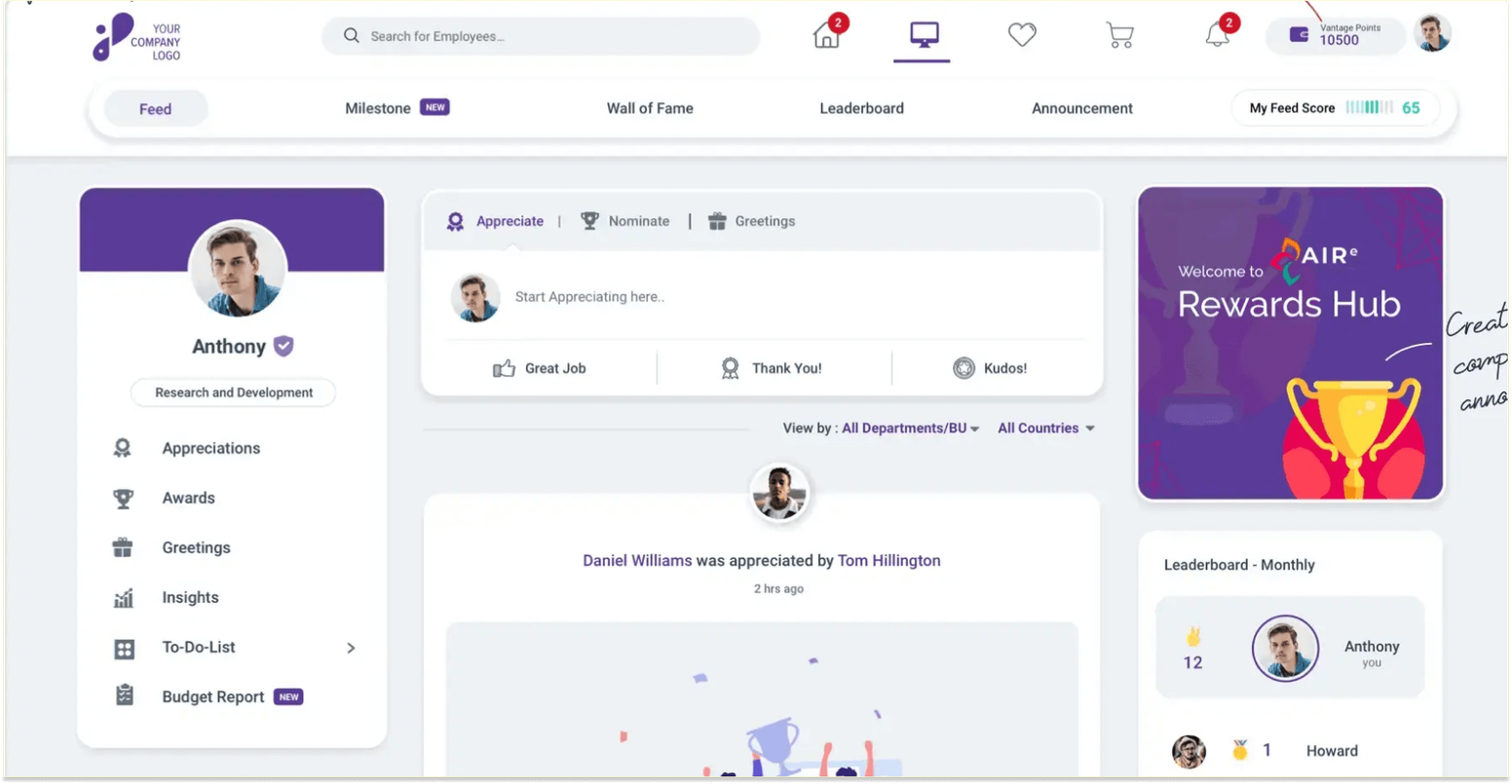
Vantage Recognition (formerly Vantage Rewards) sits in all three plans. Employees send value-aligned badges and eCards, managers issue SPOT awards, service milestones fire automatically from the HRIS, and a social feed carries reactions and comments. Nomination workflows with approve and decline steps handle structured award programs, and AI-generated messages plus printed cards extend reach to frontline staff.
Earned points accumulate rather than reset. Per Vantage Circle’s own help center, organization-allocated points carry a validity period the employer sets, and reward points become invalid once an employee exits the organization. Neither is unusual for an accumulating-points vendor, but both belong on your offboarding checklist.
WorkTango: a giving balance that expires quarterly by default
WorkTango splits points the same way most peer platforms do, into a balance you give and a balance you redeem. The distinctive part is the expiry cadence. Its help center states that most companies choose to expire employees’ giving balance each quarter, and that admins can set that cadence to suit the business. Give Back Points follow the same rule.
The practical effect shows up in reviews. James W., a Team Lead in Customer Success, wrote in a five-star review on September 25, 2025: “Because points expire at the end of the quarter, it often turns into a quarter-end bonanza.” Points-economy friction is WorkTango’s largest dislike cluster on G2, led by limited points frustration (55 mentions), points expiration issues (39), and missing expiration reminders (22).
One thing not to assume: WorkTango publishes no policy on earned, redeemable points expiring, so confirm that separately rather than treating the quarterly rule as universal.
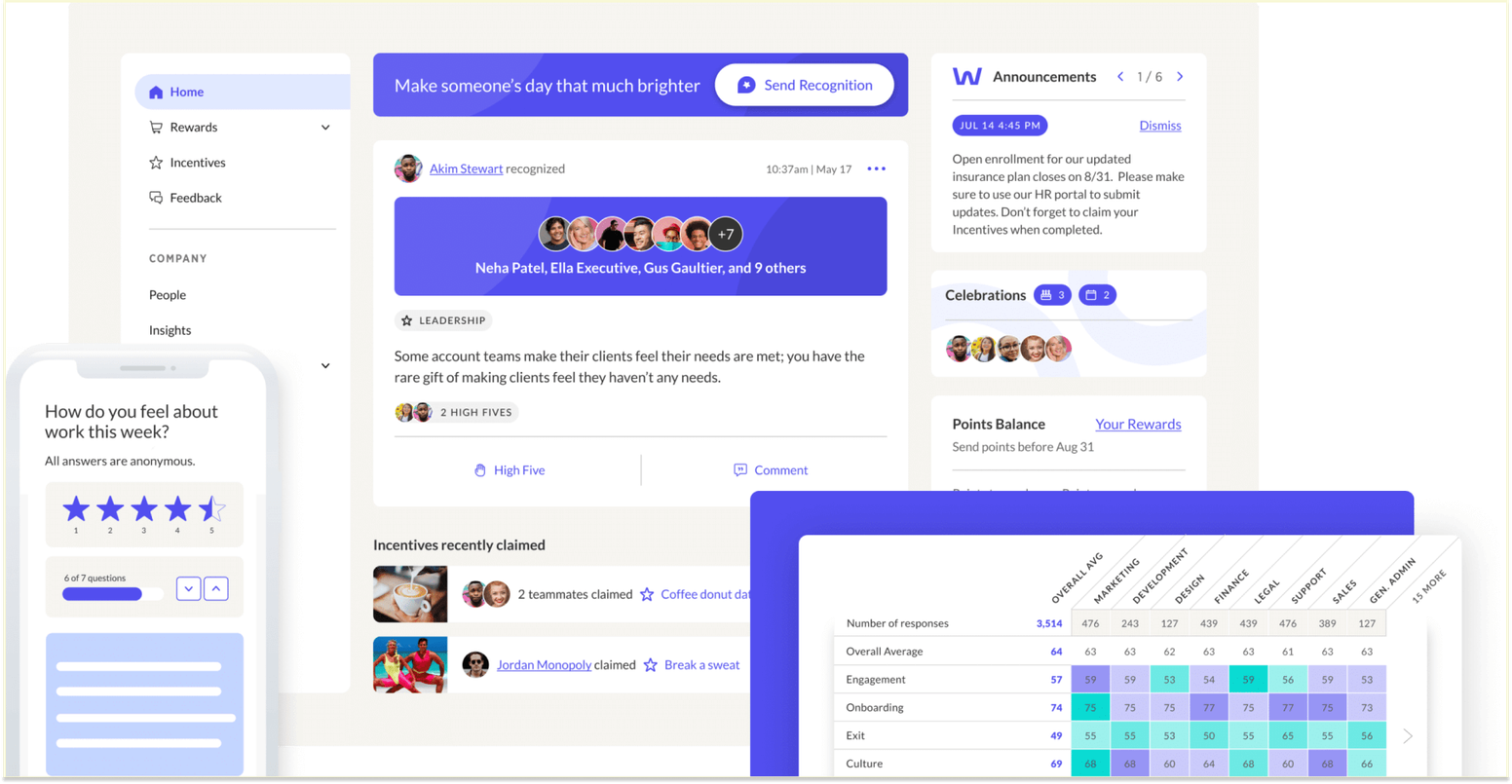
Where WorkTango pulls ahead is program governance. Its Incentives module ships 50+ pre-configured campaign templates, optional manager or HR approval before rewards are issued, budget limits per campaign, per employee, or per manager, and claim cap safeguards.
That is more published spend control than most recognition vendors document, and it is a fair reason for a finance team to prefer it.
Rewards catalogs and funding: what each vendor publishes
On rewards billing, WorkTango is the more transparent of the two, and that deserves saying plainly.
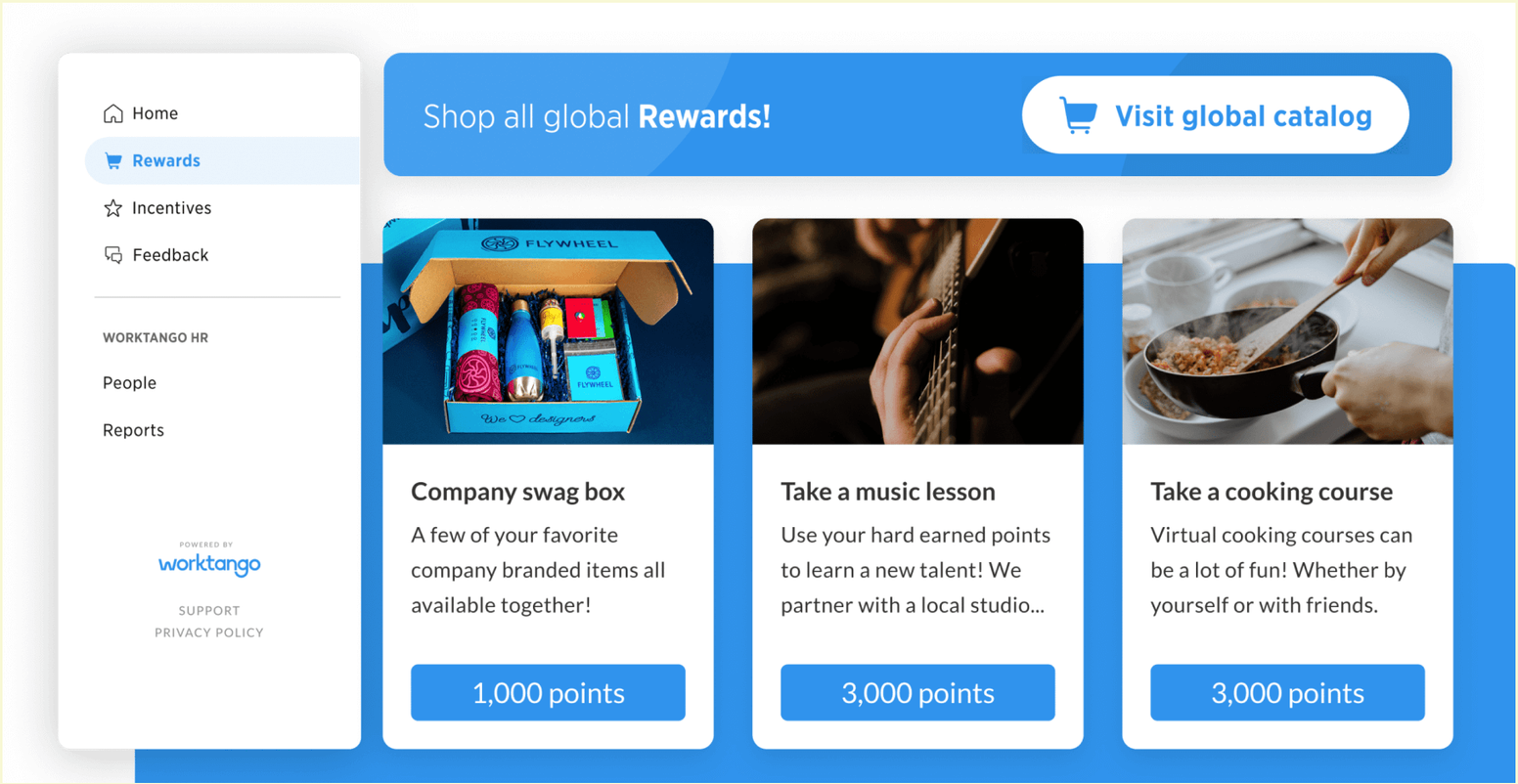
WorkTango uses a pay-on-redemption model: companies pay for rewards only when employees redeem, and points cost nothing until converted. Its marketplace page states that 100% of an allocated budget goes to employee rewards with no hidden fees or markups, so a $50 budgeted award delivers $50 of value.
That is a clean model on paper. Its current catalog advertises more than 10 million choices across 90+ countries, plus donations to over 1.2 million charities.
One live change belongs in your diligence. On July 20, 2026, WorkTango announced it had been acquired by BI WORLDWIDE, ending roughly eight years of Vista Equity Partners ownership.
Per WorkTango’s own release, the brand, team, and product identity are retained as a BI WORLDWIDE subsidiary, and core reward fulfillment will transition to BI WORLDWIDE’s global rewards marketplace, which operates in 200+ countries and adds milestone awards, experiences, and events. The catalog upside is real.
The open questions are equally real and unanswered publicly: the cutover timeline, what happens to banked points mid-migration, whether the no-markup promise carries over, and where the roadmap sits under new ownership. Ask all four in the demo.
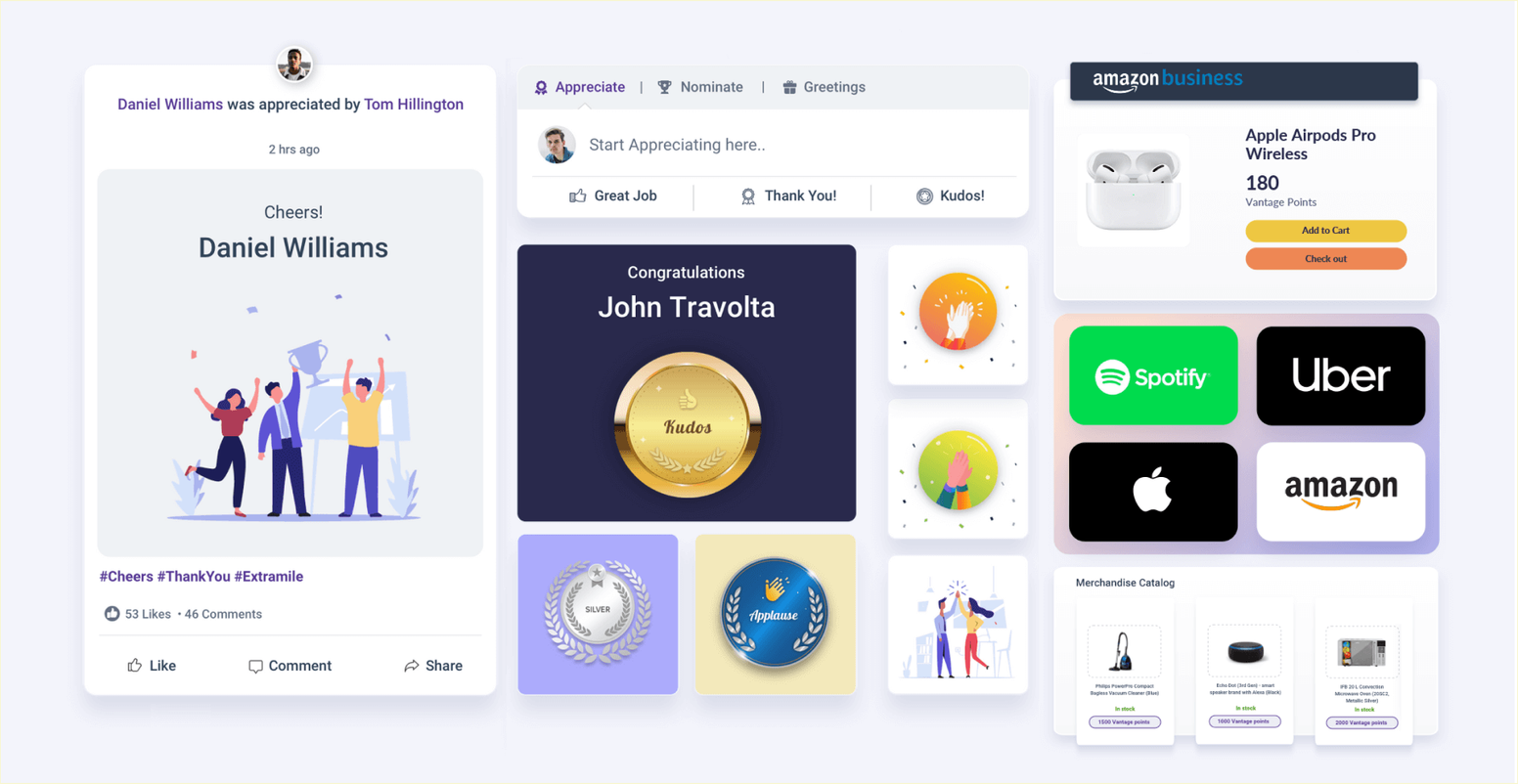
Vantage Circle’s catalog is genuinely global too: gift cards, merchandise, experiences, travel, an Amazon Business integration for milestone rewards, multi-wallet balances, and cross-country point transfers. Its distinctive mechanic is SOLI, which adjusts point value by local cost of living, including for employees relocating internationally.
Two cautions: its own published figures differ by page, with the homepage citing 10,000+ reward options across 100+ countries while the rewards product page cites 10 million+ rewards across 70+ countries; and it publishes no reward funding fee schedule.
| Funding question | Vantage Circle | WorkTango |
|---|---|---|
| Funding model | Not publicly documented | Pay-on-redemption: you pay when employees redeem, not when points are issued |
| Markup on rewards | Not published either way | States no hidden fees or markups; a $50 budgeted award delivers $50 of value |
| Published fee schedule (card, ACH, deposits) | None published | None published; the help center carries no billing articles |
| Published catalog scale | 10,000+ reward options (homepage) or 10 million+ rewards (product page) | 10 million+ choices across 90+ countries, pre-migration |
| Cross-country value | SOLI-adjusted point value, including for international relocations | Global currencies with conversion handled by WorkTango |
| Points when an employee leaves | Help center states reward points become invalid once an employee exits | Not publicly documented |
Pricing transparency and contract terms
Neither vendor will give you a number without a sales conversation, but WorkTango does publish its terms, which matters more than it sounds.
Vantage Circle sells Grow, Transform (badged Best Value and Most Popular), and Scale. On its plans and pricing page, all three show Custom pricing behind a Book a Demo call to action, with no per-user rates, minimums, setup fees, contract terms, or free trial published.
At the same time, Vantage Circle’s own comparisons hub lists transparent per-user pricing without revenue share or reward markups as a criterion buyers should use when choosing a vendor.
Both pages were live in August 2026. We will let the two sit side by side, other than to say it is a fair thing to raise in the demo.
WorkTango is equally quote-gated across its three products, Employee Surveys and Insights, Recognition and Rewards, and the full Employee Experience Platform. But its pricing page does publish two commitments Vantage Circle does not: a 12-month minimum contract length, and an implementation timeline of four to six weeks for most organizations.
Third-party buyer guides estimate roughly $5 to $10 per user per month; treat that as an outside estimate, not WorkTango’s price. Weigh the 12-month minimum against the ownership transition above: a first-year commitment signed now runs straight through the fulfillment migration.
Surveys and employee listening: WorkTango’s strongest ground
If listening is a top-three requirement, this section decides the comparison, and it decides it for WorkTango.
WorkTango was built as a combined surveys and recognition platform, and the survey half is the deeper half.
It offers unlimited surveys, engagement and lifecycle templates, analytics with heatmaps and trends, generative AI comment summarization and thematic analysis on open text, WorkTango Coach, and Constellation, an AI-moderated group listening product launched July 22, 2026. Its support documentation tilts visibly toward the survey product, consistent with where the investment sits.
The proof is quantified: its American Eagle Financial Credit Union study reports engagement rising from 69 to 81 over twelve months, action scores from 43 to 66, favorability from 62% to 78%, and participation from 71% to 89%, after cutting an 80-question annual survey to a 20-question pulse.
Vantage Pulse is a real eNPS-based tool with sentiment analysis and parallel surveys, but its packaging works against buyers who need it: it is an add-on on both Grow and Transform, and included only at Scale. Surveys are therefore a top-tier purchase or a line item on your quote.
The same pattern applies to Vantage Fit, its wellness module, an add-on on Grow and included on Transform and Scale.
The fair verdict: WorkTango wins employee listening clearly. Vantage Circle wins breadth, since perks and wellness have no WorkTango equivalent.
Integrations, marketplaces, and mobile
Both platforms integrate with Slack and Microsoft Teams, but their public marketplace footprints look very different.
Vantage Circle runs a native embedded Teams app distributed through AppSource, rating 4.6 across 3,631 ratings, alongside a real Slack Marketplace listing that supports monetary and non-monetary awards, slash commands, and leaderboards. It names Workday, SAP, Oracle, BambooHR, and Darwinbox among its HRIS integrations, and adds WhatsApp notifications for frontline reach.
WorkTango’s integrations are real but less publicly visible. It supports sending recognition in Slack, a Teams tab with a recognition and activity feed, and recognition in Outlook, which almost nobody else offers and is worth conceding.
It lists 60+ HRIS and HCM integrations including Workday, ADP Workforce Now, SAP SuccessFactors, Paylocity, and BambooHR, plus broad SSO, and it appears on the UKG and ADP marketplaces.
That said, WorkTango has no listing on the Microsoft Teams app store and no public Slack Marketplace listing we could find as of August 2026, so there are no store ratings or install counts to evaluate.
Mobile is where the gap widens. WorkTango’s apps rate 3.1 across 86 App Store ratings and 2.4 across 296 Google Play reviews as of August 2026, the weakest mobile scores among major platforms in this category, and both listings still carry naming debris from earlier owners.
Vantage Circle markets a mobile-first experience, though its own reviewers describe the app as functional rather than polished. If much of your workforce will use a phone as their primary device, test both before signing.
What G2 reviewers say about Vantage Circle and WorkTango
Both platforms hold a 4.7 on G2. The difference is the size of the evidence base behind that score.
Vantage Circle (4.7 across 10,896 reviews on G2) has one of the largest review bases in the category, skewed toward enterprise employees and heavily represented by India-based reviewers. Per G2’s review summary, praise leads with ease of use and quick access to offers (865 mentions) and variety of redeemable options (509).
The criticism is tightly clustered: all five top dislike themes concern the catalog and redemption, roughly 690 mentions in total. Nishanth J., a Sr. Engineer, described a “Straightforward redemption flow” and a stable mobile app on March 9, 2026, while flagging weak search filters and regional catalog gaps.
Prashanth Sai A., a Data Engineer, praised the Teams integration for peer recognition on April 29, 2026, and noted the same regional catalog variation.
WorkTango (4.7 across 1,329 reviews on G2) has the smaller base, with a mid-market reviewer profile. Praise concentrates on ease of peer recognition (158 mentions), recognition features (156), and ease of use (126).
Rochie C., a Customer Service Representative, wrote in a five-star review on December 8, 2025 that the Recognition Writing Assistant helps users write clearer, more meaningful recognition messages. The criticism runs to the points economy and reward value.
Dylan B., a Contributing Writer, wrote on April 29, 2026, in a 4.5-star review: “Non-cash prizes are overpriced.” Chris H., a Sales Manager, wrote on April 28, 2026, at 3.5 stars: “Seems to lack engagement by a lot of users.” A slow-loading performance cluster (27 mentions) also shows up here and does not appear on Vantage Circle’s profile.
Read the volume difference honestly. Vantage Circle’s 10,896 reviews give more statistical confidence; WorkTango’s 1,329 come from a narrower, more comparable mid-market population. Both are useful, for different reasons.
Where Vantage Circle wins
- Suite breadth under one contract: recognition, a corporate perks and discounts marketplace, wellness through Vantage Fit, surveys through Vantage Pulse, and AIRe strategy advisory from a single vendor.
- SOLI cost-of-living parity: point value adjusted by location, including for employees relocating internationally.
- Review volume: 10,896 G2 reviews at 4.7, plus 4.7 on Capterra across 5,121+ reviews.
- Public marketplace presence: 4.6 across 3,631 Microsoft Teams app store ratings and a real Slack Marketplace listing, both with visible track records.
- Scale proof: 3.2 million+ users and a Wipro deployment covering 234,054 employees across 66 countries with a reported 97.5% increase in peer recognition.
- Frontline touches: WhatsApp notifications and printed recognition cards for workers without a company device.
- Certifications: ISO 27001:2013 and ISO 27701:2019 documented on its security page.
Where WorkTango wins
- Employee listening: unlimited surveys, lifecycle templates, AI comment summarization and thematic analysis, WorkTango Coach, and Constellation. Genuinely deeper than a recognition-first survey add-on.
- Published contract terms: a 12-month minimum and a four-to-six-week implementation timeline, both stated on its pricing page rather than discovered in a contract.
- Clean rewards billing: pay-on-redemption with an explicit no-markup promise, so a $50 budgeted award delivers $50 of value.
- Program governance: the Incentives module publishes 50+ templates, approval workflows, per-campaign, per-employee and per-manager budget caps, and claim cap limits.
- Outlook recognition: alongside Slack and Teams, a delivery channel almost no competitor offers.
- Quantified case studies: American Eagle Financial Credit Union reports engagement rising 69 to 81 and participation 71% to 89%; Pizza Pizza reports a 46-point eNPS swing, from -32 to +14, over its 2018 to 2021 program.
- Fulfillment upside ahead: the move to BI WORLDWIDE’s marketplace expands reward reach from 90+ to 200+ countries.
The third option: Matter
Both platforms above assume recognition lives in their own app, funded by allocated points that expire on someone else’s schedule. Matter makes a different bet: recognition should live inside Slack and Microsoft Teams with no separate login, and it should run on a weekly rhythm.
Every week, Feedback Friday™ (US Patent 12,199,935) prompts the whole team to recognize someone, and give-coins reset weekly so they get used rather than saved for a quarter-end rush.
The cadence is measurable: in The Recognition Habit, Matter’s 2026 Benchmark Report, built on aggregate, de-identified platform data, teams that build recognition around a weekly ritual give about 2.5x more recognition per member than ad hoc teams, and roughly 8 in 10 ritual teams stay active in nearly every month.
On the criteria this guide has used: Matter’s Free plan is for unlimited users, paid tiers are published at $1 to $5 per user/month, billed annually, and Matter hasn’t raised prices in 8 years.
Reward funding fees are published too, including a 0% ACH prepay path, and the catalog spans 10,000+ eGift card options across 200+ countries. On the Microsoft Teams app store, Matter holds a 5.0 across 1,476 ratings.
Two honest concessions. If employee listening is your primary requirement, WorkTango’s unlimited survey suite with AI thematic analysis is deeper than Matter’s Surveys tier, and you should choose accordingly.
And if you are running a multi-country Fortune 500 program that needs cost-of-living-adjusted point parity across dozens of currencies, or a perks and wellness marketplace alongside recognition, Vantage Circle is genuinely built for that and Matter is not. For the detailed head-to-heads, see Vantage Circle vs. Matter and WorkTango vs. Matter.
Which platform is right for your team?
Choose Vantage Circle if:
- Your workforce spans many countries and reward parity across them is a hard requirement.
- You want recognition, perks and discounts, wellness, and surveys consolidated with one vendor.
- A visible public track record matters to your stakeholders, from review volume to marketplace ratings.
Choose WorkTango if:
- You need a serious survey and employee-listening suite in the same contract as recognition.
- Published program controls, budget caps, and approval workflows are part of your requirements.
- You are comfortable with a 12-month minimum and a four-to-six-week implementation, and you have asked what the BI WORLDWIDE fulfillment migration changes for you.
Choose Matter if:
- Your team lives in Slack or Microsoft Teams and you want recognition there, not in another app.
- You prefer a weekly recognition ritual over points that expire on a quarterly or employer-set schedule.
- You want to start free with unlimited users and see published pricing before talking to anyone.
Frequently asked questions about Vantage Circle vs. WorkTango
Is Vantage Circle or WorkTango cheaper?
Neither publishes a price, so an honest comparison needs two written quotes. Vantage Circle lists all three tiers (Grow, Transform, and Scale) as custom pricing behind a demo request, and publishes no minimums or contract terms.
WorkTango is also quote-gated but does publish a 12-month minimum contract and a four-to-six-week implementation window; third-party buyer guides estimate roughly $5 to $10 per user per month, which is an outside estimate rather than WorkTango’s own figure.
Compare total cost, not licence cost: platform fee, rewards budget, and funding terms all belong in the same model.
What is the main difference between Vantage Circle and WorkTango?
Breadth versus depth. Vantage Circle is a wider suite, adding a corporate perks and discounts marketplace and a wellness module to recognition, with SOLI cost-of-living parity for multi-country programs. WorkTango is narrower but deeper on employee listening, pairing recognition with an unlimited survey suite, AI comment analysis, and published budget and approval controls in its Incentives module.
Which is better for employee surveys, Vantage Circle or WorkTango?
WorkTango, clearly. Surveys are half its platform: unlimited surveys, lifecycle templates, AI thematic analysis of open-text comments, and the Constellation group-listening product launched in July 2026. Vantage Pulse is a capable eNPS tool, but it is an add-on on the Grow and Transform tiers and included only at Scale, so survey depth costs extra unless you buy the top plan.
Do Vantage Circle and WorkTango points expire?
Both can, on different schedules. On Vantage Circle, organization-allocated points carry a validity period the employer sets, and its help center states reward points become invalid once an employee exits the organization.
On WorkTango, the help center says most companies expire the giving balance each quarter, and admins can change that cadence; WorkTango does not publish a policy on earned redeemable points expiring, so confirm that in writing.
What does the BI WORLDWIDE acquisition mean for WorkTango customers?
WorkTango announced on July 20, 2026 that it was acquired by BI WORLDWIDE from Vista Equity Partners.
Per WorkTango’s own release, the brand, team, and product identity are retained as a BI WORLDWIDE subsidiary, and core reward fulfillment moves to BI WORLDWIDE’s global rewards marketplace, which operates in 200+ countries and adds milestone awards, experiences, and events. That is a catalog expansion from WorkTango’s currently advertised 90+ countries.
What is not published is the cutover timeline, the treatment of banked points during migration, whether the no-markup commitment survives on the new marketplace, and the roadmap under new ownership. Those are questions for the vendor, not conclusions to draw.
Vantage Circle vs. WorkTango: the bottom line
Pick on the axis where they actually diverge. Vantage Circle gives you the wider suite, cross-country reward parity, and the larger public track record. WorkTango gives you real survey science, published contract terms and program controls, and clean pay-on-redemption billing, with an ownership transition worth asking about.
Neither publishes a price, so budget for a sales cycle either way. And if a weekly recognition habit inside Slack or Teams with published pricing is closer to what you need, that belongs on the shortlist too. Related reading: Vantage Circle alternatives, WorkTango alternatives, and the full comparison hub.

![Kudos vs. Vantage Circle Comparison: Pricing & Reviews [2026 Guide]](https://cdn.sanity.io/images/kqqb5xry/production/c0f4834f2403e1febb8f8e1e58e699af3e634e8d-800x600.jpg?w=720&q=75&fit=max&auto=format)
![Vantage Circle vs. Matter Comparison: Pricing & Reviews [2026 Guide]](https://cdn.sanity.io/images/kqqb5xry/production/a6135e0425176ca218fa290bf02567dc7932f729-800x600.jpg?w=720&q=75&fit=max&auto=format)
![Nectar vs. Vantage Circle Comparison: Pricing & Reviews [2026 Guide]](https://cdn.sanity.io/images/kqqb5xry/production/8eec85d78433f606041ec2ca685ac2525544aceb-800x600.jpg?w=720&q=75&fit=max&auto=format)