

The 30-second verdict: Bonusly or Motivosity?
Choose Bonusly if you want per-user pricing you can budget without a sales call, a free tier to pilot on, and the fastest-shipping AI feature set in the category. Team is $3 per user/month, billed annually, Team + Bizy is $5, the free plan covers up to 8 users, and there is a 30-day trial with no credit card.
Choose Motivosity if you are a mid-market or enterprise team that wants recognition denominated in real dollars rather than abstract points, an instant tap-to-pay ThanksMatters Visa card for redemption, and an employee-insights and eNPS layer from the same vendor, and you can budget for a quote-based contract with a $3,000 minimum annual investment.
A third option exists: if what you actually want is recognition running inside Slack or Microsoft Teams on a weekly rhythm with published pricing, Matter is covered near the end of this guide.
Bonusly and Motivosity both run peer recognition on a monthly giving budget, and both sell to mid-market HR teams, but they sit on opposite sides of the buying process: one publishes its prices, the other quotes them behind a $3,000 annual floor.
This comparison was verified in August 2026 against both vendors’ pricing pages, their own help-center documentation, and their G2 profiles. Full disclosure: this guide is published by Matter, an employee recognition platform that competes with both Bonusly and Motivosity.
We have kept the head-to-head honest, we say plainly where each product wins, and we introduce Matter only near the end as a third option. Weigh our perspective accordingly, and confirm current pricing with each vendor before you buy.
How we researched this comparison
We build Matter, which competes with both platforms on this page, so weigh our perspective accordingly.
For Bonusly and Motivosity we reviewed each vendor’s public pricing, product pages, and help-center or billing documentation, plus their G2 profiles and named, dated reviews, and we drew on conversations with teams evaluating and switching between recognition platforms. We have not used either product hands-on.
Every claim here is sourced to the vendors’ own materials, named reviews, or Matter’s published data, and facts were last verified in August 2026.
Bonusly vs. Motivosity at a glance
| Bonusly | Motivosity | Matter | |
|---|---|---|---|
| Starting price | Team $3 per user/month, billed annually ($5 with Bizy AI); public tiers | Quote-gated on every tier; $3,000 minimum annual investment is the only published figure | Free plan, then $1 to $5 per user/month, billed annually; public tiers |
| Free plan | Yes, up to 8 users; 30-day trial, no card | No free plan and no self-serve trial; demo-led | Yes, unlimited users |
| G2 rating | 4.7 (7,000+ reviews) | 4.7 (3,615 reviews) | 4.7 (1,186 reviews) |
| Teams app store | 4.4 (45 ratings) | 4.2 (58 ratings) | 5.0 (1,476 ratings) |
| Best for | SMB and mid-market office teams that want public pricing and shipped AI features | Mid-market and enterprise teams that want dollar-based rewards and a spendable Visa card | Slack/Teams-first teams that want recognition inside chat |
Recognition mechanics: points versus dollars
Both platforms give every employee two balances: an allowance for giving that refills monthly, and an earned balance to redeem. The difference is what the units mean and how the giving budget behaves at month end.
Bonusly: a monthly points allowance with the Points Boost loop
On Bonusly, your giveable balance resets to the full monthly allowance at the start of each budget period, usually the 1st, and unused give-points expire with no carryover. Earned redeemable points do not expire by default, though companies can configure expiration rules.
Managers get extra allowance per direct report, and admins can set allowance rules by department, location, or role. Bonusly’s most distinctive mechanic is Points Boost: employees can spend earned points to permanently raise their own monthly giving allowance, a self-reinforcing loop no other major platform ships.
One number worth knowing before you size a budget: Bonusly’s own rewards calculator states that on average 60% of monthly recognition allowances are given away each month, which means roughly 40% of allowance points go unused and expire every month.

Motivosity: dollar-denominated bucks that reset on the 1st
Motivosity drops the points abstraction entirely. One Motivosity buck equals one US dollar, so a $5 give reads as $5 to both sender and recipient. That clarity is a real design win, and it makes budgets easier to explain to finance.
The cadence, however, is the same as Bonusly’s: per Motivosity’s own General User FAQ, To Give dollars reset on the first of each month without rollover, while earned To Spend dollars generally do not expire unless a company sets an expiration policy.
Admins allocate a monthly default and layer Special Giving Rules by user, team, org, or custom criteria, and those rules stack.
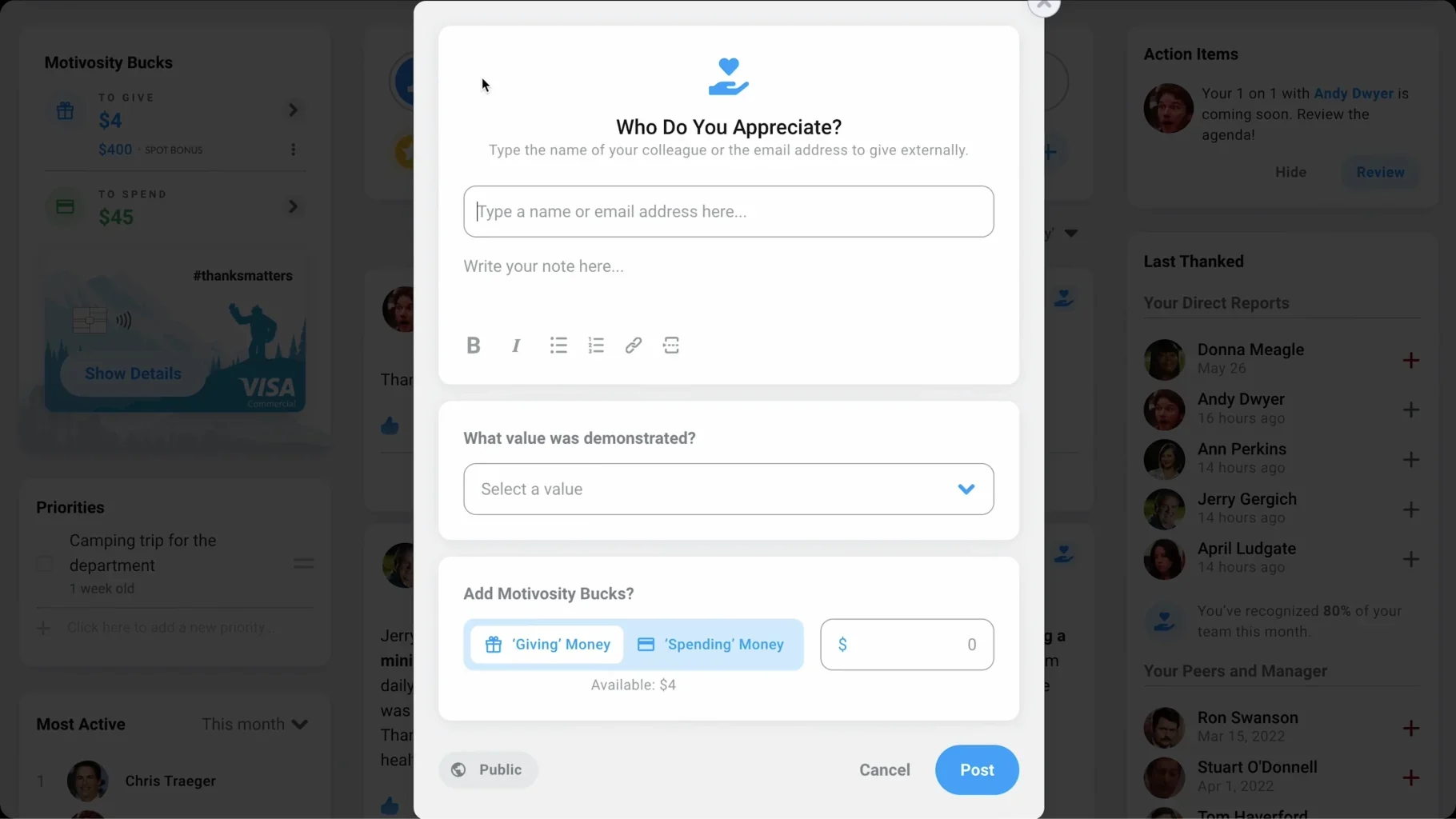
The honest synthesis: these are two implementations of the same monthly-allowance design, and neither has a structural edge on cadence. Motivosity wins on unit clarity, because a dollar is a dollar. Bonusly wins on admin depth, with per-department allowance rules, one-time boosts, and the Points Boost loop.
The shared trade-off shows up in both review bases: budgets that reset monthly push people to spend near the deadline rather than in the moment.
Rewards, catalogs, and reward funding fees
On both platforms the rewards budget is separate from the software fee, and you pay only for what employees actually redeem. What differs is how you get money into the system and what that costs.
Bonusly rewards and funding
Bonusly’s gift cards are all electronic, with some taking up to 48 hours to activate. Curated physical gifts ship through its partner Snappy, company swag runs through an AXOMO integration, and charitable donations are included.
Per Bonusly’s help center article on paying for rewards, there are three funding modes: Pay-as-You-Go by card, billed in arrears with an 8% convenience fee; the Flex Plan, prefunding $200 or more by card at a 5% convenience fee with auto-recharge at 50% depletion; and the Fixed Plan, a $2,500 minimum upfront deposit paid by invoice via ACH or wire with no convenience fee.

Motivosity rewards and funding
Motivosity claims 500M reward options across 175+ countries with no markups, plus the ThanksMatters Visa card for instant tap-to-pay redemption, backed by Apple Wallet support.
Behind the branded experience, generic Visa reward cards are fulfilled through Tango Card with card support handled by Prepaid Digital Solutions, and physical Visa cards take around 45 days to arrive.
Funding is prepay only, per Motivosity’s help center: a US bank account by ACH at no fee but 5 to 6 business days to clear, or a US-based credit card at a 3.5% transaction fee that processes in about 4 to 6 hours.
Deposit caps apply on both routes, and both funding sources must be US-based, worth raising in a demo if your entities sit outside the United States.

| Funding route | Bonusly | Motivosity |
|---|---|---|
| 0% fee path | Fixed Plan: invoice via ACH or wire, $2,500 minimum upfront deposit | ACH from a US bank account: no fee, 5 to 6 business days to clear |
| Prefund by credit card | Flex Plan: 5% convenience fee, $200 minimum, auto-recharge at 50% | 3.5% transaction fee, US-based cards only, processes in about 4 to 6 hours |
| Billed in arrears | Pay-as-You-Go: 8% convenience fee, no deposit, self-serve | Not offered; funding is prepay only |
Read the table both ways. Motivosity is cheaper on both prepay routes, and it reaches 0% without parking $2,500, which matters for smaller programs. Bonusly is the only one of the two that lets you start without prefunding anything, though at 8% that convenience is the most expensive money on either platform.
One caveat that applies to both: neither vendor’s documentation states whether an unused prefunded balance is refundable at cancellation, so ask in writing before you deposit.
Pricing transparency: published tiers versus a $3,000 floor
This is the sharpest split between the two, and Bonusly clearly wins it. Bonusly publishes everything on bonusly.com/pricing: a free plan for up to 8 users focused on peer recognition, Team at $3 per user/month billed annually, Team + Bizy at $5 per user/month, and a quote-based Organization tier.
In a category drifting toward quote-only pricing, a published fee schedule is a genuine buyer benefit and Bonusly deserves credit for it.
Motivosity publishes no rates at all. Its pricing page sells modular bundles by company size, and the only public number is the minimum: its own FAQ states that the minimum annual investment is $3,000.
Its 2026 software roundup repeats the point in its own words, listing an annual minimum contract of roughly $3,000 as a barrier for very small teams. Motivosity also markets a 30 to 60 day implementation requiring 5 to 10 admin hours, so budget onboarding time as well as licence cost.
For a 50-person team, that $3,000 floor lands before a single dollar of rewards is funded, while the same team on Bonusly Team is $1,800 per year at list.

Surveys, insights, and AI tooling
If listening tools are on your requirements list, Motivosity is the fuller product. Its employee-insights module covers eNPS and engagement measurement, and its Appreciation Intelligence branding adds AI-assisted recognition writing plus turnover-risk insights. Insights is a module, so it adds per-employee cost on top of the platform fee: price it in the demo.
Bonusly’s listening layer is lighter. Pulse Checks, launched in October 2025, is a sentiment pulse rather than a full survey suite. Bonusly’s 2026 investment has gone into performance and AI instead: the Bizy recognition sidekick, AI-assisted 1:1s, Recaps, 360 feedback, goals, a Recognition Quality Score, and MCP support for AI assistants.
On shipped AI breadth as of August 2026, Bonusly is ahead. On depth of employee listening, Motivosity is ahead.
Mobile apps and workplace marketplaces
Motivosity has the better mobile story. Its iOS app rates 4.8 across roughly 5,700 ratings and its Android app 4.8 across 815 reviews, with both stores shipping releases in early August 2026. Bonusly’s iOS app matches it at 4.8 across roughly 4,500 ratings, but its Android app sits at 3.7 across 669 reviews, a split worth testing with your own Android users before rollout.
Marketplace presence tells a different story. Both vendors integrate with Slack and Microsoft Teams and both are Microsoft 365 certified, but neither has built a deep Teams following: Bonusly rates 4.4 across 45 ratings on the Microsoft Teams app store and Motivosity’s Team Connector rates 4.2 across 58. For context, Matter holds a 5.0 across 1,476 ratings on the same store.
On both platforms the centre of gravity remains the vendor’s own app and social feed, with chat tools acting as a notification and shortcut surface.

What G2 reviewers say about Bonusly and Motivosity
Both platforms hold a 4.7 on G2, so the star rating will not separate them. The review text and the review volume will.
Bonusly (4.7, 7,000+ reviews on G2): ease of use and no-training adoption dominate the praise. Edson O., a Team Lead, wrote in a five-star review in May 2026: “It makes recognition simple, visible, and tied to real rewards.” The most common criticism is the size of the monthly allowance.
Nikki C., a small-business reviewer, wrote in a five-star review on May 5, 2026: “I regularly run out of points as I have a big team and want to recognise them.” Across Bonusly’s top dislike themes, roughly 2,100 mentions concern the points economy.
Motivosity (4.7, 3,615 reviews on G2): reviewers single out the ease of the recognition flow and the reporting.
Stacie D., an HR Operations Specialist at a mid-market company, wrote in a five-star review on June 3, 2026 that the “reporting side is a massive time-saver for anyone running team evaluations.” The criticism splits two ways.
On the allowance, Clayton M., a Customer Success Manager at a mid-market company, described month end in a 4.5-star review on April 21, 2026: “you would still have money to spend and it felt like you were just trying to come up with something to compliment someone on, which didn’t feel as genuine.” Unusually for a 4.7-rated product, navigation and interface complaints are also prominent, at roughly 135 mentions across the top ten dislike themes, alongside about 150 on allowance size, reward flexibility, and redemption.
The finding worth carrying into your own evaluation: the same complaint class leads on both platforms, and it is about the monthly allowance model itself rather than bugs or support.
Where Bonusly wins
- Published pricing: public per-user tiers, a real free plan for up to 8 users, and a 30-day trial with no credit card. Motivosity publishes only its $3,000 annual minimum.
- Shipped AI: Bizy, AI 1:1s, Recaps, Recognition Quality Score, and MCP support put Bonusly ahead of most of the category, Motivosity included, on AI actually in production as of August 2026.
- Self-serve start: you can trial and launch without a sales cycle, against Motivosity’s 30 to 60 day implementation and demo-led motion.
- Pay-as-you-go funding: the only route of the two that lets you launch rewards without prefunding a balance.
- Admin allowance depth: rules by department, location, or role, one-time boosts, and the Points Boost loop.
- Integration breadth: Slack, Teams, and a rare Google Chat integration, plus 30+ HRIS systems.
- Gentler offboarding: points and history are never deleted, and companies can let departing employees redeem earned points.
Where Motivosity wins
- Dollar-denominated recognition: one buck equals one dollar, with no point-conversion math for employees or finance to decode.
- The ThanksMatters Visa card: genuinely differentiated instant, tap-to-pay redemption with Apple Wallet support, rather than waiting on a gift-card code.
- Cheaper reward funding: 0% by ACH with no $2,500 deposit required, and 3.5% by card against Bonusly’s 5%.
- Mobile quality on both platforms: 4.8 on iOS across roughly 5,700 ratings and 4.8 on Android across 815 reviews, with no Android gap.
- Employee listening: an insights and eNPS module with turnover-risk analysis, against Bonusly’s lighter Pulse Checks.
- Global catalog claims: 500M reward options across 175+ countries, 70+ languages, and tax support in 63 countries.
- Documented enterprise proof: its Old National Bank case study reports 85% adoption in the first month rising to 90%, 12,000+ peer recognition moments, and a full workday per week of admin time recovered.
The third option: Matter
Both platforms above assume recognition lives in their own app and feed, funded by a monthly allowance. Matter makes two different bets: recognition should live inside Slack and Microsoft Teams with no separate app or login, and it should run on a weekly rhythm rather than a monthly budget.
Every week, Feedback Friday™ (US Patent 12,199,935) prompts the whole team to recognize someone, and give-coins reset weekly so they get used rather than banked for a month-end scramble.
The cadence is measurable: in The Recognition Habit, Matter’s 2026 Benchmark Report, built on aggregate, de-identified platform data, teams that build recognition around a weekly ritual give about 2.5x more recognition per member than ad hoc teams, and roughly 8 in 10 ritual teams stay active in nearly every month.
On the criteria this guide has used: Matter’s Free plan is for unlimited users, paid plans are published at $1 to $5 per user/month, billed annually, and Matter hasn’t raised prices in 8 years.
Reward funding fees are published as well, including a 0% ACH prepay path, and the catalog spans 10,000+ eGift card options across 200+ countries.
On the Microsoft Teams app store Matter holds a 5.0 across 1,476 ratings, and it rates 4.7 on G2. To be equally honest about fit: Matter is built for teams that live in Slack or Teams, so if you want a standalone social feed as the centre of your program, Bonusly and Motivosity are closer to that shape.
And Matter does not offer a spendable Visa card like Motivosity’s, or match Bonusly’s performance-management and AI feature count. For the detailed head-to-heads, see Bonusly vs. Matter and Motivosity vs. Matter.
Which platform is right for your team?
Choose Bonusly if:
- You want to budget from a published price list and start on a free tier or a 30-day trial without a sales call.
- Shipped AI and manager tooling, including 1:1s, Recaps, and 360 feedback, are on your requirements list.
- You want to fund rewards without prefunding a balance, and the 8% convenience fee is acceptable for that flexibility.
Choose Motivosity if:
- You want recognition denominated in real dollars and redeemed instantly on a tap-to-pay Visa card.
- You need eNPS and employee insights from the same vendor and can pay for the module.
- Your annual recognition budget clears $3,000 comfortably and a 30 to 60 day guided implementation suits your team.
Choose Matter if:
- Your team lives in Slack or Microsoft Teams and you want recognition there, not in another app.
- You prefer a weekly recognition ritual over a monthly allowance that resets on the 1st.
- You want to start free with unlimited users and see published pricing before talking to anyone.
Frequently asked questions about Bonusly vs. Motivosity
Is Bonusly or Motivosity cheaper?
On published numbers, Bonusly. It lists a free plan for up to 8 users, Team at $3 per user/month billed annually, and Team + Bizy at $5.
Motivosity is quote-gated on every tier, and the only figure it publishes is a $3,000 minimum annual investment, confirmed on both its pricing page and its FAQ. For a 50-person team, Bonusly Team is $1,800 per year at list while Motivosity’s floor alone is $3,000 before rewards.
Both bill rewards separately, so compare platform fee, rewards budget, and funding fees together, and get Motivosity’s number in writing.
What is the main difference between Bonusly and Motivosity?
Mechanically they are close: both run monthly giving allowances that reset without rollover, both keep earned balances that do not expire by default, and both sell rewards funded from a separate budget.
The practical differences are that Bonusly publishes its pricing, leads on shipped AI, and offers a self-serve start, while Motivosity uses real dollars instead of points, adds the ThanksMatters Visa card for instant redemption, includes an eNPS and insights module, and sells through a demo with a $3,000 annual minimum.
Does Motivosity have a free plan or a free trial?
No. Motivosity has no free plan and lists no self-serve free trial on its pricing page; evaluation runs through a demo and a custom quote. Bonusly does offer both a free plan for up to 8 users and a 30-day trial with no credit card. Among alternatives, Matter’s Free plan supports unlimited users.
Do Bonusly points and Motivosity bucks expire?
The giving side expires on both. Bonusly’s giveable allowance resets at the start of each budget period with no carryover, and Motivosity’s To Give dollars reset on the first of each month without rollover per its own General User FAQ.
Earned balances are different: Bonusly’s redeemable points and Motivosity’s To Spend dollars do not expire by default, though on both platforms an employer can configure an expiration policy. Ask what policy your admin plans to set.
Which is better for large organizations, Bonusly or Motivosity?
Motivosity positions itself for mid-market and enterprise, and its strongest public proof is at that size: Old National Bank reports 85% adoption in the first month rising to 90% across roughly 5,000 employees and nearly 400 locations.
Bonusly serves large teams too, with 3,400+ organizations and a Toast case study reporting 86% participation, and it scales without a minimum contract. The deciding factors are usually procurement style and redemption experience rather than headcount.
Bonusly vs. Motivosity: the bottom line
Both are well-reviewed platforms built on the same monthly-allowance foundation, and both hold a 4.7 on G2. Decide on the axes where they genuinely differ: published pricing, self-serve onboarding, and shipped AI (Bonusly), or dollar-denominated rewards, the ThanksMatters Visa card, cheaper reward funding, and an insights module (Motivosity).
If neither buying model appeals and you would rather have recognition living inside chat on a weekly rhythm, that is the case for Matter. Related reading: Bonusly alternatives, Motivosity alternatives, and the full comparison hub.