

The 30-second verdict: Bonusly or WorkTango?
Choose Bonusly if you want per-user pricing you can budget without a sales call, a lightweight peer-to-peer points feed that office teams adopt with no training, and the fastest-shipping AI feature set in the category. Its free plan covers up to 8 users, there is a 30-day trial with no credit card, and Team runs $3 per user/month, billed annually.
Choose WorkTango if you want a genuine employee-listening suite and a recognition program on one contract, you are a mid-market organization of roughly 500 to 10,000 people, and you are comfortable with quote-based pricing, a twelve-month minimum, and a four-to-six-week implementation.
A third option exists: if what you actually want is recognition running inside Slack or Microsoft Teams with published pricing, Matter is covered near the end of this guide.
Bonusly and WorkTango both promise recognition your employees will actually use, but they are sold as different things. Bonusly is a self-serve peer-recognition platform with published per-user pricing.
WorkTango is a combined surveys-and-recognition suite bought on a quote, with a twelve-month minimum, and it changed owners in July 2026. This comparison was verified in August 2026 against both vendors’ public pages, help-center documentation, press releases, app-store listings, and G2 profiles.
Full disclosure: this guide is published by Matter, an employee recognition platform that competes with both Bonusly and WorkTango. We have kept the head-to-head honest, we say plainly where each product wins, and we introduce Matter only near the end as a third option.
Weigh our perspective accordingly, and confirm current terms with each vendor before you buy.
How we researched this comparison
We build Matter, which competes with both platforms on this page, so weigh our perspective accordingly.
For Bonusly and WorkTango we reviewed each vendor’s public pricing, product pages, and help-center or billing documentation, plus their G2 profiles and named, dated reviews, and we drew on conversations with teams evaluating and switching between recognition platforms. We have not used either product hands-on.
Every claim here is sourced to the vendors’ own materials, named reviews, or Matter’s published data, and facts were last verified in August 2026.
Bonusly vs. WorkTango at a glance
| Bonusly | WorkTango | Matter | |
|---|---|---|---|
| Starting price | Team $3 per user/month, billed annually ($5 with Bizy AI); public tiers | Quote-only on every tier; twelve-month minimum contract. Third-party estimates put it near $5 to $10 per user/month | Free plan, then $1 to $5 per user/month, billed annually; public tiers |
| Free plan | Yes, up to 8 users (recognition only) | No free plan and no self-serve trial | Yes, unlimited users |
| G2 rating | 4.7 (7,000+ reviews) | 4.7 (1,329 reviews) | 4.7 (1,186 reviews) |
| Teams app store | 4.4 (45 ratings) | No listing on the Microsoft Teams app store | 5.0 (1,476 ratings) |
| Best for | SMB and mid-market office teams that want public pricing and shipped AI features | Mid-market organizations that want surveys and recognition from one vendor | Slack/Teams-first teams that want recognition inside chat |
Recognition mechanics: a monthly reset vs. a quarterly expiry
Both platforms give employees a budget of points to hand out, and on both that budget expires. The difference is the clock.
Bonusly: a monthly allowance everyone spends
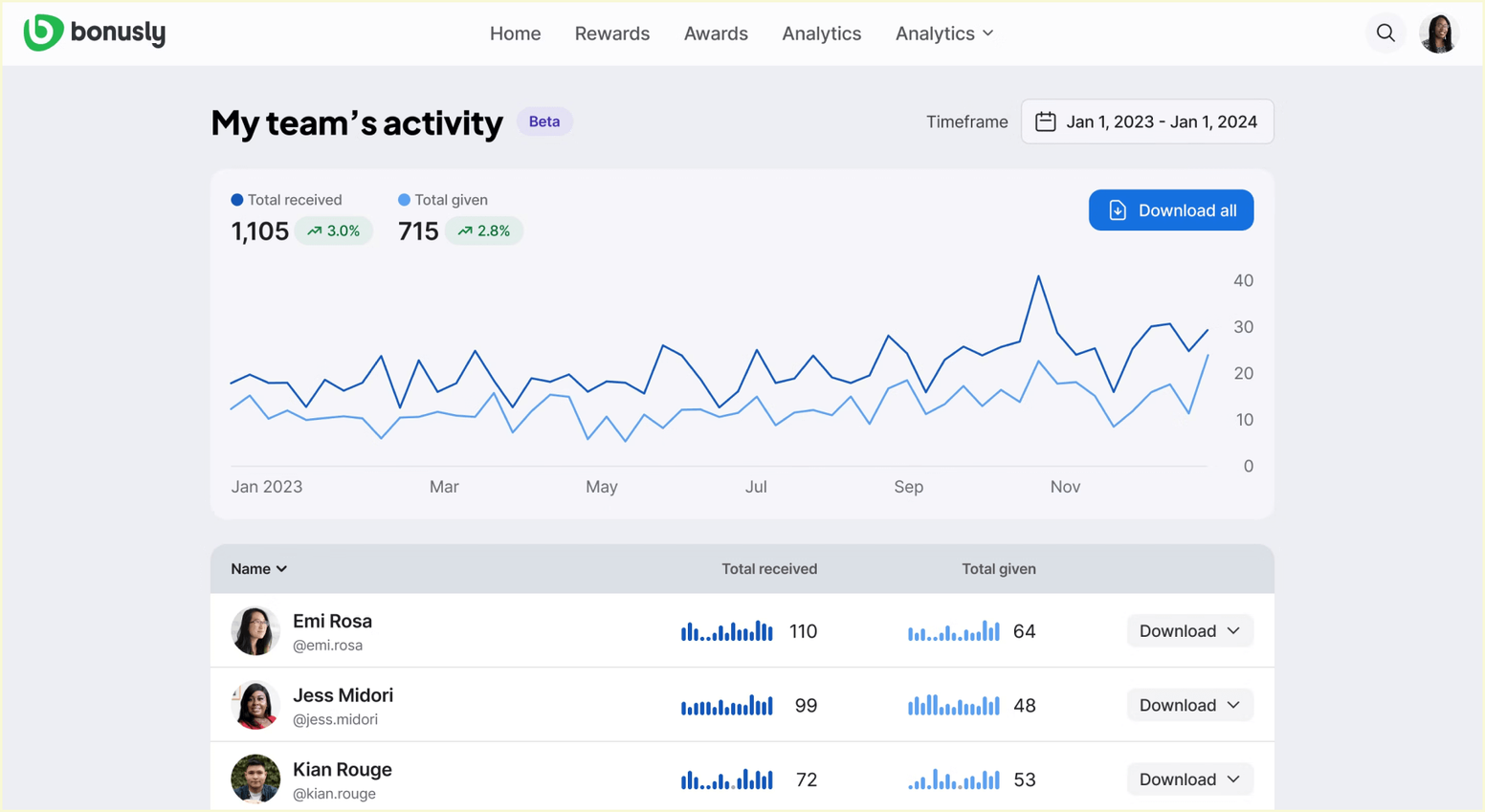
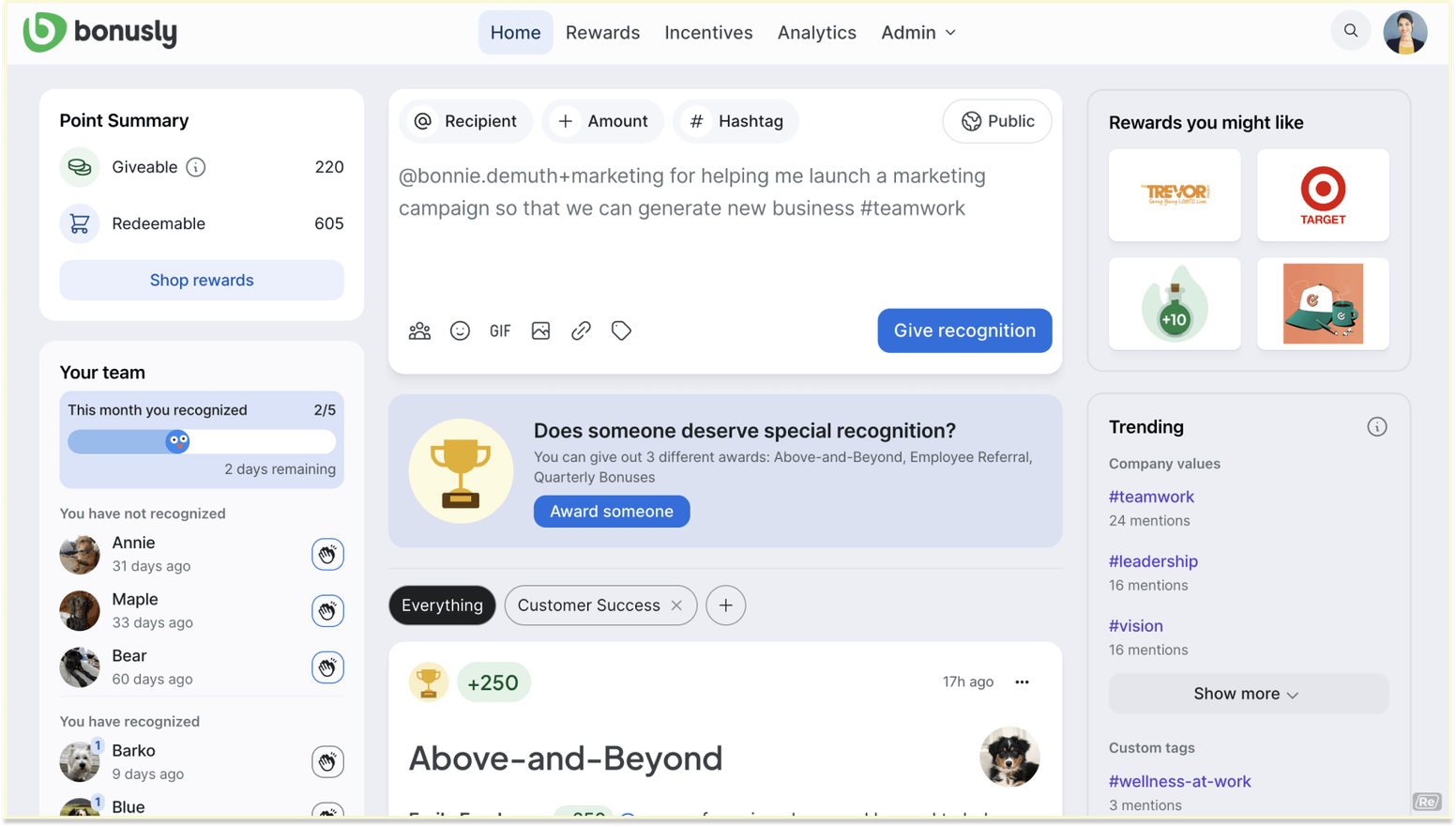
Bonusly runs a two-balance economy. Every employee gets a giveable allowance that resets to full at the start of each budget period, usually the 1st of the month, and unused give-points expire with no carryover. Earned redeemable points do not expire by default, though companies can configure expiration rules.
Managers receive extra allowance per direct report, and admins can set allowance rules by department, location, or role. Bonusly’s cleverest mechanic is Points Boost, which lets employees spend earned points to permanently raise their own giving allowance.
The trade-off shows up in Bonusly’s own numbers: its rewards calculator states that on average 60% of monthly recognition allowances are given away each month, which means roughly 40% of allowance points go unused and expire monthly.
WorkTango: a company-set allowance that usually expires quarterly
WorkTango’s giving balance is company-configured, and its help center is explicit about the common setting: most companies choose to expire their employees’ giving balance each quarter, and admins can expire point balances on whatever cadence suits the business. Give Back Points follow the same rule.
WorkTango also supports custom conversion ratios and custom point rules for managers or executives. Whether earned redeemable points expire is not documented publicly, so treat that as a question for your rep rather than an assumption either way.
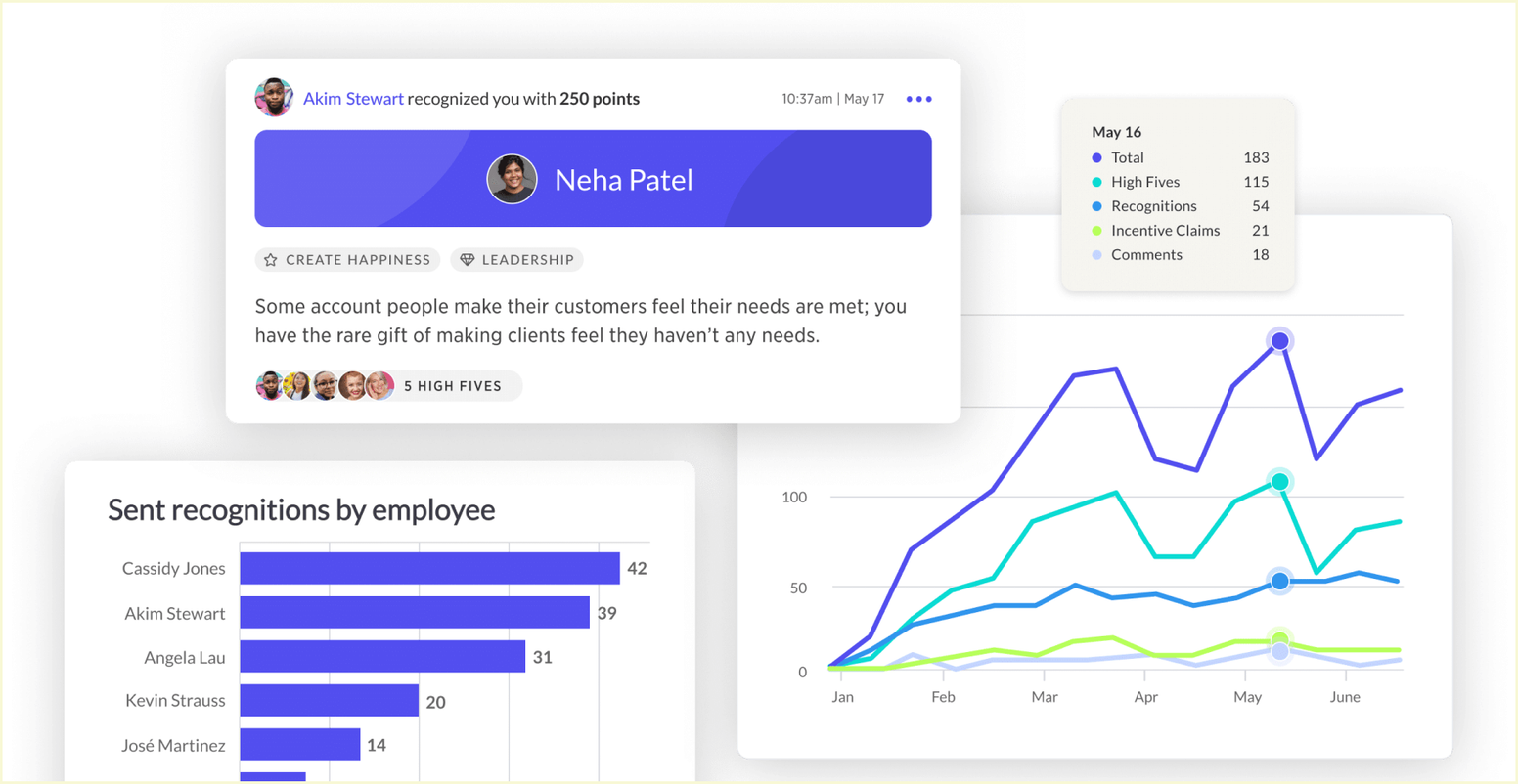
A quarterly clock produces lumpier behavior than a monthly one, and WorkTango reviewers describe the effect precisely.
James W., a Customer Success Team Lead at a mid-market company, wrote in a five-star review dated September 25, 2025: “Because points expire at the end of the quarter, it often turns into a quarter-end bonanza.”
The G2 dislike themes corroborate it, with points expiration issues (39 mentions) and a lack of expiration reminders (22) sitting alongside general limited-points frustration (55).
Where WorkTango is clearly stronger is program governance: its Incentives module documents 50+ campaign templates, approval before rewards are issued, budget limits per campaign, per employee, or per manager, and claim cap safeguards, which is more published control than Bonusly offers.
Rewards catalogs and funding: Bonusly vs. WorkTango
Both keep the reward budget separate from the platform fee, and both only charge for what employees actually redeem. What differs is how much of the arithmetic each vendor shows you.
Bonusly rewards and a published fee schedule
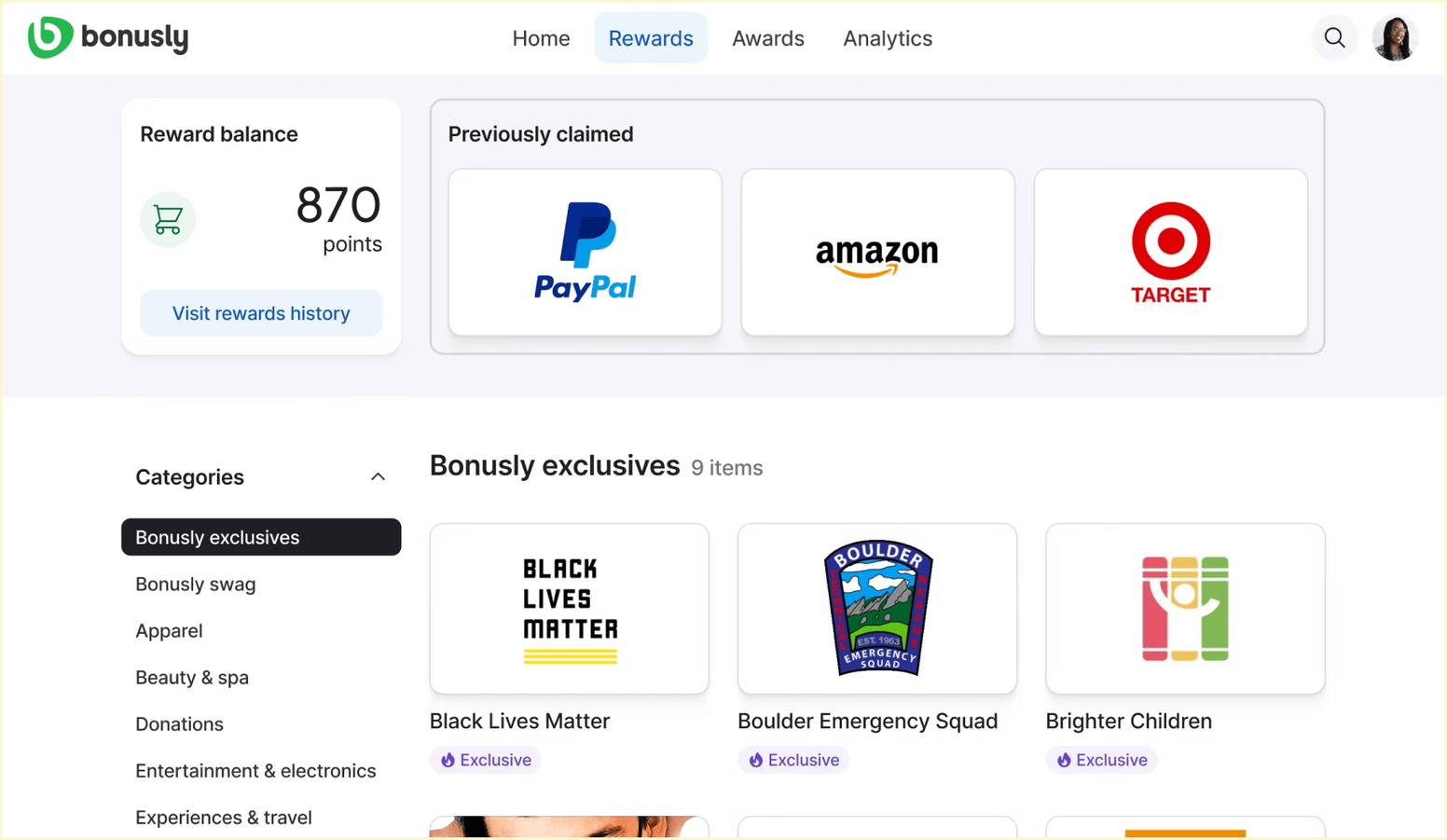
Bonusly’s gift cards are all electronic, with some taking up to 48 hours to activate. Curated physical gifts ship through its partner Snappy, company swag runs through an AXOMO integration, and donations are included.
Per Bonusly’s help center article on paying for rewards, there are three funding routes: Pay-as-You-Go by card, billed in arrears with an 8% convenience fee, charged when the running balance passes minus $100 or at month end; the Flex Plan, prefunding $200 or more by card at a 5% convenience fee; or the Fixed Plan, a $2,500 minimum upfront deposit by invoice via ACH or wire with no convenience fee.
WorkTango rewards and a zero-markup promise
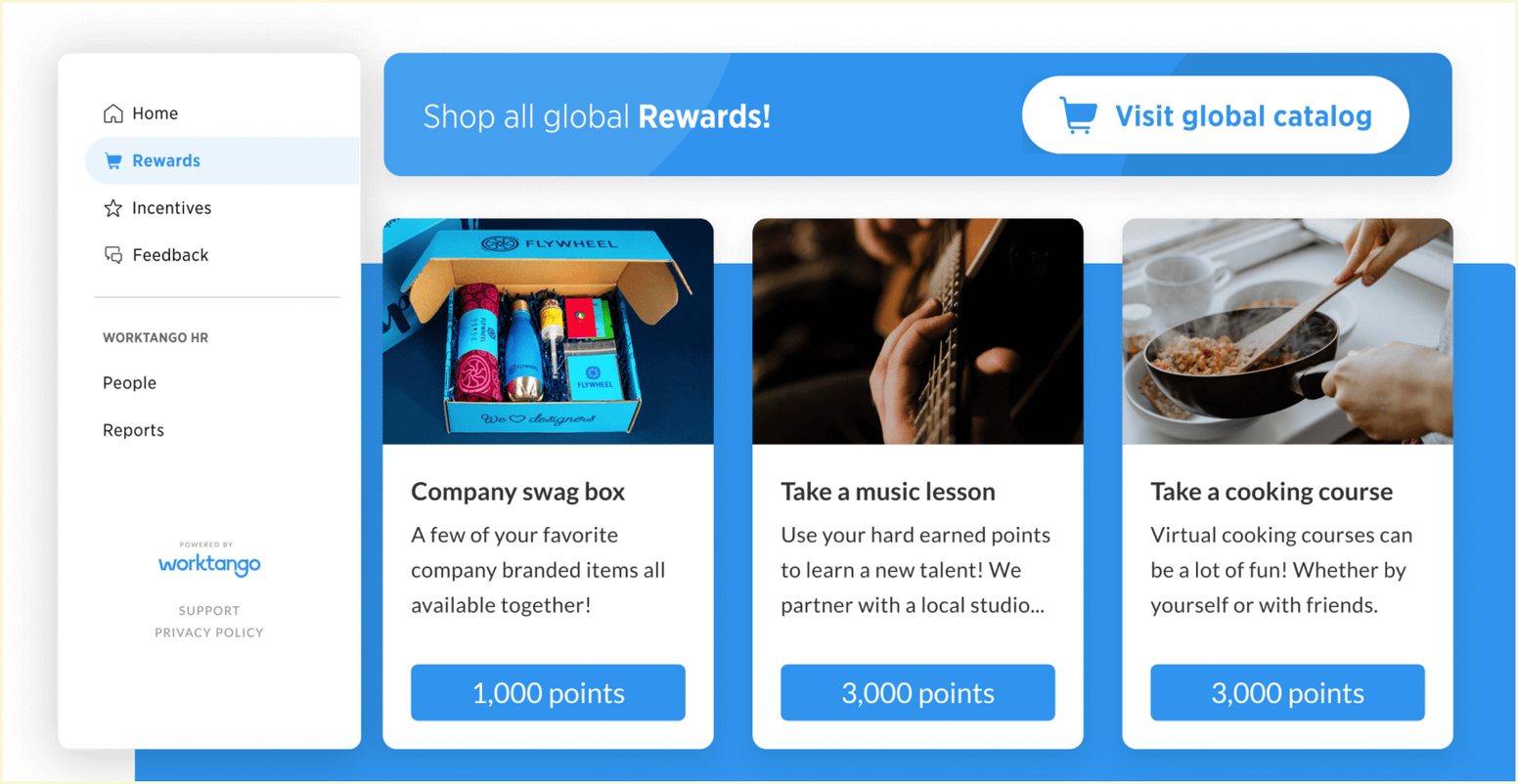
WorkTango’s current marketplace page advertises over 10 million choices across 90+ countries: gift vouchers, experiences, physical merchandise, company swag, custom catalogs, point pools, and donations to more than 1.2 million charities. Its funding model is pay-on-redemption: companies pay only when employees actually redeem, and points cost nothing until they convert.
It also makes a clean markup promise, stating that 100% of your allocated budget goes directly to employee rewards with no hidden fees or markups added to marketplace items, so a $50 award is $50 of value. That is a genuinely good model on paper.
The gap is disclosure. WorkTango publishes no fee schedule, and its help center carries no billing articles at all, so prefunding rules, card processing fees, minimum deposits, and refundability of unused budget are contract-gated.
On reward value, one reviewer pushes back on the catalog: Dylan B., a Contributing Writer at a mid-market company, noted in a four-and-a-half-star review dated April 29, 2026 that “non-cash prizes are overpriced.” Read the table below with your own funding method in mind.
| Funding route | Bonusly | WorkTango |
|---|---|---|
| 0% fee path | Fixed Plan: invoice via ACH or wire, $2,500 minimum deposit | Not publicly documented; funding terms are contract-gated |
| Prefund by credit card | Flex Plan: 5% convenience fee, $200 minimum | Not publicly documented |
| Pay only on redemption | Pay-as-You-Go: 8% convenience fee, no deposit, self-serve | Yes, the standard model: you pay when employees redeem |
| Markup on reward items | None claimed | States that no markups are added to marketplace items |
| Public fee schedule | Yes, in the help center | No |
Pricing and contract terms: published tiers vs. a twelve-month minimum
Bonusly publishes everything on its pricing page: a free plan for up to 8 users focused on peer recognition, Team at $3 per user/month billed annually, Team + Bizy at $5, and a quote-based Organization tier. The 30-day trial needs no credit card, and there are no seat minimums.
You can model a year of platform cost in a spreadsheet before speaking to anyone.
WorkTango publishes no prices. All three of its packages, Surveys & Insights, Recognition & Rewards, and the full Employee Experience Platform, require a quote.
Its pricing page does publish two commitments that matter more than a number: the minimum contract length is twelve months, and most organizations are ready to launch in four to six weeks.
Third-party buyer guides estimate roughly $5 to $10 per user/month, but that is an outside estimate rather than WorkTango’s own figure, so treat it as directional only.
The practical difference is commitment shape: Bonusly can be trialled and abandoned in a month; WorkTango is a year-long agreement with a scoped implementation before anyone sends recognition.
Surveys and employee listening: Pulse Checks vs. a full suite
If surveys are on your requirements list, this section probably decides the comparison.
Bonusly’s survey capability is Pulse Checks, launched in October 2025: a lightweight sentiment pulse, not a survey suite. Its 2026 investment went into AI and performance tooling instead.
The Bizy recognition sidekick launched in August 2026 and is now baked into plan names and pricing, alongside AI-assisted 1:1s, Recaps, 360 feedback, goals, a Recognition Quality Score, and MCP support for external AI assistants. On shipped AI, Bonusly is ahead of most of this category.
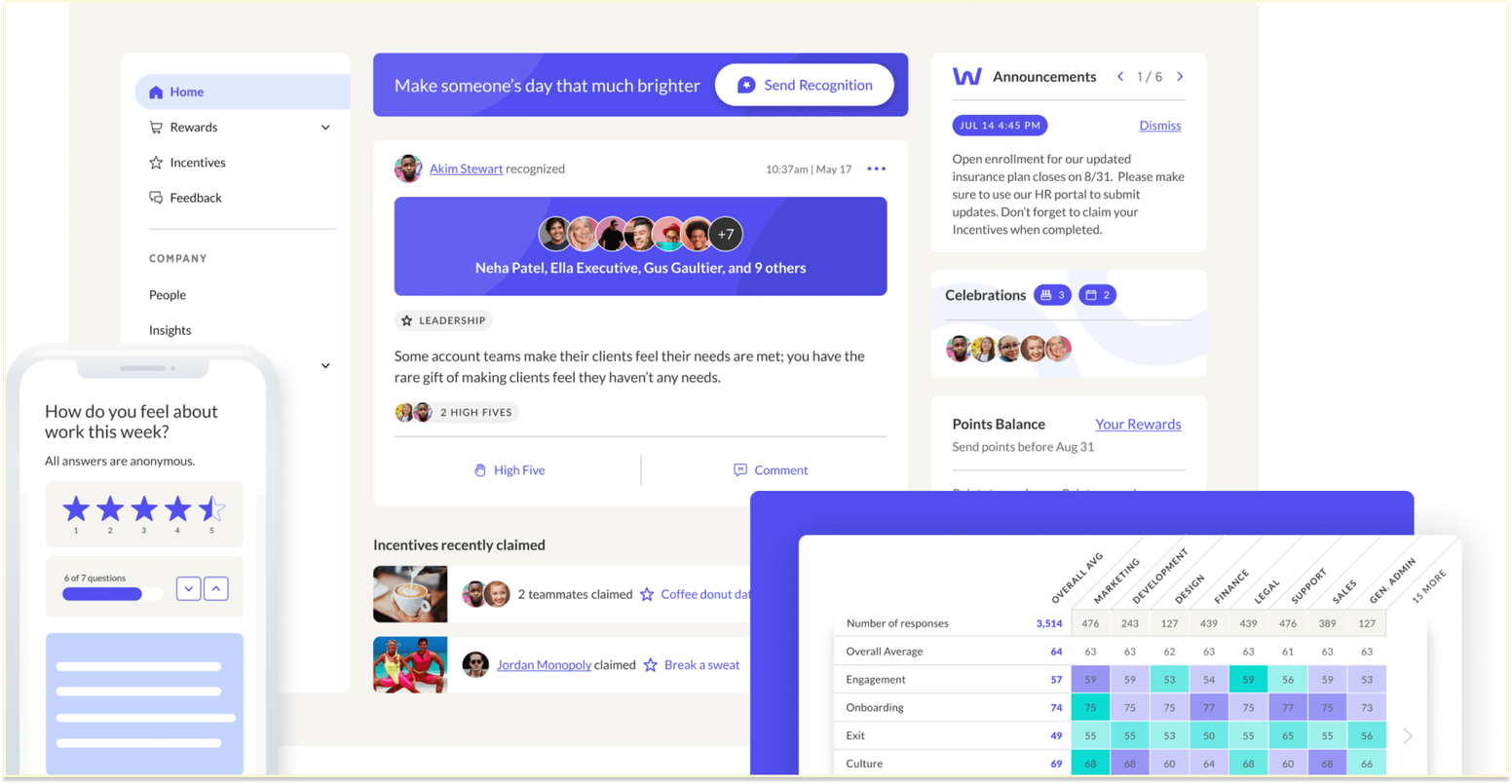
WorkTango sells employee listening as a first-class product, not a feature. Its Surveys & Insights package covers unlimited surveys, engagement and pulse programs, AI comment summarization and thematic analysis, heatmap and trend dashboards, action planning, and confidentiality protections.
It added Constellation, an AI-moderated group listening product, on July 22, 2026, and it also ships WorkTango Coach and a Recognition Writing Assistant that reviewers like.
Rochie C., a Customer Service Representative at an enterprise company, wrote in a five-star review dated December 8, 2025 that the “Recognition Writing Assistant helps users write clearer, more meaningful recognition messages.”
Its customer evidence is survey-led too: American Eagle Financial Credit Union, a 350-person credit union, reported its engagement score rising from 69 to 81 and survey participation from 71% to 89% over twelve months after cutting an 80-question annual survey down to a 20-question pulse.
Not every reviewer is convinced, and one HR director flagged limits in survey design, data flexibility, and reporting, but on breadth this is a real listening platform and Bonusly is not trying to be one.
New ownership: what the BI WORLDWIDE acquisition changes
On July 20, 2026, WorkTango was acquired by BI WORLDWIDE, a global rewards and incentives firm, ending roughly eight years of ownership by Vista Equity Partners. Per WorkTango’s own release, the brand, team, and product identity are retained and the company operates as a BI WORLDWIDE subsidiary.
CEO Monique McDonough said the company can now “offer our customers more choice and deeper support across rewards, recognition, and beyond, while giving us a clear path to grow further into the mid-market.” This is a continuation, not a wind-down.
One concrete operational change is confirmed: WorkTango will transition its core fulfillment infrastructure to BI WORLDWIDE’s global rewards marketplace, which operates in 200+ countries and adds milestone awards, experiences, and events.
Measured against the 90+ countries WorkTango’s own marketplace page currently advertises, that is a meaningful upgrade in reach for anyone with international staff, and it deserves to be counted as an upside. It also means the redemption experience is going to change.
Sensible questions, none with published answers yet: the cutover timeline, whether the zero-markup promise carries to the new marketplace, what happens to banked points mid-migration, where redemption support sits afterwards, and how the roadmap is prioritized under a larger parent.
Ask in writing, since a twelve-month minimum commits you while the integration plays out.
The lineage also explains the naming debris buyers run into: YouEarnedIt and HighGround merged as Kazoo in 2018, Kazoo acquired WorkTango and took its name in 2022, and BI WORLDWIDE acquired the company in 2026. Bonusly has had no ownership change to plan around.
Apps, marketplaces, and what G2 reviewers say
Both platforms sit at 4.7 on G2, so the headline score separates nothing; volume and the review text do. Bonusly carries 7,000+ reviews on G2 against WorkTango’s 1,329.
Bonusly reviewers praise ease of use and no-training adoption; Edson O., a Team Lead, wrote in a May 2026 five-star review: “It makes recognition simple, visible, and tied to real rewards.”
Its dominant criticism is the points economy, roughly 2,100+ mentions across the top dislike themes, summed up by Vasanth J., a Media Analyst at a mid-market company, in a five-star review dated April 24, 2026: “The monthly points limit feels a bit restrictive, especially during busy months.”
Distribution is where the two diverge most. Bonusly integrates with Slack, Microsoft Teams, and Google Chat, is Microsoft 365 certified, and rates 4.8 on the App Store across roughly 4,500 ratings, though its Android app trails at 3.7 across 669 reviews.
WorkTango integrates with Slack, offers a Microsoft Teams tab, and supports recognition from Outlook, which almost nobody else in this category does.
But WorkTango has no listing on the Microsoft Teams app store, and we found no public Slack Marketplace listing for it either as of August 2026, so there is no store rating to check before you buy.
Its mobile apps are the weaker pair on the numbers: 3.1 on the App Store across 86 ratings and 2.4 on Google Play across 296 reviews, both as of August 2026. If a large share of your workforce will live in a phone app, pilot that experience before signing a twelve-month agreement.
Where Bonusly wins
- Pricing transparency: public tiers, a real free plan up to 8 users, a 30-day no-card trial, and no seat minimum. WorkTango publishes none of those.
- Published funding fees: the 8%, 5%, and 0% routes are documented, so reward costs can be modeled before signing.
- No contract lock-in: month-to-month flexibility against a twelve-month minimum and a four-to-six-week implementation.
- Shipped AI and manager tools: Bizy, AI 1:1s, Recaps, 360 feedback, goals, and MCP support.
- Review volume and social proof: 7,000+ G2 reviews against 1,329, with named case studies including Toast at 86% user participation.
- Distribution: Slack, Teams, and a rare Google Chat integration, plus 30+ HRIS systems and Microsoft 365 certification.
- Mobile on iOS: 4.8 stars across roughly 4,500 App Store ratings.
Where WorkTango wins
- A real survey suite: unlimited surveys, engagement and pulse programs, AI comment summarization and theme analysis, action planning, and the new Constellation listening product. Bonusly offers light Pulse Checks.
- Quantified customer proof on listening: American Eagle Financial Credit Union moved engagement from 69 to 81 and participation from 71% to 89% in twelve months.
- Zero-markup rewards: a pay-on-redemption model with a published promise that the full budget reaches the employee.
- Documented program governance: Incentives campaigns with approval workflows, per-campaign, per-employee, and per-manager budget caps, claim cap limits, and 50+ templates.
- Outlook recognition: a genuinely rare integration, alongside Slack, a Teams tab, and 60+ HRIS and HCM systems.
- Fulfillment upside ahead: the move to BI WORLDWIDE’s marketplace expands reach from 90+ to 200+ countries and adds experiences and events.
- AI writing help that reviewers name: the Recognition Writing Assistant and WorkTango Coach.
The third option: Matter
Both platforms above assume recognition lives in their own app, funded by a points budget on a clock. Matter makes a different bet: recognition belongs inside Slack and Microsoft Teams, where the work already happens, and it should run on a weekly rhythm.
Every week, Feedback Friday™ (US Patent 12,199,935) prompts the whole team to recognize someone; give-coins reset weekly so they get used rather than hoarded, and earned coins never expire.
The cadence is measurable: in The Recognition Habit, Matter’s 2026 Benchmark Report, built on aggregate, de-identified platform data, teams that build recognition around a weekly ritual give about 2.5x more recognition per member than ad hoc teams, and roughly 8 in 10 ritual teams stay active in nearly every month.
On the criteria this guide has used: Matter’s Free plan is for unlimited users, paid plans are published at $1 to $5 per user/month, billed annually, and Matter hasn’t raised prices in 8 years.
Reward funding fees are published too, including a 0% ACH prepay path, the catalog spans 10,000+ eGift card options across 200+ countries, and setup takes about two minutes rather than four to six weeks.
On the Microsoft Teams app store Matter holds a 5.0 across 1,476 ratings, and it rates 4.7 on G2. Two honest limits. If employee listening is the reason you are buying, WorkTango’s unlimited surveys, AI theme analysis, and action planning go deeper than Matter’s surveys add-on.
And Matter does not try to match Bonusly’s performance-management tooling, so if AI-assisted 1:1s, 360 feedback, and goals are requirements, Bonusly is the better answer. For the detailed head-to-heads, see Bonusly vs. Matter and WorkTango vs. Matter.
Which platform is right for your team?
Choose Bonusly if:
- You want to budget from a public price list and start on a free tier or a 30-day trial.
- You are not ready to sign a twelve-month agreement or wait four to six weeks to launch.
- Shipped AI and manager tools such as 1:1s, Recaps, and 360 feedback are on your list.
- Your team works in Slack, Microsoft Teams, or Google Chat.
Choose WorkTango if:
- You need a real employee-listening suite and recognition from one vendor on one contract.
- You are a mid-market organization with an HR team to run surveys, action planning, and incentive campaigns.
- Documented budget caps, approval workflows, and claim limits matter to your finance partners.
- Broader global reward fulfillment through BI WORLDWIDE is an upside you want, and you are comfortable asking hard questions about the transition.
Choose Matter if:
- Your team lives in Slack or Microsoft Teams and you want recognition there, not in another app.
- You prefer a weekly recognition ritual over a monthly or quarterly points budget.
- You want to start free with unlimited users and see published pricing before talking to anyone.
Frequently asked questions about Bonusly vs. WorkTango
Is Bonusly or WorkTango cheaper?
Bonusly is the only one of the two you can price without a sales call: a free plan for up to 8 users, Team at $3 per user/month billed annually, and Team + Bizy at $5.
WorkTango is quote-only on every tier with a twelve-month minimum contract; third-party buyer guides estimate roughly $5 to $10 per user/month, but that is an outside estimate, not WorkTango’s published price.
On what each vendor actually publishes, Bonusly is cheaper to start and far easier to budget, though both bill reward spend separately from the platform fee.
Who owns WorkTango?
BI WORLDWIDE, a global rewards and incentives firm, which acquired WorkTango on July 20, 2026 from Vista Equity Partners. WorkTango retains its brand, team, and product identity and operates as a BI WORLDWIDE subsidiary.
The company has also said it will move its core reward fulfillment to BI WORLDWIDE’s global marketplace, which operates in 200+ countries. The wider lineage runs YouEarnedIt and HighGround merging into Kazoo in 2018, Kazoo acquiring WorkTango and adopting its name in 2022, and the BI WORLDWIDE acquisition in 2026.
Do WorkTango points expire?
The giving balance does, on a cadence each company sets. WorkTango’s help center states that most companies choose to expire employees’ giving balance each quarter and that admins can set whatever cadence suits the business.
Whether earned redeemable points expire is not documented publicly, so ask for your program’s specific terms in writing. On Bonusly, monthly give-points expire while earned points do not expire by default, though admins can configure expiration.
What is the main difference between Bonusly and WorkTango?
Scope and how you buy. Bonusly is a recognition-first platform with published per-user pricing, a free tier, a 30-day trial, and heavy 2026 investment in AI and manager tooling.
WorkTango is a combined surveys-and-recognition suite sold on a quote with a twelve-month minimum and a four-to-six-week implementation, whose center of gravity is employee listening. Bonusly resets giving allowances monthly; WorkTango typically expires them quarterly.
Which is better for employee surveys, Bonusly or WorkTango?
WorkTango, clearly. It sells surveys as a full product line with unlimited surveys, engagement and pulse programs, AI comment summarization and thematic analysis, heatmap dashboards, action planning, and its Constellation listening product launched in July 2026. Bonusly’s Pulse Checks, launched October 2025, are a lightweight sentiment pulse rather than a survey suite. If listening is a primary requirement, Bonusly is not the right shortlist entry.
Bonusly vs. WorkTango: the bottom line
This comes down to scope and commitment. Bonusly is the better answer if recognition is the job, you want to start this week, and you want to read the price and the reward funding fees before you buy.
WorkTango is the better answer if employee listening is genuinely half the reason you are buying, you have the HR capacity to run surveys and action planning, and a twelve-month agreement with a scoped rollout is normal for you, with the BI WORLDWIDE fulfillment questions asked in writing first.
If neither shape fits, because what you want is recognition inside chat on a weekly rhythm with published pricing, that is the third path. Related reading: Bonusly alternatives, WorkTango alternatives, and the full comparison hub.

![Bonusly vs. Kudos Comparison: Pricing & Reviews [2026 Guide]](https://cdn.sanity.io/images/kqqb5xry/production/82c27fccf7cd7f08572b86a4809b1111df9b0eb0-800x600.jpg?w=720&q=75&fit=max&auto=format)
![Kudos vs. WorkTango Comparison: Pricing & Reviews [2026 Guide]](https://cdn.sanity.io/images/kqqb5xry/production/5f38b00c45db2bc4bbe09bcad09552116948cd8a-800x600.jpg?w=720&q=75&fit=max&auto=format)
![WorkTango vs. Matter Comparison: Pricing & Reviews [2026 Guide]](https://cdn.sanity.io/images/kqqb5xry/production/5bf41fa2873a9e349472c7edb674fbbcb46c832d-800x600.jpg?w=720&q=75&fit=max&auto=format)