

Finding the ideal survey partner can feel overwhelming when countless vendors promise similar results and outcomes. At Matter, we recognize that choosing an employee engagement survey company requires evaluating far more than features alone. HR leaders must weigh implementation expertise, industry knowledge, analytics depth, and partnership quality before committing resources. The selection process benefits from understanding what separates exceptional providers from adequate ones in this space.
Mastering the landscape of engagement survey providers empowers organizations to make confident, informed purchasing decisions today. When teams understand how associate engagement surveys differ from satisfaction surveys, they select appropriate tools. Knowledge about employee surveys, pulse surveys, and engagement questions leads to smarter vendor conversations overall. This guide delivers the insights needed to evaluate providers and build thriving workplace cultures through measurement.
What is an employee engagement survey?

An employee engagement survey captures how emotionally connected employees feel to their work. These instruments measure psychological investment, discretionary effort, and alignment with organizational purpose beyond simple contentment. Companies systematically deploy surveys to uncover key drivers of performance, retention, and overall workforce health. The strategic value lies in transforming employee voices into action plans that strengthen workplace culture.
Employee engagement reflects whether workers genuinely care about organizational outcomes and their role in achieving them. Engaged employees consistently exceed expectations because they feel personally invested in company success and growth. Surveys quantify this connection through validated scales that measure dimensions such as pride, commitment, and motivation. Organizations use resulting data to benchmark progress and identify specific areas requiring attention from leaders.
How surveys transform workforce feedback into a strategic advantage
Surveys convert scattered opinions into structured data that reveals patterns invisible to casual observation alone. This transformation enables evidence-based decisions rather than guesswork when allocating resources for culture improvement initiatives. Leaders gain clarity about which investments will yield the greatest returns in engagement and retention. The strategic advantage compounds as organizations build historical data that shows trends across multiple measurement cycles.
Effective survey programs create feedback loops where employees see their input driving visible organizational changes. This responsiveness builds trust and increases willingness to provide honest, detailed feedback in future surveys. Organizations with mature survey programs report higher participation rates and richer qualitative responses over time. The cumulative effect establishes a culture where continuous improvement becomes embedded in organizational DNA.
Distinguishing full-service providers from basic survey tools
Full-service engagement survey companies deliver comprehensive partnerships extending well beyond software licenses and questionnaire builders. These providers employ organizational psychologists who design validated questions measuring constructs predictive of business outcomes. They maintain extensive benchmarking data enabling meaningful comparisons against industry peers and high-performing organizations. Implementation support ensures surveys launch successfully and achieve strong participation rates from day one onward.
Basic survey tools offer technology without the expertise needed to maximize measurement value for organizations. They lack scientifically validated question banks developed through rigorous research across diverse workforce populations. Benchmarking capabilities are typically absent or limited to generic comparisons lacking industry specificity. Organizations using basic tools often struggle to interpret results or translate findings into effective action.
Essential services that elevate survey programs beyond data collection
Leading providers differentiate through services, transforming raw survey data into organizational improvement and measurable change. Manager enablement programs teach leaders how to discuss results constructively and facilitate team action planning. Communication strategy support helps organizations announce surveys in ways that build trust and encourage participation. Post-survey consulting guides the translation of insights into prioritized initiatives with clear accountability.
Dedicated customer success managers provide ongoing partnership throughout the entire survey lifecycle and beyond implementation. These professionals understand your organization's unique context and tailor recommendations to the specific challenges it faces. They share lessons learned from similar organizations while appropriately respecting confidentiality and competitive sensitivities. This consultative relationship ensures surveys generate lasting value rather than one-time reports quickly forgotten.
What are the benefits of working with employee engagement survey companies?

Partnering with specialized pulse survey providers offers advantages that internal teams struggle to replicate on their own. These companies accumulate expertise across hundreds of implementations, learning what works and what fails consistently. Organizations access this collective wisdom without investing years developing capabilities through costly trial and error. The efficiency gains alone often justify the investment in professional survey partnerships for most companies.
Professional providers bring objectivity that internal teams cannot offer when sensitive topics require honest feedback. Employees trust third-party confidentiality assurances more readily than internal promises about anonymity protections. This trust translates into higher response rates and more candid feedback revealing actual workforce sentiment. The quality differential between internal and professional surveys often determines whether results drive action.
Accessing validated methodology and measurement science expertise
Survey science involves complex considerations around question wording, scale construction, and statistical validity that most practitioners overlook. Professional companies employ measurement experts who ensure questions reliably capture intended constructs without bias or confusion. They continuously refine instruments based on emerging research and accumulated data from client implementations globally. This expertise produces more accurate, actionable data than homegrown surveys typically generate for organizations.
Validated methodologies protect organizations from making decisions based on flawed or misleading survey data collected. Poorly designed questions can yield results that seem meaningful but actually reflect measurement artifacts. Professional companies know how to avoid common pitfalls like leading questions, acquiescence bias, and scale ambiguity. Their expertise safeguards the investment organizations make in collecting and acting on workforce feedback.
Leveraging benchmarking data for meaningful context and comparison
Raw survey scores mean little without context showing how results compare against relevant peer organizations. Benchmarking data transforms abstract numbers into meaningful insights about relative performance and standing. Organizations learn whether their engagement scores represent strengths to celebrate or gaps requiring urgent attention. This context proves essential for prioritizing improvement efforts and setting realistic goals for future measurement.
Professional survey companies maintain extensive benchmark databases segmented by industry, size, region, and other factors. These databases enable precise comparisons against truly relevant peer groups rather than generic workforce averages. HR leaders can identify which engagement dimensions represent competitive advantages versus areas needing investment. Benchmark comparisons also help communicate results to executives in terms that resonate with business leaders.
Building sustainable improvement through ongoing partnership support
One-time surveys produce snapshots that quickly become outdated without ongoing measurement and support structures. Professional companies help organizations establish sustainable listening programs with appropriate cadences and touchpoints throughout the year. They provide frameworks for action planning that translate survey insights into concrete initiatives with accountability. Continuous partnership ensures surveys remain connected to business outcomes rather than becoming isolated HR exercises.
Action planning workshops facilitate productive discussions about survey results and potential improvement strategies for teams. Professional facilitators bring objectivity, helping groups move beyond defensiveness toward constructive problem-solving and planning. They provide templates and frameworks, ensuring action plans include clear owners, timelines, and success metrics. This structured approach dramatically increases the likelihood that surveys actually drive organizational change.
Why employee engagement surveys matter for organizational performance

Research consistently demonstrates that employee pulse survey programs connect directly to measurable business outcomes. Organizations with highly engaged workforces consistently outperform competitors on profitability, productivity, and customer satisfaction metrics. Understanding this connection helps leaders justify investments in survey programs and improvement initiatives funded. The business case for engagement measurement has never been stronger, given current talent market dynamics.
Surveys provide early warning systems identifying engagement problems before they manifest as turnover or performance decline. Waiting for exit interviews means learning about issues only after losing valuable employees to competitors. Proactive measurement enables intervention while there is still an opportunity to retain at-risk talent in organizations. This preventive approach delivers significant cost savings compared to reactive talent management strategies employed.
Quantifying the business impact of engaged versus disengaged workforces
Engaged employees deliver discretionary effort that compounds into substantial productivity advantages over disengaged colleagues. They solve problems more creatively, collaborate more effectively, and persist through challenges that others abandon. Customer-facing, engaged employees create better experiences that sustainably drive loyalty, referrals, and revenue growth. The cumulative impact of engagement on organizational performance justifies significant investment in measurement.
Disengaged employees cost organizations through presenteeism, quality problems, missed deadlines, and negative cultural influence. They require more supervision, generate more complaints, and often undermine team morale through negativity. The cost of disengagement typically exceeds direct compensation when accounting for productivity losses and management burden. Survey programs help identify and address disengagement before costs compound into serious organizational problems.
Ensuring measurement quality through professional expertise and rigor
Data quality determines whether survey investments produce reliable insights or misleading noise, directing resources poorly. Professional companies apply statistical rigor, ensuring surveys measure what they intend to measure accurately and consistently. They design samples, monitor response rates, and analyze results using methods that produce trustworthy conclusions. This expertise protects organizations from making important decisions based on fundamentally flawed data.
Confidentiality management significantly impacts whether employees provide honest feedback or socially desirable responses, masking reality. Professional providers implement technical and procedural safeguards that genuinely protect respondent anonymity from identification. They communicate these protections credibly, building the trust necessary for candid workforce feedback collection. The honesty differential between well-protected and poorly protected surveys often determines the measurement value.
Driving retention and culture through continuous listening programs
Employee retention improves when workers feel their voices matter and see tangible responses to feedback. Surveys demonstrate organizational commitment to understanding and addressing workforce concerns through systematic listening. When employees observe survey results driving visible improvements, trust deepens and engagement strengthens over time. This positive cycle creates powerful retention advantages in competitive talent markets.
Culture improvement requires understanding the current state before designing interventions targeting specific weaknesses identified. Surveys provide diagnostic capability, revealing where stated values and actual experience diverge for employees. They identify subcultures within organizations where engagement significantly differs from the overall averages reported. This granularity enables targeted interventions rather than one-size-fits-all approaches that waste resources.
5 types of employee surveys that professional companies offer
Professional pulse survey question providers offer multiple survey types to address different organizational needs. Each type serves specific purposes within comprehensive workforce listening strategies implemented by leading organizations. Combining multiple approaches creates a complete picture of the employee experience across the entire employment lifecycle. Understanding options helps HR teams design measurement programs matching their specific organizational requirements.
5 survey types available:
- Annual engagement surveys measuring comprehensive workforce sentiment and key drivers
- Pulse surveys provide frequent, lightweight feedback between major measurement events
- Associate engagement surveys designed specifically for frontline and hourly workforces
- Employee satisfaction surveys focusing on contentment with specific job conditions
- Lifecycle surveys capturing feedback at onboarding, transitions, and exit touchpoints
Annual engagement surveys for comprehensive workforce assessment
Annual surveys provide comprehensive baseline measurements covering multiple engagement dimensions simultaneously and thoroughly. These instruments typically include validated scales measuring pride, commitment, enablement, satisfaction, and advocacy intentions. Results establish benchmarks for tracking progress and identifying priority areas requiring focused improvement efforts. The comprehensive nature justifies longer survey lengths that might fatigue respondents in more frequent pulse formats.
Annual surveys are used by organizations to support future strategic workforce planning and resource allocation decisions. Results feed into business planning processes, systematically connecting people strategy with broader organizational objectives. Trending data across years reveals whether improvement initiatives are producing intended effects on engagement. This longitudinal perspective proves essential for evaluating program effectiveness and justifying continued investment.
Pulse surveys for continuous listening between major assessments
Pulse surveys deploy brief questionnaires frequently to track sentiment changes between comprehensive annual measurements. These lightweight instruments typically include fewer than ten questions, enabling completion in under three minutes. The brief format supports frequent deployment without creating survey fatigue that undermines participation over time. Organizations use pulses to monitor specific initiatives, seasonal patterns, and emerging concerns that require attention.
Continuous listening through pulse surveys enables faster response to engagement shifts than annual measurement allows. Leaders can detect problems early and intervene before issues escalate into serious retention or performance concerns. The approach aligns with agile organizational cultures, emphasizing rapid iteration and continuous improvement philosophies. Pulse data complements annual surveys by filling gaps between comprehensive measurements with timely insights.
Lifecycle surveys capturing feedback at critical employee journey moments.
Lifecycle surveys gather feedback at specific touchpoints, including onboarding, role transitions, and exit from organizations. These targeted instruments capture experience data when events are fresh, and memories are most accurate and detailed. Onboarding surveys identify early warning signs of poor fit or inadequate support during critical first months. Exit surveys reveal reasons for departure that annual surveys might miss due to deployment timing.
The lifecycle approach recognizes that engagement evolves through employment phases requiring different measurement approaches. New employees have different concerns than long-tenured staff approaching retirement or career transitions ahead. Capturing feedback at transitions provides insights into how experience changes as employees progress through careers. This comprehensive view informs talent management strategies that address needs throughout the entire employee journey.
Leading employee engagement survey companies for enterprise deployment

Enterprise organizations require employee engagement survey questions from vendors capable of complex global implementations. These buyers need platforms with enterprise security certifications, multi-language capabilities, and extensive integration options. Implementation complexity demands vendors with dedicated professional services teams and proven large-scale deployment experience. The following profiles highlight leading options serving enterprise market segments with appropriate capabilities.
Evaluation criteria for enterprise buyers extend beyond features to include service quality and partnership approach. Vendor stability, financial health, and long-term viability matter when organizations make multi-year platform commitments. Reference calls with similar clients provide insights no vendor presentation can match for accuracy. Enterprise selections benefit from thorough due diligence, given the significant investment and switching costs involved.
Enterprise capabilities requiring specialized vendor expertise
Global deployments require platforms that support dozens of languages with culturally appropriate translations, ensuring consistency. Time zone management ensures surveys reach employees at appropriate local times across worldwide operations. Regional compliance requirements around data privacy, particularly in Europe, demand vendor expertise and infrastructure. Multi-currency reward integrations and region-specific benchmarks further complicate enterprise vendor requirements.
Security certifications such as SOC 2 Type II and ISO 27001 demonstrate a vendor's commitment to protecting sensitive data. Enterprise buyers require detailed security documentation, penetration testing results, and compliance attestations before approval. Integration capabilities must support connections with enterprise HRIS, identity management, and business intelligence systems. These technical requirements eliminate many vendors from consideration in the enterprise, regardless of their feature appeal.
Full-service providers delivering consulting alongside technology platforms
Enterprise implementations benefit from dedicated consulting resources guiding strategy, design, and execution throughout engagements. Leading vendors assign client teams, including engagement consultants, data scientists, and implementation project managers. These teams bring experience from similar deployments, accelerating implementation and helping avoid common pitfalls. The consulting relationship continues post-launch through ongoing optimization and action planning support.
Professional services differentiate vendors competing for enterprise contracts with similar underlying technology capabilities. The quality of consultants, their industry expertise, and their availability significantly impact implementation success. References should specifically address consulting quality, not just platform functionality, when evaluating vendors. Enterprise buyers often find consulting quality more variable than technology across vendors they evaluate.
Advanced analytics transforming survey data into strategic insights
Enterprise survey platforms increasingly incorporate advanced analytics, including natural language processing and machine learning. These capabilities automatically categorize open-ended comments, identify themes, and efficiently detect sentiment at scale. Predictive models flag flight risks and identify engagement patterns statistically associated with retention outcomes. The sophistication of analytics expected by enterprise buyers continues to advance rapidly across the market.
Customizable dashboards enable different stakeholders to access relevant insights without requiring technical expertise. Executive dashboards emphasize strategic metrics, while manager views focus specifically on team-level actionable data. HR analysts need detailed data access for custom analysis beyond the standard reporting capabilities provided. Role-based access ensures that the right information reaches each audience while protecting confidentiality.
Employee experience platforms integrating surveys with broader capabilities
Pulse survey software is increasingly integrated into comprehensive employee experience platforms serving organizations. These unified solutions combine surveys, recognition, performance management, and internal communications in a single ecosystem. Organizations benefit from connected data that reveals relationships between engagement and other workforce metrics. Platform approaches reduce administrative burden while providing a more holistic view of the employee experience.
The integration trend reflects recognition that engagement connects to many aspects of the employment experience. Measuring engagement separately from recognition, development, and performance misses important relationships between these elements. Unified platforms enable analysis showing how different programs influence engagement scores over time. This connected perspective informs more effective improvement strategies than siloed measurement approaches.
Platforms connecting surveys with employee recognition programs
Recognition and engagement share deep connections that integrated platforms help organizations understand and leverage. Survey data reveals whether recognition programs actually impact engagement or merely create activity without results. Integration enables analysis showing which recognition types most strongly correlate with engagement improvements. Organizations can optimize recognition investments based on evidence rather than assumptions about effectiveness.
Recognition programs reinforced by survey insights become more targeted and impactful for employees receiving acknowledgment. When surveys reveal recognition gaps, integrated platforms enable immediate program adjustments addressing identified issues. The feedback loop between surveys and recognition creates continuous improvement cycles, benefiting both programs. Employees experience more coherent organizational investment in their experience through integrated approaches.
Unified dashboards revealing connections across employee experience dimensions
Integrated platforms provide consolidated views showing engagement alongside recognition, performance, and other experience metrics. HR leaders see relationships between dimensions that separate systems would never reveal to analysts. Correlations between recognition frequency and engagement scores become visible through unified analytics capabilities. These insights inform more effective strategies than analyzing each dimension in isolation.
Manager dashboards in unified platforms combine team engagement data with recognition activity and performance information. This consolidated view enables managers to get a complete picture of their team without accessing multiple systems. They can identify connections between recognition patterns and engagement trends within their teams directly. Unified access empowers managers to take informed action without depending on HR for analysis.
Lifecycle feedback capabilities spanning the entire employee journey
Comprehensive platforms systematically capture feedback throughout employment, from candidate experience to exit interviews. This longitudinal view reveals how engagement evolves as employees progress through different career stages. Organizations identify where experience breaks down and where it exceeds expectations across the journey. Lifecycle data informs interventions targeting specific phases rather than generic workforce-wide initiatives.
Integration across lifecycle touchpoints enables sophisticated journey mapping based on actual employee feedback data. Organizations see how the onboarding experience influences engagement, as measured months or years later in surveys. They identify which early experiences most accurately predict long-term engagement and retention outcomes. This predictive insight enables proactive investment in experiences with the greatest downstream impact.
20+ survey questions recommended by leading engagement experts

The effectiveness of kudos employee recognition programs and surveys depends fundamentally on the quality of the questions. Leading survey companies invest heavily in developing and validating questions that reliably measure engagement across populations. These validated instruments produce more accurate, actionable data than ad-hoc questions organizations create themselves. Understanding what makes questions effective helps organizations evaluate vendor offerings and customize implementations.
Question selection should align with organizational priorities rather than aiming for comprehensive coverage of all topics. Focused surveys with carefully chosen questions often generate better data than lengthy, comprehensive instruments. Respondent fatigue undermines data quality when surveys become too long or burdensome for employees. Professional vendors help organizations select questions, balancing coverage needs with practical participation considerations.
Validated questions measuring core engagement drivers reliably
Research identifies specific factors that most strongly predict engagement across diverse workforce populations studied. Questions measuring these key drivers help organizations focus improvement efforts where impact potential is greatest. Driver questions address trust in leadership, growth opportunities, meaningful work, and connection to purpose. Validated versions of these questions have demonstrated reliability across millions of survey administrations globally.
Recommendation questions asking whether employees would suggest their organization as a workplace prove highly predictive. Questions about pride in organizational membership correlate strongly with retention and discretionary effort outcomes. Intent to stay questions directly measure retention risk that organizations can address through targeted interventions. These foundational questions belong in virtually every engagement survey, regardless of other customization.
Questions assessing manager effectiveness and leadership quality
Manager relationships exert enormous influence on engagement, often exceeding organizational factors in predictive power. Questions assessing manager effectiveness help identify development needs and highlight leadership strengths to replicate. They reveal variations in management quality, explaining engagement differences across teams and departments. Results inform targeted coaching, training, and intervention strategies addressing specific leadership gaps.
Effective manager questions address communication, feedback, support, recognition, and specifically the facilitation of development behaviors. They assess whether managers create environments where employees can do their best work daily. Questions explore psychological safety, asking whether employees feel comfortable raising concerns with managers. This data helps organizations build management capability that sustains high engagement over time.
Career development questions exploring growth and opportunity perceptions
Development opportunities consistently represent one of the most influential factors in driving engagement across various industries and demographic groups. Questions exploring development assess whether employees see viable advancement paths within their organizations. They measure satisfaction with learning opportunities, stretch assignments, and organizational investment in growth. Results help organizations identify where development programs need strengthening to meet workforce expectations.
Skill utilization questions ask whether employees feel their abilities are being leveraged effectively in their roles. They reveal situations of underemployment in which capable employees become disengaged due to insufficient challenge. Career conversation questions assess whether managers discuss development regularly with their team members. This data informs talent management strategies that retain top talent through compelling development opportunities.
Survey questions predicting retention and performance outcomes
Certain engagement questions demonstrate particularly strong statistical connections to retention and performance results. Employee recognition and rewards programs often address factors that these predictive questions measure effectively. Organizations that focus their improvement efforts on high-impact areas see the greatest returns on engagement investments. Survey companies identify predictive questions through statistical analysis of outcome data across client populations.
Predictive questions help organizations prioritize among many potential improvement opportunities competing for resources. They focus attention on factors that actually influence whether employees stay and perform well. This evidence-based approach ensures programs deliver measurable business impact rather than symbolic initiatives. HR leaders build stronger investment cases when connecting survey items to concrete business outcomes.
eNPS questions measuring employee advocacy and loyalty
Employee Net Promoter Score questions capture willingness to recommend the organization as an employer. This single question consistently predicts retention, referral behavior, and overall engagement with remarkable accuracy. Organizations track eNPS trends to assess whether improvement initiatives are creating meaningful change. The metric's simplicity makes it valuable for executive communication and for deploying pulse surveys.
Matter uses a research-backed 5-point scale for eNPS measurement rather than a traditional 11-point scale. This simplified format increases participation while maintaining measurement validity, as proven by extensive research. The 5-point format proves especially effective for mobile completion, where traditional scales create usability issues. Organizations gain clearer data without complexity that undermines response quality with longer scales.
Belonging questions assessing inclusion and psychological safety
Belonging questions measure whether employees feel accepted, valued, and included as full team members. Research demonstrates that belonging significantly impacts engagement, productivity, and retention across all demographic groups. Questions assess whether employees can bring authentic selves to work without judgment or penalty. They explore whether diverse perspectives are welcomed and whether all employees have an equal voice.
Inclusion questions examine whether organizational practices create equitable experiences regardless of background characteristics. They assess fairness perceptions in opportunities, recognition, and treatment across demographic groups within organizations. Results identify gaps between stated inclusion commitments and actual employee experience reported. This data informs initiatives creating genuinely inclusive cultures where all employees thrive.
Well-being questions evaluating sustainable engagement and balance
Well-being questions assess whether employees can sustain engagement without experiencing burnout or exhaustion. They measure the reasonableness of the workload, flexibility, and organizational support for personal needs outside work. Results reveal whether high engagement comes at an unsustainable cost to employee health and well-being. Organizations use this data to design policies supporting long-term engagement rather than short-term intensity.
Stress and overwhelm questions identify employees at risk of burnout before productivity and health suffer. They reveal whether pace expectations are realistic given available resources and support structures. Recovery questions assess whether employees can adequately disconnect from work during personal time. This proactive measurement enables intervention before burnout drives turnover or performance problems.
Survey companies offering exceptional benchmarking capabilities

Peer-to-peer recognition programs and engagement surveys both benefit from understanding competitive positioning. Benchmarking data provides essential context for interpreting survey results and setting improvement targets. Without comparison data, organizations cannot determine whether scores represent strengths or concerning gaps. Leading survey companies maintain extensive benchmark databases from thousands of client organizations globally.
Benchmark quality varies significantly across providers, making evaluation important during vendor selection processes. Some offer only aggregate benchmarks while others provide granular segmentation by industry, size, and region. Organizations should evaluate the relevance, recency, and sample sizes of benchmarks when assessing vendor capabilities. The best benchmarks reflect current data from truly relevant peer groups rather than outdated populations.
Industry-specific benchmarks enabling meaningful peer comparisons
Industry benchmarks allow comparisons against organizations facing similar workforce challenges and competitive dynamics. Healthcare organizations compare themselves to healthcare peers rather than to technology companies with different workforce characteristics. Retail companies benchmark against retail employers with similar frontline workforce compositions and challenges. This specificity ensures comparisons produce meaningful, actionable insights for strategic planning.
Percentile rankings show where organizations stand relative to all companies in their comparison group. A score at the 75th percentile indicates performance better than three-quarters of comparable peers. This context helps leaders understand whether results represent a competitive advantage or an opportunity for improvement. Percentile data informs goal-setting and supports investment cases for engagement initiatives.
Regional benchmarks accounting for geographic and cultural differences
Geographic benchmarks account for regional differences in workplace expectations and employment market dynamics. Employee expectations vary significantly across countries, making global benchmarks potentially misleading for interpretation. Regional benchmarks show whether engagement levels meet local standards rather than inappropriate global comparisons. This segmentation helps global organizations set appropriate targets for different operating regions.
Organizations with dispersed workforces benefit from accurately comparing locations against appropriate regional benchmarks. A location scoring below the global average might actually exceed regional benchmarks given the local context. This nuanced understanding prevents misallocating resources to locations actually performing well locally. Regional data also reveals best practices that might transfer across locations within organizations.
Size-segmented benchmarks for appropriate peer group comparisons
Company size significantly influences engagement dynamics, making size-appropriate benchmarks essential for comparison. Small organizations demonstrate different engagement patterns than large enterprises with complex hierarchies. Size-appropriate benchmarks ensure that organizations compare themselves with peers facing similar scale-related challenges and opportunities. This segmentation prevents inappropriate comparisons that could lead to misguided conclusions and investments.
Startup and growth-stage companies face unique engagement challenges distinct from those of mature enterprise organizations today. Rapidly scaling organizations often experience fluctuations in engagement as their culture evolves with growth. Size-specific benchmarks help these organizations understand whether their patterns are normal or concerning. This context informs realistic expectations across different organizational lifecycle phases.
Frontline workforce survey specialists serving retail and service industries
Pulse survey tools designed for frontline workers require specialized approaches addressing unique constraints. These employees often lack dedicated workstations, company email addresses, or regular computer access during work. Reaching them requires mobile-first designs and alternative distribution methods beyond traditional email approaches. Specialists understand these challenges and offer solutions optimized for diverse frontline workforce populations.
Frontline workers account for the vast majority of employees in retail, hospitality, healthcare, and manufacturing. Traditional engagement surveys often underrepresent these populations due to access barriers and design limitations. Specialists help organizations hear from all employees regardless of job type, location, or technology access. Inclusive measurement ensures that engagement data accurately reflects the complete workforce perspective.
Mobile-first platforms optimized for deskless employee participation
Mobile-first platform design surveys are primarily designed for smartphone completion rather than adapting desktop formats. This approach ensures surveys display properly, load quickly, and complete easily on smaller screens. Mobile optimization dramatically increases response rates among populations who cannot easily access computers. Leading frontline specialists achieve participation rates far exceeding traditional survey approaches with these populations.
Distribution through SMS links, QR codes, and app notifications reaches employees without a company email effectively. Offline completion capabilities serve employees working in areas with limited connectivity during shifts. Results sync automatically when connectivity is restored, ensuring no responses are lost to technical issues. These capabilities make surveys accessible to virtually any employee regardless of work environment.
Simplified formats accommodating diverse literacy and language needs
Frontline workforces often include employees with varying literacy levels and educational backgrounds across populations. Effective surveys use simple language, avoid jargon, and keep questions clear and unambiguous. Visual response scales and icons supplement text to improve comprehension across diverse populations. Multi-language support with culturally appropriate translations ensures all employees can participate meaningfully.
Survey length matters significantly for frontline populations with limited time available during work activities. Specialists recommend shorter surveys respecting employee time constraints during busy shifts and periods. Focused question sets provide value without the fatigue that undermines participation and response quality. This practical approach maintains engagement with the survey process itself among frontline workers.
Multi-location deployment expertise for distributed retail operations
Organizations with hundreds of locations face unique challenges in deploying consistent surveys across distributed operations. Specialists offer tools for managing complex deployments while maintaining data quality and comparability throughout. Location-level reporting enables managers to see results specific to their sites and teams. Hierarchical structures ensure appropriate visibility at every organizational level, from the frontline to the executive.
Coordination across time zones, varying store hours, and seasonal business patterns requires specialized deployment expertise. Specialists help design communication strategies reaching employees across diverse schedules and work patterns. Templates enable local customization while maintaining consistent core messaging across all locations. This balance between standardization and flexibility maximizes participation across distributed organizations.
Employee satisfaction survey providers for workplace contentment measurement
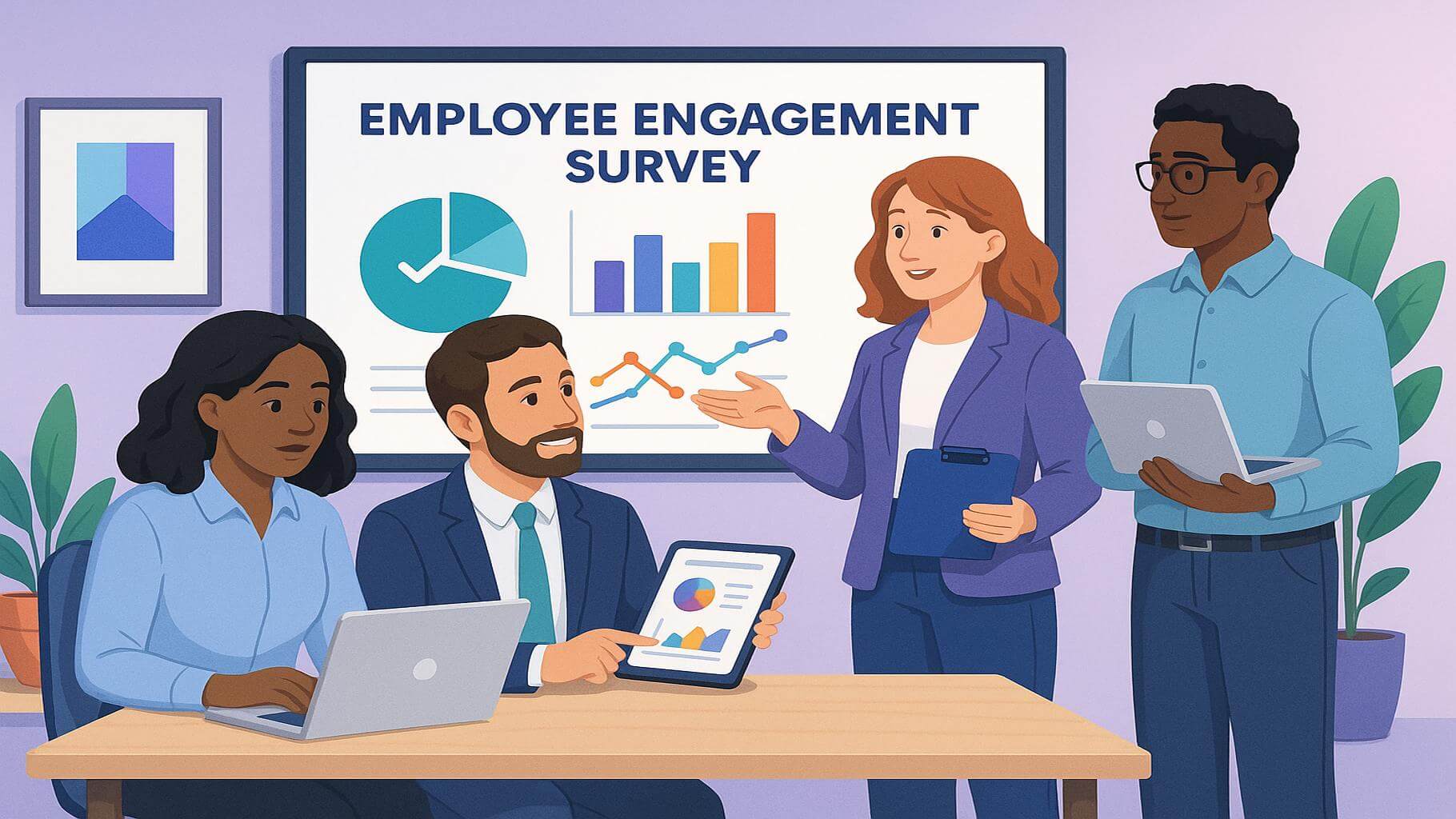
Employee recognition platform providers often include satisfaction measurement alongside engagement and recognition capabilities. While engagement and satisfaction differ conceptually, both contribute to workforce experience and retention. Satisfaction surveys focus on contentment with job conditions, compensation, benefits, and work environment. Organizations benefit from understanding both to create complete improvement strategies.
Satisfaction addresses fundamental needs that must be met before higher employee engagement becomes possible. Dissatisfaction with basic factors like compensation, working conditions, or management undermines engagement efforts. Satisfaction surveys identify foundational issues requiring attention before engagement initiatives can succeed. This diagnostic value makes satisfaction measurement an important complement to engagement assessment.
Identifying satisfaction drivers through statistical analysis
Satisfaction surveys identify which factors most influence contentment among different employee populations served. Statistical analysis reveals whether compensation, benefits, management, or environment drives satisfaction most strongly. Driver analysis helps organizations prioritize investments among competing demands for attention and resources. Results show where improvements will have the greatest impact on the measured overall satisfaction scores.
Different employee segments often have distinct satisfaction drivers, requiring targeted approaches to improvement. Compensation might matter most to some populations, while flexibility might drive others more strongly. Geographic and demographic differences influence which factors matter in different contexts and locations. Segmented analysis ensures improvement strategies address what actually matters to specific employee populations.
Benefits and compensation perception measurement
Benefits and compensation represent significant investments deserving regular assessment of employee perceptions and satisfaction. Surveys reveal whether employees understand, value, and utilize available programs effectively and fully. They identify gaps between organizational offerings and workforce preferences for different benefit types. This feedback informs design decisions, maximizing value for both employees and organizations.
Compensation fairness questions assess whether employees perceive pay practices as equitable and transparent. They reveal whether workers understand how pay decisions are made within organizational structures. Results help identify communication opportunities and potential issues that require prompt leadership attention. Data supports compensation strategy decisions, balancing organizational constraints with employee expectations.
Work environment and culture fit assessment
The physical environment significantly impacts satisfaction, particularly for employees who spend substantial time in the workplace. Surveys assess workspace adequacy, amenities, safety, and overall comfort of working conditions. Results inform facilities decisions and help prioritize investments in workplace improvements that matter. This feedback ensures organizations invest in changes employees actually value and appreciate.
Culture-fit questions explore alignment between an employee's values and the organizational culture they experience daily. They reveal whether workers feel comfortable and authentic in their work environments. Results identify areas where culture might exclude or disadvantage certain employee populations. This insight helps organizations build inclusive cultures that broadly support satisfaction and engagement.
Survey providers with comprehensive implementation and change support
Employee rewards programs and engagement surveys both require thoughtful implementation to achieve results. Many organizations underestimate the change management required to launch successful survey programs effectively. Implementation support helps navigate logistics, communication challenges, and stakeholder management requirements. Professional support significantly increases the likelihood of success and lasting organizational value creation.
Implementation expertise distinguishes full-service survey companies from basic technology providers in markets. Companies offering implementation support draw on experience from hundreds of successful deployments across industries. They anticipate challenges before they occur and provide proven solutions, accelerating time to value. This expertise proves particularly valuable for organizations launching survey programs for the first time.
Launch planning, ensuring strong participation from day one
Successful launches require careful planning that addresses timing, communication, and stakeholder preparation comprehensively. Specialists help develop launch plans that build anticipation and encourage broad employee participation. Communication templates explain survey purpose, confidentiality protections, and how results will drive action. Strategic messaging builds trust, encouraging honest, thoughtful responses rather than rushed completion.
Launch planning addresses logistics, including distribution methods, reminder schedules, and response monitoring approaches. Specialists help set realistic expectations and identify potential participation barriers early in the planning process. Checklists ensure that no crucial steps are missing during the complex deployment processes. This structured approach reduces stress for HR teams while increasing launch success rates.
Manager training building capability for results discussions
Managers play critical roles in encouraging participation and acting on survey results with their teams. Training prepares managers to communicate survey importance and address employee questions about confidentiality. Programs teach managers to interpret team results and facilitate productive discussions about findings. Enablement ensures managers become partners in improvement rather than barriers to participation.
Training covers constructive responses to both positive results and areas requiring improvement. Managers learn techniques facilitating team discussions that generate actionable improvement ideas collaboratively. They gain skills in creating action plans addressing specific engagement challenges revealed through data. Capability building creates sustainable improvement processes continuing beyond initial survey implementation.
Action planning facilitation, translating insights into organizational change
Survey value depends entirely on organizations taking meaningful action based on results and feedback. Action planning workshops help leadership translate insights into concrete improvement initiatives with accountability. Professional facilitators guide discussions, prioritizing actions based on impact, feasibility, and resource requirements. Structured processes ensure surveys generate real change rather than reports gathering dust.
External facilitation brings objectivity, preventing defensive reactions from undermining productive planning discussions. Facilitators help organizations confront difficult findings that internal discussions might avoid acknowledging. They provide frameworks ensuring action plans include clear owners, timelines, and success measures. This structured approach increases the likelihood that surveys drive the organizational change sought.
15+ top survey companies with features and pricing comparisons

Selecting among employee rewards programs and engagement survey vendors requires systematic evaluation of options. The following profiles highlight leading companies across enterprise, mid-market, and small business segments. Each profile includes capabilities, pricing, and customer perspectives to inform evaluation decisions made. Organizations should request demonstrations from multiple providers before making final partner selections.
1. Matter
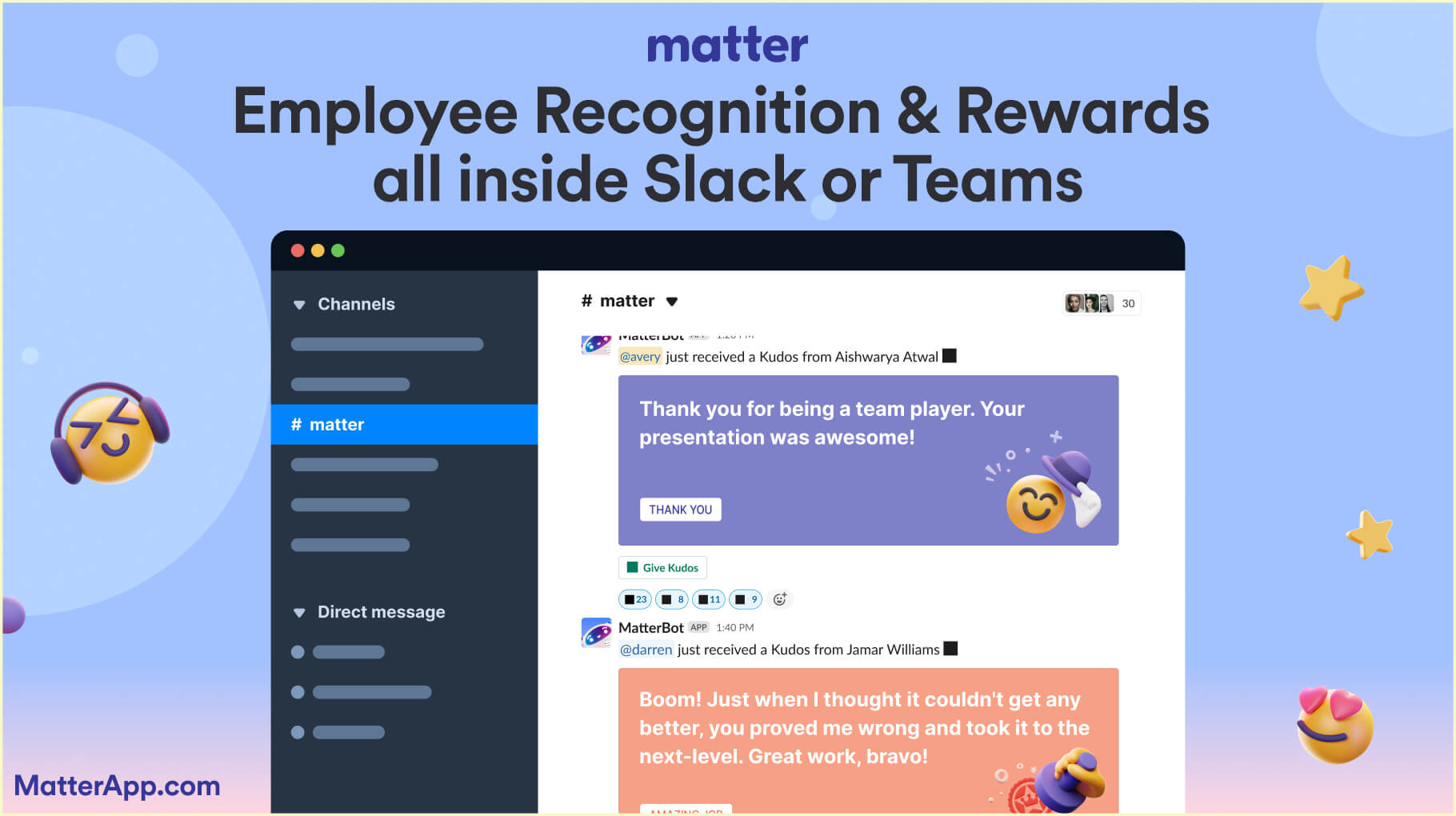
About Matter: Matter combines engagement surveys with peer recognition on a Slack-first, Teams-first platform. The platform offers pulse surveys, eNPS measurement, and comprehensive engagement assessment capabilities for organizations. Matter's research-backed 5-point eNPS scale increases participation while maintaining measurement validity throughout surveys. Setup takes minutes with an intuitive design, enabling rapid deployment without extensive technical support required.
Matter integrates recognition with measurement, enabling organizations to see connections between appreciation and engagement. The coin-based reward system resets weekly, encouraging authentic recognition rather than point hoarding over time. Automated celebrations for birthdays and work anniversaries ensure milestones receive acknowledgment without manual effort. Feedback Friday automation maintains consistent feedback collection without requiring HR to send manual reminders.
Matter main features:
- Pulse surveys and eNPS with a validated 5-point measurement scale
- Customizable kudos cards for values recognition and celebration
- Automated Feedback Friday reminders, ensuring consistent participation
- Native Slack and Microsoft Teams integration for seamless workflow
Matter pricing:
- Free Forever: $0/user/month
- Basic: $1/user/month, billed annually
- Pro: $3/user/month, billed annually
- Pro + Surveys: $5/user/month, billed annually
To learn more, view Matter's pricing page.
Matter G2 score: Matter has a G2 score of 4.7/5 based on user reviews.
What Matter customers are saying: "I was astonished at the start because I was used to feedback tools being very unemotional and static. That’s why I love Matter, because it provides necessary structure for an organization while allowing feedback to be enjoyable and personable.” - Dominik Bernhart, Chief Happiness Officer at COBE (Customer Story).
2. Culture Amp

About Culture Amp: Culture Amp delivers comprehensive engagement and performance management for growing organizations globally. Extensive template libraries developed with organizational psychologists provide validated measurement instruments for clients. Industry-leading benchmarks from thousands of companies enable meaningful comparisons against relevant peer groups. The platform emphasizes turning feedback into action through guided manager workflows and support.
Culture Amp main features:
- Extensive validated survey question libraries for measurement
- Industry-leading benchmarking database for comparisons
- Manager effectiveness surveys and 360-degree feedback
- Action planning tools with guided workflows
Culture Amp pricing:
- Engage: contact the sales team for exclusive features
- Perform: contact the sales team for exclusive features
- Develop: contact the sales team for exclusive features
- People Analysis: contact the sales team for exclusive features
To learn more, view Culture Amp’s pricing page.
Culture Amp G2 score: Culture Amp has a G2 score of 4.5/5 based on user reviews.
What Culture Amp customers are saying on G2: “I’ve been using this software for a while now, and one of its standout features is how well-organized the system is. Everything is laid out in a clear and intuitive way, making it easy to navigate. Additionally, the punctuality of the communications is exceptional – notifications and updates are always timely, ensuring that I stay on top of tasks and deadlines. It’s a reliable tool for those who value efficiency and clear communication. Highly recommended!” - Anna L., SEO Consultant (G2 Review for Culture Amp).
3. Qualtrics EmployeeXM
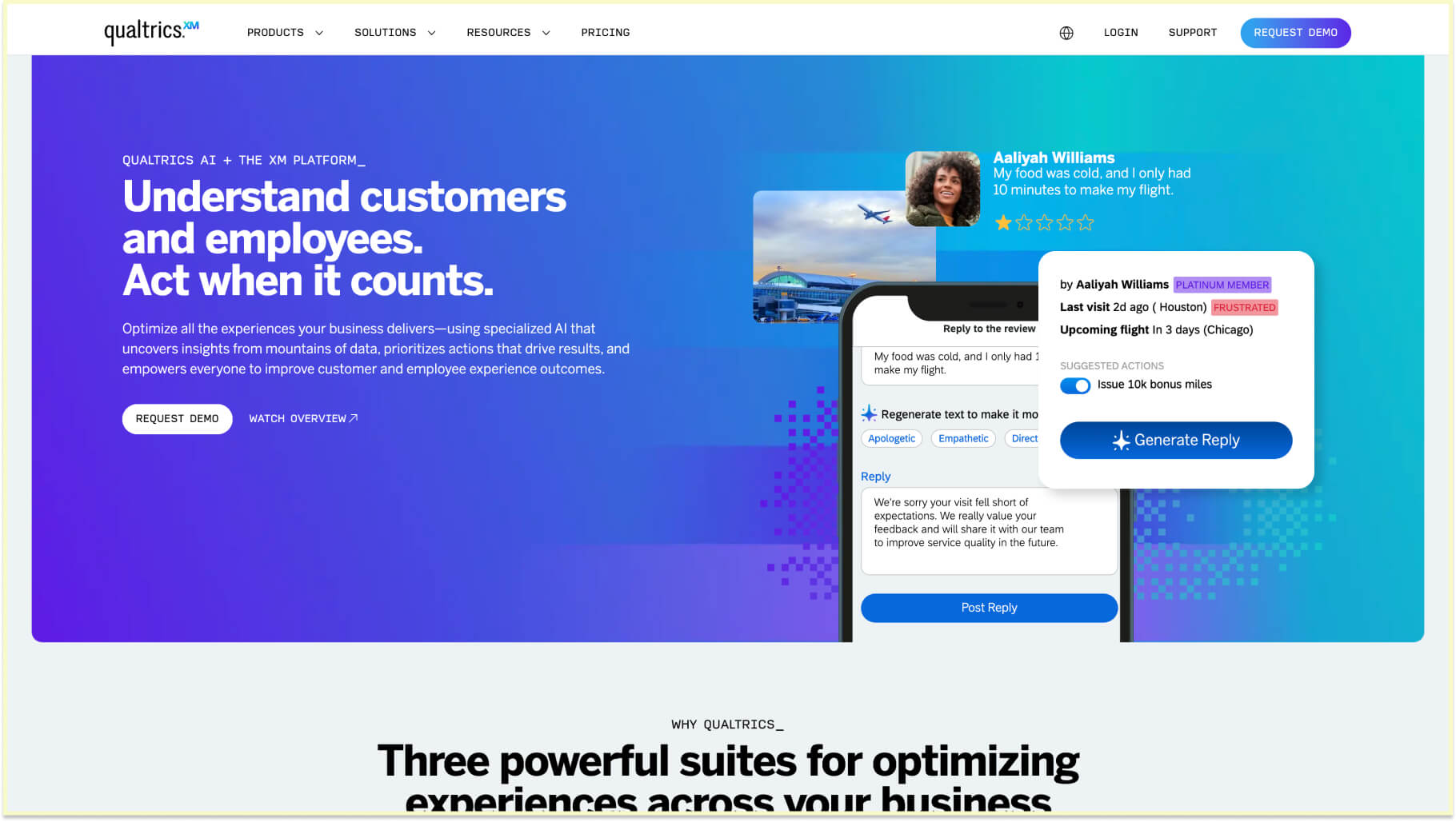
About Qualtrics EmployeeXM: Qualtrics EmployeeXM offers enterprise-scale employee experience management with powerful analytics capabilities. The platform supports comprehensive lifecycle surveys capturing feedback throughout the entire employee journey. AI-powered text analytics automatically identifies themes in open-ended responses at scale. Statistical tools uncover patterns in large datasets that manual analysis would miss entirely.
Qualtrics EmployeeXM main features:
- AI-powered text and sentiment analysis capabilities
- Advanced statistical analysis and predictive modeling
- Comprehensive employee lifecycle survey support
- Enterprise-grade security and compliance certifications
Qualtrics EmployeeXM pricing: Pricing is not listed on the website. To learn more about pricing, you'll need to schedule a demo/sales call with Qualtrics EmployeeXM.
Qualtrics EmployeeXM G2 score: Qualtrics EmployeeXM has a G2 score of 4.4/5 based on user reviews.
What Qualtrics EmployeeXM customers are saying on G2: “Preston Donohoo, with Red Pepper, has been fantastic to partner with. He is thorough, excellent at training and his customer support is outstanding. He made our implementation go very smoothly. We have found the Qualtrics engagement survey and 360s tools easy to use, with the ability to dive deep into our results. We would definitely recommend Qualtrics to others.” - Kelli G., Global Talent Manager (G2 Review for Qualtrics EmployeeXM).
4. Lattice
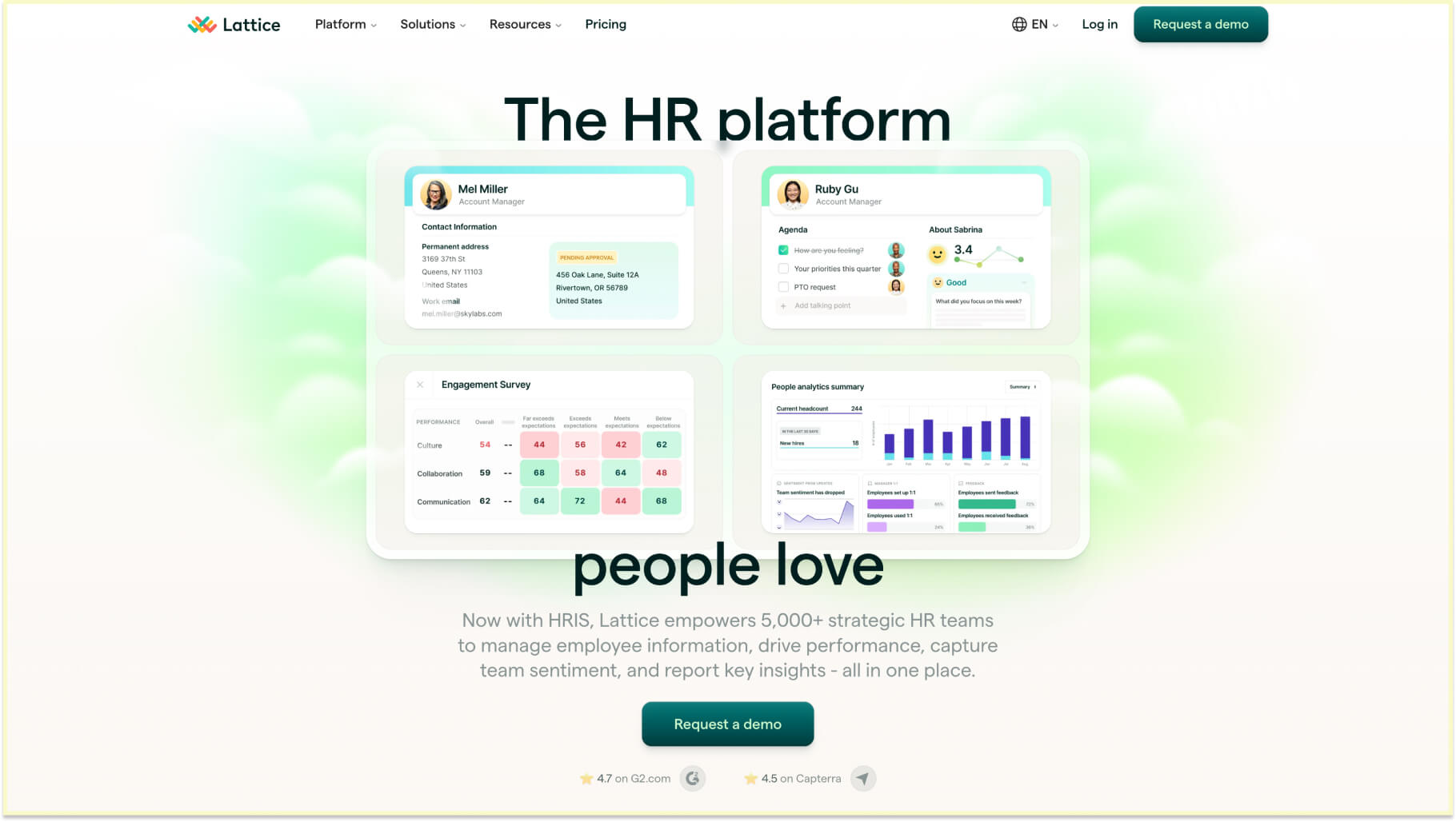
About Lattice: Lattice combines engagement surveys, performance management, and people analytics capabilities. The platform serves organizations wanting integrated talent management rather than standalone survey solutions. Science-backed templates developed through collaboration with researchers provide validated measurement instruments. Manager dashboards deliver team-level insights and guided action-planning support.
Lattice main features:
- Integrated engagement, performance, and goals platform
- Science-backed survey templates and questions
- Manager dashboards with team-level insights
- HRIS integration for seamless data synchronization
Lattice pricing:
- Talent Management: $11/seat/month
- Foundation: $11/seat/month
- Engagement: $4/seat/month
- Grow: $4/seat/month
- Compensation: $6/seat/month
To learn more, view Lattice's pricing page.
Lattice G2 score: Lattice has a G2 score of 4.7/5 based on user reviews.
What Lattice customers are saying on G2: “Ease of use and ease of implementation. The implementation time commitment was hours not weeks. We initially implemented all modules except Grow, Comp, and Engage and manged to configure and test all modules in less than two weeks. The product team is very receptive to feedback and also able to help come up with creative workarounds for functional gaps. The customer support is great and very responsive.” - Matthew H., Senior Human Resources Manager (G2 Review for Lattice).
5. 15Five

About 15Five: 15Five integrates engagement surveys with weekly check-ins and performance review capabilities. The platform emphasizes continuous feedback through lightweight weekly questions, supplementing formal survey programs. Regular touchpoints help managers stay connected with team sentiment between annual measurements. The approach supports cultures emphasizing ongoing dialogue between managers and team members.
15Five main features:
- Weekly check-ins integrated with engagement measurement
- 1-on-1 meeting templates and agenda tools
- Engagement surveys with science-backed questions
- Manager effectiveness assessment and coaching support
15Five pricing:
- Engage: $4/user/month, billed annually
- Perform: $11/user/month, billed annually
- Total Platform: $16/user/month, billed annually
To learn more, view 15Five's pricing page.
15Five G2 score: 15Five has a G2 score of 4.6/5 based on user reviews.
What 15Five customers are saying on G2: “We have built a company wide OKR tied to our company wide average Pulse score. It is an easy check of how the company is "feeling" from week to week, and over the last 2 years, I have found it to be accurate, important and super easy for the team to adopt and stay consistent in use.”- Dan A., Small-Business (G2 Review for 15Five).
6. Workleap/Officevibe
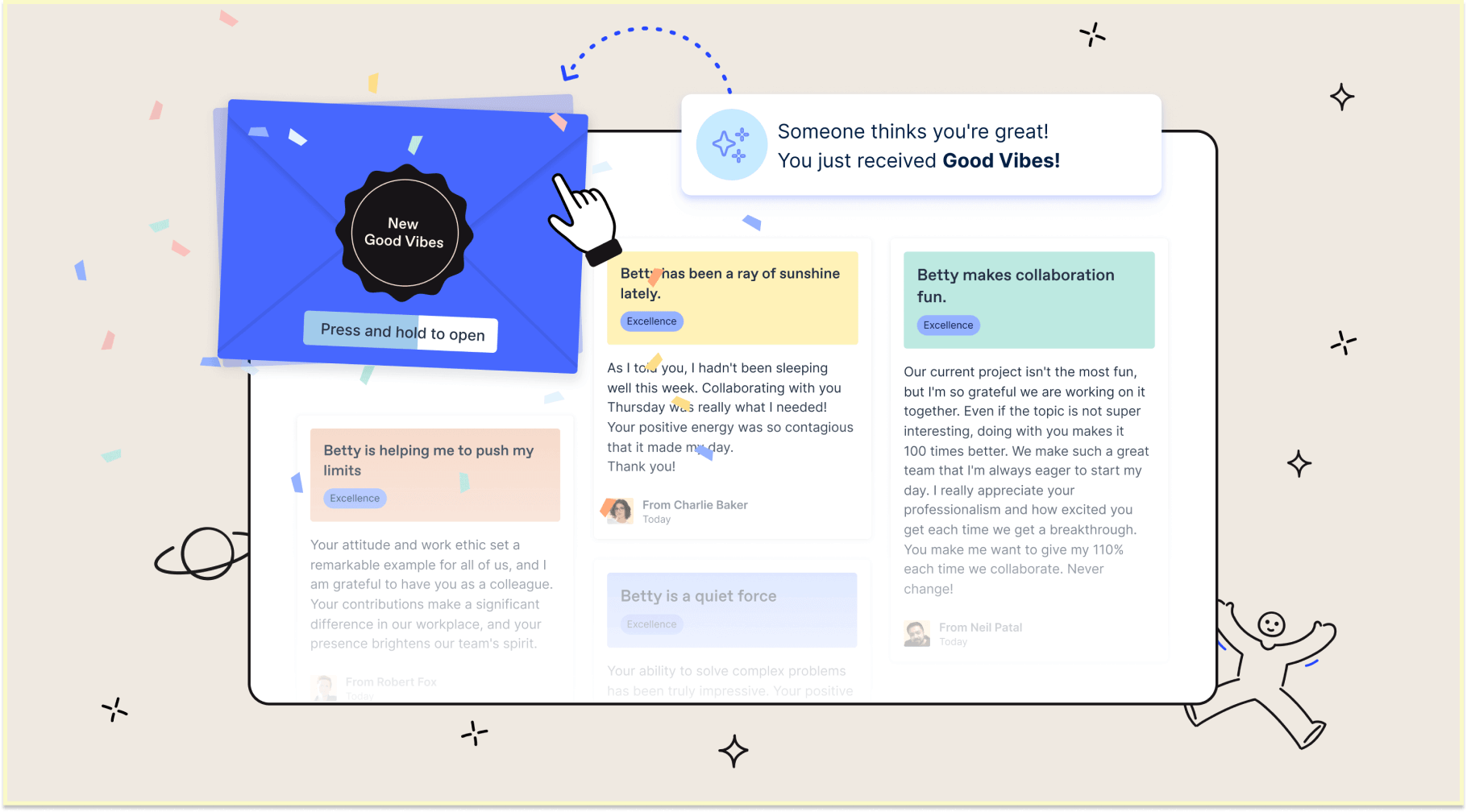
About Workleap/Officevibe: Workleap/Officevibe offers pulse surveys with strong anonymous feedback capabilities. Over 120 pre-built pulse surveys, plus custom builders, provide flexibility for diverse measurement needs. The platform emphasizes psychological safety through robust anonymity protections, encouraging honest feedback. Integration with Slack and Teams enables participation without requiring separate platform access.
Workleap/Officevibe main features:
- Extensive pulse survey library with custom builder
- Strong anonymity protections for honest feedback
- AI-powered real-time reporting and insights
- eNPS and DEIB surveys included
Workleap/Officevibe pricing:
- Officevibe: $5/month,10 users minimum
- Performance: $5/month,10 users minimum
- Compensation: $5/month,100 users minimum
To learn more, view Workleap/Officevibe’s pricing page.
Workleap/Officevibe G2 score: Workleap/Officevibe has a G2 score of 4.3/5 based on user reviews.
What Workleap/Officevibe customers are saying on G2: “Officevibe provides a regular stream of honest feedback and discussion between managers and employees across our company. GoodVibes has become THE way our employees appreciate and recognize one another. Our management team disucsses the data and anonymous responses on a monthly basis.” - Anthony B., President (G2 Review for Workleap).
7. Glint

About Glint: Glint provides engagement measurement integrated within Microsoft's productivity suite offerings. Seamless integration benefits organizations already using Microsoft 365 for daily work activities. Continuous listening capabilities include frequent pulse surveys between scheduled comprehensive annual measurements. AI-powered insights identify engagement trends and recommend improvement actions automatically for managers.
Glint main features:
- Deep Microsoft 365 and Teams integration
- Continuous listening with AI-powered recommendations
- Manager dashboards with guided action planning
- Enterprise security through Microsoft cloud infrastructure
Glint pricing:
- Microsoft Viva Employee: $2.00 user/month (Annual commitment)
- Microsoft Viva Workplace: $6.00 user/month (Annual commitment)
- Microsoft Viva Suite: $12.00 user/month (Annual commitment)
To learn more, view Glint’s pricing page.
Glint G2 score: Glint has a G2 score of 4.6/5 based on user reviews.
What Glint customers are saying on G2: “Good depiction of data, easy to view formats with a variety of different cuts of data available. Not super user-friendly, requires too many clicks to filter the data needed.” - Anjali A., Human Resources Consultant (G2 Review for Glint).
8. Perceptyx
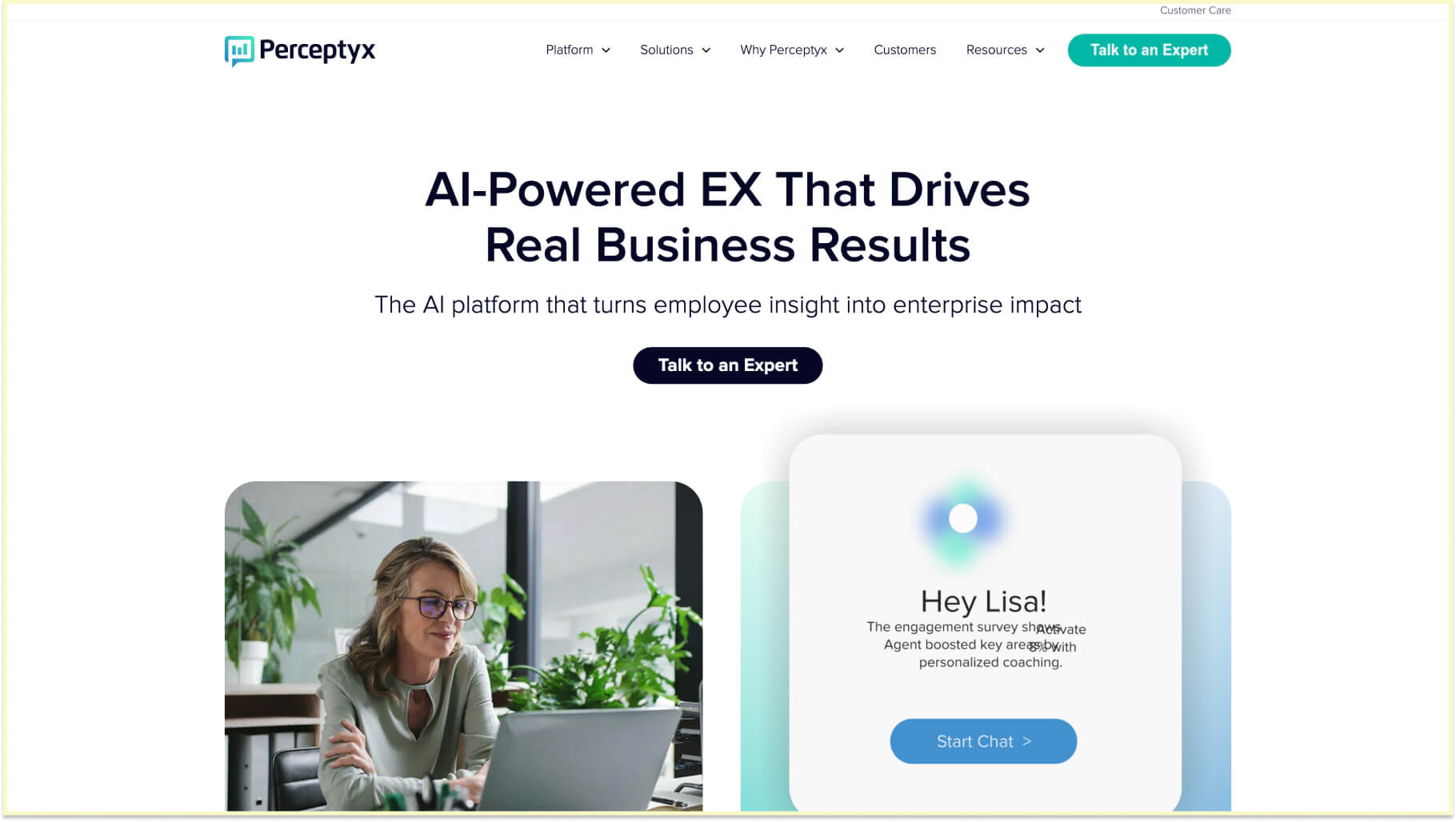
About Perceptyx: Perceptyx specializes in enterprise employee listening with advanced analytics and consulting support. The platform serves large organizations that require sophisticated survey programs and dedicated professional services. Continuous listening approaches combine annual surveys with pulse checks throughout the year. Consulting teams help interpret results and develop evidence-based action plans for improvement.
Perceptyx main features:
- Enterprise-scale continuous listening platform
- Advanced text analytics and natural language processing
- Dedicated consulting and professional services support
- Sophisticated benchmarking and comparative analytics
Perceptyx pricing: Pricing is not listed on the website. To learn more about pricing, you'll need to schedule a demo/sales call with Perceptyx.
Perceptyx G2 score: Perceptyx has a G2 score of 3.8/5 based on user reviews.
What Perceptyx customers are saying on G2: “I have found the Theme Frequency report to be largely inaccurate regardless of which survey I am looking at - onboarding, engagement, and exit. It sometimes picks up more concrete themes well, like benefits, training, compensation, etc., but anything like trust, culture, teamwork, etc. the comments often do not correspond to the theme. I think it has improved since we first started using this functionality but it could still use some work.” - Verified User in Transportation (G2 Review for Perceptyx).
9. Eletive

About Eletive: Eletive provides real-time engagement insights through continuous pulse surveys with intuitive dashboards. The platform emphasizes turning feedback into action quickly through guided workflows for managers. Benchmarking data and AI-powered recommendations help prioritize improvement efforts effectively. Multi-language support serves organizations with international workforces across regions.
Eletive main features:
- Continuous pulse surveys with real-time insights
- AI-powered recommendations for improvement priorities
- Intuitive dashboards for managers and HR
- Multi-language support for global organizations
Eletive pricing:
- Essential: Contact the sales team for exclusive features
- Standard: Contact the sales team for exclusive features
- Professional: Contact the sales team for exclusive features
To learn more, view Eletive’s pricing page.
Eletive G2 score: Eletive has a G2 score of 4.6/5 based on user reviews.
What Eletive customers are saying on G2: “They walk the talk (they do what they say and they say what they do). The survey is easy to implement, the plateform is user-friendly and having the results in real time is very helpful! The relationship with our Customer Success Manager and the support we get from her whenever we need it is also making a huge difference for us.” - Karima A., Senior Human Resources Officer (G2 Review for Eletive).
10. SurveySparrow

About SurveySparrow: SurveySparrow offers conversational survey experiences with employee engagement templates included. The platform's conversational format increases completion rates through engaging, chat-like interfaces for respondents. Automated scheduling and recurring surveys support continuous listening programs for organizations. Multi-channel distribution reaches employees effectively through email, SMS, and embedded surveys.
SurveySparrow main features:
- Conversational survey format increases engagement
- Automated scheduling for recurring surveys
- Multi-channel distribution capabilities
- Employee engagement survey templates included
SurveySparrow pricing:
- Basic: $19/user/month, billed annually
- Starter: $26/user/month, billed annually
- Business: $52/user/month, billed annually
- Professional: $162/user/month, billed annually
- Enterprise: contact sales for exclusive features
To learn more, view SurveySparrow's pricing page.
SurveySparrow G2 score: SurveySparrow has a G2 score of 4.4/5 based on user reviews.
What SurveySparrow customers are saying on G2: “It produces attractive surveys that are a good experience for the participant. The interface is fairly straightforward and attractive on the backend too. There are good reporting features and export formats (e.g. to SPSS, CSV, and Google Sheets). I really like the audio questions, which automatically transcribe the participants answer as they speak. I can see that being very useful in my work. The branching and display logic is good, allowing control for blocks of questions as well as individual questions and answer options within a question. It allows piping. There are options for scheduling emails and reminders. It's easy to create different links that you can use to track the different channels through which you are sharing your survey. After using it for a year in our company of 16 people, we have decided that the features are good enough that we can switch away from Qualtrics, which has become cost prohibitive. I also like that there are options to push the data automatically to Google Sheets. Customer support is also good, with quick answers to questions via the chat.” - Claire Q., Senior Research Associate (G2 Review for SurveySparrow).
11. Leapsome

About Leapsome: Leapsome combines engagement surveys with performance management, goals, and learning capabilities. The integrated platform serves organizations seeking unified people management rather than point solutions. Engagement surveys include validated questions with benchmarking against similar companies for context. Manager dashboards provide team insights and guided action-planning workflows.
Leapsome main features:
- Integrated engagement, performance, and learning platform
- Validated survey questions with benchmarking
- Manager dashboards with action planning guidance
- Goals and OKR tracking integration
Leapsome pricing: Pricing is not listed on the website. To learn more about pricing, you'll need to schedule a demo/sales call with Leapsome.
Leapsome G2 score: Leapsome has a G2 score of 4.9/5 based on user reviews.
What Leapsome customers are saying on G2: “It is step to step process implementation of sales pattern , customer support , and a lot of feature to understand customer need .It also help to ease of interagtion customer mindset and win situation .It have a good dashboard GUI to understand also support avilable in a single call , once again thank you team leapsome because i was a layman and after half an hour training i became super user.” - SUMIT KUMAR O., Senior Technical Sales Engineer (G2 Review for Leapsome).
12. CultureMonkey

About CultureMonkey: CultureMonkey focuses on employee engagement with anonymous feedback and pulse survey capabilities. The platform offers industry benchmarks and action planning tools for HR teams and managers. AI-powered insights help identify improvement priorities from survey data collected. Multi-language support and mobile accessibility serve diverse, distributed workforces.
CultureMonkey main features:
- Anonymous feedback with strong privacy protections
- Industry benchmarking for comparison
- AI-powered insights and recommendations
- Mobile-friendly for distributed workforces
CultureMonkey pricing: Pricing is not listed on the website. To learn more about pricing, you'll need to schedule a demo/sales call with CultureMonkey.
CultureMonkey G2 score: CultureMonkey has a G2 score of 4.7/5 based on user reviews.
What CultureMonkey customers are saying on G2: “Culture Monkey has the most advanced dashboards that I have come across in a lot of tools that i have evaluated or worked with in the past. There are customized reports and views available, split by manager level, locations, departments and roles. The best feature is the manager-level cuts and the action planning where we can actively involve stakeholders and make them a part of the solution to improve engagement scores across the org.” - Pallavi D., Mid-Market (G2 Review for CultureMonkey).
13. Peoplebox

About Peoplebox: Peoplebox integrates OKR tracking with employee engagement surveys and performance management. The platform serves organizations wanting goal alignment alongside engagement measurement capabilities. Automated check-ins and feedback collection complement formal survey programs effectively. Integration with work tools like Slack increases participation and accessibility.
Peoplebox main features:
- Integrated OKRs, engagement, and performance
- Automated check-ins and feedback collection
- Work tool integrations, including Slack
- Analytics connecting goals to engagement
Peoplebox pricing:
- Talent Management: $7/user/month, billed annually
- OKR Platform: $8/user/month, billed annually
- Full Suite - Professional: $12/user/month, billed annually
- Full Suite - Premium: $15/user/month, billed annually
- Enterprise: contact sales team
To learn more, view Peoplebox's pricing page.
Peoplebox G2 score: Peoplebox has a G2 score of 4.5/5 based on user reviews.
What Peoplebox customers are saying on G2: “What I like most about Peoplebox is how it makes it easy to track goals and ensure everyone is on the same page. It helps teams align with company objectives and encourages regular feedback and check-ins, which leads to better communication. The platform works well with other tools, so it fits into existing workflows without much hassle. Plus, the insights it provides help leaders make better decisions and improve team performance.” - Abhijit P., Senior Media buyer (G2 Review for Peoplebox).
14. PerformYard

About PerformYard: PerformYard combines performance management with employee engagement survey capabilities for organizations. The platform offers flexible survey creation with validated engagement questions available for use. Manager dashboards provide team insights while HR gains organization-wide visibility into results. Dedicated customer success support helps organizations implement effective survey programs.
PerformYard main features:
- Flexible survey creation with validated questions
- Performance management integration
- Manager and HR dashboards
- Dedicated customer success support
PerformYard pricing:
- PerformYard AI: $1-3/user/month, billed monthly
- Employee Engagement: $1-3/user/month, billed monthly
- Meetings: $2-4/user/month, billed monthly
- Surveys: $2-4/user/month, billed monthly
To learn more, view PerformYard's pricing page.
PerformYard G2 score: PerformYard has a G2 score of 4.8/5 based on user reviews.
What PerformYard customers are saying on G2: “We received excellent support from our dedicated Customer Success Manager, Liz Tiriris, who guided us through the process. The set up was easy and simple to use; Liz was able to help us decide how we wanted to use the tool and the features that would help us customise PerformYard to suit our specific needs. We had regular calls to discuss all the different functions setting up the reviews and goals for our company. The feedback section is perfect and allows us to share this between individuals, managers and the entire company.” - Emma S., Risk and Governance Manager (G2 Review for Perform Yard).
15. Quantum Workplace

About Quantum Workplace: Quantum Workplace offers engagement surveys with integrated recognition, goals, and performance capabilities. The platform serves mid-market organizations seeking comprehensive people management solutions together. Validated surveys with extensive benchmarking effectively provide context for interpreting results. Action planning tools and manager resources support follow-through on survey insights gathered.
Quantum Workplace main features:
- Validated engagement surveys with benchmarking
- Recognition and goals integration
- Action planning tools and resources
- Manager dashboards and development support
Quantum Workplace pricing:
- Engagement: Contact sales for exclusive features
- Performance: Contact sales for exclusive features
- Developmental: Contact sales for exclusive features
To learn more, view Quantum Workplace's pricing page.
Quantum Workplace G2 score: Quantum Workplace has a G2 score of 4.4/5 based on user reviews.
What Quantum Workplace customers are saying on G2: “Quantum workplace is very user friendly. The platform is easy to navigate and when you cannot figure something out or have questions their support library and chat features are detailed and quick to use.” - Brittney C., Employee Engagement Manager (G2 Review for Quantum Workplace).
How Matter helps organizations measure and improve engagement
Matter delivers workforce feedback capabilities that connect directly with recognition tools, reinforcing positive behaviors. The Slack-first and Teams-first architecture eliminates barriers by embedding surveys within daily communication workflows. Response rates climb when employees participate without logging into separate systems or checking email. Organizations capture authentic sentiment because the experience feels natural rather than disruptive to work.
The platform bridges the gap between understanding engagement and actually improving workplace culture meaningfully. Survey insights become actionable when paired with recognition features that reward behaviors employees identified as valuable. When data reveals that acknowledgment matters most, organizations can immediately increase appreciation through kudos. This closed loop transforms measurement from passive observation into active culture building every day.
Research-backed measurement maximizing data quality and participation
Matter employs a 5-point eNPS scale developed through research examining how employees actually respond to surveys. Traditional 11-point scales create confusion about the differences between adjacent numbers, such as six and seven. The simplified approach reduces cognitive burden while preserving statistical validity for accurate trend tracking. Employees complete surveys more quickly and provide more thoughtful responses to open-ended questions.
Mobile-friendly design ensures participation regardless of where or when employees access the survey. Frontline workers without dedicated computers participate as easily as office-based staff with workstations. Accessibility removes barriers that traditionally excluded significant portions of the workforce from participating in feedback. Complete workforce representation yields insights that reflect actual sentiment rather than skewed samples.
Dedicated support guiding organizations from launch through optimization
Matter assigns customer success professionals who understand survey science and organizational change management. These partners help design communication strategies that build trust and encourage candid participation. They provide templates, timing recommendations, and messaging frameworks proven across successful implementations. Launch support helps organizations avoid common mistakes that undermine first-survey experiences.
The partnership continues beyond deployment through regular optimization conversations and best-practice sharing. Customer success monitors participation patterns and recommends adjustments to improve response quality over time. They help interpret results and facilitate action planning discussions, translating insights into initiatives. Organizations gain ongoing expertise rather than one-time access to software without guidance.
Unified recognition and measurement create continuous improvement cycles
Matter uniquely positions survey capabilities alongside peer recognition, rewards, and automated celebrations together. When engagement data reveals opportunities, recognition features enable immediate response through appreciation initiatives. Feedback Friday automation maintains consistent acknowledgment rhythms without the manual HR coordination required weekly. The coin-based reward system resets regularly, encouraging authentic recognition rather than strategic hoarding.
Automated birthday and anniversary celebrations demonstrate organizational care, reinforcing engagement survey themes identified. Customizable kudos cards align recognition with specific values and behaviors organizations want to strengthen. Analytics reveal which recognition patterns correlate with engagement improvements across teams and departments. This integration creates feedback loops in which measurement informs action, and action improves future measurements.
Frequently asked questions about employee engagement survey companies
Q: What criteria matter most when selecting an engagement survey vendor?
A: Prioritize validated measurement instruments, relevant benchmark databases, and dedicated implementation guidance from experts. Evaluate whether the vendor provides action planning frameworks that translate data into workplace improvements. Matter stands apart by integrating surveys directly with recognition tools that reinforce positive changes identified. Always schedule demonstrations and speak with reference customers before committing to any platform.
Q: What budget range covers most engagement survey solutions available today?
A: Investment levels span from zero cost to enterprise pricing, depending on organizational requirements and support. Matter offers a Free Forever plan without a financial commitment required. Paid tiers typically range from $1 to $15 per employee per month across the market. Custom enterprise agreements involve dedicated negotiations based on deployment scope and service requirements.
Q: What participation percentage indicates a successful survey deployment?
A: Strong survey programs typically achieve participation rates between sixty and eighty percent of employees. Matter's native Slack and Teams integration consistently pushes response rates above 80%. Low participation often signals communication gaps, confidentiality concerns, or skepticism about organizational follow-through. Improving rates requires addressing root causes rather than simply extending survey windows longer.
Q: How often should workforce engagement measurement occur throughout the year?
A: Most organizations benefit from annual comprehensive assessments paired with shorter pulse checks quarterly. Matter's Feedback Friday feature automates continuous listening without overwhelming employees with requests. Measurement frequency should match organizational capacity to analyze results and implement meaningful changes. Surveying without acting erodes trust faster than not surveying at all.
Q: What distinguishes Matter from traditional engagement survey platforms available?
A: Matter integrates pulse surveys and eNPS directly alongside peer recognition and rewards in one platform. The research-backed 5-point scale simplifies responses while maintaining statistical validity for tracking trends. Native workspace integration eliminates friction by meeting employees within their daily communication tools. Organizations gain measurement and improvement capabilities together rather than managing disconnected systems separately.
Q: What timeline should organizations expect for survey program implementation?
A: Matter enables basic deployment within days due to intuitive configuration and seamless integration. Programs requiring custom questions and comprehensive communication planning typically need two to four weeks. Large-scale implementations involving multiple regions and system integrations may take up to 3 months. Faster implementation allows organizations to begin gathering actionable insights sooner rather than waiting.
Final thoughts on selecting employee engagement survey companies
Choosing the right engagement survey partner shapes whether measurement drives organizational improvement or becomes administrative overhead. The companies profiled offer diverse approaches serving different organizational needs, budgets, and requirements. Team rewards programs and engagement surveys work best when organizations commit to acting decisively. Success requires matching provider capabilities to specific organizational context and priorities.
Technology matters less than the commitment to use survey insights for meaningful organizational change. The best platforms become valuable when leaders embrace continuous improvement informed by workforce feedback. Provider partnerships should support this journey through expertise, tools, and ongoing guidance for teams. When measurement connects to recognition and action, organizations create thriving workplaces that attract and retain talent.
Ready to partner with an engagement survey provider combining intuitive technology with proven support? Schedule a demo with a Matter expert and discover how integrated measurement and recognition drive results. Matter helps organizations implement surveys confidently and create cultures of continuous improvement for lasting impact.