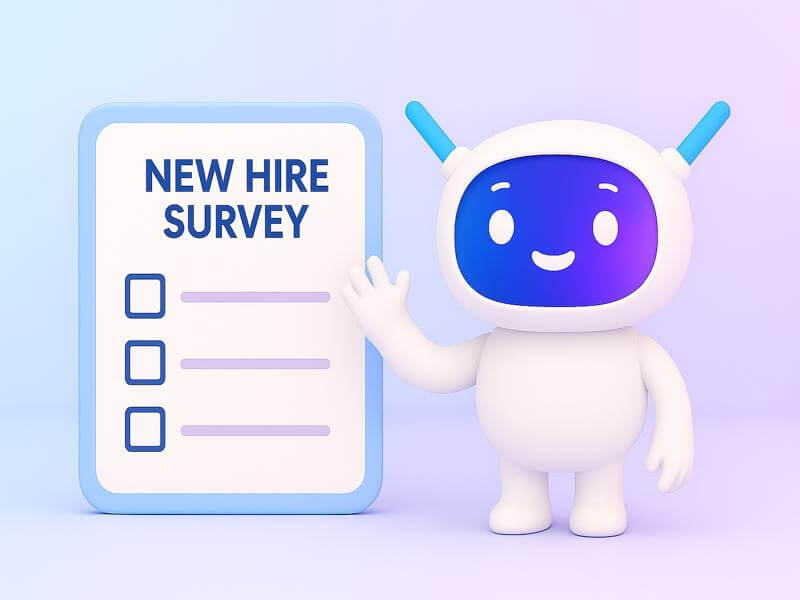

Starting a new job is both exciting and overwhelming for employees joining your organization. The first weeks and months shape how new hires perceive your company culture and their role within it. Organizations that gather structured feedback during the induction process obtain valuable insights into effective practices and areas requiring enhancement. At Matter, we understand the challenges HR teams face when creating meaningful onboarding survey experiences that drive real change.
New-hire surveys are essential tools for understanding the employee experience from day one. These surveys help organizations identify gaps in training, communication, and support systems. When designed thoughtfully, they provide actionable data that improves retention and engagement. This comprehensive guide offers templates, questions, and strategies to help you build an effective new hire survey program.
What is a new hire survey?
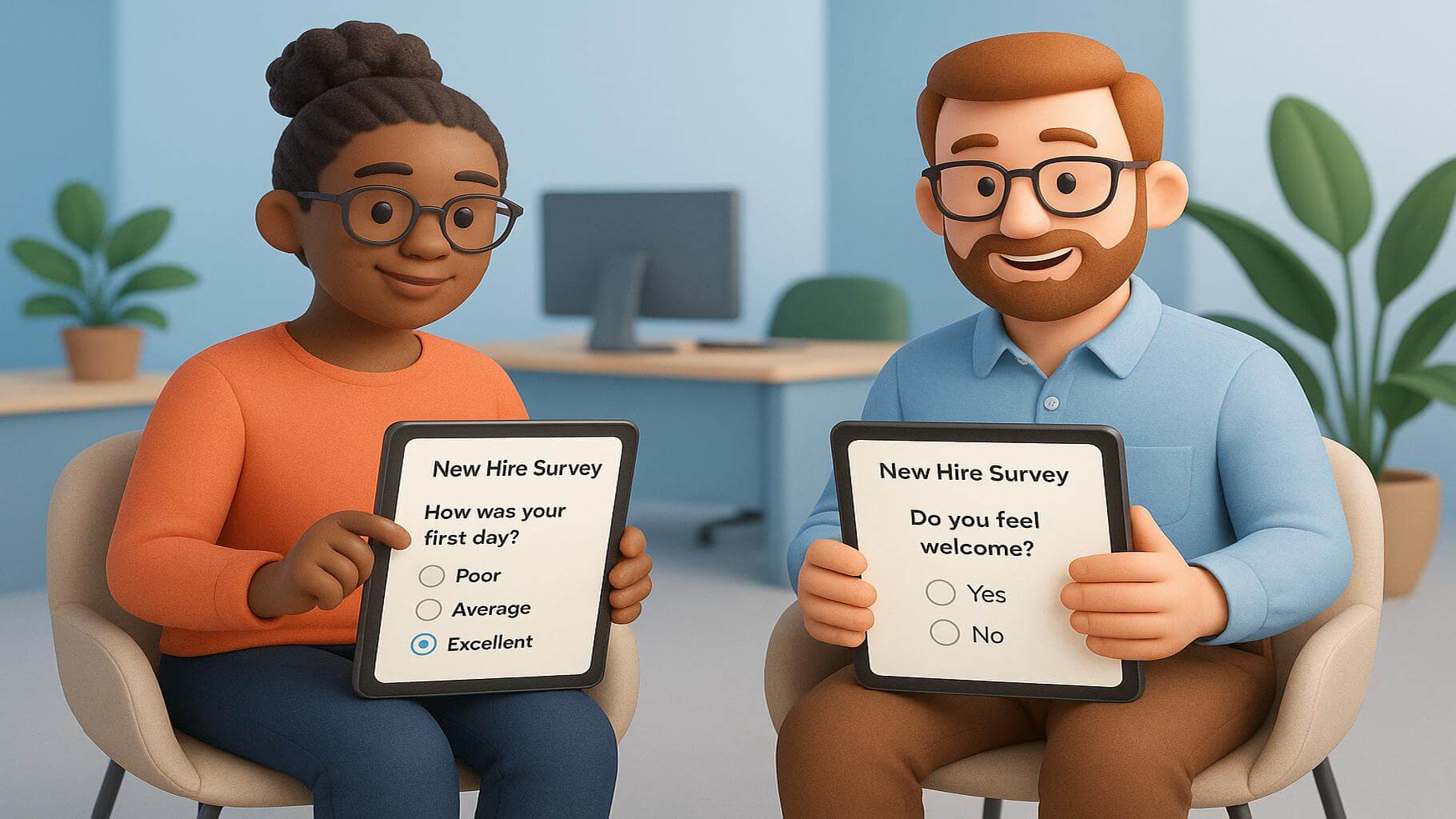
A new hire survey is a structured feedback tool designed to capture employee perspectives during the onboarding process. These surveys gather insights about training effectiveness, manager support, and overall job satisfaction. Organizations use this data to refine their onboarding programs and address concerns before they become larger issues. The concept involves establishing a feedback loop that advantages both the individual and the organization.
New hire surveys differ from annual engagement surveys in their timing and focus areas. They target specific onboarding milestones such as the first week, first month, or first quarter. This targeted approach allows HR teams to intervene quickly when problems arise during critical adjustment periods. The immediacy of feedback makes these surveys particularly valuable for improving retention rates.
Key components of effective new hire surveys
Effective surveys balance quantitative ratings with qualitative open-ended questions for deeper insights. They should cover topics like job expectations, training quality, and team integration experiences. The best surveys are concise enough to encourage completion while comprehensive enough to gather meaningful data. Timing matters significantly because asking questions at the right moment yields more accurate responses.
Survey design should align with your organization's specific onboarding goals and culture priorities. Questions must be clear and avoid leading language that could bias responses toward certain answers. Including a mix of scaled questions and comment boxes gives employees flexibility in how they share feedback. Regular review and updating of survey questions ensures continued relevance as your organization evolves.
Types of new hire surveys
First-impression surveys capture immediate reactions during the first days of employment with your organization. These surveys focus on administrative processes, workspace setup, and early team interactions that shape perceptions. They help identify quick wins that can improve the experience for future hires joining your team. Early feedback allows organizations to address issues while they are still fresh.
Milestone surveys track progress at specific intervals, such as 30, 60, and 90 days after the start date. Each milestone survey builds on previous responses to show development and changing perspectives over time. This longitudinal approach reveals patterns that single surveys might miss entirely. Organizations can compare responses across milestones to identify where support is most needed.
What are the benefits of new hire surveys?
Implementing new-hire surveys lays the foundation for continuous improvement in your overall onboarding process. These surveys demonstrate to employees that their opinions matter and will be acted upon meaningfully. Organizations that actively seek feedback build stronger relationships with their workforce from the start. The data collected guides strategic decisions about training, resources, and support systems.
New hire surveys also serve as early warning systems for potential retention risks within your organization. Employees who express concerns early can receive targeted support before deciding to leave the company. This proactive approach reduces turnover costs and preserves institutional knowledge that would otherwise be lost. The investment in surveys pays dividends in the form of improved retention rates over time.
Improved onboarding process effectiveness
Survey feedback reveals specific areas where your onboarding process excels or needs improvement across departments. Teams can identify which training modules resonate and which leave new hires confused or unprepared. This data-driven approach replaces guesswork with evidence-based program refinements that actually work. Continuous improvement becomes possible when you have reliable feedback to guide your decisions.
Organizations using employee onboarding survey data report higher satisfaction scores among recent hires. The feedback loop creates accountability for managers and trainers to consistently deliver quality experiences. When employees see their suggestions implemented, trust in the organization grows substantially. This virtuous cycle benefits everyone involved in the onboarding journey.
Enhanced employee engagement and retention
Early engagement through surveys sets expectations for ongoing communication throughout the employment relationship. New employees who feel heard are more likely to stay interested and committed to their jobs. The act of asking for feedback signals that the organization values employee input at all levels. This foundation supports long-term employee engagement and reduces costly turnover.
Retention improvements from effective onboarding surveys can be substantial for most organizations implementing them. Employees who have positive onboarding experiences are significantly more likely to stay with companies long-term. Survey data helps identify at-risk employees before they begin searching for other opportunities elsewhere. Proactive intervention based on survey responses keeps talented team members engaged and growing.
Why are new hire onboarding surveys important?
Onboarding surveys matter because first impressions significantly shape the trajectory of the entire employee experience. The initial weeks establish patterns of communication, trust, and engagement that persist for years afterward. Organizations that neglect early feedback miss critical opportunities to course-correct before problems become entrenched. Understanding why these surveys are important helps build organizational commitment to the practice.
The importance of onboarding surveys extends beyond individual employee satisfaction to organizational performance overall. Teams with well-onboarded members achieve productivity faster and collaborate more effectively with colleagues. Survey data helps organizations clearly understand the connection between onboarding quality and business outcomes. This strategic perspective elevates onboarding from an administrative process to a competitive advantage for your organization.
First impressions matter for long-term success
Research consistently shows that early experiences disproportionately influence long-term attitudes and behaviors at work. Employees form opinions about company culture, leadership quality, and growth potential within their first weeks. These initial impressions are difficult to change once they are completely established in an employee's mind. Capturing feedback during this critical period allows organizations to shape these formative impressions positively.
The concept that impressions matter applies to every touchpoint in the onboarding journey for new hires. From the first email to the first team meeting, each interaction contributes to the overall picture. Surveys help organizations understand which touchpoints have the greatest impact on employee perceptions today. This knowledge enables targeted improvements that will have the greatest impact on experience.
Data-driven decision making for HR teams
Survey data transforms onboarding from art to science by providing measurable feedback for improvement efforts. HR teams can easily track trends over time and compare results across departments or locations. This quantitative approach supports budget requests and resource allocation decisions with concrete evidence available. Leaders respond better to data than anecdotes when making strategic decisions about programs.
The analytical capabilities of modern pulse survey tools make data interpretation more accessible than ever before. Dashboards and reports highlight key findings without requiring users to have advanced statistical knowledge today. HR professionals can focus on action rather than analysis when tools handle the heavy lifting automatically. This efficiency allows smaller teams to run sophisticated feedback programs effectively across organizations.
5+ new hire survey templates for the first week
The first week establishes the foundation for everything that follows in the onboarding journey. Templates for this period focus on immediate needs, first impressions, and administrative effectiveness during orientation. These surveys should be brief to respect the overwhelming amount of information new hires are processing. Quick pulse checks work better than comprehensive questionnaires during this intensive learning period overall.
First-week surveys also capture authentic reactions before organizational norms shape how employees respond. New hires often become more diplomatic over time as they learn what answers are expected. Early surveys capture raw, honest feedback that becomes harder to obtain as employment continues forward. This authenticity makes the first week's data particularly valuable for quickly identifying real issues.
Welcome experience survey template
This template assesses the quality of day-one activities and initial welcome experiences for new employees. Questions cover topics like workspace readiness, technology setup, and introductions to team members present. The goal is to understand whether new hires felt prepared and welcomed during their initial hours. Responses identify gaps in preparation that create unnecessary stress for incoming team members joining.
- How would you rate the organization of your first day activities and schedule?
- Was your workspace and equipment ready when you arrived at the office?
- Did you receive clear information about where to go and who to meet?
- How welcome did you feel during your first interactions with team members?
- What could have made your first day experience better overall?
Orientation effectiveness survey template
Orientation programs vary widely in quality and comprehensiveness across different organizations and departments. This template evaluates whether orientation sessions provide the information new hires actually need today. Questions assess content relevance, presentation quality, and opportunity for questions during sessions attended. Feedback helps training teams refine their orientation approach for future cohorts joining.
- How relevant was the orientation content to your specific role and responsibilities?
- Were the orientation presenters engaging and clear in their explanations?
- Did you have adequate opportunity to ask questions during orientation sessions?
- What topics were missing from orientation that you needed to know about?
- How would you rate the overall quality of your orientation experience?
Manager introduction survey template
The relationship between new hires and their direct managers significantly influences engagement and retention rates. This template focuses specifically on the quality of initial manager interactions and communications received. Questions explore whether managers set clear expectations and demonstrate early investment in employee success. Strong manager relationships start with intentional first conversations about role and responsibilities together.
- Did your manager meet with you during your first week as scheduled?
- Did your manager clearly communicate expectations for your role?
- How accessible was your manager for questions during your first week?
- Did your manager introduce you to key team members and stakeholders?
- What additional support would you like from your manager going forward?
Team integration survey template
Feeling part of the team matters as much as understanding job duties for new employees. This template examines how well new hires are being integrated into their immediate work groups. Questions cover introductions, inclusion in meetings, and opportunities to contribute to team discussions. Social integration often predicts job satisfaction more strongly than technical training quality alone.
- Have you been introduced to all members of your immediate team?
- Are you being included in relevant team meetings and communications?
- Do you feel comfortable asking your team members questions?
- Has anyone been designated to help you navigate team dynamics?
- What would help you feel more connected to your team?
Administrative process survey template
Paperwork and administrative tasks can be frustrating for new employees if not handled smoothly. This template evaluates the efficiency of HR processes, benefits enrollment, and system access setup. Questions identify bottlenecks that slow down productivity and create negative first impressions early. Streamlining administrative processes shows respect for new hire time and attention during onboarding.
- How clear were the instructions for completing the required paperwork?
- Did you experience any delays in getting system access or equipment?
- Were benefits enrollment options explained clearly to you during orientation?
- How easy was it to find answers to administrative questions?
- What administrative processes could be improved for future new hires?
5+ critical new hire onboarding survey questions for milestone assessments
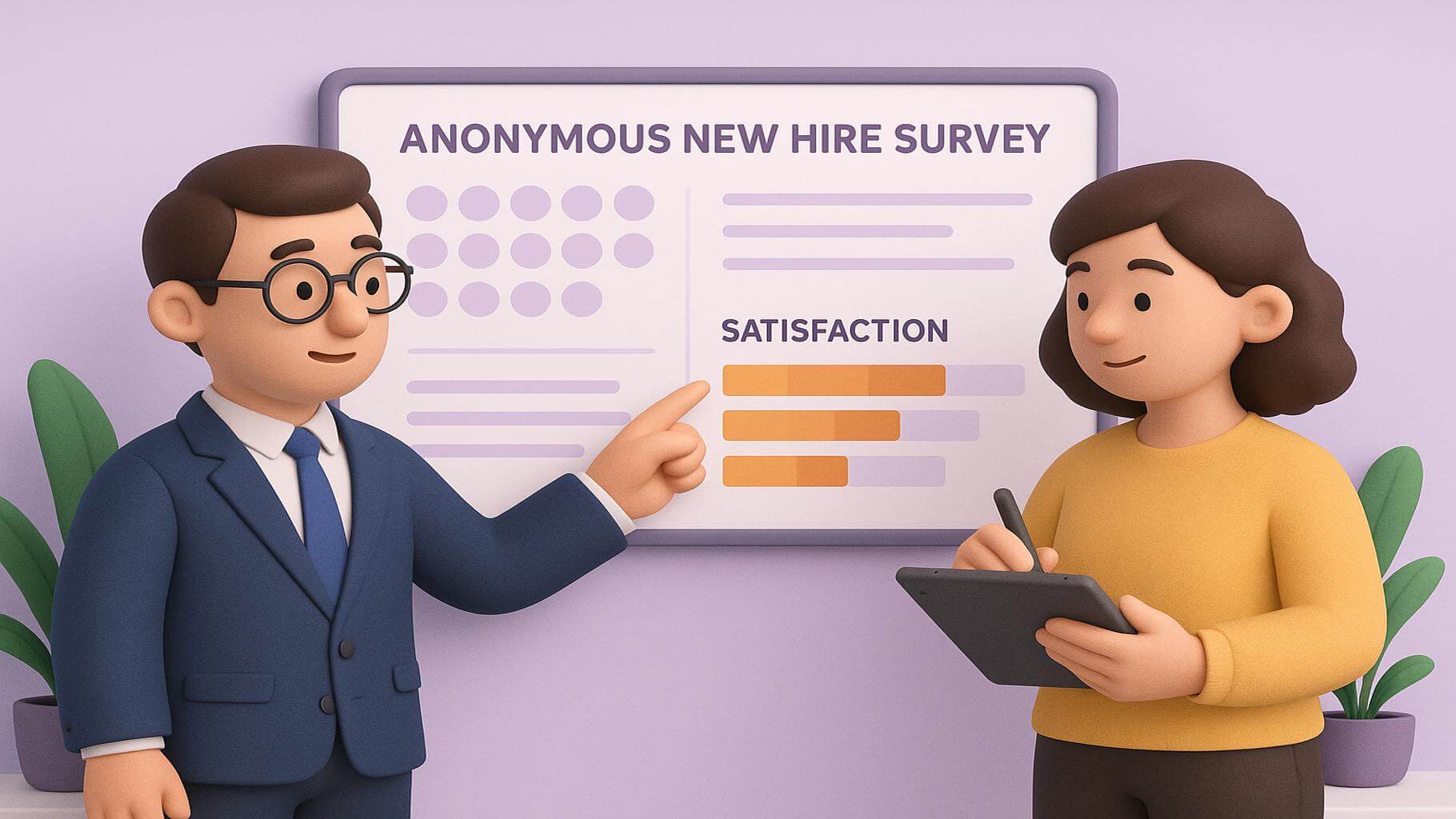
Milestone surveys track the evolution of new hire experiences as they progress through onboarding phases. Each milestone represents a different stage of integration, with unique challenges and opportunities. The 30-60-90-day framework aligns with common probationary periods and management check-in schedules used. Consistent timing enables comparisons across cohorts and the identification of patterns over time.
These surveys should reference previous responses to show continuity and demonstrate that feedback matters. Acknowledging earlier concerns and asking about resolution builds trust in the survey process itself. The questions become more nuanced as employees gain context and experience within the organization. Later surveys can explore topics that new hires lacked the perspective to address earlier.
30-day check-in survey questions
At thirty days, new hires have moved beyond initial orientation into active role engagement daily. They have enough experience to evaluate training effectiveness but remain close to their fresh perspective. This milestone surveys focus on whether employees have the resources needed to do their jobs well. Questions also assess whether initial expectations accurately match the reality of the position.
- How well does your actual job match the description you provided during the hiring process?
- Do you have the tools and resources needed to perform your responsibilities?
- How effective has your job-specific training been so far?
- Are you receiving adequate feedback on your performance from your manager?
- What challenges have you encountered that you need help addressing?
60-day progress survey questions
Sixty days mark the transition from learning mode to contributing mode for most new employees. Employees should be handling some responsibilities independently while still receiving guidance on complex tasks. This survey assesses whether the pace of independence matches employee readiness and comfort levels. Questions explore both capability development and relationship building with colleagues.
- How confident do you feel in performing your core job responsibilities now?
- Are you receiving the right balance of autonomy and support from your manager?
- How well do you understand how your role contributes to team goals?
- Have you had opportunities to provide input on team projects or decisions?
- What additional training would help you succeed in your role?
90-day evaluation survey questions
The 90-day milestone often coincides with the end of probationary periods at many organizations. This survey provides a comprehensive retrospective assessment of the entire onboarding experience. Questions evaluate both the process and the outcomes of onboarding efforts for employees. Responses inform strategic decisions about program improvements for future hiring cycles ahead.
- How would you rate your overall onboarding experience from start to finish?
- Do you feel fully integrated into your team and the organization?
- Has your manager regularly provided clear performance expectations and feedback?
- Would you recommend this organization to a friend seeking employment here?
- What one thing would most improve the onboarding experience for future hires?
Role clarity assessment questions
Understanding roles and responsibilities clearly prevents confusion and enables productive work for all. These questions assess whether job descriptions, expectations, and success metrics are clearly communicated to employees. Clarity issues often emerge as employees take on more complex tasks during their first months. Addressing ambiguity early prevents frustration and performance problems from developing later.
- How clearly do you understand your primary responsibilities in this role?
- Do you know how your performance will be evaluated and measured?
- Are boundaries between your role and others' roles clear to you?
- Have you received documentation outlining your key responsibilities and goals?
- What aspects of your role remain unclear or confusing to you?
Professional development questions
Career growth expectations influence how engaged new hires become with their roles and organizations. These questions explore whether employees see paths for advancement and skill development ahead. Understanding development opportunities early helps retain ambitious employees who might otherwise look elsewhere. Organizations benefit when employees invest in growing their capabilities over time.
- Have you discussed career development goals with your manager yet?
- Are there clear paths for advancement within the organization?
- What skills would you like to develop during your first year here?
- Has the organization provided learning resources or training opportunities?
- How supported do you feel in your professional growth and development?
5+ important new hire recruiting survey templates for candidate experience
The survey process should begin before employees officially start their new positions. Recruiting surveys capture feedback about the candidate experience from application through offer acceptance. This data helps talent acquisition teams refine their processes and improve candidate satisfaction levels. Positive candidate experiences strengthen employer branding and significantly increase offer acceptance rates.
Recruiting feedback also reveals whether expectations set during hiring match actual job realities. Gaps between promises and reality create disappointment that undermines engagement from day one. Survey data identifies where communication needs improvement to set accurate expectations upfront. Honest recruiting leads to better person-job fit and higher retention rates over time.
Application process survey questions
The application process creates first impressions before candidates ever meet human representatives of organizations. These questions evaluate the user experience of applying for positions at your organization. Feedback helps identify technical issues, confusing instructions, or unnecessary barriers in your system. Streamlined applications attract more qualified candidates and significantly reduce abandonment rates.
- How easy was it to find and apply for the position you were hired for?
- Was the application process length reasonable for the role you applied for?
- Did you encounter any technical difficulties during the application process?
- Were the required application materials clearly specified in the posting?
- What would improve the application experience for future candidates?
Interview experience survey questions
Interviews shape candidate perceptions of organizational culture and management quality significantly. These questions assess whether interviews were professional, informative, and respectful of the candidate's time. Feedback helps interviewers consistently improve their techniques and create better candidate experiences. Strong interview experiences increase offer acceptance rates and build a positive employer reputation.
- How well did the interview process allow you to showcase your qualifications?
- Were interviewers prepared and professional during your conversations with them?
- Did you receive adequate information about the role and organization?
- How timely was communication throughout the interview process?
- What would make the interview experience better for future candidates?
Offer and negotiation survey questions
The offer stage is a critical decision point at which candidates choose to accept or decline the offer. These questions evaluate whether the offer process was handled professionally and transparently. Feedback reveals whether compensation, benefits, and terms were communicated clearly to candidates. Positive offer experiences lay the foundation for the employment relationship on a foundation of trust.
- Was the job offer communicated clearly and professionally to you?
- Did you have adequate time to review and consider the offer?
- Were you able to ask questions and receive clear answers about terms?
- How transparent was the organization about compensation and benefits?
- What would improve the offer process for future candidates?
Pre-boarding communication survey questions
The interval between offer acceptance and the commencement date requires meticulous communication and strategic planning. These questions assess whether pre-boarding communications kept candidates informed and engaged during waiting. Feedback identifies gaps that leave new hires feeling uncertain or neglected before starting. Strong pre-boarding reduces first-day anxiety and demonstrates organizational competence early.
- Did you receive adequate communication between accepting the offer and starting?
- Were you provided clear instructions about what to expect on your first day?
- Did you complete any pre-boarding paperwork or tasks before starting?
- How prepared did you feel when you arrived for your first day?
- What additional information would have been helpful before starting?
Overall candidate experience survey questions
Comprehensive candidate experience surveys capture the full journey from first contact to hire completion. These questions provide a holistic assessment of your talent acquisition function and its effectiveness. Feedback helps prioritize improvements across multiple touchpoints in the hiring process overall. Strong candidate experiences contribute significantly to employer branding and to the development of the talent pipeline.
- How would you rate your overall experience as a candidate for this organization?
- Did the hiring process timeline meet your expectations throughout?
- Would you recommend applying to this organization to others seeking employment?
- What was the strongest aspect of your candidate experience with us?
- What one improvement would most enhance the candidate experience here?
5+ key new hire orientation survey questions for program evaluation
Orientation and training represent significant investments of time and resources for organizations. Survey feedback ensures these investments produce the intended outcomes for new employees. Questions should evaluate both content quality and delivery effectiveness during training sessions. The goal is to create training that genuinely prepares employees for success in their roles.
Training surveys also help identify differences between stated curriculum and actual learning outcomes. Employees may report completing training while still lacking the necessary skills or knowledge today. Survey questions that assess the application of learning reveal these gaps before they cause problems. Continuous improvement of training programs depends on honest feedback from participants.
Training content relevance questions
Training content must align with actual job requirements to provide value for new employees. These questions evaluate whether training topics matched what employees needed to know. Feedback identifies outdated content, missing topics, and irrelevant material that wastes time. Relevant training accelerates time-to-productivity and increases employee confidence in their abilities.
- How relevant was the training content to your actual job responsibilities?
- Were there topics covered that seemed unnecessary for your role?
- What important topics were missing from your training program?
- Did training accurately reflect how work is actually done here?
- How confident are you in applying what you learned during training?
Training delivery effectiveness questions
Even excellent content fails if delivered poorly to training participants and learners. These questions assess whether the training methods engaged learners and effectively facilitated understanding. Feedback helps identify trainers who need development and methods that need updating. Effective delivery transforms information transfer into genuine learning and skill development.
- How engaging were the training sessions you attended during onboarding?
- Was the pace of training appropriate for learning the material presented?
- Did trainers clearly explain concepts and answer questions effectively?
- How effective was the mix of lecture, practice, and discussion used?
- Which delivery methods would improve your training experience?
Training resource quality questions
Supporting materials and resources extend learning beyond formal training sessions for employees. These questions evaluate whether job aids, documentation, and references meet employee needs. Feedback identifies resources that need updating or formats that need changing for better usability. Quality resources support ongoing learning and reduce dependence on constant supervision.
- How useful are the job aids and reference materials provided to you?
- Are training materials easy to access when you need them today?
- How current and accurate is the documentation for your role?
- What additional resources would help you perform your job better?
- How easy is it to find answers to job-related questions?
Manager training support questions
Managers play crucial roles in reinforcing training and supporting the application of new skills. These questions assess whether managers actively participate in new hire development efforts. Feedback reveals whether organizational training investments are supported at the team level. Manager involvement significantly influences training effectiveness and skill retention over time.
- Does your manager discuss and reinforce what you learned in training?
- Has your manager provided additional coaching beyond formal training sessions?
- Does your manager check your understanding of key job processes?
- How available is your manager to answer questions about your work?
- What additional support would help you apply your training effectively?
Technology and systems training questions
Modern jobs require proficiency with multiple systems, tools, and technologies on a daily basis. These questions evaluate whether technology training adequately prepared employees to use the system. Feedback identifies systems that need urgent additional training or documentation. Technology competence directly impacts productivity and employee confidence in their abilities.
- How well did training prepare you to use the required systems and tools?
- Are there systems you need to use that you did not receive training on?
- How easy is it to get help when you encounter technology problems?
- Did you receive adequate training on security and compliance systems?
- What technology training would most improve your effectiveness?
5+ new hire feedback survey templates for continuous improvement
Collecting feedback shouldn't require starting from scratch every time. Ready-to-use templates streamline the process, ensure consistency across departments, and help HR teams gather actionable insights without reinventing the wheel. The right new hire feedback survey template saves time while capturing the specific information your organization needs to refine its onboarding approach.
These templates serve different purposes throughout the onboarding journey. Some focus on initial impressions during the first week, while others assess training effectiveness or manager support after 30, 60, or 90 days. By using multiple templates at strategic intervals, organizations can track how new hire sentiment evolves and identify exactly where improvements are needed.
5+ feedback survey templates:
- First-week impressions template
- 30-day onboarding checkpoint template
- Training effectiveness template
- Manager support assessment template
- 90-day integration template
- Role clarity and expectations template
First-week impressions template
The first week shapes how new hires perceive your organization. This template captures immediate reactions to orientation, workspace setup, and initial team interactions before memories fade.
Survey introduction: "Thank you for completing your first week at [Company Name]. Your feedback helps us improve the onboarding experience for future team members. Please answer honestly, as all responses remain confidential."
Questions:
- On a scale of 1-5, how welcome did you feel on your first day?
- Did you have access to all necessary equipment and tools by [end of day one/end of first week]?
- How clear were your first-week goals and priorities?
- Did the job description accurately reflect your initial experience? If not, what differed?
- How would you rate your orientation session in terms of usefulness?
- What one thing would have made your first week better?
- Is there anything you wish you had known before starting?
- Additional comments: [Open text field]
30-day onboarding checkpoint template
By day 30, new hires have moved past orientation and begun settling into their roles. This template assesses whether they have the support and information needed to perform effectively.
Survey introduction: "You've been with [Company Name] for 30 days. We'd like to hear about your onboarding experience so far. Your honest feedback helps us support you and improve the process for others."
Questions:
- From a scale of 1 to 5, how confident are you in executing your primary job duties?
- Have you received sufficient training to do your job effectively?
- How comfortable are you asking questions when you need help?
- Do you understand how your performance will be measured?
- How often do you meet with your manager for one-on-one conversations?
- Do you feel connected to your team and colleagues?
- What resources or support would help you be more successful in your role?
- On a scale of 1 to 5, how likely are you to recommend [Company Name] as a great place to work?
- What has been the best part of your onboarding experience?
- What has been the most challenging part of your onboarding experience?
- Additional comments: [Open text field]
Training effectiveness template
Training programs require ongoing refinement to stay relevant. This template specifically targets the quality, format, and usefulness of training materials and sessions that new hires experience.
Survey introduction: "We want to ensure our training programs prepare you for success. Please share your feedback on the training you've received during onboarding at [Company Name]."
Questions:
- On a scale of 1-5, how relevant was your training to your actual job responsibilities?
- Was the training paced appropriately? (Too fast / Just right / Too slow)
- Which training format was most effective for you? (In-person sessions / Video modules / Written documentation / Hands-on practice / Shadowing colleagues)
- Did you have opportunities to ask questions and get clarification during training?
- What topics needed more coverage or depth?
- What topics felt unnecessary or redundant?
- How would you rate the quality of training materials provided?
- Did your trainer or facilitator explain concepts clearly?
- What skills or knowledge gaps do you still have after completing training?
- How could we improve the training program for future new hires?
- Additional comments: [Open text field]
Manager support assessment template
Direct managers significantly influence new hire success and retention. This template focuses specifically on the manager relationship and support quality during onboarding.
Survey introduction: "Your relationship with your manager plays an important role in your success at [Company Name]. This confidential survey helps us understand how well managers support new team members."
Questions:
- On a scale of 1-5, how supported do you feel by your direct manager?
- How frequently do you conduct individual meetings with your supervisor? (Weekly / Bi-weekly / Monthly / Rarely / Never)
- Does your manager provide clear expectations for your role?
- When you have questions, how accessible is your manager?
- Has your manager provided constructive feedback on your work?
- Do you feel comfortable bringing concerns or challenges to your manager?
- Has your manager introduced you to key colleagues and stakeholders?
- Does your manager check in on your overall well-being, not just work tasks?
- What does your manager do well in supporting your onboarding?
- What could your manager do differently to better support you?
- Additional comments: [Open text field]
90-day integration template
The 90-day mark is a critical milestone at which new hires should feel fully integrated. This comprehensive template captures the complete onboarding experience and predicts long-term engagement.
Survey introduction: "Congratulations on reaching 90 days at [Company Name]. We'd love to hear your reflections on the complete onboarding journey and your outlook going forward."
Questions:
- How satisfied are you with the entire onboarding process, from beginning to end?
- Do you feel fully integrated into your team and the company culture?
- How well do you understand [Company Name]'s mission, values, and goals?
- Do you have the tools, resources, and knowledge to perform your job effectively?
- How would you describe your relationship with your colleagues?
- Do you see opportunities for growth and development in your role?
- On a scale of 1-10, how likely are you to still be working at [Company Name] one year from now?
- What was the highlight of your onboarding experience?
- What was the biggest challenge during your first 90 days?
- If you could change one thing about the onboarding process, what would it be?
- Is there any additional support you need to be successful going forward?
- Would you recommend [Company Name] as a great place to work? Why or why not?
- Additional comments: [Open text field]
Role clarity and expectations template
Misaligned expectations cause frustration and early turnover. Whether or not new recruits comprehend their roles and the criteria for evaluation is a key component of this form.
Survey introduction: "Understanding your role clearly is essential to your success. This survey helps us ensure new hires have the clarity they need to thrive at [Company Name]."
Questions:
- Please rate the clarity of your day-to-day tasks from 1 to 5.
- Does your actual role match what was described during the interview process?
- Do you know what success looks like in your position?
- Have specific performance goals been communicated to you?
- Do you understand how your role contributes to [Department Name]'s objectives?
- Do you understand how your role contributes to [Company Name]'s broader goals?
- Are your workload and expectations realistic and manageable?
- Do you know who to go to for different types of questions or issues?
- What aspects of your role remain unclear or confusing?
- What information would help you better understand your responsibilities?
- Additional comments: [Open text field]
Best new hire onboarding survey questions to include

Some questions provide value regardless of survey timing or specific focus areas chosen. These foundational questions should appear in most new hire surveys to ensure comprehensive coverage. They address universal concerns while allowing customization for organizational context and needs. Building surveys around these core questions ensures consistency while permitting flexibility.
The best questions balance standardization for comparison with specificity for actionable insights gathered. They avoid jargon and leading language that could bias responses or confuse respondents. Clear, simple questions produce more reliable data than complex or ambiguous alternatives. Testing questions with diverse audiences helps identify potential interpretation issues before deployment.
Essential satisfaction and engagement questions
Overall satisfaction questions provide effective baseline metrics for tracking trends over time. These questions offer simple indicators of whether onboarding is working as intended. Engagement questions reveal early emotional investment in the role and organization. Combining satisfaction and engagement measures provides a comprehensive assessment of employee experience.
- How satisfied are you with your onboarding experience so far?
- How engaged do you feel in your work at this point?
- Would you recommend this organization as a place to work?
- How likely are you to be working here one year from now?
- How well does this job meet your expectations overall?
Manager relationship questions
The manager-employee relationship significantly influences nearly every aspect of the employee experience. These questions assess fundamental qualities of the supervisor-employee relationship early. Problems identified early can be addressed before they cause disengagement or departure. Strong manager relationships correlate with higher satisfaction, engagement, and retention rates.
- How would you rate the quality of your relationship with your manager?
- Does your manager provide clear expectations for your work?
- How comfortable are you giving feedback to your manager?
- Does your manager recognize your contributions and efforts?
- How supported do you feel by your manager in your role?
Culture and values alignment questions
Cultural fit significantly predicts long-term success and employee satisfaction in organizations. These questions explore whether organizational values match employee expectations and experiences. Alignment issues identified early can guide conversations about expectations and fit. Strong cultural alignment supports engagement and reduces values-based conflicts over time.
- How well do the organization's values align with your personal values?
- Is the organizational culture what you expected when you accepted the job?
- Do you feel you can be yourself at work without negative consequences?
- How inclusive and welcoming has the work environment been for you?
- What aspects of the culture have surprised you since starting?
Open-ended feedback questions
Open-ended questions capture insights that structured questions might miss entirely in surveys. They give employees the freedom to raise concerns or suggestions that survey designers did not anticipate. These responses often contain the most actionable and specific feedback for improvement. Including at least one open-ended question in every survey maximizes insight gathered.
- What has been the best part of your experience so far?
- What has been the most challenging aspect of starting here?
- What suggestions do you have for improving the onboarding process?
- Is there anything else you would like to share with us?
- What question should we have asked that we did not?
Net promoter score questions
Employee net promoter score questions provide standardized metrics for benchmarking and comparison purposes. These questions ask about the likelihood of recommending the organization as an employer. The scoring methodology enables effective tracking of trends and comparison with industry benchmarks. eNPS has become a standard measure of employee sentiment across organizations.
- On a scale of 0-10, how likely are you to recommend this organization as a place to work?
- What is the primary reason for the score you gave?
- What would need to change for you to give a higher score?
How to design effective new hire survey questions
Question design significantly impacts the quality and usefulness of survey data collected. Poorly designed questions yield unreliable or misleading results, undermining decision-making efforts. Understanding principles of effective question design helps create surveys that generate actionable insights. Investment in question design pays dividends through better data and clearer direction.
The design process should involve stakeholders who will use the data for decision-making purposes. Their input ensures questions address real business needs rather than theoretical interests alone. Testing questions with representative samples identifies problems before full deployment occurs. Iterative refinement based on feedback continuously improves survey quality over time.
Question clarity and simplicity principles
Clear questions use simple language that all respondents understand consistently across audiences. Refrain from using jargon, acronyms, or technical terminology that could potentially confound new employees. Each question should focus on a single concept to avoid confusion about meaning. Simple questions produce more reliable responses than complex multi-part alternatives.
- Use everyday language rather than HR or industry-specific terminology
- Ask one thing per question to avoid double-barreled questions
- Keep questions short and easy to read quickly
- Test questions with people unfamiliar with survey goals
Avoiding bias in question construction
Biased questions lead respondents toward particular answers and undermine data validity completely. Leading questions suggest the desired response through word choice or framing. Social desirability bias causes respondents to answer how they think they should. Neutral question construction significantly reduces bias and improves data reliability.
- Avoid leading language that suggests correct or expected answers
- Balance positive and negative response options equally
- Randomize response order when appropriate for questions
- Include neutral response options for scaled questions
Choosing appropriate response scales
Response scales must match the type of information you want to collect from respondents. Likert scales work well for measuring agreement or satisfaction levels. Numeric scales enable calculation of averages and tracking of trends over time. The right scale depends on how you plan to analyze and use the data.
- Use 5-point scales for general agreement or satisfaction questions
- Use 10-point scales for metrics like eNPS that require finer distinctions
- Include clear labels for scale endpoints and midpoints
- Maintain consistent scales throughout the survey
Balancing quantitative and qualitative questions
Effective surveys combine structured questions with open-ended opportunities for elaboration. Quantitative questions effectively enable comparison and trend tracking over time. Qualitative questions provide context and detail that numbers alone cannot capture. The right balance depends on your analysis capacity and action planning process.
- Use quantitative questions for metrics you want to track over time
- Include qualitative questions to understand the "why" behind numbers
- Place open-ended questions strategically to avoid survey fatigue
- Plan for qualitative analysis resources before including many open questions
New hire checklist examples for survey deployment
Successful survey deployment requires attention to timing, communication, and technical execution details. Checklists ensure consistent deployment that produces reliable, comparable results across administrations. Planning deployment details prevents problems that compromise data quality later. Standardized processes also make survey administration more efficient over time.
Deployment planning should consider the new hire's experience of receiving and completing surveys. Survey fatigue occurs when employees receive too many surveys too frequently overall. Coordination with other organizational surveys prevents overwhelming new hires with requests. Respectful deployment demonstrates that you value employee time and attention.
Pre-deployment preparation checklist
Preparation before launch ensures a smooth execution and prevents avoidable problems.
- Finalize and test all survey questions with diverse reviewers
- Configure survey platform settings and distribution lists accurately
- Prepare communication templates for survey invitations and reminders
- Establish a timeline for the survey open period and response deadlines
- Brief managers on the survey purpose and their role in encouraging participation
- Test survey links and confirm proper routing and skip logic
Survey distribution best practices
Distribution methods and timing significantly affect response rates and overall data quality.
- Send surveys at times when new hires are likely to respond
- Use clear subject lines that communicate the survey's purpose
- Personalize invitations when possible to increase engagement
- Provide estimated completion time to set expectations
- Include an explanation of how feedback will be used
- Ensure a mobile-friendly survey format for accessibility
Follow-up and reminder protocols
Strategic reminders increase response rates without annoying survey recipients excessively.
- Send first reminder 2-3 days after initial invitation
- Limit total reminders to avoid creating negative associations
- Thank those who have already responded in reminder messages
- Provide deadline reminders as the survey's close date approaches
- Consider manager involvement for critical survey initiatives
Data collection and storage procedures
Proper data handling protects confidentiality and ensures data integrity for analysis purposes.
- Establish clear data access permissions and restrictions
- Document data storage locations and retention policies
- Configure anonymity settings appropriately for the survey purpose
- Test data export and reporting functions before survey close
- Plan for secure handling of sensitive or identifying information
Common mistakes to avoid with new hire surveys

Even well-intentioned survey programs fail when common mistakes undermine their effectiveness completely. Learning from others' errors helps you build a stronger program from the start. Awareness of pitfalls enables proactive prevention rather than reactive problem correction. Avoiding these mistakes improves both data quality and employee experience.
Mistakes often stem from treating surveys as isolated events rather than ongoing programs. Sustainable survey programs require consistent infrastructure, processes, and commitment over time. Shortcuts that seem efficient often create problems that require more effort to fix. Investing in conducting surveys properly yields better returns than quick, flawed approaches.
Asking too many questions at once
Long surveys create fatigue, significantly reducing response quality and completion rates. New hires facing overwhelming workloads may abandon lengthy surveys entirely before finishing. Respect for employee time demonstrates organizational values better than comprehensive questioning does. Focus on essential questions and save others for future survey opportunities instead.
- Limit first-week surveys to 5-10 questions maximum
- Save comprehensive assessments for later milestones
- Remove questions that do not drive specific actions
- Test survey length with actual respondents
Failing to act on feedback received
Nothing undermines survey credibility faster than ignoring the feedback employees provide you. Employees who see no response to their input stop participating in future surveys. Action on feedback demonstrates that surveys serve real purposes beyond data collection. Even small actions show commitment to using feedback constructively over time.
- Create action planning processes before launching surveys
- Communicate changes made based on survey feedback
- Close the loop with respondents about how the input was used
- Prioritize visible quick wins alongside longer-term improvements
Ignoring anonymity and confidentiality concerns
Trust determines whether employees provide honest feedback or safe answers instead. New hires, particularly, worry about the consequences of negative feedback they might provide. Clear communication about anonymity and data use builds confidence in the process. Technical safeguards must align with stated confidentiality commitments for credibility.
- Clearly explain anonymity protections in survey invitations
- Avoid questions that could identify individuals in small groups
- Train managers on appropriate and inappropriate uses of data
- Report only aggregate data to protect individual responses
Poor timing of survey administration
Survey timing affects both response rates and response quality significantly overall. Surveys sent during the overwhelming first days get ignored or receive superficial responses. Waiting too long loses the fresh perspective that makes early feedback valuable. Strategic timing balances proximity to experience with respondent capacity for reflection.
- Avoid surveying during the most hectic onboarding days
- Allow enough time for experience before asking for an evaluation
- Consider organizational calendar events that affect response rates
- Test different timing approaches to optimize response patterns
Advanced new hire recruiting survey strategies
Basic survey practices provide a foundation, but advanced strategies significantly elevate program impact. These approaches require more sophistication but produce substantially better results overall. Organizations with mature survey programs continuously refine their approaches over time. Advanced strategies separate leaders from average practitioners in the field.
Advanced strategies often involve effective integration with other organizational systems and processes. Surveys become more powerful when connected to performance management and development programs. Data sharing across functions enables a more comprehensive understanding of employee experience. Strategic integration significantly multiplies the value of survey investments.
Integrating surveys with performance management
Survey data enriches performance conversations by providing context beyond manager observations alone. New hire survey responses inform productivity development planning and goal-setting discussions. Integration creates accountability for managers to support employee onboarding effectively throughout. Connected systems prevent survey data from sitting unused in separate silos.
- Share relevant survey themes with managers before performance discussions
- Use survey data to identify development priorities for individuals
- Track whether performance improvement follows survey feedback
- Create manager dashboards combining survey and performance data
Segmentation and cohort analysis approaches
Different employee groups may have systematically different experiences worth understanding separately. Segmentation reveals patterns hidden in aggregate data by examining subgroups. Cohort analysis compares groups hired at different times to identify trends. These analytical approaches enable targeted interventions rather than one-size-fits-all responses.
- Analyze results by department, location, role type, and demographics
- Compare cohorts to identify whether onboarding is improving over time
- Look for consistent patterns that suggest systemic issues
- Use statistical methods to identify significant differences between groups
Predictive analytics for retention risk
Survey responses can predict future retention outcomes when properly analyzed over time. Identifying predictive questions helps focus attention on the highest-impact factors affecting turnover. Early warning indicators enable intervention before at-risk employees decide to leave. Predictive models become more accurate as organizations accumulate historical data.
- Identify survey questions that correlate with later turnover
- Create risk scores based on response patterns observed
- Develop intervention protocols for high-risk new hires
- Validate and refine predictive models over time
Continuous improvement feedback loops
The best survey programs continuously improve based on meta-feedback about surveys themselves. Asking about survey experience helps optimize future administrations effectively. Process metrics, such as response rates and completion times, indicate program health. Regular review cycles ensure surveys remain relevant and valuable.
- Periodically survey employees about the survey experience itself
- Track response rates and identify factors affecting participation
- Review questions annually to update for relevance
- Benchmark practices against industry standards
How to analyze new hire survey results
Data analysis transforms raw survey responses into actionable insights for improvement efforts. Without proper analysis, survey data remains unused potential rather than driving value. Analysis approaches should align with organizational capacity and decision-making processes. Simple analysis done well beats sophisticated analysis done poorly every time.
Analysis should focus on questions that drive decisions rather than generating interesting statistics. Connecting analysis to action planning increases the likelihood that insights produce change. Involving stakeholders in analysis builds understanding and commitment to acting on findings. Collaborative analysis also surfaces interpretations that single analysts might miss entirely.
Quantitative analysis fundamentals
Basic statistical analysis effectively reveals patterns and trends in structured response data. Calculating averages, percentages, and distributions provides an overview of the results obtained. Comparing results across groups or time periods identifies meaningful differences present. Simple statistics often provide sufficient insight without advanced analytical techniques.
- Calculate means and distributions for scaled questions
- Compare results across departments, roles, and time periods
- Identify questions with the lowest scores as improvement priorities
- Track trends over time to assess progress
Qualitative analysis methods
Open-ended responses require different analytical approaches than structured questions do. Thematic analysis identifies common topics and patterns across text responses. Coding responses into categories enables quantification of qualitative data. Quotes illustrate themes and bring a human voice to numerical findings.
- Read all responses to develop an overall understanding first
- Identify recurring themes and categorize responses accordingly
- Count the frequency of themes to prioritize attention
- Select representative quotes to illustrate key themes
Benchmarking and comparison strategies
Context helps determine whether results are good, bad, or typical for a given situation. Internal benchmarks compare current results to past performance or other groups. External benchmarks compare against industry standards or best practices observed. Benchmarking prevents over- or under-reacting to results lacking context.
- Compare current results to previous survey administrations
- Benchmark against other departments or locations internally
- Seek external benchmarks from industry sources when available
- Establish targets for improvement based on benchmark analysis
Communicating findings effectively
Analysis is only valuable if findings reach and influence decision-makers appropriately. Reports should clearly highlight key findings and recommended actions. Visualizations help audiences quickly understand patterns in data. Different audiences need different levels of detail and framing.
- Create executive summaries for senior leadership audiences
- Develop detailed reports for HR and operational managers
- Use visualizations to make patterns clear and memorable
- Present findings in the context of organizational goals
Industry-specific approaches to new hire surveys

Different industries face unique onboarding challenges requiring tailored survey approaches. Generic surveys may miss industry-specific concerns that significantly impact employee experience. Customizing questions to the industry context demonstrates an understanding of the realities employees face. Industry-specific approaches produce more relevant and actionable insights overall.
Industry differences affect not only question content but also deployment methods and timing. Field workers need a different survey delivery than office employees do. Regulated industries may have compliance considerations affecting survey design choices. Understanding industry context helps optimize all aspects of survey programs.
Healthcare industry considerations
Healthcare onboarding involves extensive credentialing, compliance training, and clinical orientation requirements. Survey questions should address these unique elements of healthcare onboarding experiences. Patient safety culture and team communication warrant specific attention in surveys. Healthcare workers often face shift work and access challenges, which affect survey completion.
- Include questions about credentialing and compliance training effectiveness
- Assess preparation for patient interaction and safety protocols
- Consider clinical preceptor relationships in manager questions
- Accommodate varied schedules in survey deployment timing
Technology sector approaches
Technology companies often have fast-paced, constantly changing environments for new hires. Survey questions should address technical onboarding, tool access, and code contribution readiness. Remote and hybrid work arrangements may be more common, requiring specific questions. Agile methodologies may influence how onboarding and feedback are structured.
- Assess the technical environment setup and system access
- Include questions about documentation quality and accessibility
- Address remote work integration and virtual team building
- Consider shorter, more frequent pulse surveys for faster feedback
Retail and hospitality considerations
Frontline employees in retail and hospitality face unique customer-facing challenges daily. Survey questions should address customer service training and the effective handling of difficult situations. Scheduling, benefits, and physical work conditions warrant attention in surveys conducted. Mobile-friendly surveys make it easy for employees without regular computer access to participate.
- Focus on customer service preparation and confidence levels
- Include questions about scheduling and work-life balance early
- Assess safety training and physical work environment
- Use SMS or app-based surveys for frontline accessibility
Financial services requirements
Financial services onboarding includes extensive compliance and regulatory training requirements. Survey questions should assess regulatory training effectiveness and confidence in compliance levels. Fiduciary responsibilities and ethical training warrant specific attention in surveys. Security and confidentiality concerns may significantly affect survey design choices.
- Address compliance training comprehensiveness and clarity
- Include questions about ethical guidelines and decision-making support
- Assess preparation for regulatory examination and audit processes
- Consider confidentiality implications for survey responses
Using new hire surveys to improve retention
Retention improvement represents one of the most valuable outcomes of effective survey programs. Survey data identifies risk factors and intervention opportunities before employees leave. The cost of turnover makes even modest retention improvements highly valuable. The strategic use of survey data directly contributes to the organization's bottom line.
Retention-focused analysis requires connecting survey responses to subsequent employment outcomes. Tracking which survey responses predict later turnover identifies the highest-impact questions. Developing interventions based on survey risk factors creates actionable retention strategies. The connection between surveys and retention justifies program investment compellingly.
Early warning indicators in survey data
Certain survey responses consistently predict higher turnover risk for new hires. Low satisfaction with manager relationship, role clarity, and cultural fit indicates risk. Declining scores across milestone surveys suggest emerging problems that warrant attention. Identifying these patterns enables proactive intervention before resignation occurs.
- Monitor key questions known to predict turnover risk
- Track score trajectories across milestone surveys
- Create alert systems for concerning response patterns
- Develop intervention protocols for high-risk indicators
Intervention strategies based on survey feedback
Survey data should trigger specific actions, not just reports and analysis activities. Developing intervention playbooks ensures a consistent response to concerning feedback received. Manager coaching, additional training, or role adjustments may address identified issues. Timely intervention while problems are still solvable increases the impact on retention.
- Create standard interventions for common feedback themes
- Train managers on responding to concerning survey results
- Establish escalation paths for serious concerns identified
- Track intervention effectiveness to refine approaches
Measuring the retention impact of survey programs
Demonstrating program value requires measuring retention outcomes for surveyed employees. Compare retention rates between employees who receive interventions and those who do not. Calculate return on investment by comparing program costs to turnover cost savings. Impact measurement justifies continued investment and guides program improvement.
- Track retention rates by survey response patterns
- Compare outcomes for employees receiving interventions versus those not receiving interventions
- Calculate cost savings from retention improvements achieved
- Report impact metrics to organizational leadership regularly
Technology solutions for new hire survey deployment
Today, technology platforms enable efficient survey administration, analysis, and action planning. Modern survey tools offer features that were impractical with manual approaches previously. Choosing the right technology affects program effectiveness and sustainability over time. Integration with existing systems significantly multiplies technology value.
Technology should serve survey goals, not drive them inappropriately. Selecting platforms based on actual needs prevents overspending on unnecessary features. User experience for both administrators and respondents affects adoption and data quality. Sustainable programs require technology that teams can actually use effectively.
Key features to look for in survey platforms
Certain platform capabilities significantly impact survey program success and efficiency levels.
- Mobile-responsive design for employee accessibility
- Automation for survey triggering and reminder sending
- Integration with HRIS for employee data and targeting
- Reporting dashboards for real-time results monitoring
- Action planning tools for translating insights into initiatives
- Anonymity controls to build respondent trust
Integration with existing HR systems
Connected systems reduce administrative burden and enable more sophisticated analysis overall. HRIS integration automates survey targeting based on hire dates and other attributes. Performance system integration enriches understanding of the impact of employee experience. Single sign-on improves respondent experience and increases response rates.
- Connect the survey platform to HRIS for automated targeting
- Share relevant data with performance management systems
- Enable single sign-on for seamless survey access
- Consider data warehouse integration for advanced analytics
Automation opportunities
Automation reduces manual effort while significantly improving consistency and timeliness. Triggered surveys automatically deploy when hire date milestones are reached. Automated reminders maintain response rates without the need for manual follow-up. Automated reporting delivers insights without waiting for manual analysis completion.
- Configure trigger-based survey deployment by hire date
- Set up automated reminder sequences for non-respondents
- Create automated reports for managers and leadership
- Use automation to close the loop with respondents
Best practices for maximizing new hire survey response rates

Response rates determine whether survey data accurately reflect the overall employee experience. Low response rates introduce bias and significantly limit analytical possibilities. Investing in response rate optimization improves data quality and program credibility. Multiple strategies combine to create conditions for high participation.
Response rate optimization begins before surveys are deployed, through stakeholder engagement. Manager support, organizational communication, and cultural expectations all influence participation levels. Technical factors, such as survey length and accessibility, also affect completion rates. A comprehensive approach addressing all factors produces the best results.
Communication strategies
Effective communication builds understanding and motivation to participate in surveys conducted.
- Explain the survey's purpose and how feedback will be used clearly
- Emphasize confidentiality protections to build trust
- Share examples of past changes resulting from survey feedback
- Use multiple channels to reach employees effectively
- Time communications are appropriately relevant to survey deployment
Manager involvement approaches
Managers significantly influence whether their team members complete surveys consistently.
- Brief managers on the survey purpose and importance before deployment
- Provide talking points for managers to encourage participation
- Share team-level results to create manager accountability
- Recognize managers who achieve high response rates
- Avoid pressuring managers in ways that undermine voluntary participation
Incentive considerations
Incentives can increase response rates but require careful implementation to avoid problems.
- Consider whether incentives align with organizational culture
- Use modest incentives that motivate without creating obligation
- Avoid individual incentives that could bias responses
- Consider team or organizational incentives instead
- Ensure incentives do not compromise anonymity
Technical optimization
Technical factors affect whether employees can easily complete surveys as intended.
- Optimize surveys for mobile devices and accessibility
- Minimize survey length to reduce abandonment
- Test surveys thoroughly before deployment
- Provide technical support for employees experiencing issues
- Use progress indicators to show completion status
How Matter can help with new hire surveys
Matter provides comprehensive tools for gathering and acting on new hire feedback effectively. The platform integrates smoothly with Slack and Microsoft Teams, where employees are already engaged on a daily basis. Matter's approach combines recognition and feedback to create positive employee experiences throughout. Organizations using Matter build cultures where feedback flows naturally in both directions.
Matter goes beyond basic surveys to create connected feedback and recognition experiences daily. The platform enables the seamless deployment of employee pulse surveys alongside recognition programs. Automated features like Feedback Friday ensure consistent feedback collection without manual effort. Beautiful, customizable kudos cards naturally celebrate onboarding milestones alongside survey touchpoints.
Frequently asked questions about new hire surveys
Q: What is the best time to send a new hire survey?
A: Send initial surveys after the first week, when employees have formed impressions, but memories remain fresh. Subsequent surveys work best at 30, 60, and 90-day milestones aligned with natural onboarding phases.
Q: How many questions should a new hire survey include?
A: First-week surveys should include a maximum of 5-10 questions to respect overwhelming schedules. Milestone surveys at 30, 60, and 90 days can include 15-20 questions for a more comprehensive assessment.
Q: How do you ensure new hire survey responses remain confidential?
A: Use anonymous survey settings, report only aggregate data, and clearly communicate confidentiality protections. Avoid questions that could identify individuals in small teams or departments.
Q: What response rate should organizations target for new hire surveys?
A: Aim for 70-80% response rates to ensure data represents employee experience accurately. Lower rates may indicate problems with survey design, timing, or communication about purpose.
Q: How should organizations act on new hire survey feedback?
A: Create action plans addressing top concerns, communicate changes to employees, and track progress over time. Even small actions demonstrate commitment to using feedback constructively for improvement.
Q: What is the difference between new hire surveys and annual engagement surveys?
A: New hire surveys target specific onboarding experiences at defined milestones during the first months. Annual engagement surveys assess broader organizational topics across the entire employee population yearly.
Final thoughts on new hire surveys
Effective new-hire surveys transform onboarding from a hopeful process into a data-driven program with measurable outcomes. The templates and strategies in this guide provide a foundation for building your own approach. Starting with simple surveys and refining based on experience produces better results than perfecting before launching. Every organization's optimal approach emerges through iteration and learning over time.
New hire feedback connects directly to employee recognition when organizations celebrate early wins and progress. Matter's platform enables this connection by seamlessly combining surveys with recognition tools. Recognizing new hire achievements during onboarding reinforces positive experiences captured in survey feedback. This integrated approach creates virtuous cycles of feedback, recognition, and continuous improvement.
The investment in new-hire surveys pays off through improved retention, faster productivity, and a stronger culture. Organizations that systematically gather and act on feedback demonstrate values that attract and retain talent. Starting your survey program today sets the stage for better onboarding outcomes. Small steps accumulate into significant improvements when sustained consistently over time.
Ready to transform your new hire feedback and recognition programs with powerful, integrated tools? Schedule a demo with a Matter expert today and discover how the right platform can help you gather meaningful feedback, celebrate onboarding milestones, and build a culture where new hires thrive from day one.