
Designing effective new-hire survey questions remains a significant challenge for organizations seeking to optimize their onboarding processes and reduce early turnover. Many HR professionals struggle to craft questions that capture both tactical onboarding issues and emotional experience factors that predict whether new employees will stay long-term.
Thoughtful survey design transforms feedback collection from a compliance checkbox into a strategic talent retention tool. This applies equally to new-hire onboarding survey questions, orientation survey questions, and training survey questions. At Matter, we recognize that asking the right new hire employee survey questions and using proven new hire survey question examples matters for identifying friction points before they cause turnover, and the right knowledge about new hire survey structure helps organizations implement reliable onboarding feedback survey programs that gather feedback, collect feedback, and drive employee engagement improvements throughout the entire new hire experience.
What are the new hire survey questions?
New hire survey questions are structured inquiries designed to gather feedback from employees during their early employment period. These questions capture perspectives on everything from pre-boarding communication to manager relationships and team integration. The goal is to understand how new hires experience the onboarding journey so organizations can make data-driven improvements. Effective survey questions help identify what works well and what needs adjustment in the employee onboarding program.
Definition and purpose of new employee feedback
New employee feedback refers to the information gathered from new hires about their experiences joining the organization. This feedback serves multiple purposes, including validating onboarding effectiveness and identifying systemic issues early. Organizations use this data to refine processes, improve training programs, and enhance the overall onboarding experience. The ultimate purpose is to create conditions that allow new employees to succeed and contribute quickly.
Key characteristics of effective survey questions
Effective onboarding survey questions share several important characteristics that maximize response quality. They use clear, simple language that new hires can easily understand without ambiguity or confusion. Good questions focus on specific, actionable topics rather than vague concepts that produce unhelpful responses. Additionally, strong questions avoid leading language that might bias answers toward positive or negative outcomes.
- Questions should target one concept at a time for clarity
- Response scales must remain consistent throughout the survey
- Open-ended questions should complement rating-based items
- Questions need a direct connection to improvable outcomes
How new hire questions differ from engagement surveys
Pulse survey questions and annual engagement surveys measure different aspects of the employee experience. New hire surveys focus specifically on the onboarding process, initial training, and early integration rather than general workplace sentiment. Engagement surveys assess broader topics such as career growth, organizational commitment, and overall satisfaction after employees have established tenure. New hire surveys require time-sensitive deployment to capture experiences while memories remain fresh.
What are the benefits of new hire survey questions?
Implementing a comprehensive onboarding feedback survey program delivers measurable benefits across multiple organizational dimensions. These surveys create systematic approaches for understanding what new hires experience during their critical first days and weeks. Organizations that consistently collect feedback can identify trends, benchmark progress, and demonstrate a commitment to continuous improvement. The benefits extend beyond HR into broader business success metrics.
Early identification of onboarding process gaps
New hire surveys reveal gaps in the onboarding process before they cause widespread problems or increased turnover. When multiple new employees report similar issues, organizations can address root causes rather than individual symptoms. This early warning system helps HR professionals prioritize improvements that affect the greatest number of incoming talent. Identifying gaps quickly means organizations can fix problems before they impact future hires' experiences.
Improved retention through responsive adjustments
Organizations that act on employee engagement survey data and onboarding feedback demonstrate a genuine commitment to employee experience. New hires who see their feedback result in visible changes develop stronger organizational commitment and loyalty. This responsiveness signals that leadership values input and invests in creating positive workplace conditions. Responsive organizations consistently achieve better retention outcomes during the critical first year of employment.
- Feedback-driven changes reduce early turnover rates significantly
- New hires feel valued when concerns receive attention
- Continuous improvement cycles build organizational learning capabilities
- Retention improvements compound over time as processes mature
Data-driven program optimization and ROI
Employee onboarding programs require significant investment in time, resources, and personnel effort. New hire surveys provide data needed to optimize these investments and demonstrate return on onboarding spending. Organizations can compare cohort results to measure whether program changes produce desired improvements over time. This data-driven approach replaces guesswork with evidence when making decisions about onboarding investments.
Why new hire surveys are important for organizations
The strategic importance of new-hire surveys extends far beyond simple feedback collection. These surveys directly influence whether new employees become engaged, productive contributors, or quickly become turnover statistics. Organizations that prioritize understanding new hires' experiences gain competitive advantages in talent markets. The information gathered shapes decisions that affect organizational culture, manager development, and business success.
Impact of first impressions on long-term engagement
First impressions during the onboarding experience have a lasting effect on how employees feel about their employment decision. New hires form opinions quickly about company culture, leadership quality, and organizational competence. Positive early experiences correlate strongly with higher engagement levels, job performance, and retention rates. Conversely, negative first impressions are difficult to overcome and often lead employees to leave.
Connection between question quality and retention outcomes
The quality of onboarding survey questions directly influences the actionability of insights gathered from new employees. Poorly designed questions produce vague data that cannot guide meaningful improvements to programs or processes. High-quality questions generate specific, actionable insights that connect directly to retention-influencing factors. Organizations with sophisticated survey strategies consistently achieve better employee engagement survey results.
Cost savings from reducing early turnover
Early employee turnover creates substantial costs, including recruiting expenses, lost productivity, and knowledge transfer failures. New hire surveys help organizations identify turnover risk factors before new employees make decisions to leave. Proactively addressing onboarding issues costs significantly less than replacing employees who depart within their first year. The financial case for investing in quality onboarding surveys remains compelling across industries and organization sizes.
- Replacement costs can equal several months of an employee's salary
- Knowledge loss impacts team productivity for extended periods
- Recruiting effort diverts resources from other priorities
- Early turnover damages employer brand perception
15+ essential new hire onboarding survey questions for first impressions
First impressions shape how new hires perceive their decision to join the organization and influence early engagement. Capturing feedback about pre-boarding communication and initial experiences helps organizations refine their welcome processes. These questions should be deployed within the first week to ensure memories remain accurate and detailed. The insights gathered inform improvements that benefit future team members.
15 first impression questions:
- How clear was the communication about your start date and first day logistics?
- Did you receive all the necessary information before your first day?
- How well did pre-boarding materials prepare you for starting?
- Was your workspace ready when you arrived on day one?
- How welcoming was your first day experience overall?
- Did someone greet you and guide you through initial activities?
- How comfortable did you feel during your first day?
- Were your login credentials and system access working properly?
- Did you receive the employee handbook and essential documents?
- How well did your first week meet your expectations?
- Was your manager available during your first few days?
- Did you understand your immediate priorities after orientation?
- How organized did the onboarding process feel to you?
- Were there moments during your first week when you felt lost?
- Would you recommend our onboarding experience to friends?
Pre-boarding communication and preparation assessment
Pre-boarding represents the period between offer acceptance and the official start date for new employees. Effective pre-boarding reduces first-day anxiety and accelerates time to productivity for incoming team members. Questions in this area assess whether communication frequency, content quality, and logistics information met new hires' needs. Organizations that excel at pre-boarding create confident, prepared new employees ready to contribute quickly.
First-day welcome and orientation experience
The first day creates powerful impressions that influence how new hires feel about their employment choice. Employee onboarding survey questions about welcome experiences reveal whether organizations deliver on expectations set during the recruiting process. Feedback about initial interactions with managers, peers, and support staff identifies opportunities for improvement. Every touchpoint on day one contributes to or detracts from the overall quality of the onboarding experience.
Initial resource and system access verification
New employees need functional tools, systems, and resources to begin contributing to organizational goals. Nothing frustrates new hires more than spending their first week waiting for technology access or equipment. Questions about resource availability identify operational bottlenecks that delay productivity and create negative impressions. Streamlined resource provisioning demonstrates organizational competence and respect for new employees' time.
10+ critical new hire orientation survey questions for program evaluation
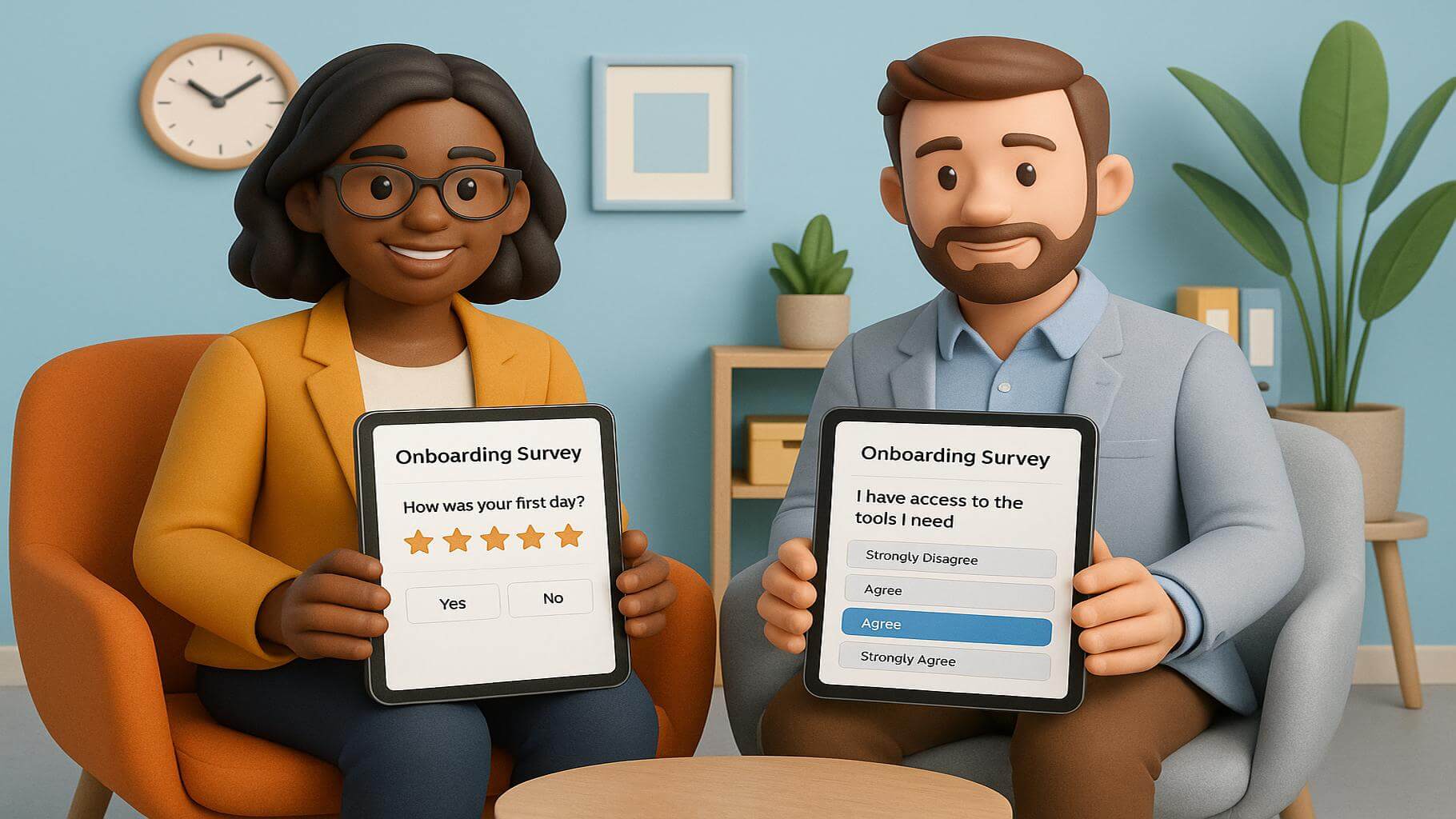
Orientation programs systematically introduce new hires to organizational policies, procedures, culture, and expectations. Evaluating orientation effectiveness ensures these programs deliver value rather than simply consuming time. Questions should assess both content quality and delivery methods to enable comprehensive program improvements. Gathering this onboarding feedback helps organizations refine orientation experiences for future hires.
10 orientation evaluation questions:
- How relevant was the orientation content to your role?
- Did orientation provide a clear understanding of the company's mission?
- How engaging were the orientation presentations and activities?
- Was the orientation pacing appropriate for absorbing information?
- Did you learn about the company's policies during orientation?
- How well did orientation explain the organization's culture?
- Were the orientation materials easy to understand and follow?
- Did orientation connect you with important contacts?
- How confident are you in your ability to navigate the organization?
- What topics should orientation cover more thoroughly?
Orientation, content relevance, and clarity
Orientation content must balance comprehensive coverage with practical relevance for new employees. Questions assessing content relevance help organizations prioritize information that matters most to incoming talent. New hires often report feeling overwhelmed by information that lacks a clear connection to their daily responsibilities. Focused orientation content improves retention of important concepts and accelerates role readiness.
Presentation delivery and engagement effectiveness
How orientation content gets delivered matters as much as what information gets included in sessions. Onboarding survey questions about presentation quality indicate whether facilitators effectively engage new hires. Boring presentations cause attention drift and poor information retention regardless of content quality. Gathering feedback on delivery helps organizations improve facilitation skills and presentation formats.
Company culture and values introduction quality
New hires need early exposure to the company culture they joined and to the values that guide organizational behavior. Orientation provides structured opportunities to communicate cultural expectations and demonstrate values in action. Questions about culture introduction assess whether new employees understand behavioral norms and expectations. Strong cultural onboarding accelerates assimilation and helps new hires feel they belong.
10+ important new hire training survey questions for skill development
Training programs equip new hires with the fundamentals they need to know to do their jobs well. Evaluating training quality ensures that organizations invest wisely in developing the capabilities of incoming talent. These questions should be administered shortly after initial training concludes, while the experience remains fresh. The insights guide improvements to training materials, methods, and instructor selection.
10 training evaluation questions:
- How relevant was the training content to your job responsibilities?
- Did the training sessions build your confidence for the role?
- How effective were the instructors or facilitators?
- Were the training materials clear and easy to follow?
- Did you receive adequate practice opportunities during training?
- How well did training prepare you for real work situations?
- Was the training pace appropriate for your learning style?
- Did training cover all the necessary tools you need?
- How confident are you in applying what you learned?
- What additional training would help you succeed?
Training program content relevance and quality
Effective onboarding training directly addresses the knowledge and skill gaps new hires bring to their roles. Training programs must balance foundational concepts with role-specific applications to maximize value. Questions about content relevance identify disconnects between the training curriculum and actual job requirements. Organizations that align training closely with job needs accelerate time to full productivity.
Instructor effectiveness and support availability
Training effectiveness depends heavily on instructor quality and their ability to engage learners meaningfully. Onboarding feedback survey questions about facilitators reveal strengths to leverage and development needs to address. New hires benefit when trainers demonstrate patience, subject expertise, and genuine interest in learner success. Support availability during and after training influences whether new employees apply learning effectively.
Knowledge application and confidence building
Training programs ultimately succeed when new hires confidently apply learned skills in real work contexts. Questions assessing application confidence reveal whether training translates into practical capability improvements. New employees who lack confidence despite completing training need additional support or practice opportunities. Confidence levels predict how quickly new hires will attempt independent work and contribute productively.
15+ key new hire employee survey questions for integration assessment
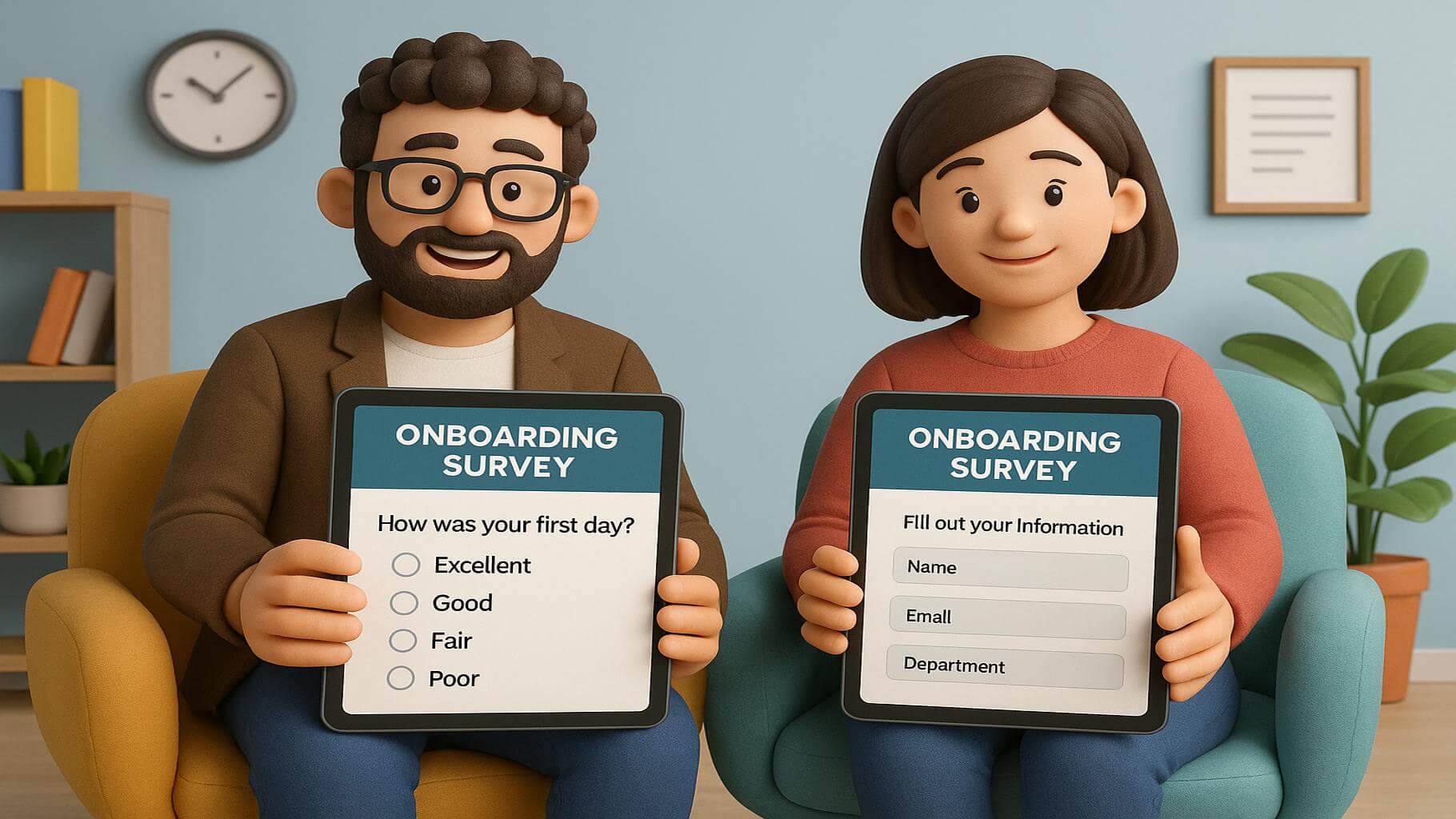
Integration encompasses how well new hires connect with managers, teams, and broader organizational networks. Successful integration predicts job satisfaction, performance, and retention outcomes for new employees. These questions assess relationship quality, communication effectiveness, and the development of a sense of belonging. Early integration feedback enables timely interventions when new hires struggle to connect.
15 integration assessment questions:
- How accessible has your manager been for questions?
- Does your manager provide clear expectations for your role?
- How often do you get constructive criticism from your manager?
- Have your coworkers been helpful during your transition?
- Do you feel welcomed by your immediate team members?
- How comfortable are you asking colleagues for help?
- Do you understand how your role connects to team goals?
- Has someone served as an informal mentor or guide?
- How clear are your job responsibilities at this point?
- Do your daily tasks match the job description you received?
- How well do you understand performance expectations?
- Do you have regular one-on-one meetings with your manager?
- How included do you feel in team activities?
- Are there sufficient opportunities to learn from colleagues?
- Do you understand how your work contributes to success?
Manager relationship and communication quality
Manager relationships profoundly influence whether new hires succeed or struggle in their new roles. Questions about manager accessibility, feedback frequency, and communication style reveal the health of the relationship. New hires who feel supported by managers report higher satisfaction and demonstrate better performance. Manager-focused questions help human resources identify leaders who excel at onboarding and those who need development.
Team dynamics and peer connections
New team members need welcoming peers who invest time in helping newcomers learn and integrate successfully. Onboarding experience survey questions about peer relationships reveal team climate and collaboration quality. Isolated new hires face higher turnover risk regardless of how much they enjoy their actual work. Assessing team integration helps organizations address connection gaps before they cause problems.
Role clarity and expectation alignment
Many new hires experience uncertainty about exactly what their managers expect them to accomplish. Questions about role clarity and unclear job expectations reveal alignment between job descriptions and actual responsibilities. Misalignment causes frustration, wasted effort, and eventual disengagement when expectations remain unclear. Role clarity correlates strongly with job satisfaction and early performance levels.
10+ new hire survey questions examples for milestone check-ins
Milestone surveys capture how new hire perceptions and experiences evolve over their first ninety days. Each checkpoint reveals different aspects of the onboarding journey as employees gain exposure and context. Comparing responses across milestones shows improvement trends and identifies persistent problem areas. Strategic timing maximizes the value of each survey touchpoint.
10 milestone check-in questions:
- How satisfied are you with your decision to join?
- Do you have all the necessary tools to do your work?
- How confident are you in performing your core responsibilities?
- Have you established productive working relationships?
- Do you see a future for yourself at this organization?
- How well does reality match what you expected?
- What has surprised you most about working here?
- Do you feel comfortable sharing concerns with your manager?
- How supported do you feel by the organization overall?
- What could improve your experience going forward?
30-day progress and satisfaction assessment
The 30-day mark is a meaningful checkpoint when initial impressions begin to solidify into opinions. New employees have enough experience to assess whether onboarding promises match organizational reality. Questions at this stage gauge early overall satisfaction and identify emerging concerns requiring attention. Thirty-day feedback often reveals issues that shorter timelines miss.
60-day skill development and confidence
Within sixty days, new hires should demonstrate increasing competence and confidence in their role responsibilities. Employee pulse survey questions at this stage assess progress in skill development and remaining capability gaps. New employees who lack confidence within sixty days may need additional training or support resources. This checkpoint helps organizations intervene before performance concerns become serious issues.
90-day cultural fit and commitment evaluation
Ninety days is a common threshold for organizations and employees to assess mutual fit and commitment levels. New hires have sufficient experience to evaluate whether the organization's culture matches their preferences. Questions about cultural fit, future intentions, and overall satisfaction predict retention probabilities. Ninety-day feedback provides a comprehensive perspective on the complete onboarding experience.
How to craft effective new hire onboarding survey questions

Question design significantly impacts the quality and usefulness of feedback gathered from new employees. Thoughtful construction produces clear, unbiased questions that generate actionable insights for improvements. Poor question design wastes respondent time and produces unreliable data that misleads decision-making. Investing effort in question crafting pays dividends through better feedback quality.
Writing clear, unbiased questions for honest responses
Clear questions use simple, straightforward language that all respondents interpret consistently and correctly. Avoiding jargon, acronyms, and complex sentence structures improves comprehension across diverse respondent populations. Unbiased questions neither suggest preferred answers nor make respondents feel judged for honest responses. Creating psychological safety for honest feedback requires careful attention to the wording of questions.
- Use familiar vocabulary appropriate for new employees
- Test questions with pilot groups before full deployment
- Review questions for potential cultural or demographic bias
- Ensure questions translate well for multilingual workforces
Balancing quantitative and qualitative question types
Effective new-employee onboarding survey instruments combine numerical ratings with open-ended response options. Quantitative questions enable trend tracking, benchmarking, and statistical analysis of feedback patterns. Qualitative questions capture nuanced perspectives, unexpected insights, and specific suggestions that numbers miss. The optimal balance depends on survey purpose, respondent time constraints, and analysis capabilities.
Avoiding leading language and common pitfalls
Leading questions contain embedded assumptions or emotional language that push respondents toward particular answers. Questions that assume positive experiences or use superlatives bias results toward favorable but inaccurate responses. Common pitfalls include double-barreled questions that ask about multiple topics and confuse respondents. Reviewing questions critically before deployment catches problems that undermine data quality.
Best practices for new hire orientation survey questions
Following established best practices maximizes the value organizations extract from onboarding survey programs. Timing, sequencing, and scale selection all influence response quality and completion rates. These practices apply across industries and organization sizes with appropriate customization. Consistent application creates reliable feedback systems that improve over time.
Timing surveys for maximum response quality
Survey timing directly affects memory accuracy and response quality for onboarding feedback collection. Deploying surveys too early misses important experiences, while waiting too long allows memories to fade. The first week captures immediate reactions, while the 30-, 60-, and 90-day surveys track evolution. Collecting survey responses at strategic intervals provides comprehensive journey mapping.
Question sequencing for natural flow
Logical question ordering creates a natural flow that keeps respondents engaged throughout the survey experience. Starting with easier questions builds momentum before tackling more complex or sensitive topics. Grouping related questions together reduces cognitive load and improves response consistency. Poor sequencing confuses respondents and increases abandonment rates before they complete the survey.
Response scale selection and consistency
Pulse survey questions and onboarding surveys benefit from consistent response scales throughout the instruments. Five-point scales balance granularity with simplicity for most organizational survey applications. Mixing different scale types within surveys forces respondents to repeatedly recalibrate, introducing error. Consistent scales enable easier comparison across questions and survey administrations.
Common mistakes in new hire training survey questions design
Even well-intentioned survey efforts can yield poor results when common design mistakes are made. Understanding these mistakes helps organizations avoid pitfalls that undermine the quality and usefulness of feedback. Learning from others' errors accelerates the development of effective survey programs. Recognizing problems early enables correction before wasted effort and unreliable data accumulate.
Questions that are too vague or complex
Vague questions, such as asking whether onboarding was "good," fail to yield actionable insights for improvement. Complex questions containing multiple clauses or concepts confuse respondents and produce unreliable answers. Each question should address one specific, concrete aspect of the experience being assessed. Specificity enables organizations to connect feedback directly to the processes and programs that can be improved.
Overloading surveys with too many questions
Long surveys cause respondent fatigue, reducing answer quality and increasing incomplete submission rates. The design of the onboarding survey template should prioritize essential questions over comprehensive coverage. Ten to fifteen questions per survey checkpoint typically balances depth with respondent burden. Shorter surveys achieve higher completion rates while still gathering valuable insights for improvements.
- Eliminate redundant questions that measure similar concepts
- Focus on high-priority topics aligned with improvement goals
- Split comprehensive assessments across multiple shorter surveys
- Test survey length before full deployment to assess burden
Failing to customize for different roles
Generic onboarding surveys miss important role-specific experiences that vary across job families and functions. Sales team members have different onboarding concerns than engineering staff or customer support representatives. Employee engagement pulse survey programs should include role-specific modules alongside core questions. Customization demonstrates understanding that different employees have different onboarding needs.
Advanced new hire employee survey questions for remote workers
Remote onboarding presents unique challenges that traditional survey questions may not adequately address. Virtual new hires experience different obstacles around connection, technology, and integration than office-based colleagues. Dedicated questions for remote employees capture insights specific to distributed work experiences. Organizations with hybrid or fully remote workforces need specialized feedback approaches.
Virtual onboarding experience assessment
Remote new employees assess whether virtual onboarding delivered equivalent quality to in-person alternatives. Questions about video meeting effectiveness, virtual resource access, and digital engagement capture remote-specific concerns. Virtual onboarding requires intentional design to overcome distance barriers that in-person programs naturally address. Feedback guides improvements to remote onboarding technology and facilitation approaches.
Technology setup and digital tool proficiency
Remote new hires depend entirely on technology to perform work and connect with colleagues. Employee pulse survey tools help organizations gather feedback on technology provisioning and support experiences. Questions about equipment delivery, software access, and technical support reveal operational gaps affecting productivity. Technology-related frustrations cause an outsized negative impact on remote employees who lack alternative resources.
Remote connection and isolation evaluation
Social connection poses a significant challenge for new hires who never meet their colleagues in person. Questions about relationship building, informal interactions, and feelings of belonging reveal isolation risks. Remote new employees who feel disconnected face a higher turnover risk, regardless of job satisfaction. Proactive assessment enables interventions before isolation causes disengagement or departure.
New hire survey questions examples by department

Different functional areas present unique onboarding challenges requiring tailored survey approaches. Department-specific questions complement core onboarding items to capture specialized concerns accurately. Understanding departmental differences enables targeted improvements benefiting specific employee populations. HR professionals can leverage these examples as starting points for customization.
Sales team onboarding and ramp-up questions
Sales new hires face distinct pressure to achieve quota productivity within compressed timeframes. Questions should assess product knowledge acquisition, proficiency with sales tools, and clarity around quotas. Ramp-up effectiveness directly impacts revenue generation and individual compensation outcomes for sales talent. Sales onboarding feedback often reveals training gaps that delay revenue contribution.
Engineering and technical role questions
Technical new hires need access to development environments, documentation, and familiarity with the codebase quickly. Employee engagement survey tools should include engineering-specific items on the quality of technical onboarding. Questions about code review processes, architecture understanding, and development workflow clarity assess readiness. Engineering onboarding requires extended timelines compared to less technical role transitions.
Customer service and support questions
Customer-facing new employees need thorough product knowledge and system training before handling customer interactions. Questions should assess confidence in handling common scenarios and understanding the escalation procedure. Customer service onboarding quality directly impacts customer experience and satisfaction outcomes. Feedback identifies training gaps that could cause poor customer experiences.
How to analyze new hire survey responses effectively
Collecting survey data represents only the first step toward improving onboarding programs and outcomes. Analysis transforms raw responses into actionable insights that guide prioritization decisions for improvement. Effective analysis identifies patterns, reveals correlations, and generates clear recommendations for action. Building analysis capabilities ensures survey investments deliver maximum organizational value.
Identifying patterns across cohorts and departments
Employee engagement survey analysis techniques help identify meaningful patterns within onboarding feedback data. Comparing results across hiring cohorts reveals whether program changes produce desired improvements over time. Departmental comparisons highlight areas where some groups excel while others struggle. Pattern identification focuses improvement efforts where they deliver the greatest impact.
Correlating feedback with retention outcomes
Connecting survey responses with subsequent retention outcomes validates which questions predict turnover risk most reliably. New hires who report specific concerns may demonstrate higher departure rates than satisfied colleagues. Understanding these correlations helps organizations prioritize interventions targeting the highest-risk feedback patterns. Longitudinal analysis requires tracking systems that connect survey responses to employment outcomes.
Creating action plans from survey insights
Survey data must translate into specific improvement actions to generate organizational value from feedback. Effective action plans identify responsible parties, timelines, and success metrics for each improvement initiative. Sharing aggregated results with team leaders and managers creates accountability for addressing identified issues. Action planning closes the loop between feedback collection and meaningful organizational improvement.
Using new hire onboarding survey questions for continuous improvement
Onboarding surveys deliver the most value when integrated into systematic, continuous improvement processes. One-time surveys provide snapshots while ongoing programs reveal trends and measure intervention effectiveness. Building improvement cycles around onboarding feedback creates organizational learning capabilities. Continuous improvement transforms feedback collection from an administrative activity into a strategic advantage.
Tracking trends over time for program refinement
Consistent survey administration enables trend tracking that reveals whether changes produce intended improvements. Organizations should compare results across multiple cohorts to establish baselines and measure progress. A consistent employee engagement survey template enables valid comparisons while allowing targeted updates. Trend analysis provides evidence for continued investment or program modification decisions.
- Establish baseline metrics before implementing changes
- Track key indicators consistently across survey administrations
- Document changes made and expected impact on metrics
- Compare actual results against predictions to validate assumptions
Benchmarking against industry standards
External benchmarks provide context for interpreting internal survey results and identifying competitive gaps. Organizations can compare results against industry averages or best practice standards where available. Benchmarking reveals whether internal perceptions align with reasonable expectations or present improvement opportunities. HR professionals should select benchmarks carefully to ensure valid comparisons.
Closing the feedback loop with new employees
New hires who provide feedback should learn how their input influences organizational improvements. Closing the feedback loop demonstrates that the organization values employee voice and acts on concerns. This communication builds trust and encourages continued participation in future hire surveys. Organizations that close loops effectively report higher survey participation rates.
New hire orientation survey questions for different industries
Industry context shapes onboarding requirements and priorities that surveys should address appropriately. Regulatory requirements, safety concerns, and operational complexity vary significantly across sectors. Tailoring onboarding surveys to the industry context improves the relevance and actionability of gathered feedback. These examples illustrate how industry needs influence survey design priorities.
Healthcare and clinical role questions
Healthcare new hires face extensive compliance, credentialing, and patient safety training requirements. Questions should assess confidence in navigating regulatory requirements and clinical protocols safely. Healthcare onboarding feedback directly impacts patient safety outcomes and organizational compliance status. The benefits of employee engagement survey programs extend to identifying safety-relevant training gaps.
Technology and software company questions
Technology companies often emphasize rapid integration into agile development processes and product knowledge. Questions should assess understanding of product roadmaps, development methodologies, and the quality of technical documentation. Tech onboarding often includes extensive self-directed learning that surveys should evaluate. Feedback helps organizations balance structured training with exploratory learning.
Retail and hospitality onboarding questions
Retail and hospitality new hires need to quickly develop customer interaction skills and operational knowledge. Questions should assess proficiency with the point-of-sale system, understanding of service standards, and procedural knowledge. These industries often experience high turnover, making onboarding efficiency particularly important. Feedback identifying shortcomings enables rapid cycle improvements affecting many new employees.
Technology solutions for deploying new hire survey questions

Modern survey technology streamlines administration, increases response rates, and enables sophisticated analysis capabilities. Organizations should evaluate technology options based on integration needs, analysis capabilities, and user experience. The right technology transforms survey administration from burdensome to effortless for HR teams. Investment in survey technology often produces significant returns through efficiency gains.
Automated survey scheduling and distribution
Automation ensures surveys are deployed at appropriate intervals without requiring manual tracking and sending. Pulse survey software systems can trigger surveys based on start dates, milestone completion, or calendar timing. Automated distribution eliminates administrative burden and prevents surveys from falling through operational cracks. Consistency improves when human attention limitations no longer affect survey deployment.
Integration with HRIS and onboarding platforms
Survey systems integrated with HR information systems automatically identify new hire populations and demographics. Integration eliminates duplicate data entry and ensures survey targeting uses current employment information. Connected systems enable analysis by employee attributes maintained in HR systems of record. Platform integration creates seamless experiences for both administrators and respondents.
Real-time reporting and analytics dashboards
Real-time dashboards provide immediate visibility into incoming survey responses, eliminating the need for manual analysis. Visualization tools transform complex data into accessible charts and summaries for diverse audiences. Employee engagement survey software with strong analytics accelerates time from data collection to insight generation. Dashboard accessibility democratizes feedback access across leadership and management audiences.
How to increase response rates for new hire surveys
High response rates ensure survey results accurately reflect the overall new-hire population's experiences. Low participation introduces bias and limits confidence in conclusions drawn from partial data. Strategic approaches to survey design, communication, and administration maximize participation rates. Investment in response rate optimization yields better data quality and more reliable insights.
Communication strategies that encourage participation
Clear communication about survey purpose, confidentiality, and how results drive improvements motivates participation. New hires should understand that their feedback directly influences organizational decisions and resource allocation. Personalized invitations from managers perform better than generic automated messages. Follow-up reminders delivered through multiple channels increase participation without creating annoyance.
Survey length and mobile optimization
Short surveys that respect respondent time constraints achieve significantly higher completion rates. Employee engagement survey questions should prioritize essential items that inform actionable improvements. Mobile-optimized surveys accommodate new hires who prefer completing them on smartphones at convenient times. Testing surveys on mobile devices before deployment catches usability issues that reduce participation.
Creating psychological safety for honest feedback
New employees may hesitate to share critical feedback, fearing negative consequences for candid responses. Confidential survey administration that protects individual identity encourages honest, unfiltered feedback. Employees feel safe when organizations demonstrate, through action, that feedback leads to positive change rather than retaliation. Building trust in survey confidentiality takes time but produces dramatically more valuable feedback.
How Matter can help with new hire survey questions
Matter provides comprehensive survey solutions designed to efficiently gather actionable new-hire feedback. The platform integrates seamlessly with existing workflows to minimize administrative burden while maximizing insight generation. Organizations using Matter benefit from expertly designed question libraries and automated deployment capabilities. Matter transforms onboarding feedback collection from manual effort into streamlined, insightful processes.
Pre-built question libraries for every onboarding phase
Matter offers science-backed survey templates for Day 7, Day 30, Day 60, and Day 90 checkpoints. These pre-built libraries eliminate guesswork about which questions generate the most actionable feedback. Organizations can use templates immediately or customize them to address specific organizational contexts and priorities. Expert-designed questions ensure reliable measurement of factors that predict retention outcomes.
- Day 7 templates capture initial impressions and immediate concerns
- Day 30 surveys assess early integration and role clarity
- Day 60 questions evaluate skill development progress
- Day 90 instruments measure cultural fit and commitment
5-point eNPS system that maximizes completion rates
Matter uses a 5-point Likert scale for eNPS measurement, based on research showing superior usability compared to traditional 11-point scales. This approach reduces respondent confusion and increases completion rates compared to complex alternatives. The fully labeled response format eliminates ambiguity about the meaning of each rating level. Higher completion rates produce more representative data, enabling confident decision-making.
Automated deployment and real-time insights
Matter automates survey distribution based on each new hire's start date, ensuring consistent deployment timing. Onboarding survey administration becomes effortless as the platform handles scheduling, sending, and reminder delivery automatically. Real-time analytics dashboards provide immediate visibility into response trends and emerging concerns. Integration with Slack and Microsoft Teams enables convenient survey completion within existing workflows.
Frequently asked questions about new hire survey questions
Q: What are the most important new hire survey questions to ask?
A: Focus on pre-boarding preparation, orientation quality, training effectiveness, manager support, team integration, and resource adequacy across multiple touchpoints during the first ninety days.
Q: When should you deploy new hire onboarding survey questions?
A: Send surveys at strategic milestones, including pre-boarding, day one, end of first week, thirty days, sixty days, and ninety days, to capture the complete onboarding journey comprehensively.
Q: How many new hire orientation survey questions should you include?
A: Limit surveys to ten to fifteen questions per checkpoint to maximize completion rates while gathering sufficient insights for meaningful program improvements and optimization.
Q: What makes effective new hire training survey questions?
A: Effective questions are specific, actionable, unbiased, and directly tied to measurable outcomes like skill confidence, knowledge retention, and training application success.
Q: How do you use the results of the new hire employee survey questions?
A: Share aggregated results with managers and HR teams, create action plans for identified issues, communicate improvements to employees, and track metrics over time.
Q: Should new hire surveys be anonymous or confidential?
A: Consider confidential rather than anonymous to enable personalized follow-up while maintaining enough privacy to encourage honest feedback about sensitive topics.
Final thoughts about new hire survey questions
Strategically designed new hire survey questions create exceptional onboarding experiences that reduce regrettable turnover and build competitive advantage through superior talent integration. Organizations that master the art and science of onboarding feedback transform new employees into engaged contributors who remain committed. Effective surveys identify managers who provide outstanding support, peers who help new team members succeed, and mentors who accelerate integration. These insights create opportunities for timely recognition that reinforces positive onboarding behaviors and strengthens the company culture.
Matter provides a complete solution for organizations serious about leveraging new hire feedback strategically and systematically. The platform offers expertly crafted onboarding survey questions for new hires, an intuitive 5-point rating system driving higher response rates, and integrated analytics that deliver valuable insights. Automated deployment ensures consistent survey timing while real-time dashboards enable immediate action on emerging concerns. Matter transforms new-hire feedback into a strategic program that delivers measurable improvements in employee retention, productivity, and organizational culture.
Ready to transform your new hire experience with strategic survey questions? Schedule a demo with a Matter expert today and discover how our platform can help you gather actionable feedback, identify risks early, and create a culture of continuous improvement.