

The 30-second verdict: Motivosity or Workhuman?
Choose Motivosity if you are an SMB or mid-market team that wants recognition denominated in real dollars rather than abstract points, likes the idea of employees tapping a ThanksMatters Visa card to spend what they earn, and can clear a $3,000 minimum annual investment. It is the lighter, faster, more peer-driven of the two.
Choose Workhuman if you are a global enterprise with a structured HR function, formal award programs with approval workflows, and a real need for fulfillment in 180+ countries.
It is the deepest recognition platform in the category, with 8 million users and more than $1 billion in annual reward redemptions behind it, and it is built for rollouts that Motivosity is not sized for.
A third option exists: if what you actually want is recognition running inside Slack or Microsoft Teams with published pricing, Matter is covered near the end of this guide.
Motivosity and Workhuman sit at opposite ends of the same category. One is a mid-market platform built on dollar-denominated peer giving and a spendable Visa card; the other is the enterprise incumbent that has been running global recognition programs since 1999. Both keep their prices behind a sales call, both hold a 4.7 on G2, and both are genuinely good at what they do, so this decision rarely comes down to quality.
It comes down to scale, structure, and how you want recognition to actually happen. This comparison was verified in August 2026 against both vendors’ public pages, their help-center and facts-page documentation, and their G2 profiles.
Full disclosure: this guide is published by Matter, an employee recognition platform that competes with both Motivosity and Workhuman. We have kept the head-to-head honest, we say plainly where each product wins, and we introduce Matter only near the end as a third option.
Weigh our perspective accordingly, and get a written quote from each vendor before you buy.
How we researched this comparison
We build Matter, which competes with both platforms on this page, so weigh our perspective accordingly.
For Motivosity and Workhuman we reviewed each vendor’s public pricing, product pages, and help-center or billing documentation, plus their G2 profiles and named, dated reviews, and we drew on conversations with teams evaluating and switching between recognition platforms. We have not used either product hands-on.
Every claim here is sourced to the vendors’ own materials, named reviews, or Matter’s published data, and facts were last verified in August 2026.
Motivosity vs. Workhuman at a glance
| Motivosity | Workhuman | Matter | |
|---|---|---|---|
| Starting price | Quote-based; $3,000 minimum annual investment published, no per-user rate | Quote-based; no public pricing page, its own anchor is 1% of payroll as program spend | Free plan, then $1 to $5 per user/month, billed annually; public tiers |
| Free plan | No; demo-led, no self-serve trial | No; demo-led, no self-serve trial | Yes, unlimited users |
| G2 rating | 4.7 (3,615 reviews) | 4.7 (2,400+ reviews) | 4.7 (1,186 reviews) |
| Teams app store | 4.2 (58 ratings) | 4.7 (2,979 ratings) | 5.0 (1,476 ratings) |
| Best for | SMB and mid-market teams that want dollar-based giving and instant card spending | Global enterprises running formal, approval-based award programs at scale | Slack/Teams-first teams that want recognition inside chat |
Recognition mechanics: monthly giving dollars vs. nomination awards
This is the deepest difference between the two products, and it is worth understanding before you look at anything else. Motivosity runs a peer allowance. Workhuman runs an award program. They produce very different recognition cultures.
Motivosity: two balances, and the giving side resets monthly
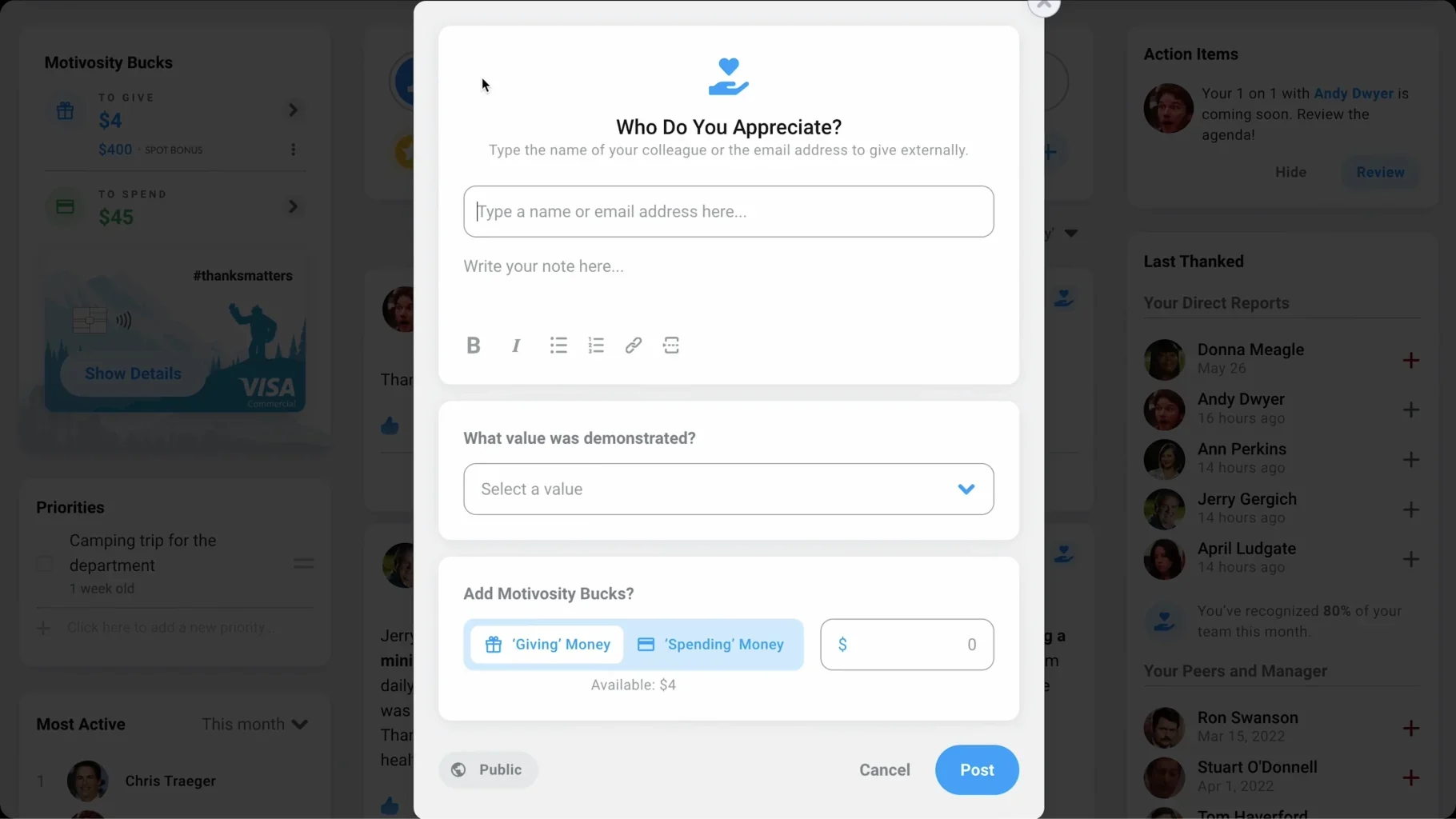
Motivosity gives every employee two balances. The first is To Give, funded by an admin-set monthly allocation, and per Motivosity’s own general user FAQ in its help center it resets on the first of each month with no rollover.
The second is To Spend, the balance an employee has earned, which generally does not expire although companies can configure expiration policies.
Administrators set Monthly Giving Defaults for everyone and then layer Special Giving Rules on top by user, team, org, or custom criteria; rules stack, and role changes can recalculate and reduce a giving balance.
The clarity win here is real: Motivosity Bucks are dollar-denominated, so one buck is one US dollar. There is no points-to-currency conversion for employees to decode. The trade-off is the classic monthly-allowance problem, which Motivosity’s own reviewers describe well and which we cover in the reviews section below.

Workhuman: nominate, approve, then award
Workhuman has no recurring peer giving allowance at all. Colleagues nominate one another for titled awards tied to company values, with written justification, and those nominations route through approval flows managed in the Program Administrator hub, where admins can approve, modify, or disapprove before an award is released.
Approved awards arrive as points redeemable in the Global Rewards Store. Companies can also cap how many awards a person receives in a year, and nominators are typically asked to select an impact level that maps to a point value rather than choosing an amount directly.
That structure buys governance: spend control, misuse detection inside the iQ and admin tooling, and an audit trail that a 50,000-person organization genuinely needs. It costs frequency. Recognition on Workhuman is an event rather than a habit, and reviewers say so plainly.

Rewards, redemption, and how each program gets funded
Both platforms sell reward spend separately from the software, so model platform cost and reward budget as two line items on either one.
Motivosity rewards and funding fees
Motivosity claims 500 million reward options across 175+ countries, 70+ languages, 140 currencies, and tax support in 63 countries. The marquee redemption path is the ThanksMatters Visa card, powered by Stripe and issued by Celtic Bank, which lets employees tap and spend earned bucks anywhere Visa is accepted, with Apple Wallet support. Gift cards, company items, and charitable donations round out the catalog.
Funding is prepay only, and Motivosity publishes the mechanics. Companies connect a US bank account by ACH at no fee, clearing in five to six business days, or a US-based credit card at a 3.5% transaction fee that processes in roughly four to six hours.
Deposit caps step up over time on both routes. Two details worth flagging honestly: funding sources are US-only, which is real friction against a 175-country story, and Motivosity’s help documentation does not address whether unused prefunded balances are refundable at cancellation.
Generic Visa reward cards are fulfilled through Tango Card with card support handled by Prepaid Digital Solutions, and physical cards can take 45 days to arrive while digital tokens are immediate.

Workhuman rewards and funding
Workhuman operates the largest reward marketplace in the category by a wide margin: more than 1 million reward choices from 600+ suppliers, fulfilled in 180+ countries with localized catalogs in 150+, and over $1 billion redeemed annually. It holds PCI DSS Level 3 merchant certification, which implies it runs that commerce in-house rather than reselling someone else’s rails.
How companies fund awards is a different story. Workhuman publishes no help center and no fee schedule, so whether programs prefund, are invoiced on redemption, carry platform fees on rewards, or have a breakage policy is not publicly documented.
That is not an accusation, it is a gap: you will only learn the answer in a sales conversation, so put it on your question list.
The same applies to what happens to a departing employee’s unredeemed points, and to points expiration, which appears to be configured per program rather than set globally.

Pricing transparency: two flavors of quote-gated
Neither vendor publishes a per-user price, so the honest comparison is about which one gives you more to work with before the call.
Motivosity gives you a floor. Its pricing page and FAQ both state a $3,000 minimum annual investment, sold as a modular per-employee-per-month model across bundles for celebrating people, building culture, and scaling globally. Reward spend sits on top.
Motivosity’s own 2026 software listicle concedes the constraint in its own words, calling the roughly $3,000 annual minimum a barrier for very small teams.
It is worth noting that the same FAQ describes the pricing as transparent and predictable while publishing no rates, and that the 3.5% card funding fee lives in the help center rather than alongside the no-hidden-fees language.
Workhuman gives you an anchor instead of a floor. There is no pricing page at all, but its own facts page recommends program spend of 1% of payroll as the ROI tipping point.
That is a spend-level recommendation rather than a license price, but it is their number and it is the only one they publish. For a 1,000-person company at an $80,000 average salary, 1% of payroll is roughly $800,000 a year in program spend. That figure tells you exactly who this product is for.
Practical read: at the small end, Motivosity is the only one of the two with a number you can budget against. At the large end, the comparison stops being about list price and becomes a scoping exercise on both sides.
Surveys, insights, and analytics
Motivosity sells employee insights and eNPS as a module, which means survey capability adds per-employee-per-month cost on top of the recognition bundle.
It also markets Appreciation Intelligence, an AI layer covering recognition writing assistance and turnover-risk insights, launched across 2025 and 2026. For a mid-market HR team that wants recognition and a sentiment read from one vendor without a separate procurement, that is a reasonable package.
Workhuman’s analytics are the stronger side of this comparison and it is not especially close.
Workhuman iQ analyzes recognition data at a scale nobody else has, the Human Intelligence AI suite launched in February 2025 on more than a billion recognition data points, and Inclusion Advisor bias-checks recognition language before it is sent.
Its survey tool, Moodtracker, exists but is not the platform’s center of gravity, so if employee listening is your primary requirement rather than recognition, neither of these two is an obvious first pick.
Workhuman also runs a research partnership with Gallup, which is where most of its published ROI claims originate, so treat those figures as vendor and partner research rather than independent findings.

Implementation, integrations, and admin load
Motivosity describes implementation as 30 to 60 days with only five to ten admin hours, and its comparison content elsewhere cites a four-to-six-week average time to launch.
It integrates with 50+ HRIS and SSO tools including ADP, Workday, and Okta, and it publishes both a Slack app and a Microsoft 365 certified Teams app called Motivosity Team Connector.
The core experience, though, is still Motivosity’s own web and mobile app and social feed; chat is a delivery channel rather than the product.
Workhuman’s implementation is a consultative program: planning, change management, and scoping, with no published timeline, sold alongside what it calls the industry’s only ROI Guarantee. Its certified integration list is short and deliberate, covering Microsoft Teams, Outlook, Slack, and Workday.
The Teams app launched in September 2023 and is Microsoft 365 certified, and Workhuman’s Teams app store presence is the strongest of the pair at 4.7 across 2,979 ratings, compared with Motivosity’s 4.2 across 58. There is no public Slack Marketplace listing for Workhuman that we could find as of August 2026, though the Slack integration is certified per its own facts page.
On compliance, Workhuman carries ISO 27001:2022, ISO 27701:2019, PCI DSS Level 3, GDPR and CCPA alignment, and twice-annual third-party audits, which is exactly the stack an enterprise security review will ask for.
Mobile is a genuine strength for both, and neither deserves a staleness criticism. Motivosity rates 4.8 on the App Store across roughly 5,700 ratings and 4.8 on Google Play across 815 reviews.
Workhuman rates 4.9 on the App Store across roughly 8,400 ratings and 4.4 on Google Play across 2,720 reviews, with both apps shipped within days of our August 2026 verification.
What G2 reviewers say about Motivosity and Workhuman
Both platforms hold a 4.7 on G2, so the scores do not separate them. The complaint patterns do, and they are strikingly different.
Motivosity (4.7 across 3,615 reviews on G2): praise clusters on the ease of the recognition process, peer recognition, and a friendly interface. The criticism splits between the size of the monthly allowance and navigation.
Clayton M., a Manager of Customer Success at a mid-market company, captured the allowance problem in a 4.5-star review on April 21, 2026: “[at month end] you would still have money to spend and it felt like you were just trying to come up with something to compliment someone on, which didn’t feel as genuine.”
The balancing view comes from Stacie D., an HR Operations Specialist at a mid-market company, in a five-star review on June 3, 2026: “reporting side is a massive time-saver for anyone running team evaluations.” Notably, UI and navigation complaints are unusually prominent for a 4.7-rated product.
Workhuman (4.7 across roughly 2,400 reviews on G2, plus 9.1 out of 10 on TrustRadius across 57 reviews): the top praise themes are ease of recognizing achievements and ease of use, so the product itself is not the problem.
The dislike themes are catalog value and approval bureaucracy, with reward variety drawing 252 mentions and slow approvals or complex criteria drawing 230. Kelton K., an Engineer at an enterprise company, put the governance cost bluntly in a 2.5-star review on February 26, 2026: “Limiting it six awards per person a year sucks.”
For balance, Tasha B., an Administrative Assistant at an enterprise company, wrote in a five-star review on July 9, 2026: “It’s very user-friendly and doesn’t require any training—you can simply open the software and start using it.”
The useful synthesis: Motivosity’s friction is that the budget runs out or gets dumped at month end; Workhuman’s friction is that getting an award approved and then finding something worth redeeming it for takes effort. Those are different problems, and which one you would rather have is a real decision input.
Where Motivosity wins
- A published price floor: a $3,000 minimum annual investment is a real number you can budget against. Workhuman publishes nothing comparable.
- Dollar-denominated giving: one buck equals one dollar, with no point-conversion math for employees to decode.
- The ThanksMatters Visa card: tap-to-pay spending of earned bucks with Apple Wallet support is the most immediate redemption experience of the pair.
- Published funding fees: 0% by ACH and 3.5% by card are documented, where Workhuman’s funding mechanics are not publicly documented at all.
- Faster, lighter rollout: 30 to 60 days with five to ten admin hours, versus a consultative enterprise implementation with no published timeline.
- Larger G2 base: 3,615 reviews to Workhuman’s roughly 2,400, and a documented mid-market case study in Old National Bank reporting 85% adoption in the first month rising to 90%, 12,000+ peer recognition moments, and a full workday per week of admin time recovered.
Where Workhuman wins
- Global fulfillment reach: 1 million+ reward choices from 600+ suppliers in 180+ countries with localized catalogs in 150+, and more than $1 billion redeemed a year. Nobody in this category matches it.
- Enterprise scale, proven: 8 million users as of March 2026, and a Merck rollout across 85 countries and 67,000 employees producing nearly 3 million recognition moments and a 12-point lift on the engagement survey’s recognition question.
- Governance and controls: approval workflows, spend control, delegate assignment, and marketed misuse detection, which formal award programs require.
- Analytics and AI depth: Workhuman iQ, the Human Intelligence suite launched February 2025, and Inclusion Advisor bias-checking, all trained on more than a billion recognition data points.
- Service milestones and lifecycle: Service Milestones, Life Events, and Community Celebrations are best-in-class for long-tenure award programs.
- Enterprise trust signals: ISO 27001:2022, ISO 27701:2019, PCI DSS Level 3, twice-annual audits, a 4.7 across 2,979 Teams app store ratings, and a 4.9 iOS rating across roughly 8,400 ratings.
The third option: Matter
Both platforms above assume recognition lives in their own app, funded either by a monthly dollar allowance or by an approved award. Matter makes a different bet: recognition should happen inside Slack and Microsoft Teams with no separate login, on a weekly rhythm rather than a monthly budget or a nomination cycle.
Every week, Feedback Friday™ (US Patent 12,199,935) prompts the whole team to recognize someone, and give-coins reset weekly so they get used rather than hoarded or dumped.
The cadence is measurable: in The Recognition Habit, Matter’s 2026 Benchmark Report, built on aggregate, de-identified platform data, teams that build recognition around a weekly ritual give about 2.5x more recognition per member than ad hoc teams, and roughly 8 in 10 ritual teams stay active in nearly every month.
On the criteria this guide has used: Matter’s Free plan is for unlimited users, paid plans are published at $1 to $5 per user/month, billed annually, and Matter hasn’t raised prices in 8 years.
Reward funding fees are published too, including a 0% ACH prepay path, and the catalog spans 10,000+ eGift card options across 200+ countries. On the Microsoft Teams app store, Matter holds a 5.0 across 1,476 ratings.
Two honest concessions: a genuinely global enterprise deployment, with fulfillment in 180+ countries, formal approval workflows, and consultative change management, is exactly what Workhuman is built for and Matter is not, and a team that wants employees tapping a physical Visa card to spend earned rewards will prefer Motivosity’s ThanksMatters card. For the detailed head-to-heads, see Motivosity vs. Matter and Workhuman vs. Matter.
Which platform is right for your team?
Choose Motivosity if:
- You are an SMB or mid-market team that can clear a $3,000 minimum annual investment and wants a number before the sales call.
- Dollar-denominated giving and instant Visa card spending matter more to you than global fulfillment depth.
- You want recognition plus an eNPS and insights layer from one mid-market vendor.
Choose Workhuman if:
- You are a global enterprise that needs reward fulfillment in 180+ countries with localized catalogs.
- Formal award programs, approval workflows, and spend governance are requirements rather than overhead.
- You want the deepest recognition analytics available and consultative implementation support for a large rollout.
Choose Matter if:
- Your team lives in Slack or Microsoft Teams and you want recognition there, not in another app.
- You prefer a weekly recognition ritual over a monthly allowance or a nomination and approval cycle.
- You want to start free with unlimited users and see published pricing before talking to anyone.
Frequently asked questions about Motivosity vs. Workhuman
Is Motivosity or Workhuman cheaper?
Motivosity is almost always the cheaper entry point, and it is the only one of the two you can budget against without a call: it publishes a $3,000 minimum annual investment on its pricing page and FAQ, with modular per-employee-per-month rates quoted on top.
Workhuman publishes no pricing page at all; its own facts page recommends program spend of 1% of payroll, which for a 1,000-person company at an $80,000 average salary is roughly $800,000 a year.
Reward budget is separate from software on both platforms, so compare written quotes that include software, reward spend, and funding fees together.
What is the main difference between Motivosity and Workhuman?
The recognition model. Motivosity gives every employee a monthly allowance of dollar-denominated bucks to hand to peers, and the giving side resets on the first of each month with no rollover.
Workhuman has no peer allowance: colleagues nominate one another for titled awards with written justification, and those nominations pass through approval workflows before points are released. Motivosity produces frequent, informal, peer-to-peer recognition; Workhuman produces less frequent, more formal, governed recognition at global scale.
Which is better for large global organizations, Motivosity or Workhuman?
Workhuman, in most cases. It fulfills rewards in 180+ countries with localized catalogs in 150+, serves 8 million users, and brings the approval workflows, spend controls, compliance certifications, and change management a large multinational rollout requires.
Motivosity makes global claims of its own, at 500 million reward options across 175+ countries, but one practical limit is worth checking in your own scoping: its funding sources are US-only, covering US bank accounts and US-based credit cards.
Do Motivosity or Workhuman offer a free plan or free trial?
Neither. Both are demo-led with no free tier and no self-serve trial, and Motivosity additionally carries a $3,000 minimum annual investment. Among alternatives, Matter’s Free plan supports unlimited users, so a team that wants to try recognition before committing to a contract has options outside this pair.
Do Motivosity bucks or Workhuman points expire?
On Motivosity, the two balances behave differently: To Give dollars reset on the first of each month with no rollover, while earned To Spend dollars generally do not expire, though a company can configure an expiration policy.
Workhuman does not publish a universal expiration policy; at least one reviewer has reported points expiring after a year, which suggests it is configured per program. Ask both vendors in writing what happens to unredeemed balances, including when an employee leaves.
Motivosity vs. Workhuman: the bottom line
These two are not really competing for the same buyer. Motivosity is the mid-market pick, with a published price floor, dollar-clear giving, and a spendable Visa card.
Workhuman is the enterprise pick, with unmatched global fulfillment, real governance, and the deepest analytics in the category, at a program cost anchored to 1% of payroll. If neither profile fits, and what you want is recognition living inside chat on a weekly rhythm with published pricing, that is the third path.
Related reading: Motivosity alternatives, Workhuman alternatives, and the full comparison hub.