

Selecting the right feedback platform can feel overwhelming when organizations face dozens of vendors with varying features and pricing structures. At Matter, we understand that HR teams want more than surface-level comparisons when evaluating workforce feedback solutions. The challenge intensifies when trying to understand what makes employee engagement survey software effective versus simply functional. Knowing the difference between satisfaction platforms and engagement systems transforms the selection process from chaotic to strategic.
Understanding employee engagement survey results, reviewing employee engagement survey examples, and learning about types of employee engagement surveys help organizations build reliable feedback programs. The right knowledge empowers businesses to gather actionable insights that drive meaningful improvements. When organizations choose tools that align with their employee needs, they create productive workforce environments where feedback flows naturally. This guide provides everything needed to select, implement, and maximize value from engagement survey platforms.
What is an employee engagement survey?
An employee engagement survey is a structured feedback mechanism that measures how emotionally committed employees feel toward their organization. Unlike simple satisfaction surveys that ask whether workers are content, engagement surveys explore deeper connections between team members. These assessment methods evaluate whether employees feel motivated to contribute discretionary effort beyond minimum requirements. They also measure whether team members plan to remain with the company long-term and recommend it to others.
Modern employee engagement survey platforms have evolved far beyond basic questionnaires distributed manually via email or paper forms. They now incorporate advanced analytics, automated distribution, and real-time reporting, enabling immediate insights. Understanding how employee engagement software works helps organizations make informed decisions about platform selection. The right employee engagement solution seamlessly fits unique workplace culture and employee experience goals.
Defining employee engagement surveys versus satisfaction surveys
Employee satisfaction surveys focus on whether workers feel content with their jobs, compensation, and immediate working conditions. These surveys measure happiness at a surface level, asking questions about benefits, work schedules, and physical workspace comfort. While valuable for understanding basic workplace contentment, satisfaction data alone does not predict employee retention outcomes. Organizations need deeper insights to understand what truly drives workforce commitment and performance.
Effective employee engagement surveys dig deeper into emotional and psychological connections between employees and their organizations. They assess whether team members feel proud to work for the company and would recommend it to others. Employee engagement software measures alignment with company culture, trust in leadership, and belief in organizational direction. These deeper metrics reveal whether employees will stay committed during challenging periods or seek opportunities elsewhere.
The distinction matters because satisfied employees may still leave for better opportunities when they arise. Engaged employees, however, demonstrate loyalty and consistently contribute beyond minimum expectations. Effective employee engagement software captures both dimensions to provide comprehensive workforce insights for decision-making. Organizations benefit most when they measure satisfaction and engagement together through integrated survey approaches.
Core components that effective feedback platforms must include
Quality employee engagement software shares several essential features that separate these platforms from basic questionnaire systems. These components ensure organizations collect meaningful feedback while maintaining participation rates and data accuracy throughout cycles. Without these foundational capabilities, survey programs struggle to generate actionable insights that drive improvement. The following features constitute the essential requirements for efficient workforce feedback collection.
- Customizable survey templates that adapt to organizational needs and industry contexts
- Anonymous feedback collection that encourages honest responses without fear of repercussions
- Real-time analytics dashboards that surface engagement data immediately after survey completion
- Benchmarking capabilities that compare results against industry benchmarks and historical trends
- Mobile accessibility that allows employees to access surveys from any device
- Integration options that connect with existing HR systems and communication platforms
These key features transform basic feedback collection into strategic listening programs that effectively inform organizational decisions. Organizations should prioritize platforms that offer extensive libraries of questions while maintaining flexibility for custom additions. The best platforms balance standardization with customization to meet unique organizational needs and industry requirements. Evaluating these capabilities early in the selection process prevents costly platform switches later.
How survey platforms connect feedback to business outcomes
The most valuable engagement platforms demonstrate clear connections between employee sentiment and organizational performance metrics. Research consistently shows that engaged employees drive higher customer satisfaction, greater productivity, and stronger business performance. These correlations justify investment in engagement technology by linking workforce feedback to measurable business results. Understanding these connections helps HR teams effectively communicate the value of the survey program to executive leadership.
Effective platforms help HR teams identify trends between engagement drivers and retention rates across different populations. They reveal how improvements to the work environment correlate with reduced turnover costs and increased productivity over time. Advanced analytics enable organizations to listen to workforce concerns while systematically tracking progress on improvement initiatives. These insights transform feedback from interesting data points into actionable intelligence that guides resource allocation.
Pulse survey capabilities within engagement platforms allow organizations to measure impact over time through frequent check-ins. When improvements occur, survey responses reflect those changes, creating a visible return on investment for stakeholders. This connection between feedback and business outcomes justifies ongoing investment in engagement technology and program resources. Organizations that track these relationships build stronger cases for continued funding and expansion of their engagement programs.
What are the benefits of workforce feedback platforms?

Implementing dedicated employee engagement software delivers advantages that manual feedback processes simply cannot match in scale or efficiency. These platforms transform how organizations collect feedback, analyze employee data, and systematically respond to workforce concerns. The efficiency gains alone often justify investment, but the strategic insights are even more valuable for decision-making. Organizations that adopt these tools gain competitive advantages in talent retention and workforce productivity.
Organizations that leverage employee pulse survey tools consistently outperform competitors in retention and productivity metrics over time. The structured approach to gathering insights eliminates guesswork from people management decisions and resource allocation. HR teams gain data-driven approach capabilities that influence executive decisions and demonstrate measurable program impact. These advantages compound over time as organizations build historical data that reveals long-term trends.
Automated survey administration that saves time and increases consistency
Manual survey distribution consumes significant administrative hours while introducing inconsistencies across departments and locations over time. Automated platforms eliminate these inefficiencies by scheduling surveys, sending reminders, and managing participant lists without intervention. The time savings allow HR professionals to focus on analyzing results rather than managing logistics and chasing responses. This shift from administration to analysis dramatically improves the value HR teams deliver to their organizations.
Consistency matters because engagement measurement requires comparable data points over time to identify meaningful trends. When survey administration varies across cycles, organizations lose the ability to accurately identify trends and compare results. Automated systems ensure identical processes each time, strengthening data reliability and enabling valid comparisons. This standardization allows organizations to attribute score changes to actual workplace improvements rather than methodological variations.
Employee recognition programs integrated with feedback platforms create additional automation opportunities, multiplying program effectiveness. Solutions that combine these functions reduce administrative burden while seamlessly connecting feedback to actionable responses. The integrated approach enhances motivation while streamlining workflows for HR teams managing multiple systems. Organizations benefit from unified data that reveals how recognition patterns influence engagement scores over time.
Real-time analytics dashboards that surface trends immediately
Traditional annual surveys create months-long gaps between data collection and action planning, reducing program effectiveness. Modern platforms provide instant access to results as responses arrive, eliminating these delays. This immediacy allows organizations to address concerns before they escalate into larger problems affecting retention. Quick response times also demonstrate organizational commitment to acting on employee feedback promptly.
Real-time dashboards display engagement metrics across multiple dimensions simultaneously for comprehensive analysis and quick identification. HR teams can filter by department, location, tenure, or custom segments to gain insights into specific populations. Visual representations make patterns obvious without requiring statistical expertise or advanced analytical training. These accessible formats enable managers at all levels to engage with survey data meaningfully.
The speed of insight generation transforms how organizations respond to workforce feedback and implement improvements. Rather than waiting for quarterly reports, managers can track progress weekly and adjust approaches as needed. This continuous listening approach builds trust by demonstrating responsiveness to employee sentiment and concerns. Employees notice when organizations act quickly on feedback, which encourages participation in future surveys.
Benchmarking capabilities that contextualize results against industry standards
Raw engagement scores mean little without context for interpretation and comparison against relevant reference points. A score that seems low might actually exceed industry benchmarks for comparable organizations in similar markets. Platforms offering benchmarking help organizations understand where they truly stand relative to peers and competitors. This context prevents misallocation of resources toward areas already performing above average.
Industry benchmarks provide valuable insights for goal setting and resource prioritization across different engagement dimensions. Organizations can identify whether specific areas require attention or already perform above average compared to peers. This context prevents overreaction to scores that simply reflect industry-wide challenges rather than organization-specific problems. Strategic leaders use benchmark data to set realistic improvement targets and celebrate genuine achievements.
Historical benchmarking tracks organizational progress over time, revealing improvement trajectories that motivate continued investment. Even if industry benchmarks remain out of reach, improvement trajectories demonstrate positive momentum and program effectiveness. These trends validate the program's effectiveness and justify continued resource allocation to engagement initiatives. Organizations build compelling narratives around progress that engage leadership and maintain program support.
Why are employee engagement surveys important for organizational health?

Organizational health depends on understanding workforce perspectives before problems become crises that affect retention and productivity. Engagement surveys provide a systematic approach to consistently measuring employee experience across entire organizations. Without these tools, leaders rely on anecdotal observations that may not accurately reflect broader workforce sentiment. Structured feedback collection ensures that all voices contribute equally to the organization's understanding.
Employee rewards programs become more effective when guided by engagement data that reveals employee preferences and values. Survey insights reveal which recognition approaches resonate most strongly with different employee populations across departments. This targeted application of resources maximizes impact while avoiding wasted investment on approaches that fail to motivate. Organizations that align rewards with survey insights see stronger engagement improvements from their recognition investments.
Connection between engagement measurement and retention rates
Employee retention represents one of the most expensive challenges facing modern organizations across all industries and sizes. Replacement costs for departing employees range from significant portions of annual salary to multiples for specialized roles. Engagement surveys identify retention risks before employees decide to leave, enabling proactive intervention strategies. Early identification of disengagement allows organizations to address concerns while employees remain committed to finding solutions.
Predictive analytics within advanced platforms flag individuals and teams showing declining engagement patterns that indicate retention risk. These early warnings allow managers to intervene with targeted support or address underlying concerns before resignation. The proactive approach proves far more effective than reactive retention efforts that occur after employees announce departures. Organizations save high costs by addressing engagement issues early rather than managing the consequences of turnover.
Survey data reveals which engagement drivers most strongly influence retention decisions within specific organizational contexts. Some organizations discover that career development matters most, while others find that work-life balance drives employee loyalty. Understanding these priorities enables focused improvement efforts that address the factors most likely to reduce turnover. This targeted approach produces better results than generic retention programs that fail to address specific workforce concerns.
How regular surveys build trust and psychological safety
Employees who believe their feedback matters contribute more openly and honestly to organizational improvement efforts over time. Regular surveys demonstrate a commitment to listening, especially when followed by visible action to address concerns raised. This approach fosters psychological protection, enabling employees to express concerns without apprehension of adverse repercussions. Organizations that establish this trust receive more valuable feedback that reveals genuine workforce sentiment.
Trust develops through consistent follow-through on survey insights that demonstrate organizational commitment to improvement. When organizations address concerns raised in previous surveys, participation rates for future surveys increase noticeably. Employees recognize that their voices meaningfully influence organizational decisions and resource allocation. This recognition encourages continued engagement with feedback processes and higher-quality responses.
Anonymous surveys reduce fear of negative consequences for honest feedback that might otherwise remain unspoken. Platforms guaranteeing confidentiality encourage candid responses that reveal true workforce sentiment without filtering. This honesty produces more valuable insights than superficial responses driven by social desirability or fear. Organizations benefit from understanding actual employee perspectives rather than polished versions designed to please leadership.
Impact on productivity metrics and business performance
Engaged employees consistently demonstrate higher productivity than their disengaged counterparts across all industries and role types. They invest discretionary effort, solve problems proactively, and support colleagues willingly without being asked explicitly. Engagement surveys help organizations understand which factors most strongly influence these valuable behaviors within their context. This understanding enables targeted investments that improve productivity metrics measurably over time.
The connection between engagement and customer loyalty appears across multiple industries in consistent patterns. Employees who feel committed to organizational success deliver better customer experiences that drive satisfaction and retention. Survey tools help organizations track this relationship and invest accordingly in employee engagement initiatives. Understanding these connections helps justify engagement program investments to executive leadership focused on business outcomes.
Financial performance correlates with engagement levels in measurable ways that appear consistently across research studies. Organizations with highly engaged workforces experience lower absenteeism, fewer safety incidents, and stronger overall revenue growth. Engagement survey data helps leaders make data-driven decisions about workforce investments and resource allocation priorities. These connections make engagement measurement a strategic imperative rather than merely a nice-to-have HR initiative.
10 tips for designing effective employee engagement surveys
Survey design directly impacts response quality and participation rates, which in turn determine program success overall. Poorly constructed surveys yield unreliable data, leading to misguided decisions and wasted improvement efforts. Following established best practices ensures organizations gather meaningful feedback that drives effective action and real change. The investment in quality survey design pays dividends in the form of more accurate insights and greater employee trust.
The most successful surveys balance comprehensiveness with respect for employee time and attention throughout completion. They ask questions that feel relevant while avoiding redundancy or confusion that frustrates respondents. Strategic design choices create surveys that employees willingly complete because they recognize their value and purpose. This willingness translates directly into higher-quality data that reflects genuine workforce sentiment.
Survey structure and question design tips
Building effective surveys requires attention to both content and format elements that influence quality. These structural elements influence completion rates and response quality significantly across all employee populations. Getting structure right prevents common problems that undermine survey program effectiveness and data reliability. The following tips address the most impactful structural decisions organizations face when developing surveys.
- Keep surveys to 15 questions or fewer for higher completion rates across all employee populations. Lengthy surveys often lead to abandonment as respondents lose patience with extensive questionnaires. Focus on essential questions that directly inform action planning and improvement efforts. Prioritizing quality over quantity produces more reliable data from engaged respondents.
- Employ a combination of rating scales and open-ended inquiries to gather various forms of feedback. Quantitative data enables trend tracking while qualitative responses provide context and a deeper understanding. Both types provide unique, valuable insights into comprehensively understanding employee experience. The combination produces richer data than either approach alone.
- Focus questions on actionable workplace conditions that organizations can actually improve through targeted efforts. Avoid asking about factors outside organizational control that cannot change, regardless of the feedback received. Employees become frustrated when surveys address issues that cannot be changed and feel their time was wasted. Actionable focus maintains trust in the feedback process and encourages future participation.
- Avoid leading or biased question language that might influence how employees respond to items. Neutral wording prevents bias in responses and yields more accurate data reflecting true sentiment. Review questions for unintentional framing that might skew results in particular directions. Having multiple reviewers examine questions helps identify bias that the original authors might miss.
- Include progress bars to show completion status so respondents know how much of the survey remains. Visual indicators reduce abandonment by showing how much remains before completion is achieved. Respondents feel motivated to finish when the end appears close, and progress feels tangible. This simple feature significantly improves completion rates across all survey types.
Pulse survey software platforms often include question libraries with pre-validated items, saving development time. These resources accelerate survey development while ensuring measurement quality meets professional standards. Organizations can customize pre-built questions to match their specific context and terminology preferences. Starting with validated questions reduces the risk of measurement errors that compromise data quality.
Question clarity and relevance tips
Clear questions produce reliable data while confusing items generate noise that obscures true employee sentiment. Every question should pass tests for understandability and relevance before inclusion in final surveys. Ambiguous wording leads to inconsistent interpretations, reducing data quality and comparability across respondents. The following tips help ensure that questions are communicated clearly and feel relevant to all participants.
- Use specific timeframes, such as "in the last month," to ensure consistent interpretation across respondents. Vague temporal references lead to inconsistent interpretations, compromising data comparability and trend analysis. Defined periods ensure all respondents evaluate the same window when providing their feedback. This specificity improves data quality and enables meaningful comparisons between survey cycles.
- Test questions with small groups before full deployment to identify problems early. Pilot testing reveals confusing language or problematic response options that need revision. This investment prevents larger problems during full rollout that would compromise data quality. Feedback from pilot participants often improves question wording in ways designers did not anticipate.
- Ensure questions align with company values and priorities that employees recognize as important. Surveys should reflect organizational culture and strategic direction to feel relevant and purposeful. Disconnected questions feel irrelevant to respondents and reduce engagement with the feedback process. Alignment demonstrates that leadership cares about measuring what actually matters to the organization.
- Make questions relevant to all employee levels regardless of role, department, or seniority. Avoid items that apply only to managers or to specific roles that exclude portions of the workforce. Universal relevance maintains participation across workforce segments and ensures all voices contribute to results. Questions that feel irrelevant cause respondents to disengage or provide thoughtless answers.
- Provide context for each question to help employees understand its purpose. Brief explanations help employees understand the purpose and feel their responses will be used meaningfully. This transparency encourages thoughtful responses rather than rushed selections that reduce data quality. Context transforms surveys from bureaucratic exercises into meaningful conversations about workplace improvement.
Employee recognition and rewards platforms often include survey capabilities with built-in guidance for question development. These integrated tools streamline the process of creating effective surveys while maintaining measurement quality. Organizations benefit from having recognition and feedback capabilities within a single platform for efficiency. The integration also enables connecting recognition patterns with engagement survey results for deeper insights.
8 tips for maximizing employee engagement survey participation

High participation rates ensure survey results accurately represent overall workforce sentiment across all populations. Low response rates introduce bias because respondents may differ systematically from non-respondents. Strategic approaches to survey promotion and accessibility maximize response rates and improve data representativeness. Organizations that invest in participation strategies see significantly better results than those that simply distribute surveys.
Organizations should view participation as a reflection of trust in the feedback process and organizational commitment. When employees believe surveys lead to action, they invest time in thoughtful, honest responses. Building this belief requires consistent communication and visible follow-through on previous survey results. Trust develops over multiple survey cycles as employees observe organizational responses to their feedback.
Communication and launch strategy tips
Effective launch strategies address employee concerns while generating enthusiasm for participation in feedback collection. These communication approaches increase response rates significantly when implemented consistently across the organization. Poor communication represents one of the most common reasons for low survey participation rates. The following tips address the most impactful communication decisions organizations face during survey launches.
- Send personalized invitations from direct managers rather than generic organizational communications. Messages from immediate supervisors carry more weight than generic HR communications with employees. A personal connection motivates a response because employees feel their manager values their input directly. This approach also signals that managers will see and act on team-level results.
- Communicate survey purpose and past actions taken based on previous feedback cycles. Employees want assurance that feedback matters and will lead to actual improvements. Highlighting previous improvements demonstrates the organization's commitment to meaningfully acting on employee input. This history of action builds trust, encouraging participation in current surveys.
- Guarantee confidentiality and anonymity to address concerns about identification and potential consequences. Fear of identification prevents honest responses that reveal true workforce sentiment. Clear explanations of data protection build confidence in privacy and encourage candid feedback. Organizations should explain specifically how anonymity is maintained and when results are aggregated.
- Use multiple reminder channels, including email, Slack, and posters, to reach all employees. Different employees prefer different communication methods and may miss single-channel announcements. Multi-channel approaches reach everyone effectively regardless of their primary communication preferences. Consistent messaging across channels reinforces the importance of the survey and maintains visibility throughout the response period.
Kudos employee recognition programs can reinforce survey participation by recognizing those who contribute feedback. Recognition creates positive associations with the feedback process and encourages continued engagement. Some organizations highlight participation milestones to build momentum during survey periods. This integration of recognition and feedback strengthens both programs simultaneously.
Timing and accessibility tips
Survey logistics significantly impact participation rates, thereby determining overall program success and data quality. Thoughtful timing removes barriers to response that would otherwise reduce workforce representation in results. Universal accessibility ensures all employees can participate regardless of their work location or technological resources. The following tips address the most impactful logistical decisions organizations face during survey deployment.
- Launch surveys midweek to achieve optimal response rates from employees across all departments and locations. Monday mornings and Friday afternoons see lower engagement because employees are focused on starting or ending the week. Tuesday through Thursday launches capture attention most effectively when employees have settled into work routines. This timing increases completion rates without requiring additional promotional efforts from HR teams.
- Ensure mobile accessibility for remote workers who may not have regular desktop access. Many employees work primarily from phones and tablets rather than traditional computers during their workdays. Mobile-friendly surveys accommodate diverse work arrangements that have become standard in modern organizations. Poor mobile optimization excludes significant employee populations and reduces data representativeness
- Provide surveys in multiple languages to effectively reach global workforces with diverse linguistic backgrounds. Global organizations require translation options that ensure all employees can understand questions and respond thoughtfully. Language barriers prevent otherwise willing participants from responding accurately to survey questions. Professional translation maintains question validity while enabling inclusive participation across all regions.
- Set reasonable completion deadlines of seven to ten days that balance urgency with adequate response time. Short windows create appropriate urgency without creating excessive pressure that reduces response quality. Extended periods allow surveys to fade from attention and lose momentum among potential respondents. Reminder sequences throughout the deadline period maintain visibility without overwhelming employees' inboxes.
Types of employee engagement surveys that modern tools support
Different survey types serve distinct purposes within comprehensive employee engagement strategies and measurement programs. Understanding these variations helps organizations select appropriate employee engagement software for their specific goals. The most effective employee engagement platforms support multiple survey types within a unified system for greater efficiency. Matching survey types to organizational needs ensures maximum value from feedback investments.
Employee engagement software selection should consider which types the organization needs most urgently for improvement. Some platforms excel at comprehensive annual employee engagement surveys, while others specialize in quick pulse checks. Matching platform strengths to organizational priorities ensures maximum value for employee experience improvement efforts. Organizations benefit from evaluating platform capabilities against their specific survey type requirements.
Annual comprehensive surveys for year-over-year tracking
Annual surveys provide deep dives into workforce sentiment across multiple engagement dimensions simultaneously. These comprehensive assessments typically include 50 or more questions that thoroughly cover all aspects of the employee experience. They establish baselines and track long-term trends that reveal organizational progress over extended periods. The depth enables thorough examination of factors that shorter survey formats cannot adequately address.
The depth of annual surveys allows exploration of nuanced topics that shorter formats cannot address effectively. Questions about career development, organizational strategy, and leadership effectiveness fit naturally within annual assessments. The extended format accommodates a thorough examination of complex engagement drivers across all dimensions. Organizations gain a comprehensive understanding that informs strategic planning and resource allocation decisions.
Year-over-year comparisons reveal whether initiatives produce lasting change or fade after initial implementation enthusiasm. Annual surveys identify whether improvements sustain or decline after the initial implementation period ends. This longitudinal view effectively guides resource allocation for ongoing engagement improvement initiatives. Tracking multi-year trends helps organizations distinguish temporary fluctuations from meaningful changes in engagement.
Pulse survey platforms for continuous feedback
Employee pulse survey tools enable frequent check-ins that continuously track commitment between annual assessments. These brief surveys typically include three to five questions and are deployed weekly or monthly. The continuous listening approach detects changes quickly before they escalate into larger organizational problems. Organizations gain real-time visibility into workforce sentiment that annual surveys cannot provide.
Pulse surveys work especially well for monitoring specific initiatives or responding to organizational changes. When companies implement new policies, pulse surveys measure immediate reactions from affected employee populations. This agility allows rapid course correction when needed to address emerging concerns effectively. Organizations can test changes and measure impact without waiting for annual assessment cycles.
The brevity of pulse surveys helps maintain participation over time without causing respondent fatigue or frustration. Employees willingly complete short check-ins repeatedly, where longer surveys would create survey fatigue. This sustainable approach generates consistent engagement data that reveals trends across extended periods. Regular brief surveys produce more representative data than infrequent comprehensive assessments.
Event-triggered surveys for onboarding, exits, and transitions
Lifecycle surveys capture feedback at critical moments in employee journeys when experiences are fresh. Onboarding surveys assess new hire experiences during the first weeks and months of employment. Exit surveys reveal the reasons behind departures, helping organizations address retention issues proactively. These targeted surveys provide insights that general engagement surveys cannot capture effectively.
Event-triggered timing ensures relevance to respondent experiences at specific moments in their employment journey. Questions about onboarding make sense during that period, not months later when memories have faded. This contextual alignment improves response quality by enabling employees to engage with relevant, timely questions. The specificity produces more actionable insights than generic surveys administered at arbitrary times.
Transition surveys capture sentiment during promotions, transfers, or reorganizations that create workplace uncertainty. These moments create heightened uncertainty, affecting engagement and requiring organizational support. Understanding employee needs during transitions guides support strategies that reduce anxiety and maintain productivity. Organizations that monitor transition experiences identify issues before they impact retention or performance.
Best employee engagement survey questions that top tools include
Question quality determines survey value more than any platform feature or analytical capability available. The best employee engagement software includes validated question libraries developed through research and extensive testing. These pre-built questions measure engagement drivers reliably in employee engagement surveys across diverse organizations. Starting with validated questions reduces development time while ensuring measurement quality meets professional standards.
Understanding question categories helps organizations evaluate employee engagement platform question libraries effectively. Different employee experience dimensions require different question approaches tailored to specific topics. Comprehensive coverage ensures no critical areas escape attention during engagement measurement activities. Organizations should evaluate whether platform question libraries address all relevant engagement dimensions before selection.
Manager effectiveness and support questions
Employee engagement survey questions about managers consistently predict engagement levels and retention decisions accurately. The immediate supervisor relationship shapes daily employee experience more than almost any other factor. Research demonstrates that employees leave managers more often than they leave organizations or roles. Understanding manager effectiveness enables targeted development that improves engagement across entire teams.
Questions should assess communication quality, feedback frequency, and the availability of support from direct supervisors. Whether managers recognize contributions and support career growth matters significantly to employee engagement outcomes. These items reveal manager effectiveness across critical dimensions that directly influence team performance. Organizations gain actionable insights that guide manager development programs and coaching initiatives.
Avoid questions that feel like performance reviews of specific individuals named in the questions. Frame items around support received rather than manager characteristics to reduce defensiveness. This approach generates honest feedback without creating interpersonal tension between employees and supervisors. Employees respond more openly when questions focus on experiences rather than evaluating specific people.
Career growth and development opportunity questions
Employees increasingly prioritize career development when evaluating employer relationships and making retention decisions. Questions about growth opportunities reveal whether organizations meet these expectations for professional advancement. Gaps in this area often drive departures of high performers who seek development elsewhere. Understanding career satisfaction enables organizations to address concerns before talented employees decide to leave.
Effective items ask about skill development resources, promotion pathways, and learning opportunities available to employees. Whether employees see future potential within the organization indicates the likelihood of retention over the coming months. These questions surface performance gaps before talent leaves for competitors offering better development. Organizations can prioritize development investments based on feedback about specific growth needs.
Development questions should distinguish between satisfaction with current opportunities and confidence in future possibilities. Current contentment may mask concerns about long-term trajectories that affect retention decisions. Both perspectives matter for a complete understanding of employee career sentiment and engagement. Questions that address the present and future create comprehensive pictures of development needs across the workforce.
Work environment and resource adequacy questions
Physical and digital work environments significantly affect the daily employee experience across all role types. Questions should assess whether employees have the tools needed to perform effectively in their positions. Resource adequacy influences both productivity and satisfaction, thereby affecting overall engagement scores. Understanding resource gaps enables targeted investments that improve both performance and employee sentiment.
Remote work has expanded environmental questions beyond physical workspace considerations to include digital factors. Access to technology, home-office support, and collaboration tools now require attention in survey design. Platforms should include items reflecting modern work arrangements that have become standard across industries. Organizations need current questions that address contemporary workplace realities rather than outdated office-centric assumptions.
Environment questions also cover psychological safety and interpersonal dynamics within teams and departments. Whether employees feel comfortable speaking up affects engagement profoundly and influences innovation levels. The workplace culture created by colleagues matters alongside physical resources for overall satisfaction. A comprehensive environmental assessment addresses both tangible resources and intangible cultural factors that affect employee experience.
Employee engagement survey examples and templates to accelerate deployment
Starting from blank templates slows survey deployment while increasing error risk across all stages. Employee engagement survey examples provide proven starting points that organizations can customize for specific needs. Quality templates incorporate research-backed questions and logical flow that improve response quality. Using templates accelerates implementation while maintaining measurement quality standards across all survey cycles.
Template selection should align with organizational context and objectives to maximize relevance to respondents. Different industries face different workforce challenges that require tailored assessment approaches. Templates designed for specific contexts outperform generic alternatives that may miss industry-specific factors. Software with strong template libraries accelerates implementation while ensuring measurement quality meets professional standards.
Onboarding survey templates with milestone check-ins
New hire surveys should be deployed at multiple points during the onboarding journey to capture experiences. Day one reactions differ from thirty-day reflections or ninety-day assessments of the overall experience. Milestone-based templates capture evolving perspectives as new employees integrate into organizational culture. This phased approach reveals how onboarding experiences develop and identifies intervention points for improvement.
Early surveys focus on first impressions, orientation quality, and initial manager interactions during entry. Later surveys assess role clarity, team integration, and training effectiveness as employees settle in. This progression tracks onboarding success comprehensively across all stages of the new hire journey. Organizations gain visibility into exactly where onboarding processes succeed and where they need improvement.
Team rewards tied to strong onboarding scores motivate departments to invest in new-hire experiences. Linking recognition to survey outcomes reinforces desired behaviors that improve the onboarding process. Departments that welcome new employees effectively receive acknowledgment that encourages continued excellence. This connection between feedback and recognition strengthens both programs while improving organizational outcomes.
Department-specific survey examples
Different functions face different engagement challenges requiring tailored assessment approaches for accurate measurement. Sales teams worry about quota fairness, while engineering teams focus on technical debt and code quality. Generic surveys miss these nuances that significantly affect engagement within specific functional areas. Understanding function-specific concerns enables targeted interventions that address actual workforce needs.
Department-specific templates include questions relevant to particular work contexts and challenges employees face. They avoid items that respondents find irrelevant, which reduces engagement with the feedback process. This relevance improves participation and response quality by making surveys feel worthwhile to complete. Employees provide more thoughtful responses when questions address issues they actually care about.
Template libraries should offer industry and function variations that match diverse organizational structures. Organizations can select the closest matches and customize from there to fit specific needs. This approach accelerates deployment while ensuring appropriateness for each workforce population surveyed. Customization options enable organizations to add context-specific questions while maintaining validated core measures.
Remote work engagement assessment templates
Distributed workforces require assessment approaches that address unique remote challenges not faced by office workers. Connection to colleagues, access to information, and work-life boundaries are experienced differently by remote employees. Templates should reflect these realities that have become increasingly common across modern organizations. Generic templates designed for office environments miss critical factors affecting remote employee engagement.
Remote engagement questions cover communication effectiveness, concerns about isolation, and equipment adequacy for home offices. Whether remote employees feel included in decisions and informed about changes matters significantly. These factors accurately predict retention and engagement among distributed workforce populations. Organizations gain insights into specific remote work challenges that require targeted support strategies.
Hybrid work arrangements add complexity, requiring additional template variations for accurate assessment. Employees splitting time between locations face different challenges than fully remote workers. Assessment approaches should acknowledge these distinctions to capture accurate engagement data. Templates designed specifically for hybrid workers address the unique scheduling and coordination challenges they experience.
Employee satisfaction platforms for measuring workplace happiness
Pulse survey tools often include satisfaction measurement alongside commitment assessment for a comprehensive understanding. While distinct concepts, both contribute to a comprehensive understanding of the workforce and inform different interventions. Satisfaction data reveals contentment with specific workplace elements that affect daily employee experience. Understanding satisfaction helps organizations address concerns that reduce happiness and harm retention.
Satisfaction surveys typically focus on hygiene factors that prevent dissatisfaction rather than on factors that drive motivation. Compensation adequacy, benefit quality, and schedule flexibility are essential elements in this category. Addressing deficits prevents departures, but it does not necessarily inspire commitment or discretionary effort. Organizations need both satisfaction and engagement data to accurately understand the full workforce sentiment.
Job satisfaction measurement capabilities
Core satisfaction assessment covers contentment with daily work experiences that employees encounter regularly. Questions address workload manageability, role fit, and task variety that influence daily satisfaction. Whether employees enjoy their actual work matters for their well-being and overall engagement. Understanding job satisfaction helps organizations improve roles to better match employee preferences and strengths.
Satisfaction tools should distinguish between role satisfaction and organizational satisfaction for a complete understanding. Employees may love their work while resenting company policies that negatively affect their experience. Understanding both dimensions guides appropriate interventions that address actual sources of dissatisfaction. This distinction prevents organizations from addressing the wrong factors when trying to improve satisfaction.
Trend tracking reveals whether satisfaction changes over time or across populations within the organization. Declining satisfaction in specific departments signals localized issues that require leadership attention. This granularity enables targeted responses rather than broad initiatives that waste resources on unaffected areas. Organizations benefit from understanding where satisfaction challenges concentrate versus where conditions are strong.
Work-life balance assessment features
Concerns about balance have intensified as work increasingly intrudes on personal time through technology and connectivity. Satisfaction tools should assess whether employees maintain healthy boundaries between professional and personal life. Burnout prevention requires understanding work-life dynamics that affect employee sustainability over time. Organizations that monitor balance can intervene before burnout causes departures or performance decline.
Questions about flexibility, schedule control, and recovery time reveal balance challenges employees experience. Whether employees feel able to disconnect affects long-term sustainability and reduces burnout risk. These items identify populations at risk of burnout before problems escalate into retention challenges. Early identification enables targeted support that preserves employee health and organizational productivity.
Employee rewards ideas that support work-life balance resonate strongly with overwhelmed employees seeking relief. Survey data guides the selection of recognition approaches addressing actual employee needs for balance. Organizations can tailor benefits and rewards based on feedback about what employees value most. This alignment between feedback and action demonstrates responsiveness that builds trust and engagement.
Compensation and benefits feedback collection
While engagement focuses on emotional commitment, compensation satisfaction affects retention decisions significantly over time. Tools should include mechanisms for gathering feedback on pay and benefits without creating unrealistic expectations. Understanding compensation perceptions helps organizations address fairness concerns that undermine engagement. This feedback informs the total rewards strategy and helps prioritize benefits investments effectively.
Sensitive questions about compensation require careful framing to generate honest, useful responses. Focus on fairness perceptions rather than specific amount satisfaction to avoid unrealistic expectations. Whether employees feel fairly paid relative to contributions matters more than absolute levels. Questions should assess perceived equity rather than invite demands for specific compensation changes.
Benefits satisfaction questions assess awareness and utilization, alongside satisfaction with the offerings available. Employees cannot appreciate benefits they do not understand or fail to utilize effectively. Feedback may reveal communication gaps rather than actual benefit deficiencies requiring investment changes. Organizations often improve satisfaction through better education rather than costly benefit enhancements.
Employee engagement pulse survey tools for real-time feedback
Continuous feedback mechanisms have become essential for responsive people management in modern organizations. Pulse capabilities enable frequent check-ins that effectively track sentiment between comprehensive annual assessments. This approach catches changes quickly while maintaining ongoing dialogue with workforce populations throughout the year. Organizations gain real-time visibility that enables rapid response to emerging engagement challenges.
Pulse survey effectiveness depends on brevity and consistency to maintain participation over extended periods. Short surveys maintain participation, while a regular cadence effectively reveals trends over time. Organizations must balance frequency against fatigue considerations to sustain long-term program success. The best platforms automate this balance effectively through employee engagement survey tools features.
Weekly and monthly pulse survey automation
Automated scheduling removes administrative burden while ensuring consistent data collection across survey cycles. Platforms should allow flexible frequency settings matching organizational preferences for feedback collection. Some teams benefit from weekly pulses while others prefer monthly rhythms based on their needs. This flexibility ensures organizations can tailor pulse programs to their specific cultural contexts.
Automation includes reminder sequences that boost participation without manual intervention from HR teams. Systems track who has responded and automatically send targeted follow-ups to non-responders. This efficiency frees HR teams from analysis to focus on survey logistics. Automated reminders significantly improve response rates without creating additional workload.
Rotation logic prevents question repetition, which can cause respondent fatigue over extended periods. Platforms can cycle through question banks, ensuring variety while maintaining measurement continuity across surveys. This approach sustains engagement with the survey process itself over months and years. Employees remain willing to participate when questions feel fresh rather than repetitive.
Quick check-in features with 3-5 question formats
Employee rewards system integrations can reward consistent pulse survey participation to encourage engagement. Brief formats respect employee time while gathering essential engagement data efficiently. Three to five questions strike an optimal balance between comprehensiveness and respondent burden. This brevity maintains high participation rates, ensuring representative data across the workforce.
Question selection for brief pulses requires prioritization of the highest-value items that provide actionable insights. Open-ended questions work less well in short formats where rating scales dominate effectively. Occasional qualitative items provide context without overwhelming respondents with extensive writing requirements. Strategic question selection maximizes value from each brief pulse survey cycle.
Results from brief pulses require a different interpretation than comprehensive surveys with a broader scope. A narrow scope limits the conclusions available from individual cycles compared to those from annual assessments. Trend analysis across multiple pulses provides fuller pictures of engagement dynamics over time. Organizations should combine pulse insights with periodic, comprehensive surveys to gain a complete understanding.
Mobile-first survey delivery for on-the-go access
Many employees lack regular access to desktop computers, making mobile delivery essential for inclusive feedback collection. Platforms should optimize survey experiences for smartphone completion with touch-friendly interfaces. Clunky mobile interfaces depress participation among desk-less workers who cannot access traditional computers. Mobile optimization ensures all employees can participate regardless of their primary work tools.
Push notifications through mobile apps increase visibility and response rates significantly compared to email-only. Email-only distribution disadvantages employees who check email infrequently during their workdays. Multi-channel delivery effectively reaches diverse workforce populations with different communication preferences. Organizations should utilize all available channels to maximize participation across all employee segments.
Mobile interfaces must accommodate touch interaction and smaller screens than desktop computers. Question formats should resize appropriately, and response options must be easily selectable on phones. Poor mobile optimization excludes significant employee populations from participating in feedback programs. Testing surveys on mobile devices before deployment ensures accessibility for all potential respondents.
Employee engagement survey software with advanced analytics capabilities

Raw data provides limited value without analytical platforms that surface meaningful insights for action. Advanced pulse survey template platforms include sophisticated analytics that transform responses into actionable intelligence. These capabilities distinguish basic feedback collection from strategic listening platforms that drive improvement. Organizations need analytical power to extract value from the feedback investments they make.
Analytics sophistication varies significantly across platforms in today's market. Some offer basic frequency counts while others provide predictive modeling and advanced visualization. Understanding analytical capabilities helps organizations select appropriately powerful tools for their needs. Matching analytical requirements to platform capabilities ensures organizations get value from their investments.
Sentiment analysis and natural language processing
Open-ended responses contain rich insights that manual review cannot efficiently extract at scale. Natural language processing automatically categorizes themes and identifies emotional tone in text responses. This technology scales qualitative analysis to large datasets that would overwhelm human reviewers. Organizations gain insights from qualitative data that would otherwise remain unanalyzed and unused.
Sentiment scoring reveals whether comments trend positive, negative, or neutral across different topics. Changes in sentiment over time signal shifting workforce perceptions that require attention. Automated analysis catches patterns human reviewers might miss due to volume or cognitive biases. This technology democratizes access to qualitative insights that previously required expensive manual analysis.
Peer-to-peer recognition programs generate text that can be analyzed for sentiment patterns. Combining recognition sentiment with survey sentiment provides a comprehensive understanding of workplace mood. This integration reveals connections between recognition patterns and engagement that inform strategy. Organizations gain holistic views of employee sentiment across multiple feedback channels.
Heatmaps and trend visualization dashboards
Visual representations make engagement patterns immediately apparent to stakeholders at all levels. Heatmaps clearly show engagement variations across departments, locations, or demographic groups. Color-coding highlights areas requiring attention versus strengths, visually celebrating strengths. These displays communicate complex data quickly without requiring technical expertise to interpret.
Trend lines track metrics over time, accurately revealing improvement trajectories or concerning declines. Visualization makes complex data accessible to non-technical stakeholders who need insights. Executives engage more readily with visual presentations than with spreadsheet data. Accessible formats encourage broader organizational engagement with survey results and implications.
Interactive dashboards allow users to drill into areas of interest for detailed exploration. Clicking on the concerning departments reveals underlying question-level data for investigation. This exploration capability supports a thorough investigation of problem areas identified in overview displays. Users can move from high-level patterns to specific details without requesting additional reports.
Predictive analytics for retention risk identification
Advanced platforms apply machine learning to identify flight risks before resignation occurs unexpectedly. Patterns in survey responses accurately predict departure likelihood for early intervention. Early warning enables proactive intervention that addresses concerns before employees decide to leave. This capability transforms surveys from retrospective measurement to forward-looking risk management tools.
Predictive models consider multiple factors together, including engagement trends, tenure, and role characteristics. No single variable determines retention risk in isolation from other factors. Sophisticated algorithms weigh combinations appropriately to generate accurate predictions for individuals. This multivariate approach produces more reliable predictions than simple single-factor analysis.
Actionable predictions include recommendations for intervention approaches tailored to specific risk factors. Simply flagging risk provides limited value without guidance on response strategies. The best platforms suggest actions tailored to each individual's identified risk factors. This guidance helps managers respond effectively even without expertise in retention strategies.
15 best workforce feedback platforms and software comparison
The employee engagement platform market includes dozens of options, spanning enterprise platforms to budget-friendly alternatives. This comparison organizes leading solutions by market segment to simplify evaluation. Each category addresses different organizational needs and budget constraints.
Selection should match organizational size, budget, and specific requirements. Enterprise platforms offer sophistication that smaller organizations may not need. Budget options provide core functionality without premium features.
5 enterprise-level survey platforms
Large organizations require software that can serve thousands of employees across multiple locations and languages. Enterprise solutions offer advanced security, extensive customization, and dedicated support. These platforms justify higher investment due to their comprehensive capabilities.
1. Matter
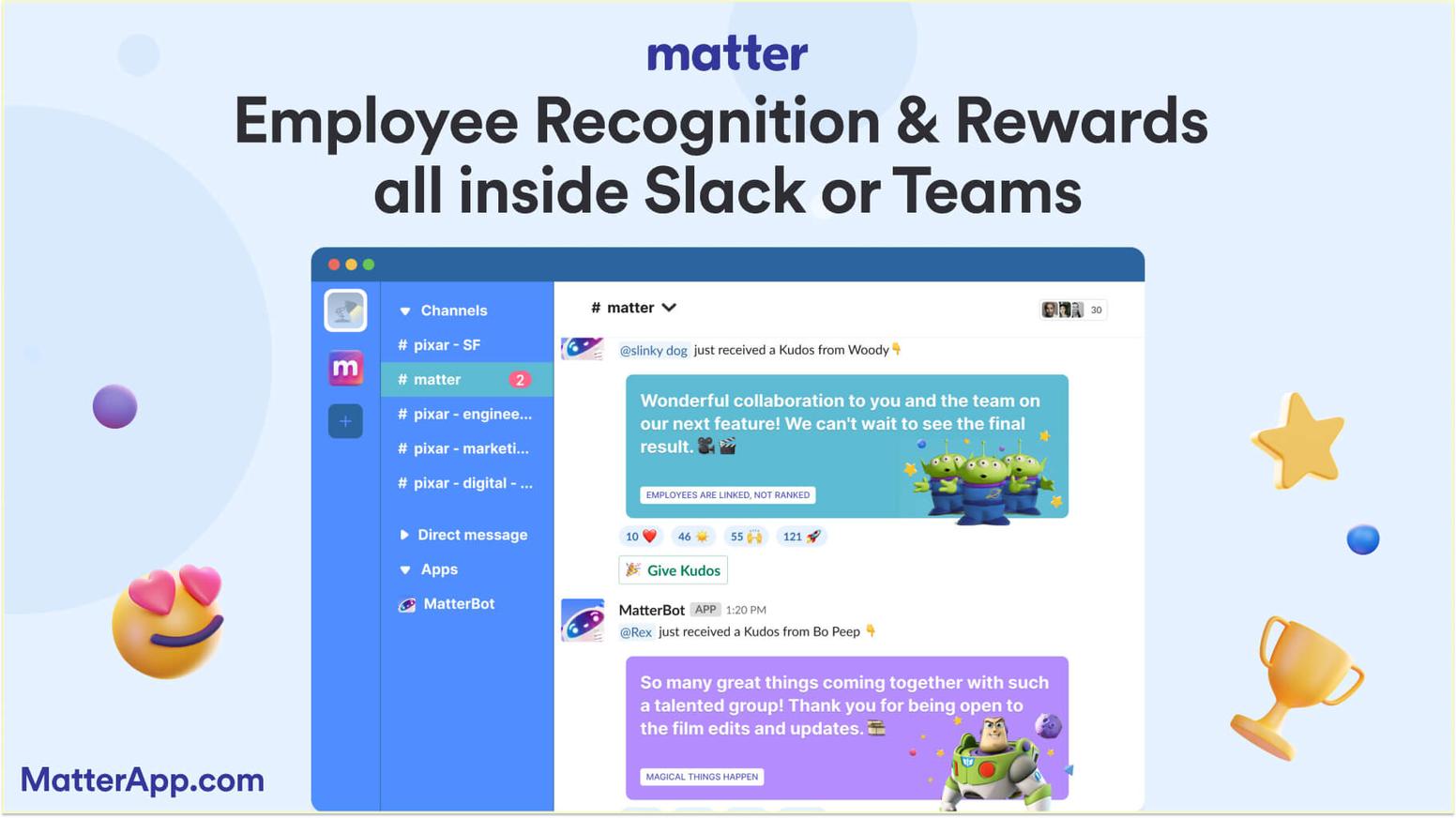
About Matter: Matter is a platform that prioritizes Slack and Teams, seamlessly integrating survey functionalities with recognition and rewards. The platform features a simplified 5-point eNPS system that maximizes response rates through intuitive, user-friendly interfaces. Matter's research-backed approach uses fully labeled response scales that prove more reliable than traditional 11-point formats. Enterprise capabilities include scalable architecture, advanced analytics with benchmarking, and automated survey scheduling that reduces administrative burden.
Matter main features:
- Simplified 5-point eNPS surveys with research-validated methodology
- Slack and Microsoft Teams integration for seamless survey delivery
- Customizable pulse survey templates with flexible scheduling options
Matter pricing:
- Free Forever: $0/user/month
- Basic: $1/user/month, billed annually
- Pro: $3/user/month, billed annually
- Pro + Surveys: $5/user/month, billed annually
To learn more, view Matter's pricing page.
Matter G2 score: Matter has a G2 score of 4.7/5 based on user reviews.
What Matter customers are saying: "Matter helps us connect and interact while showing people what kind of culture we strive for — we want people to be themselves and feel free to play and have fun at work!” - Leah Howse, Head of Staff at BRIO (Customer Story).
2. Culture Amp

About Culture Amp: Culture Amp is a comprehensive employee experience platform emphasizing research-backed survey methodologies developed by organizational psychologists. The platform provides extensive benchmarking databases that enable comparisons with thousands of organizations across multiple industries and regions. Action planning tools help translate survey insights into targeted improvement initiatives with measurable outcomes. Culture Amp serves enterprise organizations seeking sophisticated analytics and science-based approaches to workforce engagement measurement.
Culture Amp main features:
- Research-backed survey templates developed by organizational psychologists
- Comprehensive benchmarking database with industry-specific comparisons
- Action planning and change management tools for initiative tracking
Culture Amp pricing:
- Engage: contact the sales team for exclusive features
- Perform: contact the sales team for exclusive features
- Develop: contact the sales team for exclusive features
- People Analysis: contact the sales team for exclusive features
To learn more, view Culture Amp’s pricing page.
Culture Amp G2 score: Culture Amp has a G2 score of 4.5/5 based on user reviews.
What Culture Amp customers are saying on G2: “I’ve been using this software for a while now, and one of its standout features is how well-organized the system is. Everything is laid out in a clear and intuitive way, making it easy to navigate. Additionally, the punctuality of the communications is exceptional – notifications and updates are always timely, ensuring that I stay on top of tasks and deadlines. It’s a reliable tool for those who value efficiency and clear communication. Highly recommended!” - Anna L., SEO Consultant (G2 Review for Culture Amp).
3. CultureMonkey
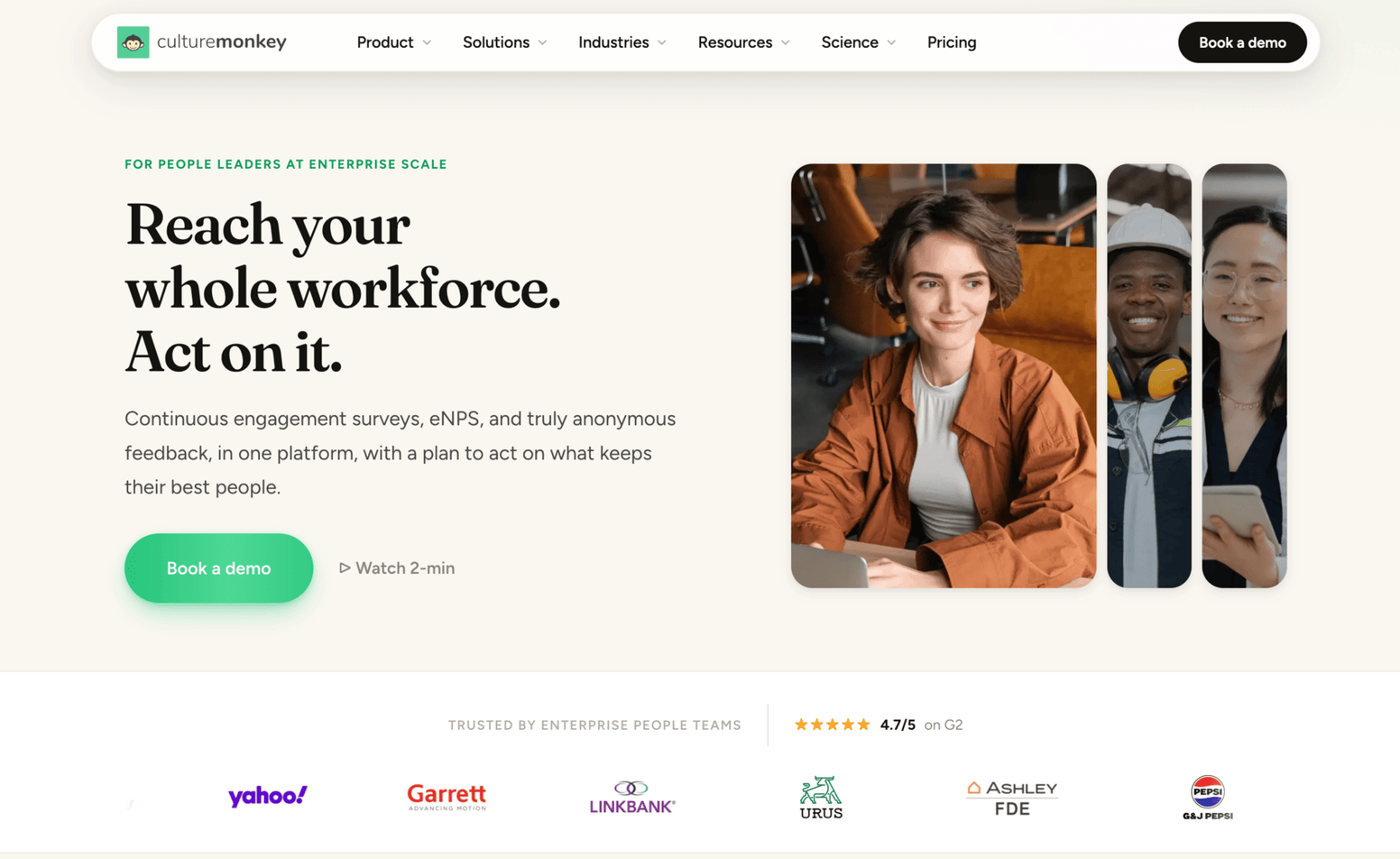
About CultureMonkey: CultureMonkey is an enterprise employee experience platform designed to help organizations strengthen trust, improve participation, and make better people decisions. It gives HR leaders a reliable way to understand what employees need, identify workplace concerns early, and maintain visibility across complex workforces. Its accessible approach helps organizations reach office-based, remote, and frontline employees while preserving confidentiality and encouraging honest responses. CultureMonkey also supports leadership teams in creating accountability, monitoring progress, and sustaining meaningful improvements over time. It is particularly valuable for global enterprises seeking an adaptable, user-friendly solution backed by responsive guidance and ongoing partnership at scale.
CultureMonkey main features:
- Customizable engagement, pulse, eNPS, onboarding, and employee lifecycle surveys
- Multilingual survey delivery through email, WhatsApp, Text message, QR codes, kiosks, Slack, and Microsoft Teams
- AI-powered insights, industry benchmarks, manager dashboards, and trackable action planning tools
CultureMonkey pricing: Custom pricing based on organization size, employee headcount, and selected requirements. To learn more, view CultureMonkey’s pricing page.
CultureMonkey G2 score: CultureMonkey has a G2 score of 4.7/5 based on user reviews.
What CultureMonkey customers are saying on G2: “Customer service. Back-end support is excellent. Easy to use. Analytics. Supports a lot of different languages.” The reviewer highlighted the platform’s strong service, simple user experience, reporting capabilities, and multilingual support for enterprise-wide surveys. - Sabir H., Enterprise user (G2 Review for CultureMonkey).
4. Qualtrics EmployeeXM
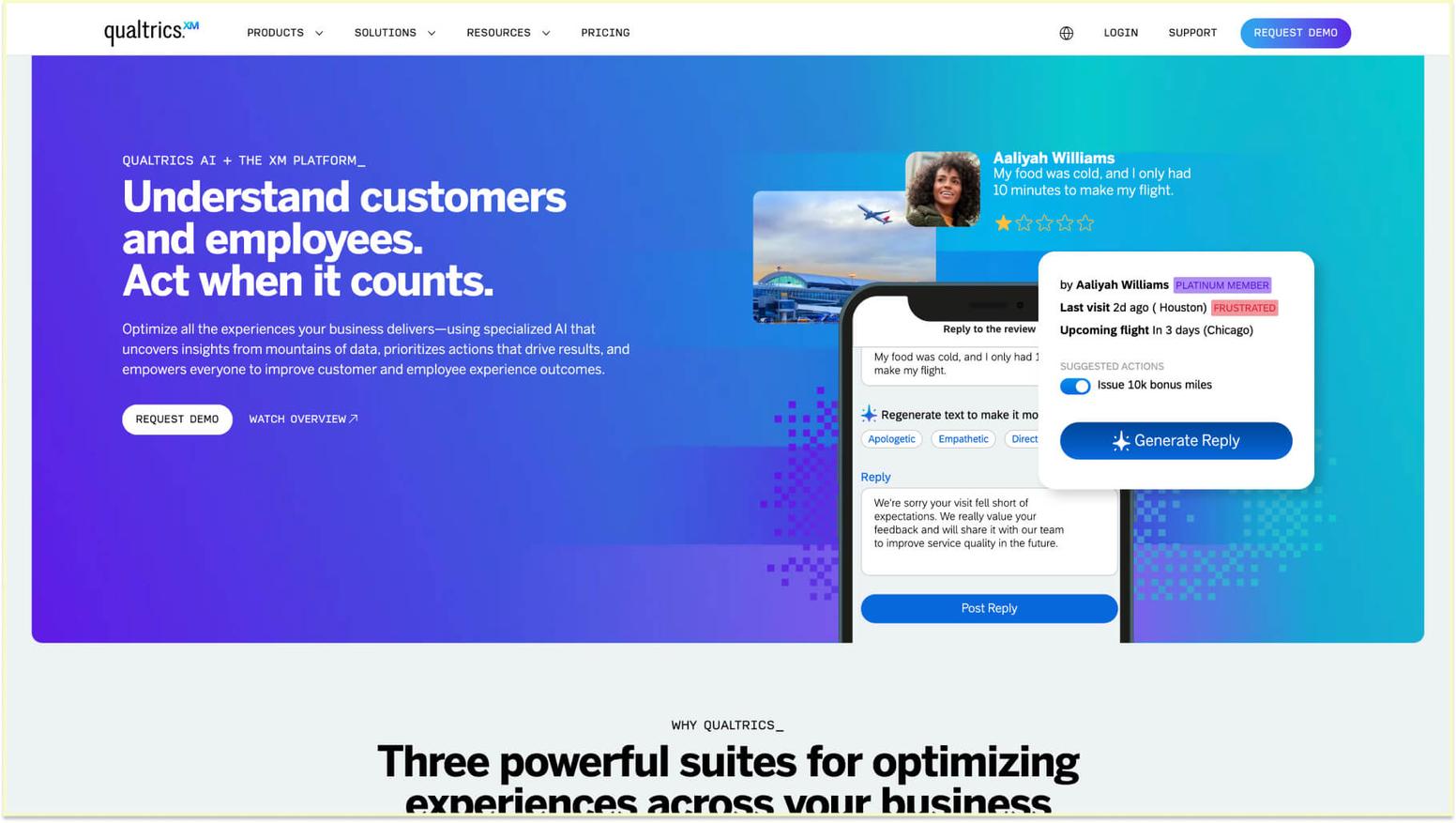
About Qualtrics EmployeeXM: Qualtrics EmployeeXM offers an enterprise experience management platform with sophisticated analytics capabilities and comprehensive survey functionality. The platform supports multi-language deployment across global organizations with diverse workforce populations and complex structures. Predictive intelligence features identify engagement risks before they impact retention, enabling proactive intervention strategies. Advanced reporting and customization options make Qualtrics suitable for large organizations requiring extensive configuration flexibility.
Qualtrics EmployeeXM main features:
- Enterprise-grade experience management with advanced analytics
- Multi-language support for global workforce deployment
- Predictive intelligence and AI-driven insights
Qualtrics EmployeeXM pricing: Pricing is not listed on the website. To learn more about pricing, you'll need to schedule a demo/sales call with Qualtrics EmployeeXM.
Qualtrics EmployeeXM G2 score: Qualtrics has a G2 score of 4.4/5 based on user reviews.
What Qualtrics EmployeeXM customers are saying on G2: “Preston Donohoo, with Red Pepper, has been fantastic to partner with. He is thorough, excellent at training and his customer support is outstanding. He made our implementation go very smoothly. We have found the Qualtrics engagement survey and 360s tools easy to use, with the ability to dive deep into our results. We would definitely recommend Qualtrics to others.” - Kelli G., Global Talent Manager (G2 Review for Qualtrics EmployeeXM).
5. Glint

About Glint: Glint provides real-time pulse surveys with AI-powered insights designed specifically for enterprise organizations with complex needs. The platform features manager enablement dashboards that help supervisors understand and improve team engagement through actionable recommendations. Predictive retention modeling identifies flight risks early, enabling organizations to intervene before valuable employees leave. LinkedIn's acquisition of Glint has strengthened its integration capabilities with professional development and talent management systems.
Glint main features:
- Real-time pulse surveys with AI-driven insights
- Manager enablement dashboards for team-level action
- Predictive retention modeling and risk identification
Glint pricing:
- Microsoft Viva Employee: $2.00 user/month (Annual commitment)
- Microsoft Viva Workplace: $6.00 user/month (Annual commitment)
- Microsoft Viva Suite: $12.00 user/month (Annual commitment)
To learn more, view Glint’s pricing page.
Glint G2 score: Glint has a G2 score of 4.6/5 based on user reviews.
What Glint customers are saying on G2: “Good depiction of data, easy to view formats with a variety of different cuts of data available. Not super user-friendly, requires too many clicks to filter the data needed.” - Anjali A., Human Resources Consultant (G2 Review for Software).
6. Workday
About Workday: Workday offers a continuous listening platform with powerful automation capabilities for enterprise deployment. The platform emphasizes privacy-first feedback collection while providing AI-driven recommendations that guide managers toward effective action. Integration with Workday HCM creates unified workforce data that connects engagement insights with broader talent management processes. Continuous listening methodology enables organizations to track sentiment changes in real-time rather than waiting for annual survey cycles.
Workday main features:
- Continuous listening platform with automated scheduling
- AI-driven insights and recommendations
- Privacy-first feedback collection methodology
Workday pricing:
- Workday Adaptive Planning: Free for 30 days
- Workday Adaptive Planning: contact sales to request pricing
- Workday Adaptive Planning Close & Consolidation: contact sales to request pricing
To learn more, view Workday’s pricing page.
Workday G2 score: Workday has a G2 score of 4.0/5 based on user reviews.
What Workday customers are saying on G2: “I've found Workday to be a reliable application for handling holiday and HR activities at my company. Its user-friendly interface makes requesting leave and checking balances easy and efficient. Real-time updates ensure I always know my leave status without chasing paperwork. I appreciate the integration with other HR functions, which provides a central hub for important information. While there can be some lag during busy times, overall, Workday simplifies holiday management and enhances transparency for both employees and HR teams.” - Saurabh Y., Senior Engineer (G2 Review for WorkDay).
5 mid-market survey software options
Mid-sized organizations need capable platforms without enterprise complexity or pricing. These solutions balance functionality with accessibility, offering strong feature sets at reasonable investment levels.
1. Matter
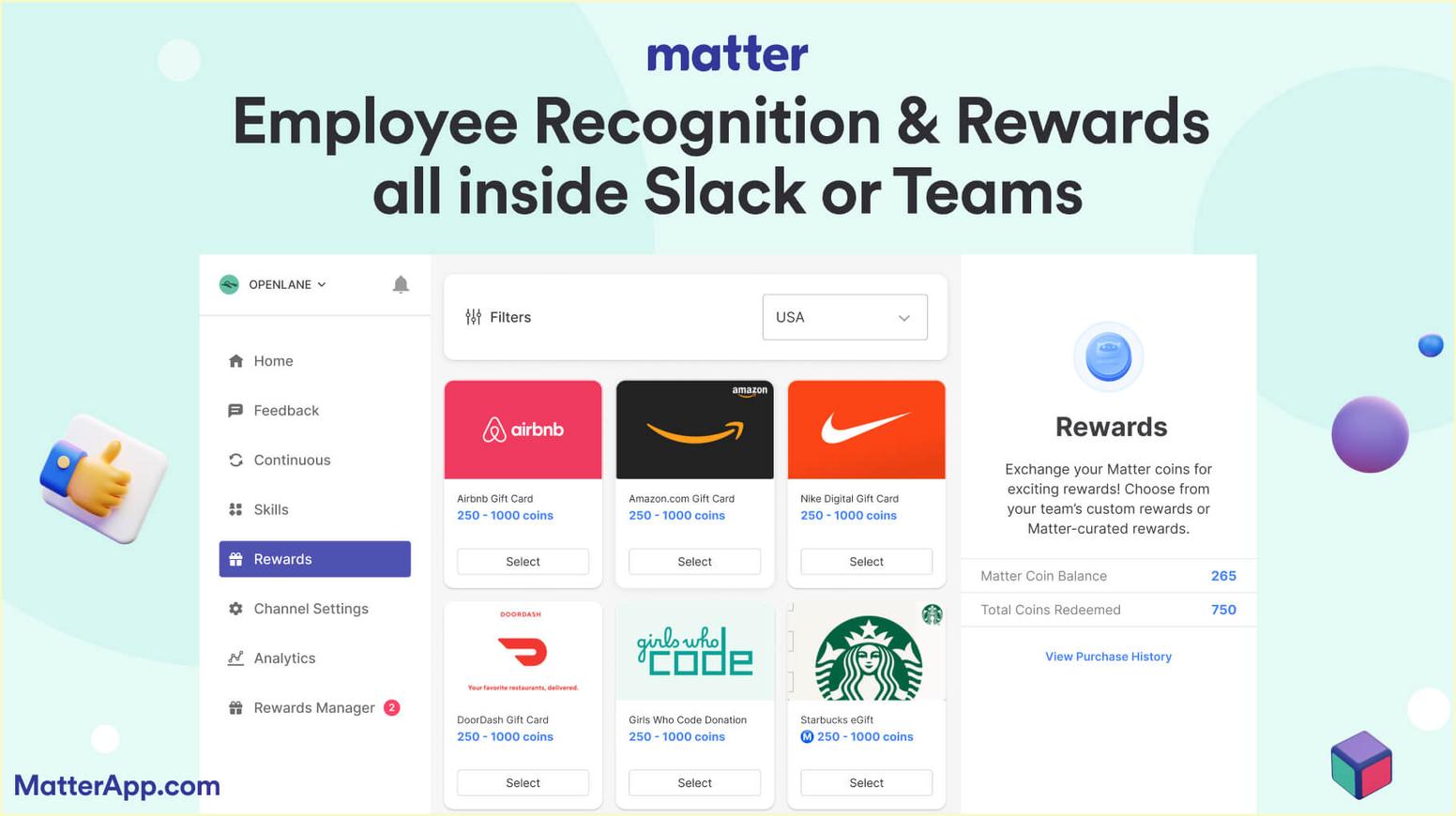
About Matter: Matter provides mid-market organizations with an ideal balance of powerful features and accessible affordability for engagement measurement. Implementation typically completes in under two weeks, allowing rapid deployment without extensive IT involvement or technical expertise. The integrated platform combines surveys with recognition capabilities, creating comprehensive engagement management within a single unified system. Organizations benefit from Matter's intuitive design, which encourages high participation and meaningful feedback collection across all departments.
Matter main features:
- Quick implementation under two weeks
- Integrated surveys and recognition platform
- Automated Feedback Friday reminders for consistent engagement
Matter pricing:
- Free Forever: $0/user/month
- Basic: $1/user/month, billed annually
- Pro: $3/user/month, billed annually
- Pro + Surveys: $5/user/month, billed annually
To learn more, view Matter's pricing page.
Matter G2 score: Matter has a G2 score of 4.7/5 based on user reviews.
What Matter customers are saying: “People can get so busy with their work, that they become unaware of all the good things happening across the company. Matter allows us to see what others are accomplishing and gives us a platform to congratulate each other for wins big and small." - Gabriela Ruiz, Head of People at Hunty (Customer Story).
2. Lattice
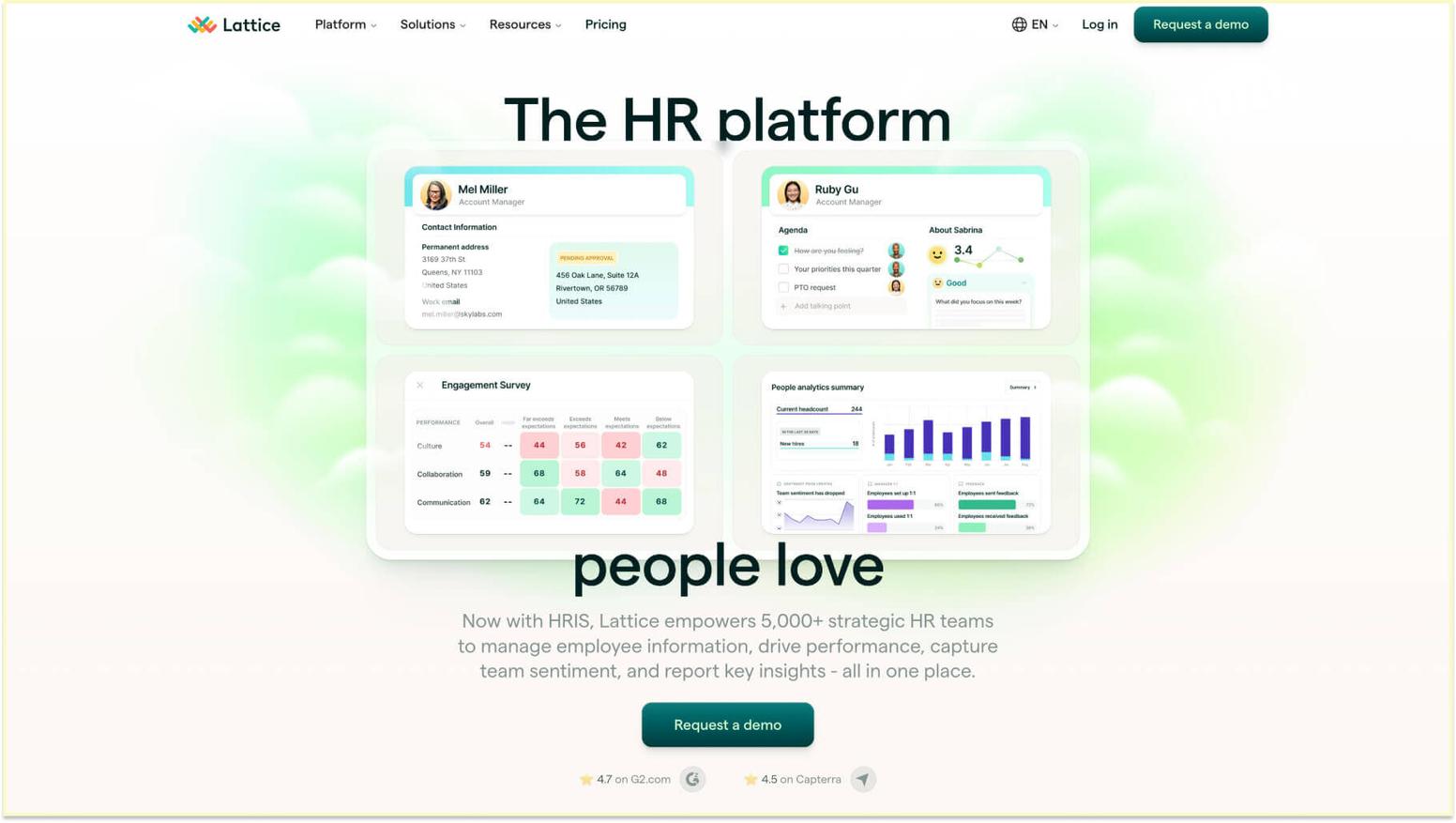
About Lattice: Lattice combines performance management with employee engagement measurement in a unified platform designed for growing organizations. Customizable survey templates adapt to specific organizational needs while maintaining research-validated measurement standards for reliable results. Goal tracking and OKR integration connect engagement data to performance outcomes, enabling data-driven decisions about workforce development. The platform serves mid-market companies seeking comprehensive people management solutions without enterprise-level complexity or pricing.
Lattice main features:
- Combined performance and engagement platform
- Customizable survey templates and question libraries
- Goal tracking and OKR integration
Lattice pricing:
- Talent Management: $11/seat/month
- Foundation: $11/seat/month
- Engagement: $4/seat/month
- Grow: $4/seat/month
- Compensation: $6/seat/month
To learn more, view Lattice's pricing page.
Lattice G2 score: Lattice has a G2 score of 4.7/5 based on user reviews.
What Lattice customers are saying on G2: “Ease of use and ease of implementation. The implementation time commitment was hours not weeks. We initially implemented all modules except Grow, Comp, and Engage and manged to configure and test all modules in less than two weeks. The product team is very receptive to feedback and also able to help come up with creative workarounds for functional gaps. The customer support is great and very responsive.” - Matthew H., Senior Human Resources Manager (G2 Review for Lattice).
3. 15Five

About 15Five: 15Five offers weekly check-ins with integrated eNPS tracking capabilities that maintain ongoing dialogue between managers and team members. The platform includes manager training resources and enablement tools that improve response to feedback and drive meaningful action. Performance and engagement combine in a unified approach that connects employee sentiment data with individual development and growth. Organizations use 15Five to build consistent feedback rhythms that strengthen manager-employee relationships throughout the year.
15Five main features:
- Weekly check-ins with eNPS tracking
- Manager training resources and enablement
- Combined performance and engagement platform
15Five pricing:
- Engage: $4/user/month, billed annually
- Perform: $11/user/month, billed annually
- Total Platform: $16/user/month, billed annually
To learn more, view 15Five's pricing page.
15Five G2 score: 15Five has a G2 score of 4.6/5 based on user reviews.
What 15Five customers are saying on G2: “We have built a company wide OKR tied to our company wide average Pulse score. It is an easy check of how the company is "feeling" from week to week, and over the last 2 years, I have found it to be accurate, important and super easy for the team to adopt and stay consistent in use.”- Dan A., Small-Business (G2 Review for 15Five).
4. Workleap/Officevibe
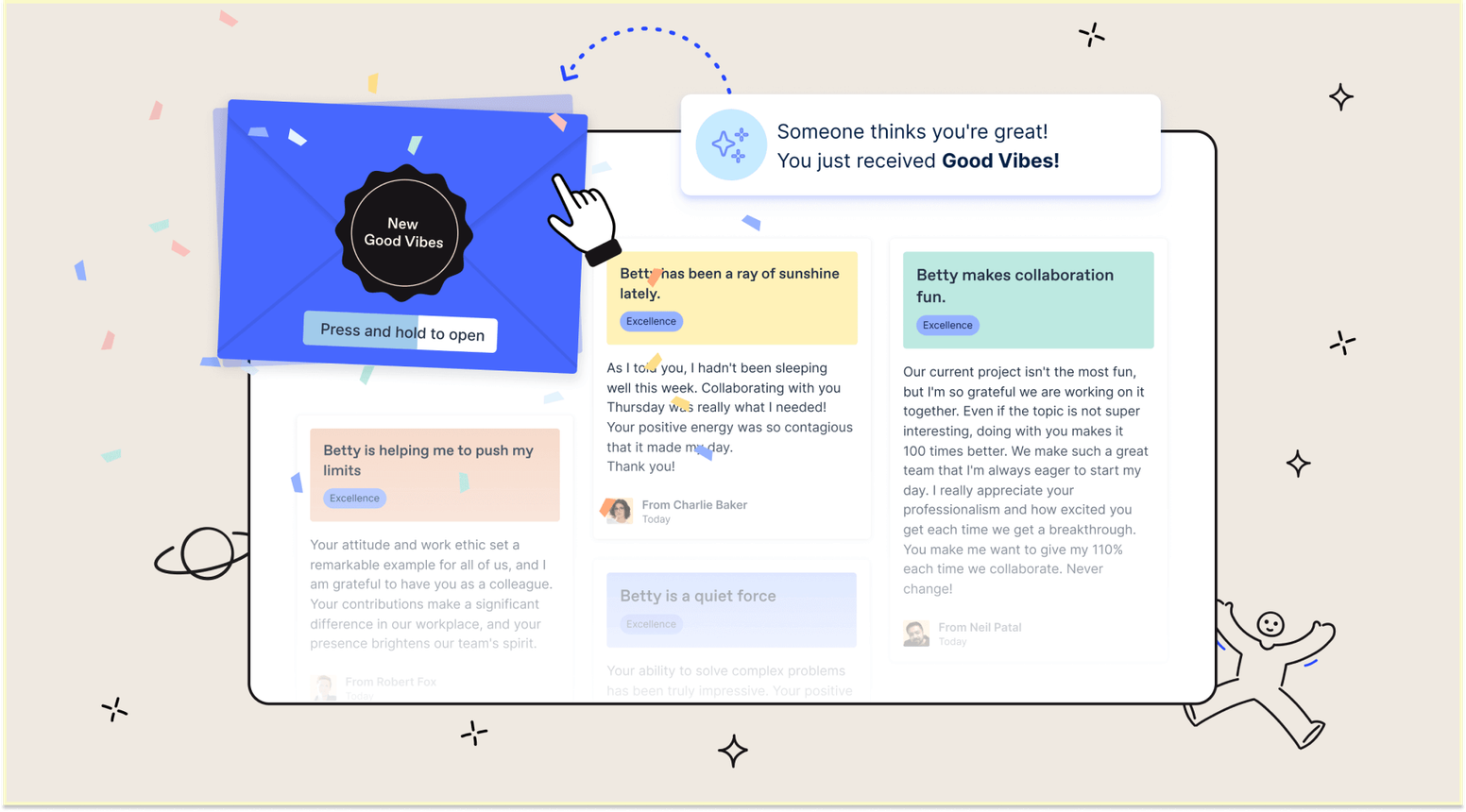
About Workleap/Officevibe: Workleap/Officevibe provides automated weekly pulse surveys with science-backed question libraries validated through organizational psychology research. Team health metrics dashboards give managers clear visibility into engagement patterns and trends affecting their direct reports. The platform emphasizes ongoing feedback collection over traditional annual assessments, which miss important sentiment shifts. Officevibe helps organizations build consistent listening habits that strengthen workplace culture and improve employee retention outcomes.
Workleap/Officevibe main features:
- Automated weekly pulse surveys
- Science-backed question library
- Team health metrics dashboard
Workleap/Officevibe pricing:
- Officevibe: $5/month, 10 users minimum
- Performance: $5/month, 10 users minimum
- Compensation: $5/month, 100 users minimum
- Office & Performance: $8/user/month, 10 users minimum
To learn more, view Workleap/Officevibe's pricing page.
Workleap/Officevibe G2 score: Workleap/Officevibe has a G2 score of 4.3/5 based on user reviews.
What Workleap/Officevibe customers are saying on G2: “Officevibe provides a regular stream of honest feedback and discussion between managers and employees across our company. GoodVibes has become THE way our employees appreciate and recognize one another. Our management team disucsses the data and anonymous responses on a monthly basis.” - Anthony B., President (G2 Review for Workleap).
5. TinyPulse
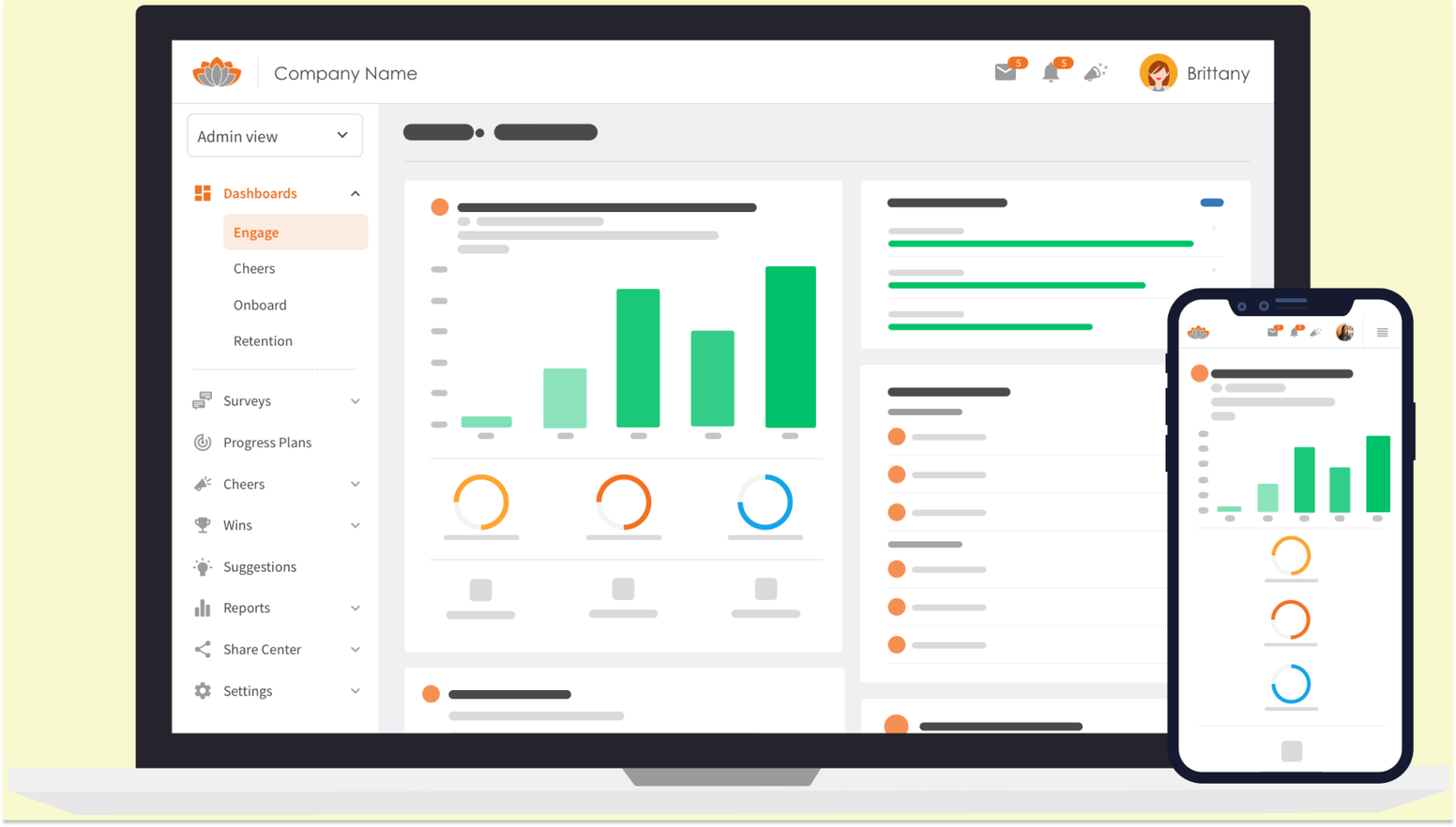
About TinyPulse: TinyPulse specializes in collecting anonymous feedback, with peer recognition features that encourage honest, open communication. The platform includes a suggestion box for ongoing idea collection, surfacing employee innovations, and improvement opportunities. Simple, intuitive interfaces encourage regular participation without creating survey fatigue or overwhelming busy employees with complex tools. TINYpulse serves organizations seeking straightforward engagement measurement with built-in recognition functionality at accessible pricing.
TinyPulse main features:
- Anonymous feedback collection
- Peer recognition features
- Suggestion box capabilities
TinyPulse pricing: Pricing is not listed on the website. To learn more about pricing, you'll need to schedule a demo/sales call with TinyPulse.
TinyPulse G2 score: Tinyulse has a G2 score of 4.9/5 based on user reviews.
What TinyPulse customers are saying on G2: “There is no way to turn off the comment boxes which allows people to share any and all feedback, whether relevant or not. Many people question the anonymity of it so it's hard to get responses even when private messaging.” - Verified User in Higher Education.
5 budget-friendly survey platforms
Budget constraints should not prevent organizations from gathering workforce feedback. These affordable options provide core functionality without premium pricing. Small organizations can implement effective measurement within limited budgets.
1. Matter
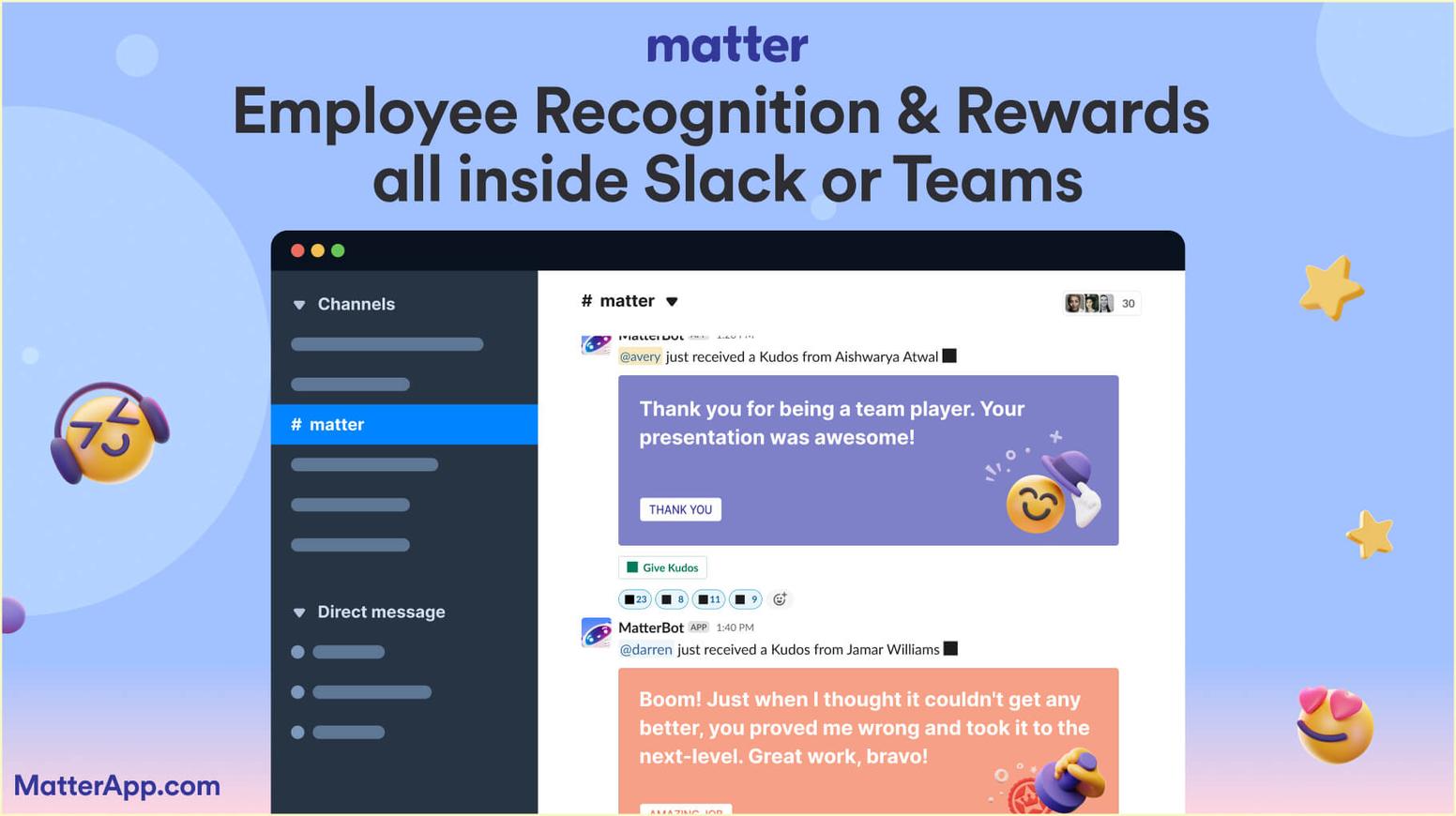
About Matter: Matter offers a Free Forever plan that provides core survey and recognition features at no cost to budget-conscious organizations. The simplified 5-point eNPS system requires minimal training while maximizing participation rates through an intuitive, user-friendly design. Low per-user pricing starting at one dollar monthly makes scaling affordable as organizations grow beyond free tier limits. Matter delivers professional engagement measurement capabilities without requiring significant budget allocation or long-term financial commitments.
Matter main features:
- Free Forever plan with core features
- Simplified 5-point eNPS system
- Low per-user cost starting at $1/month
Matter pricing:
- Free Forever: $0/user/month
- Basic: $1/user/month, billed annually
- Pro: $3/user/month, billed annually
- Pro + Surveys: $5/user/month, billed annually
To learn more, view Matter's pricing page.
Matter G2 score: Matter has a G2 score of 4.7/5 based on user reviews.
What Matter customers are saying: "The setup was extremely easy. It had a good UX and interface, and people knew how to use it intuitively. The channel got popular in the first two weeks." - Mathis Bogen, Head of Internal Communications at Bolt (Customer Story).
2. SurveyMonkey
About SurveyMonkey: SurveyMonkey provides pre-built survey templates for DIY deployment that organizations can customize without specialized expertise. The platform offers flexible survey creation and distribution capabilities suitable for teams managing their own feedback collection processes. Basic analytics and reporting features meet essential needs for organizations starting their engagement measurement journey. SurveyMonkey works well for teams seeking general survey functionality rather than specialized employee engagement tools.
SurveyMonkey main features:
- Pre-built survey templates
- DIY survey creation and distribution
- Basic analytics and reporting
SurveyMonkey pricing:
- Team Advantage: $25/user/month, starting at 3 users, billed annually
- Team Premier: $75/user/month, starting at 3 users, billed annually
- Enterprise: Talk to sales for pricing
To learn more, view SurveyMonkey’s pricing page.
SurveyMonkey G2 score: SurveyMonkey has a G2 score of 4.4/5 based on user reviews.
What SurveyMonkey customers are saying on G2: “The free plan lets you create surveys with up to 25 responses. For most real-world uses, that's very limiting. The basic paid plan doesn't cut it either. If you need to export your data, you're looking at the higher tiers that run closer to $100/month. Additionally, the survey customization options can be a lot better. The competitors in this space offer advanced customization that SurveyMonkey is definitely missing.” -Nitin M., Product Manager (G2 Review for SurveyMonkey).
3. Google Forms

About Google Forms: Google Forms offers free survey creation with flexible question types, accessible to anyone with a Google account. The platform integrates seamlessly with Google Sheets for basic data collection, storage, and export to other analysis tools. Simple interfaces make deployment straightforward for teams without technical expertise or dedicated survey administration resources. Google Forms serves as an entry point for organizations beginning to gather employee feedback before investing in specialized platforms.
Google Forms main features:
- Completely free survey creation
- Flexible question types and formats
- Basic data collection and export to Sheets
Google Forms pricing:
- Starter: $6.30 user per month
- Standard: $12.60 user per month
- Plus: $22 user per month
- Enterprise Plus: Talk to sales for pricing
To learn more, view Google Forms pricing page.
Google Forms G2 score: Google Forms has a G2 score of 4.6/5 based on user reviews.
What Google Forms customers are saying on G2: “Honestly, I enjoy using Google Workspace overall, though it can be somewhat challenging when the internet connection is unstable, as most of its tools require being online. Additionally, with so many apps like Docs, Sheets, Drive, and Meet, it can feel a bit overwhelming at first. However, once you become familiar with the platform, everything tends to run very smoothly.” - Girishchand B., Test Engineer Level 2 (G2 review for Google Forms).
4. Energage
About Energage: Energage is an employee engagement platform built on over 20 years of workplace research and culture insights. The platform combines research-backed surveys with AI-powered analysis to help organizations measure engagement, identify cultural strengths, and take targeted action. Energage powers the prestigious Top Workplaces awards program and has surveyed over 23 million employees across 70,000 organizations. The platform offers comprehensive benchmarking capabilities that allow companies to compare their engagement metrics against industry standards, providing valuable context for improvement initiatives.
Energage main features:
- Research-backed Workplace Survey with AI-powered insights
- Pulse surveys for real-time employee feedback
- Benchmarking against industry peers and Top Workplaces data
Energage pricing: Pricing is not listed on the website. To learn more about pricing, you'll need to schedule a demo/sales call with Energage.
Energage G2 score: Energage has a G2 score of 4.6/5 based on user reviews.
What Energage customers are saying on G2: “The pulse survey section still needs work I want a system that I can customize the wording of the rankings, create yes/no questions if I want and be able to order the sequence of questions so they make sense to me. I want to add skip logic so people who answer one way to a question can skip over a question to the next question. Changes were made to the pulse survey section so that it really doesn't work for me now. I've stopped using it and moved to google forms instead” - Verified User in Staffing & Recruiting (G2 Review for Energage).
5. Polly
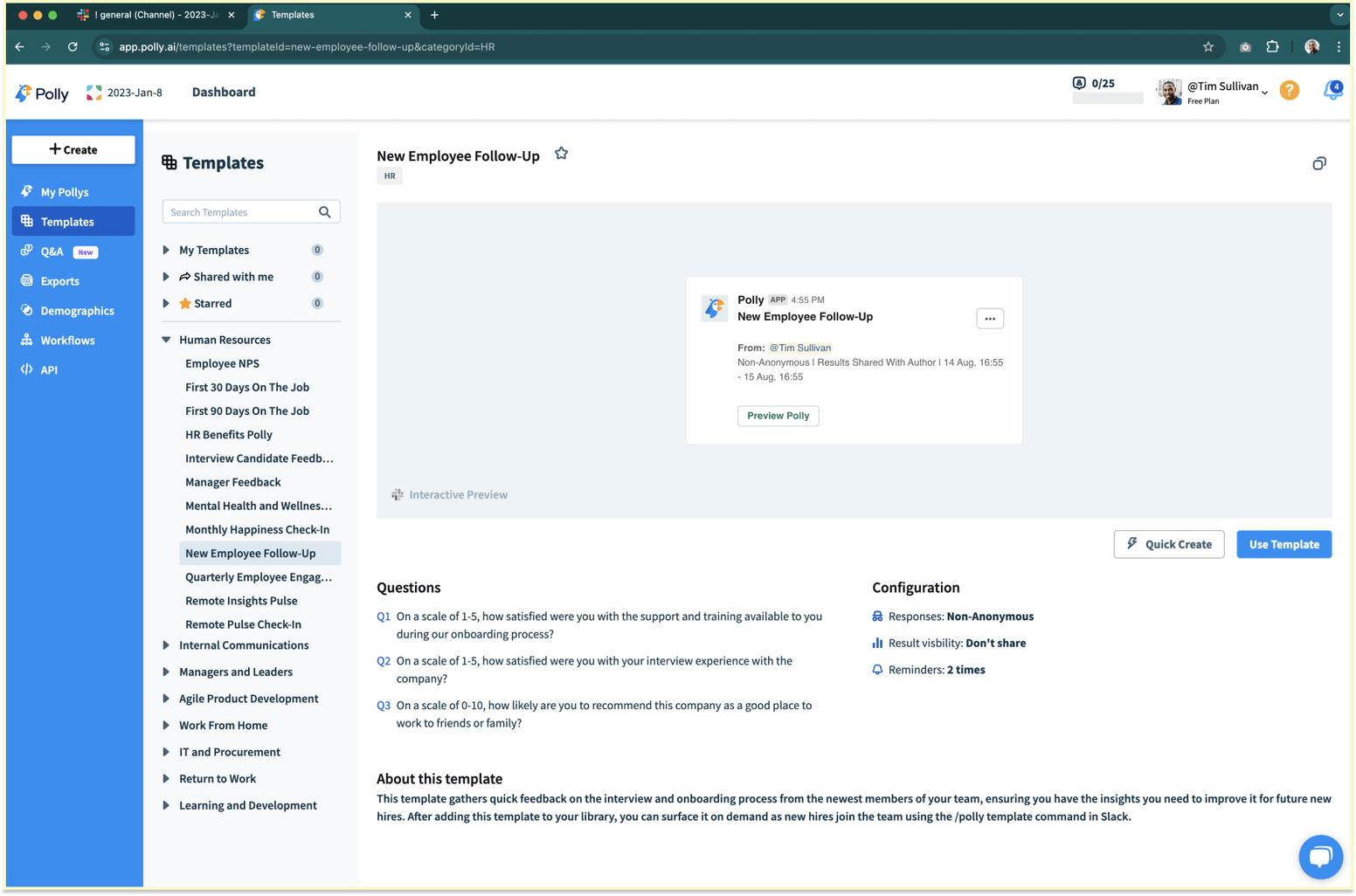
About Polly: Polly enables simple polls and surveys directly within Slack and Microsoft Teams workspaces for immediate feedback. The platform offers quick pulse checks without requiring employees to leave their primary communication tools during busy workdays. Free and paid tiers accommodate different organizational needs and budget constraints with flexible feature access. Polly works best for teams seeking lightweight feedback collection rather than comprehensive engagement measurement programs.
Polly main features:
- Simple polls and surveys in Slack
- Quick pulse checks
- Free and paid tiers
Polly pricing:
- Free: $0 per month
- Basic: $12 per month. Billed $144 annually for 1 license
- Pro: $24 per month. Billed $288 annually per license
- Enterprise: Talk to sales for pricing
To learn more, view Polly’s pricing page.
Polly G2 score: Polly has a G2 score of 4.6/5 based on user reviews.
What Polly customers are saying on G2: “Love that it integrates so seamlessly with Slack. I can create a question bank and share it with certain channels. The options for questions is great, making surveys as complete as possible in order to get the most feedback. Super easy to use and implements so well. I use on a case to case basis but slowly making part of my weekly use.” - Stephanie R. (G2 Review for Polly).
8 tips for analyzing survey results effectively
Collecting survey data represents only the beginning of the improvement process. Employee recognition software platforms that include analytics accelerate the transition from data to action. Systematic analysis approaches ensure organizations extract maximum value from feedback investments.
Analysis quality directly determines the effectiveness of the action plan. A superficial review misses important patterns, while a thorough examination reveals precise improvement opportunities. These tips guide comprehensive result evaluation.
Data analysis and interpretation tips
Effective analysis requires systematic approaches that avoid confirmation bias and surface unexpected findings.
- Segment results by department, tenure, and role. Overall scores mask significant variations across populations. Segmentation reveals where specific attention is needed.
- Compare current results to previous surveys. Trend direction matters as much as absolute scores. Improvement trajectories indicate initiative effectiveness.
- Identify statistically significant changes. Small score variations may reflect random fluctuation rather than real change. Statistical testing confirms meaningful differences.
- Look for patterns in open-ended responses. Qualitative data provides context for quantitative scores. Themes across responses reveal shared concerns.
Insight generation and reporting tips
Translating analysis into actionable reports requires focusing on practical implications.
- Focus on the top 3 strengths and 3 opportunities. Comprehensive lists overwhelm stakeholders and diffuse attention. Prioritization ensures meaningful action.
- Create executive summaries for leadership. Senior leaders need high-level views with key takeaways. Detailed data belongs in the appendices for interested parties.
- Generate team-specific reports for managers. Supervisors need data relevant to their teams. Organization-wide averages provide insufficient guidance for local action.
- Benchmark against industry standards. Context transforms abstract numbers into meaningful indicators. Benchmark comparisons reveal relative positioning.
Pulse survey best practices include regular analysis cadences that prevent data accumulation without review.
8 tips for taking action on feedback results

Survey value depends entirely on the organization's response to the findings. Employee rewards software that connects recognition to improvement priorities reinforces positive change. Action planning transforms feedback into tangible workplace improvements.
Employees watch carefully whether organizations act on the feedback they provide. Visible responses build trust and encourage future participation. Failure to act destroys credibility and discourages honest sharing.
Action planning and communication tips
Transparent communication about survey results and planned responses maintains employee trust.
- Share results within 30 days of survey close. Delays signal low priority and reduce perceived impact. Quick communication demonstrates organizational commitment.
- Create action plans with specific owners and timelines. Vague intentions rarely produce results. Accountability requires named individuals and deadlines.
- Prioritize quick wins alongside long-term initiatives. Immediate improvements demonstrate responsiveness while larger projects are in development. Balance creates visible progress.
- Communicate what will and won't change. Honest acknowledgment of constraints builds credibility. Explaining the reasoning behind decisions shows respect for employee intelligence.
Implementation and follow-through tips
Sustained implementation requires ongoing attention and resource commitment.
- Form employee committees to guide improvements. Including employees in solution development increases buy-in and surfaces better ideas. Participation creates ownership.
- Allocate budget for high-priority action items. Meaningful change often requires investment. Budget commitment signals a genuine organizational priority.
- Track progress and share updates regularly. Visibility maintains momentum and demonstrates accountability. Regular updates keep initiatives on track.
- Connect improvements to recognition programs. Celebrating progress reinforces positive change. Recognition motivates continued effort toward goals.
Pulse survey objectives should include tracking progress on action items between comprehensive assessments.
How Matter can help with feedback collection and continuous listening
Matter provides a comprehensive measurement solution combining intuitive survey capabilities with recognition and rewards. The platform's Slack-first and Teams-first approach delivers surveys where employees already work, dramatically increasing response rates. Organizations gain actionable insights without adding friction to employee workflows.
The integrated platform connects feedback with recognition programs, enabling complete cycles. When surveys reveal appreciation gaps, Matter's recognition features address them directly. This closed-loop approach distinguishes Matter from standalone platforms.
Matter's simplified 5-point eNPS system that maximizes response rates
Pulse survey app experiences a significant impact on participation rates, and Matter's design prioritizes usability. The 5-point eNPS scale draws from research showing that fully labeled response formats outperform traditional 11-point scales. This simplified approach reduces respondent effort while maintaining measurement validity.
Matter calculates eNPS as promoters minus detractors, where promoters are those selecting "strongly agree," and detractors are those selecting "neutral" through "strongly disagree." This methodology aligns with academic research demonstrating equivalent measurement quality with improved user experience. Higher completion rates produce more representative data.
The intuitive interface requires minimal training to complete a survey. Employees understand the scale immediately, without confusion about the meanings of the numbers. This clarity improves response quality alongside participation rates.
Pulse survey automation with customizable frequencies and questions
Matter automates survey scheduling to ensure consistent feedback collection without administrative burden. HR teams set frequencies matching organizational preferences, from weekly pulses to monthly check-ins. The system handles distribution, reminders, and collection automatically.
Customizable question libraries allow organizations to focus on relevant topics while maintaining core engagement metrics. Templates provide starting points that teams modify based on unique circumstances. Flexibility ensures surveys feel relevant to respondents.
The Feedback Friday feature creates predictable rhythms that employees come to expect and anticipate. Regular cadence normalizes feedback as an ongoing conversation rather than an annual event. This cultural shift produces more authentic engagement data.
Real-time analytics dashboards with department-level insights
Recognition program integration allows Matter's analytics to reveal connections between appreciation patterns and engagement scores. Real-time dashboards surface trends immediately as responses arrive. Waiting for monthly reports becomes unnecessary when insights appear continuously.
Department-level views enable managers to understand their specific team dynamics rather than relying on organizational averages. This granularity guides targeted interventions where they matter most. Aggregated data informs executive decisions while detailed views support frontline action.
Trend visualization makes patterns obvious without requiring statistical expertise. Color-coded displays highlight areas of concern and celebrate strengths. Interactive exploration allows users to deeply investigate areas of interest.
Frequently asked questions about workforce feedback platforms
Q: What are employee engagement survey tools?
A: Software platforms that automate survey creation, distribution, collection, and analysis. They help organizations systematically measure workforce commitment levels and identify improvement opportunities through structured feedback programs.
Q: What are the best workforce feedback platforms?
A: The best platforms offer customizable surveys, real-time analytics, seamless workplace integrations, and flexible pricing. Matter stands out with its Slack-first and Teams-first approach, simplified 5-point eNPS system, and Free Forever plan. Selection depends on organizational size, budget, and specific feature requirements. Pulse survey examples help reveal different approaches to measurement.
Q: How much do these platforms cost?
A: Pricing ranges from free plans like Matter's Free Forever tier to enterprise solutions costing more than fifteen dollars per user monthly. Most mid-market platforms charge between three and ten dollars per user monthly with annual billing.
Q: What features should employee engagement survey software include?
A: Essential features include customizable survey templates, automated scheduling, real-time analytics, benchmarking capabilities, and integration with existing workplace tools. Advanced platforms add sentiment analysis and predictive retention modeling.
Q: What is the difference between pulse platforms and annual surveys?
A: Pulse surveys deploy brief three to five-question check-ins weekly or monthly for continuous feedback. Annual surveys provide comprehensive assessments with fifty or more questions measuring all dimensions once yearly. Pulse survey questions for employees focus on immediate sentiment while annual surveys examine broader patterns.
Q: How do satisfaction platforms differ from engagement platforms?
A: Satisfaction tools measure contentment with workplace conditions like compensation and benefits. Engagement tools assess emotional commitment, discretionary effort, and organizational loyalty. Satisfaction indicates happiness, while engagement predicts retention and performance.
Final thoughts about workforce feedback platforms
These platforms transform feedback collection from manual, sporadic processes into automated systems that drive continuous improvement. The right platform enables organizations to systematically gather insights, analyze results effectively, and act on findings promptly. Modern tools integrate with recognition programs to close the feedback loop and reinforce positive behaviors.
Matter provides a complete engagement solution with simplified 5-point eNPS surveys, automated pulse survey scheduling, comprehensive analytics dashboards, and seamless integration with peer recognition. The free forever plan makes professional engagement measurement accessible to organizations of all sizes. By embedding surveys within Slack and Microsoft Teams, Matter transforms engagement measurement from expensive annual events into continuous feedback systems that build trust, improve employee retention, and drive measurable business results through actionable insights.
Employee rewards ideas aligned with survey improvement priorities amplify positive change and demonstrate the organization's responsiveness to feedback.
Ready to transform your workforce measurement with intuitive feedback platforms? Schedule a demo with a Matter expert today and discover how our platform can help you maximize response rates, analyze results effortlessly, and create a culture of continuous improvement.

![Employee Engagement Surveys [25+ Tips & Tools for 2026]](https://cdn.sanity.io/images/kqqb5xry/production/13fd70d57fbbac5ce7dc325b8217cacb5509a53c-800x600.jpg?w=720&q=75&fit=max&auto=format)
![39+ Employee Engagement Survey Software & Tips [2026 Guide]](https://cdn.sanity.io/images/kqqb5xry/production/96f3aa6a6719a27d6c2daeca50c0087b2197d200-800x600.jpg?w=720&q=75&fit=max&auto=format)