

Pulse survey templates provide the foundation for continuously measuring employee engagement and capturing real-time insights into workplace culture. At Matter, we recognize that organizations encounter significant challenges when trying to deploy employee pulse surveys quickly while lacking the expertise to design survey templates that yield actionable insights from employees. Creating pulse survey templates from scratch takes weeks of valuable time, especially when HR professionals need immediate feedback to measure employee sentiment, address satisfaction concerns, or track the impact of organizational changes on their teams.
Ready-to-use pulse survey templates eliminate these obstacles by providing research-backed frameworks that organizations can deploy immediately. These proven pulse survey templates ensure comprehensive measurement of key areas affecting employee engagement, maintain optimal survey length to achieve high completion rates, and enable HR teams to focus on acting on insights rather than spending weeks building surveys from scratch.
What is a pulse survey and pulse survey definition?
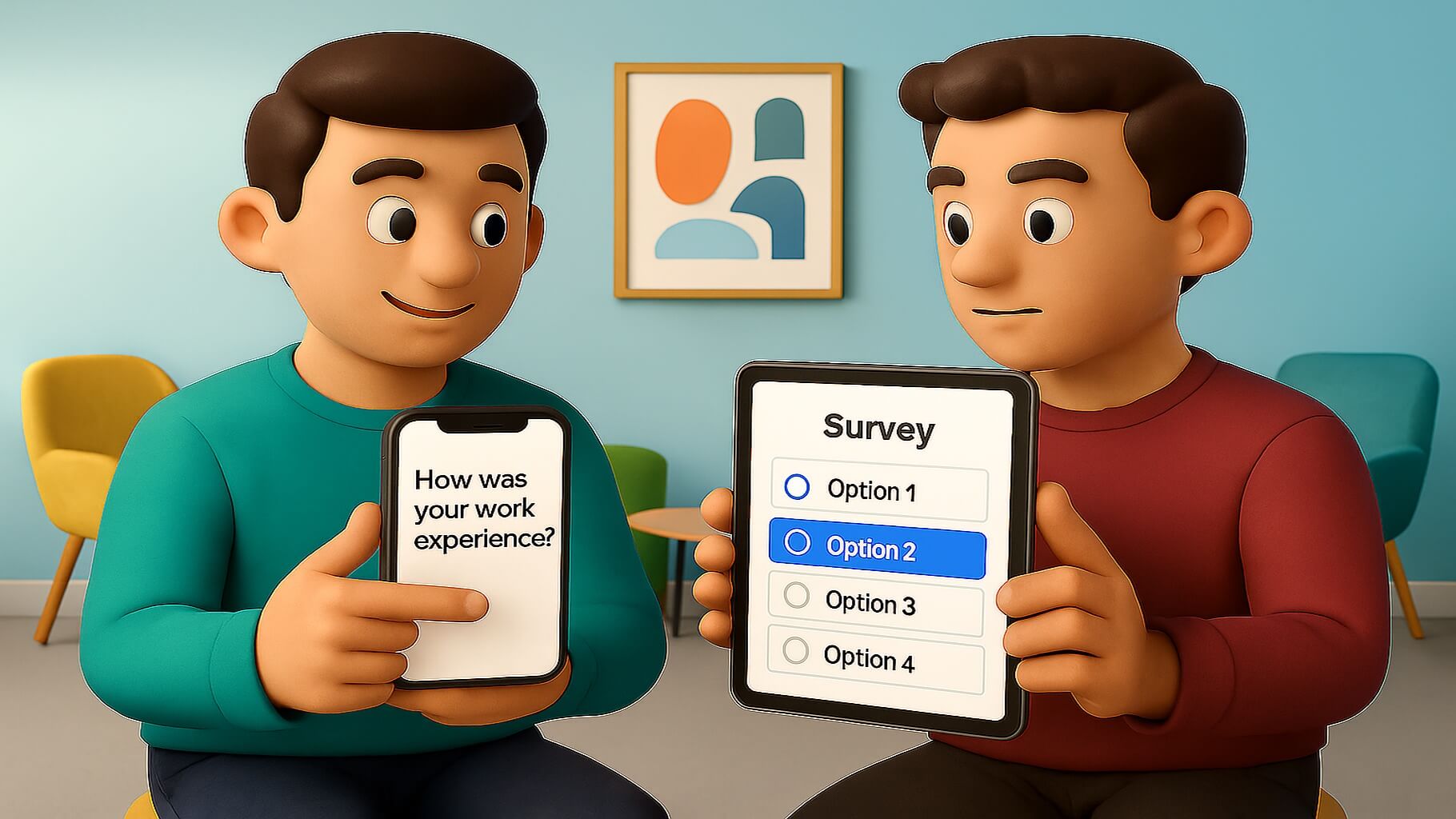
Pulse surveys represent a fundamental shift in how organizations approach employee feedback and engagement measurement. A pulse survey is a brief, frequent questionnaire designed to capture real-time employee sentiment on specific workplace topics. These pulse surveys typically contain between five and fifteen questions and can be completed in under five minutes, making pulse survey templates far less burdensome than comprehensive employee surveys.
The core purpose of pulse surveys is to provide organizations with regular check-ins on employee morale, satisfaction, and engagement, allowing leaders to identify trends, address concerns promptly, and make informed decisions based on current data rather than outdated annual employee feedback.
Comprehensive testing approaches ensure survey quality before full deployment. Internal reviews by HR team members check for clarity, while cognitive interviews reveal where employees get confused as they think aloud. Pilot deployments with small, representative employee groups identify issues before full launch. Technical testing across devices and browsers confirms functionality, and data validation ensures responses are captured correctly.
Benefits of using pulse survey template frameworks
Implementing pulse surveys with pre-built templates delivers substantial advantages for organizations committed to understanding and improving employee engagement through regular employee surveys. These pulse survey template frameworks transform what could be a time-intensive process into a streamlined practice that consistently yields valuable insights about employee sentiment and workplace culture.
Accelerating survey deployment with proven templates
Time represents one of the most significant challenges when implementing pulse surveys. Building pulse surveys from scratch requires research into best practices, careful question crafting for employee surveys, selection of response scales, and thorough testing. This process can consume weeks or even months. Pulse survey templates eliminate these barriers by providing ready-to-use pulse survey frameworks that organizations can deploy within hours.
These pulse survey templates come pre-loaded with questions that have been tested and refined across thousands of employee implementations. The speed advantage of pulse survey templates extends beyond initial setup. With survey templates, organizations can establish a regular cadence of pulse surveys without requiring significant preparation time for each cycle.
Ensuring comprehensive question coverage through templates
Well-designed pulse survey templates ensure balanced coverage across key areas identified by research as critical drivers of employee engagement. These pulse survey templates typically include questions measuring clear expectations and understanding of role responsibilities, access to necessary resources and tools, recognition and appreciation for contributions, opportunities for growth and professional development, and trust in leadership and organizational direction.
By using pulse survey templates that incorporate these essential elements, organizations can be confident they're gathering comprehensive data that provides a complete picture of employee sentiment and a deeper understanding of workplace experience.
Reducing design time while maintaining quality
Creating effective pulse survey questions requires specialized knowledge about survey methodology, question design, response scales, and survey data analysis. Pulse survey templates created by employee recognition experts and informed by organizational research solve these quality challenges. Each question in a professional pulse survey template has been carefully crafted to be clear, neutral, and focused on specific aspects of the employee experience.
15 employee pulse survey template examples for different needs

Selecting the right pulse survey template depends heavily on your organization's specific objectives and the stage of the employee journey you want to measure. Different scenarios call for different approaches to gathering employee feedback, and using purpose-built employee pulse survey templates ensures you're asking the most relevant questions for each situation.
5 onboarding employee pulse survey templates
New hire experiences significantly influence long-term employee engagement and retention. The first few weeks shape how employees view the organization, their role, and their likelihood of staying. Poor onboarding often leads to early turnover, while positive experiences build lasting commitment. Onboarding pulse surveys help organizations identify and fix issues before they drive new hires away.
Template 1: First week pulse survey
Subject Line: Quick check-in on your first week
Questions:
- How satisfied are you with your first week's experience? (1-5 scale)
- My role expectations were clearly explained (Strongly Disagree to Strongly Agree)
- I feel welcomed by my team members (Strongly Disagree to Strongly Agree)
- I have the resources I need to get started (Strongly Disagree to Strongly Agree)
- What would improve your onboarding experience? (Open-ended)
Template 2: 30-day onboarding check-in
Questions:
- I understand how my role contributes to company goals (Strongly Disagree to Strongly Agree)
- I have received adequate training for my responsibilities (Strongly Disagree to Strongly Agree)
- I feel connected to colleagues who can support my success (Strongly Disagree to Strongly Agree)
- I understand our company values and culture (Strongly Disagree to Strongly Agree)
- What additional support would be helpful? (Open-ended)
Template 3: 60-day integration assessment
Questions:
- I feel confident in my role responsibilities (Strongly Disagree to Strongly Agree)
- I have the tools and resources needed for my work (Strongly Disagree to Strongly Agree)
- My manager provides helpful guidance and feedback (Strongly Disagree to Strongly Agree)
- I see opportunities for professional growth here (Strongly Disagree to Strongly Agree)
- Overall, how satisfied are you with your experience so far? (1-5 scale)
Template 4: 90-day onboarding completion
Questions:
- The onboarding process prepared me well for success (Strongly Disagree to Strongly Agree)
- I feel integrated into the team and company culture (Strongly Disagree to Strongly Agree)
- I would recommend this organization as a great place to work (Strongly Disagree to Strongly Agree)
- I have clear development opportunities ahead (Strongly Disagree to Strongly Agree)
- What could improve the onboarding experience for future hires? (Open-ended)
Template 5: Manager onboarding feedback
Questions:
- The new hire was prepared to contribute effectively (Strongly Disagree to Strongly Agree)
- Onboarding resources supported successful integration (Strongly Disagree to Strongly Agree)
- The timeline for onboarding was appropriate (Strongly Disagree to Strongly Agree)
- I received adequate support during the onboarding process (Strongly Disagree to Strongly Agree)
- How can we improve onboarding for future team members? (Open-ended)
5 engagement measurement template examples
Measuring ongoing employee engagement requires pulse survey templates that assess the key drivers of workplace satisfaction and commitment, and many organizations enhance participation by connecting feedback programs with rewards that recognize contributors.
Template 1: Core engagement driver survey
Questions:
- My work feels meaningful and fulfilling (Strongly Disagree to Strongly Agree)
- I have autonomy to make decisions in my work (Strongly Disagree to Strongly Agree)
- I am developing new skills and capabilities (Strongly Disagree to Strongly Agree)
- My work connects to a larger purpose (Strongly Disagree to Strongly Agree)
- What would increase your engagement at work? (Open-ended)
Template 2: Team dynamics and collaboration
Questions:
- Team members communicate effectively (Strongly Disagree to Strongly Agree)
- We collaborate well to achieve shared goals (Strongly Disagree to Strongly Agree)
- I feel comfortable sharing ideas with my team (Strongly Disagree to Strongly Agree)
- Conflicts are resolved constructively (Strongly Disagree to Strongly Agree)
- How could team collaboration improve? (Open-ended)
Template 3: Leadership and management effectiveness
Questions:
- My manager provides clear direction for my work (Strongly Disagree to Strongly Agree)
- I receive regular, helpful feedback from my manager (Strongly Disagree to Strongly Agree)
- Leadership communicates openly about decisions (Strongly Disagree to Strongly Agree)
- I trust leadership will make decisions in employees' best interest (Strongly Disagree to Strongly Agree)
- How can leadership better support your success? (Open-ended)
Template 4: Work environment and well-being
Questions:
- I can maintain a healthy work-life balance (Strongly Disagree to Strongly Agree)
- My workload feels manageable (Strongly Disagree to Strongly Agree)
- I have adequate support to manage stress (Strongly Disagree to Strongly Agree)
- The work environment supports my productivity (Strongly Disagree to Strongly Agree)
- What would most improve your well-being at work? (Open-ended)
Template 5: Recognition and appreciation
Questions:
- I feel valued for my contributions (Strongly Disagree to Strongly Agree)
- My manager regularly acknowledges my accomplishments (Strongly Disagree to Strongly Agree)
- Recognition is distributed fairly across our team (Strongly Disagree to Strongly Agree)
- I have opportunities to recognize colleagues (Strongly Disagree to Strongly Agree)
- How could recognition practices improve? (Open-ended)
5 leadership effectiveness template options
Understanding how employees perceive leadership quality is critical for organizational success. Leadership directly influences employee engagement, retention, and overall workplace satisfaction. When employees lack confidence in their leaders, motivation drops and turnover increases. Regular measurement of leadership perception helps organizations address issues before they escalate into larger problems.
Template 1: Executive leadership confidence
Questions:
- I trust senior leadership to guide our organization (Strongly Disagree to Strongly Agree)
- Leadership communicates strategic direction clearly (Strongly Disagree to Strongly Agree)
- Organizational decisions are communicated transparently (Strongly Disagree to Strongly Agree)
- I feel confident in our company's future direction (Strongly Disagree to Strongly Agree)
- What would strengthen your trust in leadership? (Open-ended)
Template 2: Direct manager effectiveness
Questions:
- My manager provides clear expectations (Strongly Disagree to Strongly Agree)
- I receive constructive feedback regularly (Strongly Disagree to Strongly Agree)
- My manager advocates for my professional development (Strongly Disagree to Strongly Agree)
- I feel comfortable approaching my manager with concerns (Strongly Disagree to Strongly Agree)
- How can your manager better support you? (Open-ended)
Template 3: Change leadership and communication
Questions:
- Leadership explains reasons for organizational changes (Strongly Disagree to Strongly Agree)
- I receive timely information about changes affecting my work (Strongly Disagree to Strongly Agree)
- Leaders address employee concerns during transitions (Strongly Disagree to Strongly Agree)
- Change initiatives are managed effectively (Strongly Disagree to Strongly Agree)
- What would improve communication during changes? (Open-ended)
Template 4: Inclusive leadership practices
Questions:
- Leaders create psychologically safe environments (Strongly Disagree to Strongly Agree)
- Diverse perspectives are valued in decision-making (Strongly Disagree to Strongly Agree)
- All team members feel included and heard (Strongly Disagree to Strongly Agree)
- Leadership demonstrates commitment to inclusion (Strongly Disagree to Strongly Agree)
- How can leadership be more inclusive? (Open-ended)
Template 5: Development and growth coaching
Questions:
- My manager supports my professional development goals (Strongly Disagree to Strongly Agree)
- I receive coaching that helps me improve (Strongly Disagree to Strongly Agree)
- Leadership invests in employee skill development (Strongly Disagree to Strongly Agree)
- I have clear opportunities for career advancement (Strongly Disagree to Strongly Agree)
- What development support would be most valuable? (Open-ended)
Pulse survey tool template options across platforms

Modern pulse survey tools integrate directly with platforms where employees already work, making participation convenient and response rates higher. These integrated solutions offer extensive libraries of pre-built pulse survey templates that organizations can deploy with minimal setup.
Templates built into pulse survey software
Most dedicated pulse survey software platforms include comprehensive pulse survey template libraries covering a wide range of measurement objectives. These built-in pulse survey templates represent best practices compiled from thousands of implementations across diverse industries and organization sizes.
Professional pulse survey platforms typically offer pre-validated question sets with established reliability, recommended survey cadences and deployment schedules, automated reminders and follow-up messaging to boost participation rates, built-in analytics that highlight trends and flag key areas requiring attention, and real-time insights and data collection that updates as responses come in.
Customizable pulse survey tool template features
While pre-built pulse survey templates provide an excellent starting point, the ability to customize them is equally important for organizations with unique cultures or specific measurement objectives.
Key customization capabilities to look for include easy addition or removal of questions from standard pulse survey templates, the ability to modify question wording while maintaining core intent, options to adjust response scales to match organizational preferences, demographic filtering to enable analysis by department or location, and custom branding to ensure pulse surveys reflect organizational identity.
Integration-ready templates for workplace platforms
The most effective pulse surveys meet employees where they already spend their time rather than requiring them to navigate to separate platforms. Integration with tools like Slack, Microsoft Teams, and email enables organizations to deliver pulse surveys directly within communication channels employees use daily, significantly increasing participation rates
Integration-ready pulse survey templates are specifically designed to work seamlessly within these platforms. Organizations using these integrated approaches often see substantial improvements in response rates compared to standalone survey links, and can combine measurement with employee rewards to further boost engagement.
How to create a pulse survey template from scratch
While pre-built pulse survey templates offer significant advantages, some organizations need custom pulse survey templates that address highly specific measurement needs or unique organizational contexts. Building effective pulse survey templates from scratch requires thoughtful planning and attention to survey design principles.
Identifying key objectives before template creation
Successful pulse survey templates begin with crystal-clear objectives that define the information you need to collect and how it will drive decision-making. Vague goals like "measure engagement" lead to surveys that try to cover too much ground, providing little insight into any particular area.
Start by identifying the business challenge or opportunity driving your need for employee feedback. Problem-focused objectives might include "Understand why turnover increased in the sales department" or "Identify barriers preventing successful adoption of new software." Initiative-focused objectives could be "Measure employee response to new flexible work policy" or "Assess effectiveness of recent leadership training program."
Structuring questions for optimal response rates
The way you structure and phrase survey questions directly impacts both response rates and data quality. Poorly designed questions confuse respondents, introduce bias, or require so much cognitive effort that employees abandon the survey before completing it.
Effective pulse survey questions use clear, specific language that avoids jargon. Each question should focus on a single topic rather than combining multiple items. Response scales should have equal numbers of positive and negative options, and the scale orientation should remain consistent throughout the survey. Match your question types strategically to the information you need.
For rating questions, use scales that employees can interpret consistently. Five-point Likert scales work well for agreement or frequency questions, while zero-to-ten scales are effective for satisfaction or likelihood ratings.
Testing and refining your custom template
No matter how carefully you design your initial template, thorough testing is essential before deploying it to your entire workforce. Testing reveals problems that weren't apparent during creation. Implement a multi-stage testing approach that includes internal review by HR team members, cognitive interviews with employees to understand how they interpret each question, a pilot deployment to a representative sample, and technical validation across different devices and access methods.
15 Pulse check survey template examples for quick feedback
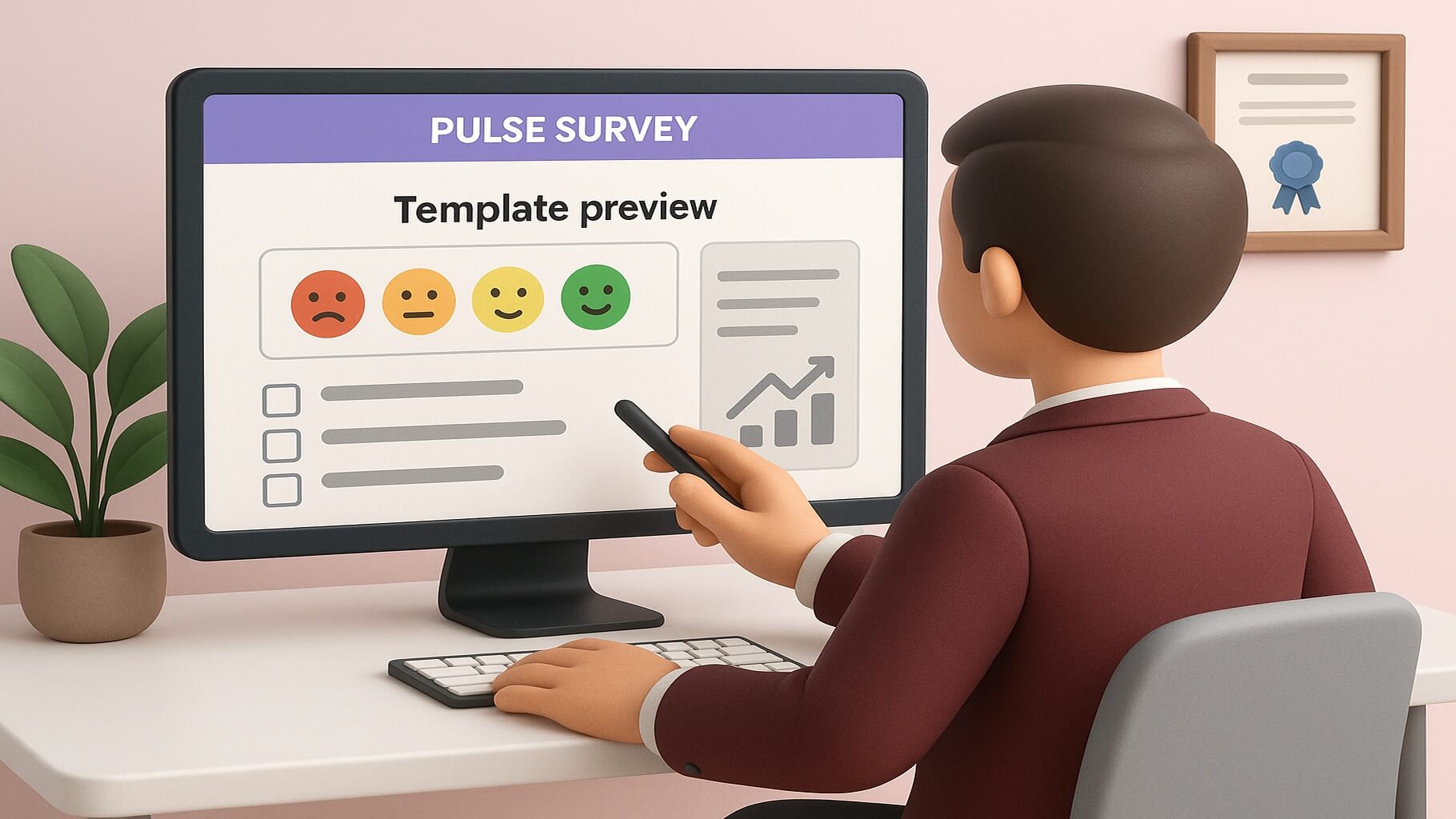
Pulse check surveys represent the most agile form of employee feedback, designed for rapid deployment when organizations need immediate insights. These ultra-brief pulse survey templates typically contain just three to five questions focused on a narrow topic, allowing employees to provide feedback in under two minutes.
Weekly pulse check templates for continuous feedback
Template 1: Monday motivation check
Questions:
- How motivated do you feel starting this week? (1-5 scale)
- I have clarity on my priorities for this week (Strongly Disagree to Strongly Agree)
- I have the resources needed for success (Yes/No/Unsure)
Template 2: Midweek progress pulse
Questions:
- Work is progressing as expected this week (Strongly Disagree to Strongly Agree)
- Are there obstacles blocking your productivity? (Yes/No)
- If yes, what support do you need? (Open-ended)
Template 3: Friday reflection check
Questions:
- I'm satisfied with this week's accomplishments (Strongly Disagree to Strongly Agree)
- I feel prepared for next week's challenges (Strongly Disagree to Strongly Agree)
- What would make next week more productive? (Open-ended)
Template 4: Team collaboration pulse
Questions:
- Team communication was effective this week (Strongly Disagree to Strongly Agree)
- Collaboration helped achieve goals (Strongly Disagree to Strongly Agree)
- How can team collaboration improve? (Open-ended)
Template 5: Workload and well-being check
Questions:
- My workload feels manageable (1-5 scale)
- I maintained a healthy work-life balance this week (Strongly Disagree to Strongly Agree)
- What would help you manage your workload better? (Open-ended)
Event-triggered pulse check survey frameworks
Template 1: Post-meeting feedback
Questions:
- The meeting content was relevant to my work (Strongly Disagree to Strongly Agree)
- I clearly understand the next steps (Yes/No)
- What questions remain unanswered? (Open-ended)
Template 2: Training program evaluation
Questions:
- The training was relevant to my role (Strongly Disagree to Strongly Agree)
- I can apply what I learned immediately (Strongly Disagree to Strongly Agree)
- What additional training would be helpful? (Open-ended)
Template 3: Policy change response
Questions:
- I understand the new policy (Strongly Disagree to Strongly Agree)
- The policy change seems fair and reasonable (Strongly Disagree to Strongly Agree)
- What concerns do you have about this change? (Open-ended)
Template 4: Project milestone celebration
Questions:
- I'm satisfied with the project outcomes (Strongly Disagree to Strongly Agree)
- Team collaboration was effective (Strongly Disagree to Strongly Agree)
- What lessons should we apply to future projects? (Open-ended)
Template 5: Recognition event impact
Questions:
- I feel appreciated for my contributions (Strongly Disagree to Strongly Agree)
- Recognition programs are meaningful (Strongly Disagree to Strongly Agree)
- How can recognition practices improve? (Open-ended)
Department-specific pulse check template options
Template 1: Sales team motivation and resources
Questions:
- I feel confident about my pipeline (Strongly Disagree to Strongly Agree)
- Sales tools support my success (Strongly Disagree to Strongly Agree)
- What resources would improve performance? (Open-ended)
Template 2: Customer support satisfaction
Questions:
- My workload feels manageable (1-5 scale)
- Systems support efficient customer service (Strongly Disagree to Strongly Agree)
- What would improve the customer support experience? (Open-ended)
Template 3: Engineering team innovation
Questions:
- I have opportunities for creative problem-solving (Strongly Disagree to Strongly Agree)
- Technical tools support quality work (Strongly Disagree to Strongly Agree)
- What would enhance innovation on the team? (Open-ended)
Template 4: Marketing campaign feedback
Questions:
- Cross-functional collaboration is effective (Strongly Disagree to Strongly Agree)
- I have adequate resources for campaigns (Strongly Disagree to Strongly Agree)
- What would improve marketing outcomes? (Open-ended)
Template 5: Operations efficiency
Questions:
- Processes support efficient workflows (Strongly Disagree to Strongly Agree)
- Cross-functional coordination works well (Strongly Disagree to Strongly Agree)
- What operational improvements are needed? (Open-ended)
15 pulse survey email template examples for deployment
Effective deployment emails directly impact pulse survey participation rates and response quality. The way you introduce surveys to employees shapes their perception of the process and influences whether they take time to provide thoughtful feedback. These 15 email templates cover different scenarios, from initial survey launches to follow-up reminders, helping you communicate clearly and encourage genuine participation. Adjust the wording to fit how your organization actually talks, but keep the key parts that encourage people to respond.
Standard quarterly pulse survey launch
Use this template when deploying routine quarterly surveys to measure ongoing engagement levels.
Subject: Quick check-in: Share your thoughts in 5 minutes
Hi [Team/Name],
We're launching our quarterly pulse survey today to understand how things are going and where we can improve. Your honest feedback helps us make better decisions about the workplace.
The survey takes about 5 minutes and covers topics like workload, team dynamics, and resources. Your responses stay confidential and get combined with everyone else's to spot patterns.
[Survey Link]
Please complete the survey by [Date]. Thanks for taking the time to share your perspective.
[Your Name]
First-time pulse survey introduction
Deploy this when introducing pulse surveys to an organization for the first time.
Subject: Introducing our new employee feedback approach
Hi everyone,
We're starting a new way to gather your feedback through short, focused surveys every quarter. Unlike our annual survey, these pulse checks take just a few minutes and help us respond to issues faster.
This first survey covers the basics: how you're feeling about your work, your team, and the support you're getting. There are no right or wrong answers—we want your honest perspective.
[Survey Link]
Your responses are anonymous and will be reviewed only in aggregate. We'll share what we learn and the actions we plan to take within two weeks.
Survey closes [Date].
Thanks, [Your Name]
Post-change initiative feedback
Send this after implementing a significant organizational change to measure employee response.
Subject: How's the [new process/system/change] working for you?
Hi team,
It's been [timeframe] since we rolled out [specific change]. We want to hear how it's actually working in practice.
This quick survey asks about your experience with the transition, what's working well, and where you're hitting roadblocks. Your input will help us make adjustments before issues become bigger problems.
[Survey Link]
Takes about 3 minutes. Survey closes [Date].
Appreciate your feedback, [Your Name]
Manager-specific pulse survey
Use this when surveying teams about their direct manager's effectiveness.
Subject: Share feedback about your experience on the team
Hi [Name],
We're gathering confidential feedback about team dynamics and leadership to help managers support their teams more effectively. This survey focuses on communication, support, and team development opportunities.
Your answers are anonymous and get grouped with everyone else's. No individual responses will be shared with your manager—only aggregated themes.
[Survey Link]
The survey takes 4-5 minutes. Please complete it by [Date].
Thanks, [Your Name]
New hire 30-day onboarding check
Deploy this to new employees at the 30-day mark to assess onboarding effectiveness.
Subject: How's your first month going?
Hi [Name],
You've been here about a month now, and we want to make sure your onboarding experience is setting you up for success. This short survey asks about your first few weeks—what's been helpful, what's been confusing, and what would make things easier.
[Survey Link]
Your honest feedback helps us improve the experience for future new hires. The survey takes about 3 minutes and closes [Date].
Thanks for your input, [Your Name]
Remote work experience pulse
Send this to assess how remote or hybrid work arrangements are functioning.
Subject: Quick check on remote work experience
Hi everyone,
As we continue with [remote/hybrid] work, we want to understand what's working and what needs adjustment. This pulse survey covers collaboration tools, communication patterns, and work-life boundaries.
[Survey Link]
Takes about 4 minutes. Your feedback will inform decisions about our remote work policies and support resources.
Survey closes [Date].
Thanks, [Your Name]
Post-event feedback collection
Use this immediately after a company event, all-hands meeting, or training session.
Subject: Thoughts on [event name]?
Hi team,
Now that [event] has wrapped up, we'd like your quick take on what worked and what didn't. This helps us plan better events that actually provide value.
The survey asks about content relevance, format, timing, and what you'd like to see in future sessions.
[Survey Link]
Takes 2 minutes. Survey closes [Date].
Appreciate it, [Your Name]
Reminder email for low participation
Send this midway through the survey window when participation is below target.
Subject: Reminder: We still need your input
Hi,
Just a quick reminder that our pulse survey closes [Date]. We've heard from about [X]% of the team so far, but we need more voices to get an accurate picture.
If you haven't had a chance yet, the survey takes 5 minutes, and your perspective matters:
[Survey Link]
Your responses are confidential and help shape decisions that affect your day-to-day work.
Thanks, [Your Name]
Department-specific pulse survey
Deploy this when surveying a specific department about unique challenges or initiatives.
Subject: Quick survey for [Department] team
Hi [Department] team,
We're running a short pulse survey specifically for our department to understand how recent changes to [specific initiative] are landing. This is separate from company-wide surveys and focuses on issues unique to our team.
[Survey Link]
The survey covers [specific topics] and takes about 4 minutes. Responses are confidential and will inform our Q[X] planning.
Please complete by [Date].
Thanks, [Your Name]
Wellbeing and burnout assessment
Use this to check in on employee stress levels and workplace wellness.
Subject: How are you really doing?
Hi everyone,
We know the past [timeframe] has been intense. This brief survey asks about workload, stress levels, and the support you're getting. We want to catch burnout risks early and make sure you have what you need.
[Survey Link]
Your responses are anonymous. We'll use this data to identify where we need to adjust expectations or add resources.
Survey takes 3-4 minutes and closes [Date].
Take care, [Your Name]
Exit interview alternative pulse
Send this to employees who've given notice to gather candid feedback before they leave.
Subject: Would you share feedback before you go?
Hi [Name],
Since you'll be leaving us soon, we'd really value your honest perspective on your experience here. This survey covers what worked, what didn't, and what would have made a difference.
[Survey Link]
Your feedback is confidential and will help us improve for current and future team members. The survey takes about 5 minutes.
Thank you for your time here and for helping us get better.
Best, [Your Name]
Recognition and appreciation pulse
Deploy this to measure how well employee recognition practices are working.
Subject: Quick question about recognition at work
Hi team,
We want to understand how appreciation and recognition are working across the company. This short survey asks whether you feel valued, how often you receive feedback, and how we could improve recognition practices.
[Survey Link]
Takes 3 minutes. Your input will help us build a culture where everyone's contributions are noticed.
Survey closes [Date].
Thanks, [Your Name]
Leadership communication effectiveness
Use this to assess how well leadership messages are reaching and resonating with employees.
Subject: How well are we communicating?
Hi everyone,
We're checking in on whether our communication from leadership is clear, timely, and helpful. This survey asks about the information you're getting (or not getting) about company direction, decisions, and changes.
[Survey Link]
Your honest feedback helps us communicate more effectively. The survey is anonymous and takes about 4 minutes.
Please complete by [Date].
Thanks, [Your Name]
Team collaboration assessment
Send this to evaluate how effectively teams are working together.
Subject: How's collaboration working?
Hi team,
We're gathering feedback on how well teams are collaborating across the organization. This survey asks about communication between departments, shared resources, and where collaboration breaks down.
[Survey Link]
Takes 4 minutes. Your input will help us remove obstacles and improve how we work together.
Survey closes [Date].
Appreciate your time, [Your Name]
Final reminder before survey closes
Deploy this 24-48 hours before the survey window closes.
Subject: Last chance: Survey closes tomorrow
Hi,
Our pulse survey closes tomorrow at [Time]. If you haven't completed it yet, we'd really appreciate your input—it only takes 5 minutes.
[Survey Link]
We've heard from [X]% of the team so far. Your perspective helps us understand the full picture and make better decisions.
Thanks for taking the time, [Your Name]
15 pulse survey sample questions to include in templates
The specific questions included in pulse survey examples ultimately determine the quality and actionability of the insights collected. Well-crafted pulse survey questions yield clear data that directly informs decision-making. Poorly worded questions produce confusing data that sits unused in reports. Well-crafted questions yield clear insights that directly inform decision-making and drive meaningful change. The difference between effective and ineffective surveys often comes down to how thoughtfully questions are written and structured."
Essential engagement questions for all templates
Core engagement questions measure fundamental aspects that apply across virtually all organizational contexts:
- "I am satisfied with my role and responsibilities" (Overall job satisfaction)
- "I have the resources and tools I need to do my best work" (Resource adequacy)
- "I feel valued for the contributions I make" (Recognition and appreciation)
- "I would recommend this organization as a great place to work" (eNPS)
- "I see opportunities for my professional growth here" (Career development)
Leadership and management question samples
Leadership quality represents one of the most influential factors affecting employee engagement:
- "My manager provides clear direction for my work" (Role clarity)
- "I get regular feedback that helps me improve (Strongly Disagree to Strongly Agree)"
- "Leadership communicates openly about decisions" (Transparency)
- "I trust leadership will make decisions in employees' best interest" (Trust)
- "My manager advocates for my professional development" (Career support)
Culture and workplace environment questions
Culture and environment profoundly influence employee well-being and satisfaction:
- "I feel comfortable sharing my ideas at work (Strongly Disagree to Strongly Agree)"
- "Our workplace culture values and respects diverse perspectives" (Inclusion)
- "I have a healthy work-life balance" (Work-life integration)
- "Our organization lives its stated values in daily decisions" (Values alignment)
- "I feel connected to and supported by colleagues" (Team relationships)
10 pulse survey examples that showcase effective templates

These ready-to-use templates provide frameworks that save significant time during survey design. Organizations can deploy them immediately if they need quick insights. Alternatively, teams can customize templates to address specific measurement objectives unique to their workplace. The flexibility makes templates valuable for both urgent feedback needs and strategic engagement programs.
1. Weekly engagement check-in template
Questions:
- On a scale of 1-5, how satisfied are you with your work this week?
- Do you have the resources and support needed to be successful? (Yes/No)
- What is one thing that would improve your experience next week? (Open-ended)
2. Manager effectiveness template
Questions:
- My manager provides clear expectations for my work (Strongly Disagree to Strongly Agree)
- I receive regular, constructive feedback (Strongly Disagree to Strongly Agree)
- My manager supports my professional development (Strongly Disagree to Strongly Agree)
- I feel comfortable approaching my manager with concerns (Strongly Disagree to Strongly Agree)
- My manager recognizes and appreciates my contributions (Strongly Disagree to Strongly Agree)
3. Workplace well-being template
Questions:
- I can maintain a healthy work-life balance (Strongly Disagree to Strongly Agree)
- My current workload feels manageable (Strongly Disagree to Strongly Agree)
- I have adequate support to manage stress (Strongly Disagree to Strongly Agree)
- I feel energized and motivated in my role (Strongly Disagree to Strongly Agree)
- What would most improve your well-being at work? (Open-ended)
4. Change management template
Questions:
- I understand the reasons for this change (Strongly Disagree to Strongly Agree)
- I have received adequate information about how this affects my work (Strongly Disagree to Strongly Agree)
- I have the resources needed to adapt (Strongly Disagree to Strongly Agree)
- Leadership is communicating effectively (Strongly Disagree to Strongly Agree)
- What questions or concerns do you have? (Open-ended)
5. Team collaboration template
Questions:
- Team members communicate effectively (Strongly Disagree to Strongly Agree)
- I feel comfortable sharing ideas with my team (Strongly Disagree to Strongly Agree)
- Our team collaborates well to achieve goals (Strongly Disagree to Strongly Agree)
- Conflicts are resolved constructively (Strongly Disagree to Strongly Agree)
- What would improve collaboration? (Open-ended)
6. Recognition and appreciation template
Questions:
- I feel recognized for my contributions (Strongly Disagree to Strongly Agree)
- My manager regularly acknowledges my accomplishments (Strongly Disagree to Strongly Agree)
- Recognition is distributed fairly (Strongly Disagree to Strongly Agree)
- I have opportunities to recognize colleagues (Strongly Disagree to Strongly Agree)
- How could recognition improve? (Open-ended)
7. Professional development template
Questions:
- I have clear opportunities for professional growth (Strongly Disagree to Strongly Agree)
- I receive adequate support for skill development (Strongly Disagree to Strongly Agree)
- I understand potential career paths available (Strongly Disagree to Strongly Agree)
- My manager actively supports my development goals (Strongly Disagree to Strongly Agree)
- What development opportunities would be most valuable? (Open-ended)
8. Work-life balance template
Questions:
- I can effectively manage personal responsibilities alongside work (Strongly Disagree to Strongly Agree)
- My schedule provides adequate flexibility (Strongly Disagree to Strongly Agree)
- I can disconnect from work during personal time (Strongly Disagree to Strongly Agree)
- The organization respects work-life boundaries (Strongly Disagree to Strongly Agree)
- What changes would most improve your work-life balance? (Open-ended)
9. Communication effectiveness template
Questions:
- I receive clear, timely information about decisions affecting my work (Strongly Disagree to Strongly Agree)
- Leadership communicates openly and transparently (Strongly Disagree to Strongly Agree)
- Information flows effectively between teams (Strongly Disagree to Strongly Agree)
- I feel comfortable asking questions (Strongly Disagree to Strongly Agree)
- How could communication improve? (Open-ended)
10. Diversity and inclusion template
Questions:
- I feel included and valued as a member of this organization (Strongly Disagree to Strongly Agree)
- Our workplace culture respects diverse perspectives (Strongly Disagree to Strongly Agree)
- I can be myself at work (Strongly Disagree to Strongly Agree)
- Everyone is treated fairly regardless of background (Strongly Disagree to Strongly Agree)
- What would make our workplace more inclusive? (Open-ended)
Using pulse survey app templates for workflow integration
Modern pulse survey app solutions have transformed how organizations gather employee feedback by eliminating friction and meeting people where they already work. Rather than requiring employees to remember separate login credentials or navigate to external websites, integrated apps deliver pulse surveys directly within communication channels employees use daily.
Mobile-optimized template designs
With increasingly mobile workforces, pulse surveys must work flawlessly on smartphones and tablets. Templates designed specifically for mobile experiences use larger touch targets, simpler layouts, and fewer questions per page to accommodate smaller screens. Mobile-optimized pulse survey templates incorporate single-column layouts that don't require horizontal scrolling, large, easily tappable buttons suitable for finger interaction, minimal text per screen to reduce scrolling, progress indicators showing how many questions remain, and auto-save functionality that preserves responses if employees pause.
Platform-native template options
The most powerful pulse survey apps offer platform-native templates designed specifically for communication tools employees already use. Rather than directing employees to external survey websites, these templates enable completing entire surveys within Slack, Microsoft Teams, or other workplace platforms without switching contexts. Platform-native templates leverage unique capabilities, including Slack templates with interactive messages, Microsoft Teams adaptive cards that present surveys as rich elements within Team chats, email templates with embedded questions that require no additional clicks, and mobile app notifications that deep-link directly to survey questions.
Quick-deploy app template features
Speed to deployment represents a critical advantage of app-based pulse survey templates. Organizations face rapidly evolving challenges where timely feedback can inform better decisions, but only if surveys can be deployed quickly enough to capture relevant sentiment.
Quick-deploy capabilities make launching surveys effortless. Access the one-click template library with preview capabilities, use pre-populated distribution lists for different departments, and save deployment schedules for recurring pulse surveys. Automated reminder sequences trigger automatically, without manual setup, while real-time response-tracking dashboards show participation rates as they happen.
Best practices for customizing pulse survey templates
Pre-built pulse survey templates provide excellent starting points for measuring employee engagement. However, the most effective pulse survey programs go beyond simply using templates as-is. Organizations need to adapt templates to fit their unique culture, address specific challenges, and use language that resonates with their employees. This customization transforms generic surveys into powerful tools that drive meaningful insights and action.
Adapting templates to organizational culture
Every organization has a unique culture, reflected in its communication styles, values, and interactions. Pulse survey templates should mirror this culture in tone, language, and focus areas to feel authentic and encourage genuine participation. Cultural adaptation involves language and tone that match how people actually communicate, question topics that address issues relevant to your specific work environment, response scale options that align with how your organization typically gathers feedback, survey length and frequency that respects norms about taking time away from work tasks, and distribution methods that fit existing communication channels.
Maintaining template structure while personalizing
The structure of well-designed templates reflects careful thought about question order, mix of item types, survey length, and overall flow. While personalizing templates to fit organizational needs, it's important to preserve these structural elements that contribute to survey effectiveness. Best practices focus on maintaining survey integrity while customizing content. Keep the overall question count similar to the original template and preserve the mix of rating-scale, multiple-choice, and open-ended questions. Maintain logical question groupings that flow from broader to more specific topics. Even when adding organization-specific questions, retain core engagement measurement items to ensure consistency.
Testing customized templates before full deployment
No matter how thoughtful customization efforts are, testing is essential before launching customized templates to entire organizations. Testing reveals problems that weren't apparent during customization and provides opportunities to refine templates based on actual user experience. Comprehensive testing approaches cover multiple validation layers. Internal HR reviews and cognitive interviews with employees ensure that questions are clear. Pilot deployments to small, representative groups reveal potential issues before full launch. Technical testing across devices and browsers confirms functionality, while data validation ensures accurate response capture.
Common mistakes when using pulse survey templates

Even with access to excellent pulse survey templates, organizations often make avoidable mistakes that undermine the effectiveness of their pulse surveys. These missteps happen across companies of all sizes and experience levels. The consequences range from low participation rates to unusable data that fails to drive meaningful change. Understanding these common pitfalls helps you design better pulse survey programs.
Using templates without customization
Perhaps the most common mistake is deploying pre-built templates without adapting them to the organizational context. While templates provide solid foundations, they're designed to work across diverse organizations and therefore can't perfectly fit any specific situation without adjustment. Generic templates often include questions that don't apply to particular organizations or miss critical topics that do matter. The fix requires investing time upfront to review template questions critically and customize based on organizational needs.
Selecting inappropriate templates for objectives
Organizations sometimes select convenient templates rather than ones aligned with their actual measurement objectives. This mismatch leads to surveys that don't yield the insights needed because they focus on the wrong topics or lack depth in key areas that matter.
Template selection should start with clear objectives, not with browsing available templates to see what looks interesting. Define the decisions you need to make and the information that will inform them.
Failing to update templates over time
Organizational priorities, workplace conditions, and strategic challenges evolve continuously, yet many organizations continue using identical pulse survey templates month after month. This static approach fails to track emerging issues or measure new initiatives.
Regular template review and updating ensure pulse surveys remain relevant and valuable. Quarterly reviews of template content help identify questions that have outlived their usefulness or new areas requiring measurement.
How Matter can help with pulse survey template needs
Organizations seeking to implement effective pulse survey programs need tools that combine comprehensive pulse survey template options, flexible survey template customization, and seamless workflow integration. Matter delivers exactly this combination through its innovative approach to employee feedback and engagement.
Survey options for diverse measurement needs
Matter provides pulse survey capabilities designed to measure employee engagement and employee sentiment across multiple dimensions of the employee experience. Rather than offering a single generic survey approach, Matter enables organizations to deploy different types of employee pulse survey tools tailored to specific measurement objectives.
Matter's survey capabilities include pulse surveys for regular check-ins on employee morale and satisfaction with flexible deployment schedules, eNPS surveys using Matter's unique 5-point scale approach for measuring employee loyalty, onboarding surveys deployed automatically at key milestones to capture new hire experiences, exit surveys that gather feedback from departing employees, and custom survey options that enable organizations to measure specific topics aligned with their strategic priorities.
Seamless integration with Slack and Microsoft Teams
Matter's defining characteristic is its deep integration with Slack and Microsoft Teams, enabling survey deployment directly within the communication platforms where employees already spend their time. This native integration approach eliminates the friction associated with external survey links and separate login credentials.
The integration delivers substantial benefits, including 10x response rates compared to traditional survey methods, with Matter users regularly achieving 80-90% participation, instant delivery of pulse surveys directly in channels where employees are already active, one-click participation that allows employees to respond immediately, mobile accessibility through native apps, and automated reminders sent through familiar communication channels.
Unique 5-point eNPS approach
While many platforms use the traditional 11-point (0-10) eNPS scale, Matter has implemented a research-backed 5-point Likert scale for measuring employee Net Promoter Score through its eNPS survey capabilities. This approach offers significant advantages over conventional eNPS methodology.
Matter's 5-point eNPS calculation works as follows: Promoters equal Strongly Agree, Passives equal Agree, and Detractors equal Strongly Disagree, Disagree, and Neutrals. The 5-point scale offers several advantages. It provides better usability, particularly on mobile devices, and enables faster survey completion. Fully labeled response scales increase reliability, while the consistent methodology aligns with other survey questions using 5-point scales. The approach also delivers validated accuracy.
Set up and deployment in minutes
Unlike complex pulse survey platforms requiring extensive configuration, Matter emphasizes simplicity and speed. Organizations can set up and begin deploying pulse surveys within minutes of connecting Matter to their Slack or Teams workspace.
The streamlined setup process includes quick integration through simple authorization steps, immediate access to pulse survey capabilities without complex configuration, an intuitive interface that makes survey creation straightforward, pre-configured options that provide sensible defaults while allowing customization, and automated workflows that handle reminders and results collection.
Analytics and real-time insights
Matter provides comprehensive analytics capabilities that help organizations understand survey results and identify trends requiring attention. Rather than requiring manual data analysis or export to separate analytics tools, Matter delivers insights directly within the platform.
Matter's analytics features include real-time dashboards showing participation rates and key metrics as surveys are completed, trend analysis that tracks how scores change over time, demographic filtering enabling analysis by department or location, visual reporting that makes results accessible to stakeholders, and continuous insights into employee engagement and potential turnover risks.
Combining surveys with recognition and rewards
Matter's unique value proposition lies in connecting pulse surveys with its core recognition and rewards functionality. Rather than treating measurement and appreciation as separate activities, Matter enables organizations to understand employee sentiment through employee engagement surveys and to demonstrate appreciation through recognition in a single, integrated platform.
This combined approach delivers several benefits:
- Closed feedback loops, where organizations can recognize employees for participating in surveys
- Unified culture strategy that both measures and reinforces desired behaviors
- Higher engagement as employees see connections between their feedback and organizational appreciation
- Comprehensive insights combining quantitative survey data with qualitative recognition patterns
- Single platform simplicity
Frequently asked questions about pulse survey templates
Q: How often should we send pulse surveys?
A: Most organizations send pulse surveys quarterly, though some run them monthly or after specific events. The key is maintaining consistency without overwhelming employees. Space surveys at least 4-6 weeks apart to give people time between requests and allow you to act on feedback before asking again.
Q: Can we customize pre-built pulse survey templates?
A: Yes, and you should. Start with templates as frameworks, but adjust questions to match your organization's language, culture, and specific concerns. Add company-specific items, remove irrelevant questions, and modify wording so surveys feel authentic rather than generic. Just maintain logical flow and keep question counts manageable.
Q: What's a good response rate for pulse surveys?
A: Aim for 60-70% participation or higher. Response rates depend on survey frequency, how well you communicate the purpose, whether employees see action from past surveys, and how easy you make participation. Strong response rates come from building trust that feedback actually matters, not just from sending reminders.
Q: How many questions should a pulse survey include?
A: Keep pulse surveys between 10-15 questions to respect employees' time. Each question should have a clear purpose tied to specific metrics you're tracking. Longer surveys reduce completion rates and quality of responses. If you need more depth on certain topics, rotate question sets across survey cycles rather than cramming everything into one survey.
Q: Should pulse surveys be anonymous or identified?
A: Anonymous surveys typically get more honest feedback, especially about sensitive topics like management or workplace culture. However, identified surveys let you follow up with individuals and track changes over time. Consider your goals and organizational trust levels. You can also use anonymous surveys for most topics while using identified surveys for career development or personal growth questions.
Q: How quickly should we share pulse survey results?
A: Share results within two weeks of closing the survey. Employees lose interest when feedback disappears into a black hole for months. You don't need perfect action plans before sharing—communicate what you learned, acknowledge challenges, and outline next steps, even if you're still figuring out solutions. Speed matters more than polish when building trust in the feedback process.
Final thoughts about pulse survey templates
Pulse survey templates give you a solid starting point for understanding what's really happening with your employees. They eliminate the blank page problem and incorporate research-backed questions that actually measure what matters. However, templates work best when you adapt them thoughtfully rather than deploying them unchanged.
The most effective pulse survey programs balance structure with flexibility. Use templates as frameworks but customize questions to reflect your organization's unique culture, challenges, and priorities. Pay attention to question design, keep surveys focused, and communicate clearly about purpose and confidentiality. Most importantly, tell people what you learned from their feedback and actually do something about it.
Remember that pulse surveys are tools, not solutions. The survey itself doesn't improve engagement—how you use the insights does. Collect feedback regularly, analyze patterns honestly, involve employees in problem-solving, and follow through on commitments. When employees see their feedback leading to meaningful changes, participation and trust increase naturally.
Start with proven templates, adapt them to your needs, and commit to acting on what you learn. The combination of good questions and genuine responsiveness creates pulse survey programs that drive real improvement.
Ready to take your employee pulse survey strategy to the next level? Get started with Matter for free today and discover how the right tools can help you gather meaningful feedback, recognize great work, and support long-term engagement and success.