
Creating effective onboarding surveys is a significant challenge for organizations striving to optimize the new-hire experience and predict retention outcomes. Many HR teams struggle to identify which new-hire onboarding survey questions truly measure effectiveness rather than simply collect generic feedback that goes unused. Understanding the distinction between surface-level onboarding survey questions and strategically designed assessments transforms how organizations gather actionable insights during critical early employment periods. The right approach to onboarding surveys helps companies implement reliable feedback programs that drive continuous improvement and accelerate time to productivity.
At Matter, we understand how overwhelming it can feel when you're responsible for setting new employees up for success while lacking clear data on what's working. Effective employee onboarding surveys serve as the foundation for understanding new hires' experiences and identifying friction points before they lead to turnover. When organizations leverage proven onboarding survey questions for new hires at strategic intervals, they gain insight into everything from training effectiveness to cultural integration. This guide provides over 130 survey question examples spanning every stage of the onboarding process, helping you collect valuable feedback that transforms orientation from a checkbox exercise into a genuine competitive advantage.
What is an onboarding survey?
An onboarding survey is a structured feedback tool designed to capture new employees' perceptions, experiences, and suggestions during their initial period of employment. These surveys help organizations understand how effectively they're integrating new hires into the company culture, role responsibilities, and team dynamics. By systematically gathering feedback from new team members, companies gain insight into what's working well and where the onboarding process needs refinement.
The employee onboarding process represents a critical window for establishing engagement, building confidence, and setting expectations for long-term success. Onboarding surveys bridge the gap between what organizations think they're delivering and what employees actually experience during this foundational period. When designed thoughtfully, these surveys create open communication channels that make employees feel heard and valued from day one.
Defining onboarding surveys and their role in new hire success
Onboarding surveys function as diagnostic tools that measure the effectiveness of your orientation process and training programs at specific intervals. Unlike annual engagement surveys, these assessments focus specifically on the unique challenges and needs that new hires face during their transition into a new role. They capture feedback early when impressions are fresh, and intervention opportunities are greatest.
The primary purpose extends beyond simply asking questions to ask about satisfaction levels. Effective onboarding feedback surveys identify gaps in training, highlight unclear job responsibilities, and reveal whether new employees have the resources needed to succeed. Organizations that prioritize gathering feedback during onboarding demonstrate commitment to employee experience from the very beginning. This early investment in understanding new hires' perspectives establishes trust and signals that their voices matter to the organization.
- Diagnostic function: Surveys identify specific breakdowns in training, communication, or resource allocation that hinder new hire success
- Predictive capability: Early survey responses often correlate with retention outcomes, allowing proactive intervention with at-risk employees
- Continuous improvement: Regular feedback collection creates data streams that reveal trends and patterns across hiring cohorts
- Engagement foundation: The act of soliciting feedback demonstrates organizational commitment to employee experience and professional growth
Different types of onboarding surveys by timing and focus
Organizations implement various survey types throughout the employee onboarding journey, each serving distinct purposes and capturing different insights. Pre-boarding surveys assess readiness and expectations before the first day arrives. Day one and first-week surveys capture immediate impressions of welcome experiences, administrative processes, and initial training quality.
Thirty-day onboarding surveys evaluate role clarity, manager support, and early integration into team members' workflows and company culture. Sixty-day and ninety-day surveys measure deeper engagement, long-term success indicators, and overall onboarding effectiveness. Each timing interval reveals unique aspects of the new hires' experience that might otherwise go unnoticed by the organization. The preboarding process over the next 90 days comprises distinct phases that require tailored questions.
- Pre-boarding surveys: Assess technology readiness, communication clarity, and expectations before the employee's first day
- Day one surveys: Capture first impressions about welcome experience, workspace setup, and administrative efficiency
- First week surveys: Evaluate initial training quality, team introductions, and immediate resource availability
- Milestone surveys: 30, 60, and 90-day surveys progressively assess role mastery, cultural integration, and engagement trajectory
How onboarding surveys connect to retention and engagement outcomes
The connection between onboarding experience quality and employee retention represents one of the most documented relationships in human resources research. New employees who report positive onboarding experiences demonstrate significantly higher retention rates during their first year of employment. Conversely, those who experience confusion, isolation, or inadequate support during onboarding become flight risks within months.
Onboarding surveys provide the data necessary to understand and strengthen this retention connection. When organizations systematically collect feedback, they can identify which onboarding program elements correlate most strongly with employee engagement and commitment. Survey responses reveal whether new hires feel integrated into the company's mission, understand how their role contributes to organizational goals, and believe the organization invested adequately in their success. These insights enable targeted improvements that directly impact business success by reducing turnover costs and accelerating productivity ramps.
- Retention correlation: New hire survey data helps predict which employees may leave early, enabling proactive retention efforts
- Engagement baseline: Onboarding survey scores establish initial engagement levels that subsequent surveys can track over time
- ROI measurement: Comparing onboarding investments against survey scores and retention outcomes quantifies program effectiveness
- Cultural integration: Surveys reveal whether new employees feel connected to the company culture and values
What are the benefits of new hire onboarding survey questions?

The strategic deployment of induction survey questions for new hires yields quantifiable advantages across various facets of organizational performance. These surveys transform subjective assumptions about onboarding quality into objective data that drives decision-making and resource allocation. When organizations commit to systematic onboarding feedback collection, they unlock insights that would otherwise remain hidden until problems manifest as turnover.
The benefits extend beyond simply identifying problems to proactively shaping positive experiences for future new hires. Each survey response contributes to an evolving understanding of what new employees need to thrive during their critical first months. Organizations that leverage this feedback effectively build onboarding programs that consistently produce engaged, productive, and committed team members.
Early identification of onboarding gaps and friction points
Onboarding surveys surface problems during the narrow window when intervention remains possible and cost-effective. Without systematic feedback collection, organizations often discover onboarding failures only through exit interviews or months later through performance issues. Early survey responses allow HR teams and managers to address concerns before they compound into disengagement or resignation.
The questions to ask during initial surveys specifically target common friction points in the orientation process. These include delays in technology access, unclear job description expectations, insufficient manager availability, and missing onboarding materials. When new hires report these issues through surveys, organizations can respond immediately rather than losing talented employees to preventable problems. Gathering feedback early in the employment relationship demonstrates responsiveness and builds trust with new employees.
- Real-time problem detection: Surveys identify issues while they're still addressable, rather than discovering them through resignation letters
- Pattern recognition: Aggregated survey data reveals systemic problems affecting multiple new hires across departments or time periods
- Manager accountability: Survey results highlight which managers excel at onboarding and which need additional training or support
- Resource allocation: Feedback data justifies investments in onboarding improvements by quantifying current gaps and their impact
Data-driven improvements to training and orientation programs
Survey responses provide the evidence base for prioritizing and designing onboarding program enhancements. Rather than guessing which training modules need revision, organizations can direct resources toward areas where new hires consistently report confusion or inadequacy. This data-driven approach ensures improvement efforts address actual problems rather than perceived ones.
Pulse surveys conducted during onboarding reveal which training methods resonate with new employees and which fall flat. Organizations learn whether self-paced learning is more effective than instructor-led sessions for specific topics. They discover which onboarding materials new hires actually use versus which gather digital dust. This detailed feedback enables continuous refinement of training content, delivery methods, and timing to maximize knowledge transfer and retention.
- Content optimization: Survey feedback identifies which training topics need expansion, simplification, or complete redesign
- Delivery method refinement: Responses reveal preferences for video, written, hands-on, or peer-based learning approaches
- Timing adjustments: Feedback shows whether information arrives too early, too late, or in overwhelming quantities
- Effectiveness measurement: Pre and post-training survey comparisons quantify actual learning and skill development outcomes
Increased new hire engagement and faster time to productivity
Employees who feel heard and valued during onboarding demonstrate higher engagement levels and faster achievement of full productivity. Soliciting feedback through surveys signals the organization's investment in new hires' success and well-being. This psychological impact compounds the practical benefits of actually implementing feedback-driven improvements.
When new employees see their survey responses lead to visible changes, they develop confidence in the organization's responsiveness. This creates a positive experience foundation that carries forward throughout their employment tenure. Survey data also helps organizations identify which onboarding elements most strongly influence time to productivity. By optimizing these high-impact factors, companies can accelerate the time to full contribution, improving employee productivity and the return on recruitment investment.
- Engagement acceleration: New hires who complete surveys report feeling more valued and connected to the organization
- Productivity correlation: Survey scores on training effectiveness and resource availability predict time to full productivity
- Feedback loop creation: Acting on survey results demonstrates organizational responsiveness that builds employee trust
- Benchmark establishment: Initial survey responses create baselines for tracking engagement trajectory over time
Why are new-hire survey questions important for retention?
Employee retention begins during the recruitment process and solidifies during onboarding, when new employees form lasting impressions about their career decisions. Survey questions strategically placed throughout onboarding capture the warning signs that predict early departure before resignation occurs. Organizations that treat onboarding surveys as retention tools rather than administrative checkboxes gain significant advantages in keeping their talent investments.
The financial and operational costs of early turnover make retention-focused onboarding surveys a business imperative rather than an HR nice-to-have. Every new hire who leaves within the first year represents lost recruitment costs, training investments, and productivity gaps that ripple through team members' workloads. Understanding why some new employees thrive while others disengage requires the systematic data collection that only surveys provide.
Connection between onboarding experience and long-term retention
Research consistently demonstrates that the quality of the onboarding experience predicts employee retention years into the future. New hires who report feeling welcomed, prepared, and supported during their first months show dramatically higher retention rates through their third anniversary and beyond. Employee pulse surveys during onboarding capture the sentiment data that forecasts these long-term outcomes.
The mechanism connecting onboarding to retention operates through multiple psychological pathways. Strong company culture integration during onboarding creates emotional bonds that resist departure temptation. A clear understanding of how the role contributes to organizational goals provides meaning that sustains motivation. Adequate training builds confidence, preventing frustration from spiraling into resignation. Survey questions targeting these specific factors identify which new employees have formed the foundations for long-term commitment.
- First impression impact: Early experiences disproportionately influence employees' mental models of the organization
- Psychological commitment: New hires who feel invested during onboarding reciprocate with higher organizational commitment
- Competence development: Adequate training builds the job performance confidence that prevents frustration-driven departure
- Social integration: Team connection during onboarding creates relationship bonds that increase retention
How early feedback prevents turnover in the first 90 days
The first 90 days represent the highest-risk period for new hire turnover, making early onboarding feedback collection essential for intervention. Survey responses during this window reveal dissatisfaction, confusion, or disconnection while the employment relationship remains salvageable. Without this feedback, managers often remain unaware of struggles until the new employee announces their departure.
Effective employee onboarding surveys scheduled at strategic intervals create multiple intervention opportunities. A concerning response at thirty days triggers manager conversations that address issues before they calcify into resignation decisions. Consistently declining scores across survey waves signal deteriorating engagement requiring immediate attention. The questions to ask focus specifically on factors known to predict early departure, including role clarity, manager relationship quality, and resource adequacy.
- Warning signal detection: Survey responses identify at-risk new hires while intervention remains possible
- Manager alerting: Automated survey result sharing prompts conversations that address emerging concerns
- Trend monitoring: Declining scores across survey waves signal accelerating disengagement requiring escalation
- Exit prevention: Addressing survey-identified issues demonstrably reduces first-year turnover rates
Impact on employer brand and future talent attraction
How organizations treat new hires during onboarding directly impacts their ability to attract future talent. New employees share their onboarding experiences with professional networks, on review sites, and through word-of-mouth referrals. Collecting feedback through surveys demonstrates that the organization values employee experience, strengthening employer brand perception.
Survey-driven onboarding improvements create competitive advantages in talent markets where candidates research potential employers thoroughly. Organizations that consistently deliver excellent onboarding experiences generate positive reviews that influence candidate decisions. The interview process sets expectations for onboarding, making survey data essential to ensuring consistency between promises and reality. Strong onboarding experiences also increase the likelihood that new employees will refer talented connections from their networks.
- Review site impact: New hire experiences directly influence Glassdoor and similar platform ratings
- Referral generation: Positive onboarding experiences increase employee referral rates and quality
- Candidate expectations: Modern candidates research onboarding quality before accepting offers
- Competitive differentiation: Superior onboarding distinguishes organizations in competitive talent markets
15+ pre-boarding new hire survey questions before day one
The preboarding process represents an often-overlooked opportunity to set new hires up for success before they even arrive. Survey questions during this phase assess whether communication has been clear, logistics are handled, and expectations are appropriately set. Gathering feedback before day one identifies gaps in your pre-arrival process that create unnecessary stress or confusion for incoming team members.
Pre-boarding surveys demonstrate organizational investment in new employees' success from the moment they accept an offer. These questions reveal whether your HR teams have provided adequate information, whether technology and equipment preparations are on track, and whether new hires feel confident about their upcoming start. Addressing concerns identified during pre-boarding prevents first-day complications that damage initial impressions.
15+ pre-boarding questions list:
- Did you receive clear communication about your start date, time, and location?
- Were your questions about benefits and compensation answered satisfactorily during the offer process?
- Have you received information about what to bring on your first day?
- Do you know who to contact if you have questions before your start date?
- Has your manager reached out to welcome you to the team?
- Did you receive information about parking, building access, or remote work setup?
- Are you clear on the dress code or professional appearance expectations?
- Have you received any pre-reading materials or preparation assignments?
- Do you feel informed about what your first week will look like?
- Were your technology or equipment needs discussed during the recruitment process?
- Have you received access credentials for any systems you'll need on day one?
- Do you know who your onboarding buddy or point of contact will be?
- Are you clear on your reporting structure and who your direct manager is?
- Did the company's communication match your expectations from the interview process?
- How confident do you feel about starting your new role?
- Is there any information you wish you had received but haven't yet?
Technology and equipment preparation questions
Technology readiness questions address one of the most common sources of first-day frustration for new employees. When equipment isn't ready, system access isn't configured, or login credentials don't work, new hires spend their initial hours troubleshooting rather than learning. Pulse survey questions about technology preparation help HR professionals identify and resolve these issues proactively.
Pre-boarding technology questions should cover hardware delivery timelines, software access expectations, and technical support contacts. For remote team members, these questions are especially critical, as a home office setup may require advanced shipping and configuration. Asking new employees about their technology concerns before day one allows IT teams to prioritize and resolve issues without creating negative first impressions.
- Hardware readiness: Questions confirm whether laptops, phones, and peripherals have shipped or will be ready on arrival
- Access credentials: Surveys verify that email, communication tools, and essential systems are configured and accessible
- Technical support: Questions ensure new hires know who to contact if technology issues arise on day one
- Remote setup: For distributed new employees, questions address home office equipment and connectivity needs
Communication and expectations clarity questions
Clear pre-start communication establishes the foundation for a positive onboarding experience by reducing uncertainty and anxiety. New hires who enter their first day confused about logistics, expectations, or contacts begin their employment relationship from a position of stress. Survey questions targeting communication clarity reveal whether your pre-boarding messages hit their mark.
These questions assess whether the company's communication about role expectations matches what was discussed during the interview process. They also evaluate whether administrative information about benefits, policies, and procedures has been adequately conveyed. When survey responses indicate confusion, HR teams can provide additional clarification before the start date arrives.
- Role clarity: Questions confirm understanding of job responsibilities, team structure, and reporting relationships
- Logistical information: Surveys verify receipt and understanding of practical first-day details
- Expectation alignment: Questions assess whether pre-start communications match interview process promises
- Administrative completeness: Surveys confirm that paperwork, benefits enrollment, and policy information were received
First day logistics and information questions
Logistics questions address the practical details that determine whether day one runs smoothly or becomes a frustrating obstacle course. New employees arriving unsure of where to park, which building to enter, or who to ask for experience can cause unnecessary stress. Surveying these details during pre-boarding prevents logistical failures that undermine first impressions.
For organizations with hybrid or remote workforces, logistics questions must address both in-person and virtual onboarding scenarios. Remote team members need different information than those arriving at physical offices, and surveys should adapt accordingly. These questions also reveal whether your standard onboarding materials adequately cover the information new hires actually need.
- Physical logistics: Questions confirm understanding of location, parking, building access, and arrival procedures
- Virtual logistics: For remote new employees, questions address video conference links, schedule details, and technical requirements
- Contact information: Surveys verify that new hires know exactly who to reach and how on their first morning
- Schedule clarity: Questions confirm understanding of first-day activities, meetings, and expectations
20+ day one new hire orientation survey questions
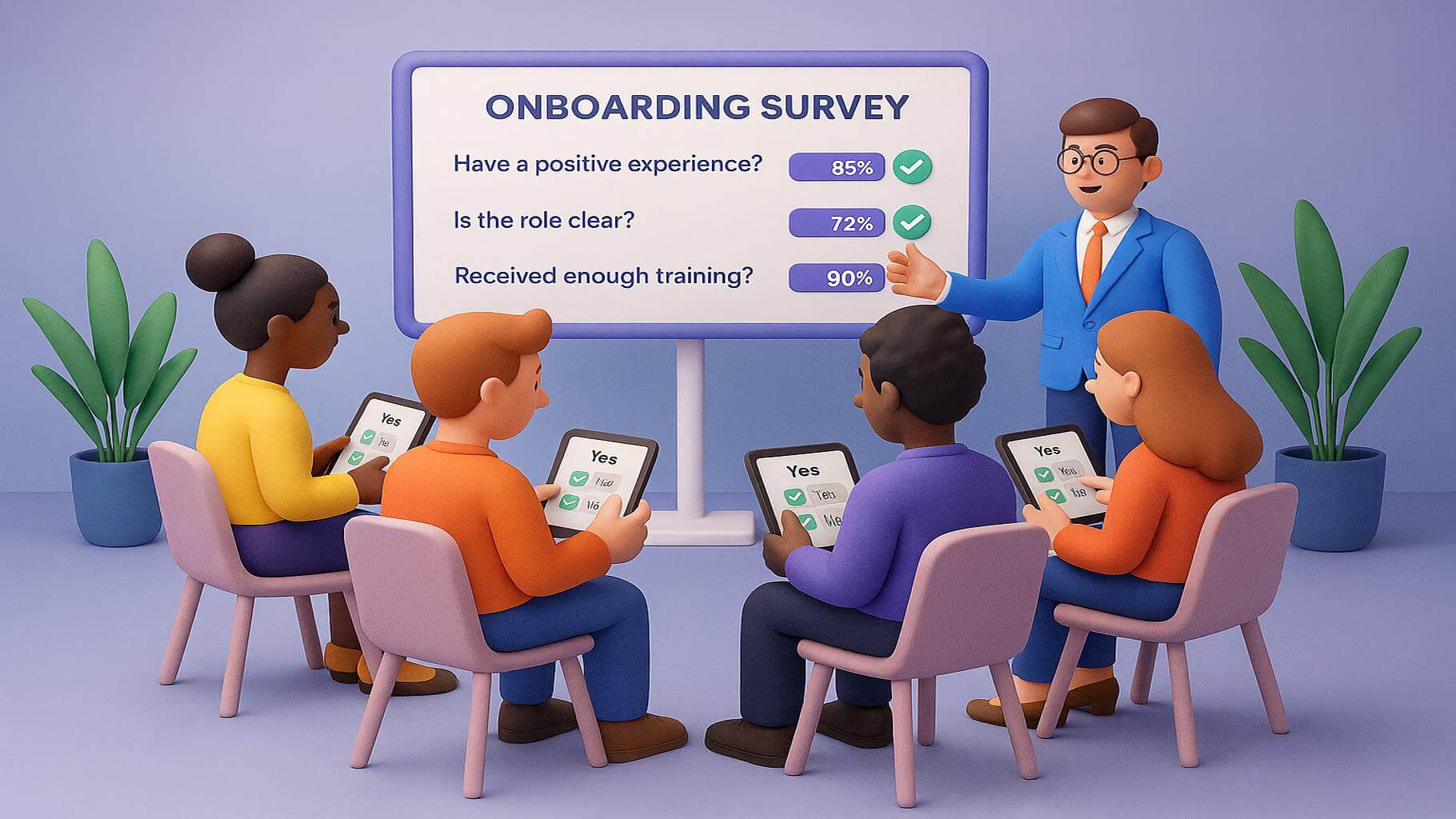
Day one surveys capture immediate impressions while experiences remain vivid and emotions are strongest. These questions assess whether your welcome procedures, administrative processes, and initial orientation meet new employees' expectations. Collecting detailed feedback after the first day reveals opportunities to refine your orientation process for future hires.
The questions to ask on day one focus specifically on controllable factors that shape first impressions. Welcome warmth, workspace readiness, technology functionality, and team introductions all contribute to how new hires feel about their decision to join. Onboarding feedback collected this early enables rapid response to problems that might otherwise compound over subsequent days.
20+ day one questions list:
- Did you feel welcomed when you arrived this morning?
- Was someone ready to greet you and guide you through your first hours?
- How would you rate the organization of your first day activities?
- Was your workspace or remote setup ready and functional when you started?
- Did you receive a clear overview of what to expect during your first week?
- Were administrative tasks and paperwork handled efficiently?
- Did you meet your direct manager and have a meaningful initial conversation?
- Were you introduced to your immediate team members today?
- Did your technology and equipment work properly?
- Was the orientation information presented at an appropriate pace?
- Did you receive the onboarding materials you need to get started?
- Were your questions answered promptly and helpfully throughout the day?
- Did you have adequate breaks and time to absorb information?
- How confident do you feel about navigating tomorrow on your own?
- Was the company culture you observed consistent with what you expected?
- Did anyone make an extra effort to help you feel comfortable today?
- Were lunch arrangements and break areas clearly explained?
- Did you leave today feeling positive about your decision to join?
- Was there anything about today that surprised you negatively?
- What could have made your first day even better?
- How would you rate your overall day one experience on a scale of one to five?
Welcome experience and first impressions questions
First impressions form within minutes and persist throughout employment, making welcome experience questions essential for onboarding feedback collection. Employee engagement survey questions adapted for day one capture whether new hires felt valued, expected, and included from their first moments. These initial feelings predict subsequent engagement trajectory.
Welcome experience questions assess both the practical and emotional dimensions of arrival. Did someone greet them warmly, or did they wander confused through hallways? Was their workspace personalized or barren? These details communicate organizational values more powerfully than any orientation presentation. Survey responses revealing cold or chaotic welcomes indicate urgent improvements needed in your greeting protocols.
- Greeting warmth: Questions capture whether new employees felt genuinely welcomed versus processed
- Personal touch: Surveys assess whether welcome included personalized elements like cards, swag, or team messages
- Preparedness signals: Questions reveal whether the organization appeared ready for the new hire's arrival
- Inclusion indicators: Surveys evaluate whether team members proactively include new hires in conversations and activities
Administrative process and paperwork questions
Administrative efficiency on day one sets the tone for organizational competence throughout employment. New employees who spend hours completing redundant paperwork, fixing incorrect information, or waiting for missing forms develop negative impressions quickly. Survey questions about administrative processes identify friction that can be eliminated for future new hires.
These questions specifically target the balance between necessary documentation and excessive bureaucracy. While certain paperwork remains legally required, organizations often burden new hires with outdated processes that could be streamlined or eliminated. Onboarding surveys reveal which administrative tasks feel reasonable versus which feel like obstacles designed without employee experience consideration.
- Efficiency assessment: Questions evaluate whether paperwork was organized, complete, and processed quickly
- Redundancy identification: Surveys reveal duplicative requests for information already provided during hiring
- Digital versus paper: Questions assess whether electronic options reduced administrative burden appropriately
- Support availability: Surveys evaluate whether help was readily available for questions about forms or processes
Workspace setup and immediate needs questions
Workspace readiness communicates organizational respect for new employees' time and contribution potential. Arriving at a configured workstation with functioning equipment sends a message that the organization prepared for and values the new hire. Conversely, missing equipment, locked accounts, or unassigned desks signal disorganization that undermines confidence.
Survey questions about immediate needs extend beyond the physical workspace to encompass everything required for day one success. This includes bathroom locations, break room access, supply availability, and emergency procedure information. For remote team members, questions address home office setup support, virtual workspace configuration, and communication tool access.
- Workstation completeness: Questions confirm whether desk, chair, equipment, and supplies were ready upon arrival
- Technology functionality: Surveys verify that the computer, phone, system access, and network connectivity worked properly
- Environment orientation: Questions assess whether new hires received adequate facility tours and information
- Immediate resource access: Surveys evaluate whether new employees can find everything needed to work effectively
25+ week one onboarding survey questions for new hires

Week one surveys assess early training effectiveness, manager engagement, and initial cultural observations after new employees have had time to form more substantive impressions. These questions move beyond logistics to evaluate whether the onboarding program successfully transfers essential knowledge and builds team connections. Survey responses from the first week reveal training gaps and integration challenges requiring immediate attention.
The questions to ask during week one focus on learning progress, relationship building, and preliminary role understanding. New hires have now experienced enough to provide valuable feedback about training quality, manager accessibility, and peer helpfulness. This timing captures insights while experiences remain fresh, but after the initial day one, chaos has settled.
25+ week one questions list:
- How effective was your first week of training overall?
- Did the training cover everything you need to start performing your role?
- Was the training pace appropriate for absorbing the material?
- How accessible has your manager been during your first week?
- Did you have a meaningful one-on-one conversation with your manager this week?
- How welcoming have your team members been?
- Do you feel comfortable asking your colleagues questions?
- Are you beginning to understand how your role contributes to team goals?
- Were the onboarding materials clear and helpful?
- Did you receive enough context about the company culture and values?
- How confident do you feel about your ability to succeed in this role?
- Were your job responsibilities explained clearly?
- Do you understand how your performance will be evaluated?
- Has anyone checked in on how you're feeling about your new role?
- Did you have opportunities to observe experienced colleagues performing similar work?
- Were you introduced to people outside your immediate team who you'll work with?
- Do you have a clear understanding of what success looks like in your first thirty days?
- How would you rate the balance between training and actual work tasks this week?
- Were there any topics you wish had been covered more thoroughly?
- Do you feel you have the tools and resources needed to do your job?
- How well do you understand the company's mission and how your role supports it?
- Has anyone explained the informal norms and unwritten rules of your team?
- Did you feel overwhelmed at any point during your first week?
- What has been the most valuable part of your onboarding so far?
- What improvement would make the biggest difference for future new hires?
- On a scale of one to five, how would you rate your first week overall?
Training effectiveness and knowledge transfer questions
Training evaluation questions assess whether your onboarding program successfully equips new employees with the knowledge and skills their roles require. Pulse survey software enables systematic collection of training feedback that reveals content gaps, delivery issues, and pacing problems. These insights drive continuous improvement of training materials and methods.
Effective training questions distinguish between information delivered and information retained. New hires may have sat through presentations without actually learning the content, and surveys reveal this discrepancy. Questions also assess whether training connected theoretical knowledge to practical application through examples, exercises, or observation opportunities.
- Content coverage: Questions assess whether training addressed all topics necessary for role performance
- Retention evaluation: Surveys reveal how much information new employees actually absorbed and can apply
- Methodology effectiveness: Questions identify which training formats and activities resonated best
- Application readiness: Surveys evaluate whether training prepared new hires to perform actual work tasks
Manager support and team integration questions
Manager relationship quality during onboarding dramatically influences new hire success, engagement, and retention outcomes. Survey questions about manager support reveal whether supervisors invest adequate time in new employees or leave them to figure things out independently. These responses help organizations identify managers who excel at onboarding versus those requiring coaching.
Team integration questions assess whether new hires feel welcomed into existing social structures and workflows. Joining an established team presents challenges as new employees navigate relationships, norms, and communication patterns. Survey responses reveal whether current team members actively facilitate this integration or remain focused only on their own work.
- Manager accessibility: Questions evaluate whether supervisors made time for new hire questions and conversations
- Guidance quality: Surveys assess whether manager guidance was clear, helpful, and appropriate to the new hire's needs
- Team inclusion: Questions reveal whether colleagues actively welcomed new employees into team activities
- Social integration: Surveys evaluate comfort level with asking questions, joining conversations, and participating in team dynamics
Company culture and values understanding questions
Cultural understanding questions assess whether onboarding successfully communicates what makes your organization unique and how employees are expected to behave. Strong company culture integration during onboarding builds the emotional connection that sustains engagement through challenges. Survey responses reveal whether your culture messaging resonates with new hires or falls flat.
These questions explore both explicit cultural elements and implicit norms that shape daily work experience. New employees need to understand formal values statements and how those values manifest in actual decisions and behaviors. Surveys also assess whether onboarding explained the unwritten rules that govern team interactions, communication styles, and professional expectations.
- Values comprehension: Questions verify understanding of stated organizational values and their practical meaning
- Behavioral norms: Surveys assess whether new hires understand expected communication styles and professional conduct
- Cultural consistency: Questions evaluate whether the observed culture matches what the onboarding presentations described
- Integration progress: Surveys reveal whether new employees feel they're learning to fit within the cultural context
30+ thirty-day onboarding survey questions examples

Thirty-day surveys evaluate whether new hires have achieved foundational role competence and begun meaningful contributions to team goals. At this milestone, employees have experienced enough to provide substantive feedback about training adequacy, support quality, and job clarity. These employee recognition opportunities also allow celebrating early wins and progress.
The questions to ask at thirty days shift from immediate impressions to demonstrated capability and emerging engagement levels. New employees should now understand their core responsibilities, have established working relationships with key colleagues, and feel increasing confidence in their ability to succeed. Survey responses indicating continued confusion or disconnection at this stage require immediate intervention.
30+ thirty-day questions list:
- Do you clearly understand your core job responsibilities?
- Are you confident in your ability to perform the key tasks of your role?
- Has your training adequately prepared you for your daily work?
- Do you understand how your performance will be measured?
- Have you received clear feedback on your work so far?
- Do you know what successful performance looks like in your role?
- How would you rate the overall quality of your onboarding experience?
- Is your manager providing adequate support and guidance?
- How often do you have meaningful conversations with your manager?
- Do you feel comfortable bringing concerns to your manager?
- Have you built productive relationships with your immediate colleagues?
- Do you understand how your work connects to broader team objectives?
- Are you receiving the resources and tools needed to do your job well?
- Do you have access to the information systems you need?
- Have technology or equipment issues been resolved satisfactorily?
- Do you understand the company's policies that affect your daily work?
- Are you clear on processes for requesting time off, submitting expenses, or similar tasks?
- Do you feel integrated into your team's culture and communication patterns?
- Have you observed company values being demonstrated in daily decisions?
- Do you feel your skills and experience are being utilized appropriately?
- Are there skills you expected to use that you haven't had the opportunity to apply?
- Do you understand your career development opportunities within the organization?
- Have you discussed your professional growth goals with your manager?
- Do you feel valued and appreciated for your contributions?
- Would you recommend this company to a friend seeking employment?
- How engaged do you feel in your work on a daily basis?
- Do you feel your opinions and ideas are welcome and considered?
- Has anything surprised you about the role or organization?
- What aspects of your onboarding have been most valuable?
- What would have improved your first thirty days?
- Is there additional training you wish you had received?
- On a scale of one to five, how would you rate your overall satisfaction at thirty days?
Role clarity and responsibility understanding questions
Role clarity at thirty days indicates whether onboarding successfully communicated what the organization expects from the new employee. Unclear job responsibilities create frustration, duplicate efforts, and conflicts with colleagues whose roles intersect. Survey questions about role understanding identify where additional clarity in communication is needed.
These questions assess whether new hires understand not just their tasks but the boundaries and handoffs between their role and adjacent positions. Understanding the job description in practice often differs from how it appeared during the interview process. Surveys reveal discrepancies between expectations and reality that may require job design adjustments or enhanced role documentation.
- Task clarity: Questions verify understanding of daily, weekly, and project-based responsibilities
- Boundary definition: Surveys assess whether new hires understand where their role ends, and others begin
- Priority understanding: Questions evaluate whether new employees know how to prioritize competing demands
- Success criteria: Surveys verify understanding of how role performance will be evaluated and measured
Training adequacy and skill development questions
Thirty-day training evaluation questions assess whether initial onboarding adequately prepared new hires for independent work. At this stage, employees have attempted to apply their training and discovered where gaps exist. Kudos employee recognition for training completion pairs well with surveys assessing training effectiveness.
These questions distinguish between topics that were covered adequately and areas where additional training is needed. Survey responses help training designers understand which modules successfully transfer skills and which require enhancement. Questions also explore whether on-the-job learning opportunities complemented formal training appropriately.
- Preparation assessment: Questions evaluate whether formal training prepared new hires for actual work challenges
- Gap identification: Surveys reveal specific topics or skills where additional training would be beneficial
- Application success: Questions assess whether new employees can successfully apply what they learned
- Ongoing learning: Surveys evaluate whether continuous learning resources and opportunities are accessible
Team relationships and collaboration questions
Team relationship quality at thirty days influences both immediate productivity and long-term retention outcomes. New employees who haven't established productive working relationships struggle to get answers, navigate processes, and contribute effectively. Survey questions about collaboration reveal whether new hires have integrated into team workflows.
These questions explore both task-focused working relationships and broader social connections within the team. Understanding who to ask for help, how to communicate effectively with different colleagues, and how team decisions get made requires relationship building. Survey responses indicating isolation or friction at thirty days suggest intervention is needed to facilitate integration.
- Working relationship quality: Questions assess whether new hires have established productive connections with key colleagues
- Collaboration effectiveness: Surveys evaluate whether team members willingly collaborate and share knowledge
- Social integration: Questions reveal whether new employees feel included in team activities beyond direct work tasks
- Communication comfort: Surveys assess whether new hires feel comfortable communicating openly with team members
20+ sixty-day new hire survey questions
Sixty-day surveys assess deeper engagement, support system effectiveness, and emerging career development expectations. By this stage, new employees have moved beyond basic onboarding into sustained performance mode. Survey questions explore whether the organization continues supporting its success after the initial training concludes.
The questions to ask at sixty days address whether initial enthusiasm has translated into sustained engagement or begun declining. New hires should now feel confident in their role, connected to their team, and clear about their future with the organization. Survey responses at this milestone reveal whether onboarding has successfully established foundations for long-term success.
20+ sixty-day questions list:
- Do you have clear performance goals and expectations?
- Has your manager provided feedback on your progress toward those goals?
- Do you understand what you need to accomplish in the next thirty days?
- Are you receiving regular one-on-one meetings with your manager?
- Do you feel supported in overcoming challenges you encounter?
- Have you received recognition for your contributions?
- Do you have access to the resources you need to meet your goals?
- Are there tools or systems that would help you be more effective?
- Do you know who to contact for various types of support needs?
- Have the resource gaps you identified been addressed?
- Do you see clear career development opportunities in this organization?
- Have you discussed your professional growth interests with your manager?
- Are there skills you want to develop that aren't currently being addressed?
- Do you feel the organization invests in employee development?
- How engaged do you feel in your daily work?
- Do you feel energized or drained by your typical workday?
- Would you recommend this organization as a place to work?
- Do you see yourself growing your career here?
- What has been the best part of your experience so far?
- What is one thing that would significantly improve your experience?
- On a scale of one to five, how would you rate your overall engagement?
Performance expectations and goal clarity questions
Performance expectation questions at sixty days assess whether new employees understand how their success will be measured and evaluated. Employee recognition and rewards programs connect meaningfully when new hires understand what behaviors and outcomes the organization values. Survey responses reveal whether performance discussions have occurred and provided adequate clarity.
These questions explore whether goals are specific, measurable, and understood by both the new hire and their manager. Misalignment between employee and manager expectations about performance creates frustration and undermines the employment relationship. Surveys identify these disconnects while correction remains straightforward.
- Goal specificity: Questions verify whether performance goals are concrete and measurable versus vague
- Timeline clarity: Surveys assess whether new hires understand deadlines and milestones for their objectives
- Feedback receipt: Questions evaluate whether managers have provided meaningful performance feedback
- Expectation alignment: Surveys reveal whether new employees and managers share consistent success definitions
Resource availability and support system questions
Resource availability questions assess whether new hires have everything needed to succeed after initial onboarding support tapers. Many organizations focus intensively on first-week training but fail to ensure ongoing access to information, tools, and assistance. Survey responses reveal whether support systems remain functional as new employees transition to independent work.
These questions explore both tangible resources and human support networks. New employees need to know where to find answers to questions that arise during daily work. They also need confidence that colleagues and managers will respond helpfully when assistance is needed. Surveys identifying resource gaps enable targeted improvements to support infrastructure.
- Tool adequacy: Questions assess whether systems, software, and equipment fully meet job requirements
- Information access: Surveys evaluate whether new hires can find documentation, procedures, and reference materials
- Human support: Questions reveal whether colleagues and managers respond helpfully to assistance requests
- Gap resolution: Surveys assess whether previously identified resource needs have been addressed
Career development and growth opportunity questions
Career development questions at sixty days assess whether new employees see future opportunities that justify long-term commitment to the organization. Talented hires who don't perceive professional growth potential begin considering alternatives quickly. Survey responses reveal whether career conversations have occurred and generated genuine optimism about advancement possibilities.
These questions explore both formal career development programs and informal growth opportunities through challenging assignments, skill building, and mentorship. Organizations that fail to discuss development with new hires during onboarding miss the window to establish loyalty and ambition alignment. Surveys identify whether these conversations are happening and whether they're generating positive outcomes.
- Opportunity visibility: Questions assess whether new hires understand potential career paths within the organization
- Development investment: Surveys evaluate whether the organization demonstrates commitment to employee growth
- Manager engagement: Questions reveal whether supervisors discuss development interests and aspirations
- Skill building: Surveys assess whether new employees see opportunities to expand their capabilities
15+ ninety-day onboarding experience survey questions

Ninety-day surveys provide a comprehensive assessment of the complete onboarding experience and its outcomes for employee engagement and retention likelihood. This milestone marks the traditional conclusion of onboarding and the transition to standard employment status. Survey questions at this stage evaluate overall effectiveness and gather recommendations for program improvement.
The questions to ask at ninety days cover both retrospective evaluation and forward-looking engagement indicators. New employees should now feel fully integrated, confident in their roles, and committed to organizational success. Survey responses at this stage provide the clearest picture of onboarding program impact on the metrics that matter most.
15+ ninety-day questions list:
- Overall, how effective was your onboarding experience?
- Did the onboarding process adequately prepare you for your role?
- Were there aspects of onboarding that should be expanded or improved?
- How would you rate the quality of training you received?
- Did onboarding accurately represent the company culture you've experienced?
- How engaged do you feel in your work after ninety days?
- Do you feel emotionally connected to the organization's mission?
- How likely are you to still be working here in one year?
- Would you enthusiastically recommend this organization to talented friends?
- Do you feel proud to work for this organization?
- How committed do you feel to contributing to organizational success?
- What was the single most valuable element of your onboarding?
- What one change would most improve the onboarding experience for future hires?
- Is there anything you wish you had learned earlier in your onboarding?
- What advice would you give to someone starting in your role tomorrow?
- On a scale of one to five, how would you rate your overall onboarding experience?
- On a scale of one to five, how would you rate your overall satisfaction with the organization?
Overall onboarding effectiveness and satisfaction questions
Effectiveness questions at ninety days provide the summary assessment that determines whether your onboarding program meets its objectives. These questions ask new hires to evaluate the complete experience retrospectively, identifying what worked well and what fell short. Peer-to-peer recognition of new employees who complete milestone surveys reinforces the value of their feedback.
These questions combine satisfaction ratings with open-ended requests for improvement suggestions. Rating scales enable quantitative tracking across hiring cohorts and over time. Qualitative responses provide the specific insights needed to design targeted improvements. Together, they create a complete picture of onboarding program performance.
- Holistic assessment: Questions capture overall impressions after experiencing the complete onboarding journey
- Preparation evaluation: Surveys assess whether onboarding successfully prepares new hires for role success
- Culture alignment: Questions evaluate whether onboarding accurately represented the actual organizational culture
- Improvement prioritization: Open-ended questions identify highest-impact enhancement opportunities
Long-term engagement and commitment questions
Engagement questions at ninety days assess whether onboarding has established the foundation for sustained commitment and discretionary effort. These responses serve as early indicators of retention risk and engagement trajectory. Survey scores at this milestone correlate meaningfully with one-year retention outcomes, making them valuable for intervention targeting.
These questions explore emotional connection, pride, and investment in organizational success that transcend transactional employment. New hires who report strong engagement at ninety days have formed the psychological bonds that sustain performance through challenges. Those reporting weak engagement require immediate attention before disengagement deepens.
- Emotional investment: Questions assess whether new hires feel personally invested in organizational success
- Pride indicators: Surveys reveal whether new employees feel proud of their organizational affiliation
- Retention likelihood: Questions directly assess intention to remain with the organization long-term
- Referral willingness: Surveys evaluate whether new hires would recommend the organization to talented contacts
Recommendations for onboarding improvement questions
Improvement recommendation questions leverage new hires' fresh perspectives to identify enhancement opportunities that longer-tenured employees may overlook. Those who recently completed onboarding remember friction points vividly and can articulate specific improvements. These insights drive continuous refinement of onboarding programs.
Open-ended questions encourage detailed, actionable suggestions rather than generic complaints. Asking for specific changes focuses respondents on constructive feedback that the organization can implement. Questions about advice for future new hires similarly generate practical recommendations grounded in recent experience.
- Priority identification: Questions ask which changes would have the greatest positive impact on the onboarding experience
- Timing feedback: Surveys reveal whether specific information or training arrived too early, too late, or at the right time
- Content gaps: Questions identify topics that new hires wish had been covered during onboarding
- Process improvements: Surveys surface suggestions for streamlining or enhancing onboarding procedures
10+ fun onboarding questions for new hires to boost engagement
Fun onboarding questions break the monotony of serious assessments while still gathering valuable insights about new hire experiences. These lighthearted questions encourage honest responses by reducing survey fatigue and creating psychological safety. Including creative questions demonstrates that your organization values both effectiveness and enjoyable work experiences.
The questions to ask in this category balance genuine information gathering with engagement-building entertainment. New hires appreciate organizations that don't take themselves too seriously and create space for authentic expression. Survey responses to fun questions often reveal insights that more formal questions miss.
10+ fun questions list:
- What emoji best describes your onboarding experience so far?
- If your first week were a movie genre, what would it be?
- What was the most surprising thing you learned during onboarding?
- What office or team quirk did you discover that made you smile?
- Who made you feel most welcome, and what did they do?
- What's one thing you wish someone had told you before your first day?
- If you could add one thing to the welcome package, what would it be?
- What's the best piece of advice you received during your first month?
- What would you name your onboarding experience if it were a book?
- What accomplishment from your first weeks are you most proud of?
- What's one misconception you had about the job or company that onboarding cleared up?
- If you could teleport one thing from your old job to this one, what would it be?
Icebreaker questions that build team connections
Icebreaker questions within surveys reveal information about team dynamics and new hire integration that standard questions may miss. Pulse survey tools can include these lighter questions alongside serious assessments. Responses often highlight team members who excel at welcoming new colleagues or reveal integration challenges requiring attention.
These questions create opportunities for positive reflection about team connections formed during onboarding. When new hires describe who made them feel welcome, they reinforce appreciation for inclusive colleagues. The responses also help HR teams identify which teams excel at integration and which may need cultural attention.
- Relationship recognition: Questions highlight individuals who actively welcomed new team members
- Social integration: Survey responses reveal the quality of connections formed during early employment
- Culture glimpses: Lighthearted questions surface informal cultural elements that formal questions miss
- Positive reflection: Fun questions encourage remembering enjoyable onboarding moments
Creative questions about first impressions and surprises
Creative questions about surprises and revelations capture honest reactions that polished corporate questions may not elicit. Asking what surprised new hires reveals gaps between expectations and reality that may be positive or negative. These responses provide actionable insights disguised in engaging question formats.
Questions about surprises also reveal whether the interview process and onboarding set accurate expectations. Positive surprises indicate areas of strength to highlight in recruiting. Negative surprises identify misalignments requiring correction in how the organization presents itself to candidates.
- Expectation gaps: Surprise questions reveal where reality differed from pre-hire expectations
- Hidden strengths: Positive surprises highlight organizational advantages to emphasize in recruiting
- Improvement opportunities: Negative surprises identify misalignments requiring communication adjustments
- Authentic responses: Creative framing encourages candid answers rather than socially desirable responses
Lighthearted questions that encourage honest feedback
Lighthearted framing of serious questions reduces defensiveness and encourages authentic responses. Asking new hires to describe their experience as a movie genre or emoji creates psychological distance that enables honesty. The answers still provide meaningful data while being more enjoyable to provide.
These questions work especially well for sensitive topics like whether the job met expectations or whether training felt adequate. By packaging serious inquiries in fun formats, surveys achieve higher response rates and more genuine answers. HR professionals can decode the playful responses into actionable insights.
- Psychological safety: Fun formats reduce anxiety about providing negative feedback
- Response authenticity: Lighthearted questions encourage honest rather than diplomatic answers
- Engagement maintenance: Creative questions prevent survey fatigue through variety and entertainment
- Memorable insights: Unique question formats generate memorable responses that stick with reviewers
Onboarding questions for measuring new hire experience quality

Experience quality measurement questions provide quantitative data enabling benchmarking, trend analysis, and program evaluation. These structured questions generate scores comparable across time periods, departments, and hiring cohorts. Including standardized measurement questions alongside more exploratory assessments creates comprehensive onboarding feedback data.
The questions to ask for quality measurement follow established survey methodology principles. Rating scales provide consistent data formats suitable for statistical analysis. Comparative questions reveal how your onboarding stacks up against alternatives new hires have experienced. Net Promoter Score questions directly measure the advocacy that drives referrals and employer brand.
Net Promoter Score questions for onboarding advocacy
Net Promoter Score questions adapted for onboarding assessment directly measure whether new hires would recommend your organization and onboarding experience to others. Employee recognition platforms can integrate eNPS tracking to connect recognition with engagement metrics. This industry-standard methodology enables benchmarking against published standards.
The standard NPS question asks how likely respondents would recommend on a zero-to-ten scale. Adapted for onboarding, questions focus on whether new hires would recommend the onboarding experience specifically or the organization overall based on their early employment experience. Follow-up questions explore reasons behind the numerical rating.
- Advocacy measurement: Standard NPS questions quantify recommendation likelihood on a consistent scale
- Benchmark capability: Industry-wide NPS usage enables meaningful external comparisons
- Segmentation analysis: NPS responses categorize new hires as promoters, passives, or detractors
- Trend tracking: Consistent NPS measurement reveals onboarding quality trends over time
Sentiment analysis questions about emotional experience
Sentiment questions capture the emotional dimensions of onboarding that functional assessments may miss. New hires may receive excellent training and adequate resources while still feeling unwelcome or undervalued. Questions targeting emotional experience reveal these intangible factors that influence engagement and retention.
These questions assess employee sentiment across dimensions, including belonging, appreciation, confidence, and optimism. Rating scales enable tracking sentiment changes across survey intervals throughout onboarding. Consistently declining sentiment scores signal problems requiring investigation, even when functional metrics look acceptable.
- Emotional barometer: Sentiment questions capture feelings that functional assessments overlook
- Belonging assessment: Questions reveal whether new hires feel included and valued by their teams
- Confidence tracking: Surveys monitor whether new employees feel increasingly capable or frustrated
- Trajectory indication: Sentiment trends across survey waves reveal improving or deteriorating emotional experience
Comparative questions benchmarking against previous employers
Comparative questions leverage new hires' previous employment experiences as benchmarks for evaluating your onboarding. Those with prior professional experience can contrast your approach against alternatives, providing a perspective that internal assessments cannot. These comparisons highlight competitive advantages and disadvantages.
Questions asking how your onboarding compares to previous employers generate insights unavailable through other methods. Strong positive comparisons indicate differentiated strengths worth preserving and promoting. Negative comparisons reveal areas where competitors may be outperforming your onboarding program.
- Competitive positioning: Comparisons reveal how your onboarding stacks up against alternatives
- Best practice identification: Positive comparisons highlight strengths to preserve and emphasize
- Improvement prioritization: Negative comparisons identify areas requiring competitive enhancement
- Industry standards: Aggregated comparisons reveal whether your practices meet or exceed norms
New hire survey questions for different departments and roles
Role-specific survey questions acknowledge that onboarding needs vary dramatically across departments and functions. Generic questions miss critical success factors unique to particular roles. Tailored questions for sales, engineering, customer service, and other functions capture relevant feedback that drives targeted improvements.
The questions to ask should align with each role's unique challenges, success criteria, and knowledge requirements. Organizations achieve better onboarding outcomes when surveys assess whether role-specific training, tools, and support actually prepare new employees for their particular responsibilities. Standard questions supplemented with role-specific modules create comprehensive assessment programs.
Sales onboarding questions about product knowledge and pipeline
Sales role onboarding requires specific knowledge about products, competitive positioning, sales methodologies, and pipeline management systems. Survey questions for sales new hires assess whether training adequately prepared them to engage prospects and close deals. These responses help sales enablement teams refine their onboarding content.
Questions explore product knowledge depth, system proficiency, and confidence in executing sales processes. Sales onboarding should also cover territory assignment, quota understanding, and compensation structure comprehension. Surveys revealing gaps in these areas enable targeted training interventions before performance suffers.
- Product mastery: Questions assess whether new sales employees can confidently discuss products and value propositions
- System proficiency: Surveys evaluate comfort with CRM, forecasting, and pipeline management tools
- Process understanding: Questions reveal whether sales methodology and best practices were effectively communicated
- Confidence level: Surveys assess whether new sales employees feel prepared to engage customers effectively
Engineering onboarding questions about technical setup and codebase
Engineering onboarding focuses heavily on development environment setup, codebase familiarization, and technical process understanding. Survey questions for engineering new hires assess whether they can effectively contribute code, navigate systems, and follow established practices. Technical teams require specific feedback beyond general onboarding assessments.
Questions explore development environment functionality, documentation quality, and code review process understanding. Engineering onboarding should also address architecture overview, testing expectations, and deployment procedures. Surveys identifying technical onboarding gaps enable precise improvements to documentation and training materials.
- Environment readiness: Questions assess whether development tools, access, and configurations work properly
- Documentation utility: Surveys evaluate whether technical documentation helped new engineers ramp up
- Architecture understanding: Questions reveal whether new hires comprehend system design and integration points
- Process clarity: Surveys assess understanding of code review, testing, and deployment procedures
Customer service onboarding questions about systems and protocols
Customer service onboarding prepares new employees to handle customer interactions effectively using established systems and protocols. Survey questions for service role new hires assess whether training covered common scenarios, system navigation, and escalation procedures. These responses inform service training program refinements.
Questions explore ticket system proficiency, knowledge base utility, and confidence in handling various customer situation types. Customer service onboarding should also address quality standards, metric expectations, and communication guidelines. Surveys revealing training gaps enable improvements before service quality suffers.
- System proficiency: Questions assess comfort navigating ticketing, CRM, and communication tools
- Scenario preparation: Surveys evaluate whether training covered likely customer situations adequately
- Escalation understanding: Questions reveal whether new hires know when and how to escalate issues
- Quality expectations: Surveys assess understanding of service standards and performance metrics
15+ onboarding survey examples with complete question sets

Complete survey examples provide templates that organizations can adapt for their specific needs and contexts. These examples demonstrate how individual questions combine into coherent assessment instruments at different onboarding stages. eNPS questions integrate naturally into these comprehensive templates.
The following examples show how questions build upon each other across survey timing intervals. Each example balances breadth of coverage with practical completion time considerations. Organizations can customize these templates by adding role-specific modules or industry-relevant questions.
First week onboarding survey example with 10 questions
This first week survey example captures initial impressions, training effectiveness, and early integration indicators. The ten questions balance comprehensiveness with brevity to maintain high response rates. New hires can complete this survey in under five minutes while providing actionable feedback.
First week survey questions:
- How effective was your first week of training? (Scale 1-5)
- Did you receive clear guidance about your initial responsibilities?
- How accessible has your manager been during your first week? (Scale 1-5)
- Do you feel welcomed by your team members?
- Were the onboarding materials clear and helpful?
- Do you have access to the tools and resources you need?
- How confident do you feel about succeeding in this role? (Scale 1-5)
- What has been most valuable about your onboarding so far?
- What would improve the first week experience for future new hires?
- Overall, how would you rate your first week's experience? (Scale 1-5)
30-day check-in survey example with 12 questions
This thirty-day survey example assesses role clarity, support quality, and emerging engagement levels. Twelve questions provide comprehensive coverage of the factors most predictive of retention outcomes. The combination of rating scales and open-ended questions generates both quantitative trends and qualitative insights.
30-day survey questions:
- Do you clearly understand your core job responsibilities? (Scale 1-5)
- Has training adequately prepared you for your daily work?
- How would you rate your manager's support? (Scale 1-5)
- Do you know how your performance will be evaluated?
- Have you built productive relationships with colleagues?
- Do you understand how your work contributes to team goals?
- Are you receiving the resources needed to do your job well?
- Do you feel valued and appreciated for your contributions?
- Would you recommend this company to a friend seeking employment? (Scale 1-10)
- How engaged do you feel in your work? (Scale 1-5)
- What aspect of onboarding has been most valuable?
- What one improvement would make the biggest difference?
90-day comprehensive onboarding survey example with 15 questions
This ninety-day survey example provides a comprehensive assessment of the complete onboarding experience and its outcomes. Fifteen questions cover onboarding effectiveness, engagement levels, retention likelihood, and improvement recommendations. This survey serves as the capstone assessment for formal onboarding programs.
90-day survey questions:
- Overall, how effective was your onboarding experience? (Scale 1-5)
- Did onboarding adequately prepare you for your role?
- How would you rate the quality of training you received? (Scale 1-5)
- Did onboarding accurately represent the company culture?
- How engaged do you feel in your work? (Scale 1-5)
- Do you feel connected to the organization's mission?
- How likely are you to still be working here in one year? (Scale 1-5)
- Would you recommend this organization to talented friends? (Scale 1-10)
- Do you feel proud to work for this organization?
- How committed are you to contributing to organizational success? (Scale 1-5)
- What was the most valuable element of your onboarding?
- What one change would most improve onboarding for future hires?
- What do you wish you had learned earlier?
- What advice would you give someone starting in your role tomorrow?
- Overall satisfaction with your onboarding experience? (Scale 1-5)
How Matter can help with new hire onboarding survey questions
Matter provides comprehensive tools that transform onboarding feedback collection from an administrative burden into a strategic advantage for improving new hire experiences. The platform integrates seamlessly with Slack and Microsoft Teams, meeting new employees where they already work rather than requiring separate survey system navigation. This integration dramatically increases survey response rates while reducing the friction that often causes onboarding feedback programs to fail.
Organizations using Matter benefit from automated survey scheduling, recognition integration, and real-time analytics that enable proactive intervention with at-risk new hires. The platform's approach to employee rewards creates natural connections between feedback collection and appreciation, incentivizing survey participation while building engagement.
Matter's automated onboarding survey scheduling at key milestones
Matter's automation capabilities eliminate the manual tracking and reminder sending that typically burden HR teams managing onboarding surveys. The platform automatically deploys surveys at configurable intervals based on each new hire's start date. This ensures consistent feedback collection without requiring calendar management or individual follow-up for every new employee.
Automated scheduling at day seven, day thirty, day sixty, and day ninety milestones ensures comprehensive coverage of the onboarding journey. Custom survey templates for each interval capture stage-appropriate feedback using proven question frameworks. Survey deployment timing adjusts automatically for weekends and holidays, maximizing response rates through strategic send timing.
- Milestone automation: Surveys deploy automatically at configured intervals from the start date
- Template customization: Stage-specific question sets capture appropriate feedback at each milestone
- Smart timing: Automated scheduling avoids weekends and holidays for optimal response rates
- Consistency assurance: Every new hire receives surveys regardless of HR team bandwidth fluctuations
Recognition integration, celebrating new hire achievements, and progress
Matter uniquely connects onboarding surveys with recognition features that celebrate new employee achievements and milestones. When new hires complete surveys, managers can recognize their engagement through the platform's kudos system. This connection transforms feedback collection from an obligation into an appreciated contribution.
The platform enables recognition for onboarding milestone completion, early wins, and demonstrated growth during the first ninety days. Team members can send customizable kudos cards celebrating new colleague achievements visible throughout the organization. This recognition integration builds an appreciation culture that supports engagement while encouraging survey participation through positive reinforcement.
- Milestone celebration: Automated recognition for completing onboarding phases and survey participation
- Achievement visibility: Platform showcases new hire accomplishments to build belonging and motivation
- Team recognition: Colleagues can acknowledge new employee contributions through the same integrated platform
- Feedback appreciation: Completing surveys triggers recognition that reinforces participation value
Real-time analytics identifying onboarding risks and opportunities
Matter's analytics dashboard transforms raw survey responses into actionable insights that drive onboarding improvements. Real-time visibility into new hire sentiment enables intervention before disengagement progresses to resignation consideration. The platform identifies at-risk employees through declining scores or concerning response patterns requiring immediate attention.
Aggregate analytics reveal onboarding program strengths and weaknesses across departments, managers, and time periods. Comparative views show which teams excel at new hire integration and which need support. Exportable reports provide the data necessary for executive presentations, budget justifications, and continuous improvement initiatives.
- Risk detection: Analytics identify new hires showing declining engagement, requiring immediate manager attention
- Trend visualization: Dashboards reveal onboarding quality trends over time and across organizational units
- Comparative analysis: Cross-team comparisons highlight integration excellence and improvement opportunities
- Export capability: Data exports support executive reporting and integration with HR analytics systems
Frequently asked questions about the new hire onboarding survey questions
Q: What are the best new hire onboarding survey questions?
A: The best questions measure training effectiveness, manager support quality, cultural integration, role clarity, and resource availability. Essential questions ask whether onboarding adequately prepared employees for their roles, how they rate manager support, whether they understand how their work contributes to goals, and if necessary resources were provided. Always include recommendation likelihood questions to capture advocacy indicators.
Q: When should you send onboarding survey questions to new hires?
A: Send surveys at multiple intervals throughout the employee onboarding process. Pre-boarding surveys ensure readiness before day one. Day one and first week surveys capture immediate impressions and training feedback. Thirty-day surveys evaluate role preparation. Sixty-day surveys measure support effectiveness. Ninety-day surveys gauge overall onboarding effectiveness and retention likelihood.
Q: How many questions should a new hire onboarding survey include?
A: Question quantity depends on survey timing. Day one surveys should include five to eight questions. First week surveys need ten to twelve questions. Thirty-day surveys require twelve to fifteen questions. Ninety-day comprehensive surveys should include fifteen to twenty questions. Keep all surveys under ten minutes to maintain high response rates.
Q: What are good onboarding survey examples?
A: Effective examples combine rating scale questions for quantitative analysis with open-ended questions for qualitative insights. First week surveys ask about training quality and team welcome. Thirty-day surveys evaluate role clarity and cultural fit. Ninety-day surveys measure overall satisfaction and retention likelihood. Mix question types to understand both what happened and why.
Q: Should onboarding surveys be anonymous or identified?
A: This depends on organizational culture and survey timing. Anonymous surveys encourage honest feedback about sensitive topics like manager effectiveness. Identified surveys enable personalized follow-up and demonstrate responsiveness. Consider hybrid approaches using anonymous questions for sensitive topics and identified questions for operational issues.
Q: What are fun onboarding questions for new hires?
A: Fun questions build engagement while gathering insights. Examples include asking what emoji describes their experience, what surprised them most, who made them feel most welcome, and what advice they would give someone starting tomorrow. These questions reduce survey fatigue and encourage honest responses to serious questions.
Final thoughts about new hire onboarding survey questions
Implementing strategic new hire onboarding survey questions transforms how organizations understand and improve the critical first ninety days when employee engagement and retention patterns become established. The questions to ask at each milestone provide the data necessary to identify what's working, address what isn't, and continuously refine the onboarding experience for every new employee who joins. Organizations that close the feedback loop by recognizing managers who receive excellent onboarding scores and celebrating new hires who complete milestone surveys create cultures where feedback drives meaningful improvement.
Matter provides a complete solution for organizations committed to optimizing their onboarding programs through systematic feedback collection and recognition integration. The platform offers automated onboarding survey scheduling at key intervals from pre-boarding through ninety days, ensuring consistent data collection without burdening HR teams. Comprehensive question banks for every stage eliminate the guesswork of survey design while remaining fully customizable. Recognition features celebrate onboarding milestones and survey completion, reinforcing participation value. Real-time analytics flag at-risk new hires before disengagement becomes resignation, enabling proactive intervention. This seamless approach transforms onboarding from a one-time administrative event into a continuous improvement process that builds trust, accelerates productivity, reduces early turnover, and creates lasting employee rewards, ideas, and engagement from day one.
Ready to optimize your new hire experience with proven onboarding survey questions? Schedule a demo with a Matter expert today and discover how our platform can help you measure onboarding effectiveness, identify improvement opportunities, and create a culture of continuous improvement.