
Creating survey questions that capture meaningful feedback from new hires is one of the most underestimated challenges HR teams face today. Many organizations invest heavily in their onboarding programs only to discover that their onboarding experience survey questions generate vague responses that offer little direction for improvement. At Matter, we understand how frustrating it can be to collect feedback that looks positive on the surface but fails to reveal the specific issues driving early turnover. The gap between asking questions and asking the right questions often determines whether your onboarding program evolves or stagnates.
When you know how to structure survey questions effectively for an onboarding experience, you can uncover blind spots that harm new-hire retention before they become costly departures. The right approach to employee onboarding survey questions helps organizations implement reliable feedback programs that drive engagement improvements throughout the entire employee lifecycle. This guide provides actionable frameworks, proven question examples, and strategic timing recommendations that transform feedback collection from guesswork into a measurable advantage for your employee onboarding program.
What are the onboarding experience survey questions?
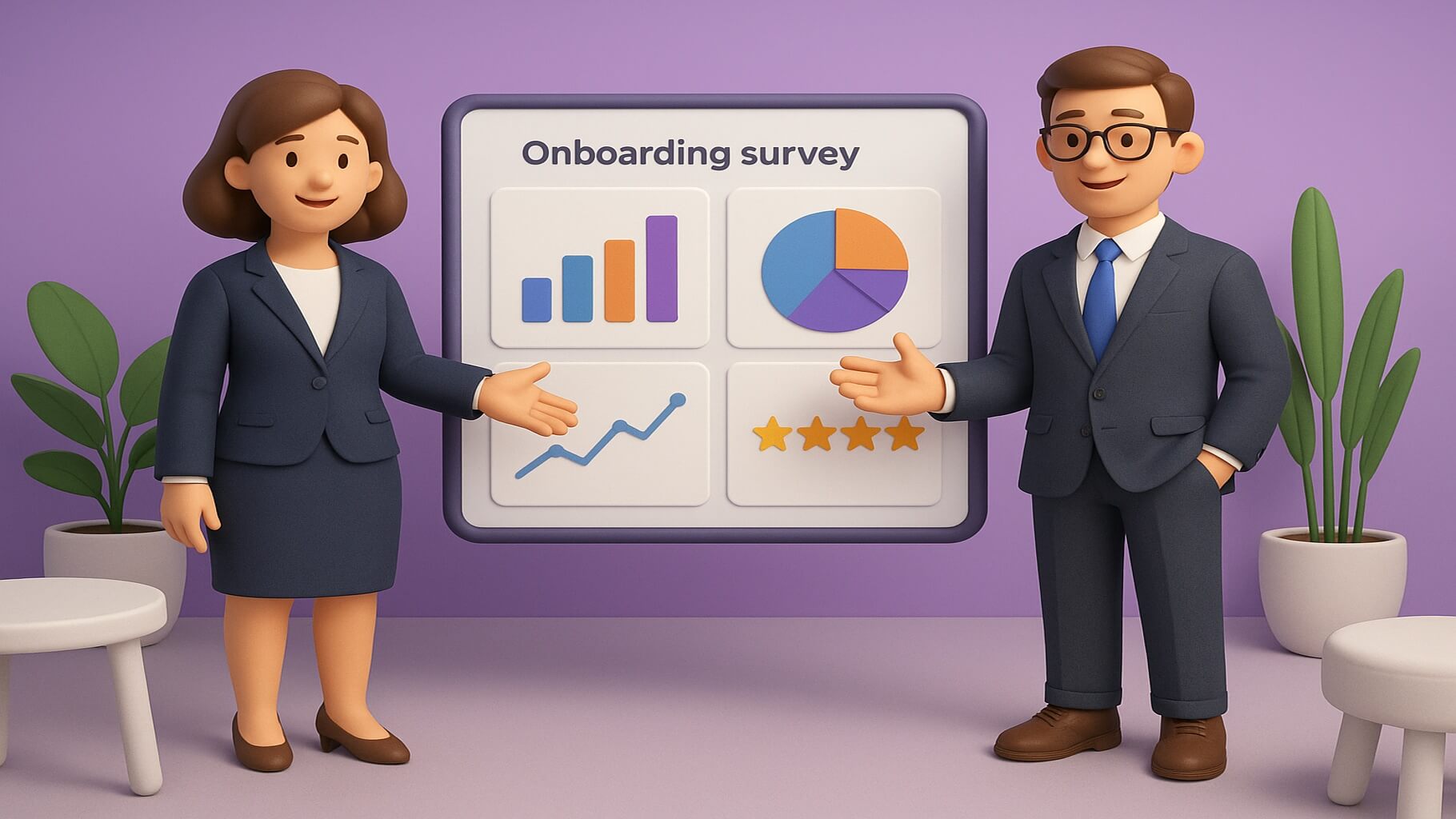
Onboarding experience survey questions are strategically designed inquiries that measure how new hires perceive their onboarding experience. These questions evaluate everything from pre-boarding communication to training effectiveness and team integration during onboarding. Unlike general employee engagement surveys, onboarding survey questions focus specifically on the unique challenges new employees face. When designed properly, an onboarding survey captures actionable insights that help organizations improve their onboarding experience.
Core elements of effective new hire feedback questions
Effective onboarding survey questions have various characteristics that enable employees to provide candid feedback on their experiences. Clarity stands as the foundation, with each question addressing a single concept that new hires can easily understand. Relevance ensures that every question connects to aspects of the onboarding program that organizations can actually change. Timing matters significantly, as gathering feedback at different stages of the employee experience reveals evolving perspectives.
The best onboarding survey questions also maintain neutrality to avoid leading respondents toward particular answers. Questions should use language that feels conversational rather than formal or intimidating to new team members. Specificity helps organizations collect feedback that translates directly into process improvements for future hires. A good onboarding survey balances quantitative rating scales with opportunities for qualitative responses.
Difference between assessment questions and feedback questions
Assessment questions measure whether new employees have acquired specific knowledge or skills during their onboarding training. These questions determine if the onboarding materials effectively conveyed critical information about job responsibilities and company policies. Feedback questions, however, ask new hires to evaluate the quality and helpfulness of their onboarding experience. Understanding this distinction helps organizations design employee onboarding surveys that serve multiple purposes effectively.
Assessment-focused onboarding questions might ask whether new employees can perform specific tasks after training sessions. Feedback-focused questions explore how confident or prepared the new hire feels about their role. Organizations benefit from including both types in their onboarding survey strategy. This dual approach ensures the onboarding process meets both educational and experiential goals.
How question design impacts response quality and honesty
Poorly designed onboarding survey questions often yield responses that seem positive but lack actionable substance. When questions are too broad, new employees default to generic answers that fail to identify challenges. Leading questions subtly pressure respondents toward answers that please management rather than reflect reality. Double-barreled questions that combine multiple concepts confuse respondents and produce unreliable survey responses.
Well-designed questions foster psychological safety, encouraging employees to share genuine perspectives on their new-hire experience. Anonymous surveys paired with carefully worded questions increase the likelihood of receiving constructive feedback. Organizations that invest in question design see higher participation rates and more valuable insights from new hires. Both the recruitment and onboarding processes benefit when organizations prioritize thoughtful question construction.
What are the benefits of survey questions for the onboarding experience?
Strategic employee onboarding surveys deliver measurable advantages that extend far beyond simple feedback collection. Organizations that systematically gather feedback from new employees identify problems before they escalate into turnover. The onboarding survey becomes an early warning system that protects your investment in talent acquisition. Every piece of onboarding feedback contributes to a continuous improvement cycle that strengthens the employee experience.
Reduced turnover through early warning signals
New hires who feel unsupported or confused during onboarding are significantly more likely to leave within their first year. Pulse survey data collected during onboarding reveals dissatisfaction before employees begin searching for other opportunities. Organizations can address concerns about unclear job expectations or inadequate training before frustration peaks. This proactive approach to employee sentiment helps protect new-hire retention rates.
Onboarding surveys help organizations detect patterns that predict early departures across different teams or departments. Managers receive actionable intelligence about which aspects of the onboarding process need immediate attention. HR leaders can allocate resources toward interventions that demonstrate the highest impact on hire retention. The cost of gathering feedback pales compared to the expense of replacing employees who leave early.
Enhanced manager accountability and performance
When managers know their direct reports will provide feedback through onboarding feedback surveys, accountability naturally increases. Survey questions about manager effectiveness highlight which leaders excel at welcoming and developing new team members. Organizations gain data to recognize managers who create exceptional onboarding experiences for new employees. This visibility motivates improvement across the leadership ranks.
Aggregate survey responses reveal whether certain managers consistently receive lower scores on support and communication. Leadership development programs can target specific skills identified by onboarding surveys as needing improvement. New employees benefit when their managers understand that their onboarding experience will be measured. The feedback loop between surveys and manager behavior creates lasting improvements in how organizations welcome new hires.
Continuous refinement of onboarding processes
Every cohort of new employees provides fresh perspectives on what works and what needs improvement in your company's onboarding process. Combining employee engagement survey data with onboarding-specific feedback creates a comprehensive picture. Organizations can test changes and measure their impact through subsequent onboarding surveys. This iterative approach transforms onboarding from a static program into an evolving system.
Onboarding feedback reveals whether recent modifications to training materials or the orientation process actually improved outcomes. Organizations build institutional knowledge about what matters most to new hires in different roles. Historical survey data enables benchmarking that shows progress over time and highlights regression. Continuous refinement based on employee feedback drives business success by equipping employees with better preparation and greater engagement.
Why asking the right onboarding questions matters

The difference between useful onboarding feedback and meaningless data often comes down to the quality of the questions. Poorly constructed questions waste everyone's time while creating a false sense that organizations understand their new hires. Asking the right onboarding survey questions for new hires uncovers specific, actionable insights that drive real improvement. Organizations that master question design gain competitive advantages in employee retention and productivity.
How poor questions lead to misleading conclusions
Vague questions like "Was your onboarding satisfactory?" generate responses that lack the specificity needed for action. New employees may rate their experience positively despite significant unaddressed concerns about the job description's accuracy. Organizations then assume their onboarding program works well when hidden problems persist beneath the surface. Poor questions create blind spots that undermine the entire purpose of collecting insights.
Double-barreled questions asking about multiple topics simultaneously produce responses that cannot be interpreted accurately. Leading questions bias results toward positive responses, masking genuine issues with the onboarding process. Organizations relying on flawed survey responses make decisions based on inaccurate information about employee satisfaction. The consequences include persistent problems, continued turnover, and wasted resources on ineffective interventions.
Impact of question timing on feedback accuracy
Surveying new hires too early captures only first impressions before meaningful onboarding experiences have occurred. Waiting too long allows memory to fade and initial concerns to seem less important or relevant. Employee pulse survey cadences should align with key milestones during the new hire's tenure. Strategic timing ensures feedback reflects actual experiences rather than vague recollections.
The first week captures reactions to welcome activities, administrative processes, and initial team integration efforts. Thirty-day surveys assess whether role clarity has developed and whether manager relationships are functioning effectively. Ninety-day feedback evaluates whether new hires feel productive and integrated into the company culture. Multiple touchpoints throughout onboarding provide a complete picture of how the experience evolves.
Connection between question specificity and actionable insights
Specific questions that reference concrete onboarding elements produce feedback that organizations can actually use. Asking whether new hires received adequate information about their job effectively identifies gaps in position-specific training. Inquiring about specific aspects of the interview process versus reality reveals alignment problems that affect expectations. Detailed questions transform survey responses into roadmaps for targeted improvements.
General questions generate general answers that offer no clear direction for process changes.
When organizations ask specifically about training sessions, software access, or manager availability, they receive precise feedback. This specificity enables leaders to identify challenges and implement focused solutions. The investment in crafting detailed onboarding questions pays dividends through measurable improvements in new employee success rates.
10+ essential onboarding experience survey sample questions for first impressions
The initial days of employment shape how new employees perceive your organization for months to come. First impressions matter because they establish expectations and influence commitment during a vulnerable transition period. Capturing feedback about early experiences helps organizations optimize the moments that have an outsized impact on engagement. These questions help gather valuable insights about what new hires experience when they first arrive.
10 first impression survey questions:
- How effectively did we communicate what to expect before your start date?
- Did you receive all the necessary equipment and access credentials on your first day?
- How welcomed did you feel by your team during your first week?
- Were the administrative tasks during orientation clearly explained and organized?
- How helpful was the initial overview of our organization's mission and values?
- Did someone adequately introduce you to colleagues you would work with regularly?
- How prepared did you feel to navigate the physical or virtual workspace?
- Were your questions during the first day answered promptly and thoroughly?
- How clearly did someone explain the schedule and expectations for your first week?
- Did the overall first-week experience match what was promised during interviews?
Pre-boarding communication and preparation assessment
Pre-boarding sets the stage for whether new employees arrive feeling confident or anxious about their decision to join. Questions about pre-arrival communication reveal gaps in the information organizations provide before day one. New hires who receive clear instructions about when and where to report feel more prepared and engaged. Assessing pre-boarding helps organizations reduce the stress that accompanies starting a new position.
Effective onboarding survey questions ask whether new employees received timely responses to their pre-start inquiries. Organizations benefit from understanding whether essential paperwork was confusing or whether the technology setup instructions were adequate. Pre-boarding survey questions also reveal whether the employee handbook arrived with sufficient time for review. These insights help organizations create seamless onboarding experiences starting before day one.
Day-one welcome and orientation evaluation
The first day creates lasting impressions that influence how new employees view their employer and colleagues. Survey questions about day-one experiences assess whether organizations deliver welcoming, organized initial encounters. New hires form opinions quickly about whether they made the right choice in accepting the position. Capturing this feedback while memories remain fresh provides accurate insights into the orientation process.
Organizations should ask whether new employees felt expected and whether their workspace was prepared appropriately. Questions about the quality of the introduction reveal whether teams genuinely welcomed new team members into their group. Assessing whether day-one objectives are clear helps organizations improve their structure and reduce confusion. First-day feedback directly impacts how they refine their approach to welcoming future hires.
First-week administrative process feedback
Administrative tasks during the first week can either feel seamless or become overwhelming distractions from more important learning. Onboarding surveys help organizations understand which paperwork, system enrollments, or compliance requirements cause frustration. New employees appreciate it when organizations respect their time by streamlining necessary administrative processes. Questions about these practical matters reveal opportunities to reduce friction during the early employment period.
Survey questions should ask whether forms and enrollment processes were confusing or repetitive for new hires. Understanding how long administrative tasks took helps organizations benchmark against reasonable expectations. Feedback about the technology setup identifies whether IT support has adequately prepared new employees to perform their jobs. Organizations use this data to collaborate with various departments to simplify the bureaucratic aspects of employee onboarding.
10+ critical survey questions for the onboarding experience after one month

The thirty-day milestone marks a transition from initial orientation to genuine integration into roles and teams. By this point, new employees have gained enough experience to provide feedback on meaningful aspects of their positions. One-month surveys capture perspectives on whether early promises are translating into daily reality for new hires. These questions reveal whether the onboarding program effectively prepares new employees for actual job demands.
10 one-month survey questions:
- How clearly do you understand what success looks like in your role?
- Has your manager been accessible when you needed guidance or support?
- How well do your actual responsibilities align with what was described during hiring?
- Are you building productive relationships with your colleagues?
- Do you have the resources needed to complete your assigned tasks?
- How confident do you feel about performing core aspects of your job effectively?
- Has someone explained how your work contributes to broader organizational goals?
- How often do you receive helpful feedback about your performance so far?
- Do you feel comfortable asking questions when you encounter challenges?
- How well does the reality of working here match your initial expectations?
Job responsibilities and expectation alignment
The gap between job description expectations and actual role requirements creates significant frustration for new employees. New hire survey questions should directly address whether positions match how they were presented during recruitment. Unclear job expectations rank among the top reasons new employees become disengaged or begin seeking alternatives. Measuring alignment helps organizations improve how they communicate role requirements throughout the recruitment process.
Questions should ask new hires whether they feel prepared to handle the responsibilities they encounter daily. Organizations need feedback about whether training adequately covered the actual tasks new employees perform. Survey data revealing misalignment signals problems with job descriptions or with the honesty of the interview process. Addressing these gaps improves both employee satisfaction and new hire retention over time.
Direct manager relationship quality assessment
The relationship between new employees and their direct managers significantly influences onboarding success and long-term engagement. Manager effectiveness questions reveal whether leaders are investing adequate time in developing their newest team members. New hires who feel supported by their managers report higher satisfaction and demonstrate faster productivity gains. Assessing manager relationships through onboarding feedback survey questions benefits both individuals and organizations.
Survey questions should ask whether managers clearly communicate expectations and provide regular guidance to new employees. Feedback about manager accessibility reveals whether new hires can get help when they encounter obstacles. Questions about feedback quality assess whether managers provide the coaching that accelerates development during onboarding. Organizations use this data to help managers become more effective at welcoming and developing new hires.
Peer relationships and team integration evaluation
Strong peer connections help new employees feel they belong and have allies in navigating organizational complexities. Team integration questions capture whether colleagues have made genuine efforts to include new team members. New hires who feel isolated struggle to become productive and often consider leaving within their first year. Measuring team integration helps organizations understand the social dynamics that influence onboarding success.
Questions should ask whether new employees have identified colleagues they can approach for informal guidance. Feedback on team dynamics reveals whether groups genuinely welcome new hires or create barriers to them. Organizations benefit from understanding whether onboarding includes structured opportunities for relationship building. Strong team integration correlates with higher engagement scores and improved employee retention among recent hires.
10+ strategic onboarding survey questions for new hires at quarter-end
The ninety-day mark represents a critical juncture when new employees have fully experienced organizational realities. Quarter-end surveys capture comprehensive perspectives on the entire onboarding journey from arrival to integration. By this point, new hires can assess whether they made a good decision and see a clear understanding ahead. These questions provide organizations with strategic insights that predict long-term retention and engagement.
10 quarter-end survey questions:
- How confident are you in your ability to perform your role at expected levels?
- Do you see opportunities for professional growth and career development here?
- How well do our stated values align with what you observe in daily practice?
- Would you recommend working here to a qualified friend or former colleague?
- What aspects of your onboarding experience could we improve for future hires?
- How integrated do you feel into the broader organizational community?
- Has your understanding of how to succeed here become clearer over time?
- Do you feel you made the right decision in accepting this position?
- How satisfied are you with the support provided during your first ninety days?
- What resources or information would have helped you become productive faster?
Professional development and growth opportunities
Employees who see advancement potential demonstrate stronger commitment and higher engagement from their earliest days. Employee engagement survey questions about growth opportunities reveal whether organizations clearly communicate development pathways. New hires benefit from understanding how their current role connects to future career development possibilities. Organizations that address growth during onboarding build stronger foundations for retaining top talent.
Survey questions should ask whether new employees understand what skills they need to develop for advancement. Feedback about training adequacy reveals whether organizations invest in building capabilities beyond immediate role requirements. Questions about mentorship and coaching assess whether new hires have access to developmental relationships. Understanding growth perceptions helps organizations improve how they position opportunities during the onboarding process.
Company culture fit and values alignment
Cultural compatibility influences whether new employees thrive or struggle to find their place within organizations. Questions about company culture assess whether organizational values manifest consistently in observable behaviors and decisions. New hires form opinions about authenticity by comparing stated values against what they experience daily. Measuring culture fit helps organizations identify gaps between promises and practice.
Survey questions should ask whether new employees regularly observe colleagues embodying the stated organizational values. Feedback about inclusion reveals whether the company culture welcomes diverse perspectives and backgrounds among new hires. Questions about cultural expectations versus reality identify alignment problems that affect engagement and retention. Organizations use culture feedback to strengthen authenticity and improve how they represent themselves during recruitment.
Overall satisfaction and likelihood to recommend
Net promoter-style questions provide high-level indicators of new employee sentiment that predict future behavior patterns. Organizations tracking whether new hires would recommend the workplace gain early signals about engagement trajectories. Overall satisfaction measures provide benchmarking data that reveals trends across hiring cohorts over time. These strategic questions complement detailed feedback by providing summary metrics that leadership teams monitor closely.
Questions about the likelihood of recommendations connect directly to employer brand strength and future recruitment success. eNPS survey questions integrated into onboarding assessments track loyalty development during critical early months. Satisfaction ratings, combined with open-ended comments, reveal both the what and the why behind employee sentiment. Organizations that measure overall sentiment can intervene quickly when scores indicate problems with specific cohorts.
Question types that generate meaningful onboarding experience feedback answers

Different question formats serve distinct purposes and generate different types of insights from respondents. Understanding which format works best for specific feedback goals dramatically improves survey effectiveness. Organizations should thoughtfully select question types that balance quantitative tracking with qualitative depth. Strategic format selection ensures onboarding surveys deliver maximum value from the time new employees invest.
Likert scale questions for quantifiable tracking
Likert scale questions ask respondents to indicate agreement levels or satisfaction ratings on consistent numerical scales. These formats enable organizations to calculate averages, track trends, and benchmark results over time. Quantitative data from rating scales supports statistical analysis that identifies significant patterns in employee onboarding experiences. Likert questions work best for topics where organizations want to precisely measure employee satisfaction.
Using consistent scales across surveys enables organizations to reliably compare results from different onboarding cohorts. Five-point scales provide adequate granularity while remaining simple enough for new hires to complete quickly. Organizations should anchor scales with clear verbal labels so respondents understand what each rating level represents. Quantifiable data from Likert questions supports the analytics that drive evidence-based improvements to onboarding programs.
Open-ended questions for context and nuance
Open-ended questions invite respondents to explain their experiences, concerns, and suggestions in their own words. These formats capture context that rating scales cannot convey, revealing the specific reasons behind satisfaction levels. New employees often share valuable insights through open-ended responses that organizations would never think to ask about directly. Qualitative feedback adds depth, transforming numbers into actionable understanding.
Organizations should limit open-ended questions to prevent survey fatigue while ensuring key topics receive qualitative exploration. Questions asking "why" or "what suggestions do you have" prompt thoughtful responses that rating scales cannot capture. Open-ended feedback often surfaces unexpected issues that quantitative questions miss entirely during early tenure. Analyzing qualitative responses requires more effort but frequently yields the most valuable feedback for improvement.
Multiple choice questions for benchmarking data
Multiple choice questions offer predefined response options that simplify completion and enable consistent categorization of answers. These formats work well when organizations want to understand distributions across known categories of experiences. New hires can quickly select applicable options, reducing the effort required to provide feedback. Standardized responses facilitate comparison and enable organizations to track specific issues across time.
Multiple-choice questions help organizations understand which specific resources or training sessions new employees found most valuable. Predefined options can list common onboarding challenges, allowing organizations to measure the prevalence of specific issues among new hires. These questions support benchmarking by ensuring consistent response categories across different survey administrations. Organizations benefit from combining multiple-choice questions with other formats to create a comprehensive employee onboarding survey.
5+ onboarding experience survey questions about manager effectiveness
The direct manager relationship represents one of the strongest predictors of whether new employees succeed and remain with organizations. Manager effectiveness questions assess whether leaders provide the support, guidance, and feedback that new hires need during onboarding. These questions hold managers accountable while identifying opportunities for leadership development across the organization. Effective manager assessment questions directly contribute to improved new-hire retention outcomes.
5 manager effectiveness questions:
- How frequently does your manager schedule dedicated time to discuss your progress?
- Does your manager provide clear feedback that helps you understand performance expectations?
- How accessible is your manager when you need guidance on unfamiliar tasks?
- Has your manager helped you understand how to navigate the organization effectively?
- How well does your manager explain how your work connects to team objectives?
Communication frequency and quality assessment
Regular manager communication during onboarding accelerates new hire development and builds trusting relationships. Questions about communication frequency reveal whether managers invest adequate time in their newest team members. Quality assessments determine whether conversations actually help new employees perform their jobs effectively. Organizations use this feedback to set expectations for manager engagement during the critical early months.
Survey questions should ask whether new hires consistently receive sufficient one-on-one time with their direct managers. Feedback about communication quality reveals whether discussions address relevant topics that support onboarding success. Questions about responsiveness assess whether managers appropriately prioritize inquiries from new employees. Communication feedback helps organizations develop manager training that improves onboarding support across all teams.
Support and guidance availability evaluation
New employees inevitably encounter situations that require direction from more experienced colleagues or leaders. Questions about manager availability reveal whether new hires feel comfortable seeking help when challenges arise. Support assessments determine whether managers create environments where asking questions feels safe and encouraged. Organizations benefit from understanding whether managers provide the tools necessary for new employee success.
Survey questions should ask whether new hires know how to reach their managers when urgent needs arise. Feedback about response times reveals whether managers prioritize supporting new employees during vulnerable early periods. Questions about proactive check-ins assess whether managers anticipate needs rather than waiting for problems to surface. Support availability directly influences how quickly new employees become productive in their roles.
Feedback and coaching effectiveness measurement
Constructive feedback during onboarding helps new employees calibrate their performance against organizational expectations early. Questions about feedback quality assess whether managers provide specific, actionable guidance that enables improvement. Coaching effectiveness determines whether managers invest in development beyond simply correcting mistakes or problems. Measuring feedback quality helps organizations develop managers who accelerate new hire development.
Survey questions should ask whether feedback from managers helps new employees understand what to do differently. Assessments about coaching conversations reveal whether managers discuss development goals beyond immediate task requirements. Questions about feedback frequency determine whether new hires receive guidance often enough to adjust their approaches. Pulse survey questions about manager coaching reveal patterns that inform leadership development priorities.
5+ survey questions for onboarding experience, technology, and tools

Modern workplaces depend heavily on technology, making smooth technical onboarding essential for new employee productivity. Tool access questions assess whether organizations adequately prepare new hires to navigate digital work environments effectively. These questions reveal gaps in IT processes that create frustration and delay productivity during early employment. Technology feedback helps organizations streamline the technical aspects of successfully welcoming new employees.
5 technology and tools questions:
- Did you have access to all necessary software and systems before you needed them?
- How adequate was the training provided on the tools essential for your daily work?
- Were technology support resources clearly identified when you encountered problems?
- How intuitive did you find the digital tools you use most frequently?
- Did someone explain how to use collaboration platforms for communicating with colleagues?
System access and technical setup evaluation
Delayed system access prevents new employees from beginning productive work and creates frustration during vulnerable first days. Questions about access timing reveal whether IT processes align appropriately with employee start dates. Technical setup assessments ensure new hires receive all necessary tools before they need them. Organizations benefit from feedback that highlights gaps between technical readiness and employee arrival dates.
Survey questions should ask whether login credentials and software access were available when new employees needed them. Feedback on equipment quality indicates whether the hardware meets the requirements for performing job responsibilities effectively. Questions about workspace setup assess whether the physical or virtual environment was prepared before arrival. Technical-readiness feedback helps organizations coordinate among HR, IT, and hiring managers for seamless onboarding.
Software training adequacy assessment
Complex software systems require adequate training for new employees to become proficient users who contribute productively. Questions about training adequacy reveal whether organizations invest sufficient time in building digital literacy among new hires. Training assessments determine whether instructional approaches effectively convey necessary knowledge about critical systems. Feedback helps organizations develop better training materials and delivery methods for technical onboarding.
Survey questions should ask whether training sessions covered the software features that new employees actually use daily. Assessments about training effectiveness reveal whether new hires can perform required tasks after completing technical training. Questions about reference materials determine whether organizations provide resources for ongoing learning beyond initial instruction. Training feedback enables organizations to identify which systems require more comprehensive onboarding coverage.
Digital collaboration tool effectiveness
Remote and hybrid work arrangements make digital collaboration tools essential for new employee integration into teams. Questions about collaboration platforms assess whether new hires understand how to communicate and coordinate with colleagues. Tool effectiveness determines whether digital environments adequately replace in-person interaction for building working relationships. Organizations benefit from understanding whether technology supports or hinders new employee integration.
Survey questions should ask whether new employees feel confident using tools that enable teamwork and communication. Feedback about collaboration experiences reveals whether digital platforms facilitate or frustrate efforts to connect with new team members. Questions about training on collaboration tools determines whether organizations adequately prepare new hires for digital teamwork. Collaboration technology feedback helps organizations select and configure tools that support effective onboarding of new employees.
How to avoid common pitfalls in onboarding experience survey sample questions
Well-intentioned surveys often contain design flaws that undermine their effectiveness and waste organizational resources. Avoiding common mistakes requires attention to question construction, survey length, and measures to prevent response bias. Organizations that eliminate pitfalls from their employee onboarding surveys generate higher-quality data that supports meaningful improvements. Learning from typical errors helps organizations design surveys that collect feedback effectively.
Eliminating double-barreled questions that confuse respondents
Double-barreled questions combine multiple concepts into a single item, making responses impossible to interpret accurately. When surveys ask whether training was "clear and comprehensive," respondents cannot indicate that it was clear but incomplete. New employees forced to answer compound questions often provide ratings that reflect neither concept accurately. Eliminating these questions requires reviewing each item to ensure it addresses only one specific topic.
Organizations should split complex questions into separate items that each measure a single aspect of the onboarding experience. Questions about manager support should be separate from questions about peer support to enable targeted improvements. Training quality and training comprehensiveness deserve distinct questions that capture each dimension independently. Careful question review eliminates double-barreled items that compromise survey data integrity.
Removing assumptive language that biases answers
Questions that assume positive or negative experiences pressure respondents toward expected answers rather than honest feedback. Asking "How much did you enjoy your orientation?" assumes enjoyment occurred and discourages critical responses from new hires. Assumptive language introduces bias that inflates satisfaction scores while hiding genuine problems with onboarding programs. Neutral question framing enables authentic responses that accurately reflect new employee experiences.
Organizations should review questions for embedded assumptions that may influence how respondents interpret and answer items. Instead of assuming experiences were positive, questions should ask neutrally whether experiences met expectations or needs. Removing leading language creates space for new employees to share concerns without fear of disappointing management. Honest feedback requires question phrasing that genuinely welcomes both positive and constructive responses from new hires.
Preventing survey fatigue through strategic question selection
Long surveys with redundant questions exhaust respondents and reduce the quality of feedback organizations receive. New employees who encounter endless question lists begin rushing through responses without providing thoughtful answers. Survey fatigue also reduces completion rates, creating data gaps that limit analytical possibilities. Strategic question selection ensures surveys collect essential information without overwhelming new hires with excessive demands.
Organizations should limit onboarding surveys to essential questions that directly inform actionable improvement opportunities. Each question should earn its place by providing unique insights that other questions do not already capture. Onboarding surveys that are important enough to require completion deserve the respect of being concise and focused. Respecting new employee time through efficient surveys improves participation rates and response quality simultaneously.
10+ specialized onboarding questions for hybrid and distributed teams

Remote and hybrid work arrangements create unique onboarding challenges that traditional questions may not adequately address. Distributed team members lack casual in-person interactions that naturally facilitate integration into organizational culture. Specialized questions help organizations understand whether virtual onboarding effectively connects new employees despite physical distance. These questions reveal opportunities to strengthen remote onboarding programs that support geographically dispersed new hires.
10 hybrid and remote onboarding questions:
- How connected do you feel to colleagues despite working remotely or in hybrid arrangements?
- Were virtual introduction sessions effective at helping you build relationships with teammates?
- How adequate is your home workspace setup for performing your job responsibilities?
- Do you have enough opportunities for informal interaction with colleagues beyond formal meetings?
- Has technology enabled you to collaborate effectively with team members in different locations?
- How well do remote communication norms help you understand expectations for responsiveness?
- Were virtual onboarding sessions as engaging as you expected them to be?
- Do you feel included in team activities even when you're not physically present?
- How supported do you feel when encountering challenges while working remotely?
- Has someone explained how to build visibility and relationships in a distributed environment?
Virtual connection and belonging assessment
Remote new employees may struggle to develop the sense of belonging that in-person workers build through daily interactions. Questions about virtual connection reveal whether organizations successfully create community despite physical separation. Belonging assessments determine whether new hires feel genuinely included in team dynamics and organizational culture. Organizations benefit from understanding whether remote onboarding adequately addresses the social needs of distributed new employees.
Survey questions should ask whether new hires have developed meaningful relationships with colleagues through virtual interactions. Feedback on inclusion reveals whether remote employees feel equally valued as colleagues who work on-site. Questions about informal connection opportunities assess whether organizations facilitate the casual interactions that build rapport. Connection feedback helps organizations design virtual onboarding that effectively addresses belonging needs.
Remote work setup and support evaluation
Effective remote work requires appropriate technology, a dedicated workspace, and organizational support for home-based employees. Questions about remote setup reveal whether organizations adequately prepare new hires for productive work outside traditional offices. Support assessments determine whether remote employees can access help when they encounter problems or questions. Organizations benefit from understanding whether remote work resources meet the needs of distributed new employees.
Survey questions should ask whether new hires received the necessary equipment and technology support for remote work. Feedback about workspace adequacy reveals whether home environments meet requirements for productive job performance. Questions about remote support accessibility assess whether new employees know how to get help when needed. Remote setup feedback helps organizations improve the logistical aspects of onboarding distributed team members.
Digital communication effectiveness measurement
Remote work depends entirely on digital communication, making proficiency with virtual tools essential for new employee success. Questions about communication effectiveness reveal whether new hires understand norms and expectations for digital interaction. Digital proficiency assessments determine whether organizations adequately train remote employees on communication best practices. Organizations benefit from understanding whether virtual communication supports or hinders new employee integration.
Survey questions should ask whether new hires understand expectations for response times and their preferred communication channels. Feedback on meeting effectiveness indicates whether virtual sessions facilitate meaningful engagement among remote participants. Questions about asynchronous communication assess whether new employees can contribute effectively across time zones. Communication feedback helps organizations develop better practices for supporting engaged remote employees.
Using onboarding experience feedback examples to improve question design
Historical feedback data provides invaluable guidance for refining future survey questions and approaches. Organizations that analyze patterns in past responses identify opportunities to continuously strengthen question design. Learning from feedback examples helps survey designers understand which questions elicit useful insights rather than vague responses. Continuous improvement of question design maximizes the value organizations derive from onboarding surveys.
Analyzing high-value feedback patterns
Some survey questions consistently generate responses that lead directly to meaningful process improvements for organizations. Identifying which questions produce high-value feedback enables organizations to prioritize similar formats and topics. Analysis reveals characteristics that separate productive questions from those that yield superficial responses. Organizations should study their most useful feedback to understand which question designs work best.
High-value questions often reference specific elements of the onboarding experience rather than general topics. Questions that invite examples or suggestions frequently generate richer responses than simple rating scales alone. Open-ended follow-ups to quantitative ratings often capture the most actionable insights from new hires. Understanding high-value patterns helps organizations design new hire survey questions that maximize impact.
Identifying questions that generate vague responses
Certain question formats consistently produce responses that lack specificity or actionable content for organizations. Identifying which questions generate vague feedback enables organizations to revise or eliminate unproductive items. Analysis reveals common characteristics of questions that fail to capture useful insights from new employees. Organizations should study low-value responses to understand what question designs should be avoided.
Vague responses often result from questions that are too broad or fail to reference specific onboarding elements. Questions using ambiguous language leave respondents uncertain about what feedback is actually being requested. Items that allow simple yes or no responses often miss opportunities for deeper exploration of experiences. Recognizing vague response patterns helps organizations improve question designs that collect insights more effectively.
Refining questions based on historical data
Organizations with established survey programs possess valuable data for guiding question improvement over time. Trend analysis reveals which questions continue to produce useful insights and which have outlived their usefulness. Refinement based on historical patterns ensures surveys evolve to address emerging onboarding challenges appropriately. Continuous improvement of questions demonstrates the organization's commitment to meaningfully acting on employee feedback.
Historical data enables organizations to test whether revisions to questions improve response quality and actionability over time. Comparing feedback from different question versions reveals which wording choices generate better insights from respondents. Organizations should track response patterns to identify when questions become stale and require refreshing. Evidence-based refinement ensures onboarding surveys remain relevant and valuable as organizational needs evolve.
5+ onboarding survey questions for new hires about company culture

Cultural alignment significantly influences whether new employees thrive within organizations or struggle to find their place. Culture questions assess whether organizational values manifest authentically in observable behaviors and daily practices. New hires form opinions about cultural fit quickly, making early assessment essential for intervention opportunities. These questions help organizations understand how effectively they communicate and demonstrate their culture during onboarding.
5 company culture questions:
- How consistently do colleagues demonstrate the values the organization claims to prioritize?
- Do you feel free to be yourself at work?
- How well does the company's actual culture match what was described during the hiring process?
- Have you observed inclusive behaviors that welcome diverse perspectives and backgrounds?
- Does leadership consistently model the cultural expectations communicated to new employees?
Values demonstration and authenticity assessment
Organizations that articulate values but fail to demonstrate them authentically create cynicism among new employees. Questions about values demonstration reveal whether stated principles translate into observable behaviors and decisions. Authenticity assessments determine whether new hires perceive alignment between organizational claims and daily realities. Organizations benefit from understanding whether their cultural messaging matches what new employees actually experience.
Survey questions should ask whether new hires observe colleagues acting in accordance with the organization's stated values. Feedback on authenticity reveals whether values feel genuine or are merely aspirational statements lacking substance. Questions about leadership behavior assess whether executives model the cultural expectations communicated during onboarding. Values-based feedback helps organizations close the gap between stated culture and the actual employee experience.
Inclusion and belonging experience evaluation
Inclusive cultures help new employees feel they belong regardless of their backgrounds, identities, or perspectives. Questions about inclusion reveal whether organizations genuinely welcome diverse contributions from all new hires. Belonging assessments determine whether new employees feel psychologically safe expressing themselves authentically at work. Organizations benefit from understanding whether inclusion efforts translate into experiences that make everyone feel valued.
Survey questions should ask whether new hires feel respected and valued by colleagues and leadership alike. Feedback on belonging tells if new employees feel comfortable bringing their complete selves to work. Questions about inclusive behaviors assess whether colleagues actively welcome different perspectives and approaches. Inclusion feedback helps organizations strengthen their commitment to creating workplaces where employees feel genuinely valued.
Cultural expectations versus reality alignment
Discrepancies between cultural promises during hiring and actual experiences create disappointment and disengagement among new employees. Questions about alignment reveal whether recruitment accurately reflected the organization's culture to candidates before they joined. Reality assessments determine whether new hires experience what they expected based on representations during the interview process. Organizations benefit from understanding whether cultural messaging during hiring aligns with authentic workplace experiences.
Survey questions should ask whether the company culture accurately matches what was communicated during the recruitment process. Feedback about alignment reveals whether new hires feel misled or pleasantly surprised by cultural realities. Questions about expectation accuracy assess whether organizations honestly represent their culture to prospective employees. Alignment feedback helps organizations improve cultural authenticity in how they attract and onboard new hires.
Question sequencing strategies for onboarding experience surveys
The order in which questions appear significantly influences response quality and completion rates for surveys. Strategic sequencing creates a natural flow that helps respondents provide thoughtful, complete answers throughout. Poor sequencing can exhaust respondents early, compromise responses to sensitive topics, or end surveys on a negative note. Organizations should carefully plan the question order to optimize the quality of feedback they receive from new hires.
Starting with easy, non-threatening questions
Beginning surveys with simple, factual questions helps respondents build momentum before encountering more complex items. Easy opening questions reduce initial resistance and create positive experiences that encourage survey completion. Non-threatening topics at the start signal that the survey is reasonable and manageable for new employees. Starting strong sets expectations that encourage respondents to engage thoughtfully throughout the entire survey.
Opening questions might ask about basics, such as whether equipment arrived on time or whether orientation materials were clear. These items require minimal reflection and establish a comfortable rhythm before more challenging questions appear. Easy beginnings help anxious new hires relax into the feedback process without feeling pressured right away. Organizations benefit from openings that build confidence rather than creating concerns about what comes next.
Building to more sensitive or critical topics
The middle sections of surveys should address more substantive topics that require respondents to reflect and carefully consider. Questions about manager effectiveness, culture fit, or role alignment benefit from placement after respondents have warmed up. Sensitive topics feel less threatening when encountered after easier questions have established a survey tone and pace. Strategic placement ensures respondents have the mental energy to address important topics thoughtfully.
Manager-related questions particularly benefit from middle placement, where respondents feel comfortable providing honest feedback. Questions about unclear job expectations or training effectiveness should be placed in positions where respondents are engaged but not yet fatigued. Sensitive cultural or inclusion questions should appear after respondents have demonstrated commitment by answering earlier items. Building to substantive topics ensures the most important feedback receives adequate attention from new hires.
Ending with forward-looking engagement questions
Closing questions should focus on future orientation and leave respondents feeling their feedback will contribute to improvements. Ending with questions about recommendations or suggestions reinforces that organizations genuinely value constructive input. Forward-looking questions help respondents conclude surveys, feeling their participation matters and will influence positive change. Strong endings increase the likelihood that respondents will participate in future surveys willingly.
Final questions might ask which resources would help new hires become productive more quickly during their onboarding. Recommendation questions about referring colleagues end surveys by inviting respondents to consider their overall satisfaction. Suggestion-focused closings empower respondents to contribute ideas rather than just evaluate existing approaches. Onboarding survey template designs should prioritize endings that leave respondents feeling valued and heard.
How to customize survey questions for the onboarding experience by role type
Different positions require different onboarding elements, meaning one-size-fits-all surveys miss important role-specific insights. Customizing questions ensures organizations capture feedback relevant to the unique experiences of various employee categories. Role-specific surveys demonstrate that organizations understand diverse positions have different onboarding needs and expectations. Customization improves the relevance and actionability of feedback organizations collect from new employees.
Individual contributor versus manager questions
Employees joining organizations in leadership roles face onboarding challenges distinct from those experienced by individual contributors. Manager-specific questions should assess whether organizations adequately prepare new leaders for managing existing team members. Individual contributors need questions that focus on skill development and on understanding how their work contributes to team success. Customizing questions by role level ensures feedback addresses the unique challenges each category faces.
New managers need to ask questions about whether they received sufficient context about their team members and dynamics. Questions about leadership resources assess whether organizations provide adequate support for managers learning new contexts. Individual contributors benefit from questions that clarify whether they understand performance expectations and success criteria. Role-specific customization enables organizations to improve onboarding for both leaders and individual contributors simultaneously.
Technical roles versus non-technical roles
Technical positions often require extensive training on systems, tools, and processes that non-technical roles may not encounter. Questions for technical new hires should assess whether specialized training adequately prepared them for role-specific demands. Non-technical roles may emphasize relationship building and process understanding over technical skill development during onboarding. Customizing by technical versus non-technical ensures questions address the priorities that matter most to each group.
Technical role questions should focus on the adequacy of training materials for specialized systems or programming environments. Assessments of technical support reveal whether specialized help is available when new technical hires encounter problems. Non-technical role questions might instead emphasize cross-functional relationship development and organizational navigation training. Role-appropriate customization ensures surveys capture feedback relevant to how each group actually experiences onboarding.
Customer-facing versus internal-facing positions
Employees who interact with customers require onboarding that prepares them to represent the organization effectively externally. Questions for customer-facing roles should assess whether training covered products, services, and customer interaction standards appropriately. Internal-facing positions may prioritize understanding organizational processes and building internal stakeholder relationships instead. Customization ensures surveys address the distinct preparation needs of externally versus internally focused positions.
Customer-facing role questions should ask whether new hires feel confident handling typical customer interactions after onboarding. Assessments about product or service knowledge reveal whether training has adequately prepared external representatives. Internal-facing positions benefit from questions about whether they understand how different departments interconnect and collaborate. Role-appropriate surveys help organizations improve onboarding effectiveness for both customer-facing and internal positions.
5+ onboarding experience survey sample questions about training quality
Training quality directly determines how quickly new employees become productive contributors who add value to organizations. Training-focused questions assess whether instructional content, delivery methods, and practice opportunities met the new hire's needs. These questions reveal opportunities to strengthen training programs that accelerate time-to-productivity for future hires. Organizations committed to efficient onboarding prioritize understanding whether training investments produce desired outcomes.
5 training quality questions:
- How relevant was the training content to tasks you actually perform in your role?
- Did the training pace allow sufficient time to understand complex concepts?
- How confident do you feel applying what you learned during training to real work?
- Were opportunities for hands-on practice sufficient to develop necessary skills?
- How helpful were the training materials as references after formal sessions ended?
Content relevance and applicability assessment
Training content should directly prepare new employees for the actual work they will perform in their positions. Questions about content relevance reveal whether training covers topics that matter for daily job effectiveness. Applicability assessments determine whether new hires can translate training lessons into productive work performance. Organizations benefit from understanding whether training investments produce practical capabilities that enhance job responsibilities.
Survey questions should ask whether training sessions covered topics that new hires actually encounter in their work. Feedback on relevance indicates whether the curriculum design aligns appropriately with real role requirements. Questions about applicability assess whether new employees can use training content to perform their jobs effectively. Relevance feedback helps organizations refine their training curricula to maximize practical impact on new-hire readiness.
Delivery method effectiveness evaluation
Different learners benefit from different instructional approaches, and organizations should assess which methods work best for their learners. Questions about delivery effectiveness reveal whether training formats engaged new hires and facilitated learning successfully. Method assessments determine whether organizations should adjust how they deliver training content to future new employees. Organizations benefit from understanding which instructional approaches produce the best outcomes for their population.
Survey questions should ask whether training formats held attention and facilitated understanding among new hires. Feedback about delivery reveals whether pace, interactivity, and engagement levels met learner expectations and needs. Questions about method preferences assess whether new employees would have benefited from alternative instructional approaches. Delivery feedback helps organizations optimize their training delivery to maximize learning effectiveness among new hires.
Knowledge retention and confidence measurement
Effective training produces lasting knowledge and confidence that enable new employees to perform independently over time. Questions about retention reveal whether training content sticks beyond the immediate learning period successfully. Confidence assessments determine whether new hires feel prepared to apply learning without constant support or supervision. Organizations benefit from understanding whether training effectiveness translates into sustained capability development.
Survey questions should ask whether new hires can recall and apply key concepts from training sessions weeks later. Feedback on confidence indicates whether training has produced the self-assurance needed for effective performance in an independent job. Questions about ongoing support needs assess whether the training created lasting capabilities or a temporary understanding. Retention feedback helps organizations improve training approaches that produce durable learning outcomes for new employees.
Measuring new hire experience through longitudinal question design
Single-point surveys capture snapshots that miss how new employee experiences evolve over time during onboarding. Longitudinal approaches that survey the same individuals at multiple milestones reveal experience trajectories and patterns. Tracking change across time provides richer insights than isolated measurements at single moments during the new hire's tenure. Organizations committed to deep understanding should design survey programs that capture evolution across the onboarding journey.
Tracking sentiment changes across onboarding phases
New employee experiences change significantly from first-day excitement to ninety-day reality awareness. Tracking sentiment at multiple checkpoints reveals whether experiences improve, decline, or remain stable over time. Longitudinal tracking enables organizations to identify phases where intervention could prevent disengagement or turnover. Understanding experience trajectories helps organizations target improvements with the greatest impact.
Survey questions repeated at different milestones enable direct comparison of how perceptions evolve during onboarding. Organizations can identify whether initial enthusiasm fades as new employees encounter frustrations or challenges over time. Tracking reveals whether positive trends continue or reverse as novelty wears off and realities become apparent. Longitudinal sentiment data provides insights that single-point surveys simply cannot capture effectively.
Comparing early expectations with later reality
New employees arrive with expectations shaped by the interview process and organizational representations during hiring. Comparing early expectation ratings against later reality assessments reveals alignment or gaps that affect engagement. Understanding expectation-reality dynamics helps organizations improve both hiring communication and onboarding delivery over time. Organizations benefit from understanding whether they deliver experiences that match or disappoint initial hopes.
Survey questions asked early should capture expectations that can be compared against experience ratings collected later. Organizations can identify specific areas where reality falls short of promises made during the recruitment process. Expectation-reality comparisons reveal whether organizations accurately represent themselves to candidates before hiring decisions. Understanding these dynamics helps organizations improve both recruiting authenticity and the delivery of the onboarding experience.
Identifying trends that predict retention outcomes
Certain patterns in early survey responses correlate with whether new employees remain with organizations long-term. Identifying predictive trends enables organizations to intervene proactively when warning signs appear in survey data. Understanding which indicators predict turnover risk transforms surveys from measurement tools into early warning systems. Organizations that identify predictive patterns can target retention efforts where they matter most.
Survey questions designed to capture predictive indicators yield actionable intelligence on new-hire retention risk levels. Organizations can track whether specific response patterns among new employees consistently correlate with later departures. Identifying at-risk individuals enables proactive manager engagement before frustration escalates to turnover decisions. Predictive analytics transform survey programs from retrospective reporting into forward-looking retention management tools.
Response scale best practices for onboarding survey questions for new hires
The scales organizations use for rating questions significantly influence response quality and analytical possibilities. Different scale types serve different purposes and create different respondent experiences during survey completion. Understanding scale options helps organizations select approaches that balance precision with simplicity for their populations. Best practices ensure scales support both respondent experience and analytical rigor simultaneously.
Five-point versus seven-point scale effectiveness
Five-point scales offer simplicity that improves completion rates while providing adequate granularity for most analytical purposes. Seven-point scales increase precision but require respondents to exert more cognitive effort when making ratings. Research suggests diminishing returns beyond five points for most organizational survey applications and populations. Organizations should consider their analytical needs against respondent burden when selecting scale lengths.
Five-point scales work well when organizations prioritize completion rates and want to minimize respondent fatigue during surveys. Seven-point scales suit organizations conducting detailed research where subtle distinctions between responses matter significantly. Most employee onboarding programs benefit from a five-point approach that balances precision with accessibility for diverse respondents. Scale selection should reflect both analytical requirements and practical considerations regarding new-hire survey completion.
Agreement scales versus frequency scales
Agreement scales ask respondents to indicate how strongly they agree with statements about their experiences. Frequency scales ask how often something occurred, capturing behavioral patterns rather than evaluative judgments directly. Each format serves different analytical purposes and generates different types of insights from respondents. Organizations should match scale types to the specific information required for each survey question.
Agreement scales work well for questions about perceptions, satisfaction, and evaluative assessments of onboarding experiences. Frequency scales are suitable for questions about manager contact, training opportunities, or other countable interaction types. Mixing survey formats can appropriately address different question types while maintaining respondent engagement. Strategic format selection ensures each question uses the scale type that best captures relevant information.
Matter's simplified 5-point Likert scale advantages
Matter uses a research-validated 5-point Likert scale for surveys, including eNPS measurement within the platform. This approach balances usability with analytical precision, making surveys quick to complete while capturing meaningful distinctions. The simplified format reduces respondent confusion compared to traditional 11-point eNPS scales that many organizations still use. Matter's approach prioritizes response quality through thoughtful survey design that respects respondent time and cognitive effort.
The 5-point format with clear verbal labels eliminates ambiguity that plagues scales where respondents must interpret numerical distinctions themselves. Research supports that fully labeled scales produce more reliable responses than unlabeled numerical alternatives that organizations often use. Matter's approach enables consistent benchmarking while maintaining accessibility for diverse respondent populations across different organizations. Organizations benefit from scale designs that balance analytical needs with practical considerations for respondents.
How Matter can help with onboarding experience survey questions
Matter provides organizations with comprehensive tools for designing, deploying, and analyzing onboarding surveys effectively. The platform seamlessly combines research-backed question libraries with automated distribution and real-time analytics. Organizations using Matter benefit from enterprise-grade survey technology that integrates with existing communication tools employees already use. Matter transforms onboarding feedback from an administrative burden into a strategic advantage for organizational improvement.
Pre-built question libraries tested across industries
Matter offers ready-to-use employee onboarding survey questions developed by survey research experts with industry experience. Question libraries span common onboarding topics, enabling organizations to launch effective surveys immediately without extensive design work. Templates covering Day 7, Day 30, Day 60, and Day 90 milestones address evolving new hire needs throughout onboarding. Organizations can customize templates while benefiting from proven question frameworks that reliably generate actionable insights.
Pre-built questions incorporate best practices for clarity, neutrality, and actionability based on extensive research and testing. Organizations save significant time by leveraging validated questions rather than developing surveys from scratch internally. Matter's libraries comprehensively cover manager effectiveness, training quality, culture fit, and other critical onboarding dimensions. Access to professional question design enables organizations of all sizes to implement sophisticated survey programs effectively.
5-point Likert system that maximizes completion rates
Matter's simplified 5-point Likert scale approach reduces respondent burden while maintaining analytical rigor for organizational insights. The user-friendly format increases completion rates by making survey participation quick and straightforward for new hires. Clear verbal anchors eliminate confusion about what ratings mean, improving response consistency across respondents. Organizations benefit from higher participation without sacrificing the precision needed for meaningful analysis and benchmarking.
The platform delivers surveys via Slack and Microsoft Teams, meeting new employees where they already work every day. Integration with existing communication tools removes the friction that standalone survey platforms create for busy respondents. Reward options for survey completion further incentivize participation through Matter's coin-based recognition system. High completion rates ensure organizations receive representative feedback that supports confident decision-making about onboarding improvements.
Real-time analytics that highlight concerning response patterns
Matter's analytics dashboard provides immediate visibility into onboarding survey results as responses arrive. Real-time insights enable organizations to identify problems quickly rather than waiting for periodic report generation. Trend visualization reveals whether experiences are improving or declining across successive cohorts of new hires. Immediate access to feedback accelerates organizational response to emerging issues affecting new employee experiences.
The platform highlights concerning patterns that may indicate retention risks or process failures requiring attention. Question-level analysis reveals which specific onboarding elements generate the most negative responses from new hires. Organizations can segment results by department, manager, or role to identify localized issues requiring targeted intervention. Real-time analytics transform onboarding surveys from retrospective measurement into proactive management tools that drive improvement.
Frequently asked questions about onboarding experience survey questions
Q: What are the most important onboarding experience survey sample questions?
A: Focus on manager support quality, role clarity, training effectiveness, team integration, and resource adequacy. These dimensions predict retention and early productivity most accurately across different organizations and industries.
Q: How should you phrase survey questions for the onboarding experience to get honest answers?
A: Use neutral language and avoid leading phrasing that suggests expected responses from new employees. Ensure anonymity when appropriate and ask specific rather than general questions to encourage candid feedback.
Q: What is the ideal number of onboarding survey questions for new hires?
A: Limit surveys to ten to fifteen questions per checkpoint to maintain high completion rates. This range gathers sufficient insights for meaningful action without creating survey fatigue among busy new employees.
Q: When should you deploy onboarding experience survey questions?
A: Survey at multiple milestones, including day one, end of first week, thirty days, sixty days, and ninety days. Multiple touchpoints track experience evolution and catch issues early before they escalate into turnover decisions.
Q: How do you turn onboarding experience feedback answers into improvements?
A: Aggregate responses to identify patterns affecting multiple new hires rather than isolated individual concerns. Create action plans with clear owners and timelines, then communicate changes back to demonstrate responsiveness.
Q: What makes onboarding questions more effective than generic engagement questions?
A: Onboarding-specific questions address unique new hire concerns like orientation quality and initial training needs. These dimensions differ from ongoing employee experience factors that general engagement surveys typically measure.
Final thoughts on the onboarding experience survey questions
Strategically designed onboarding experience survey questions transform raw feedback into competitive advantages for organizations seeking better outcomes. The right questions reveal moments where managers and peers exceed expectations, creating opportunities for immediate recognition that reinforces positive behaviors. Organizations that master survey design build feedback-rich cultures in which continuous improvement is embedded in how they welcome new employees. Thoughtful onboarding questions directly drive measurable improvements in new-hire retention, faster productivity ramps, and stronger relationships.
Matter provides a complete solution with research-backed question templates validated across industries and organization types. The platform's intuitive 5-point Likert scale removes friction from feedback collection while maintaining analytical rigor for organizational insights. Automated survey distribution based on start dates ensures every new employee receives timely opportunities to share their experiences. Real-time analytics highlight patterns requiring attention, transforming onboarding feedback into actionable intelligence that drives measurable improvement. Matter's seamless integration with recognition capabilities enables organizations to celebrate the wins that surveys reveal, building cultures where appreciation and feedback work together to accelerate success in the new-hire experience.
Ready to unlock better onboarding insights with strategic survey questions? Schedule a demo with a Matter expert today and discover how our platform can help you ask the right questions, identify process gaps faster, and promote a culture of continuous improvement.