

Gathering consistent feedback from new hires is vital for building an onboarding program that drives retention and accelerates employee productivity. At Matter, we understand that designing effective onboarding survey templates can be challenging when organizations need frameworks that work across different roles, departments, and onboarding phases. Understanding the employee onboarding survey template structure and the onboarding feedback survey template design principles transforms feedback collection from a time-consuming custom project into a scalable, repeatable process. Using proven onboarding survey questions for new hires and onboarding survey samples matters for maintaining measurement consistency and enabling meaningful benchmarking across your company's onboarding process.
This guide provides actionable onboarding survey examples, essential onboarding survey questions for hiring managers, and template customization strategies that help organizations implement reliable feedback programs. Structured templates help your organization gather honest feedback and identify gaps in the employee onboarding experience. These insights drive improvements in engagement that help new hires feel welcome and prepared for long-term success.
What is an onboarding survey?
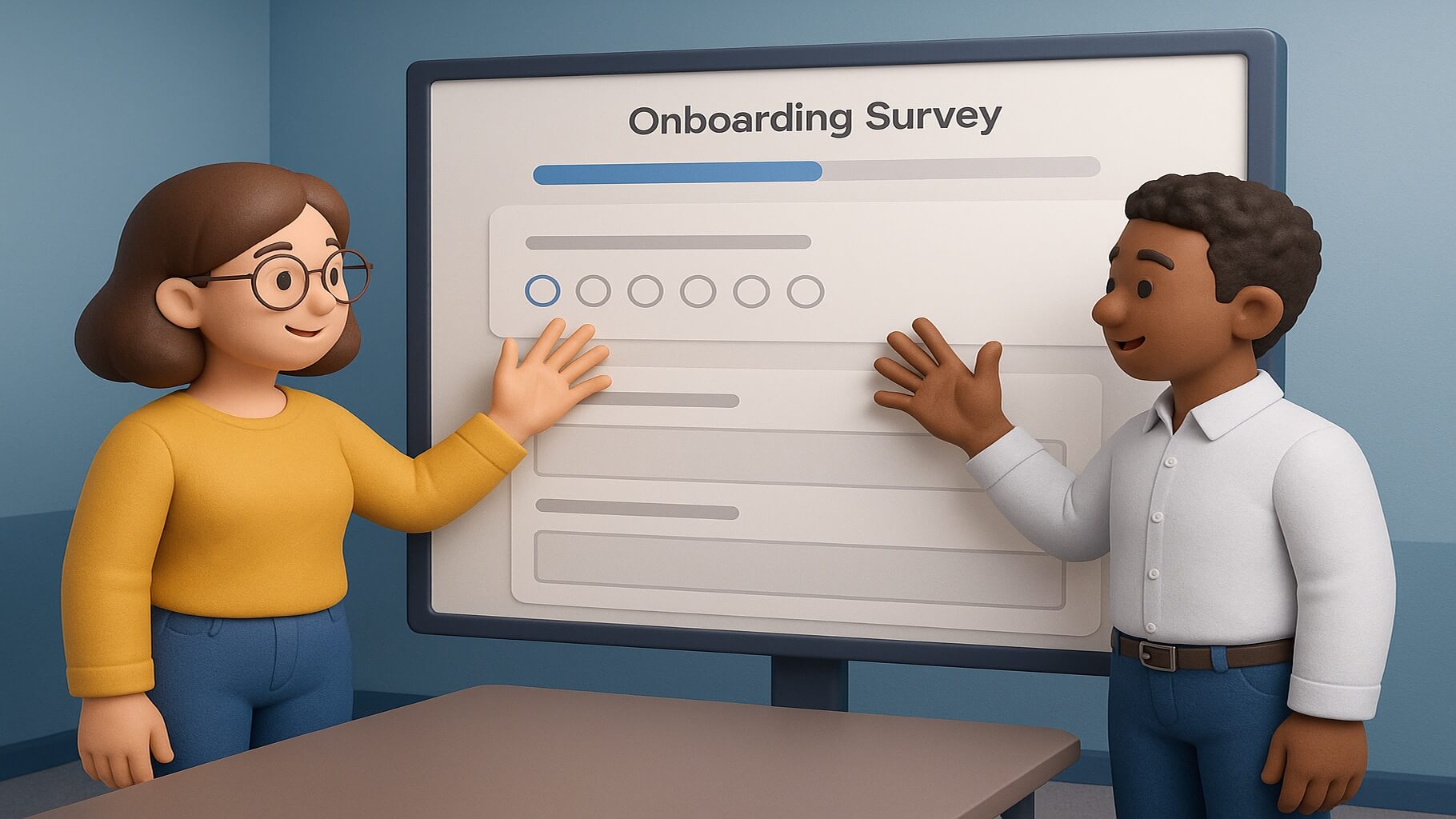
An onboarding survey is a structured feedback tool that captures new hire experiences during their transition into a company. These surveys gather valuable insights about orientation quality, training effectiveness, and cultural integration at specific milestones throughout the employee lifecycle. Organizations use onboarding surveys to identify gaps in their employee onboarding process and make data-driven improvements that benefit future new hires. First impressions matter significantly, and the feedback collected helps companies understand how new employees perceive their early experiences.
Definition and purpose of new hire feedback collection
New hire feedback collection serves as a systematic approach to understanding the onboarding experience from the perspective of those living it. The primary purpose is to identify which aspects of the onboarding process meet expectations and where improvements can yield better outcomes. Companies use employee feedback to refine training sessions, manager support, and resource allocation for incoming team members. Good onboarding requires continuous refinement based on what new employees actually experience during their first weeks and months.
Core components of effective onboarding surveys
Every effective onboarding survey template includes questions about pre-boarding preparation and initial impressions of company culture. Training effectiveness questions assess whether new employees received all the resources needed to perform their new job successfully. Manager relationship and team integration questions evaluate how well new hires feel connected to their colleagues and supported in their roles. Role clarity questions determine whether the job description matches the actual position responsibilities and daily work.
How onboarding surveys differ from engagement surveys
Onboarding surveys focus specifically on the early experiences and first impressions of new employees during their initial weeks and months. A pulse survey measures ongoing sentiment across your entire workforce at regular intervals throughout employment. The onboarding survey captures feedback about specific transition elements, including orientation, training, and cultural integration with existing teams. Engagement surveys assess broader topics like career path satisfaction, organizational values alignment, and factors affecting long-term engagement.
What are the benefits of employee onboarding surveys?
Both the new recruit experience and the organization's overall effectiveness can be enhanced with the help of employee onboarding surveys. These benefits compound as companies refine their onboarding program based on consistent feedback patterns from multiple cohorts. Organizations that implement structured survey templates see improvements in retention, employee productivity, and employee satisfaction scores. The investment in proper survey design pays dividends through better onboarding outcomes and reduced turnover costs.
Time savings through pre-built question frameworks
Pre-built onboarding survey templates eliminate the need to design questions from scratch for each new hire cohort joining your organization. HR professionals can deploy surveys within minutes rather than spending hours crafting and validating new questions for different roles. Standardized frameworks ensure that survey template design follows proven methodologies that gather valuable feedback effectively and consistently. Teams save significant time while still collecting comprehensive data about every aspect of the employee onboarding process.
Consistency in data collection across departments
Using the same employee onboarding survey template across departments enables meaningful comparisons between teams and managers over time. Consistent question formats produce reliable data that HR teams can analyze for patterns, trends, and identify areas requiring attention. This standardization supports benchmarking employee engagement surveys across the organization at every level. Companies gain a clear idea of which departments excel at onboarding and which need additional support or resources.
Ability to benchmark results over time
Standardized onboarding survey questions create longitudinal datasets that reveal improvement trends across multiple new-hire cohorts. Organizations can track whether changes to the onboarding process result in measurable improvements in new employee satisfaction scores. Benchmarking capabilities help identify whether onboarding program investments deliver expected returns on time and resources. Historical comparisons provide valuable insights into which initiatives create positive experiences that help new hires feel welcomed.
Why onboarding feedback surveys are important

Understanding why onboarding surveys are important extends beyond simple data collection to strategic workforce development and retention. Without structured feedback collection, organizations operate on assumptions rather than data about the effectiveness of their employee onboarding process. These surveys reveal whether new employees receive adequate support, training, and the resources they need during the critical early weeks. The importance extends beyond individual experiences to organizational effectiveness, company culture reinforcement, and retention outcomes.
Reducing survey design errors and bias
A professional onboarding survey template design eliminates common mistakes that compromise data quality and reliability in feedback collection. Well-crafted templates avoid leading questions, confusing rating scales, and other design flaws that skew results toward inaccurate conclusions. Employee recognition of survey design best practices ensures that feedback gathered is honest responses from new employees. Reducing bias yields more accurate insights that drive meaningful improvements to onboarding programs across departments.
Enabling rapid deployment for new hire cohorts
Standardized templates allow organizations to deploy onboarding surveys immediately when new employees start, rather than waiting for custom design work. Rapid deployment ensures that new hires provide feedback while their early experiences and initial impressions remain fresh and detailed. Quick turnaround times mean that hiring managers receive actionable insights faster, enabling them to address concerns before they escalate. This speed enables continuous improvement in the company's onboarding process, regardless of hiring volume.
Supporting scalable onboarding program management
As organizations grow, scalable survey templates maintain consistency without requiring additional design resources for each new employee joining. Templates that work across different roles and departments reduce the complexity of managing multiple onboarding feedback initiatives simultaneously. Scalability ensures that growing companies can maintain high-quality feedback collection regardless of hiring volume or geographic distribution. Systematic approaches support sustainable management of employee onboarding programs over time without increasing administrative burden.
5+ best onboarding survey templates for first-week feedback
First-week feedback captures initial impressions while new employees still experience the onboarding process with fresh perspectives and clear memories. These early touchpoints identify immediate issues that require quick resolution before they negatively impact engagement or retention. Good onboarding programs recognize that impressions matter most during these critical early days when employees form lasting opinions. Organizations should select templates that match their onboarding program structure and timing requirements.
5 first-week survey templates:
- Day-one quick pulse survey template
- End-of-week comprehensive assessment template
- Pre-boarding preparation evaluation template
- Orientation quality assessment template
- Initial manager meeting feedback template
Day-one quick pulse survey template
Day-one surveys gauge whether new hires feel welcome and prepared before they form lasting impressions of company culture. Keep this employee pulse survey template brief with a maximum of five to seven sample questions to respect busy schedules. Questions should focus on administrative readiness, workspace preparation, and initial comfort levels during orientation activities. This approach establishes that the company values employee feedback from the very beginning of employment.
Sample day-one questions:
- Did you receive all the resources you need to start your first day successfully?
- How welcome did you feel by your manager and team members today?
- Was your workspace properly prepared with the necessary equipment and access?
- Do you have a clear understanding of your schedule for the first week?
End-of-week comprehensive assessment template
End-of-week templates provide new employees time to form meaningful first impressions before gathering detailed onboarding feedback about their experience. This survey template covers orientation quality, initial training sessions, and early team interactions that shape perceptions. Questions assess whether the information presented during the first week accurately matched expectations from the interview process. Comprehensive week-one feedback identifies gaps that require immediate attention before problems compound.
Sample end-of-week questions:
- Did your first week match the expectations set during the recruiting process?
- How effective were the training sessions in preparing you for your role responsibilities?
- Do you feel connected to your team after your first week of interactions?
- What aspects of the onboarding experience exceeded or fell below your expectations?
Pre-boarding preparation evaluation template
Pre-boarding surveys assess whether new hires received adequate information and preparation before their official start date. This template evaluates the candidate experience transition from accepted offer through the first day of arrival. Questions cover communication quality, documentation clarity, and the completeness of administrative preparation for smooth transitions. Strong pre-boarding creates positive experiences that set the tone for the entire employee onboarding process ahead.
Sample pre-boarding questions:
- Did you receive clear instructions about your first-day logistics before you started?
- How well did pre-boarding communications prepare you for your new job expectations?
- Were all necessary documents and forms provided with adequate time for completion?
- Did you feel informed about company culture and organizational values before arrival?
5+ essential employee onboarding survey templates for milestone check-ins

Milestone check-ins capture how the onboarding experience evolves as new employees move beyond initial orientation into productive work phases. These templates assess progress at 30, 60, and 90-day intervals to track integration, development, and employee satisfaction over time. Each milestone reveals different aspects of the employee onboarding process and the level of cultural integration success. Strategic timing ensures that employee rewards and recognition align with demonstrated progress milestones.
5 milestone survey templates:
- 30-day integration assessment template
- 60-day progress evaluation template
- 90-day comprehensive review template
- Six-month retention check-in template
- First anniversary assessment template
30-day integration assessment template
The 30-day template evaluates whether new employees have successfully moved beyond
orientation into productive contribution phases. Questions assess role clarity, training effectiveness, and early relationship building with managers and team members across departments. This checkpoint identifies new hires who may need additional support before issues become retention risks affecting tenure. New-hire surveys at this stage gather feedback on whether initial onboarding promises have been fulfilled.
Sample 30-day questions:
- Do you have a clear understanding of your role expectations and success metrics?
- Has your manager provided adequate guidance and regular feedback during your first month?
- How confident do you feel in performing your core job responsibilities independently?
- Does the onboarding process meet your expectations based on what was communicated?
60-day progress evaluation template
Sixty-day surveys assess deeper cultural integration and whether new employees feel fully welcomed into their teams and workflows. This employee engagement pulse survey template examines productivity levels and confidence in role performance. Questions explore whether employees feel they have established meaningful connections with colleagues across the organization. The 60-day mark often reveals whether new hires will become engaged employees or remain disconnected from company culture.
Sample 60-day questions:
- How well do you understand how your role contributes to broader company goals?
- Are you confident in your ability to pose questions and request assistance from colleagues when necessary?
- Has your onboarding experience prepared you for independent work in your role?
- How aligned do you feel with organizational values and company culture overall?
90-day comprehensive review template
The 90-day survey provides a comprehensive assessment of the effectiveness and outcomes of the entire employee onboarding program. This hire survey template covers all aspects of the onboarding experience, from pre-boarding through full productivity. Questions assess overall satisfaction, likelihood to recommend the company, and suggestions for future new hires joining. Data from 90-day surveys directly correlates with long-term retention and employee productivity outcomes measurably.
Sample 90-day questions:
- Would you recommend this company to a friend seeking a new job opportunity?
- Did the onboarding process meet your expectations based on the interview process?
- What would you change about the hiring experience for future new hires?
- How prepared do you feel to succeed in your role long-term at this organization?
5+ critical onboarding feedback survey templates by focus area
Focus-area templates allow organizations to dive deep into specific aspects of the onboarding experience for detailed analysis. These specialized surveys complement milestone assessments by gathering targeted feedback about particular program components and outcomes. The templates below address training, manager relationships, and team integration as distinct focus areas requiring attention. Employee rewards programs can recognize managers and mentors identified through these focused survey results.
5 focus-area survey templates:
- Training effectiveness evaluation template
- Manager relationship assessment template
- Team integration and culture fit template
- Resource and tools adequacy template
- Communication effectiveness template
Training effectiveness evaluation template
Training-focused templates assess whether educational content and delivery methods meet new employee needs for role success. Questions evaluate both the quality of information presented and the relevance to actual job requirements and daily responsibilities. This employee survey template identifies gaps between training content and real-world role responsibilities requiring additional resources. Effective training surveys reveal opportunities to improve employee productivity through better educational programs and materials.
Sample training effectiveness questions:
- Did training sessions provide relevant information for your daily responsibilities?
- How effective were the training delivery methods for your learning style preferences?
- Were the training sessions paced appropriately to support content absorption and retention?
- What additional training would help you succeed in your role going forward?
Manager relationship assessment template
Manager relationship surveys evaluate whether direct supervisors provide adequate support during the critical onboarding period. Questions assess communication quality, regular feedback frequency, and availability for new hire questions and concerns. This template identifies managers who excel at onboarding new employees and those who need development support. Strong manager relationships significantly impact whether hires feel welcomed, supported, and committed to staying.
Sample manager relationship questions:
- Does your manager provide clear guidance about role expectations and priorities?
- How frequently do you receive feedback about your performance and progress?
- Do you feel comfortable discussing challenges or concerns with your manager openly?
- Has your manager helped you understand career path opportunities at the company?
Team integration and culture fit template
Team integration templates assess whether new employees have built meaningful relationships and feel connected to colleagues. Questions evaluate cultural integration, social inclusion, and the effectiveness of collaboration during the early months of employment. Pulse survey software can automate these assessments at appropriate intervals throughout onboarding. This feedback reveals whether teams create welcoming environments where hires feel included and valued.
Sample team integration questions:
- Do you feel included in team activities, meetings, and decision-making processes?
- How well do you understand how your role connects with team member responsibilities?
- Have colleagues been helpful and supportive during your onboarding experience?
- Do employees feel aligned with team norms and collaborative working styles?
5+ specialized onboarding survey templates for different roles
Different roles require specialized onboarding survey questions that address their unique job requirements and success factors. These templates supplement standard assessments with role-specific questions that capture relevant feedback for each position type. Customization ensures that onboarding surveys gather valuable insights specific to each position's challenges and requirements. Employee recognition and rewards can be tailored based on role-specific survey results and achievements.
5 role-specific survey templates:
- Sales team onboarding template
- Technical and engineering role template
- Customer service and support template
- Leadership and management template
- Healthcare and clinical role template
Sales team onboarding template
Sales onboarding templates focus on product knowledge acquisition, CRM training, and quota understanding for revenue success. Questions assess whether new sales employees feel prepared to engage prospects and close deals confidently. This template evaluates the clarity of territory assignment and knowledge of competitive positioning relative to market alternatives. Sales-specific surveys identify gaps that may impact early performance, employee productivity, and quota attainment.
Sample sales onboarding questions:
- Do you feel confident explaining product value propositions to potential customers?
- How well do you understand your territory, quota, and compensation structure?
- Have you received adequate training on sales tools and CRM systems?
- Do you understand the recruitment process for identifying the right talent prospects?
Technical and engineering role template
Technical role templates comprehensively address code repository access, development environment setup, and documentation quality. Questions evaluate whether engineers received adequate context about architecture, coding standards, and deployment processes. This template assesses the quality of mentorship and the knowledge transfer from existing team members to new employees. Technical onboarding surveys reveal whether new employees can contribute meaningful work effectively.
Sample technical onboarding questions:
- Did you receive adequate access to systems, repositories, and development tools?
- How clear is your understanding of code standards and review processes?
- Have you received sufficient documentation about system architecture and dependencies?
- Do you feel prepared to contribute meaningful work to current projects?
Customer service and support template
Customer service templates thoroughly evaluate product knowledge, support tool training, and understanding of the escalation process. Questions assess whether new support employees feel prepared to help customers resolve issues effectively and efficiently. This template examines quality standards, clarity, and understanding of performance metrics for accountability. Support role surveys identify training gaps that may impact customer satisfaction and service quality.
Sample customer service questions:
- Do you feel confident resolving common customer issues independently?
- How well do you understand escalation procedures for complex problems?
- Have you received adequate training on support tools and knowledge bases?
- Do you understand quality standards and how your performance will be measured?
Leadership and management template
Leadership onboarding templates focus on understanding team dynamics, direct report relationships, and clarity of strategic context. Questions assess whether new managers understand the company culture, decision-making processes, and stakeholder relationships important for success. This template evaluates executive team interactions and cross-functional collaboration preparation for leadership effectiveness. Leadership surveys identify support needs for new managers joining the company at senior levels.
Sample leadership onboarding questions:
- Do you have a clear understanding of your team's strengths, challenges, and dynamics?
- How well do you understand strategic priorities and how your team contributes?
- Have you met key stakeholders and established productive working relationships?
- Do you feel prepared to lead your team effectively in this new environment?
Healthcare and clinical role template
Healthcare templates address credentialing, compliance training, and understanding patient care protocols for safe practice. Questions assess whether clinical employees feel prepared to consistently deliver safe, high-quality patient care. This template assesses electronic health record training and the integration of clinical workflows with existing systems. Healthcare surveys ensure that new employees meet regulatory requirements and feel confident in their clinical roles.
Sample healthcare onboarding questions:
- Did you receive comprehensive training on clinical protocols and safety procedures?
- How confident are you in your ability to effectively and precisely utilize electronic health record systems?
- Have you completed all required compliance and credentialing documentation?
- Do you understand your role within the broader patient care team?
Key onboarding survey questions to include in every template
Certain core questions belong in every onboarding survey template, regardless of role, department, or company size. These foundational questions enable consistent benchmarking and comparison across different new hire cohorts over time. Including standardized questions ensures that organizations can systematically track improvements in their employee onboarding program. Pulse survey questions provide additional templates for ongoing feedback collection beyond onboarding.
Role clarity and expectation questions
Role clarity inquiries assess whether new employees comprehend their responsibilities and how success will be evaluated objectively. These questions reveal alignment or gaps between job description promises and actual role requirements in practice. Strong role clarity correlates with higher employee satisfaction and faster time to productivity for new hires. Include these questions in every survey template to identify needed improvements in onboarding communication.
Essential role clarity questions:
- Do you have a clear understanding of your primary responsibilities and priorities?
- How well did the interview process accurately describe your actual role duties?
- Do you understand how your performance will be evaluated and measured?
- Is there a clear idea of what success looks like in your position?
Support and resource adequacy questions
Support questions assess whether new hires received all the resources needed to succeed in their new positions. These questions evaluate manager availability, peer support, and access to tools, systems, and information required for work. Resource adequacy directly impacts employee productivity and early experiences that shape long-term engagement. Survey templates should always include questions about support quality and resource availability.
Essential support questions:
- Have you received all the resources needed to perform your job effectively?
- Is your manager available when you need guidance or have questions?
- Do colleagues provide adequate support when you need assistance?
- Are you receiving regular feedback about your progress and development?
Overall satisfaction and recommendation questions
Satisfaction and recommendation questions provide clear summary metrics for overall onboarding program effectiveness. The recommendation question specifically measures whether new employees would encourage others to join the company name. Overall satisfaction captures general sentiment about the onboarding experience quality and effectiveness. These questions enable benchmarking against industry standards and internal historical data trends.
Essential satisfaction questions:
- How would you rate your overall satisfaction with the induction process?
- Would you recommend this company to a friend looking for a new job?
- Did the onboarding process meet your expectations for the candidate experience?
- How likely are you to remain with the company for at least two years?
Best onboarding survey questions for new hires by department

Department-specific questions capture unique aspects of the onboarding experience that vary across different functional areas. These questions supplement core templates with relevant items that address departmental priorities and specific challenges. Customizing by department ensures that surveys gather feedback about the most critical onboarding elements for each function. Kudos employee recognition can celebrate departmental leaders who excel at onboarding new team members.
Sales team onboarding question sets
Sales departments need questions that comprehensively assess competitive knowledge, pipeline management training, and quota understanding. Include items about CRM proficiency and customer communication preparation for client-facing interactions. Sales onboarding questions should evaluate whether new hires feel ready to prospect and close deals successfully.
Sales department questions:
- Do you understand your territory boundaries and target customer profiles?
- How confident are you in your ability to articulate competitive differentiators?
- Have you received adequate training on sales methodology and pipeline management?
- Do you feel prepared to meet quota expectations in your first performance period?
Engineering and technical role questions
Engineering departments require questions about code review processes, documentation quality, and development environment readiness. Include items about architectural understanding and deployment procedures for production systems. Technical questions should assess whether new employees can quickly and independently contribute meaningful work.
Engineering department questions:
- Is your development environment fully configured and functional?
- Do you understand the code review process and approval requirements?
- How adequate is the technical documentation for the systems you will work on?
- Have you received sufficient context about current projects and priorities?
Customer service and support questions
Customer service departments need questions that comprehensively assess product knowledge depth and support tool proficiency. Include items on understanding quality standards, clarity of the escalation procedure, and escalation for complex issues. Support questions should evaluate confidence in handling customer interactions independently and professionally.
Customer service department questions:
- Do you feel knowledgeable enough about products to help customers effectively?
- How comfortable are you navigating support tools and knowledge bases?
- Do you understand when and how to escalate complex customer issues?
- Have you received other feedback about your customer interaction quality?
How to customize onboarding survey templates for your organization
Template customization ensures that standard frameworks effectively address your organization's unique culture, industry, and role requirements. Effective customization balances standardization for benchmarking with flexibility for capturing relevant feedback specifically. Organizations should develop clear guidelines for what can be modified and what must remain consistent across surveys. Employee engagement survey tools often include customization features to adapt templates.
Adapting language to match company culture
Every company name and brand has unique language, values, and communication styles that should appear in onboarding surveys. Replace generic terms with company-specific vocabulary that new employees encounter during their onboarding experience daily. Culturally aligned language makes surveys feel authentic rather than generic or disconnected from reality. Customized language increases response rates and gathers more honest feedback from respondents.
Language customization tips:
- Use your company's actual terminology for roles, teams, and processes
- Reference specific programs, systems, or initiatives by their internal names
- Match the formality level of your organizational communication style
- Include references to stated organizational values and cultural principles
Adding role-specific or industry-specific questions
Standard templates should include space for three to five role-specific questions that address unique position requirements. Industry-specific questions capture regulatory, compliance, or sector-specific onboarding elements important for success. These additions ensure surveys gather valuable insights about specialized training and preparation needs. Role customization yields more actionable feedback to improve specific onboarding paths.
Customization best practices:
- Limit role-specific additions to five questions maximum to maintain survey length
- Focus custom questions on the most critical success factors for each role
- Ensure that added questions use a consistent rating scale with the core template
- Review custom questions quarterly based on feedback trends and role changes
Balancing standardization with customization needs
Maintain the core questions unchanged across all templates to enable effective benchmarking and longitudinal tracking. Allow customization only in designated sections that supplement rather than replace standardized content. Document customization decisions so that future template updates maintain consistency across versions. Employee rewards ideas can recognize teams that effectively balance template standardization and customization.
Balance strategies:
- Designate specific template sections as customizable and others as fixed
- Create a library of approved supplemental questions for different contexts
- Review customizations annually to identify questions that should become standard
- Train hiring managers on proper customization within established guidelines
Onboarding survey sample templates from leading companies
Examining how successful companies structure their onboarding surveys provides valuable models for template development. These samples illustrate different survey design approaches based on company size, industry, and cultural priorities. Organizations can adapt elements from multiple samples to create templates that fit their unique needs. Sample templates demonstrate best practices in question design and survey structure effectively.
Technology startup rapid onboarding template
Technology startups often use streamlined templates that prioritize speed and agility in onboarding. These companies focus on rapid integration questions that assess whether new employees can contribute quickly to projects. Startup templates typically emphasize cultural fit and self-directed learning capabilities for fast-paced environments. The sample below illustrates a condensed approach suitable for organizations valuing speed over comprehensiveness.
Startup template sample questions:
- Did you receive adequate access to tools and systems on your first day?
- How quickly do you feel you became productive in your role?
- Does our company culture match what you expected from the interview process?
- What would help future new hires onboard even faster at our company?
Enterprise healthcare comprehensive template
Enterprise healthcare organizations require comprehensive templates that thoroughly address regulatory compliance and patient safety requirements. These surveys must assess credentialing, clinical protocols, and proficiency with electronic health records for safe practice. Healthcare templates balance thoroughness with respect for busy clinical schedules and patient care demands. Pulse survey tools help healthcare organizations collect feedback efficiently without disrupting care.
Healthcare template sample questions:
- Have you completed all required compliance training and credentialing steps?
- How confident do you feel following clinical protocols and safety procedures?
- Did your orientation adequately prepare you for patient care responsibilities?
- Do you understand reporting relationships and care team coordination?
Remote-first organization virtual integration template
Remote-first companies need templates that address the specific challenges of virtual onboarding and cultural integration without a physical presence. These surveys comprehensively assess digital tool proficiency, virtual team connection, and the quality of remote work support. Remote templates must evaluate whether new employees feel connected despite geographic separation from colleagues. Virtual onboarding surveys are increasingly important as remote work becomes more common across industries.
Remote-first template sample questions:
- Did virtual orientation effectively introduce you to the company culture and values?
- How connected do you feel to your team, even though you're working remotely?
- Have you received adequate support for your home office setup and equipment?
- Are virtual communication tools sufficient for your collaboration needs?
Essential onboarding survey questions for hiring managers
Hiring managers provide unique perspectives on new-hire readiness, team integration, and the overall effectiveness of the onboarding program. Manager surveys complement new hire feedback by capturing observations that new employees themselves may not recognize. These questions help organizations understand the manager and employee experience of onboarding new team members. Peer-to-peer recognition can highlight managers who excel at supporting new employees.
Manager's perspective on new hire readiness
Manager readiness questions assess whether new employees arrived prepared for their roles based on recruiting process outcomes. These questions reveal gaps between candidate promises during the recruiting process and the actual capabilities they demonstrate. A manager's perspective helps organizations improve their recruitment process and candidate evaluation methods. Readiness feedback indicates whether interview-process assessments accurately predict on-the-job performance.
Manager readiness questions:
- How well did the new hire's qualifications match expectations from the recruiting process?
- Was the new employee adequately prepared for their first day and week?
- Did pre-boarding communication set appropriate expectations for both parties?
- How accurate was the job description in describing actual role requirements?
Team integration support assessment
Team integration inquiries assess the extent to which managers effectively foster relationships between new hires and current team members. These questions assess whether managers created opportunities for new employees to feel welcomed and included. Integration feedback helps organizations develop manager training and support resources for onboarding excellence. Strong team integration correlates with higher retention and faster productivity achievement.
Team integration questions:
- How effectively has the new hire integrated with existing team members?
- Have you facilitated introductions and relationship-building opportunities?
- Does the new employee participate actively in team meetings and discussions?
- Are there any integration challenges that require additional resources or support?
Training delivery effectiveness evaluation
Manager training questions assess whether educational content and delivery methods prepared new employees for actual job performance. These questions reveal gaps between the training curriculum and the real-world role requirements. Training feedback from managers often differs from new-hire self-assessments, offering a valuable perspective. A dual perspective improves the effectiveness of training programs and employee productivity outcomes.
Training delivery questions:
- Did training adequately prepare the new hire for their core responsibilities?
- Are there skill gaps that require additional training or development resources?
- How effective was the training delivery method for this employee's learning style?
- What training improvements would benefit future new hires in this role?
Creating effective onboarding survey examples for different roles
Effective survey examples demonstrate how to structure questions for maximum clarity and to collect actionable feedback. These examples show proper formatting, response scale usage, and question sequencing for different role types. Organizations can use these examples as starting points for developing their own customized templates. eNPS questions should be included as a core element in all role-specific templates.
Individual contributor template examples
Individual contributor templates focus on task readiness, peer relationships, and resource adequacy for independent work performance. These examples emphasize practical preparation questions that assess daily job capability and confidence. Contributor templates typically include fewer questions about leadership and strategy than manager versions.
Individual contributor example format:
- Use 5-point rating scale questions for quantitative benchmarking (strongly agree to strongly disagree)
- Include three to five open-ended questions for qualitative insights
- Limit the total survey length to a maximum of fifteen questions maximum
- Sequence questions from general satisfaction to specific improvement suggestions
Management and leadership role templates
Management templates include questions about team dynamics, stakeholder relationships, and clarity of strategic context. These examples assess whether leaders received adequate information about company culture and decision-making processes. Leadership surveys should assess cross-functional relationship-building and executive team integration.
Management template example format:
- Include questions about direct report backgrounds and team history
- Assess understanding of budget authority and resource allocation processes
- Evaluate clarity about performance management expectations and timelines
- Add questions about peer leader relationships and collaboration expectations
Specialized technical position templates
Technical role templates require questions about system access, documentation quality, and understanding of code or technical standards. These examples address the unique onboarding challenges of engineering, IT, and other technical positions. Specialized templates should assess mentorship quality and the effectiveness of knowledge transfer.
Technical position example format:
- Include questions about development environment configuration and tool access
- Assess documentation completeness for systems and processes
- Evaluate technical mentorship and code review feedback quality
- Add questions about the understanding of technical debt and priority decisions
Best practices for onboarding feedback survey template design
Survey design best practices ensure that templates gather reliable, actionable feedback without unnecessarily overwhelming respondents. These guidelines address question count, ordering, and response scale selection for optimal results and participation. Following design best practices significantly improves response rates and data quality. Team rewards can recognize teams that achieve high survey participation rates.
Optimal question count and survey length
Research consistently shows that survey completion rates decline significantly as question count increases beyond fifteen items. Keep onboarding surveys between ten and fifteen questions to maximize completion while gathering comprehensive feedback. Longer surveys should be reserved for major milestone assessments like comprehensive 90-day reviews. Shorter pulse checks work better for frequent touchpoints during early onboarding phases.
Question count guidelines:
- Day-one surveys: five to seven questions maximum
- Weekly pulse checks: five to ten questions
- Monthly milestone surveys: ten to fifteen questions
- Comprehensive 90-day reviews: fifteen to twenty questions
Question ordering and flow strategies
Begin surveys with easier, less sensitive questions before progressing to more reflective or critical items. Organize related questions into coherent groups to establish a logical sequence and minimize cognitive effort for survey participants. Place open-ended questions at the end, after rating-scale questions have primed thinking about the topics. Strategic ordering improves response quality and reduces survey abandonment rates.
Ordering best practices:
- Start with simple factual questions about onboarding logistics
- Progress to satisfaction and experience quality assessments
- Include improvement suggestions and other feedback near the end
- End with overall recommendation and likelihood to stay questions
Response scale selection and consistency
Use consistent rating scales throughout the survey and across all templates to enable meaningful comparisons. Five-point scales, spanning from strongly concur to strongly disagree, offer sufficient granularity without overburdening respondents. Avoid mixing different scale types within the same survey for consistency. Consistent scales effectively support benchmarking and longitudinal tracking.
Response scale guidelines:
- Use five-point agreement scales for attitude and satisfaction questions
- Apply the same scale anchors consistently across all questions
- Avoid mixing numerical and descriptive scale formats
- Include a neutral midpoint option for balanced response collection
How to deploy onboarding survey templates at scale
Scaling onboarding survey deployment requires automated systems that deliver surveys at appropriate times without manual intervention. Organizations growing quickly need templates that work across multiple locations, departments, and hiring volumes. Effective deployment ensures consistent feedback collection regardless of organizational complexity or geographic distribution. Employee engagement survey questions can complement onboarding surveys for comprehensive feedback programs.
Automated scheduling and distribution systems
Automated survey distribution ensures that new hires receive assessments at precisely the right onboarding milestones consistently. Systems should trigger surveys based on the start date, completion of specific training modules, or reaching time-based checkpoints. Automation removes the necessity for manual monitoring and decreases the likelihood of overlooking opportunities to gather feedback. Reliable automation effectively supports scalable program management for employee onboarding.
Automation features to implement:
- Start date-triggered survey deployment for consistent timing
- Automatic reminder emails for non-respondents
- Manager notifications when team member surveys are completed
- Dashboard alerts for concerning response patterns requiring attention
Integration with HRIS and onboarding platforms
Survey platforms should integrate with human resource information systems to automatically access new-hire data. Integration lowers the need for manual data entry while also providing accurate demographic information for research and benchmarking. Connected systems enable sophisticated segmentation and comparison across different employee populations. Seamless integration improves data quality and significantly reduces the administrative burden.
Integration priorities:
- Automatic new hire import from HRIS systems
- Department and manager assignment for reporting segmentation
- Start date synchronization for milestone survey timing
- Performance system integration for outcome correlation analysis
Multi-language template considerations
Global organizations need templates available in multiple languages to ensure all new employees can provide feedback comfortably. Translation should maintain the question's meaning and cultural appropriateness across different regions worldwide. Multilingual support guarantees that language obstacles do not prohibit meaningful feedback from multinational employees. International templates require careful validation to ensure measurement equivalence across cultures.
Multi-language guidelines:
- Use professional translation rather than automated tools for accuracy
- Validate translations with native speakers familiar with survey methodology
- Consider cultural differences in response style when comparing international data
- Maintain consistent scale anchors across all language versions
Common mistakes in employee onboarding survey template creation
Understanding common mistakes helps organizations avoid pitfalls that compromise survey effectiveness and data quality. These errors reduce response rates, produce unreliable data, or fail to generate actionable insights for improvement. Learning from others' mistakes accelerates template improvement without having to experience problems firsthand. Employee recognition platform features can help address issues identified through surveys.
Including too many open-ended questions
Open-ended questions require significantly more effort from respondents and often receive lower-quality responses in surveys. Limit open-ended items to two or three per survey to maintain completion rates and response quality. Use open-ended questions strategically for areas where quantitative scales cannot capture nuanced feedback. Balance structured questions with targeted opportunities for additional resources and detailed comments.
Open-ended question guidelines:
- Include no more than three open-ended questions per survey
- Place open-ended questions after related rating scale questions
- Use specific prompts rather than general invitations for comments
- Make open-ended questions optional to avoid abandonment
Using inconsistent rating scales across questions
Inconsistent scales confuse respondents and prevent the effective comparison and aggregation of survey results. Switching between different scale types within surveys forces respondents to repeatedly reorient their thinking. Standardize on a single scale type for all quantitative questions within templates. Consistency across templates enables accurate, time-based benchmarking and tracking.
Scale consistency rules:
- Choose one scale type and use it throughout all templates
- Use identical anchor labels for all questions using the same scale
- Avoid mixing frequency, agreement, and satisfaction scales in one survey
- Apply consistent directionality so higher numbers always mean better
Failing to update templates based on feedback trends
Static templates naturally become outdated as organizational processes, tools, and priorities evolve. Regular review ensures that questions remain relevant to the current employee onboarding process. Templates should incorporate lessons learned from previous survey cycles and program improvements. Periodic updates maintain the effectiveness of the template and respondent engagement over time.
Template update practices:
- Review templates quarterly for relevance and accuracy
- Remove questions that consistently produce low-value responses
- Add questions addressing new programs, tools, or identified gaps
- Document template version history for tracking changes over time
Advanced onboarding survey templates for specialized scenarios
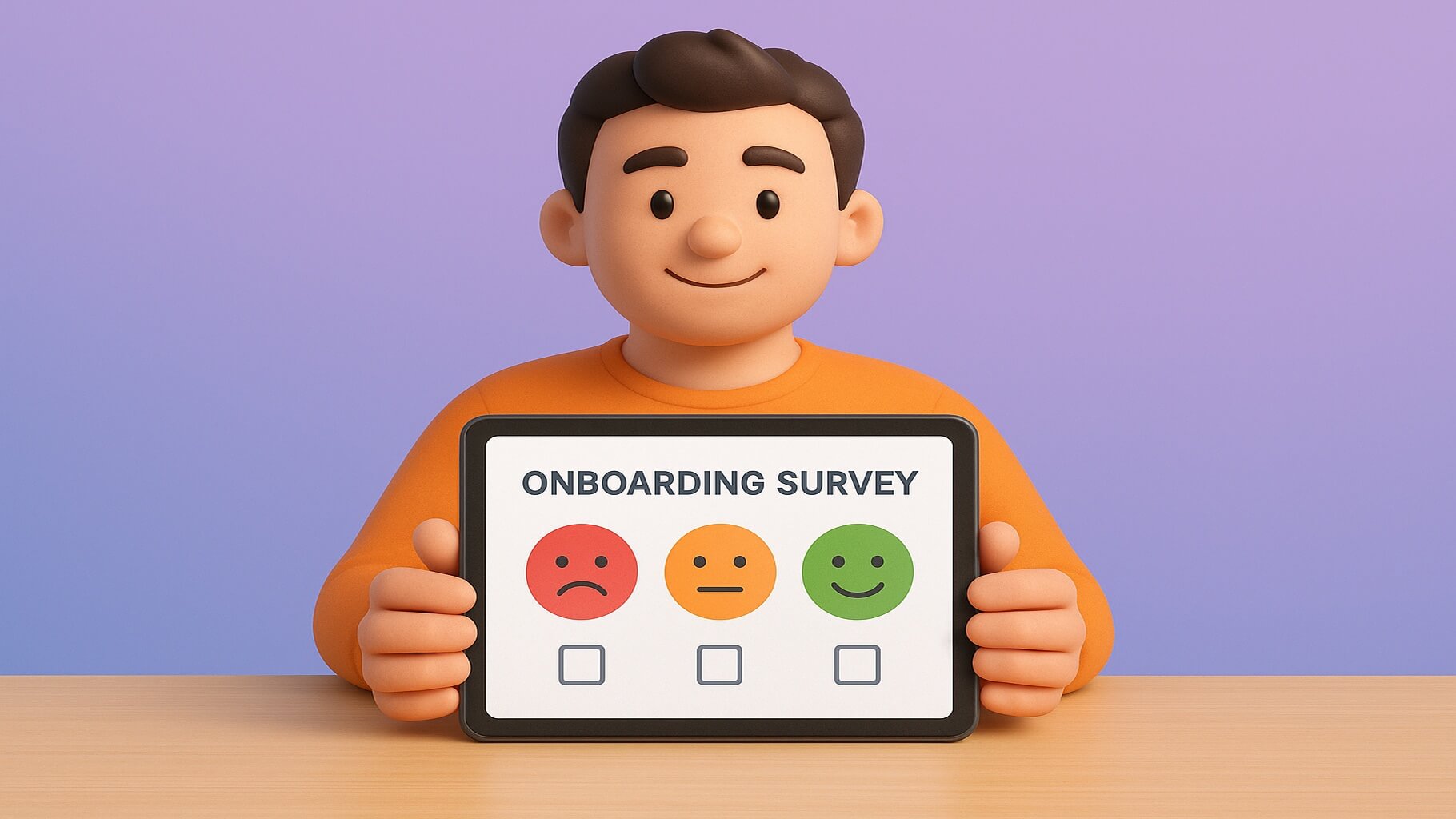
Specialized scenarios require template modifications that address unique onboarding circumstances and challenges effectively. These advanced templates supplement standard frameworks for situations requiring customized approaches. Organizations should develop specialized templates for their most common non-standard onboarding situations. Identifying gaps through standard surveys often reveals the need for specialized template development.
Remote and hybrid worker onboarding templates
Remote and hybrid workers face unique onboarding challenges that require specifically designed survey questions. These templates comprehensively assess virtual tool proficiency, remote culture integration, and home workspace adequacy. Remote surveys must evaluate whether employees feel connected to teams despite geographic separation. Virtual onboarding presents distinct challenges that standard templates may not adequately address.
Remote worker template additions:
- Questions about home office equipment and setup adequacy
- Assessment of virtual communication tool proficiency and comfort
- Evaluation of virtual relationship building with the manager and the team
- Feedback on remote work policies and expectations clarity
International employee integration templates
International employees experience additional onboarding complexity due to cultural differences, language barriers, and work authorization requirements. These templates address unique challenges of integrating employees across geographic and cultural boundaries. International surveys should assess support for relocation, cultural adjustment, and cross-border collaboration. Global organizations need templates that work effectively across diverse cultural contexts.
International template additions:
- Questions about relocation support and settling-in assistance
- Assessment of cross-cultural communication and collaboration
- Evaluation of time zone accommodation and schedule flexibility
- Feedback on language support and communication accessibility
Acquisition and merger integration templates
Employees joining through acquisitions and mergers face unique onboarding experiences that differ from standard new-hire experiences. These templates assess culture change adaptation, retention concerns, and the effectiveness of integration programs. Acquisition surveys must be sensitive to anxiety about job security and organizational change. Integration templates help organizations understand how acquired employees feel about their transitions.
Acquisition template additions:
- Questions about cultural differences and adaptation challenges
- Assessment of communication quality during the integration period
- Evaluation of concerns about role changes or job security
- Feedback on the comparison between previous and current employer experiences
Using onboarding survey samples to benchmark your program
Benchmarking against external samples and industry standards reveals opportunities for improvement and validates program effectiveness. Organizations can compare their results against published benchmarks to understand relative performance levels. Sample analysis identifies the best practices that high-performing organizations have successfully implemented. Benchmarking provides context that transforms raw survey data into actionable insights for improvement.
Industry standard template comparisons
Industry benchmarks provide context for evaluating whether your onboarding survey results indicate above or below average performance. Compare your template structure against published frameworks from HR associations and research organizations. Industry-specific benchmarks account for sector variations in onboarding complexity and timeline expectations. Understanding industry standards helps set realistic improvement targets for your programs.
Benchmarking sources:
- Society for Human Resource Management onboarding research
- Industry-specific HR association publications and surveys
- Academic research on onboarding effectiveness and best practices
- Vendor benchmark reports from survey platform providers
Identifying gaps in your current templates
A gap analysis compares your current templates with best-practice samples to identify missing questions or undercovered areas. Systematic gap identification ensures that surveys gather comprehensive feedback about all critical onboarding elements. Regular gap analysis keeps templates up to date with evolving best practices in the field. Filling gaps significantly improves the actionable value of survey feedback.
Gap analysis process:
- Compare question coverage against comprehensive template frameworks
- Identify onboarding phases that lack dedicated survey touchpoints
- Assess whether role-specific variations adequately address unique needs
- Evaluate whether templates capture both satisfaction and improvement feedback
Adopting best practices from top performers
High-performing organizations often share their onboarding survey approaches through case studies, conferences, and publications. Learning from these examples accelerates improvement without requiring extensive experimentation internally. Adapt best practices to fit your company culture rather than copying templates exactly. Continuous learning from top performers drives sustained program improvement over time.
Best practice adoption steps:
- Research award-winning onboarding programs and their measurement approaches
- Attend HR conferences and webinars focused on onboarding excellence
- Network with peers at companies known for exceptional new hire experiences
- Test adapted best practices in pilot programs before full deployment
Technology solutions for onboarding survey template management

Technology platforms provide essential capabilities for effectively managing survey templates at scale across organizations. These solutions offer template libraries, automation features, and analytics that support effective feedback programs. Selecting the right technology ensures sustainable survey management without excessive administrative burden. Integration capabilities determine how effectively survey platforms connect with other HR systems.
Template library features and organization
Template library features enable organizations to store, organize, and access approved survey templates efficiently. Well-organized libraries reduce duplication and ensure consistency across different users and departments. Search and filtering capabilities help users find appropriate templates quickly when needed. Library management supports governance and quality control over template usage.
Library management features:
- Organized folders or categories for different survey types
- Search functionality based on template name, purpose, or content
- Template previews without requiring full document access
- Usage tracking to identify the most frequently deployed templates
Version control and template updates
Version control ensures that users always access current templates while maintaining historical records of previous versions. Controlled update processes prevent unauthorized modifications that could compromise data consistency. Clear version identification helps users confirm they are deploying the correct template. Version history supports auditing and troubleshooting when issues arise.
Version control capabilities:
- Automatic version numbering for all template modifications
- Change logs documenting what was modified and by whom
- Ability to compare versions and identify specific differences
- Rollback capability to restore previous versions if needed
Collaboration tools for template development
Collaboration features enable HR teams to work together on template development, review, and approval processes. Shared editing capabilities reduce bottlenecks when multiple stakeholders need to contribute. Approval workflows ensure appropriate oversight before templates are deployed to employees. Collaborative development improves template quality through diverse input and perspectives.
Collaboration features:
- Shared editing with simultaneous multi-user access
- Comment and suggestion capabilities for feedback
- Approval workflows requiring sign-off before deployment
- Notification systems alerting stakeholders to review requests
How Matter can help with onboarding survey templates
Matter provides a comprehensive onboarding survey solution that combines proven templates, intuitive customization, and automated deployment. The platform includes an extensive library of pre-built templates designed for every phase of the employee onboarding experience. Organizations can deploy Day 7, Day 30, Day 60, and Day 90 surveys automatically based on employee start dates. Matter integrates seamlessly with Slack and Microsoft Teams to deliver surveys where employees already work.
Extensive pre-built template library for every phase
Matter's template library covers the entire employee onboarding journey, from first-day pulse checks to comprehensive 90-day reviews. Each template includes carefully designed questions that gather actionable feedback while respecting employee time constraints. Templates are either ready to use right away or can be tailored to your organization's specific requirements and culture. The library continues to expand based on customer feedback and onboarding research.
Library highlights:
- Day 7: first impressions and orientation quality assessment
- Day 30: integration and training effectiveness evaluation
- Day 60: cultural integration and confidence assessment
- Day 90: comprehensive onboarding program review
5-point eNPS system integrated into all templates
Matter uses a research-validated 5-point eNPS scale that provides consistent measurement across all survey templates. The scale ranges from one to five with fully labeled response options that guide respondents clearly. Matter calculates eNPS by subtracting detractors (responses of one through three) from promoters (responses of five). This methodology ensures reliable benchmarking and longitudinal tracking capabilities.
eNPS features:
- Consistent 5-point scale across all survey templates
- Automatic eNPS calculation and trending displays
- Benchmark comparisons against historical performance
- Segment analysis by department, location, or manager
Easy customization tools and automated deployment
Matter's customization tools enable organizations to adapt templates without compromising measurement consistency or data quality. The platform automatically deploys surveys based on start dates, eliminating manual tracking and ensuring consistent timing. Real-time analytics provide instant visibility into response rates, scores, and improvement opportunities. Optional coin rewards for survey completion help organizations achieve the highest participation rates.
Automation and customization features:
- Start date-triggered automated survey deployment
- Simple drag-and-drop template customization interface
- Real-time analytics dashboards with actionable insights
- Optional coin rewards to incentivize survey completion
Frequently asked questions about onboarding survey templates
Q: What should an effective employee onboarding survey template include?
A: Include questions about pre-boarding preparation, orientation quality, training effectiveness, manager support, team integration, resource adequacy, and overall satisfaction. Distribute questions across multiple touchpoints, including Day 7, Day 30, and Day 90 milestones. Use consistent rating scale questions throughout for reliable benchmarking. Add three to five role-specific questions to address unique position requirements.
Q: How many onboarding survey templates do you need?
A: Maintain at least three core templates for different phases covering first week, 30-day, and 90-day assessments. Add specialized templates for remote workers, managers, and high-volume departments with unique onboarding needs. Consider role-specific supplemental templates for sales, engineering, and customer service positions. Most organizations effectively manage programs with five to eight distinct templates.
Q: Should onboarding feedback survey templates be the same for all roles?
A: Use a core set of consistent questions across all roles for benchmarking and comparison purposes. Add three to five role-specific questions to address unique onboarding requirements for different positions. Maintain standardized rating scales and question formats even when adding customized content. This approach balances measurement consistency with the collection of relevant feedback.
Q: Where can I find good onboarding survey samples?
A: Look for industry-specific templates from HR platforms, professional associations, and recognized thought leaders. Matter provides an extensive library of research-validated templates ready for immediate deployment. Academic research and SHRM publications offer evidence-based question frameworks. Customize samples to match your company culture and specific program needs.
Q: How often should you update onboarding survey templates?
A: Review templates quarterly based on feedback trends, response patterns, and program changes. Make minor adjustments as needed while maintaining the core questions for longitudinal tracking. Major template overhauls should occur annually or when significant onboarding program changes require new measurement approaches. Document all changes to maintain version control and comparison validity.
Q: What makes onboarding survey questions for hiring managers different?
A: Manager surveys focus on their perspective of new hire readiness, support needs, training effectiveness, and team integration observations. These questions assess the manager's experience of the onboarding process rather than the new hire's direct experience. Manager surveys reveal gaps between employee self-assessment and supervisor observations. Dual-perspective feedback improves the effectiveness of the onboarding program more than either source alone.
Final thoughts on onboarding survey templates
Well-designed onboarding survey templates eliminate repetitive design work while ensuring consistent measurement across every new-hire cohort. These templates enable continuous program improvement by standardizing feedback collection, revealing trends, and identifying opportunities. Organizations using structured templates can effectively benchmark performance over time and against industry standards.
Templates that include manager assessment questions identify leaders who excel at onboarding and deserve recognition for their efforts. New hire feedback reveals peer mentors and team members who provide exceptional support during critical transition periods. This systematic identification creates opportunities for recognition that reinforces positive onboarding behaviors across the organization. Recognition connected to survey feedback demonstrates that employee contributions to successful onboarding are valued.
Ready to transform your onboarding feedback program with proven survey templates? Schedule a demo with a Matter expert today and discover how automated deployment, intuitive customization, and integrated recognition can help you gather actionable insights, improve new hire experiences, and build a stronger onboarding program.