

Calculating employee net promoter score shouldn't feel like decoding a mathematical mystery that requires a statistics degree. At Matter, we understand that HR teams face genuine frustration when calculating eNPS accurately, especially when conflicting methodologies and confusing formulas make this essential metric feel unnecessarily complex. Without clear guidance on proper categorization rules, formula application, and score interpretation, organizations risk generating flawed data that leads to misguided workplace initiatives or missed opportunities to address critical engagement issues. This confusion wastes valuable time and resources while preventing teams from accessing the actionable insights that drive meaningful improvements in employee retention and organizational success.
What is eNPS calculation?
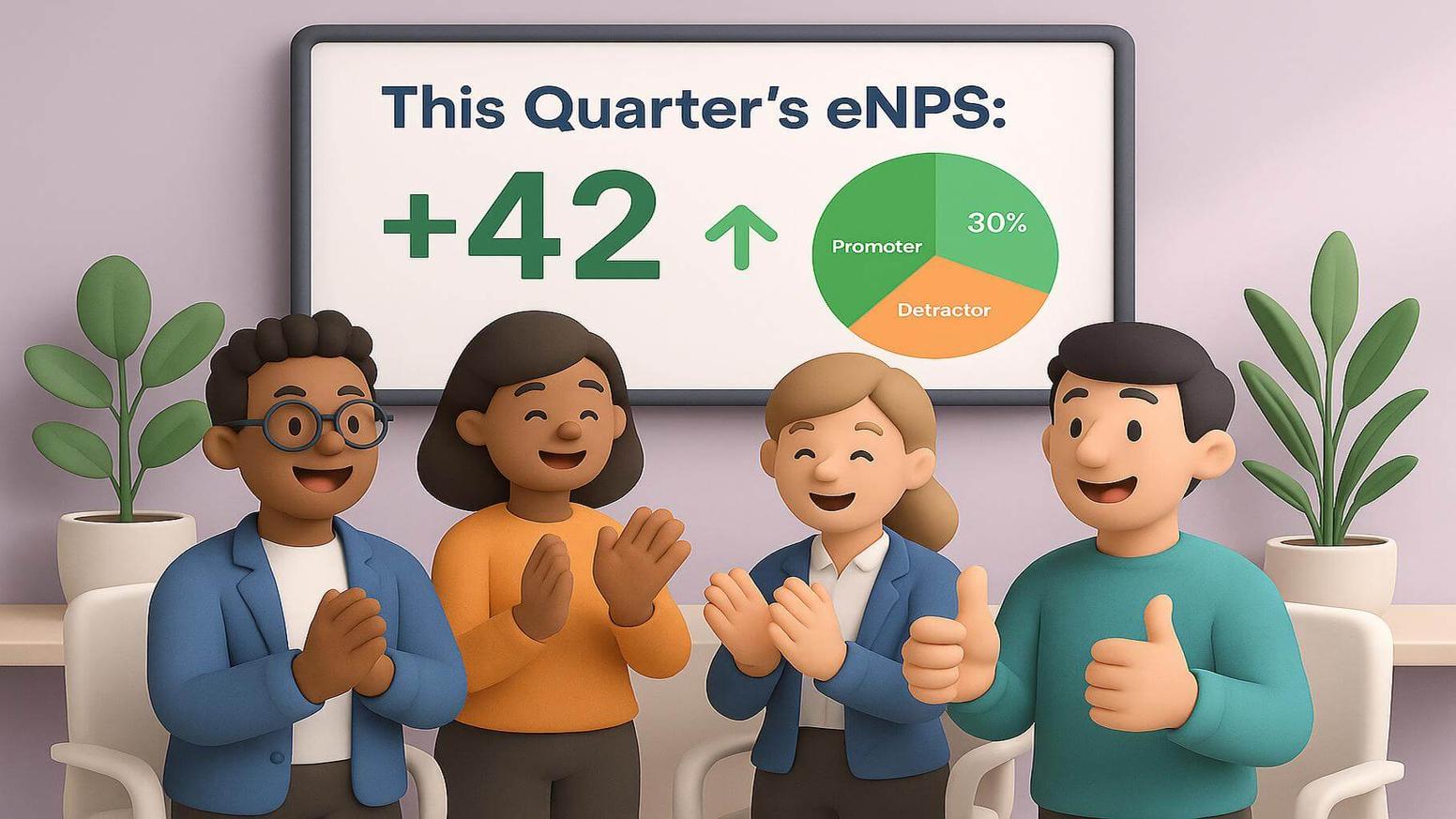
Understanding the employee net promoter score formula provides the foundation for accurately measuring workplace loyalty. This standardized assessment approach assists firms in determining how likely are employees to advocate their workplace to others?. The calculation process involves categorizing survey responses into three distinct groups and applying a simple mathematical formula that produces scores ranging from negative to positive values. Organizations new to this metric should first understand what eNPS is before diving into the calculation methodology.
Understanding the employee net promoter score (eNPS) formula fundamentals
The employee net promoter score methodology takes a simple technique, subtracting the percentage of Detractors from the percentage of Promoters to generate the final score. This net promoter score calculation intentionally excludes Passives from the mathematical equation, focusing only on employees who express strong opinions about their workplace.
Key aspects of the eNPS formula include:
- Universal application: Companies can use different rating scales to collect responses, whether traditional 0-10 scales or simplified 5-point Likert systems, as long as they apply consistent categorization rules
- Mathematical consistency: The net promoter score NPS formula itself remains constant regardless of which rating scale a company chooses, making it adaptable to different survey methodologies
- Industry comparability: This standardized approach maintains comparability across industries, allowing organizations to benchmark their scores against competitors
- Focus on extremes: By excluding neutral responses, the formula emphasizes employees with the strongest positive or negative sentiments about their workplace
The difference between eNPS and traditional customer NPS calculations
While the employee net promoter score and customer NPS share the same mathematical foundation, they measure fundamentally different relationships with a company. Understanding these distinctions helps organizations interpret results appropriately and set realistic expectations.
Critical differences include:
- Measurement focus: Customer NPS measures purchasing behavior and brand loyalty by asking customers if they are likely to recommend items or services to others.
- Internal versus external: The net promoter score eNPS shifts this focus inward, measuring workplace advocacy and employee willingness to recommend their company as a great place to work
- Contextual factors: HR teams must recognize that employees have different expectations and experiences than customers, which means company eNPS scores typically range differently from customer satisfaction metrics
- Interpretation frameworks: Employee scores require distinct interpretation approaches tailored to workplace dynamics rather than consumer purchasing patterns
- Relationship depth: Employees have deeper, more complex relationships with organizations than customers do with brands, affecting how they respond to loyalty questions
Why eNPS score matters for measuring workplace loyalty
Tracking eNPS provides companies with a single, quantifiable metric that reflects overall employee sentiment and workplace advocacy trends over time. This important metric helps human resources identify patterns in employee disengagement before they escalate into costly employee retention problems or productivity declines. Companies can benchmark their scores against industry standards to understand how their workplaces compare with competitors in attracting new talent and retaining satisfied employees.
Regular employee NPS measurement creates accountability for leadership teams, encouraging proactive strategies that address concerns and build cultures where employees feel valued, engaged, and motivated to contribute their best work each day. Organizations that measure eNPS regularly gain a complete picture of workplace satisfaction and can take action immediately when scores indicate emerging issues. Most companies find that tracking this useful metric alongside other metrics provides valuable insight into employee experience and helps identify areas where improvements will have the greatest impact on creating a great workplace environment.
What are the benefits of calculating eNPS?
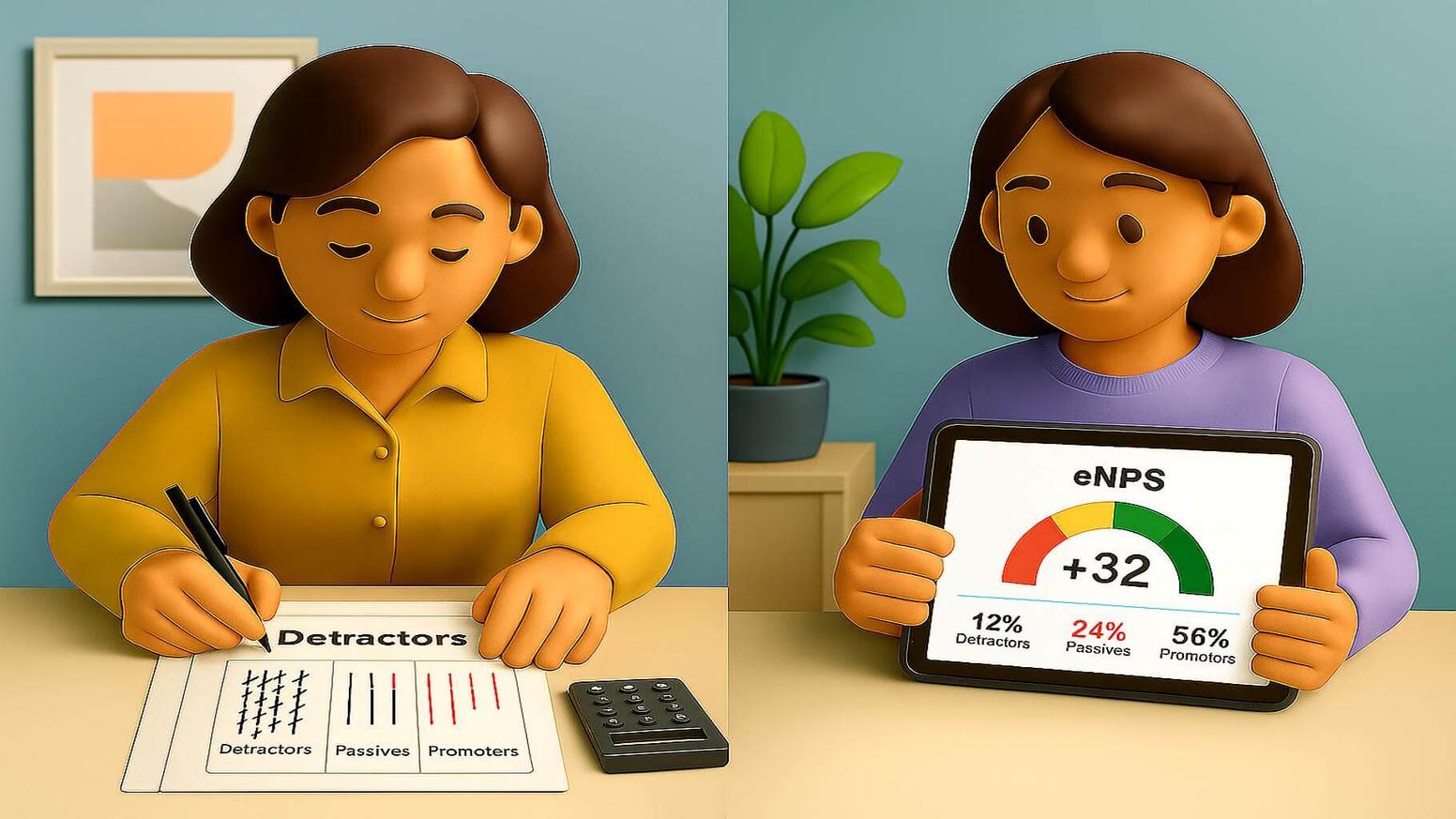
Measuring workplace advocacy through standardized net promoter score eNPS calculations offers organizations multiple advantages for understanding and improving culture. These benefits extend beyond simple numerical scores to provide actionable insights that inform strategic decisions about employee experience optimization. Organizations that regularly calculate employee net promoter scores gain a competitive advantage in talent management, planning, and creating positive workplace environments where employees feel motivated to perform at their best. The Net Promoter methodology, developed by Fred Reichheld in collaboration with Satmetrix Systems for customer loyalty measurement, translates effectively into employee satisfaction tracking when appropriately adapted to workplace contexts.
Tracking employee loyalty trends over time accurately
Regular eNPS surveys create historical data that reveals whether engagement levels and satisfaction rates are improving, declining, or remaining stable across different time periods. This longitudinal tracking provides invaluable insights for strategic planning and helps organizations measure employee engagement and employee satisfaction more effectively.
Benefits of trend tracking include:
- Pattern identification: Organizations can identify seasonal patterns, correlations with specific business events, or the impact of new policies on workplace sentiment and employee motivation
- Initiative validation: Leadership teams can assess whether their employee engagement initiatives are producing measurable results or require strategic adjustments based on survey results
- ROI demonstration: Consistent measurement intervals at regular intervals, whether quarterly or biannually, provide reliable comparison points that guide continuous improvement efforts
- Data-driven decisions: Historical trends demonstrate ROI on culture-building investments and justify future resource allocation for highly satisfied and highly engaged teams
- Proactive management: Early detection of declining trends, including low eNPS scores or high eNPS fluctuations, allows organizations to intervene before small issues become major retention problems
- Comprehensive analysis: Tracking scores alongside qualitative data from follow-up surveys helps most companies gain a better idea of what drives employee sentiment beyond just the number, ranging from negative to positive
Identifying retention risks through quantifiable metrics
Low employee NPS scores serve as early warning signals that team members may be considering leaving the organization or expressing employee dissatisfaction about their workplace experience. Organizations can segment data by department, role, or tenure to pinpoint specific areas where concerns concentrate among team members. This granular analysis enables targeted interventions before problems escalate into costly turnover patterns that affect team performance. HR teams can prioritize resources toward departments with the lowest scores, implementing focused strategies that address the specific concerns of at-risk groups and identify areas requiring immediate attention to prevent further employee dissatisfaction.
Benchmarking performance across departments and competitors
Organizations that regularly calculate their eNPS score can compare their performance to industry norms and see whether they are competitive in hiring top people. Internal benchmarking reveals which departments excel at creating positive employee experiences and which struggle, creating opportunities to share best practices across teams. Companies can use eNPS benchmark data to set realistic improvement targets and measure progress toward becoming employers of choice in their sectors. This competitive intelligence helps businesses understand where they stand in the talent marketplace and what they need to do to differentiate themselves as workplaces where most employees thrive and actively promote the company culture.
Why learning how to calculate the eNPS score is important
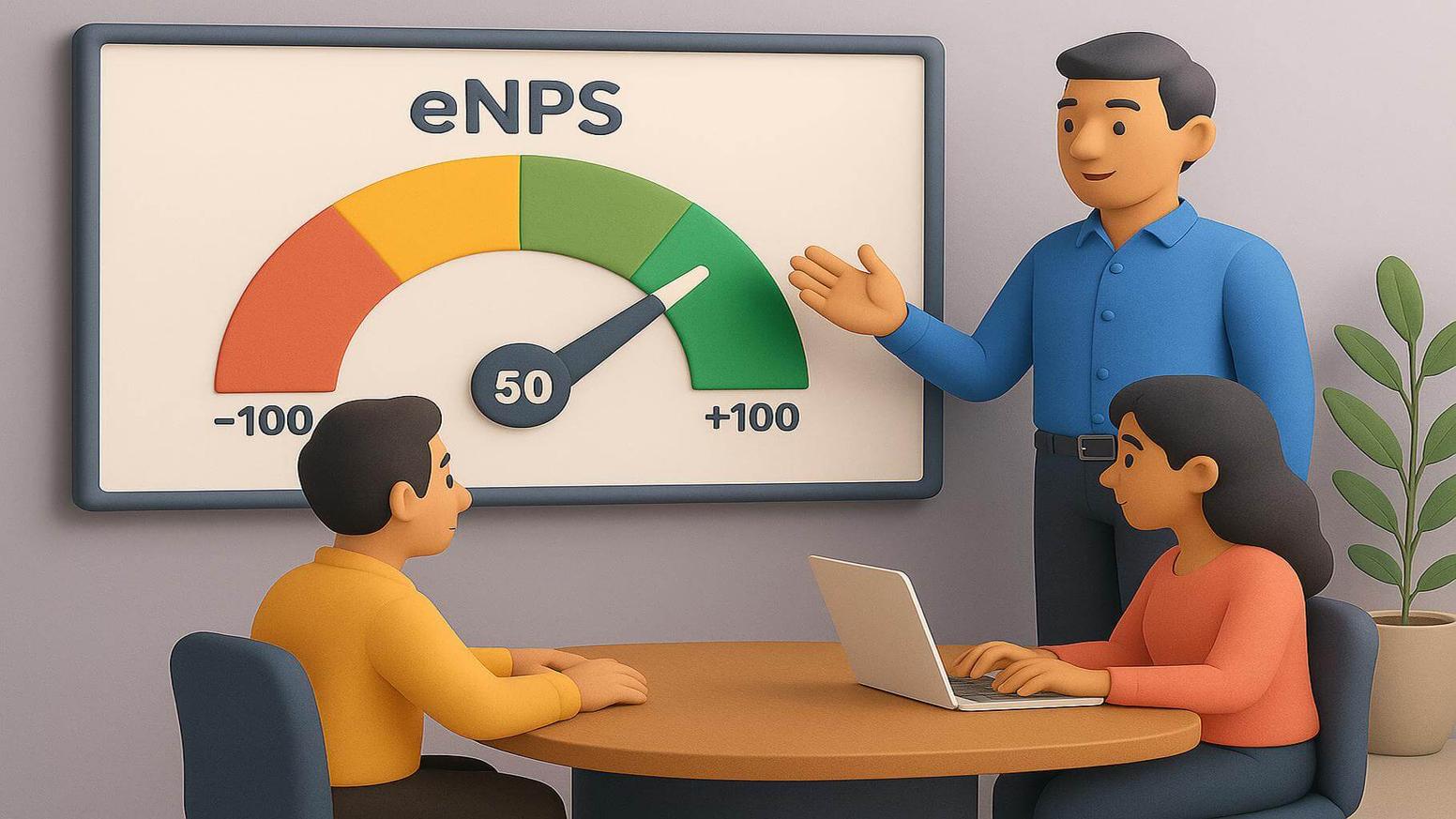
Mastering proper calculation techniques ensures companies generate reliable data that genuinely reflects employee sentiment rather than producing skewed or misleading survey results. Accurate calculations build confidence in the data that informs major strategic decisions about workplace culture and team dynamics. Companies that understand the nuances of employee net promoter score measurement avoid common pitfalls that undermine the effectiveness of their programs for gathering employee feedback across all levels.
Ensuring accuracy in employee sentiment measurement
Proper calculation methodology ensures that employee input translates into meaningful metrics that accurately reflect workplace advocacy and engagement levels across the company. Accuracy in measurement forms the foundation for all subsequent strategic decisions.
Essential accuracy factors include:
- Proper categorization: Companies must understand which respondents to include in calculations and how different rating scales affect categorization thresholds when employees rate their workplace experience
- Process consistency: Accurate measurement requires consistency in survey distribution, response collection, and data analysis processes that maintain integrity throughout the measurement cycle
- Standardized protocols: When companies follow standardized eNPS calculation protocols, they can trust their survey results
- Informed decision-making: Accurate data enables companies to make informed decisions about improvements that help employees feel more valued and engaged in their daily work
- Reduced bias: Proper methodology minimizes sampling bias and ensures representative results across all employee populations
Avoiding common calculation errors that skew results
Many companies mistakenly include Passive responses in their net promoter calculations, fundamentally distorting the final score and misrepresenting true employee sentiment across the business. Others use incorrect categorization ranges for their chosen rating scale, classifying employees into the wrong groups and producing invalid scores that mislead leadership about actual workplace conditions. Understanding the employee net promoter score calculation correctly prevents these mathematical errors that waste resources on inaccurate data and misdirected improvement initiatives. Companies that master proper calculation techniques avoid the confusion and misinterpretation that comes from flawed methodology, ensuring their programs generate actionable intelligence that truly reflects how employees feel about their workplace experience.
Building confidence in data-driven decision making
When leadership teams trust their eNPS survey calculations, they feel empowered to make significant investments in culture improvements and employee engagement initiatives that benefit all employees. Accurate calculation knowledge enables HR professionals to defend their recommendations with solid data that withstands executive scrutiny and demonstrates the company's eNPS trends over time. Companies build credibility with their workforce when they demonstrate competence in measuring and acting on input, creating positive cycles in which participation rates increase because employees see tangible results from sharing their perspectives. Calculation accuracy transforms the employee net promoter score from a simple number into a strategic tool that drives meaningful organizational change and helps employees feel heard, valued, and motivated to actively promote their workplace to prospective talent.
15 best tips for calculating eNPS score accurately

Implementing proven strategies for calculating the net promoter score ensures companies generate reliable data that supports effective decision-making about workplace culture and employee experience. These comprehensive tips cover the entire measurement process from initial survey design through final score interpretation and action planning. Following these best practices helps companies avoid common mistakes while maximizing the value of their employee net promoter score programs. Organizations can also leverage eNPS tools to automate and streamline the calculation process.
Companies committed to accurate employee engagement measurement should approach calculations systematically, paying careful attention to each phase of the process. The following recommendations reflect industry best practices that have been validated across thousands of businesses and millions of responses from employees worldwide.
5 tips for collecting and categorizing survey responses
1. Use consistent rating scales, such as 5-point or 0-10 scales, or other methods. Companies must select a single rating system and apply it consistently across all surveys to maintain data consistency and enable meaningful comparisons over time. Switching between different scales creates confusion for employees and makes historical trend analysis impossible for tracking how the company's eNPS evolves.
2. With traditional 0-10 scales: classify 9-10 as Promoters, 7-8 as Passives, 0-6 as Detractors. This standard categorization framework has been validated through extensive research on the Net Promoter Score methodology. Companies using this scale must strictly adhere to these ranges to maintain comparability with industry benchmarks.
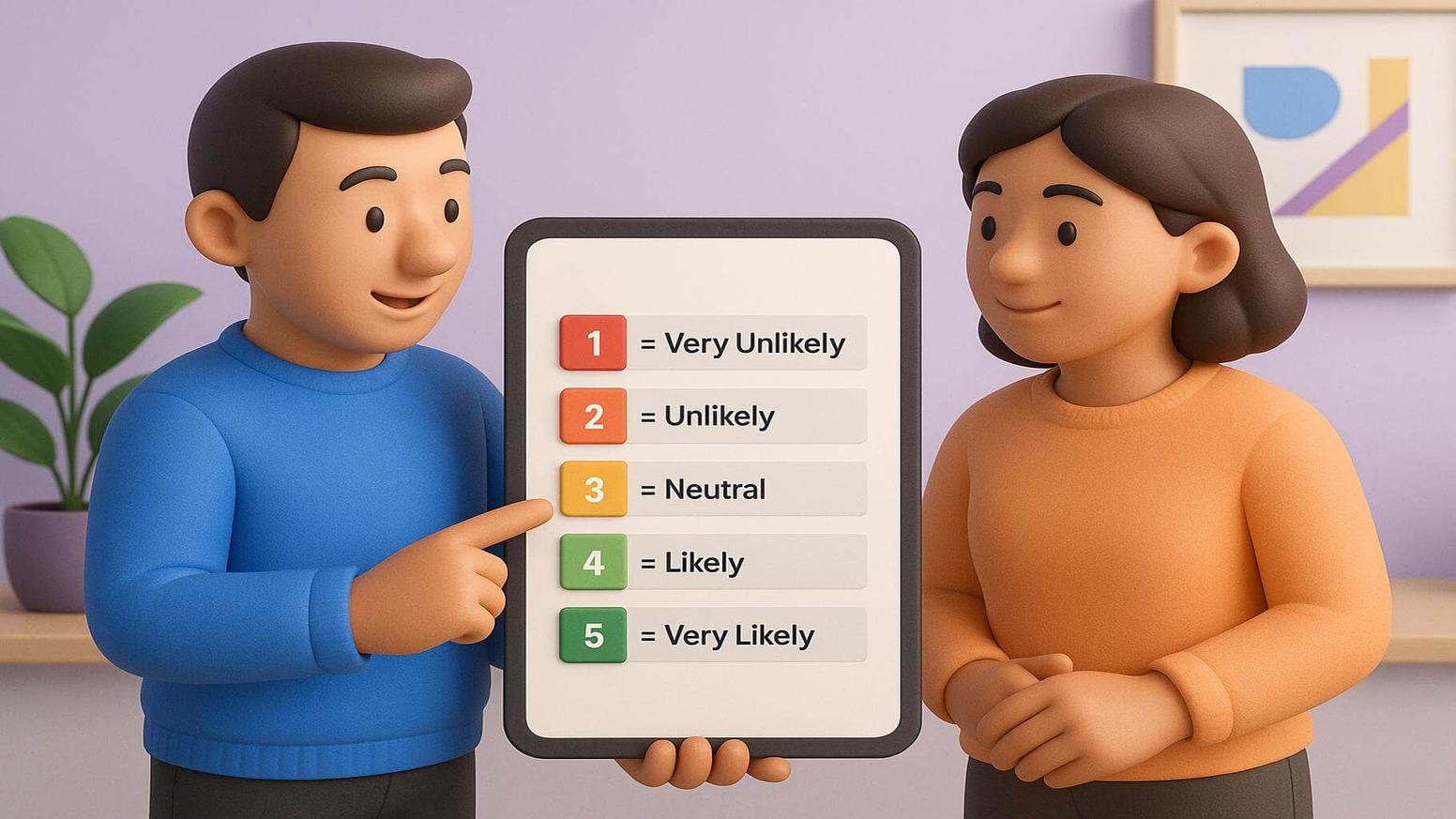
3. With Matter's 5-point Likert scale: classify 5 as Promoters, 4 as Passives, 1-3 as Detractors. Matter uses a research-backed approach where only the highest rating (5 - strongly agree) represents true Promoters who actively advocate for the workplace. A rating of 4 (agree) indicates satisfaction but not enough enthusiasm to actively promote, while ratings of 1-3 represent varying degrees of dissatisfaction.
4. Ensure consistent categorization rules for your chosen scale. Whether using a 0-10 scale or a 5-point system, companies must document their classification thresholds and apply them uniformly across all measurement periods to maintain data integrity and enable accurate trend analysis over time.
5. Ensure responses are anonymous to get honest input. Employees must feel safe providing candid opinions without fear of retaliation or judgment from leadership, which directly impacts the quality and accuracy of survey data. Anonymous surveys typically yield higher response rates and more accurate data because employees feel comfortable sharing genuine sentiments rather than what they think management wants to hear.
5 tips for applying the eNPS calculation formula
1. Calculate the total number of responses received. This baseline number becomes the denominator for all percentage calculations and determines whether the sample size is sufficient for reliable analysis of survey results. Companies should aim for response rates above 60% to ensure results accurately reflect overall employee sentiment across all departments and levels.
2. Count the number of Promoters and divide by the total responses for the percentage. This calculation identifies the proportion of highly engaged employees who actively advocate for the workplace and demonstrate strong satisfaction. For example, if a company receives responses from 100 employees and 40 are classified as Promoters, the Promoter percentage equals 40%.
3. Count the number of Detractors and divide by the total responses for the percentage. This step quantifies the proportion of disengaged employees who may spread negativity about their workplace. Using the same 100-employee example, if 15 employees are Detractors, the Detractor percentage equals 15%.
4. Subtract the Detractor percentage from the Promoter percentage for the final score. This simple subtraction yields the eNPS score, which ranges from -100 to 100. Continuing the example, 40% Promoters minus 15% Detractors equals an eNPS of 25.
5. Exclude Passives completely from the eNPS calculation regardless of scale used. Passive responses provide valuable context about neutral employees, but don't factor into the mathematical formula. This exclusion focuses the metric on employees with strong opinions while still tracking the middle group separately for deeper analysis.
7 tips for interpreting and validating eNPS results
1. Express the final result as a whole number between -100 and 100. The employee net promoter score should always be presented without percentage signs or decimal points to maintain consistency with standard net promoter score NPS reporting conventions. A score of -100 implies that all respondents are detractors, whereas a score of 100 indicates that all are promoters. Understanding if a score is acceptable in your sector requires context and benchmarking.
2. Compare results against industry benchmarks. Organizations should evaluate their scores against industry benchmarks to determine whether their performance indicates strong, average, or weak employee loyalty relative to competitors. A good score typically ranges from 10 to 30, while excellent scores exceed 50 in most industries. The vast majority of organizations fall within this acceptable range, though expectations vary by sector and company culture.
3. Track changes over time rather than focusing on single snapshots. Individual measurements provide limited value compared to trend analysis, which reveals whether employee engagement is improving or deteriorating over different periods. Organizations should establish regular measurement cadences that enable meaningful period-over-period comparisons and show how satisfaction evolves as workplace conditions change. Planning your next survey strategically ensures consistent data collection without survey fatigue.
4. Segment data by department to identify specific problem areas. Breaking down scores by team, location, or other factors reveals where challenges concentrate and where organizations excel. This analysis helps HR teams understand which employee groups need support and which practices should be replicated across the broader organization.
5. Cross-reference eNPS with other surveys and metrics for accuracy. Validating eNPS results against turnover rates, absenteeism patterns, pulse surveys, or employee engagement surveys confirms whether the score accurately reflects workplace reality. Organizations should view eNPS as one component of a comprehensive measurement strategy that includes customer loyalty principles adapted for internal stakeholders.
6. Segment data by department to identify specific problem areas. Breaking down company-wide scores into departmental or team-level results reveals where employee engagement challenges concentrate. This granular analysis enables targeted interventions that address specific issues rather than implementing blanket solutions that may not fit all contexts.
7. Cross-reference eNPS with other engagement metrics for accuracy. Validating eNPS results against turnover rates, absenteeism patterns, or other employee surveys confirms whether the score accurately reflects workplace reality. Organizations should view eNPS as one component of a comprehensive employee engagement measurement strategy rather than a standalone metric.
Step-by-step guide to calculate eNPS
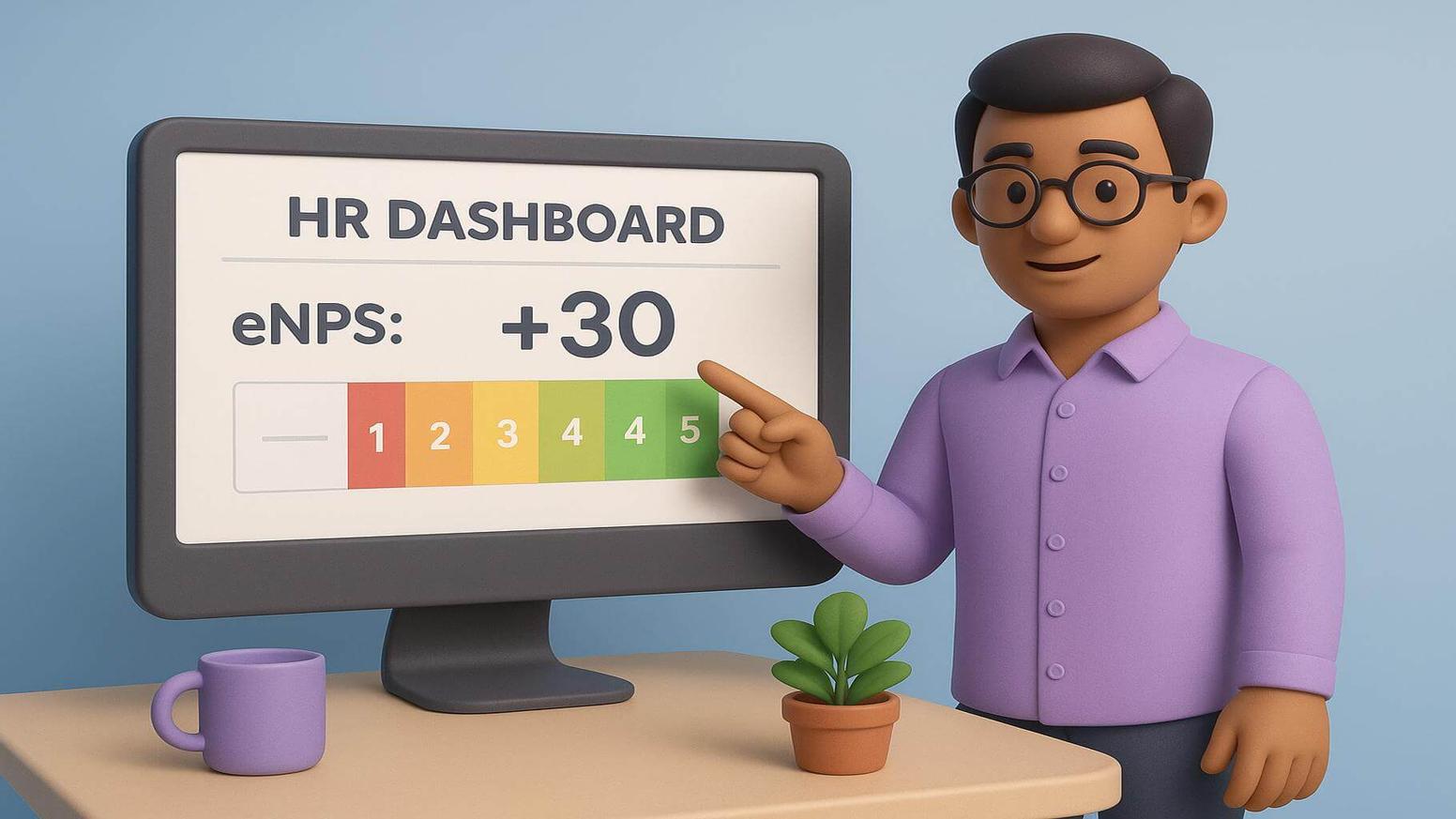
Following a systematic approach to employee net promoter score calculation ensures accuracy and consistency across multiple measurement cycles. This process guides companies through each phase from survey design to final score interpretation and action planning. Understanding these sequential steps helps prevent errors that compromise data quality and the strategic insights needed to improve employee workplace satisfaction. Many organizations integrate eNPS into their broader pulse survey strategy to gather continuous feedback.
Collecting eNPS survey responses using standardized questions
Organizations should begin by crafting clear, unambiguous questions that ask about employee' likelihood to recommend their workplace to others. The core eNPS question typically reads: "On a scale of [chosen rating system], how likely are you to recommend our organization as a place to work?"
Best practices for eNPS surveys distribution include:
- Follow-up questions: Many organizations include follow-up questions alongside the main eNPS question to understand the reasons behind different ratings and gather feedback about specific workplace factors like work-life balance, compensation, and growth opportunities
- Question design: Organizations often reference best practices for pulse survey questions when designing their eNPS surveys to maximize response quality and capture both quantitative and qualitative insights
- Distribution channels: Survey distribution should reach all team members simultaneously through preferred communication channels, whether email, Slack, Teams, or dedicated survey platforms
- Timing considerations: Response collection periods should remain open long enough to achieve strong participation rates, typically one to two weeks, while avoiding extended windows that reduce urgency or create survey fatigue
- Communication transparency: Organizations must communicate the survey's purpose, emphasize response anonymity, and explain how employee responses will inform workplace improvements to encourage honest participation from team members at all levels
- Response expectations: Setting clear expectations about how organizations will use employee feedback and when they'll share results builds trust and increases future participation in eNPS surveys and other measurement initiatives
Categorizing respondents into promoters, passives, and detractors
After collecting responses, organizations must apply the appropriate categorization rules based on their chosen rating scale to group respondents into three categories. This classification process determines how employee NPS scores are calculated and interpreted.
Standard categorization approaches include:
- 5-point Likert systems: Team members who rate 5 (strongly agree) become Promoters, those rating 4 (agree) become Passives, and those rating 1-3 become Detractors
- Traditional 0-10 scales: Users classify 9-10 ratings as Promoters, 7-8 as Passives, and 0-6 as Detractors
- Automation benefits: This categorization process should be automated whenever possible to prevent manual errors and ensure consistent application of classification rules across all team members
- Driver analysis: Organizations can analyze eNPS questions alongside the core question to understand the drivers behind different rating categories
- Sentiment understanding: Proper categorization helps explain why team members feel the way they do about their workplace experience, what factors influence their loyalty, and whether they're likely to actively promote the organization or spread negativity about their employment experience
- Higher expectations management: Understanding that some industries naturally generate higher expectations helps contextualize scores and prevent misinterpretation of results
Applying the formula and interpreting your final score
The final calculation involves dividing the number of Promoters by total responses to get the Promoter percentage, then dividing the number of Detractors by total responses to get the Detractor percentage. Subtracting the Detractor percentage from the Promoter percentage produces the eNPS score expressed as a whole number. Companies should document their calculation methodology and retain raw data for validation purposes and future trend analysis. Score interpretation requires comparing results against previous measurements, industry benchmarks, and departmental variations to identify actionable insights about how satisfied employees feel. Leadership teams should translate numerical scores into strategic priorities, developing action plans that address the root causes of low scores or capitalize on areas of strength to improve the overall employee experience.
Common mistakes when calculating the eNPS score

Companies frequently make preventable errors that compromise the validity of their employee net promoter score measurements and lead to flawed strategic decisions about workplace culture. Understanding these pitfalls helps teams implement more rigorous calculation processes that generate trustworthy data from employees. Avoiding these mistakes saves resources and prevents misguided interventions based on inaccurate information about how employees truly feel about their workplace.
Including passive responses in the calculation incorrectly
One of the most common errors involves treating Passive responses as either Promoters or Detractors rather than excluding them from the net promoter formula entirely. Understanding how to properly handle Passives is critical for calculation accuracy.
Common mistakes with Passive responses include:
- Incorrect inclusion: Some companies mistakenly add Passives to their total when calculating percentages, which fundamentally changes the mathematical relationship and produces invalid scores
- Split categorization: Others split Passives between the two groups or create weighted averages that deviate from standard methodology
- Misunderstanding their role: The correct approach always excludes Passives from the calculation while still tracking them separately to understand the size of the neutral employee population
- Conversion potential: Passives represent employees who could become either Promoters or Detractors, making them valuable to track even though they don't factor into the score
- Engagement impact: Large Passive populations don't accurately reflect how engaged employees feel, as these individuals lack strong positive or negative sentiments
Using the wrong rating ranges for categorizing respondents
Companies sometimes apply incorrect categorization thresholds for their chosen rating scale, classifying employees into the wrong groups, skewing final results, and misrepresenting workplace sentiment. A common mistake is treating 7s or 8s on a 0-10 scale as Promoters rather than Passives, or miscategorizing a 4 on a 5-point scale when employees rate their workplace. These classification errors compound through the calculation process, producing scores that dramatically misrepresent actual employee sentiment across the company. Companies must carefully document their categorization rules and apply them consistently across all eNPS survey questions and measurement periods to maintain data integrity.
Misunderstanding eNPS meaning and what scores actually represent
Leadership teams sometimes misinterpret employee net promoter scores by expecting unrealistically high numbers or panicking over negative scores that may be normal for their industry context. Others treat small score changes as significant shifts when they fall within normal statistical variation for their sample size of employees. Some companies compare their eNPS directly to customer NPS scores without recognizing the different contextual factors that influence workplace advocacy versus customer satisfaction. Proper interpretation requires understanding that scores reflect relative positioning rather than absolute performance, and that improvement trends matter more than achieving specific numerical targets for the company's eNPS score.
How Matter can help with eNPS calculation
Measuring employee net promoter score becomes streamlined through Matter's automated survey distribution, real-time calculations, and intuitive analytics dashboards. The platform's 5-point rating scale simplifies response collection for employees while maintaining statistical validity and comparability with traditional methodologies. This approach offers better usability than 0-10 scales, particularly on mobile devices, and uses fully labeled response options that reduce confusion for employees. Companies using the platform eliminate manual calculation errors and reduce the administrative burden associated with systematically gathering employee feedback. As one of the leading eNPS software solutions, Matter combines measurement accuracy with ease of use.
Automated survey distribution and response collection
Seamless integration with Slack and Microsoft Teams enables employee engagement survey tools that reach employees where they already work and communicate with their teams daily. As a comprehensive eNPS survey tool, the platform handles everything from question design to response analysis.
Key automation features include:
- Smart scheduling: Surveys are automatically scheduled at optimal times to maximize participation rates
- Reminder systems: Automated reminder notifications increase participation rates among employees without requiring manual follow-up
- Seamless access: Response collection happens without requiring employees to navigate to external websites or platforms
- Privacy protection: Anonymous response collection happens automatically, protecting privacy while generating higher participation rates and more honest feedback about satisfaction than traditional email-based surveys
- Flexible cadence: Companies can customize survey frequencies based on their measurement needs, whether quarterly pulse surveys or annual comprehensive assessments that capture detailed insights from all employees
Real-time eNPS calculation with instant dashboards
Automatic eNPS calculation using the correct formula and categorization rules eliminates manual errors and provides instant visibility into employee sentiment across the company. Organizations seeking comprehensive pulse survey software benefit from this all-in-one approach to measurement and analysis.
Dashboard capabilities include:
- Historical comparisons: The analytics dashboard displays current scores alongside historical trends, making it easy to identify whether engagement levels among employees are improving or declining over time
- Granular filtering: Companies can filter results by department, team, location, or custom demographic attributes to pinpoint areas requiring attention
- Support identification: Results help leadership understand which groups of employees need additional support or intervention
- Impact monitoring: Real-time updates enable leadership teams to monitor the immediate impact of culture initiatives or policy changes on satisfaction metrics
- Instant insights: Automated calculations remove waiting periods, allowing teams to respond rapidly to developing patterns or issues
Trend tracking and benchmark comparisons built in
Advanced analytics capabilities automatically generate trend visualizations that show how eNPS evolves over multiple measurement periods, revealing patterns and inflection points in employee sentiment. The platform provides industry-specific benchmark data that helps companies understand how their scores compare with those of similar businesses and competitors.
Advanced analytics features include:
- Visual trend reports: Automated generation of trend visualizations showing score evolution over time and identifying critical inflection points
- Industry benchmarking: Access to industry-specific benchmark data for accurate competitive comparisons
- Shareable insights: Built-in reporting tools make it easy to share results with stakeholders and create action plans based on data-driven insights from employees
- Metric correlation: Companies can correlate eNPS trends with other engagement metrics for comprehensive analysis
- Strategic planning: Comprehensive views of workplace culture health inform strategic decision-making about improving satisfaction among all employees across the organization
Frequently asked questions about how to calculate eNPS

Q: What is the exact method for computing the net promoter score (NPS) for employees?
A: The eNPS formula is: (Percentage of Promoters) minus (Percentage of Detractors) equals eNPS Score. To calculate percentages, divide the number of Promoters or Detractors by total responses and multiply by 100. Passives are excluded from the calculation entirely, regardless of whether you use a 5-point Likert scale or a traditional 0-10 scale.
Q: How do you convert raw survey data into eNPS percentages?
A: Count the number of Promoters and divide by total responses to get the Promoter percentage, then repeat for Detractors. For example, if 30 out of 50 employees are Promoters, that is 60%. If 10 are Detractors, that is 20%. Your eNPS is 60% minus 20% which equals a positive 40, regardless of the rating scale used.
Q: Should you include passive responses when calculating eNPS?
A: No, Passives are intentionally excluded from the eNPS calculation, whether they're represented by a rating of 4 in a 5-point system or scores of 7-8 in a 0-10 scale. While they provide valuable insight into employee sentiment, they do not factor into the mathematical formula. Only Promoters and Detractors determine your final eNPS score.
Q: How do different rating scales affect eNPS calculation?
A: Different rating scales (5-point vs 0-10) use the same calculation formula but different classification ranges. Matter's 5-point Likert system classifies 5 (strongly agree) as Promoters, 4 (agree) as Passives, and 1-3 as Detractors. Traditional 0-10 scales use 9-10, 7-8, and 0-6, respectively. Both methods produce comparable scores using the same Promoter percentage minus Detractor percentage formula.
Q: Can you calculate eNPS with small sample sizes?
A: While you can technically calculate eNPS with any sample size, results become more reliable with at least 30-50 responses. Smaller samples may show dramatic swings from individual responses. For department-level analysis, aim for response rates above 60% to ensure your eNPS accurately represents employee sentiment.
Q: What makes a net promoter score calculation example valid?
A: A valid net promoter score calculation example must properly categorize respondents into the three categories (using appropriate ranges for the chosen scale), exclude Passives from the formula, and present the result as a whole number between negative 100 and positive 100. Any calculation outside this framework is not a true eNPS measurement.
Organizations seeking to improve their pulse survey tools can leverage these calculation principles across various employee feedback initiatives beyond just eNPS measurement.
Final thoughts about calculating eNPS
Knowing how to accurately calculate the employee net promoter score is essential for companies committed to measuring and improving workplace advocacy through data-driven approaches that inform strategic decisions. Proper calculation lays the groundwork for assessing cultural health, recognizing dangers among disengaged employees, and tracking the effectiveness of employee engagement programs over time. Whether companies choose simplified 5-point Likert systems or traditional 0-10 scales, mastering the correct categorization rules and formula application ensures reliable results that support confident decision-making about satisfaction and workplace experience. Matter simplifies this entire process with automated survey distribution that integrates seamlessly into Slack and Teams. The platform's real-time calculation engines eliminate manual errors, while intuitive dashboards transform raw data into actionable insights. Companies using Matter move beyond numbers to create meaningful employee recognition programs that improve employee satisfaction, reduce turnover, and create cultures in which all employees feel valued and driven to do their best every day.
Ready to streamline your eNPS calculation and turn data into action? Schedule a demo with a Matter expert today and discover how our platform can help you measure employee loyalty accurately, track trends effortlessly, and create a culture of continuous improvement.

![15+ eNPS Software [2026 Guide with Pricing & Examples]](https://cdn.sanity.io/images/kqqb5xry/production/f5ba581da1ed73a4a0c546ed9756b6e8bf39bdd5-800x600.jpg?w=720&q=75&fit=max&auto=format)
![29+ eNPS Survey Questions for Employees [2026 Guide]](https://cdn.sanity.io/images/kqqb5xry/production/79ed301d0081f29310816886bc9fe1c0253a149c-800x600.jpg?w=720&q=75&fit=max&auto=format)
![19+ eNPS Survey Questions for Employees [2026 Examples]](https://cdn.sanity.io/images/kqqb5xry/production/28137ecca2090eeb56f13e159bfc35c4df05f92d-800x600.jpg?w=720&q=75&fit=max&auto=format)