

Understanding what makes a strong employee net promoter score shouldn't feel like solving a puzzle with missing pieces. At Matter, we understand the frustration HR teams face when trying to determine what a good eNPS score is. Industry resources often provide conflicting benchmarks, and guidance about employee net promoter score ranges can feel contradictory at best. Without clear context around eNPS calculation and proper interpretation of eNPS benchmarks, organizations risk either overlooking critical engagement issues or panicking over scores that are perfectly normal for their sector. This uncertainty can paralyze decision-making and delay workplace improvements that truly matter for employee retention and organizational success.
What is an eNPS score?
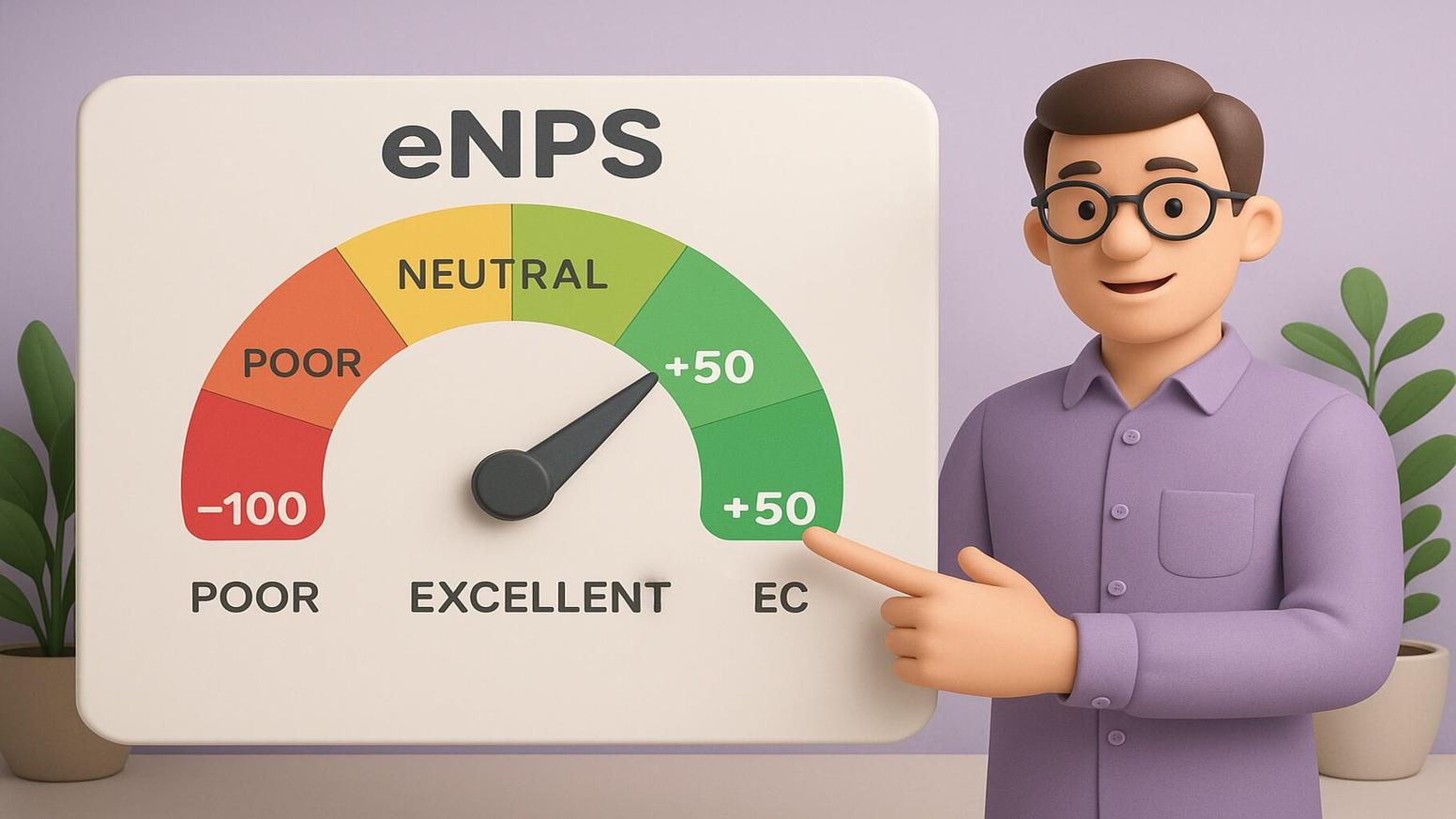
The employee net promoter score is a significant metric that gauges the likelihood that employees will recommend their organization as a desirable place to work. This measurement system provides organizations with clear insights into employee sentiment and loyalty, offering a straightforward way to gauge overall workplace satisfaction. Unlike complex survey methodologies that require extensive analysis, eNPS delivers a single number that reflects the collective voice of your workforce. The metric originated from the customer-focused Net Promoter Score (NPS) framework and has been adapted to measure employee engagement rather than customer loyalty.
Organizations across industries have adopted this approach through pulse survey tools because it provides actionable insights that directly correlate with business performance and employee retention rates.
Understanding employee net promoter score (eNPS) fundamentals
The employee net promoter score operates on a simple premise: employees who would recommend their workplace to others are more likely to be engaged, productive, and committed to organizational success. This metric captures the essence of the employee experience by asking a straightforward question about the likelihood of recommending. The eNPS calculation methodology divides respondents into three distinct categories based on their responses, creating a clear picture of workforce sentiment. Organizations can measure eNPS using either an 11-point scale (0-10), originally designed for telephone interviews, or a modern 5-point Likert scale, as in Matter's research-backed approach. The 5-point method has been validated to measure the same underlying employee sentiment while offering significantly better usability on mobile and digital devices.
Research demonstrates that well-designed 5-point Likert scales and 11-point scales measure the same underlying employee sentiment with equal validity when applied consistently. Modern 5-point approaches like Matter's offer significant advantages in completion rates and mobile usability without sacrificing measurement accuracy. The key advantage of eNPS lies in its simplicity and ability to track trends over time, making it an essential tool for measuring employee engagement and predicting retention outcomes.
The core eNPS questions that measure employee loyalty
The foundational eNPS survey centers on one critical question: "How likely are you to recommend this organization as a place to work?" This single query captures a wealth of information about employee satisfaction, engagement, and overall workplace experience. Matter's platform uses a research-backed 5-point Likert scale that delivers higher response rates and better mobile usability than traditional 11-point scales, while measuring the same underlying employee sentiment with validated accuracy. The follow-up questions prove equally valuable, asking respondents, "What is the primary reason for your rating?" and "What could we do to improve your experience?"
These open-ended inquiries transform quantitative data into actionable insights, helping HR teams understand the specific factors driving employee responses. Organizations that combine the numerical rating with qualitative feedback gain deeper insights into workplace dynamics, enabling them to address concerns proactively. The beauty of these core employee engagement survey questions lies in their simplicity and universality, making them applicable across industries, company sizes, and employee populations.
How eNPS differs from traditional employee satisfaction metrics
Traditional employee engagement survey examples often involve dozens of questions across multiple workplace dimensions, leading to survey fatigue and lower participation rates. In contrast, eNPS focuses on a single powerful question that employees can answer quickly and honestly, typically in less than 1 minute. This streamlined approach significantly increases response rates, with many organizations achieving 80-90% participation, compared to 30-40% with lengthy satisfaction surveys. Employee satisfaction measurements tend to assess satisfaction with specific workplace aspects, such as compensation, benefits, or the work environment. In contrast, eNPS captures something more profound: the willingness to advocate for the organization.
An employee might feel generally satisfied with their job but still not recommend their employer to others, revealing hidden concerns about company culture or leadership. The eNPS metric serves as an early warning system, identifying engagement issues before they escalate into turnover problems. Additionally, eNPS provides a standardized metric that enables meaningful comparisons across departments, locations, and time periods, something traditional satisfaction metrics often struggle to deliver consistently.
What are the benefits of tracking eNPS?

Tracking employee net promoter score delivers substantial advantages for organizations committed to building positive workplace culture and reducing turnover. The metric provides objective data that helps leadership teams understand current employee sentiment and predict future retention challenges. Regular eNPS measurement creates a feedback loop that demonstrates to employees that their opinions matter, fostering trust and openness within the organization. Companies that use eNPS data strategically through employee engagement survey programs can identify specific departments or teams experiencing engagement challenges, enabling targeted interventions before problems spread.
The simplicity of eNPS makes it easier for executives and board members to understand workforce health at a glance, facilitating better decision-making about resource allocation and strategic priorities. Organizations that track eNPS consistently over time develop valuable trend data, revealing whether engagement initiatives are working or need adjustment. This ongoing measurement transforms employee feedback from a periodic event into a continuous improvement process, driving better business outcomes.
Identifying retention risks before employees leave
Detractors identified through eNPS surveys represent employees at high risk of leaving the organization, providing advance warning that allows HR teams to intervene proactively. These unhappy employees often begin disengaging months before actually submitting resignation letters, and eNPS data captures this deterioration in sentiment early. Research shows that employees who rate their employer low on the likelihood of recommending them are significantly more likely to seek new opportunities within the next 12 months. Organizations can analyze eNPS results by department, tenure, role, or location to pinpoint where retention risks concentrate, enabling targeted retention strategies.
Exit interviews often reveal problems too late to address, while eNPS measurement creates opportunities to retain valuable talent by addressing concerns before employees decide to leave. Matter's platform enables teams to track pulse survey responses in real time, so managers can reach out to detractors quickly and understand their specific concerns. This proactive approach transforms retention from a reactive problem into a manageable challenge with clear data-driven solutions.
Benchmarking employee loyalty across departments and teams
Breaking down eNPS data by department reveals important patterns about where engagement thrives and where improvement opportunities exist within the organization. Some teams might consistently score as promoters while others struggle with passive or detractor responses, indicating leadership differences or workplace condition disparities. This departmental analysis helps organizations allocate resources effectively, providing additional support to struggling areas while learning from the success strategies of high-performing teams. Comparing scores across different employee groups, such as remote versus on-site workers, different tenure brackets, or various job functions, uncovers insights that broad organizational averages might obscure.
For example, new employees might show different engagement patterns than tenured staff, suggesting opportunities to improve onboarding processes or career development programs. Regular benchmarking creates accountability for managers and team leaders, encouraging them to prioritize employee experience as a measurable performance indicator. Organizations using this segmented approach can celebrate wins in high-scoring areas while developing targeted improvement plans for lower-scoring departments.
Measuring the impact of workplace initiatives on employee sentiment
Organizations invest significant resources in programs designed to boost engagement, from flexible work arrangements to professional development opportunities, but often struggle to measure their actual impact on employee morale. Tracking eNPS before and after implementing new initiatives provides clear evidence of what works and what doesn't, enabling data-driven decision-making about future investments. When a company launches a new employee recognition program or adjusts compensation structures, subsequent eNPS measurements reveal whether these changes moved the needle on employee loyalty and satisfaction. This connection between action and outcome helps justify continued investment in successful programs while redirecting resources away from ineffective approaches.
The metric also captures unintended consequences of organizational changes, such as when a well-intentioned policy actually reduces engagement among certain employee populations. By consistently measuring eNPS through employee pulse surveys, companies create a feedback mechanism that continuously refines their approach to workplace culture and employee experience. This iterative improvement process leads to steadily increasing scores over time as organizations learn what resonates with their specific workforce.
Why are eNPS scores important?
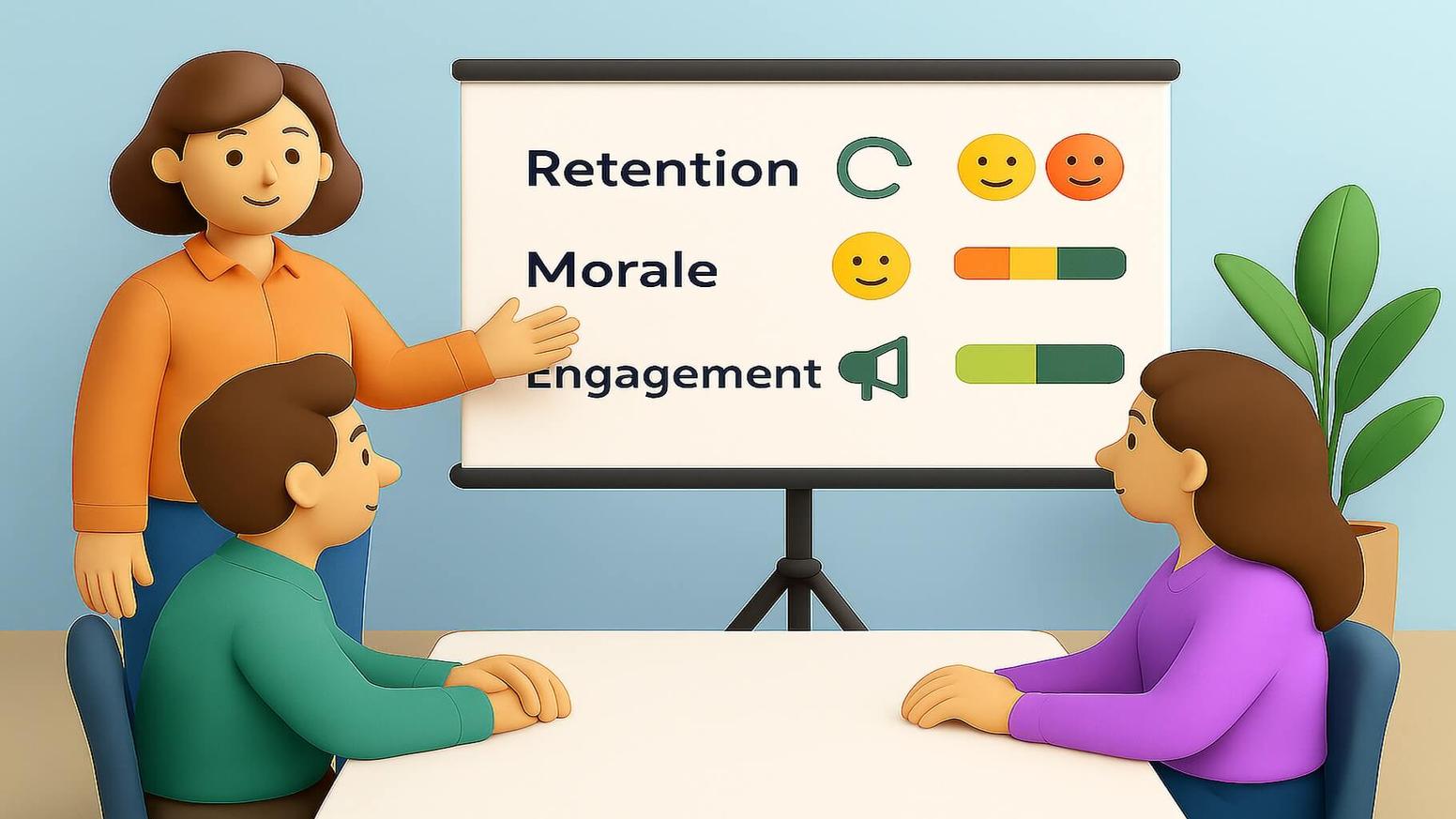
The employee net promoter score has emerged as a critical metric because it predicts outcomes that directly impact business success, including employee turnover, recruitment effectiveness, and overall organizational performance. Unlike vanity metrics that look impressive but don't correlate with meaningful outcomes, eNPS demonstrates strong relationships with tangible business results. Companies with high eNPS scores typically outperform competitors in productivity, innovation, and customer satisfaction, creating a virtuous cycle of success. The metric's importance extends beyond internal measurement, as employer brand reputation increasingly influences top talent's decision to join or stay with an organization.
Investors and board members now recognize employee engagement as a key indicator of long-term viability, with low eNPS scores signaling potential operational challenges ahead. Organizations that regularly measure eNPS through employee pulse survey systems and act on the results build cultures where employees feel valued and heard. That sense of being listened to translates directly into better business performance and reduced turnover costs.
The connection between eNPS scores and employee turnover rates
Strong research demonstrates that eNPS scores are powerful predictors of future employee attrition, with detractors showing departure rates that can exceed those of promoters by 300% or more. Organizations tracking both metrics over time observe clear patterns: as eNPS scores decline, turnover rates increase within the following quarters, providing advance warning of retention challenges. This predictive power enables proactive intervention rather than reactive crisis management when resignation waves begin. Companies experiencing consistent negative eNPS scores typically face compounding problems, as high turnover creates additional strain on remaining employees, further depressing scores in a destructive cycle.
The cost implications are substantial, with replacing a single employee often costing 50-200% of their annual salary, including recruitment, training, and productivity losses during transitions. By focusing on improving eNPS scores through targeted initiatives that address detractor concerns, organizations can significantly reduce turnover-related expenses while maintaining institutional knowledge and team cohesion. Matter's eNPS tools help organizations identify the specific factors driving low scores, enabling precise interventions that address root causes rather than symptoms.
How promoters drive recruitment through employee referrals
Employees who score as promoters don't just stay with the organization; they actively help recruit new talent by recommending the company to their professional networks. These enthusiastic advocates serve as credible ambassadors whose endorsements carry more weight than traditional recruiting messages or employer branding campaigns. Research shows that candidates referred by current employees have higher acceptance rates, faster time-to-productivity, and better retention than those hired through other channels. Organizations with strong eNPS scores benefit from this virtuous cycle, in which satisfied employees attract similarly high-quality candidates who appreciate the same cultural attributes.
The employer brand naturally strengthens as advocates share positive experiences on social media, in professional networks, and within their communities, thereby establishing a reputation advantage over competitors. Companies can amplify this effect by implementing employee rewards programs that recognize team members who successfully refer quality candidates. This referral advantage becomes particularly valuable in tight labor markets where traditional recruiting methods struggle to attract top talent, giving high-eNPS organizations a significant competitive edge.
Using eNPS as an early warning system for culture issues
Sudden drops in eNPS scores often precede visible culture problems, giving organizations time to investigate and address underlying issues before they escalate. A department showing declining scores might be experiencing management challenges, workload concerns, or interpersonal conflicts that haven't yet surfaced through formal complaints. This early detection capability proves invaluable for preventing small problems from metastasizing into organization-wide engagement crises that damage retention and performance. Regular pulse survey tools enable organizations to spot trends quickly, and Matter's platform provides automated alerts when scores drop below certain thresholds or exhibit concerning patterns.
The qualitative feedback accompanying eNPS ratings helps diagnose specific problems, distinguishing between issues requiring immediate action and those representing normal fluctuations. Organizations that respond quickly to warning signals demonstrate to employees that their feedback matters and that leadership takes their concerns seriously. This responsiveness builds trust and encourages continued honest participation in surveys, creating a transparent culture where problems can be addressed openly rather than festering in silence until employees leave. Anonymity is close to universal on Matter: 98.2% of pulse surveys run anonymous, and over half of responses arrive within the first hour, per The Recognition Habit, Matter's 2026 Benchmark Report.
17 best tips for understanding what is a good eNPS score
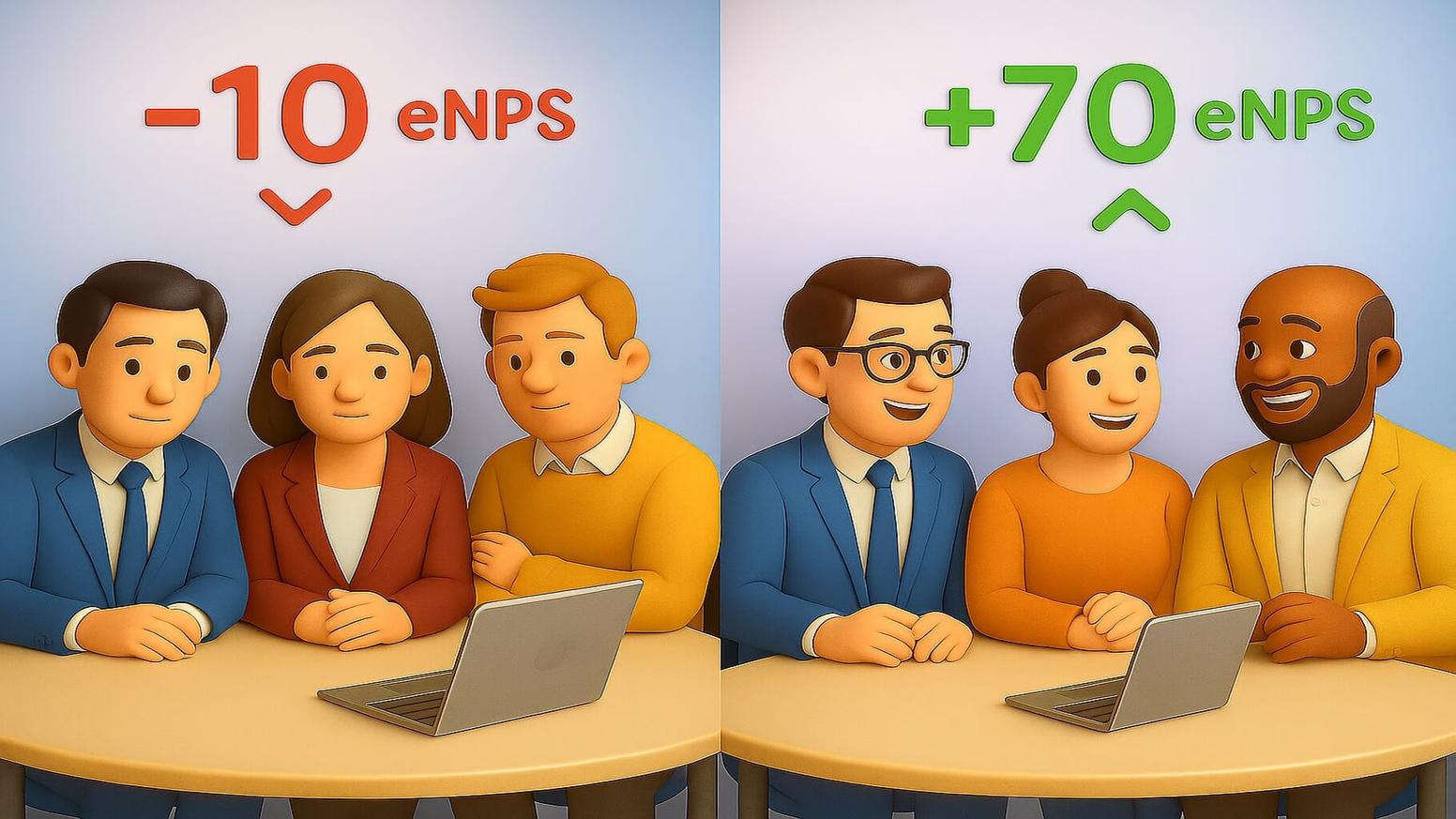
Understanding what constitutes a good eNPS score requires context about your industry, organizational maturity, and improvement trajectory rather than relying solely on absolute numbers. Organizations shouldn't become discouraged by scores that seem low compared to published benchmarks, as the most valuable insight comes from tracking your own progress over time. These tips provide a comprehensive framework for interpreting eNPS data, applying industry benchmarks appropriately, and systematically improving scores through effective employee engagement pulse survey implementation. Companies should focus on converting passives to promoters and addressing detractor concerns rather than chasing arbitrary score targets.
The following guidance helps organizations set realistic expectations, measure progress effectively, and implement strategies that generate meaningful improvements in employee loyalty and workplace satisfaction.
6 tips for interpreting eNPS score ranges
Understanding the nuances of different score ranges helps organizations set appropriate expectations and recognize when they've achieved genuine success:
Scores above +50 indicate exceptional employee loyalty and advocacy.
Organizations achieving this level have created workplaces where the vast majority of employees enthusiastically recommend the company to others, representing the top tier of employer excellence. Understanding what a good eNPS score is helps organizations set appropriate benchmarks for their industry. These companies typically experience very low turnover, strong employer brands, and competitive advantages in talent acquisition.
Maintaining scores at this level requires continuous attention to employee experience and proactive engagement strategies.
Scores between +30 and +49 reflect strong employee engagement. Companies in this range have more promoters than detractors, indicating a positive workplace culture and generally satisfied employees. These organizations have solid foundations, but still have opportunities to convert passive employees into promoters through targeted initiatives. Many successful companies operate sustainably in this range while continuously working toward improvement.
Scores between +10 and +29 show good baseline employee satisfaction.
Organizations here have achieved a positive score, indicating that promoters outnumber detractors, though passive employees make up a significant portion of the workforce. This range suggests an adequate employee experience, with clear opportunities for improvement. Companies should focus on understanding what would convert passives to promoters while maintaining current promoter satisfaction.
Scores between 0 and +9 suggest moderate engagement needing improvement.
Organizations barely achieving positive scores have nearly equal numbers of promoters and detractors, indicating an unstable situation where engagement could easily decline. These companies should treat low scores as urgent signals requiring immediate attention to prevent further erosion. Quick wins that address common concerns can rapidly improve scores in this range.
Scores between -10 and -1 reveal concerning employee sentiment issues.
Negative eNPS scores indicate that detractors outnumber promoters, suggesting that more employees would actively discourage others from joining than would recommend the organization. Companies in this range are likely to face significant retention challenges, cultural problems, or management issues that require comprehensive intervention. Recovery from negative scores demands transparency about problems and visible commitment to change.
Scores below -10 indicate critical engagement problems requiring immediate action.
Organizations with deeply negative scores face existential threats from employee disengagement, as high turnover drains resources and damages reputation. These situations often reflect systemic issues with leadership, compensation, work environment, or organizational values that demand urgent executive attention. Turning around scores this low requires acknowledging problems honestly, implementing significant changes, and demonstrating sustained commitment to employee wellbeing.
6 tips for using industry benchmarks effectively
Different industries face unique challenges that influence typical eNPS performance, making it essential to compare your organization against appropriate peers using standardized pulse survey template approaches:
Technology companies typically achieve a range of +20 to +40 as a standard.
Tech sector organizations often score higher due to competitive compensation, growth opportunities, and cultures emphasizing innovation. Companies in this industry below +20 should examine whether they're offering competitive packages and career development compared to industry alternatives. The dynamic nature of technology results in engagement levels that can vacillate swiftly in response to market conditions and growth patterns.
Healthcare organizations average +10 to +30, depending on sector demand.
Healthcare workers face unique stressors, including high-stakes responsibilities, emotional labor, and often challenging work conditions, which can impact engagement scores. Organizations in this sector achieving scores above +20 demonstrate exceptional workplace culture, given the inherent challenges. Improvements in this industry often focus on work-life balance, adequate staffing levels, and recognition programs that acknowledge the demanding nature of healthcare work.
Retail and hospitality businesses see 0 to +20 as a common baseline.
These industries traditionally struggle with engagement due to factors such as variable scheduling, customer-facing stress, and lower average compensation than in other sectors. Organizations achieving positive scores in retail and hospitality have typically invested heavily in employee experience, scheduling flexibility, and advancement opportunities. Even modest positive scores represent significant achievement given industry challenges.
Financial services firms typically maintain a +15 to +35 performance.
Banks, insurance companies, and investment firms generally achieve moderate to good scores, balancing competitive compensation against regulatory pressures and demanding work environments. Companies in this sector scoring below +15 should evaluate whether stress levels, management quality, or career progression opportunities need improvement. The regulated nature of financial services can sometimes create bureaucracy that impacts employee sentiment.
Manufacturing sectors generally score +5 to +25, depending on the workforce.
Manufacturing organizations face diverse engagement challenges varying by company size, location, union presence, and production type. Companies with strong safety cultures, clear advancement paths, and employee recognition systems typically score toward the higher end of this range. Shift work, physical demands, and concerns about automation can depress scores without proactive engagement strategies.
Professional services achieve +25 to +45, reflecting knowledge worker satisfaction.
Consulting firms, law practices, and similar organizations typically score well due to high compensation, intellectual challenge, and career development opportunities. Companies in this sector falling below +20 often face issues with work-life balance, client demands, or partnership track concerns. The competitive nature of professional services means top talent has many options, making strong eNPS scores essential for retention.
5 tips for calculating and improving eNPS scores
Accurate measurement and strategic improvement efforts maximize the value organizations derive from eNPS tracking:
Choose a validated rating method and use it consistently.
Traditional 11-point scales (0-10) were designed for telephone interviews and classify 9-10 as promoters, 7-8 as passives, and 0-6 as detractors. Modern 5-point Likert scales, like the research-backed approach used by Matter, classify 5 responses as promoters, 4 as passives, and 1-3 as detractors. Both methodologies effectively measure the same underlying employee sentiment when applied consistently using proper eNPS calculation methods. However, 5-point scales typically achieve higher response rates due to better mobile usability and fully labeled response options. Organizations should choose one methodology and stick with it to enable meaningful trend analysis over time.
Segment eNPS data by department to identify specific prob em areas.
Analyzing scores across different employee groups reveals whether challenges concentrate in particular teams, locations, or demographic segments. This segmentation enables targeted interventions addressing root causes in struggling areas while learning from successful departments' best practices. HR teams can prioritize resources where they'll have the greatest impact on overall organizational scores.
Compare your scores against previous quarters rather than only industry averages.
While benchmarks provide context, the most meaningful measure of success is improvement in your own organization's trajectory over time. A company moving from -10 to +5 has made more progress than one maintaining a steady +15, even though the latter's absolute score is higher. Track quarterly or monthly trends to evaluate whether initiatives are working.
Focus on converting passives to promoters for the fastest score improvement.
Passive employees already have moderately positive feelings about the organization, making them the easiest group to shift into promoter territory. Addressing common concerns raised by passives often requires less dramatic changes than fixing distracting issues. Small improvements in areas like recognition, communication, or growth opportunities can quickly convert passives into active participants.
Address detractor feedback immediately to prevent negative word of mouth.
Employees scoring as detractors will likely share their negative opinions with peers and external contacts, potentially damaging both internal culture and employee brand. Reaching out personally to understand and address their specific concerns demonstrates that leadership values all employee feedback. Quick responses can sometimes convert detractors to passives or even promoters when they see the organization taking action.
How to calculate eNPS

The employee net promoter score calculation follows a straightforward formula that transforms individual survey responses into a single metric representing overall employee sentiment. Organizations must first categorize each respondent into one of three groups based on their evaluation, then compute the proportion of employees in each category relative to the total survey respondents. The final eNPS score is the difference between the percentage of promoters and detractors, with passives removed from the calculation but included in the total response base. This methodology produces a score ranging from -100 (if every employee is a detractor) to +100 (if every employee is a promoter), though most organizations fall somewhere in between.
Understanding this calculation through effective pulse survey software helps teams recognize that improving eNPS requires either increasing promoters, decreasing detractors, or both, with different strategies appropriate for each goal.
The eNPS calculation formula and methodology
The mathematical formula for calculating eNPS is elegantly simple: eNPS equals the percentage of promoters minus the percentage of detractors. To determine these percentages, organizations divide the number of employees in each category by the total number of survey respondents, then multiply by 100 to convert to percentages. For example, if 100 employees respond to a survey, 60 rate highly as promoters, 25 rate moderately as passives, and 15 rate poorly as detractors, the calculation would be 60% minus 15%, yielding an eNPS score of +45. Passives don't factor into the subtraction but remain part of the denominator when calculating percentages, thereby influencing the score by reducing the proportions of both promoters and detractors.
Matter's pulse survey software automates these calculations in real time, displaying results as responses come in. The standardized formula enables comparisons across time periods, departments, and even different organizations, making eNPS a versatile metric for benchmarking and tracking employee engagement trends.
Classifying respondents as promoters, passives, and detractors
Accurate classification of survey responses into the three eNPS categories forms the foundation of reliable eNPS survey measurement. The 11-point scale approach (0-10) designates responses of 9-10 as promoters, 7-8 as passives, and 0-6 as detractors, with this distribution calibrated through extensive research on customer and employee sentiment. Matter's validated 5-point Likert scale offers improved usability while maintaining measurement accuracy: 5 responses indicate promoters who strongly recommend the organization, 4 responses represent passives who are satisfied but not enthusiastic advocates, and 1-3 responses identify detractors who would discourage others from joining. Research validates that fully labeled 5-point scales reduce respondent confusion and improve completion rates compared to unlabeled numerical scales, while both approaches reliably identify the same underlying employee sentiment when consistently applied.
Organizations should resist the temptation to reclassify responses to generate better-looking scores, as manipulation undermines the metric's predictive value regarding employee retention and satisfaction. Consistent application of classification rules over time enables meaningful trend analysis that reveals whether engagement initiatives are actually moving employees toward promoter status.
Best practices for accurate eNPS measurement and tracking
Maintaining measurement consistency and following best practices ensures that eNPS data provides reliable insights rather than misleading noise. Organizations should survey employees regularly. Quarterly works well for most companies to establish trend data without creating survey fatigue among respondents. The timing of surveys matters, as administering them immediately after major organizational changes or during particularly busy periods can skew results unrepresentatively.
Anonymous responses typically yield more honest feedback, though some organizations choose to collect identifiable data to enable targeted follow-up with detractors who want to discuss their concerns. Response rates significantly impact reliability, with participation below 60% raising questions about whether results represent the entire workforce accurately. Matter's integration with Slack and Teams dramatically improves response rates by meeting employees where they already work rather than requiring them to navigate external survey platforms. Combining quantitative eNPS scores with qualitative pulse survey questions that request specific feedback provides context to help interpret score changes and identify improvement opportunities more precisely.
How Matter can help with eNPS
Tracking employee net promoter scores often feels like a periodic survey exercise, but Matter transforms it into a continuous feedback system that drives meaningful workplace improvements. The platform's Slack-first and Teams-first approach seamlessly integrates surveys into employees' existing workflows, eliminating the friction that typically suppresses participation in traditional survey tools. Organizations using Matter achieve significantly higher response rates by meeting employees where they already work, providing representative data that leadership can trust when making engagement decisions. Beyond basic survey administration, the platform connects eNPS insights directly to recognition and reward systems through thoughtful pulse survey questions, creating closed-loop feedback where positive scores are celebrated and concerning trends trigger improvement initiatives.
Measuring engagement without acting on insights wastes everyone's time, which is why Matter facilitates rapid response to employee feedback. Companies implementing the platform typically see eNPS improvements within the first quarter as employees recognize their opinions translate into tangible changes.
Automated eNPS survey distribution and tracking
The manual work traditionally required to administer regular eNPS software surveys disappears with Matter's automated distribution and collection process. Organizations can schedule surveys to deploy automatically on a quarterly or monthly basis, with employees receiving prompts directly in Slack or Teams rather than through impersonal email links. The platform's conversational interface makes providing feedback feel natural and quick, often taking employees less than 30 seconds to complete both the rating and open-ended response.
Real-time tracking dashboards display response rates as submissions come in, allowing HR teams to send gentle reminders to non-respondents without creating pressure or anxiety.
Past response patterns are stored in the system, enabling identification of departments or employee segments with historically lower participation and targeted engagement strategies. The automated approach ensures consistency in measurement timing and methodology, eliminating variability that can complicate trend analysis. HR teams appreciate how the platform handles operational details of survey administration, freeing them to focus on analyzing results and implementing improvements rather than wrestling with survey logistics.
Real-time analytics and benchmark comparisons
Raw eNPS data transforms into actionable insights through Matter's analytics dashboard, which visualizes trends, segments performance, and highlights improvement opportunities through comprehensive employee engagement survey analysis. Organizations can view scores broken down by department, tenure, location, or any custom employee attribute, quickly identifying where engagement thrives and where interventions are needed. The platform automatically calculates eNPS scores using proper methodology, supporting both traditional 11-point scales and the validated 5-point Likert approach, ensuring accuracy without manual calculations. Benchmark comparisons show how your scores stack up against industry averages, helping leadership understand whether results reflect organizational issues or broader sector challenges.
Historical trend lines reveal whether recent initiatives have improved scores, maintained them, or allowed them to slide, providing immediate feedback on the effectiveness of the engagement strategy. Significant score changes trigger automatic alerts, notifying HR teams when departments show concerning declines that warrant investigation. The combination of real-time data and sophisticated analytics enables data-driven decision-making about where to allocate resources to maximize impact on employee engagement and retention.
Converting eNPS insights into recognition and rewards programs
Bridging the gap between measuring engagement and improving it requires connecting survey insights directly to recognition and reward capabilities. When employees provide promoter ratings, managers can immediately send kudos cards to celebrate their engagement and reinforce positive experiences that drive loyalty. Organizations can create custom recognition templates tied to values that eNPS feedback reveals as most important to employees, ensuring recognition resonates authentically. The platform's coin-based system for rewarding employees enables peer-to-peer appreciation, strengthening the very relationships that drive positive eNPS scores.
Managers receiving alerts about detractor ratings can reach out personally using the platform's communication tools, demonstrating responsiveness that often converts detractors to passives or promoters. Teams can act on qualitative feedback by sharing suggestions, voting on improvement ideas, and tracking implementation progress transparently. This integration of measurement and action creates accountability loops, making engagement everyone's responsibility rather than just an HR initiative. Organizations that use this comprehensive approach typically see faster eNPS improvements because employees see direct connections between their feedback and workplace changes.
Frequently asked questions about eNPS scores
Q: What is a good eNPS score for most companies?
A: Any positive eNPS score above zero is considered acceptable, scores between +10 and +30 are good, scores between +30 and +50 are great, and scores above +50 are exceptional. However, context matters as eNPS benchmarks vary significantly by industry, and tracking your trend over time is more valuable than comparing to absolute standards.
Q: How do you calculate eNPS from survey responses?
A: To calculate eNPS, classify responses into Promoters, Passives, and Detractors. Organizations using Matter's research-backed 5-point Likert scale classify 5 responses as Promoters, 4 responses as Passives, and 1-3 responses as Detractors. Organizations using traditional 11-point scales (0-10) classify 9-10 as Promoters, 7-8 as Passives, and 0-6 as Detractors. Both validated methodologies measure the same underlying employee sentiment. The method for how calculating eNPS involves subtracting your detractor percentage from your promoter percentage, leaving passives out of the final score.
Q: What eNPS questions should you ask employees?
A: The core eNPS question is "How likely are you to recommend this organization as a place to work?" using either a rating scale or star system. Follow-up eNPS questions should ask "What is the primary reason for your rating?" and "What could we do to improve your experience?" to gather actionable insights.
Q: What does eNPS reveal about company culture?
A: eNPS meaning extends beyond a simple metric as it reflects employee loyalty, satisfaction, and willingness to advocate for the organization. Low scores often indicate issues with management, compensation, growth opportunities, or workplace culture, while high eNPS scores suggest strong employee engagement and positive experiences.
Q: How often should organizations measure eNPS scores?
A: Most organizations conduct eNPS surveys quarterly to track trends without causing survey fatigue. Some companies measure monthly as part of pulse surveys, while others measure biannually. The key is to measure consistently at the same intervals, following pulse survey best practices, to identify meaningful trends and seasonal patterns.
Q: Can eNPS scores predict employee turnover?
A: Yes, eNPS scores strongly correlate with turnover, as Detractors are significantly more likely to leave within 12 months compared to promoters. Organizations with consistently negative eNPS score ranges typically experience higher turnover rates, increased recruitment costs, and challenges attracting talent through employee referrals.
Final thoughts about eNPS scores
Understanding what makes for a good eNPS score is only the beginning. The true value is in applying these insights to make substantial workplace adjustments that improve the employee experience and foster long-term loyalty. Organizations that treat eNPS as simply a number to report miss the opportunity to transform how they engage employees, address concerns, and celebrate successes across teams. The right employee engagement survey tools make it easy to consistently measure, track, and act on employee feedback, whether using 11-point scales or modern 5-point scales that deliver higher participation rates. Matter provides a comprehensive platform that goes beyond measurement to help organizations turn eNPS data into recognition programs and rewards that improve employee loyalty, reduce turnover, and build stronger workplace culture. More of Matter's platform data on survey participation is published at Matter's research hub.
Companies committed to continuous improvement recognize that eNPS scores reflect their current state but don't determine their future, as sustained focus on employee well-being drives steady increases in scores over time. The journey toward exceptional employee engagement requires patience, authenticity, and tools that connect listening to action in ways employees can see and feel throughout their daily work experience.
Ready to measure and improve your employee net promoter score? Schedule a demo with a Matter expert today and discover how our platform can help you track eNPS effectively, understand your benchmarks, and create a culture of continuous improvement.

![2026 Guide to eNPS Score [19+ Benchmarks & Score Methods]](https://cdn.sanity.io/images/kqqb5xry/production/3d6660449229ea8615bee6828f2cbfc19b85689b-800x600.jpg?w=720&q=75&fit=max&auto=format)
![eNPS Benchmark [27+ Insights for Score Comparison]](https://cdn.sanity.io/images/kqqb5xry/production/963303ea3c1f7bebf8b03d6b60f487d7c6469c7a-800x600.jpg?w=720&q=75&fit=max&auto=format)
![What is eNPS? [2026 Guide with 15+ Questions & Benchmarks]](https://cdn.sanity.io/images/kqqb5xry/production/4b5337449a386be4c8b38ab0538f89a7ff9c5427-800x600.jpg?w=720&q=75&fit=max&auto=format)