

Understanding employee loyalty requires clarity about what your metrics actually reveal. At Matter, we recognize that organizations encounter significant challenges in interpreting eNPS scores, determining what constitutes strong performance, and navigating conflicting benchmarks from different sources. Many companies struggle to determine whether their employee net promoter score reflects genuine loyalty or merely satisfactory working conditions, leaving leadership unsure where they truly stand. Without proper knowledge of eNPS calculation methods, industry-specific benchmarks, and how scores translate across different rating systems, organizations risk misinterpreting their data and making decisions based on an incomplete understanding. This confusion can lead to misallocated resources, missed opportunities to address retention risks, and ultimately, a workplace where leadership lacks confidence in their ability to measure and improve employee loyalty effectively. Knowing what a good eNPS score is and understanding the proper measurement context transforms this uncertainty into actionable intelligence that drives meaningful improvements in employee satisfaction and organizational culture.
What is an eNPS survey tool?
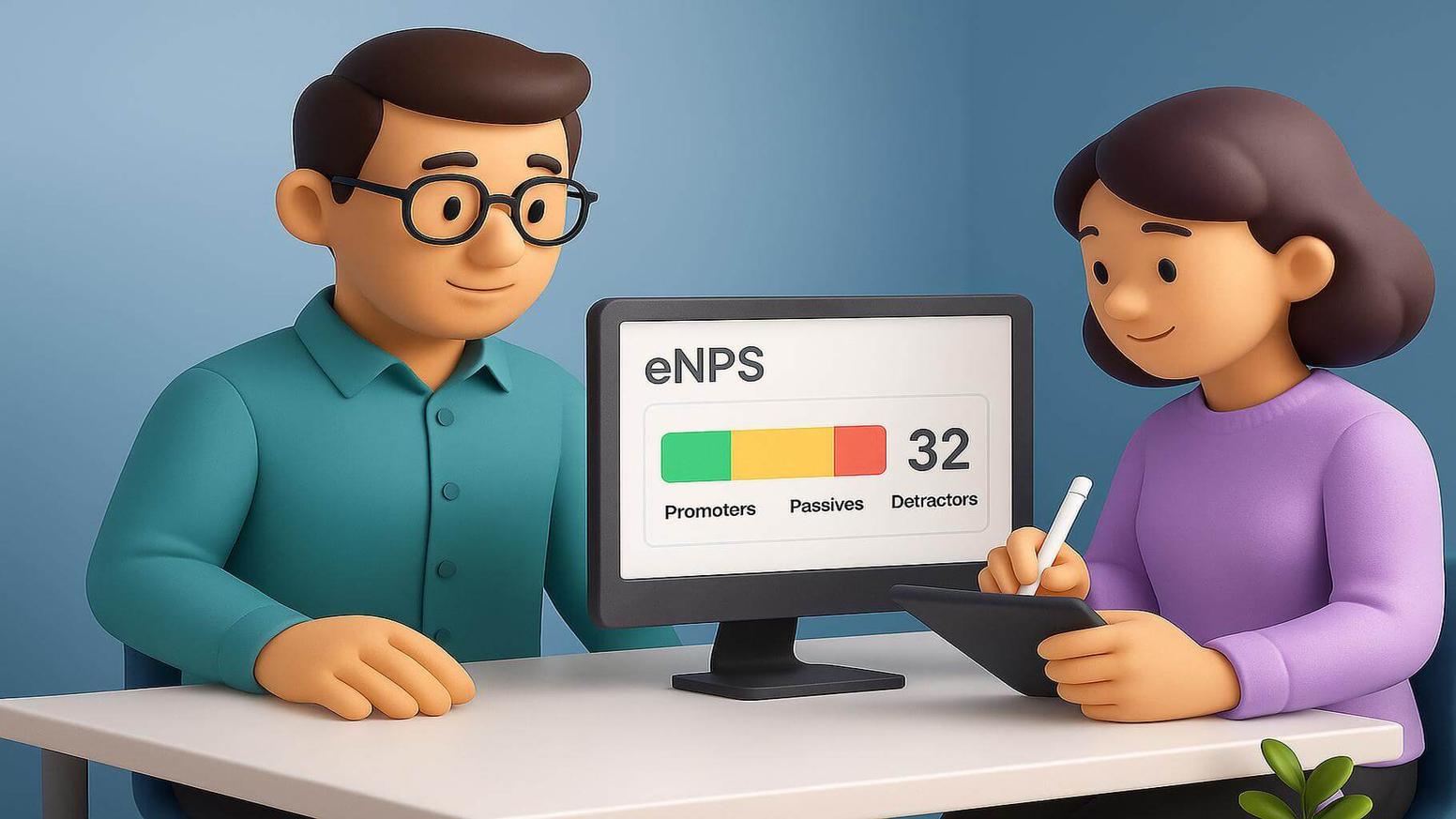
An eNPS survey tool is specialized software designed to measure employee loyalty through the question "How likely are you to recommend this company as a place to work?" These tools automate the collection, calculation, and analysis of employee responses, making it simple for organizations to track sentiment trends over time. Unlike general feedback systems, eNPS tools focus specifically on measuring the likelihood of employees becoming brand ambassadors for their workplace.
Understanding employee net promoter score (eNPS) software fundamentals
Employee net promoter score software streamlines the process of gathering honest feedback from team members about their workplace satisfaction. These platforms typically integrate with communication tools such as Slack or Microsoft Teams, enabling employees to respond quickly without disrupting their workflow. The software categorizes responses into three groups based on employee ratings, then calculates an overall score ranging from negative 100 to positive 100. Modern eNPS tools provide real-time dashboards that show trends, enabling HR teams to identify patterns and address concerns before they affect retention. Regular pulse surveys help companies monitor employee sentiment trends and respond quickly to emerging concerns. The best platforms also include features for anonymous responses, ensuring employees feel comfortable sharing their true sentiments. Anonymity is close to universal on Matter: 98.2% of pulse surveys run anonymous, and over half of responses arrive within the first hour, per The Recognition Habit, Matter's 2026 Benchmark Report.
Key features that distinguish quality eNPS tools from basic surveys
Quality eNPS tools offer automated survey distribution, eliminating the manual work of scheduling and sending questionnaires. They provide various rating scale options, including research-backed approaches like Matter's 5-point Likert scale, which achieve higher response rates and reduce respondent confusion compared to traditional, longer scales. Advanced tools include follow-up questions that capture qualitative data through pulse survey software, helping organizations understand the reasoning behind scores. Real-time analytics dashboards reveal patterns, including which departments show strong loyalty and which need attention. Integration capabilities allow eNPS data to connect with other HR systems, creating a comprehensive view of employee experience. The most effective platforms also offer benchmark comparisons, showing how your organization's scores compare with those of similar companies in your industry.
How eNPS survey tools differ from general engagement platforms
While general engagement platforms measure multiple aspects of workplace satisfaction through lengthy questionnaires, eNPS tools focus specifically on loyalty and likelihood to recommend. This targeted approach results in higher completion rates because employees can respond in under a minute. General engagement surveys often occur annually or semi-annually, whereas eNPS tools enable frequent pulse surveys that capture real-time sentiment shifts. The simplicity of the single-core question makes trends easier to track over time compared to complex engagement indices. However, the most comprehensive solutions combine eNPS measurement with broader engagement features, providing both quick loyalty checks and deeper insights when needed.
What are the benefits of using eNPS tools?
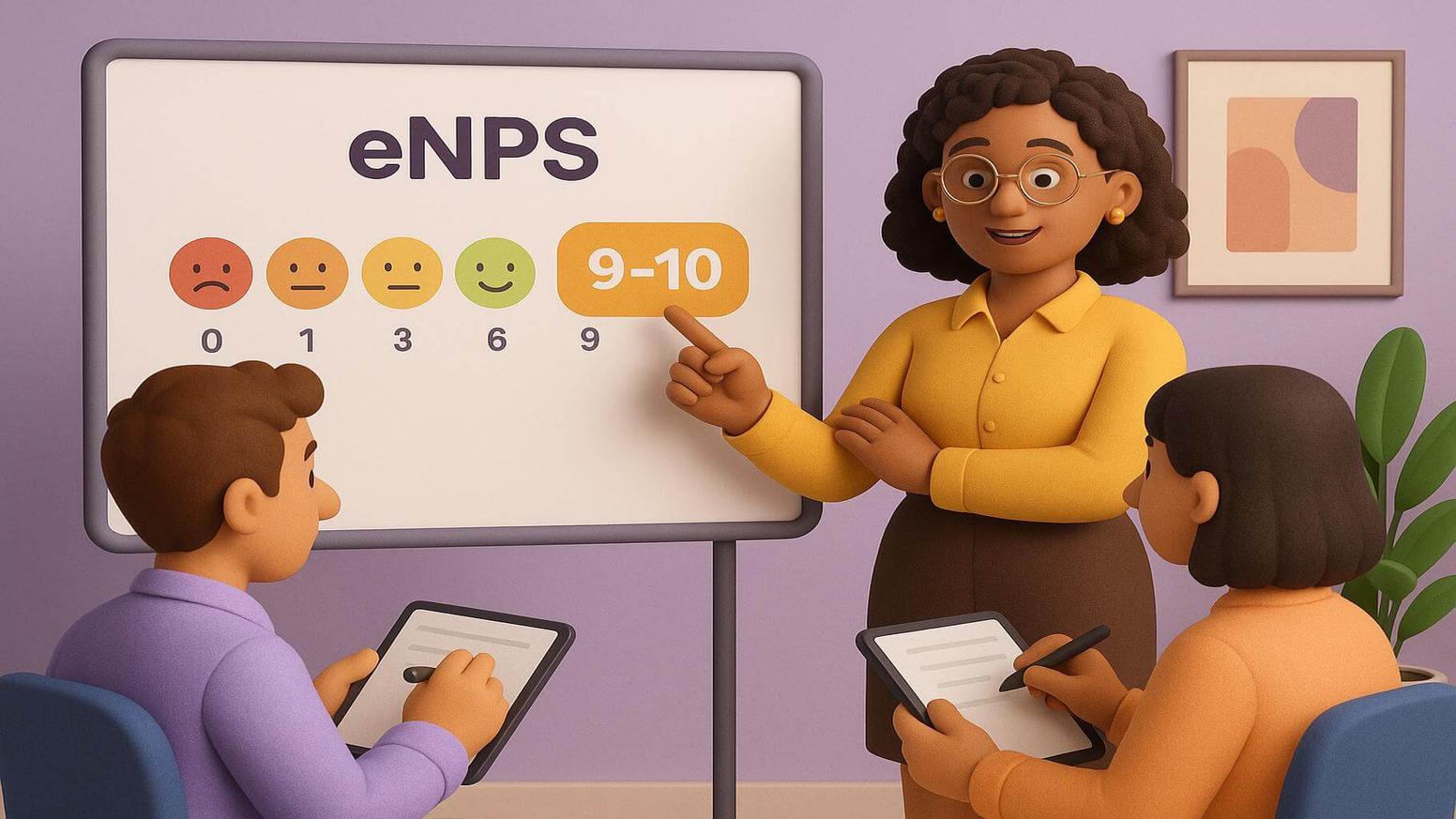
Automated eNPS tools transform how organizations measure employee sentiment by eliminating time-consuming manual processes and providing instant access to valuable insights. These platforms reduce the burden on HR teams while increasing response rates through simplified survey experiences. Organizations using dedicated eNPS software can continuously track changes in employee loyalty, spotting trends that may indicate emerging issues or successful initiatives. The data collected helps identify areas needing improvement while also highlighting what's working well, creating a balanced view of organizational health through comprehensive employee engagement surveys.
Automating eNPS calculation and eliminating manual errors
Manual eNPS calculation involves tallying responses, categorizing them into Promoters, Passives, and Detractors, and performing percentage calculations that leave room for human error. Automated tools handle calculating eNPS scores instantly as responses arrive, ensuring accuracy and saving hours of work. These systems automatically segment results by department, location, or other demographics, revealing insights that manual analysis might miss. The automation also standardizes the measurement process across the organization, eliminating inconsistencies that occur when different teams calculate scores differently. With real-time calculations, leaders can respond quickly to declining scores rather than waiting weeks for manual analysis to be completed.
Tracking employee loyalty trends with real-time dashboards
Real-time dashboards display eNPS data as it's collected, showing current scores alongside historical trends. These visual representations facilitate the identification of patterns such as seasonal variations or the influence of organizational changes on employee sentiment. Interactive charts allow users to filter data by various factors, revealing differences in loyalty levels across teams or locations. Trend tracking helps organizations measure the effectiveness of improvement initiatives by showing whether eNPS scores increase after changes are implemented. The ability to monitor employee net promoter scores continuously means leaders can act on feedback promptly rather than relying on outdated data.
Benchmarking performance against industry standards automatically
Built-in benchmarking features compare your organization's eNPS scores against industry averages, providing context for interpreting results. This automatic comparison helps teams understand whether their scores reflect excellent, average, or concerning performance relative to similar companies. Benchmark data considers factors like company size and sector, ensuring comparisons are relevant and meaningful. Access to these standards helps set realistic improvement goals based on what high-performing organizations in your industry achieve. Regular benchmark updates keep your comparisons current as industry standards evolve over time.
Why selecting the right eNPS software is important
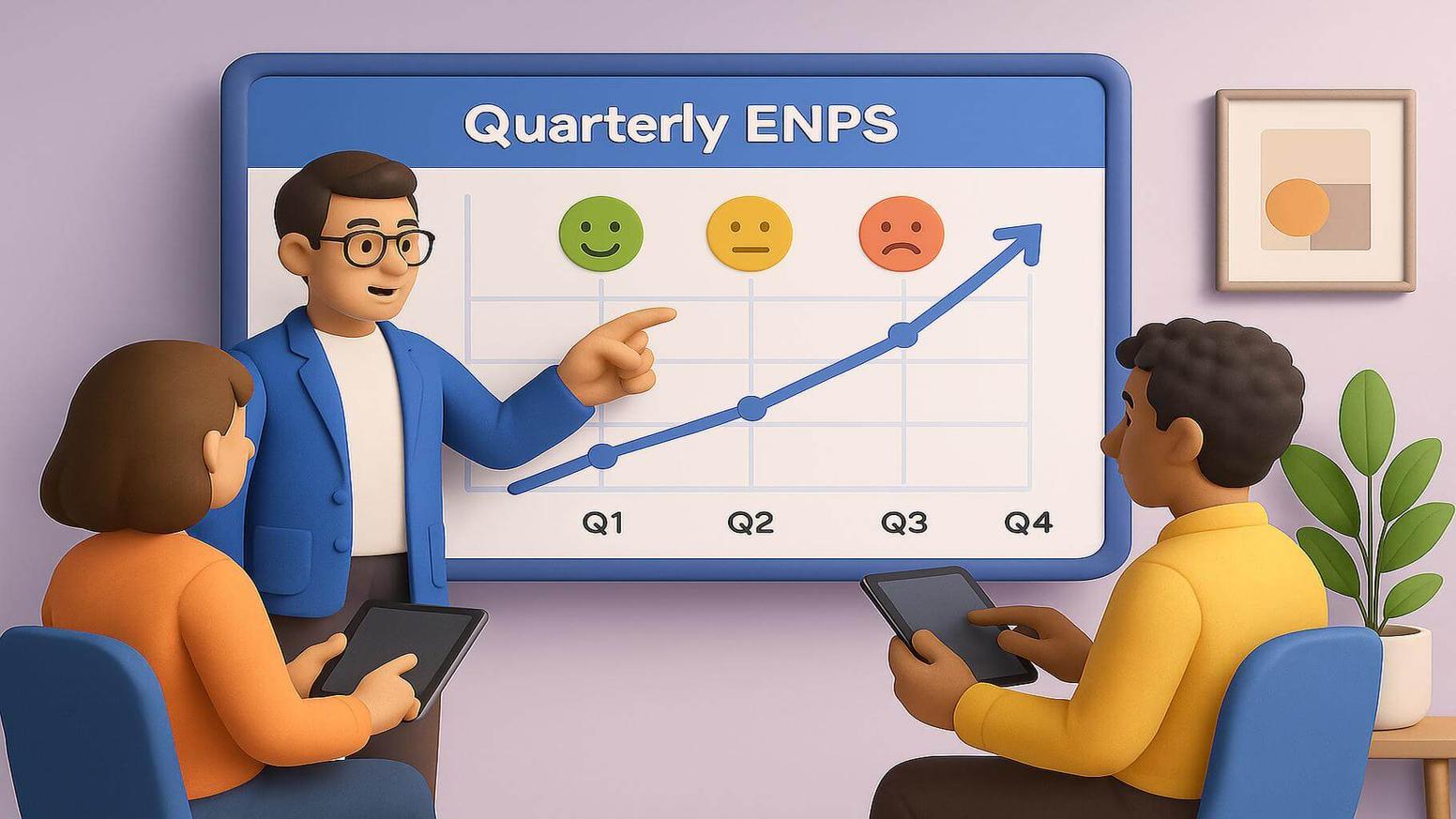
Choosing the right eNPS software impacts every aspect of your employee feedback program, from response rates to the quality of insights you receive. The wrong platform can lead to survey fatigue, inaccurate data, or analytics that don't provide actionable direction. Conversely, the right tool makes measuring employee net promoter score effortless while delivering valuable insights that drive meaningful workplace improvements. Organizations that invest time in selecting appropriate eNPS software see higher participation rates and more honest responses from team members.
Ensuring accurate employee net promoter score measurement
Accurate measurement begins with clear question wording and rating scales that employees can intuitively understand. Leading platforms use research-backed approaches, such as Matter's 5-point Likert scale, which has been validated to measure the same underlying employee sentiment as traditional 11-point scales while delivering superior response rates and user experience. Fully labeled response scales are considered the most reliable response method, particularly in digital and mobile surveys where clarity is essential. The calculation methodology must be consistent and transparent, properly categorizing responses into
Promoters, Passives, and Detractors based on established formulas. Quality eNPS survey software prevents duplicate responses and ensures only current employees can participate, maintaining data integrity. Accurate measurement also requires the ability to segment results meaningfully, identifying trends within specific teams rather than relying solely on company-wide averages.
Integrating seamlessly with existing workplace systems
Modern employees primarily work on platforms like Slack, Microsoft Teams, and other collaboration tools, making integration essential for participation. eNPS software that connects directly with these systems allows employees to respond without leaving their workflow, dramatically increasing response rates. Integration also enables automated reminders and scheduling, keeping feedback collection consistent without manual intervention. When eNPS tools connect with HRIS platforms, they can automatically update employee lists and maintain accurate demographic information for segmentation. Seamless integration reduces the technical burden on IT teams and creates a smoother experience for all participants.
Scaling feedback programs as organizations grow
As companies expand, their feedback needs become more complex, requiring tools that can handle larger employee populations and more sophisticated analysis. Scalable eNPS software maintains performance even with thousands of responses, processing data quickly without lag. The platform should support multiple languages for global teams and allow customization for different business units or regions. Growth often requires more detailed reporting and integration with additional systems, making flexibility a critical factor. Choosing software that scales prevents the costly and disruptive process of switching platforms as your organization evolves.
19+ eNPS score benchmarks and calculation methods
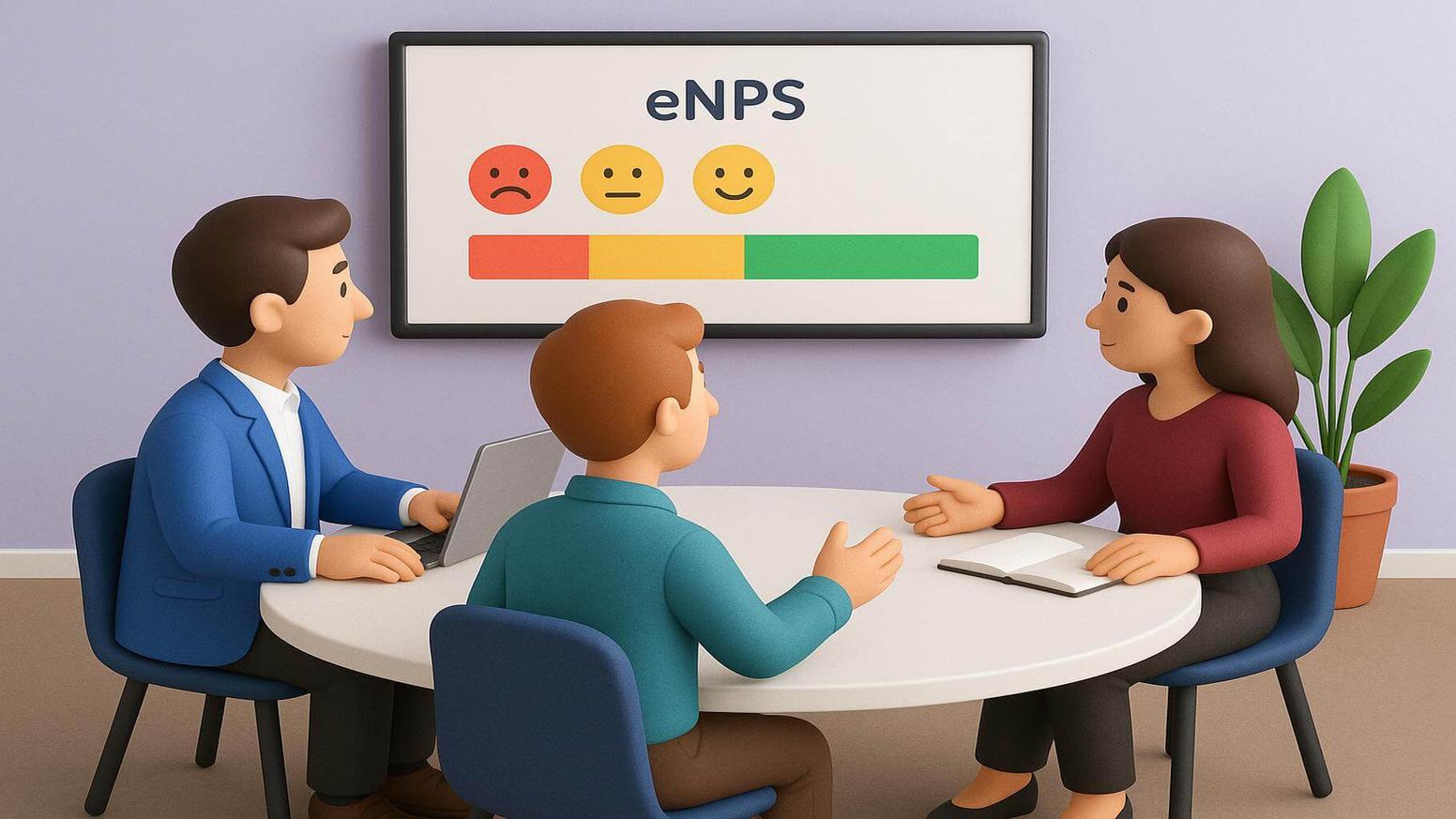
Understanding where your organization's eNPS score falls relative to industry standards and peers provides essential context for interpreting results. Different sectors, company sizes, and measurement approaches yield varying typical scores, making it important to compare against relevant benchmarks. This section explores specific eNPS benchmarks across industries and organization sizes, along with the different calculation methods that can impact results. Knowing these benchmarks helps set realistic targets and identify whether your scores indicate strong employee loyalty or areas needing attention.
8 industry-specific eNPS score benchmarks
Industry context significantly influences what constitutes a good eNPS score, with some sectors naturally achieving higher scores due to their work environments and engagement practices. Organizations should compare their results against similar companies using eNPS benchmarks rather than using universal standards that may not reflect industry-specific challenges. The benchmark scores below represent final calculated eNPS results (ranging from -100 to +100), which remain consistent regardless of whether organizations collect responses using traditional 0-10 scales or Matter's research-backed 5-point Likert system. Organizations using any scale can benefit from Matter's approach, which Fred Reichheld (creator of NPS) acknowledged as valid, often seeing significant improvements in response rates and data quality through fully labeled scales that reduce respondent confusion. Below are typical eNPS score ranges for major sectors, though individual company performance can vary widely based on culture, employee recognition programs, and leadership.
Technology sector average eNPS scores
Technology companies typically achieve eNPS scores ranging from 25 to 45, reflecting the industry's focus on innovation and competitive compensation. Organizations with strong engineering cultures and opportunities for career growth often score at the higher end of this range. Companies offering flexible work arrangements and cutting-edge projects tend to see promoter percentages above 50 percent. However, fast-paced environments and high-pressure deadlines can create stress that negatively impacts scores. Tech startups may experience more volatile scores than established firms due to uncertainty and rapid changes.
Healthcare industry enps benchmarks
Healthcare organizations generally see eNPS scores between 10 and 30, influenced by demanding work conditions and staffing challenges. Hospitals and clinics face unique pressures, including long shifts, emotional strain, and patient care responsibilities that affect employee satisfaction. Organizations that prioritize work-life balance and professional development opportunities tend to score higher within the healthcare sector. The COVID-19 pandemic added additional stress, affecting scores across the industry, though many organizations have seen improvement as conditions have normalized. Healthcare eNPS scores often correlate with patient satisfaction metrics, suggesting that satisfied employees deliver better care.
Retail and hospitality eNPS standards
Retail and hospitality businesses typically achieve eNPS scores ranging from 5 to 25, reflecting the challenges of customer-facing roles and variable schedules. Companies offering clear paths for advancement and recognizing frontline contributions see higher scores within this range. Seasonal fluctuations affect scores in this sector, with holiday periods often creating stress that temporarily lowers ratings. Organizations that invest in employee experience through training and benefits programs differentiate themselves, with scores approaching or exceeding 30. High turnover rates in these industries make tracking eNPS trends particularly valuable for identifying retention risks.
Financial services eNPS score ranges
Financial services companies generally maintain eNPS scores between 20 and 40, benefiting from competitive compensation and structured career paths. Banks, investment firms, and insurance companies with strong corporate cultures and professional development programs achieve higher scores. Regulatory pressures and performance targets can create stress that negatively impacts employee net promoter scores. Organizations emphasizing team member recognition and positive work environments see stronger loyalty indicators. The industry's focus on stability and benefits helps maintain reasonable scores even during economic uncertainty.
Manufacturing enps benchmarks
Manufacturing organizations typically see eNPS scores ranging from 15 to 35, with significant variation based on working conditions and management practices. Companies that invest in workplace safety, modern facilities, and employee input achieve higher scores in this range. Shift work and physical demands can affect satisfaction, though organizations that address these factors through adequate staffing and ergonomic improvements perform better. Manufacturing firms with strong union relationships often maintain more stable scores over time. The sector's emphasis on continuous improvement extends to employee experience in leading organizations.
Education sector eNPS scores
Educational institutions generally achieve eNPS scores between 15 and 35, influenced by factors such as administrative support and the resources available to educators. Schools and universities that prioritize faculty development and maintain reasonable workloads achieve higher scores. Budget constraints and administrative burdens often negatively affect scores in educational settings. Organizations that foster collaborative cultures and recognize teaching excellence differentiate themselves with stronger loyalty metrics. The education sector's mission-driven nature can boost scores when leaders effectively communicate purpose and impact.
Professional services eNPS standards
Professional services firms typically maintain eNPS scores of 25 to 45, reflecting the knowledge-based nature of their work and client relationships. Consulting, legal, and accounting firms with clear partnership tracks and work-life balance initiatives achieve higher scores. Billable-hour pressures and client demands can create stress that affects employee sentiment. Organizations that offer flexibility and professional development opportunities are more likely to receive stronger employee recommendations. The sector's emphasis on expertise and client service creates opportunities for meaningful work that supports higher scores.
Non-profit organization eNPS benchmarks
Non-profit organizations generally see eNPS scores between 10 and 30, influenced by mission alignment and resource constraints. Organizations with strong leadership and clear impact measurement tend to score higher within this range. Limited budgets for compensation and benefits can challenge employee satisfaction, though mission-driven work often partially offsets financial considerations. Non-profits that effectively communicate their impact and provide growth opportunities maintain stronger employee loyalty. Volunteer management and donor relations add unique dynamics that affect workplace culture and eNPS results.
6 company size eNPS score benchmarks
Organization size significantly impacts eNPS scores through factors including communication effectiveness, career path clarity, and cultural cohesion. Smaller companies often benefit from close-knit teams and direct access to leadership, while larger organizations offer structured advancement, greater resources, and comprehensive employee rewards programs. Understanding size-based benchmarks helps contextualize your results and identify whether your scores are typical for your stage of growth.
Startups (1-50 employees) average scores
Startups typically achieve eNPS scores of 20 to 50, reflecting the excitement of building something new alongside the uncertainty inherent to early-stage companies. Small teams create tight bonds and direct impact visibility that boost loyalty when the culture is strong. However, limited resources, long hours, and unclear career paths can negatively impact scores in startups facing challenges. The volatility of startup environments means scores can fluctuate significantly as the company evolves. Organizations that maintain transparent communication and celebrate wins achieve stronger scores despite resource constraints.
Small businesses (51-200 employees) benchmarks
Small businesses generally see eNPS scores between 15 and 40, balancing the personal touch of smaller organizations with increasing structure. Companies in this size range often transition from founder-led to more formalized management, which can impact culture and employee sentiment. Employees appreciate knowing leadership personally while gaining access to more defined roles and development opportunities. Growing pains during this phase can temporarily depress scores as systems and processes evolve. Small businesses maintaining their culture while scaling see stronger loyalty metrics.
Mid-market companies (201-1,000 employees) standards
Mid-market organizations typically achieve eNPS scores ranging from 10 to 35, facing the challenge of maintaining culture while growing complex. Companies this size must balance standardization needs with the preservation of personal connections that drive engagement. Clear communication becomes more difficult as layers of management develop, potentially impacting how employees feel about the organization. However, mid-market firms can offer career advancement opportunities and resources that smaller companies cannot provide. Organizations that invest in culture and communication programs achieve stronger scores during this critical growth phase.
Large enterprises (1,001-5,000 employees) range
Large enterprises generally maintain eNPS scores between 5 and 30, with bureaucracy and distance from leadership potentially impacting employee sentiment. Companies of this size offer stability, structured career paths, and comprehensive benefits that appeal to many team members. However, employees may feel disconnected from organizational decision-making and strategic direction. Successful large enterprises focus on manager effectiveness and departmental culture to maintain engagement at scale. Recognition programs and clear values help unite diverse teams and support reasonable scores.
Enterprise organizations (5,001-10,000 employees) benchmarks
Enterprise organizations typically see eNPS scores ranging from 0 to 25 and face significant cultural challenges as they maintain cohesion across thousands of employees. Geographic dispersion and business unit diversity can create vastly different employee experiences within the same company. These organizations must invest heavily in communication and culture initiatives to prevent fragmentation. However, enterprise resources enable comprehensive benefits, development programs, and career opportunities. Companies effectively leveraging technology for connection and recognition perform better within this challenging size range.
Global corporations (10,000+ employees) standards
Global corporations generally achieve eNPS scores between negative 5 and 20, with size and complexity creating natural barriers to strong employee loyalty across all locations. Cultural differences, language barriers, and time zones complicate efforts to create unified employee experiences. However, global brands offer prestige, stability, and resources that appeal to certain employee segments. Organizations succeeding at this scale prioritize local autonomy while maintaining core values and communication channels. Investment in employee experience and recognition technology helps maintain acceptable scores despite organizational complexity.
5 eNPS calculation methods and scoring approaches
Different organizations employ different approaches to calculating and interpreting eNPS data, each with unique advantages. Understanding these calculation variations helps explain why scores may differ between platforms and ensures you're comparing results appropriately. The method you choose should align with your organization's needs for simplicity, granularity, and compatibility with existing measurement frameworks.
Traditional 0-10 scale calculation method
The traditional approach uses an 11-point scale (0-10) where respondents rating 9-10 are Promoters, 7-8 are Passives, and 0-6 are Detractors. The eNPS calculation subtracts the percentage of Detractors from the percentage of Promoters, ignoring Passives in the final score. While this method has been historically common, research indicates that 11-point scales require more effort and time for respondents to understand and complete than shorter, fully labeled scales. The 0-10 scale can confuse respondents about what different numbers represent, with many employees struggling to differentiate between adjacent ratings like 6 versus 7. This confusion can introduce variability into results and potentially affect response accuracy, particularly on mobile devices where longer scales are less user-friendly.
5-point Likert scale calculation method
Research-backed platforms like Matter use a 5-point Likert scale that has been validated to capture the same underlying sentiment as 11-point scales, while delivering a superior user experience and response rates. The creator of Net Promoter Score, Fred Reichheld, recognized that various scoring approaches can deliver valid results. He went on to publish case studies that successfully applied 5-point scales. In Matter's methodology, a rating of 5 (strongly agree) represents Promoters, a rating of 4 (agree) indicates Passives, and ratings of 1-3 (strongly disagree, disagree, and neutral) are classified as Detractors. Matter uses this approach because extensive research demonstrates that it accurately measures employee loyalty while achieving significantly higher completion rates. The 5-point Likert format reduces cognitive load and completion time, encouraging more participation. Fully labeled response scales, such as the 5-point Likert scale, are considered the most reliable response method according to research, particularly in digital and mobile surveys where clarity is essential. This method maintains full compatibility with standard eNPS benchmarks by using the same Promoter minus Detractor calculation formula, producing final scores on the same -100 to +100 scale.
Weighted eNPS scoring approaches
Some organizations experiment with weighted scoring that assigns different values to Promoters, Passives, and Detractors beyond simple percentage calculations. These approaches might weigh Promoters more heavily or impose penalties on Detractors to emphasize the importance of addressing unhappy employees. Weighted methods can provide additional nuance for internal analysis and goal-setting purposes. However, weighted scores make external benchmarking difficult since most published industry standards use standard calculation methods. Organizations should maintain both standard and weighted calculations if they choose to experiment with alternative approaches.
Quarterly vs annual eNPS calculations
Survey frequency significantly impacts how organizations calculate and interpret eNPS trends over time. Quarterly measurements provide more frequent snapshots that reveal short-term changes and allow faster response to emerging issues. Annual surveys reduce survey fatigue but may miss important shifts in employee sentiment that occur between measurements. Some organizations calculate rolling averages across multiple quarters to smooth out temporary fluctuations while maintaining current relevance. The chosen calculation period should balance the need for timely data with the risk of overwhelming employees with too many surveys.
Real-time continuous eNPS measurement
Advanced platforms enable continuous eNPS tracking by collecting responses continuously rather than during specific survey windows. This approach provides the most up-to-date view of employee sentiment and reveals trends as they develop in real time. Continuous measurement typically involves lower-frequency individual responses but maintains consistent organizational-level data flow. The calculation methodology updates automatically as new responses arrive, creating a dynamic score that reflects recent sentiment. Organizations using continuous measurement must establish appropriate time windows for calculating trends, such as trailing 90-day averages.
Transitioning to research-backed measurement approaches
Many organizations currently use traditional 11-point scales for eNPS measurement but face challenges with low response rates, confusion among respondents, and poor mobile usability. Research-backed alternatives, such as Matter's 5-point Likert scale, offer these organizations a validated path to improve their measurement programs while maintaining full compatibility with existing benchmarks and historical data. Modern eNPS tools deliver superior results through intuitive rating scales that employees find easier to complete. The transition requires no changes to how final eNPS scores are interpreted, as both methods produce results on the same -100 to +100 scale.
Organizations using traditional scales can benefit significantly from adopting research-backed 5-point approaches. Technology companies experiencing survey fatigue can increase participation rates through more intuitive rating systems. Healthcare organizations with shift workers who primarily access surveys on mobile devices gain better usability and higher completion rates. Financial services firms seeking to reduce the time employees spend on surveys appreciate the faster completion enabled by clear, fully labeled response options.
Retail and hospitality businesses with high employee turnover benefit from rating systems that require less explanation for new hires. Manufacturing organizations with diverse workforces appreciate the simplicity that transcends education levels and language barriers. Professional services firms can increase response rates among busy employees who value intuitive formats that are easy to understand and complete. Nonprofit organizations with limited resources can achieve enterprise-grade measurement without the complexity of traditional systems.
The transition process is straightforward because research-backed 5-point systems use the same fundamental eNPS calculation: subtract the detractor percentage from the promoter percentage. Organizations can implement these approaches immediately without retraining employees on eNPS concepts, as 5-point Likert formats are intuitive and easy to understand. Historical trend data remains valid because the final scores use the same scale, allowing organizations to continuously track improvements before and after adopting an improved methodology.
Research shows that 5-point Likert scales measure the same underlying employee sentiment as 11-point scales, while delivering superior results. Organizations switching to research-backed approaches like Matter's system typically see response rates increase by 10x due to the combination of intuitive rating scales and deployment directly inside Slack and Microsoft Teams, where employees already work.
15 best eNPS tools for measuring employee loyalty
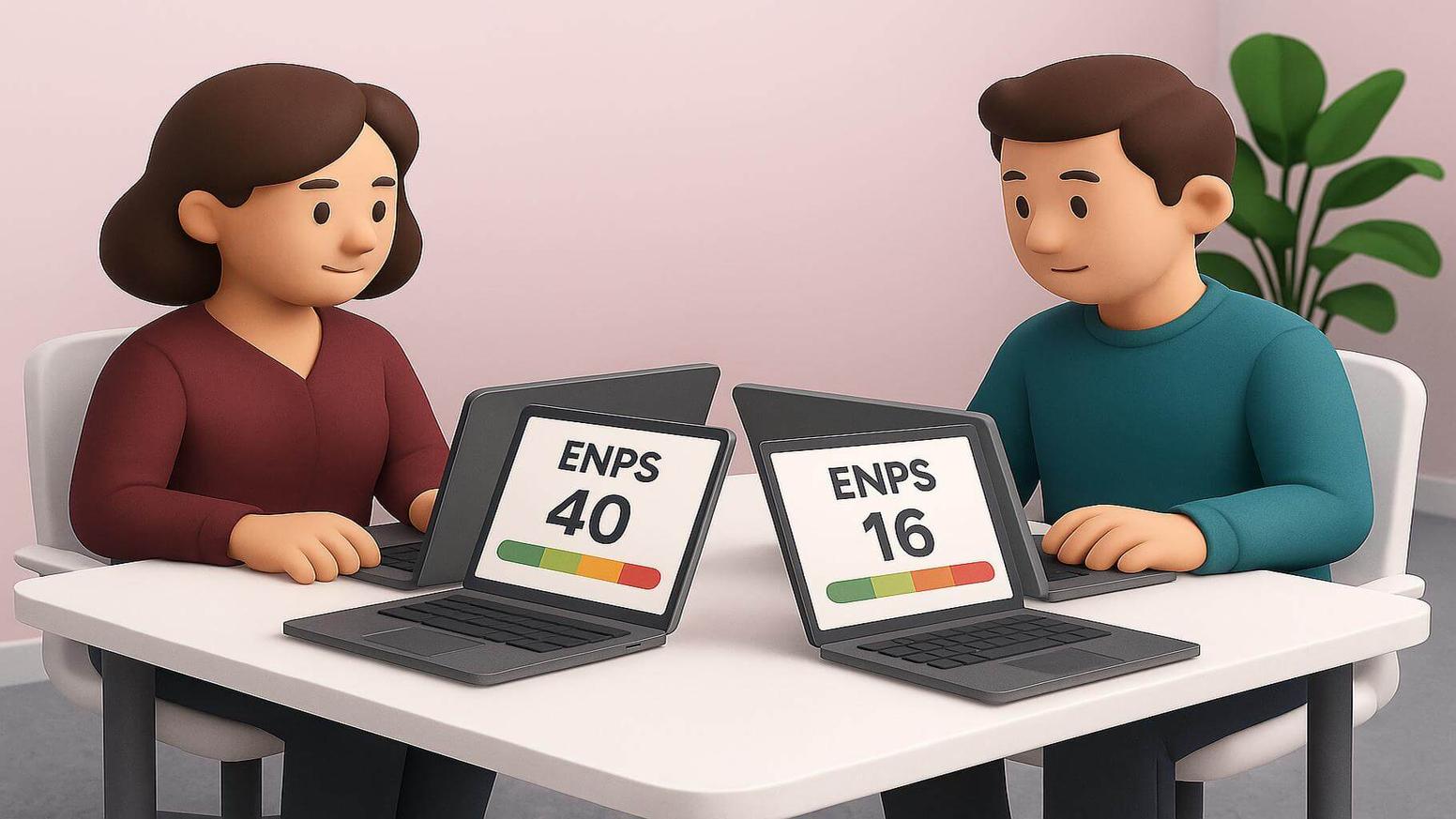
Selecting the right eNPS tool determines how effectively you'll measure and improve employee loyalty across your organization. The best employee pulse survey tools combine intuitive interfaces with powerful analytics, making it easy for employees to provide feedback while giving leaders the insights they need. This comprehensive list covers solutions from enterprise-level platforms to mid-market options and budget-friendly choices, all designed to suit organizations of all sizes and needs.
5 enterprise-level eNPS survey tools
Enterprise organizations require robust platforms that can handle thousands of employees across multiple locations while providing sophisticated analytics and integration capabilities. These tools offer advanced features, including predictive analytics, multi-language support, and comprehensive benchmarking data based on employee engagement survey examples from industry leaders. They typically include dedicated support teams and professional services to ensure successful implementation at scale.
1. Matter
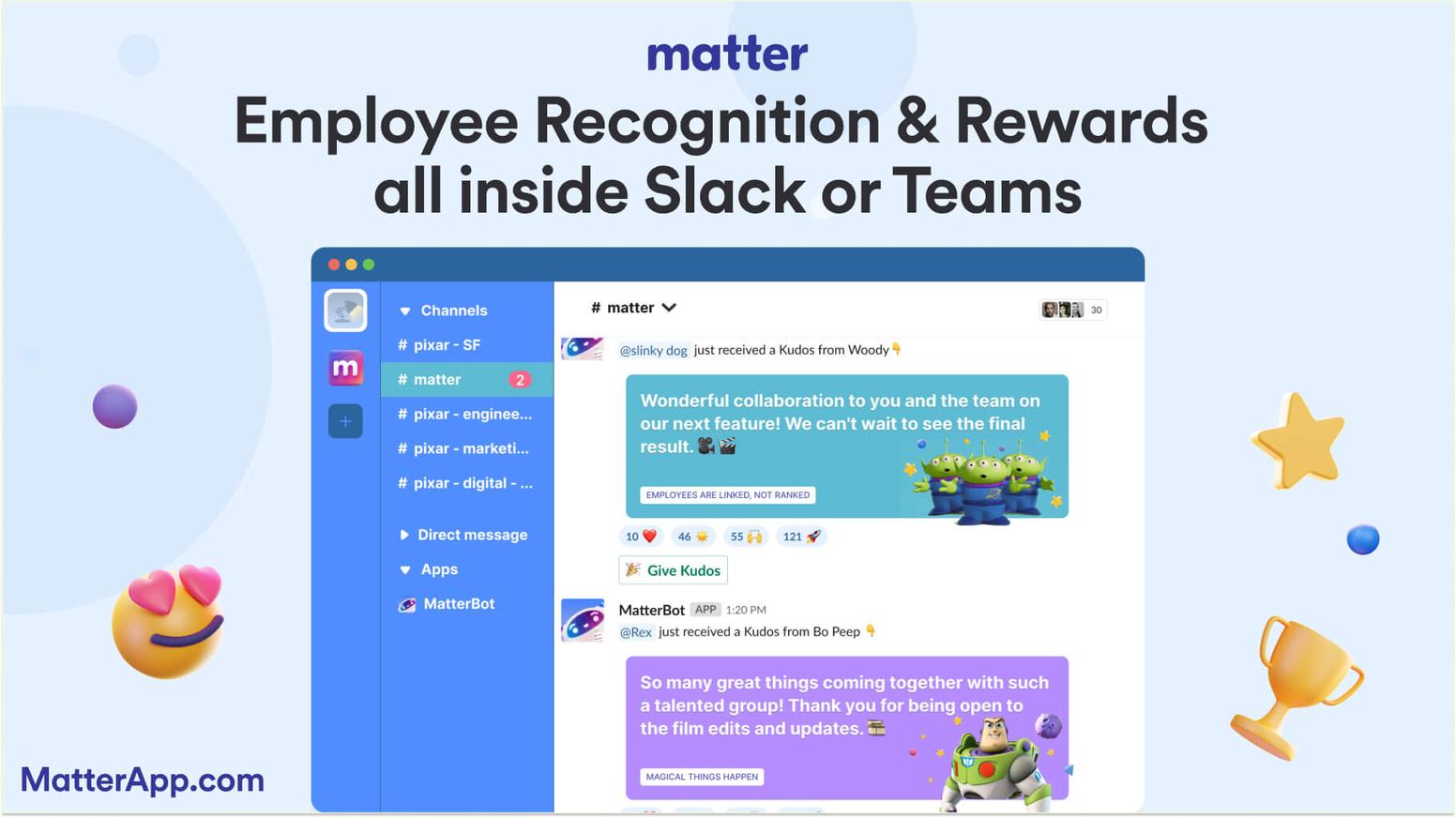
About Matter: Matter is a forward-thinking Slack-first and Teams-first platform that simplifies and amplifies employee feedback and recognition. Its seamless integration delivers 10x higher response rates by deploying surveys directly inside workplace communication tools employees already use daily. Matter's research-backed 5-point Likert scale (1-5) measures employee sentiment as accurately as traditional 11-point scales while offering significantly better usability on digital and mobile devices. The platform's Feedback Friday automation ensures regular check-ins become a natural part of workplace culture, helping teams maintain a consistent pulse on employee loyalty without manual effort.
Matter goes beyond simple surveys with its unique coin-based reward system that encourages participation and recognizes employees who provide thoughtful feedback. Coins can be redeemed for rewards like digital gift cards, charitable donations, or branded company swag, catering to diverse preferences. The platform automates birthday and work anniversary celebrations while collecting sentiment data, creating a comprehensive solution for employee experience. With robust integration into Slack and Microsoft Teams, Matter transforms feedback collection into an engaging part of daily workflows, fostering a culture of appreciation and continuous improvement across teams.
Matter main features:
- Slack and Microsoft Teams integration with 10x higher survey response rates
- Research-backed 5-point Likert scale validated by NPS creator Fred Reichheld
- Automated eNPS calculation with real-time analytics dashboards and segmentation
- Integrated recognition and rewards system for acting on feedback immediately
Matter pricing:
- Free Forever: $0/user/month
- Basic: $1/user/month, billed annually
- Pro: $3/user/month, billed annually
- Pro + Surveys: $5/user/month, billed annually
To learn more, view Matter's pricing page.
Matter G2 score: Matter has a G2 score of 4.7/5 based on user reviews.
What Matter customers are saying: "Matter helps us encourage behaviors that align with our company values and can allow us to recognize and reward those who exemplify our values." - Autumn Amescua, Chief Culture & People Officer at SXSW (Customer Story).
2. Qualtrics EmployeeXM
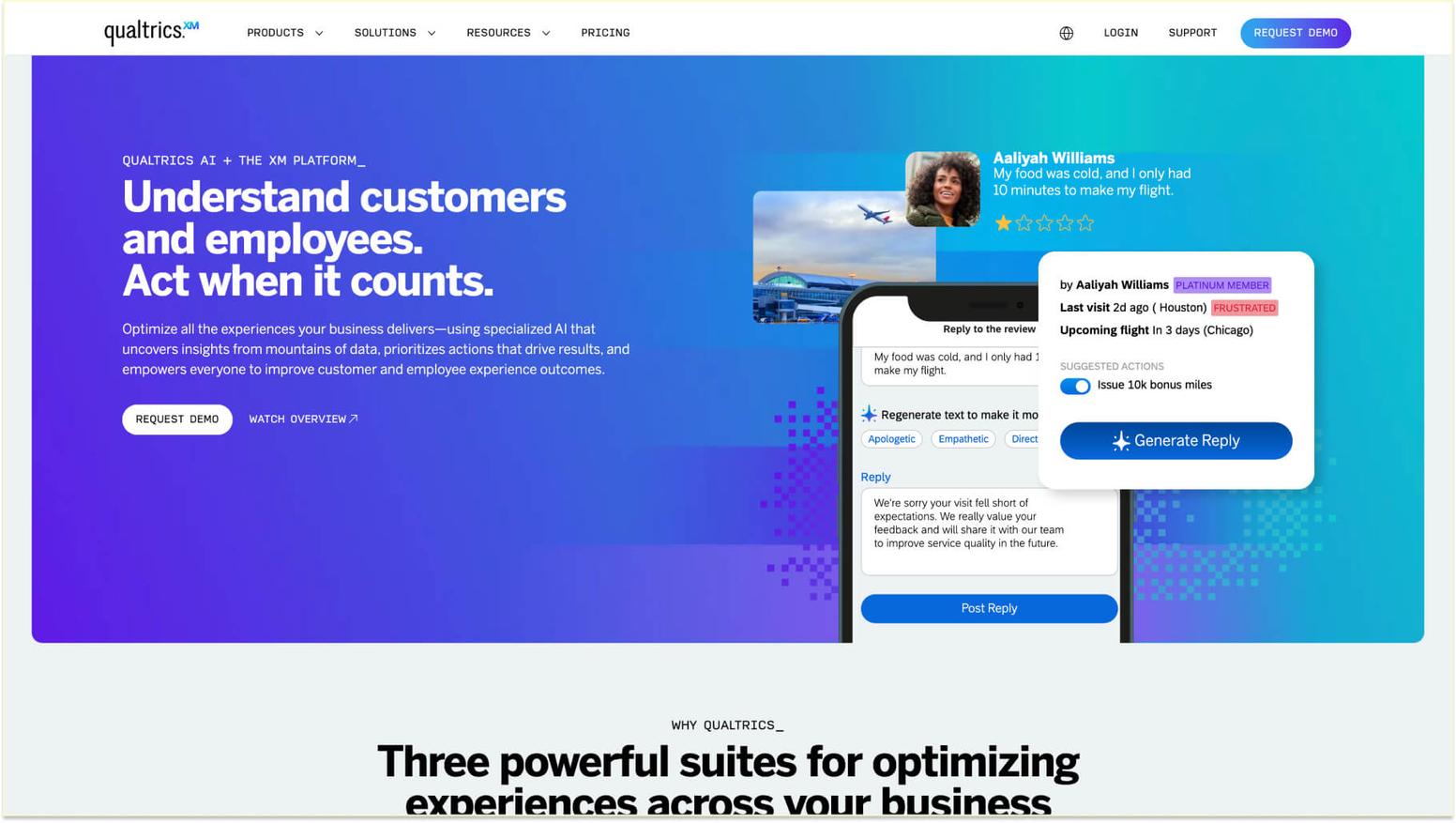
About Qualtrics EmployeeXM: Qualtrics EmployeeXM offers enterprise-grade eNPS survey capabilities within its comprehensive experience management platform. The platform provides sophisticated segmentation to analyze eNPS data by different employee groups. Advanced analytics and benchmarking features help organizations compare their scores against industry standards while identifying trends over time. Integration capabilities connect eNPS measurement with other employee experience initiatives for a holistic understanding of workplace satisfaction. Automated distribution and reminder systems help maximize response rates, and sophisticated reporting makes results suitable for executive presentations.
Qualtrics EmployeeXM main features:
- Enterprise-grade survey capabilities with comprehensive experience management
- Advanced analytics and industry benchmarking for competitive insights
- Sophisticated segmentation for detailed analysis across employee groups
- Action planning tools for translating insights into improvement initiatives
Qualtrics EmployeeXM pricing: Pricing is not listed on the website. To learn more about pricing, you'll need to schedule a demo/sales call with Qualtrics EmployeeXM.
Qualtrics EmployeeXM G2 score: Qualtrics has a G2 score of 4.4/5 based on user reviews.
What Qualtrics EmployeeXM customers are saying on G2: "Preston Donohoo, with Red Pepper, has been fantastic to partner with. He is thorough, excellent at training, and his customer support is outstanding. He made our implementation go very smoothly. We have found the Qualtrics engagement survey and 360s tools easy to use, with the ability to dive deep into our results. We would definitely recommend Qualtrics to others." - Kelli G., Global Talent Manager (G2 Review for Qualtrics EmployeeXM).
3. Culture Amp
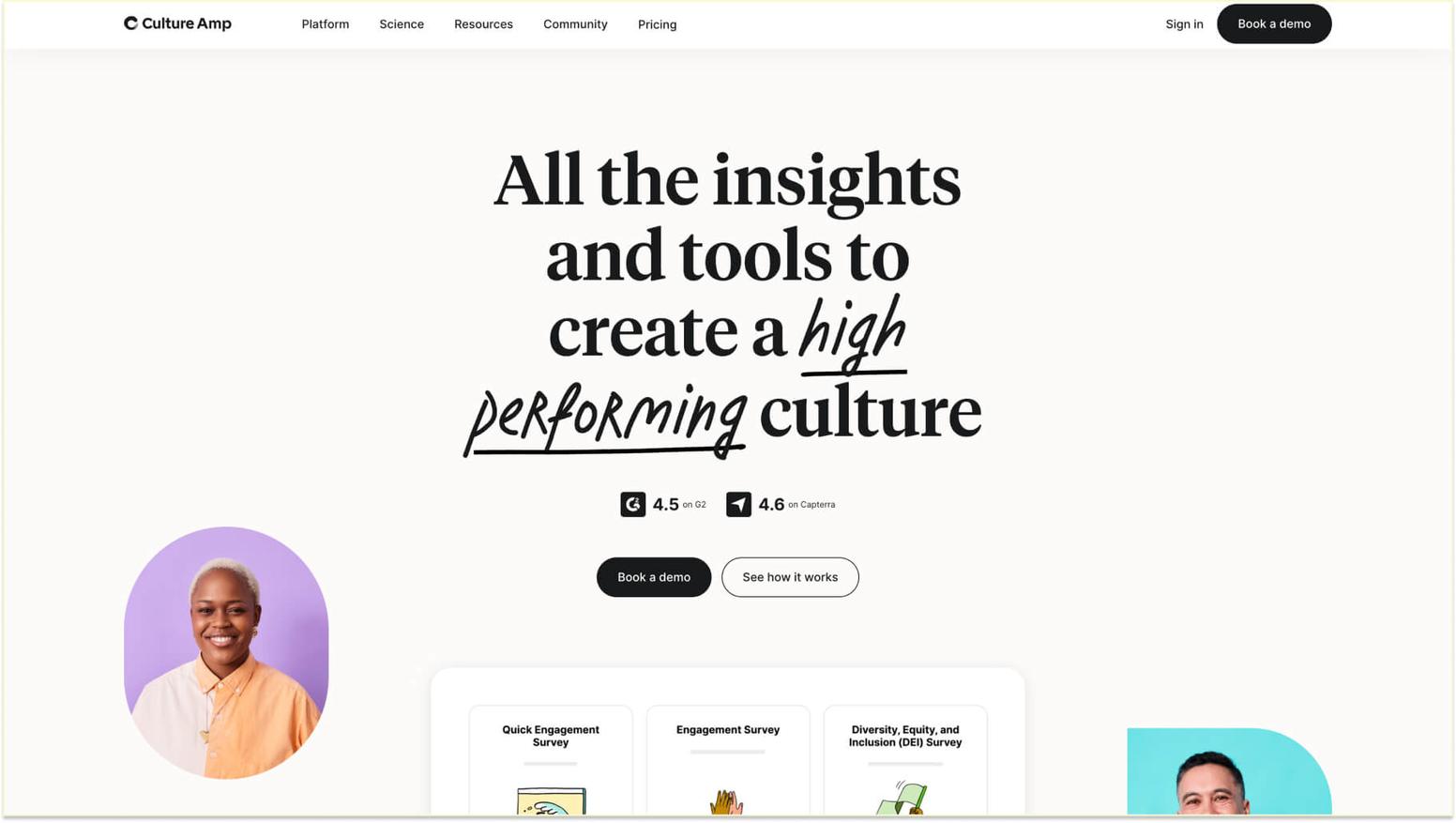
About Culture Amp: Culture Amp specializes in people analytics with robust eNPS tracking capabilities integrated into broader employee engagement measurement. The platform's strength lies in its action-planning features, which help organizations develop specific initiatives based on eNPS results. Sophisticated analytics identify correlations between eNPS scores and other employee engagement metrics. Survey design tools facilitate the development of eNPS surveys with corresponding follow-up queries customized to align with organizational priorities. Benchmarking capabilities compare scores against industry standards and similar organizations for added context.
Culture Amp's main features:
- People analytics platform with integrated eNPS tracking capabilities
- Action planning features for developing initiatives based on results
- Manager enablement tools for team-level score improvement
- Sophisticated analytics identifying correlations with other engagement metrics
Culture Amp pricing:
- Engage: contact the sales team for exclusive features
- Perform: contact the sales team for exclusive features
- Develop: contact the sales team for exclusive features
- People Analysis: contact the sales team for exclusive features
To learn more, view Culture Amp’s pricing page.
Culture Amp G2 score: Culture Amp has a G2 score of 4.5/5 based on user reviews.
What Culture Amp customers are saying on G2: "I've been using this software for a while now, and one of its standout features is how well-organized the system is. Everything is laid out in a clear and intuitive way, making it easy to navigate. Additionally, the punctuality of the communications is exceptional – notifications and updates are always timely, ensuring that I stay on top of tasks and deadlines. It's a reliable tool for those who value efficiency and clear communication. Highly recommended!" - Anna L., SEO Consultant (G2 Review for Culture Amp).
4. Lattice
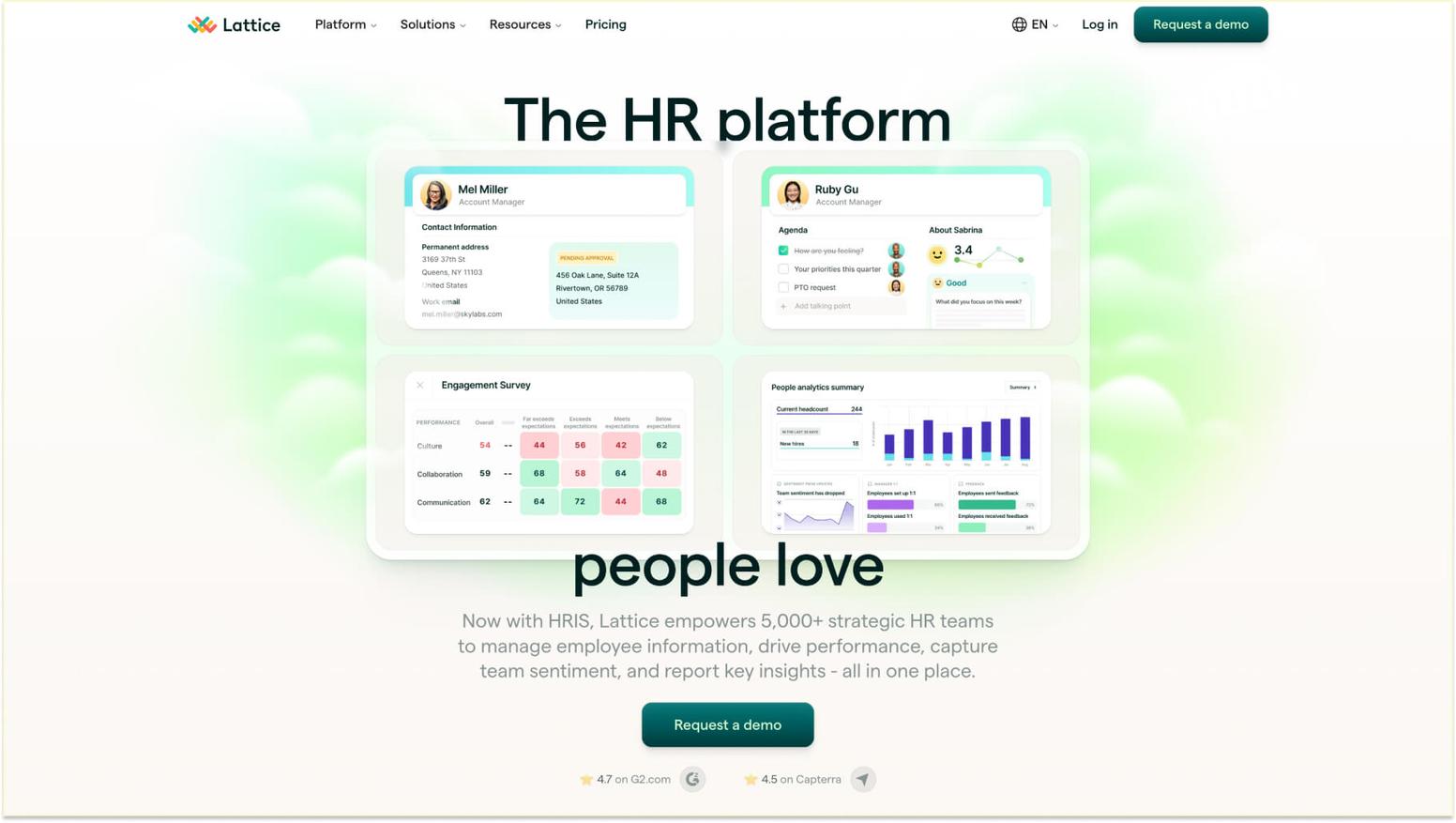
About Lattice: Lattice integrates eNPS measurement with performance management, connecting employee satisfaction to organizational outcomes. The platform's comprehensive approach links eNPS data with performance reviews, development plans, and succession planning, while continuous feedback features complement periodic eNPS surveys with ongoing pulse checks on employee sentiment. Recognition features within Lattice facilitate organizations in honoring employees who foster a positive workplace environment, while analytics demonstrate the correlation between eNPS scores and other metrics, including performance ratings and retention.
Lattice main features:
- eNPS integration with performance management for a holistic view
- Continuous feedback features complementing periodic surveys
- Recognition features for celebrating positive workplace contributors
- Analytics linking eNPS to performance ratings and retention metrics
Lattice pricing:
- Talent Management: $11/seat/month
- Foundation: $11/seat/month
- Engagement: $4/seat/month
- Grow: $4/seat/month
- Compensation: $6/seat/month
To learn more, view Lattice's pricing page.
Lattice G2 score: Lattice has a G2 score of 4.7/5 based on user reviews.
What Lattice customers are saying on G2: "Ease of use and ease of implementation. The implementation time commitment was hours, not weeks. We initially implemented all modules except Grow, Comp, and Engage, and managed to configure and test all modules in less than two weeks. The product team is very receptive to feedback and able to help develop creative workarounds for functional gaps. The customer support is great and very responsive." - Matthew H., Senior Human Resources Manager (G2 Review for Lattice).
5. Workday
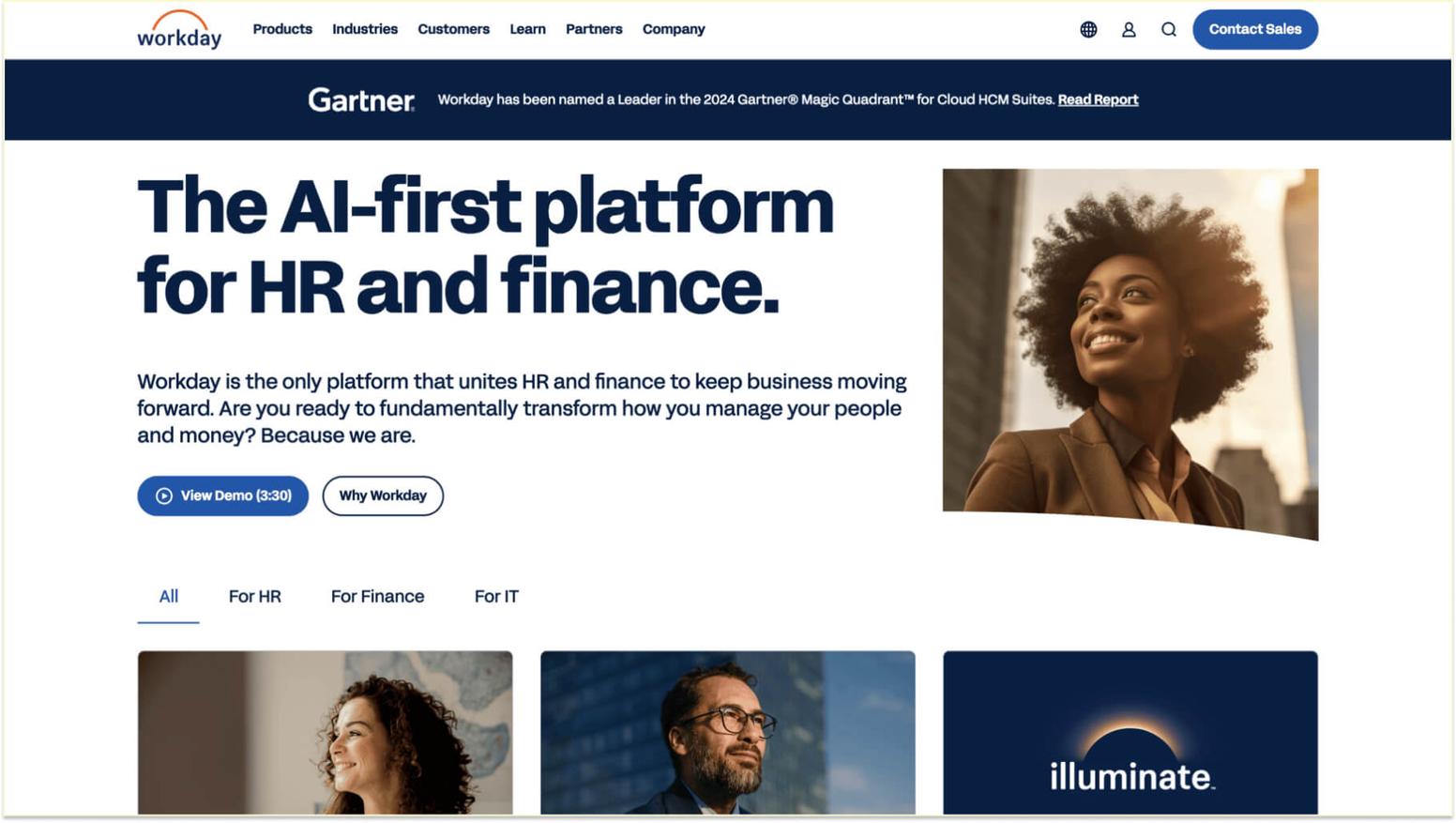
Workday: Workday provides AI-driven insights and recommendations based on eNPS data and follow-up responses. The platform's strength lies in its intelligent analysis that helps organizations prioritize actions based on potential impact. Real-time employee engagement monitoring enables quick identification of emerging issues affecting employee sentiment. Automated action-planning capabilities identify specific initiatives likely to improve eNPS scores based on patterns in survey responses. Integration with Workday's broader HR ecosystem creates a comprehensive employee experience management spanning recruitment through offboarding.
Workday main features:
- AI-driven insights and action recommendations from eNPS data
- Real-time monitoring for identifying emerging sentiment issues
- Automated action planning based on response patterns
- Integration with Workday's HR ecosystem for comprehensive management
Workday pricing:
- Workday Adaptive Planning: Free for 30 days
- Workday Adaptive Planning: contact sales to request pricing
- Workday Adaptive Planning Close & Consolidation: contact sales to request pricing
To learn more, view Workday's pricing page.
Workday G2 score: Workday has a G2 score of 4.0/5 based on user reviews.
What Workday customers are saying on G2: "I've found Workday to be a reliable application for handling holiday and HR activities at my company. Its user-friendly interface makes requesting leave and checking balances easy and efficient. Real-time updates ensure I always know my leave status without chasing paperwork. I appreciate the integration with other HR functions, which provides a central hub for important information. While there can be some lag during busy times, overall, Workday simplifies holiday management and enhances transparency for both employees and HR teams." - Saurabh Y., Senior Engineer (G2 Review for WorkDay).
5 mid-market eNPS survey tools
Mid-market organizations need platforms that balance comprehensive features with reasonable pricing and simpler implementation than enterprise solutions. These employee engagement survey tools provide essential eNPS measurement capabilities without the complexity or cost that might overwhelm growing companies. They typically offer good support resources while allowing organizations to scale usage as they expand.
1. Matter
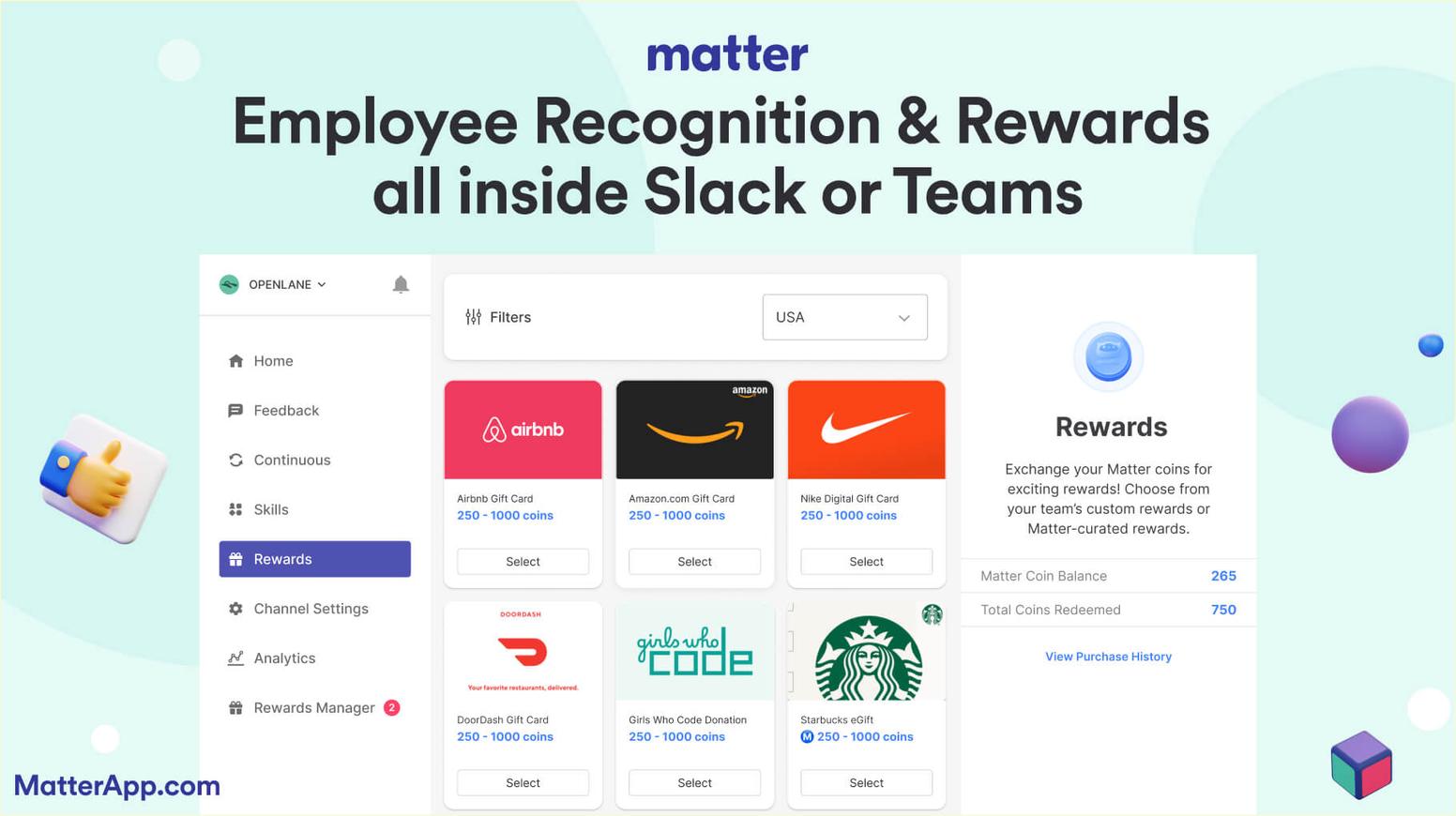
About Matter: Matter provides affordable eNPS tracking perfectly suited for growing teams that need reliable measurement without enterprise costs. The Slack-first and Teams-first platform delivers 10x higher response rates by deploying surveys directly where employees already work. Pre-built survey templates include validated eNPS questions using a research-backed 5-point Likert scale (1-5). Matter's methodology, validated by Fred Reichheld's acknowledgment that different scoring scales work effectively, uses 5 (strongly agree) for promoters, 4 (agree) for passives, and 1-3 (strongly disagree, disagree, and neutral) for detractors. Setup takes just minutes thanks to Matter's intuitive design and seamless integration with workplace communication tools.
The integrated recognition platform creates natural connections between measuring employee sentiment and taking action to improve it. The coin-based reward system enables organizations to recognize employees who provide valuable feedback through eNPS surveys. This approach encourages authentic participation and creates continuous feedback loops that drive workplace improvements. Matter's automation features and real-time analytics make sophisticated measurement accessible to mid-market companies without requiring dedicated administrators or technical expertise.
Matter main features:
- Affordable pricing with 10x higher response rates via Slack and Teams
- Pre-built templates with validated 5-point Likert methodology
- Quick setup in minutes with intuitive design
- Integrated recognition platform for acting on survey feedback
Matter pricing:
- Free Forever: $0/user/month
- Basic: $1/user/month, billed annually
- Pro: $3/user/month, billed annually
- Pro + Surveys: $5/user/month, billed annually
To learn more, view Matter's pricing page.
Matter G2 score: Matter has a G2 score of 4.7/5 based on user reviews.
What Matter customers are saying: "Being a high-performance team, Matter helps us take a moment out of our busy day to share heartfelt gratitude with kudos." - Sam Udotong, CTO & Co-founder at Fireflies.ai (Customer Story).
2. Energage
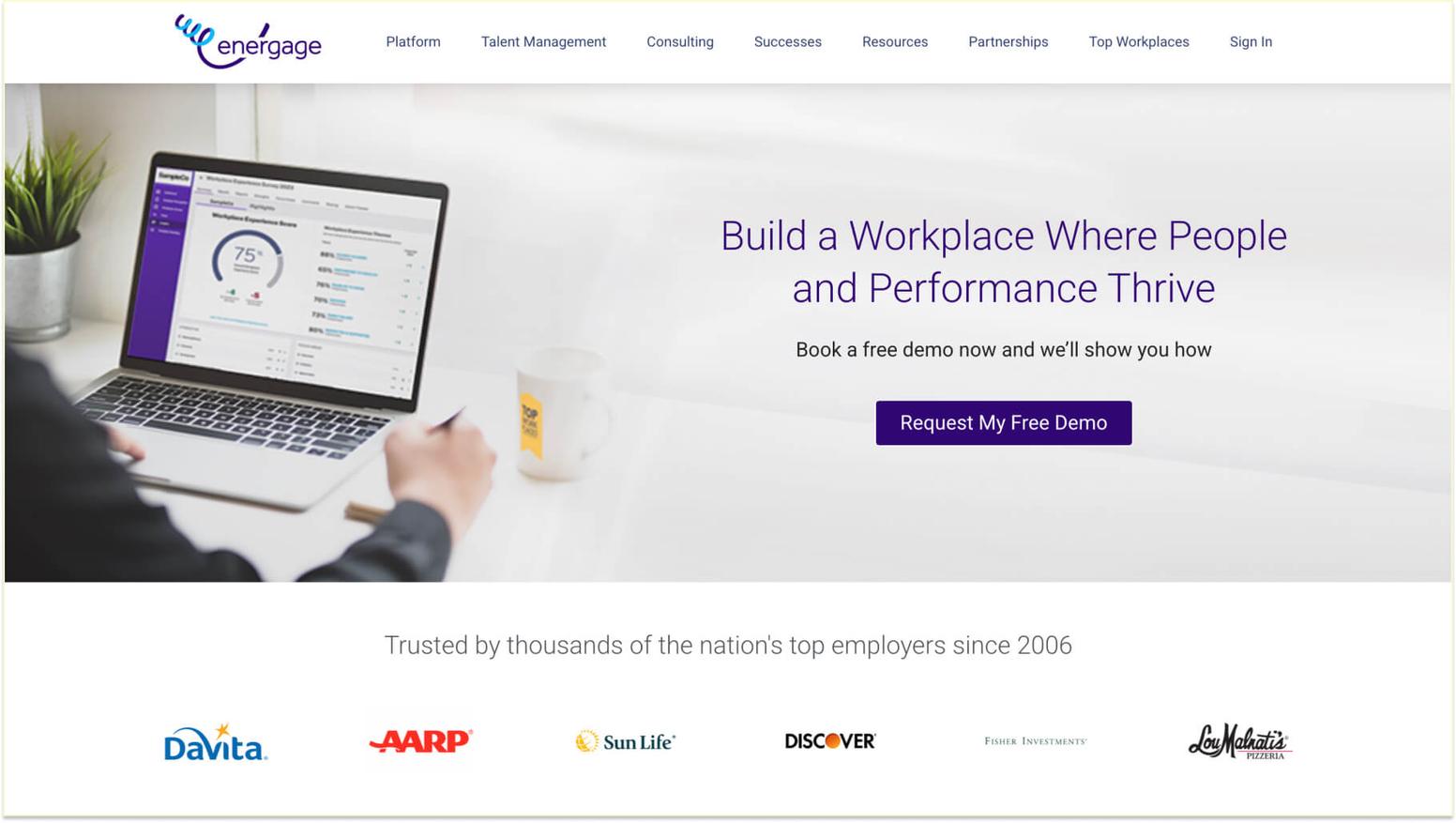
About Energage: Energage specializes in pulse surveys that include eNPS measurement alongside other engagement metrics. The platform's focus on continuous improvement helps organizations track the impact of initiatives on employee net promoter scores over time, with team-level analytics helping managers understand sentiment within their specific groups and take targeted actions. Manager coaching features guide on improving eNPS scores based on employee feedback, while survey design tools include validated questions proven to drive actionable insights.
Energage main features:
- Pulse surveys combining eNPS with other engagement metrics
- Team-level analytics for targeted manager actions
- Manager coaching features for score improvement guidance
- Benchmarking against similar companies for context
Energage pricing: Pricing is not listed on the website. To learn more about pricing, you'll need to schedule a demo/sales call with Energage.
Energage G2 score: Energage has a G2 score of 4.6/5 based on user reviews.
What Energage customers are saying on G2: "The pulse survey section still needs work I want a system that I can customize the wording of the rankings, create yes/no questions if I want and be able to order the sequence of questions so they make sense to me. I want to add skip logic so people who answer one way to a question can skip over a question to the next question. Changes were made to the pulse survey section so that it really doesn't work for me now. I've stopped using it and moved to google forms instead" - Verified User in Staffing & Recruiting (G2 Review for Software).
4. 15Five
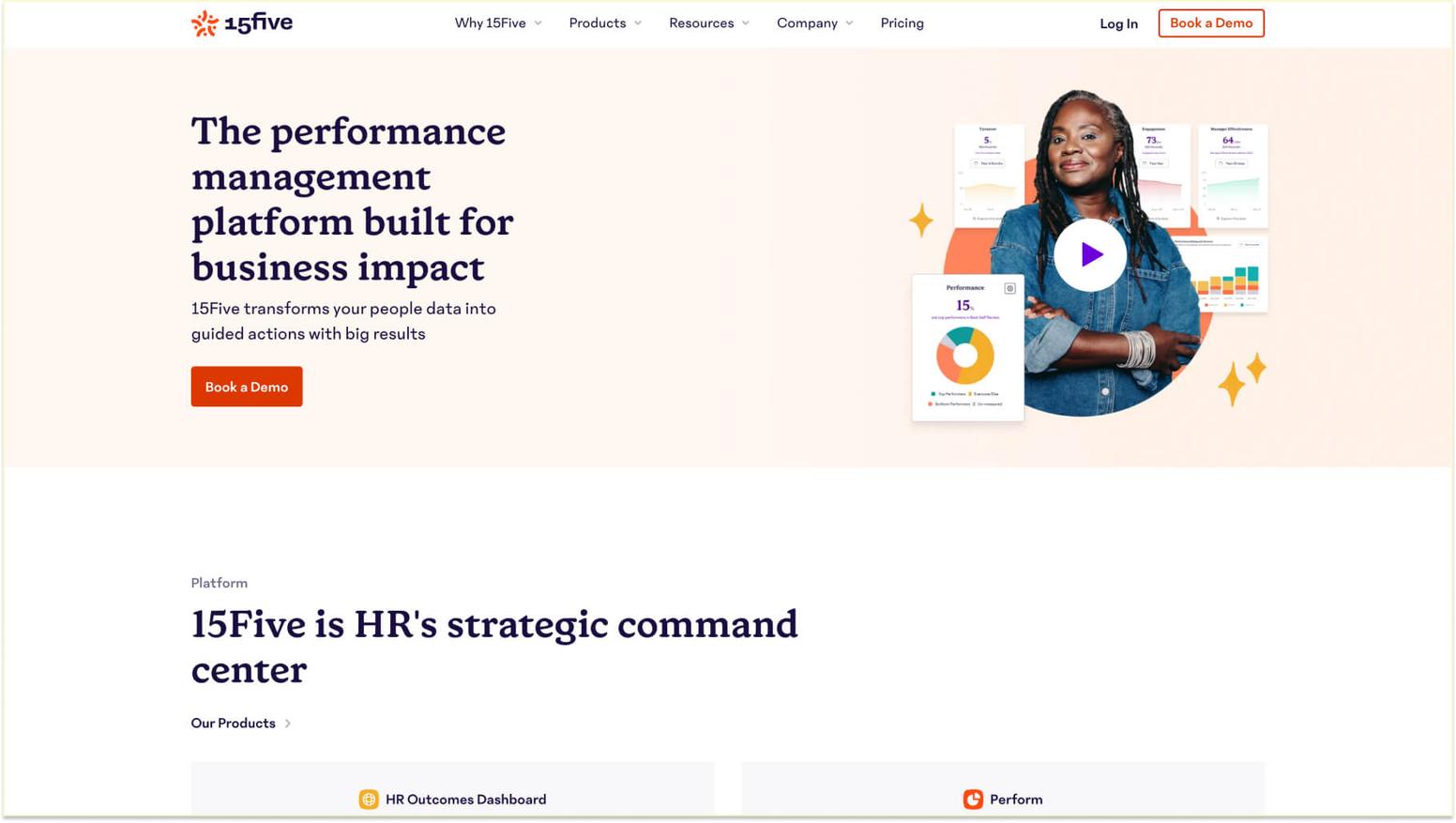
About 15Five: 15Five integrates eNPS tracking within weekly check-in routines that make measurement a natural part of manager-employee conversations. The platform's comprehensive approach links eNPS data with one-on-one meeting agendas and performance reviews, while performance management features help connect employee satisfaction with development goals and career progression. Recognition features enable managers to celebrate contributions immediately when positive sentiment is expressed, and analytics reveal trends in eNPS scores at the individual, team, and organizational levels.
15Five main features:
- eNPS tracking integrated with weekly check-in routines
- Links to one-on-one meetings and performance reviews
- Recognition features for immediate celebration of contributions
- Multi-level analytics from individual to organizational trends
15Five pricing:
- Engage: $4/user/month, billed annually
- Perform: $11/user/month, billed annually
- Total Platform: $16/user/month, billed annually
To learn more, view 15Five's pricing page.
15Five G2 score: 15Five has a G2 score of 4.6/5 based on user reviews.
What 15Five customers are saying on G2: "We have built a company wide OKR tied to our company wide average Pulse score. It is an easy check of how the company is "feeling" from week to week, and over the last 2 years, I have found it to be accurate, important and super easy for the team to adopt and stay consistent in use."- Dan A., Small-Business (G2 Review for 15Five).
3. TINYpulse
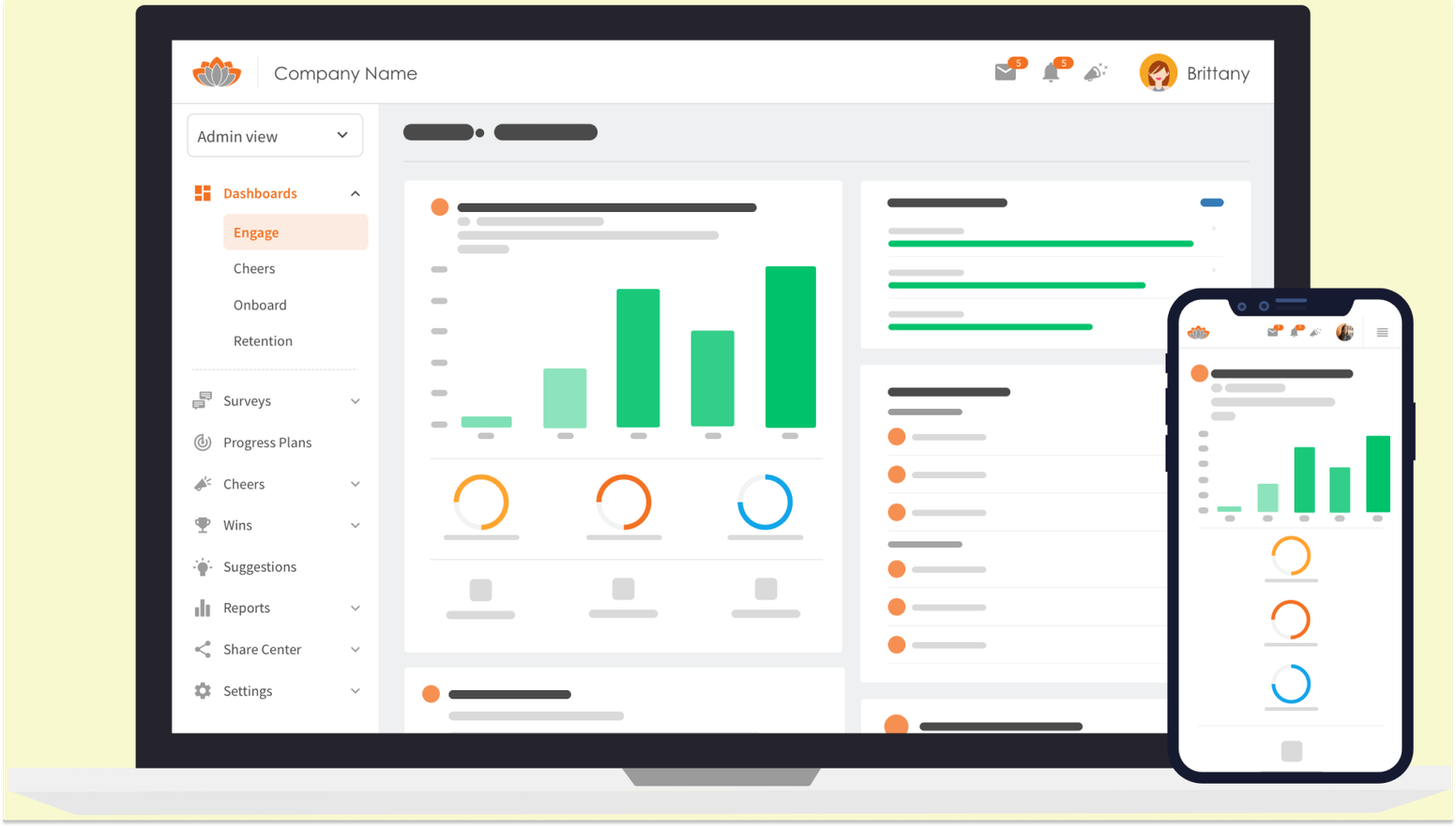
About TINYpulse: TINYpulse emphasizes anonymous eNPS surveys that encourage honest feedback by protecting employee privacy. Recognition and peer feedback features complement sentiment measurement by providing positive reinforcement for desired behaviors, while the engagement analytics dashboard presents eNPS data alongside other key employee experience metrics. Regular pulse check capabilities enable frequent measurement without survey fatigue through brief, focused questions, with integration options connecting TINYpulse with common workplace tools for streamlined survey distribution.
TINYpulse main features:
- Anonymous surveys for encouraging honest employee feedback
- Recognition and peer feedback features for positive reinforcement
- Engagement analytics dashboard with comprehensive metrics
- Regular pulse checks without survey fatigue
TINYpulse pricing: Pricing is not listed on the website. To learn more about pricing, you'll need to schedule a demo/sales call with TinyPulse.
TINYpulse G2 score: TINYpulse has a G2 score of 4.9/5 based on user reviews.
What TINYpulse customers are saying on G2: "There is no way to turn off the comment boxes which allows people to share any and all feedback, whether relevant or not. Many people question the anonymity of it so it's hard to get responses even when private messaging." - Verified User in Higher Education.
5. Leapsome
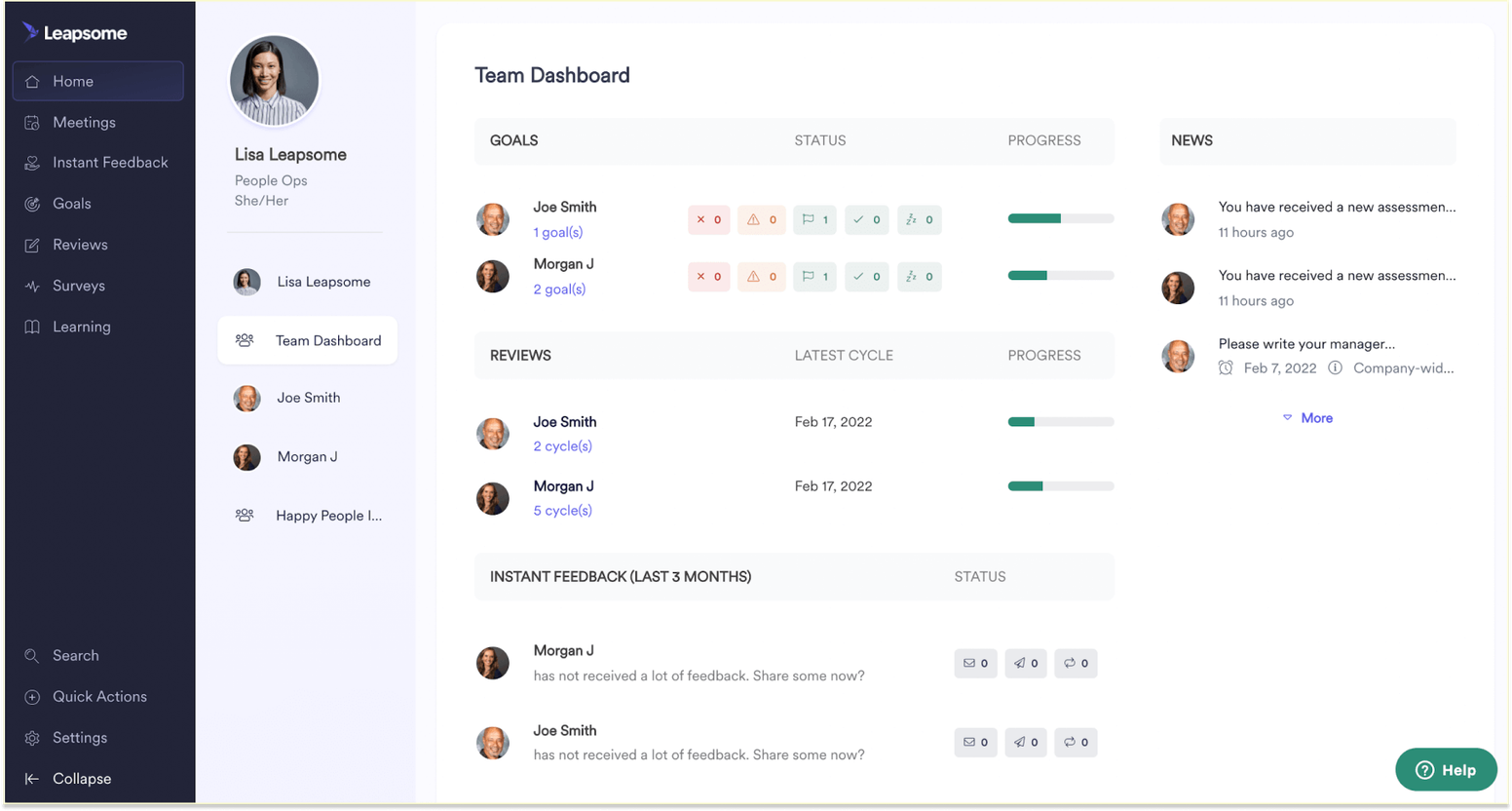
About Leapsome: Leapsome combines performance management with engagement measurement, including regular eNPS surveys. The platform's strength lies in connecting different aspects of the employee experience, with goal-tracking features helping organizations monitor progress on initiatives to improve employee net promoter scores. Learning and development integration connects career growth opportunities with overall employee satisfaction, while survey capabilities include eNPS measurement with customizable follow-up questions tailored to organizational priorities.
Leapsome's main features:
- Performance and engagement platform with regular eNPS surveys
- Goal tracking for monitoring improvement initiatives
- Learning and development integration with satisfaction measurement
- Customizable follow-up questions for organizational priorities
Leapsome pricing: Pricing is not listed on the website. To learn more about pricing, you'll need to schedule a demo/sales call with Leapsome.
Leapsome G2 score: Leapsome has a G2 score of 4.9/5 based on user reviews.
What Leapsome customers are saying on G2: "It is step to step process implementation of sales pattern , customer support , and a lot of feature to understand customer need .It also help to ease of interagtion customer mindset and win situation .It have a good dashboard GUI to understand also support avilable in a single call , once again thank you team leapsome because i was a layman and after half an hour training i became super user." - SUMIT KUMAR O., Senior Technical Sales Engineer (G2 Review for Leapsome).
5 budget-friendly eNPS tools
Smaller organizations and those just beginning eNPS measurement need affordable options that deliver core functionality without premium pricing. These tools provide essential capabilities for collecting and analyzing eNPS data while keeping costs manageable using proven pulse survey examples. They often include free tiers or low per-user pricing that makes employee loyalty measurement accessible to any organization.
1. Matter
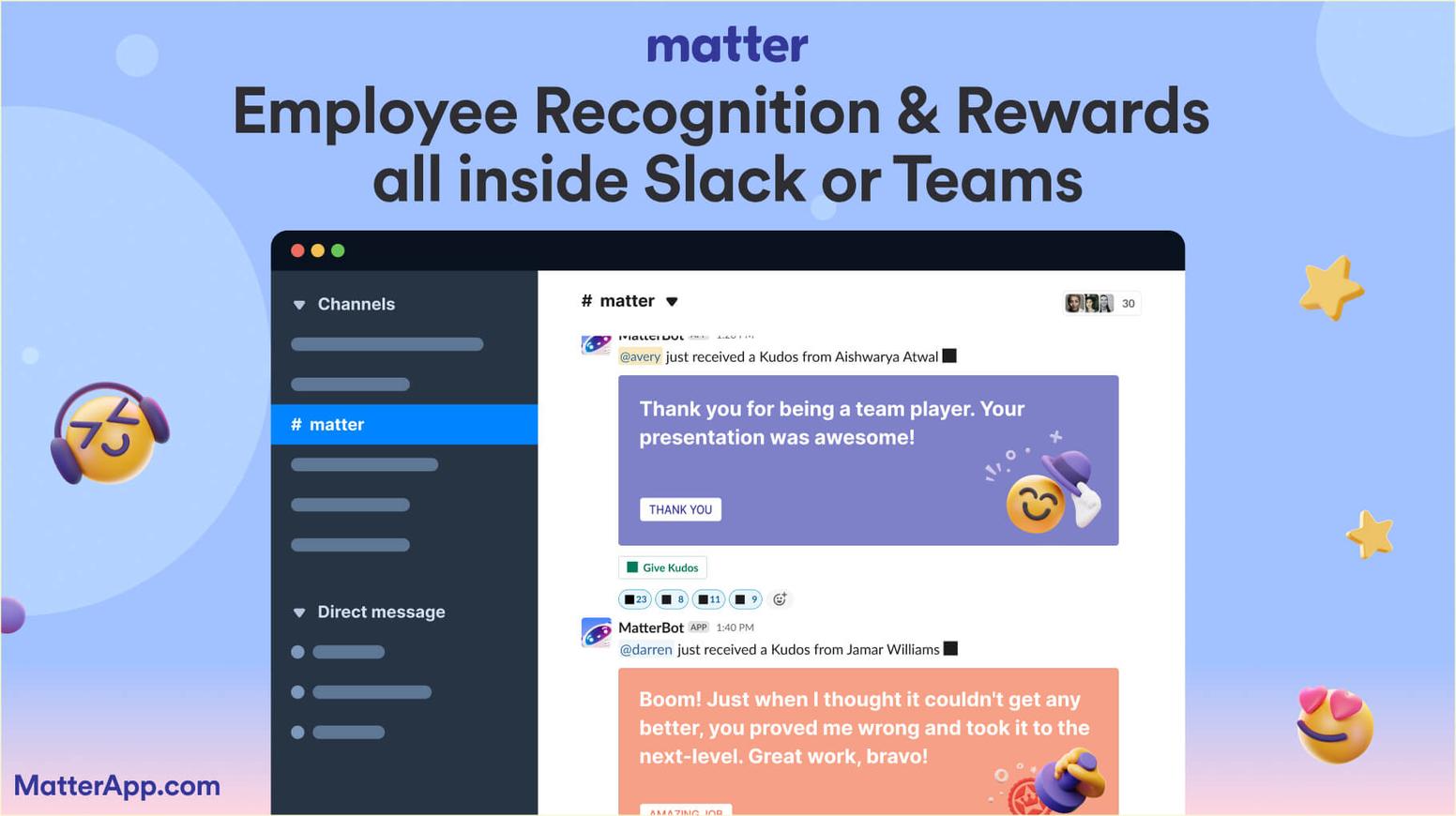
About Matter: Matter's free forever plan includes eNPS capabilities, making comprehensive employee sentiment measurement accessible for organizations of any size to begin tracking workplace satisfaction. The Slack-first and Teams-first approach delivers 10x higher response rates compared to traditional survey methods, maximizing the value of every pricing tier.
Small teams appreciate Matter's simple setup that requires no technical expertise to configure and can be operational in minutes. The platform scales seamlessly as organizations grow, eliminating the need to switch tools when requirements expand beyond initial eNPS measurement. Comprehensive analytics, automated survey deployment, real-time monitoring, and integrated recognition features provide insights and capabilities typically found only in much more expensive enterprise platforms.
Matter main features:
- Free forever plan with full eNPS capabilities included
- Pricing starting at $1 per user monthly for additional features
- 10x higher response rates with Slack and Teams integration
- Enterprise-level analytics and automation at budget-friendly prices
Matter pricing:
- Free Forever: $0/user/month
- Basic: $1/user/month, billed annually
- Pro: $3/user/month, billed annually
- Pro + Surveys: $5/user/month, billed annually
To learn more, view Matter's pricing page.
Matter G2 score: Matter has a G2 score of 4.7/5 based on user reviews.
What Matter customers are saying: "Our company's culture & morale changed overnight! In under 2 months, we've had over 2,000 kudos sent and 80%+ engagement across all employees. Matter has motivated people to participate like no other software we have ever used." - Jeff Hagel, President at McInnis & Holloway (Customer Story).
2. SurveyMonkey
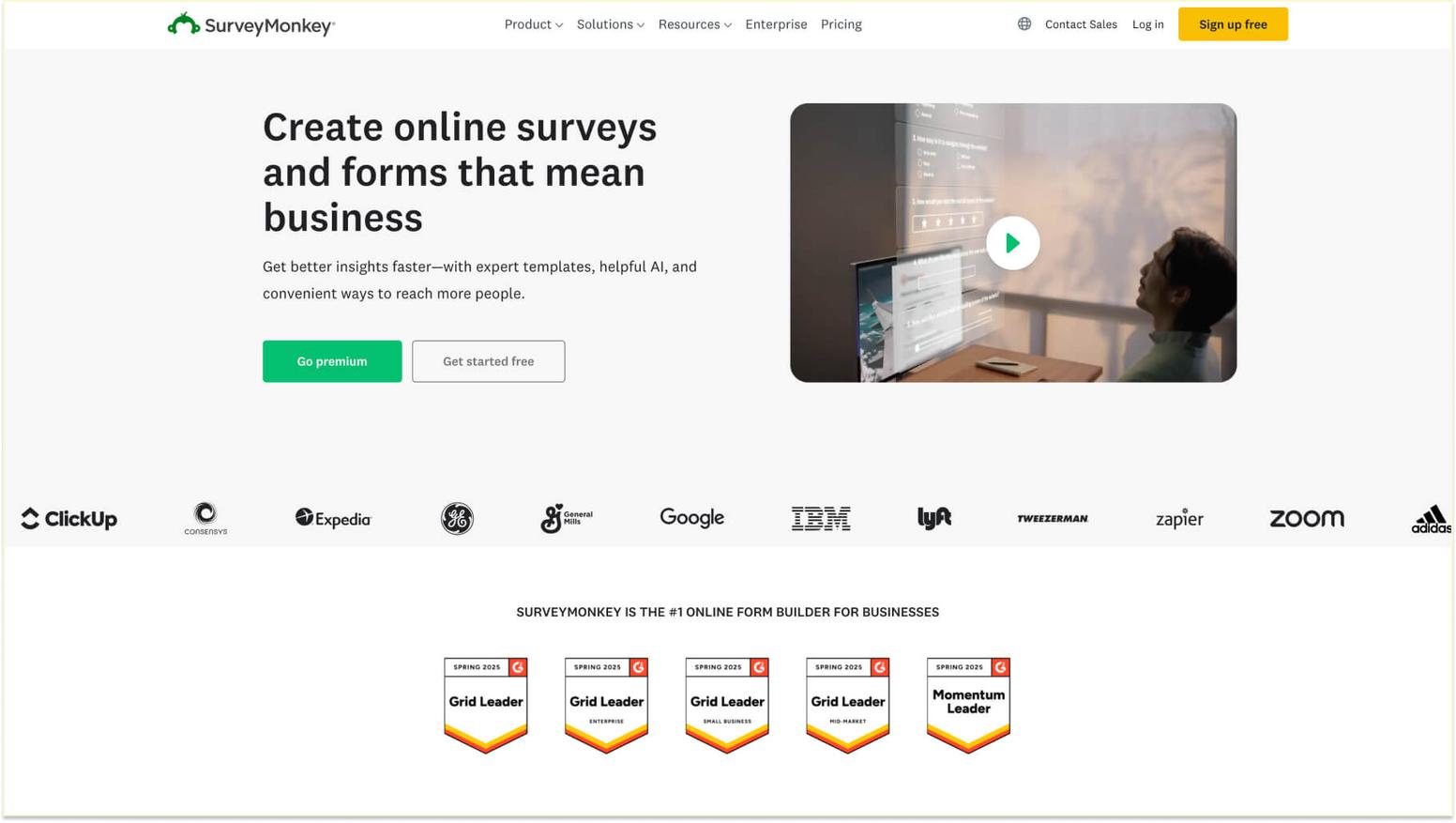
About SurveyMonkey: SurveyMonkey enables DIY eNPS survey creation with flexible templates that organizations can customize. The familiar survey platform makes it easy for HR teams to create and distribute eNPS surveys without specialized knowledge, with basic analytics and reporting features helping calculate eNPS scores and track changes over time. "Distribution options include email invitations and web links that can be shared through various channels. Data export capabilities allow organizations to analyze eNPS results in external tools for advanced insights.
SurveyMonkey main features:
- DIY survey creation with flexible, customizable templates
- Basic analytics and reporting for eNPS calculation
- Multiple distribution options, including email and web links
- Data export for external analysis tools
SurveyMonkey pricing:
- Team Advantage: $25/user/month, starting at 3 users, billed annually
- Team Premier: $75/user/month, starting at 3 users, billed annually
- Enterprise: Talk to sales for pricing
To learn more, view SurveyMonkey's pricing page.
SurveyMonkey G2 score: SurveyMonkey has a G2 score of 4.4/5 based on user reviews.
What SurveyMonkey customers say on G2: "The free plan lets you create surveys with up to 25 responses. For most real-world uses, that's very limiting. The basic paid plan doesn't cut it either. If you need to export your data, you're looking at the higher tiers that run closer to $100/month. Additionally, the survey customization options can be a lot better. The competitors in this space offer advanced customization that SurveyMonkey is definitely missing." -Nitin M., Product Manager (G2 Review for SurveyMonkey).
3. Google Forms
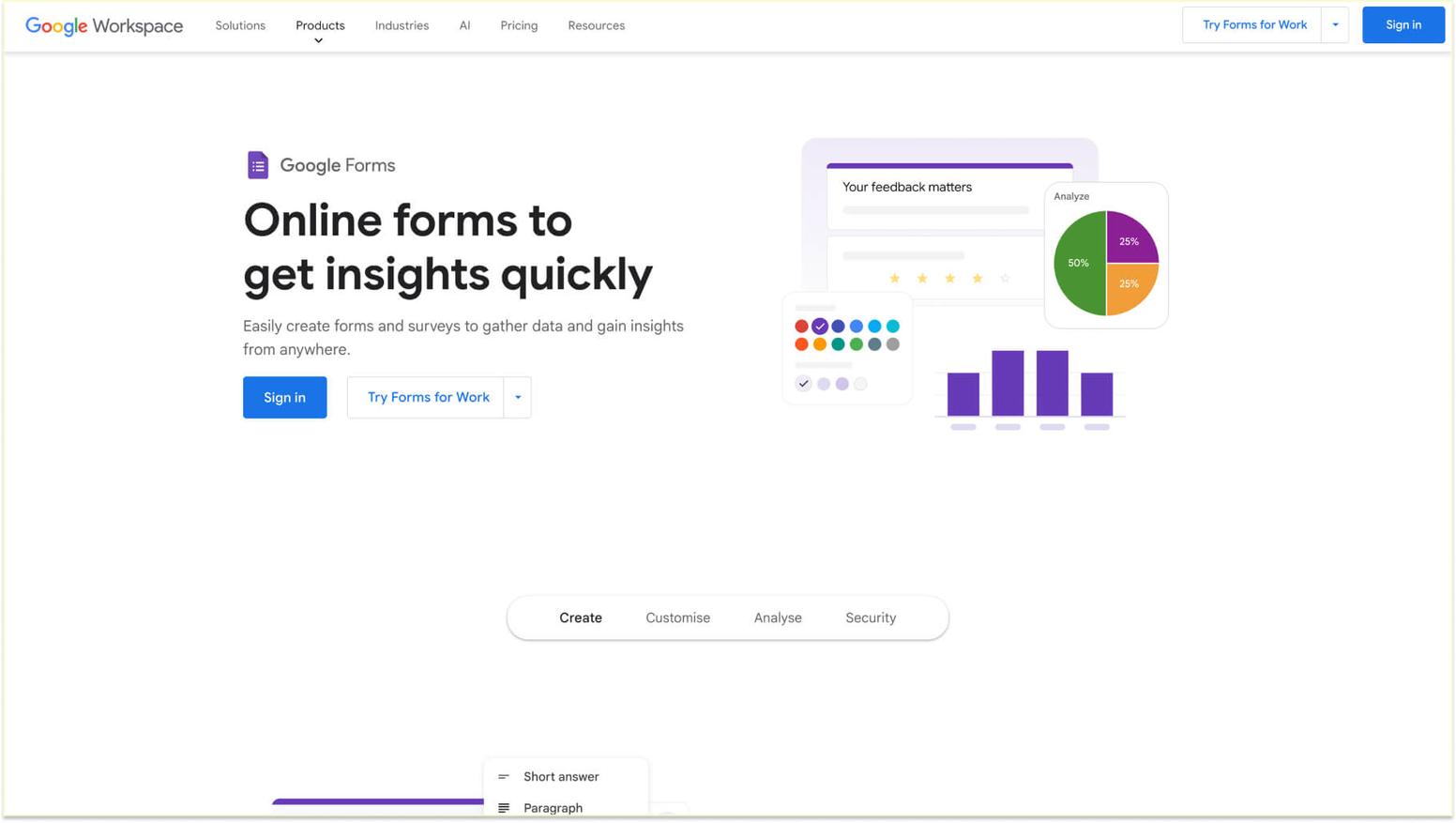
About Google Forms: Google Forms offers completely free eNPS survey creation for organizations with minimal budgets. The basic data collection tool integrates with Google Sheets for simple analysis and visualization, while manual calculation and tracking require more effort but provide accurate eNPS scores when done consistently. Organizations using Google Workspace benefit from seamless integration across their existing tools. This approach works well for small teams or as a proof of concept before investing in dedicated eNPS software.
Google Forms main features:
- Completely free eNPS survey creation and deployment
- Integration with Google Sheets for analysis
- Seamless integration with Google Workspace tools
- Suitable for small teams and proof of concept projects
Google Forms pricing:
- Starter: $6.30 user per month
- Standard: $12.60 user per month
- Plus: $22 user per month
- Enterprise Plus: Talk to sales for pricing
To learn more, view Google Forms pricing page.
Google Forms G2 score: Google Forms has a G2 score of 4.6/5 based on user reviews.
What Google Forms customers are saying on G2: "Honestly, I enjoy using Google Workspace overall, though it can be somewhat challenging when the internet connection is unstable, as most of its tools require being online. Additionally, with so many apps like Docs, Sheets, Drive, and Meet, it can feel a bit overwhelming at first. However, once you become familiar with the platform, everything tends to run very smoothly." - Girishchand B., Test Engineer Level 2 (G2 review for Google Forms).
4. Typeform
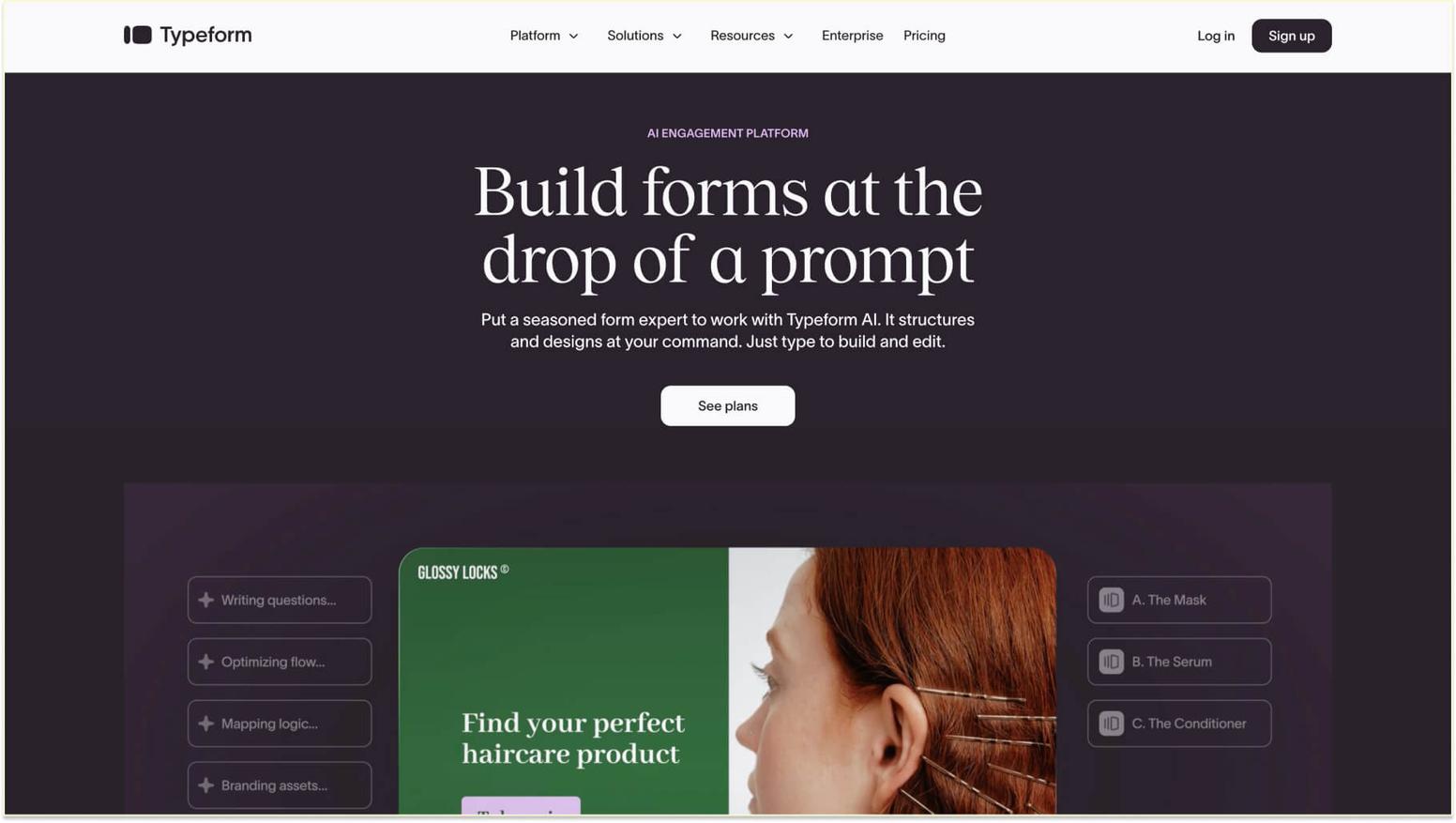
About Typeform: Typeform provides an interactive eNPS survey design that creates engaging user experiences for respondents. The platform's visual approach and conversational format can improve response rates compared to traditional survey designs. Customization options enable organizations to create branded eNPS surveys that align with their company culture and style. Integration with analytics tools enables organizations to enhance basic Typeform reporting with advanced analysis, while mobile optimization ensures a smooth survey experience regardless of device.
Typeform main features:
- Interactive and visually engaging survey design
- Conversational format for improved response rates
- Customization options for branded survey experiences
- Mobile optimization for all devices
Typeform pricing:
- Basic: $25 per month
- Plus: $50 per month
- Business: $83 per month
- Enterprise: Custom per month
To learn more, view Typeform's pricing page.
Typeform G2 score: Typeform has a G2 score of 4.5/5 based on user reviews.
What Typeform customers are saying on G2: "The user interface could be improved for applying design settings. Some of the options are buried in the brand and theme screens. It would be nice to have more control over where the questions and the answers appear on the screen, the layouts are pretty limited. On the data analysis side, it would be nice to have the ability to check questions that are tests so they are eliminated from the results. Right now I have to create a draft survey to test and once it is approved I have to copy the survey and give people a new link to the live version so I can utilize the reports." - Jennifer N., Data Analyst & Community Engagement (G2 Review for Software).
5. Jotform
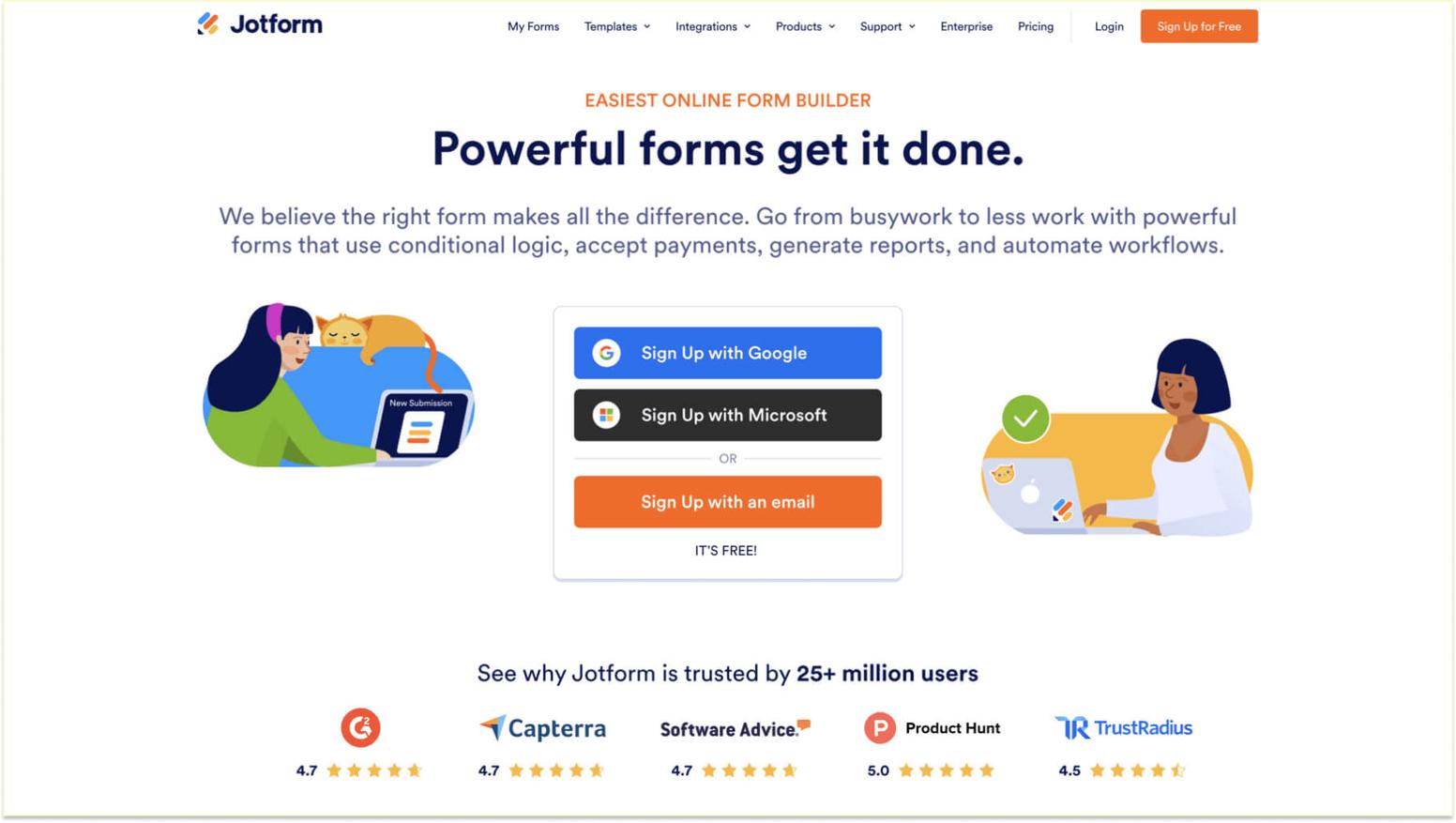
About Jotform: Jotform offers customizable eNPS survey forms with drag-and-drop design tools that require no technical skills. Automated response collection streamlines data gathering and eliminates manual data entry, while budget-friendly pricing makes Jotform accessible for organizations with limited resources. The template library includes pre-built eNPS surveys that organizations can deploy immediately or modify to meet specific needs, with integration capabilities that connect Jotform to other business tools for streamlined workflows.
Jotform main features:
- Drag-and-drop design tools requiring no technical skills
- Automated response collection and data gathering
- Pre-built eNPS survey templates ready to deploy
- Integration with other business tools for workflows
Jotform pricing:
- Starter: $0/month (All features included)
- Bronze: $34/month, billed annually
- Silver: $39/month, billed annually
- Gold: $99/month, billed annually
- Enterprise: Custom price, talk to sales for pricing
To learn more, view Jotform's pricing page.
Jotform G2 score: Jotform has a G2 score of 4.7/5 based on user reviews.
What Jotform customers are saying on G2: "JotForm's builder is really useful and has so many field options and vairables which gives you a lot of customisation ability. It's an intuitive no-code system that you can use to build fairly complex systems and processes to meet common business needs and customise them to meet your specific requirements. The support team and community have also been helpful. As it has been around for some time now, you can usually find a post similar to your challenge, but if not, you can submit a request for help and they will come back to you in good time. It has a large amount of integrations which we have found helpful to move data around securely." - Nathan C., Technology & Efficiency Manager (G2 Review for Jotform).
How Matter can help with eNPS surveys

Transforming eNPS measurement from a periodic administrative task into an engaging, continuous dialogue requires meeting employees where they already work. The platform's Slack-first and Teams-first integration delivers 10x higher response rates by deploying surveys directly within daily workflows, eliminating the friction of switching between applications. This seamless approach removes barriers that often lead to low response rates with standalone survey platforms. As a comprehensive employee pulse survey software, the research-validated 5-point Likert scale maximizes participation by providing an intuitive format that takes seconds to complete while measuring employee loyalty as accurately as 11-point scales.
Automated eNPS survey distribution and collection
The entire survey process, from distribution through reminder management, can be automated, eliminating the manual work that typically consumes HR team time. Deploying surveys directly where employees spend their workday through Slack and Teams integration delivers 10x higher response rates by removing friction from application switching. Customizable scheduling options allow organizations to choose a survey frequency that balances data freshness with concerns about survey fatigue. Automated reminders increase participation without requiring administrators to manually track who has responded, and the system automatically collects and stores responses while maintaining data integrity for immediate analysis. Celebration triggers also combine birthday and anniversary recognition with optional sentiment checks, creating natural touchpoints for feedback.
Real-time analytics and actionable insights
Real-time dashboards display eNPS scores as responses arrive, eliminating delays between data collection and insight availability. Visual trend charts reveal patterns over time, making it easy to spot improvements or concerning declines in employee sentiment. Segmentation features allow filtering by department, location, or other demographics to identify where scores are strongest and weakest. The platform highlights statistically significant changes that warrant attention rather than normal fluctuations, and actionable insights point leaders toward specific improvement opportunities based on eNPS data and qualitative feedback. Integration with recognition data links appreciation practices to loyalty metrics, demonstrating the impact of culture initiatives.
Integration with recognition and rewards programs
Combining eNPS measurement with peer recognition and rewards creates a comprehensive platform for managing employee experience. Organizations can see direct connections between recognition frequency and eNPS scores, demonstrating the impact of appreciation on loyalty. The coin-based reward system encourages survey participation and provides ongoing recognition throughout the workday. Customizable kudos cards let employees celebrate each other, fostering a positive culture that naturally supports higher eNPS. Automated celebration features for birthdays and work anniversaries maintain connection points that reinforce belonging and appreciation. By integrating measurement with action, this approach helps organizations not just track employee loyalty but actively improve it through recognition and rewards that make team members feel valued.
Frequently asked questions about eNPS surveys

Understanding the nuances of eNPS surveys helps organizations implement measurement programs that generate reliable insights and drive meaningful improvements. These commonly asked questions address practical considerations about survey design, frequency, scoring, and software selection. The answers guide both organizations just beginning their eNPS journey and those looking to optimize existing programs.
Q: What is an eNPS survey, and how does it work?
A: An eNPS survey measures employee loyalty by asking "How likely are you to recommend this company as a place to work?" using rating scales like 0-10 or research-backed alternatives like Matter's 5-point Likert system. Responses are classified as Promoters, Passives, or Detractors, and the eNPS score is calculated by subtracting the detractor percentage from the promoter percentage, producing a score between -100 and 100.
Q: What are good eNPS survey questions to ask?
A: The core question asks about the likelihood of recommending the workplace. Essential follow-ups include "What is the primary reason for your rating?" and "What would make you more likely to recommend us?" These gather context that explains scores. Keep total questions under five to maintain high response rates while collecting actionable insights using effective eNPS survey questions.
Q: How often should organizations conduct eNPS surveys?
A: Most organizations measure eNPS quarterly to track trends without creating survey fatigue. Some run monthly pulse surveys with rotating questions for continuous feedback. Organizations undergoing significant changes may survey more frequently to monitor sentiment during transitions. Consistency matters more than timing for reliable trend analysis.
Q: What is a good eNPS survey score?
A: Any positive score indicates more promoters than detractors. Scores above 10 are considered good, scores above 30 demonstrate strong engagement, and scores above 50 are excellent. Understanding what constitutes a good eNPS score varies by industry and company size, so track your trends over time and compare against similar organizations rather than fixating on absolute numbers.
Q: What eNPS survey software features matter most?
A: Essential features include research-backed rating methods that maximize completion rates (like Matter's 5-point Likert scale), anonymous response collection, automated survey scheduling, real-time analytics dashboards, and integration with workplace tools like Slack or Teams. The best employee engagement survey software balances powerful analytics with user-friendly interfaces requiring minimal training, along with benchmarking capabilities and segmentation options. More of Matter's platform data on survey participation is published at Matter's research hub.
Q: Do different rating scales affect eNPS survey results?
A: Different scales measure the same underlying sentiment while impacting response rates and user experience. Research shows that properly designed 5-point Likert scales, like Matter's measure of employee loyalty, can accurately assess employee loyalty as effectively as 11-point scales, with Fred Reichheld (NPS creator) acknowledging that different scoring scales work effectively. The 5-point approach achieves higher completion rates by reducing cognitive load. Both methods use the same eNPS calculation formula and maintain full benchmark compatibility, with final scores ranging from -100 to 100.
Final thoughts about eNPS surveys

eNPS surveys provide the essential foundation for understanding employee sentiment and driving meaningful workplace improvements that reduce turnover and strengthen company culture. Research-backed eNPS survey tools make it easy to collect honest feedback using rating systems proven effective through validation, with approaches like Matter's 5-point Likert scale maximizing participation through superior user experience compared to traditional longer scales. Organizations using any measurement approach can benefit from modern methodologies that maintain full benchmark compatibility while experiencing dramatic improvements in response rates and data quality. Organizations that measure employee loyalty consistently gain valuable insights into what drives recommendation likelihood and where opportunities for improvement exist. Matter offers a comprehensive solution that combines
eNPS measurement with recognition and rewards, creating a complete platform for building employee loyalty and satisfaction. By integrating feedback collection with appreciation practices, Matter helps organizations not just measure sentiment but actively improve it through daily recognition that makes employees feel valued. The platform's automation features and real-time analytics transform eNPS from a periodic measurement exercise into an ongoing dialogue that strengthens workplace culture and supports business success.
Ready to transform employee feedback into meaningful action? Schedule a demo with a Matter expert today and discover how our platform can help you measure employee loyalty, identify improvement opportunities, and create a culture of continuous improvement.

![#1 Guide to eNPS [29+ Questions, Tools & Score Methods]](https://cdn.sanity.io/images/kqqb5xry/production/65967139c5598da47704a0a6506df45ca6ff4682-800x600.jpg?w=720&q=75&fit=max&auto=format)
![eNPS Benchmark [27+ Insights for Score Comparison]](https://cdn.sanity.io/images/kqqb5xry/production/963303ea3c1f7bebf8b03d6b60f487d7c6469c7a-800x600.jpg?w=720&q=75&fit=max&auto=format)
![What is a Good eNPS Score? [2026 Guide & 17+ Key Benchmarks]](https://cdn.sanity.io/images/kqqb5xry/production/a98b3dd7d550a8cf067a4bf4ab4c3542d00266d5-800x600.jpg?w=720&q=75&fit=max&auto=format)