

Building a workplace where employee voices drive meaningful change requires more than collecting feedback. At Matter, we recognize that companies face significant challenges in crafting effective employee Net Promoter Score questions. Many teams struggle to design surveys that staff actually complete and distinguish between various formats. Understanding the psychology behind scale design proves equally challenging for most HR professionals.
The stakes are high when measuring employee engagement and employee loyalty through eNPS surveys. Poorly designed questions lead to low response rates and unreliable data. Companies miss opportunities to identify detractors before they leave. They also fail to understand what drives promoters to advocate for the workplace.
When businesses master these fundamentals through thoughtfully designed survey deployments, they unlock powerful capabilities. They can predict employee retention trends and effectively reduce employee attrition. Connecting employee feedback to business outcomes becomes straightforward. Most importantly, they create environments where people thrive, and employees feel genuinely connected to their work.
What is an eNPS survey question?

An employee net promoter score question measures workforce loyalty and job satisfaction by asking how likely someone is to recommend their workplace. This simple yet powerful metric adapts the traditional Net Promoter Score system for customer measurement. The core eNPS question traditionally asks employees to assess their likelihood of recommending the company on a scale of 0 to 10, although contemporary platforms such as Matter use a streamlined 5-point scale, which increases response rate. Respondents are then categorized into three categories as promoters, passives, or detractors based on their answers.
The beauty of employee net promoter score questions lies in their simplicity and directness. Rather than lengthy employee engagement surveys that people may rush through or abandon, eNPS uses focused questions. These respect people's time while yielding valuable insights into employee experience. This approach has become increasingly popular because it delivers high response rates and clear, quantifiable survey results.
Key characteristics of effective Net Promoter Score questions:
- Clear, unbiased wording that remains consistent across all surveys
- A rating scale that respondents find intuitive, whether the traditional 0 to 10 format or a simplified 5-point scale
- Open-ended question follow-ups that capture the reasoning behind each score
- Appropriate frequency that avoids survey fatigue while tracking employee sentiment
Core components of effective employee net promoter score questions
Effective employee net promoter score questions share several essential characteristics that maximize response quality and valuable insights. The primary eNPS question must be clear, unbiased, and consistently worded across all net promoter score surveys. Most companies use a simple format that asks people to rate their likelihood of recommending. An open-ended question allows respondents to explain their rating afterward.
The rating scale itself represents a critical component that significantly impacts response rates and data quality. Traditional employee engagement surveys use a scale of 0 to 10, where ratings 9-10 indicate promoters, 7-8 indicate passives, and 0-6 indicate detractors. However, innovative platforms like Matter have pioneered a 5-point scale that reduces cognitive load and increases completion rates. This simplified approach makes responding faster and more intuitive, especially on mobile devices and within Slack or Teams, while still accurately categorizing respondents when you measure eNPS.
Essential components include:
- Primary recommendation question with consistent wording across future surveys
- Intuitive rating scale, whether traditional 0 to 10 or a streamlined 5-point format
- Brief open-ended question follow-ups that provide context without overwhelming respondents
- Strategic timing and frequency to capture employee sentiment trends without causing fatigue
How employee net promoter score questions differ from traditional employee engagement surveys
Traditional employee engagement surveys typically include dozens of questions that cover multiple dimensions of employee and workplace satisfaction. These often take 15-20 minutes to complete. In contrast, employee net promoter score surveys focus on a single core question about likelihood to recommend. This fundamental difference means eNPS surveys can be deployed more frequently without causing fatigue among many employees.
The scope and purpose of these measurement approaches also differ significantly. Comprehensive employee engagement surveys measure various facets, including benefits, career progression, and work-life balance. Overall employee loyalty and desire to promote the organization are the main focus of employee NPS surveys. This narrow focus makes net promoter score (eNPS) particularly useful for tracking employee sentiment trends over time.
Key differences between approaches:
- Time investment: Employee NPS takes 1-2 minutes versus 15-20 minutes for comprehensive surveys
- Deployment frequency: Monthly or quarterly for employee net promoter score versus annual for traditional surveys
- Analysis complexity: Single metric for eNPS versus dozens of data points requiring extensive review
- Action speed: Immediate insights from net promoter score surveys versus weeks of analysis for comprehensive results
The psychology behind net promoter score question design
The psychological foundation of employee net promoter score questions taps into social proof and personal commitment principles. When people consider whether they would recommend their workplace to their broader personal network, they process their entire employee experience. They evaluate the potential social consequences of that recommendation. People naturally avoid recommending employers with whom they have had a positive or negative experience, as that experience tends to skew unfavorable.
This recommendation framework also leverages what behavioral scientists call loss aversion. People feel the pain of potential losses more acutely than the pleasure of equivalent gains. Someone who would not recommend their workplace implicitly acknowledges that working there represents a loss. This psychological dynamic helps companies determine why employee NPS often uncovers issues that traditional employee satisfaction surveys miss, including when employees express negative opinions.
Psychological principles at work:
- Social proof: Recommendations to a broader personal network carry personal reputation stakes
- Loss aversion: Unwillingness to recommend signals perceived as loss rather than gain
- Forward-looking framing: Likelihood questions yield more predictive data than employee satisfaction questions
- Cognitive load: Simpler scales, like a 5-point format, reduce mental effort and improve response quality compared to traditional 0 to 10 options
What are the benefits of eNPS survey questions?

Companies that implement employee net promoter score surveys gain immediate access to a straightforward metric that leadership teams can quickly understand. Unlike complex employee engagement measurements requiring extensive interpretation, net promoter score (eNPS) provides a single number. This clearly indicates whether the workforce mood is trending positively or negatively. The simplicity accelerates decision-making because executives do not need statistical expertise to grasp survey results.
The brevity of employee net promoter score surveys also dramatically improves response rates compared to lengthy employee engagement surveys. When surveys take only one to two minutes to complete, participation increases substantially. Higher response rates mean the resulting insights reflect the views of detractors and passives who might otherwise opt out. This gives HR teams a more accurate picture of employee satisfaction across all segments.
Primary benefits include:
- An immediate, actionable metric that leadership can understand without statistical expertise
- Higher response rates due to the brief completion time for all the responses
- More representative data, including perspectives from disengaged staff
- Ability to deploy frequently and identify trends over time
Measuring employee loyalty through simple net promoter score questions
Employee loyalty measurement through employee net promoter score offers unique advantages that more complex survey instruments cannot match. The recommendation question serves as a proxy for genuine loyalty because people only recommend employers they believe in. This creates a higher bar than simply expressing personal job satisfaction. Staff must consider whether their workplace meets standards they would feel comfortable endorsing to their broader personal network.
The distinction between promoters, passives, and detractors provides nuanced insights into workforce composition. Promoters represent the most loyal employees who actively contribute to a positive employee experience. Passives may be content but lack the enthusiasm to advocate for the company. Understanding the distribution across these three categories helps HR teams allocate resources strategically and improve employee satisfaction.
Employee loyalty measurement advantages:
- Recommendation questions create higher accountability than simple satisfaction ratings
- Three categories segmentation enables targeted employee retention strategies
- Department-level analysis reveals localized issues that company-wide metrics might obscure
- Trend tracking identifies employee sentiment shifts before they become retention crises
Predicting turnover and employee retention trends
Research consistently demonstrates strong correlations between low employee net promoter scores and elevated employee attrition rates. Staff who score their workplace as detractors are significantly more likely to be actively job searching. Employees report dissatisfaction in these Net Promoter Score surveys before making departure decisions. This gives companies advanced warning of potential turnover risks, enabling proactive engagement with affected employees before resignation.
The timing advantage of frequent pulse survey deployments cannot be overstated for employee retention efforts. Annual employee engagement surveys may reveal retention risks only after people have mentally checked out. Monthly or quarterly employee net promoter score measurements capture shifts in employee sentiment in near real time. HR teams can investigate sudden score drops while people are still receptive to retention efforts.
Predictive capabilities:
- Detractor status strongly correlates with active job searching among many employees
- Frequent measurement enables intervention before resignation decisions solidify
- Individual score tracking identifies specific retention risks warranting personalized follow-up
- Pre-post comparisons using survey findings measure whether retention initiatives actually work
Creating actionable employee feedback loops
The combination of quantitative employee net promoter scores and qualitative open-ended question responses creates rich, actionable employee feedback. While the numeric score indicates overall direction, text responses reveal specific issues people want addressed. Companies that systematically analyze all responses to these qualitative sections can identify recurring themes. This helps prioritize initiatives with the broadest positive impact on employee satisfaction.
Acting on employee feedback creates a virtuous cycle where employees feel their input leads to tangible changes. When companies share what they learned from survey findings and outline specific actions, it demonstrates that all your leaders value workforce input. This transparency builds trust and helps companies recover from low scores. Showing that people who express negative opinions are heard and taken seriously encourages future honest participation.
Employee feedback loop elements:
- Quantitative scores provide direction while qualitative responses provide specificity
- Systematic theme analysis identifies issues affecting many employees
- Transparent communication about actions taken builds trust and encourages participation
- Rapid pre-post comparisons using survey results measure whether improvement initiatives work
Why employee net promoter score surveys are important

Employee net promoter score tracking has become a critical metric for modern companies because it provides a clear, quantifiable measurement. Unlike qualitative employee feedback that is difficult to aggregate, employee NPS generates numeric data for statistical analysis. Companies can benchmark against industry standards and set measurable improvement goals to improve employee engagement. This quantitative rigor makes the net promoter score (eNPS) particularly valuable for data-driven businesses focused on business performance.
The simplicity of the employee net promoter score also makes it accessible to all your leaders at every level, from frontline managers to executives. When everyone understands what an eNPS score means and how calculating eNPS works, it creates shared accountability. Managers can own the scores for their teams and take pride in improvement trends. Executives can monitor company-wide metrics and identify which departments need support to improve employee satisfaction.
Why employee net promoter score matters:
- Provides quantifiable data enabling statistical analysis and benchmarking
- Creates shared accountability across all leadership levels
- Offers real-time visibility during organizational changes when employee sentiment shifts rapidly
- Enables evidence-based prioritization of improvement initiatives
Establishing baseline employee sentiment metrics
Creating baseline employee net promoter score measurements provides companies with a critical reference point for evaluating all future initiatives. Without this baseline, companies cannot definitively determine whether their programs improve employee satisfaction. The baseline establishes what normal looks like for the company and whether the organization met its goals. It accounts for industry-specific factors and cultural characteristics that influence how the answers employees provide vary.
Baseline employee NPS data also enables meaningful benchmarking against industry standards and competitors. A company might be disappointed with an eNPS score of 20 until discovering that their industry average is 15. Conversely, a company satisfied with 30 might become concerned upon learning similar businesses typically score 50. This context transforms raw numbers into valuable insights.
Baseline establishment benefits:
- Creates a reference point for measuring initiative impact
- Enables meaningful industry and competitor benchmarking
- Reveals operational insights about survey administration and communication strategies
- Establishes realistic expectations based on company-specific factors
Identifying the most loyal employees and detractors in your company
Distinguishing between promoters and detractors within the workforce reveals critical factors about the distribution of employee engagement. Promoters represent the company's strongest advocates, including the most loyal employees who naturally boost morale and help recruit candidates. Identifying these individuals enables companies to appropriately recognize their contributions. Understanding what makes employees happy in their experience informs the amplification of best practices.
Detractors signal areas where the company falls short of expectations, making them valuable sources of improvement insights. Rather than dismissing detractors as complainers when they express negative opinions, forward-thinking companies engage them to understand specific concerns. Many detractors are actually high performers who have become frustrated by specific barriers affecting their employee experience. They can become satisfied employees and valuable contributors if their concerns are addressed successfully.
Segmentation insights:
- Promoters serve as informal ambassadors during recruiting and onboarding
- Detractor employee feedback often identifies systemic issues affecting broader populations
- Passive engagement reveals relatively low-cost intervention opportunities
- Ratio analysis informs strategic workforce planning and culture development priorities
Connecting employee feedback to business performance
Companies that successfully correlate employee net promoter score with business performance metrics unlock powerful insights. Research across industries demonstrates clear links between high eNPS scores and desirable outcomes. These include customer satisfaction, customer loyalty, revenue growth, profitability, and innovation metrics. Quantifying these relationships makes it easier to justify investments in people programs that improve employee engagement.
The correlation between employee loyalty and consumer loyalty exhibits notably compelling dynamics. Companies with highly engaged employees who would recommend their workplace typically deliver superior experiences that positively impact customer satisfaction. Those satisfied employees bring enthusiasm, care, and extra effort to their work. Employees feel appreciated, which results in happy consumers, and customer and employee happiness rise in tandem as a result of this positive feedback loop.
Business performance connections:
- A high employee net promoter score correlates with customer satisfaction, revenue growth, and profitability.
- Engaged employees deliver superior customer experiences, creating virtuous cycles.
- Correlation analysis identifies the critical factors that drive the strongest business performance.
- An evidence-based approach ensures investments in initiatives with proven returns.
10 best core employee net promoter score examples

Companies seeking to implement effective measurement need carefully crafted Net Promoter Score survey questions that yield high response rates. The best core employee net promoter score questions balance brevity with depth, asking just enough to understand employee sentiment. Below are proven question formats that companies across industries have successfully deployed. These help measure employee engagement and loyalty while effectively identifying improvement opportunities.
These net promoter score questions work effectively across different company sizes, industries, and workforce compositions. They focus on universal aspects rather than company-specific details. Companies can deploy these core questions consistently over time to track employee sentiment trends. Supplementing them with targeted open-ended question follow-ups when specific issues emerge adds depth to understanding how employees feel.
10 core employee net promoter score questions:
- On a scale of 0 to 5, how likely are you to recommend this company as a place to work?
- Based on your experience as an employee, would you suggest our organization to friends or relatives looking for work?
- How probable is it that you would suggest this workplace to someone in your broader personal network?
- Utilizing a scale of 0 to 5, please designate your level of likelihood to endorse this company as a potential employer.
- Would you encourage talented people you know to apply for positions at our company?
- On a 5-point scale, how likely are you to promote our company as a great place to work?
- How willing would you be to recommend our company to peers in your industry?
- How enthusiastically would you suggest working here to a friend based on your own experience as an employee?
- Rate your comfort level recommending this workplace to professional contacts.
- How strongly would you endorse our company as an employer to people you respect?
3 traditional net promoter score scale questions
- On a scale of 0 to 5, how likely are you to recommend this company as a place to work?
- Employing a numerical scale ranging from 0 to 5, where zero indicates no likelihood and 5 signifies a very high likelihood, please rate your probability of recommendation.
- On a scale of 0 to 5, how probable are you to recommend our organization as a suitable place of employment?
Standard employee net promoter score inquiries, employing a 0 to 10 scale, continue to be prevalent due to their alignment with the original net promoter methodology for customer assessment. This familiar format makes employee NPS results comparable across different companies and industries. The standard scoring methodology categorizes 9-10 responses as promoters, 7-8 as passives, and 0-6 as detractors. Companies benefit from extensive research and benchmarking data that helps contextualize their scores.
The 11-point scale of 0 to 10 offers granularity that can reveal subtle distinctions in employee sentiment. However, this advantage comes with potential drawbacks in digital survey contexts. Research suggests respondents sometimes struggle to distinguish between adjacent points on lengthy scales when recording a positive or negative experience. This challenge increases on mobile devices, where interface constraints make 11-option selections cumbersome.
Modern platforms like Matter have pioneered a 5-point scale approach that addresses many of the limitations of traditional scales. The simplified format reduces cognitive load, making it easier for respondents to select a rating quickly and confidently. This streamlined experience leads to higher completion rates, particularly on mobile devices where staff increasingly engage with workplace tools. The 5-point scale also integrates more naturally into Slack and Teams interfaces, reducing the friction that causes survey abandonment. While maintaining the ability to identify promoters, passives, and detractors, this approach prioritizes ease of response and authentic participation over granular distinctions that rarely influence strategic decisions.
When to use traditional scales:
- When industry benchmarking against standard net promoter score data is important
- When historical data uses the scale of 0 to 10 format, and trend continuity matters
- When respondents have demonstrated comfort with numeric rating scales
- When detailed granularity between score levels adds analytical value for survey results
When to consider a 5-point scale approach:
- When maximizing response rates is a priority for your organization
- When staff primarily complete surveys on mobile devices
- When surveys are delivered within Slack or Teams, where simplicity improves engagement
- When speed and ease of participation matter more than granular score distinctions
4 simplified employee net promoter score variations
- Would you recommend our company as a place to work? (Yes/No/Maybe)
- How likely are you to recommend our workplace to others? (Very likely/Somewhat likely/Not likely)
- Would you encourage a friend to apply here? (Definitely/Probably/Probably not/Definitely not)
- I would recommend this company as a great place to work. (Strongly agree to Strongly disagree)
Simplified employee net promoter score question formats reduce complexity while maintaining the core recommendation focus. These variations often replace numeric scales with categorical responses that some people find less ambiguous. While purists argue these formats sacrifice granularity, proponents emphasize improved response rates. Removing barriers that cause people to abandon surveys when faced with numeric scales of 0 to 10 proves valuable.
Binary net promoter score questions asking simply whether someone would recommend the company provide the clearest response format. However, they lose the ability to distinguish between enthusiastic promoters and merely content-satisfied employees. Companies using this approach typically supplement it with a second open-ended question about the strength of the recommendation. This two-step process captures similar information while feeling less complicated to respondents.
When to use simplified variations:
- When the workforce includes hourly or field people with limited survey time
- When mobile device completion rates need improvement
- When previous surveys showed high abandonment rates on a numeric scale of 0 to 10
- When simplicity and speed matter more than granular score distinctions
3 industry-specific employee net promoter score questions
- Healthcare: How likely are you to recommend our hospital to other healthcare professionals seeking meaningful practice?
- Retail/Hospitality: Would you recommend our company to friends looking for retail or hospitality positions?
- Technology: On a scale of 0 to 5, how likely are you to recommend us to talented developers in your broader personal network?
Industry-specific employee net promoter score questions acknowledge that priorities and drivers of employee satisfaction vary significantly across sectors. Healthcare professionals may prioritize patient outcomes and clinical autonomy differently than technology workers do. Those in tech focus on innovation and new, exciting technical challenges. Customized questions that reflect industry-specific values demonstrate understanding of what matters to people.
Retail and hospitality industries often modify net promoter score questions to address schedule flexibility and customer interaction elements. Manufacturing and industrial sectors may frame questions around safety, employee development, and career progression. Including language about recommending to skilled tradespeople helps these people visualize the recommendation context within their professional communities.
Industry customization considerations:
- Healthcare: Emphasize patient outcomes, clinical autonomy, and employee development
- Retail/Hospitality: Address schedule flexibility, customer interactions, and advancement opportunities
- Technology: Focus on innovation, technical challenges, and new and exciting opportunities for growth
- Manufacturing: Highlight safety, skill development, and career progression
8 effective employee net promoter score follow-up questions

While the core employee net promoter score question provides a valuable snapshot, strategic open-ended question follow-ups transform data into valuable insights. Well-designed follow-ups help companies move beyond knowing that employees feel unhappy. They reveal precisely what needs to change to improve employee satisfaction and reduce employee attrition. These supplementary inquiries should be brief, focused, and varied based on the respondent category.
The timing and delivery of open-ended question follow-ups significantly impact response quality and completion rates. Asking too many questions immediately after the primary eNPS question rating can overwhelm respondents. Leading companies use conditional logic to present just one or two follow-ups tailored to each initial rating. This adaptive approach respects time while gathering the contextual information needed to boost engagement.
8 effective follow-up questions:
- What is the primary reason for your rating?
- What could we do to improve your employee experience and increase your score?
- What aspects of working here would you highlight when recommending our company?
- What challenges or concerns affect your willingness to recommend our workplace?
- How have your feelings about recommending our company changed over the past six months?
- What specific critical factors most influence your recommendation likelihood?
- If you could change one thing to make this a better place to work, what would it be?
- What does our company do particularly well that makes you willing or unwilling to recommend it?
3 open-ended questions for understanding promoter motivations
- What specific aspects of working here make you willing to recommend our company to others?
- What does our company do particularly well that you would highlight when recommending us?
- If you were describing our company to a friend considering joining, what would you emphasize most?
Understanding why promoters enthusiastically advocate for the company provides invaluable insights into what works well for the company. These most loyal employees have identified specific aspects of company culture, leadership, or new and exciting opportunities that exceed expectations. By systematically capturing these positive drivers through open-ended responses to questions, companies can ensure successful practices continue. This remains true even as leadership changes or growth creates complexity.
Feedback from promoter employees also assists organizations in developing genuine employer branding messages that effectively engage prospective candidates. When current staff consistently highlight specific attributes, such as innovation opportunities or a collaborative culture, those themes should feature prominently. This authenticity attracts candidates who value the same attributes, improving cultural fit and increasing future promoter proportions.
Promoter insight applications:
- Identify practices to protect and amplify during organizational changes
- Inform authentic employer branding and recruitment messaging using employee testimonials
- Extend best practices from high-performing teams to other parts of the company
- Validate recognition and rewards programs that drive positive employee experiences
3 open-ended questions for identifying detractor concerns
- What are the main critical factors that make you unlikely to recommend our company as a place to work?
- What changes would most significantly improve your employee experience and willingness to recommend our workplace?
- What specific challenges or concerns prevent you from recommending our company to others?
Detractor employee feedback represents the most critical input for improvement initiatives because affected employees are at the highest risk. Understanding exactly what drives their dissatisfaction enables targeted interventions. Companies should view detractors not as problems but as valuable sources of unvarnished truth when they express negative opinions. Many detractors are high performers who care deeply but have become frustrated by specific barriers.
The challenge with detractor employee feedback lies in distinguishing between individual grievances and systemic issues. Not every complaint merits company-level intervention, particularly when answers employees provide reflect personality conflicts or isolated incidents. However, when multiple detractors independently cite the same concerns in their open-ended question responses, companies should treat those themes as serious problems. Strategic attention and resource allocation become necessary.
Detractor feedback handling:
- Create safe, anonymous channels that encourage honest feedback without retaliation fears
- Distinguish between individual grievances and systemic issues affecting many employees
- Engage detractors to understand specific concerns rather than dismissing them as complainers
- Prioritize themes that multiple detractors cite independently in survey findings
2 open-ended questions for engaging passive employees
- What would need to change for you to become more enthusiastic about recommending our company?
- What specific improvements would increase your likelihood of recommending our workplace to others?
Passive employees represent a particularly interesting and often overlooked segment that companies should prioritize understanding. These individuals are content enough to stay but not enthusiastic enough to actively recommend. They remain vulnerable to recruitment by competitors and are unlikely to serve as cultural ambassadors. Understanding what would move passives toward becoming satisfied employees and promoters provides a strategic improvement roadmap.
Research suggests that passives often lack strong connections to the company's mission or relationships with colleagues. They may feel underrecognized for their contributions rather than experiencing acute dissatisfaction. Relatively low-cost interventions like improved communication or peer recognition programs might effectively engage this population and improve employee engagement. Companies that successfully activate passives often see disproportionate ROI on these initiatives to boost engagement.
Passive engagement strategies:
- Focus on connection-building initiatives rather than compensation adjustments
- Provide employee development conversations and mentorship connections
- Implement recognition programs that increase visibility of contributions
- Create new and exciting opportunities for meaningful project involvement and mission connection
6 employee net promoter score questions about workplace culture

Understanding employee net promoter score in the context of the company's culture reveals how people perceive the lived experience of values and norms. Culture-focused net promoter score questions probe beyond surface-level employee satisfaction into whether stated values are actually practiced. They explore whether teams collaborate effectively and whether leadership creates an environment where people thrive. These questions acknowledge that the company's culture profoundly influences the likelihood of recommendations.
Questions regarding the cultural employee net promoter score should align with the company's explicitly articulated values rather than relying on generic frameworks. A company emphasizing innovation may question whether employees feel empowered to innovate and to learn from setbacks. This customization ensures questions resonate with the daily employee experience and provide valuable insights.
6 culture-focused net promoter score questions:
- Do our company values align with your personal values?
- How well do you think we live up to our stated cultural principles?
- Do you feel like you truly belong and can be authentic at work?
- How inclusive and welcoming is our workplace culture?
- Does our culture support a healthy work-life balance?
- How effectively do teams collaborate across departmental boundaries?
2 questions measuring values alignment
- How well do our company's values align with your personal values?
- Do you feel that leadership and staff consistently demonstrate our stated values?
Values alignment questions explore whether people see their personal principles reflected in the company's culture and decision-making. When people work for companies whose values match their own, they experience greater job satisfaction. Reduced stress and stronger commitment follow because daily work feels meaningful. This alignment becomes a powerful advantage in recruitment and employee retention when the organization meets expectations.
Companies should recognize that questions about values alignment can reveal uncomfortable truths about gaps between aspirations and actual practices. Companies claiming to prioritize innovation may discover that people feel punished for taking risks. Those emphasizing work-life balance might learn that unwritten expectations contradict official policies. These gaps represent critical factors and opportunities for improvement requiring leadership courage.
Values alignment considerations:
- Perfect alignment is impossible, and some diversity strengthens culture through different perspectives
- Core values around integrity, respect, and customer focus should be genuinely shared
- Gaps between stated values and actual practices represent critical improvement opportunities
- Some value mismatches predict eventual departure regardless of other employee satisfaction factors
2 questions assessing team dynamics
- How would you rate the quality of collaboration and teamwork within your department or team?
- Do you feel supported by your teammates and believe they have your best interests in mind?
Team dynamics questions examine the quality of working relationships and collaboration patterns. Strong cohesion and positive interpersonal relationships buffer against workplace stress. They increase job satisfaction and create the psychological safety needed for innovation and learning. Individuals functioning within teams characterized by healthy dynamics are more inclined to be promoters irrespective of compensation.
These questions reveal whether companies have unintentionally created competitive cultures that pit people against each other. Excessive focus on individual performance metrics or forced ranking systems can destroy team dynamics. Identifying these patterns through employee Net Promoter Score feedback enables companies to redesign systems that inadvertently undermine collaboration. High-performing teams often have specific practices that could be replicated elsewhere to improve employee engagement.
Team dynamics insights:
- Identify pockets of excellence where collaboration is particularly strong
- Reveal whether systems inadvertently encourage competition over collaboration
- Surface psychological safety issues that stifle innovation and authentic engagement
- Inform redesign of incentives and processes that damage teamwork
2 questions evaluating leadership impact
- How effective is leadership at creating a workplace environment you would recommend to others?
- Do you have confidence in the direction senior leadership is taking our company toward the company's success?
Leadership questions assess whether managers and executives create conditions where people can succeed and employees feel supported. Research consistently demonstrates that people do not leave companies as much as they leave managers. Leadership quality may be the single most important driver of employee net promoter score and employee retention. Questions about effectiveness, accessibility, and decision-making quality provide critical insights.
These questions should distinguish between direct managers and senior leadership, as people often have different expectations. Someone might have a supportive direct manager but still be a detractor because senior leadership makes poor decisions. Conversely, people might respect executives but struggle with ineffective direct managers. Understanding these distinct dimensions helps direct employee development and coaching resources appropriately.
Leadership assessment dimensions:
- Direct manager support, communication, and development investment
- Senior leadership's strategic direction and decision-making quality
- Accessibility and responsiveness at both leadership levels
- Consistency between stated values and leadership behaviors
6 employee net promoter score questions for measuring manager effectiveness

Manager effectiveness is one of the most powerful predictors of employee satisfaction, engagement, and retention. The quality of the manager relationship influences daily employee experience more directly than abstract factors. Net Promoter Score questions targeting manager effectiveness assess whether supervisors provide adequate support, recognition, and development opportunities for employees. These insights are critical for improving the daily experience of all staff.
Companies should recognize that questions about manager effectiveness may provoke defensiveness among managers who view employee feedback as threatening. Framing these questions as opportunities to identify training needs helps create buy-in. Providing managers with aggregated team scores rather than individual ratings protects anonymity. This approach gives managers actionable feedback about where they succeed and struggle.
6 manager effectiveness net promoter score questions:
- Does your manager provide the support and resources you need to succeed?
- How effectively does your manager communicate expectations and feedback?
- Do you feel adequately recognized and appreciated by your direct supervisor?
- How well does your manager help you develop your skills and career?
- Does your manager create a psychologically safe environment for your team?
- How fairly and consistently does your manager treat team members?
2 questions about manager support and professional growth
- Does your manager provide the support, resources, and advocacy you need to succeed in your role?
- How effectively does your manager invest in your professional growth and skill-building?
Manager support questions explore whether supervisors actively remove obstacles and advocate for their teams. People working for supportive managers feel empowered to take on challenges and experiment with new approaches. They speak up about problems because they trust their manager will back them. This support creates psychological safety, enabling learning and authentic engagement, and helping employees feel valued.
Growth-focused questions assess whether managers invest time in understanding career aspirations. They reveal whether stretch assignments and learning opportunities are provided. People who see their managers as partners in advancement experience higher job satisfaction. They recognize that staying provides continuing value rather than career stagnation.
Support and growth indicators:
- Obstacle removal and resource provision for team success
- Advocacy within the company for team needs and recognition
- Understanding of individual career aspirations and goals
- Stretch assignments and skill-building opportunity provision
2 questions regarding communication and transparency
- How effectively does your manager communicate expectations, provide feedback, and explain decisions?
- Do you feel your manager is transparent and shares appropriate information with your team?
Communication effectiveness profoundly influences trust, understanding, and employee engagement with company goals. Managers who communicate expectations clearly and provide regular performance feedback help people feel informed. Consistent communication creates predictability and reduces workplace stress. People understand what is expected and where they stand, eliminating anxiety from ambiguity.
Transparency questions reveal whether managers share appropriate information about team performance and changes. People want to understand the reasoning behind decisions that affect them, even when they disagree with outcomes. Managers who explain decision rationale build trust even in difficult situations. Those who simply announce changes without context generate resentment and disengagement.
Communication best practices:
- Clear expectation setting with regular performance feedback
- Transparent explanation of decision rationale
- Appropriate information sharing about team performance and company changes
- Acknowledgment when confidentiality constraints prevent full disclosure
2 questions evaluating recognition and performance input
- Do you feel adequately recognized and appreciated by your manager for your contributions?
- How effectively does your manager provide regular, constructive guidance about your performance?
Recognition questions assess whether managers consistently acknowledge contributions and celebrate successes. Regular appreciation delivered by direct managers significantly influences job satisfaction and employee loyalty. People have a fundamental need to feel seen and valued for their work. Those whose contributions go unacknowledged often become detractors regardless of compensation levels.
Performance input questions explore whether managers provide regular, constructive guidance. Effective feedback balances praise for strengths with developmental suggestions about improvement areas. It should be delivered frequently enough that people never wonder where they stand. People receiving regular check-ins feel more engaged and confident because they understand what success looks like.
Recognition and performance guidance principles:
- Consistency matters more than elaborate gestures
- Specific acknowledgment of contributions has a greater impact than generic praise
- Regular small acknowledgments outweigh occasional grand recognition events
- Constructive input should balance positive reinforcement with development guidance
10 advanced employee net promoter score questions for deeper insights

Advanced employee net promoter score questions move beyond basic recommendation likelihood to explore specific workplace dimensions. These sophisticated net promoter score questions help companies understand not just whether people would recommend but why. They reveal which specific critical factors most influence positions. While companies should avoid overwhelming people with excessive questions, strategic deployment provides nuanced insights.
The questions in this section represent approaches used by companies that have matured beyond basic employee Net Promoter Score measurement. They demonstrate how methodology can extend into specific domains, such as growth opportunities and workplace wellness. Companies implementing these questions should do so thoughtfully. Rotating through different advanced topics quarterly rather than covering everything in every survey works best for future surveys.
10 advanced net promoter score questions:
- How does your current eNPS rating compare to how you felt six months ago?
- What specific recent event most influenced your recommendation rating?
- How does your willingness to recommend this workplace compare to your previous employer?
- If you could recommend our company to someone in a specific role, what role would benefit most?
- What would need to change for you to increase your rating by at least two points?
- How likely are you to still be working here in two years?
- Would you recommend your specific team or department compared to the company overall?
- How does recognition and appreciation influence your recommendation likelihood?
- What career progression opportunities would increase your willingness to recommend this workplace?
- How effectively does our company invest in your health, wellness, and work-life balance?
3 questions linking employee net promoter score to specific workplace factors
- Which aspect of working here most influences your likelihood to recommend our company?
- How much does your relationship with your manager impact your willingness to recommend our workplace?
- To what extent does our company's approach to health and wellness affect your likelihood of recommending us?
Factor-specific employee net promoter score questions help companies determine which specific aspects most strongly correlate with the likelihood of recommending. These questions might explore whether compensation, benefits, recognition, or employee development opportunities drive employee sentiment most strongly. By quantifying these relationships, companies can make informed decisions about where to invest resources.
Companies should recognize that factor importance varies significantly across different segments, industries, and career stages. Early-career people might prioritize new and exciting opportunities for development, while mid-career professionals focus on compensation and balance. Understanding these nuances enables targeted approaches that address specific segment needs. Generic programs may miss what actually matters to different populations.
Factor analysis applications:
- Identify which aspects most strongly correlate with recommendation likelihood
- Enable evidence-based prioritization of improvement initiatives
- Reveal segment-specific priorities that generic programs might miss
- Inform strategic resource allocation toward the highest-impact investments
4 questions measuring growth and advancement opportunities
- Do you see clear opportunities for career advancement and professional growth within our company?
- How well does our company support your skill development and learning goals?
- Do you feel your career is progressing at an appropriate pace within our company?
- Are you satisfied with the training resources and growth opportunities available to you?
Growth and advancement questions explore whether people see viable paths forward and receive support for skill-building. These critical factors significantly influence recommendation likelihood because people want their time to build toward something. Companies that effectively communicate promotion possibilities and lateral movement options typically see higher eNPS scores. People view staying as an advancement rather than stagnation.
The challenge with these questions lies in managing expectations appropriately. Not everyone can advance into management roles or receive promotions on desired timelines. Effective approaches emphasize skill building and expanding responsibilities as forms of growth alongside traditional promotion. Companies should help people understand that professional development includes many forms of progress beyond title changes.
Growth and advancement dimensions:
- Clear visibility into promotion possibilities and requirements
- Support for skill building and learning goals
- Appropriate pace of career progression
- Adequate training resources and growth opportunities
3 questions about wellness and workplace satisfaction
- Does our company support your ability to maintain healthy boundaries between work and personal life?
- How well does our company prioritize and support employees' physical and mental health?
- Do you feel you can take time off when needed without negative consequences or judgment?
These questions explore whether companies enable people to maintain healthy boundaries and address employees' health concerns. Such factors have grown increasingly important as remote and hybrid work blur boundaries. People struggling with workplace satisfaction often become detractors regardless of compensation or career opportunities. Unsustainable workload and scheduling demands erode employee satisfaction and employee loyalty over time.
Wellness-focused questions extend beyond balance into broader aspects of employees' health, stress levels, and whether the company invests in supportive resources. Companies recognizing that staff wellness directly influences productivity and employee retention increasingly treat it as a strategic priority. Employee net promoter score questions in this category reveal whether stated commitments translate into actual support for employees' physical and mental health. These insights often generate uncomfortable truths about practices that inadvertently cause harm.
Assessment areas for employee wellness:
- Support for maintaining boundaries between work and personal life
- Investment in mental health resources and overall health support
- Ability to take time off without negative consequences
- Workload sustainability and stress management support
Top employee net promoter score platforms and tools
Selecting the right platform for measuring employee net promoter score can significantly impact response rates, data quality, and the quality of valuable insights. The following tools represent leading solutions that companies use to deploy effective net promoter score surveys. Each platform offers distinct features suited to different organizational needs and existing technology stacks. Consider integration capabilities, analytics depth, and ease of use when evaluating options.
1. Matter
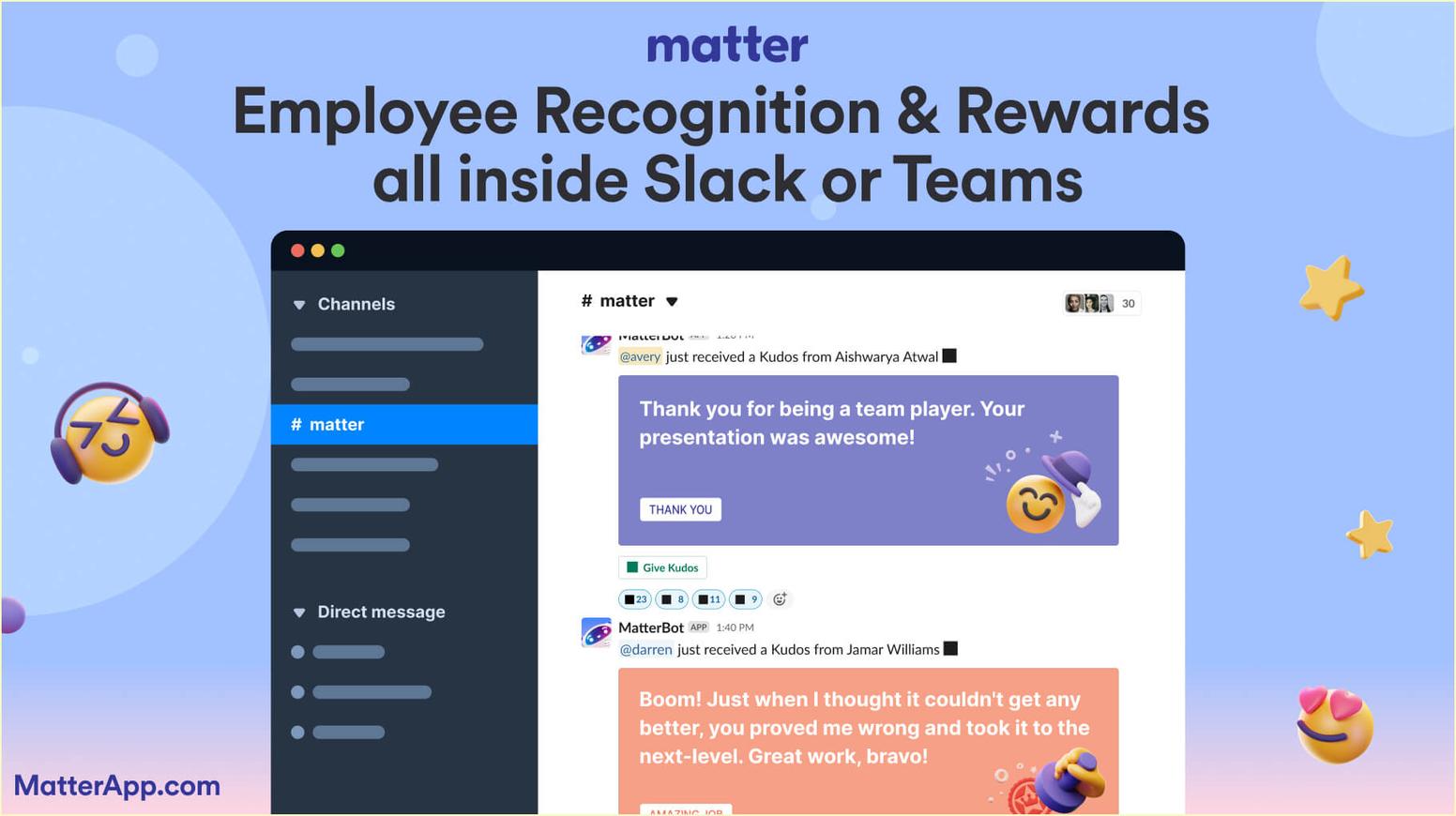
About Matter: Matter is a Slack-first and Teams-first recognition platform designed to simplify employee net promoter score measurement and employee feedback collection. The platform transforms survey participation from a separate task into a seamless workflow experience. Staff receive prompts directly within their communication platforms and can respond immediately without context switching. This integration often doubles or triples response rates compared to traditional email-based survey delivery.
Matter goes beyond simple employee engagement surveys with its unique coin-based reward system and customizable kudos cards. The platform automates birthday and work anniversary celebrations while providing real-time analytics. Its intuitive design allows leaders to set up and integrate the platform in minutes. Feedback Friday automation ensures regular recognition without requiring constant administrative attention.
Matter main features:
- Deep integration with Slack and Microsoft Teams for seamless net promoter score survey delivery
- Automated deployment and intelligent reminder systems
- Real-time analytics connecting recognition patterns to employee sentiment data
- Customizable kudos cards and automated celebrations
Matter pricing:
- Free Forever: $0/user/month
- Basic: $1/user/month, billed annually
- Pro: $3/user/month, billed annually
- Pro + Surveys: $5/user/month, billed annually
To learn more, view Matter's pricing page.
Matter G2 score: Matter has a G2 score of 4.7/5 based on user reviews.
What Matter customers are saying: "Matter helps us encourage behaviors that align with our company values and can allow us to recognize and reward those who exemplify our values." - Autumn Amescua, Chief Culture & People Officer at SXSW (Customer Story)
2. Glint
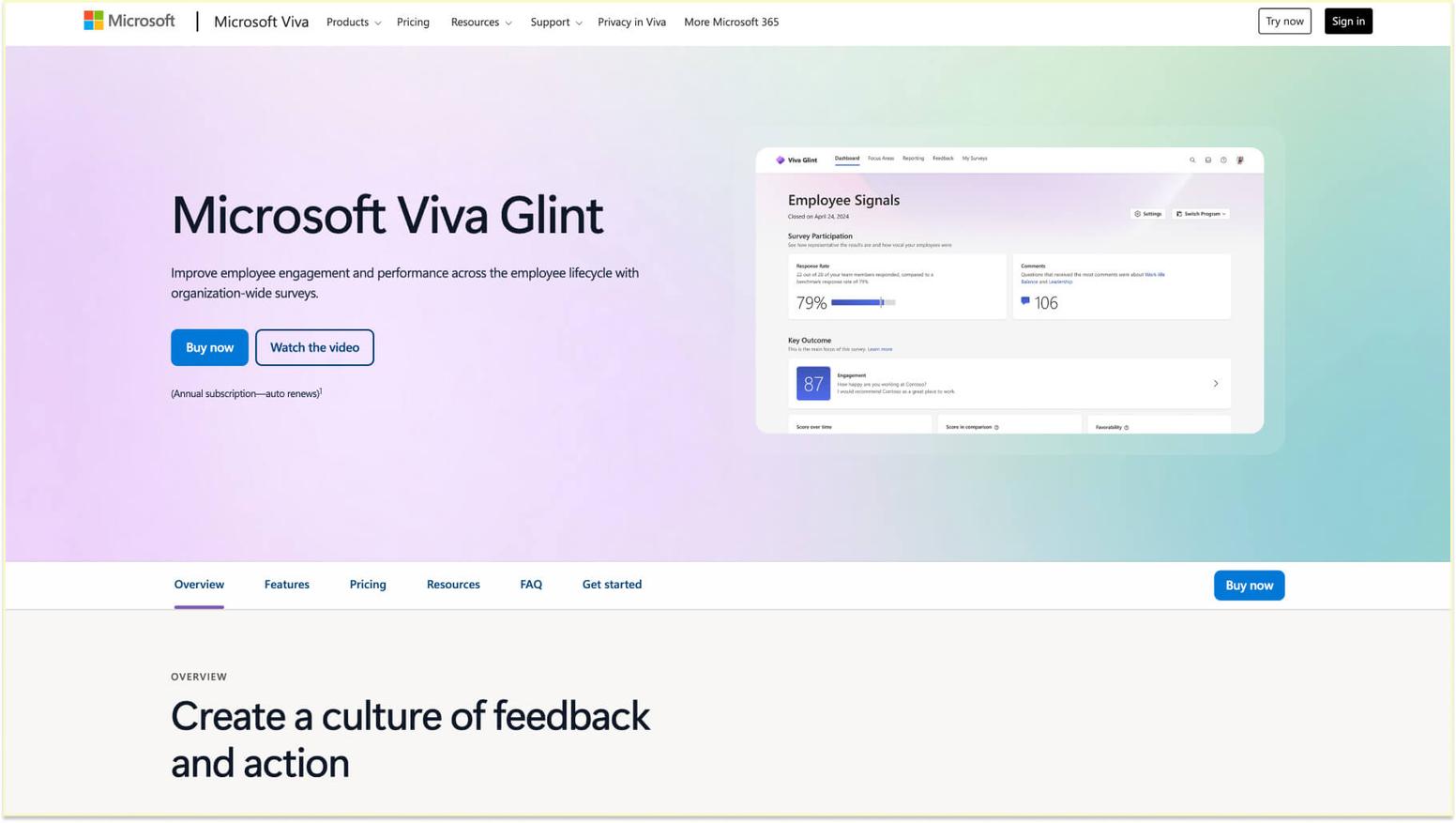
About Glint: Glint combines a standard scale of 0 to 10 measurement with artificial intelligence that surfaces non-obvious patterns from employee feedback. The platform analyzes both quantitative scores and qualitative comments to identify trends before they become widespread problems. Heat maps visualize employee sentiment across departments, locations, and demographic groups. This makes it easy to quickly spot areas needing attention.
Glint main features:
- AI-powered analysis surfacing non-obvious patterns and predictive insights
- Heat map visualization across organizational dimensions
- Prescriptive action recommendations based on identified drivers
- Integration with LinkedIn for comprehensive talent insights
Glint pricing:
- Microsoft Viva Employee: $2.00 user/month (Annual commitment)
- Microsoft Viva Workplace: $6.00 user/month (Annual commitment)
- Microsoft Viva Suite: $12.00 user/month (Annual commitment)
To learn more, view Glint’s pricing page.
Glint G2 score: Glint has a G2 score of 4.6/5 based on user reviews.
What Glint customers are saying on G2: “Good depiction of data, easy to view formats with a variety of different cuts of data available. Not super user-friendly, requires too many clicks to filter the data needed.” - Anjali A., Human Resources Consultant (G2 Review for Software).
3. TinyPulse
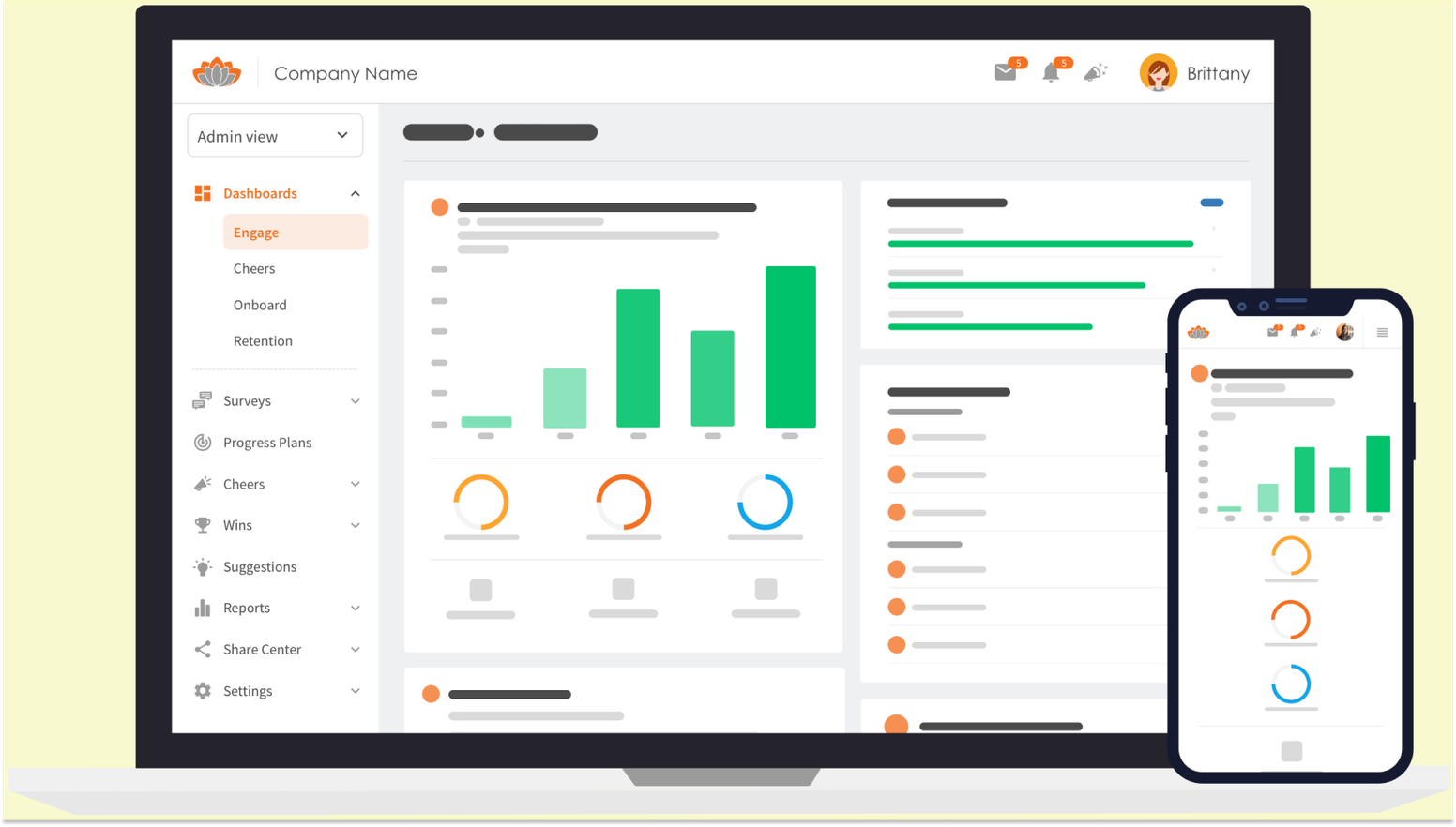
About TinyPulse: TinyPulse integrates anonymous suggestion boxes with employee net promoter score measurement, recognizing that some people want to provide specific improvement ideas. This combination enables staff to move beyond simply indicating dissatisfaction to actively participating in solution generation. Weekly check-in questions maintain regular touchpoints without the formality of comprehensive employee engagement surveys.
TinyPulse main features:
- Anonymous suggestion boxes integrated with employee net promoter score measurement
- Weekly check-in questions, maintaining regular touchpoints
- Peer recognition correlation tracking
- Real-time employee sentiment monitoring and trend detection
TinyPulse pricing: Pricing is not listed on the website. To learn more about pricing, you'll need to schedule a demo/sales call with TinyPulse.
TinyPulse G2 score: TINYpulse has a G2 score of 4.9/5 based on user reviews.
What TinyPulse customers are saying on G2: “Its unfair to the unanonymous effect, its tied through email in our company. so what we think is not known, truly it is by the supervisors. so there isn't anything anonymous.” - Kayla S., Clerical Assistant.
4. Lattice
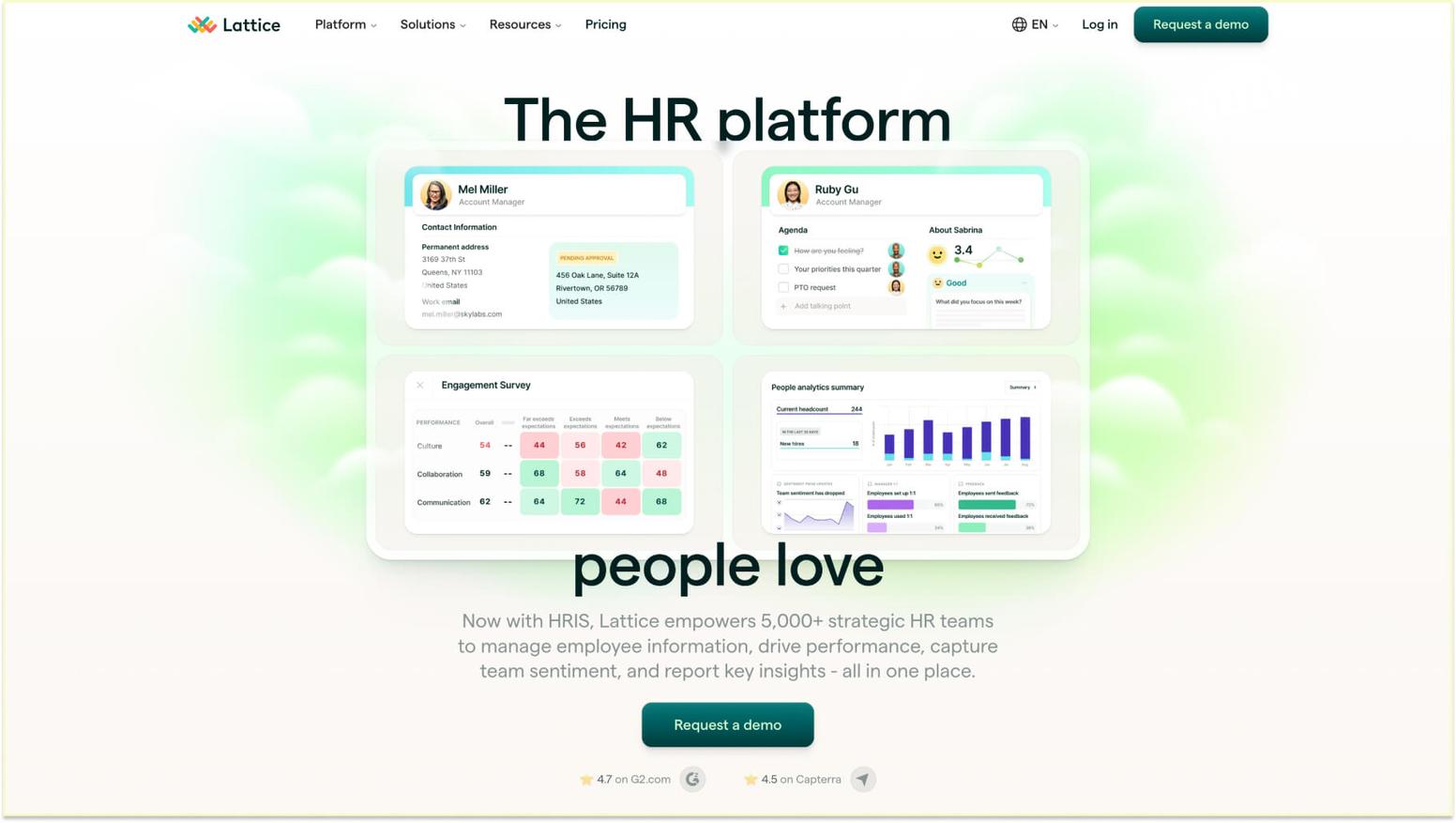
About Lattice: Lattice integrates employee Net Promoter Score measurement with performance management and goal-setting systems. The platform creates comprehensive views of how employee development and recognition connect to employee sentiment and employee loyalty. Companies can examine whether people who receive regular feedback and achieve goals have different scores. This integration reveals whether performance management practices contribute to employee satisfaction.
Lattice main features:
- Integration with performance management and goal-setting systems
- Performance review correlation with employee net promoter score trends
- Career progression visibility tools showing advancement possibilities
- OKR alignment tracking, connecting individual work to company objectives
Lattice pricing:
- Talent Management: $11/seat/month
- Foundation: $11/seat/month
- Engagement: $4/seat/month
- Grow: $4/seat/month
- Compensation: $6/seat/month
To learn more, view Lattice's pricing page.
Lattice G2 score: Lattice has a G2 score of 4.7/5 based on user reviews.
What Lattice customers are saying on G2: “Ease of use and ease of implementation. The implementation time commitment was hours not weeks. We initially implemented all modules except Grow, Comp, and Engage and manged to configure and test all modules in less than two weeks. The product team is very receptive to feedback and also able to help come up with creative workarounds for functional gaps. The customer support is great and very responsive.” - Matthew H., Senior Human Resources Manager (G2 Review for Lattice).
5. 15Five
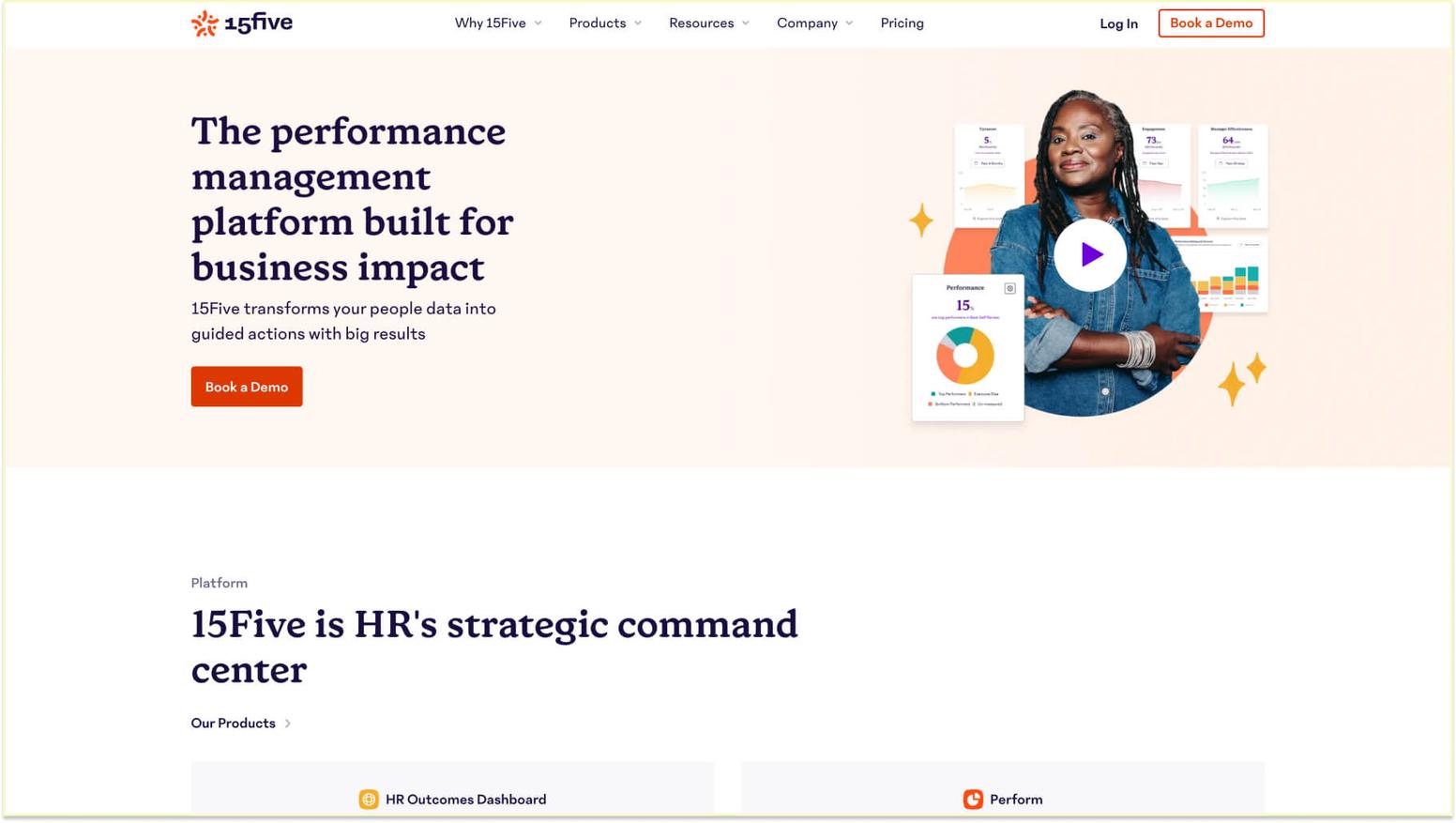
About 15Five: 15Five implements a weekly check-in methodology that keeps managers connected with employee sentiment, challenges, and needs. The brief weekly format creates regular dialogue channels that surface issues early when they are easier to address. OKR alignment tracking helps companies understand whether people whose work clearly connects to objectives receive different scores.
15Five main features:
- Weekly check-in methodology, maintaining regular manager connection
- OKR alignment tracking connecting work to company objectives
- Manager effectiveness scoring with specific behavioral data
- Continuous employee feedback loops between staff and leadership
15Five pricing:
- Engage: $4/user/month, billed annually
- Perform: $11/user/month, billed annually
- Total Platform: $16/user/month, billed annually
To learn more, view 15Five's pricing page.
15Five G2 score: 15Five has a G2 score of 4.6/5 based on user reviews.
What 15Five customers are saying on G2: “We have built a company wide OKR tied to our company wide average Pulse score. It is an easy check of how the company is "feeling" from week to week, and over the last 2 years, I have found it to be accurate, important and super easy for the team to adopt and stay consistent in use.”- Dan A., Small-Business (G2 Review for 15Five).
6. Survale
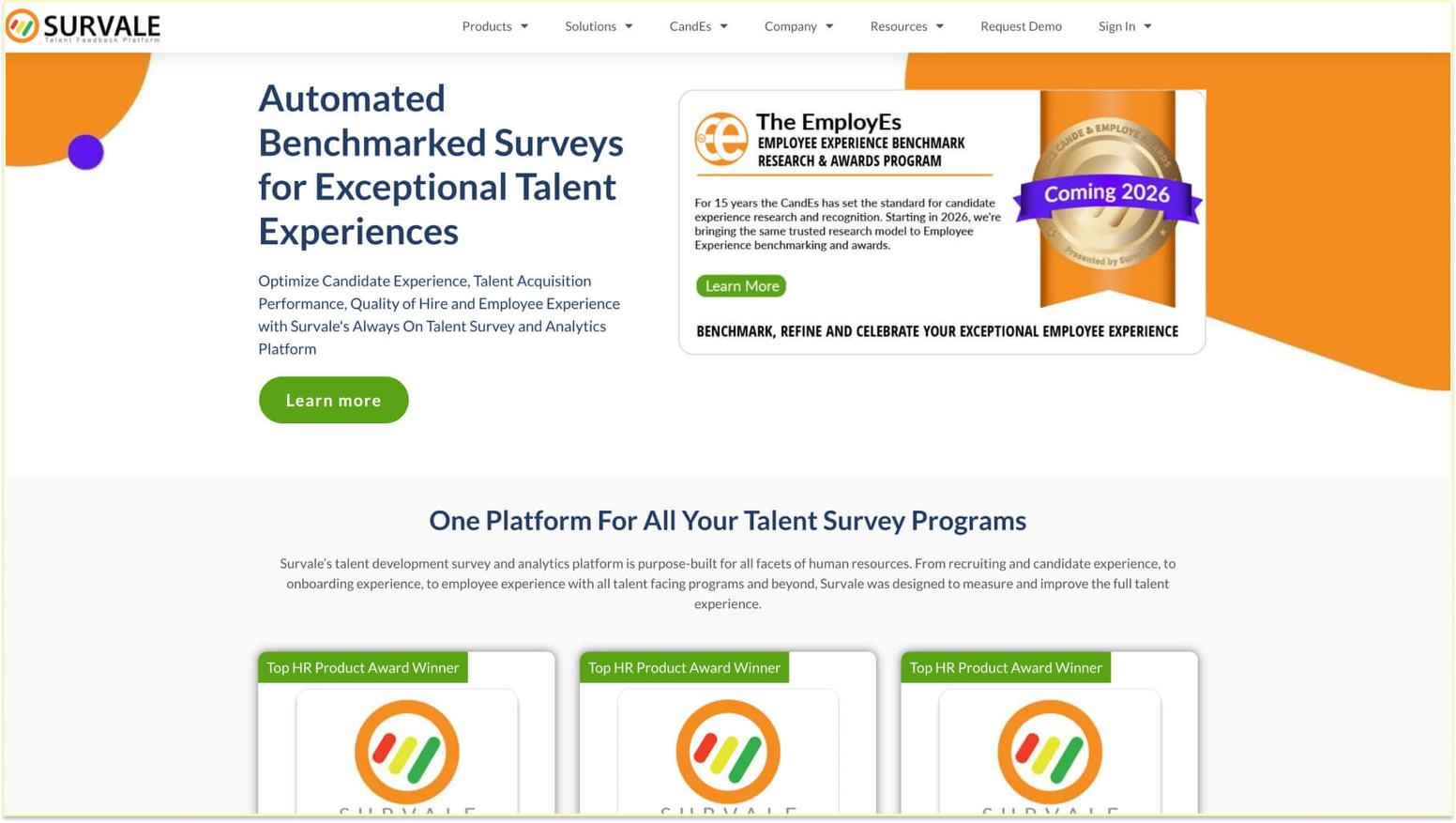
About Survale: Survale is a talent feedback platform designed to gather real-time survey data throughout the entire employee journey, from candidate experience through onboarding to ongoing employee engagement. The platform automatically triggers pulse surveys based on key transactions in your ATS or HRMS, anchoring employee feedback to specific hiring stages and talent programs. This approach enables organizations to identify friction points in their processes and optimize the people, processes, and technologies they use to hire and retain talent.
Survale main features:
- Automated pulse surveys triggered by ATS and HRMS transactions
- Real-time candidate, employee, and hiring manager employee feedback collection
- AI-powered sentiment analysis for open-text comment mining
- Integration with career sites, Slack, and enterprise HR systems
Survale pricing: Pricing is not listed on the website. To learn more about pricing, you'll need to schedule a demo/sales call with Survale.
Survale G2 score: Survale has a G2 score of 4.7/5 based on user reviews.
What Survale customers are saying on G2: “Some of the admin platforms and panels are tricky to navigate and the UX looks a little dated. The front end design is great (which is what matters most) however using the back end - especially if you have dark mode enabled on your browser - makes it tricky to see what you're doing and it's not the prettiest.” Jen G. (G2 Review for Software).
How Matter can help with employee net promoter score measurement
Maximizing the effectiveness of the employee net promoter score survey while minimizing administrative burden requires tools designed specifically for modern workplace communication. As a Slack-first and Teams-first platform, Matter transforms survey participation from a separate task into a seamless workflow experience. Staff receive prompts directly within their communication platforms and can respond immediately without context switching. This integration often doubles or triples response rates compared to traditional email-based delivery.
The platform's automated deployment and reminder capabilities reduce the significant administrative burden on HR teams. Rather than spending time manually scheduling Net Promoter Score surveys, tracking responses, and sending follow-up reminders, companies can configure a preferred cadence. Automation handles the rest, freeing HR professionals to focus on analyzing survey results and implementing improvements to boost engagement.
Key capabilities that enhance employee net promoter score measurement:
- Deep integration with Slack and Microsoft Teams ensures surveys reach people where they already work.
- Intelligent reminder systems reach non-respondents at optimal times without annoying those who participated.
- Real-time participation reports help identify departments needing targeted outreach before the survey closes
- Automated birthday and work anniversary celebrations create ongoing touchpoints, complementing survey insights.
- Analytics connecting recognition patterns to employee sentiment data reveal which teams may benefit from increased appreciation.
The platform's real-time dashboards provide all your leaders with continuous visibility into current employee net promoter score trends. This immediacy enables agile response to concerning developments and rapid amplification of successful practices. Companies using integrated analytics make better, faster decisions about employee experience. Employees report higher satisfaction when they see leadership responding to feedback promptly.
Frequently asked questions about employee net promoter score questions
Q: What is the difference between traditional Net Promoter Score questions and simplified formats?
A: Traditional employee net promoter score uses a scale of 0 to 10 where 9-10 ratings identify promoters, 7-8 identify passives, and 0-6 identify detractors. Simplified formats like Matter's 5-point scale reduce cognitive load and increase completion rates while still accurately categorizing respondents. Both approaches measure employee engagement and recommendation likelihood, but simplified scales often achieve higher response rates, especially on mobile devices.
Q: How many net promoter score questions should I include in each survey?
A: Start with the primary eNPS question, then add 2-3 targeted open-ended question follow-ups based on the initial response. This approach balances comprehensive employee feedback with survey fatigue, ensuring higher completion rates and more thoughtful answers employees provide.
Q: How often should companies send employee net promoter score questions?
A: Most companies benefit from quarterly employee net promoter score surveys to identify trends without overwhelming staff. High-performing companies may deploy monthly pulses on specific topics while maintaining quarterly comprehensive measurements for year-over-year comparisons.
Q: What makes a net promoter score survey question effective?
A: Effective net promoter score questions are clear, unbiased, and actionable. They focus on the likelihood of recommendations rather than overall employee satisfaction. Consistent language across surveys enables reliable trending. Open-ended question follow-ups allow respondents to explain ratings.
Q: How do you calculate employee net promoter score from survey responses?
A: When calculating eNPS, subtract the percentage of detractors from the percentage of promoters. Passives are excluded from the calculation. Scores above 0 are good, above 30 are great, and above 50 are excellent.
Q: Should employee net promoter score questions be anonymous?
A: Anonymous surveys typically yield more honest employee feedback, especially from detractors who may fear consequences. Named surveys allow personalized follow-up. Many companies use anonymous quarterly surveys supplemented by named pulse surveys for specific initiatives.
Q: How does employee net promoter score relate to customer satisfaction measurement?
A: The net promoter system created for measuring customer satisfaction and customer loyalty was adapted to create employee NPS. Both measure customer satisfaction and employee satisfaction through recommendation likelihood. Companies with engaged employees typically achieve better customer loyalty.
Q: What is a good employee net promoter score benchmark?
A: Industry averages vary, but generally scores above 0 indicate more promoters than detractors. Scores between 10-30 suggest moderate employee engagement, while scores above 50 indicate exceptional workplace satisfaction. Comparing against industry benchmarks helps contextualize your organization's results.
Final thoughts about employee net promoter score questions
Well-crafted net promoter score questions provide companies with powerful tools for measuring employee loyalty and employee engagement through simple inquiries. Strategic deployment of core questions supplemented by thoughtful open-ended question follow-ups transforms abstract concepts into quantifiable metrics. Leadership teams can effectively track, analyze, and act on these insights to improve employee satisfaction. Companies that master the employee net promoter score methodology gain early warning systems for employee retention risks and clear baselines for measuring initiatives.
Integration of employee net promoter score measurement with recognition and rewards platforms creates particularly powerful synergies. These reveal connections between appreciation practices and employee sentiment while maintaining high response rates. Platforms designed for modern workplace communication address fundamental usability challenges that plague traditional survey approaches. Survey participation becomes effortless and intuitive while preserving all analytical value for understanding how employees feel.
Companies implementing thoughtfully designed employee net promoter score programs gain comprehensive solutions for deploying effective surveys. They maximize response rates and create cultures of continuous improvement informed by regular employee feedback. The result is a workplace where people feel heard, valued, and genuinely connected to the company's success.
Ready to transform employee feedback into valuable insights? Schedule a demo with a Matter expert today and discover how our platform can help you deploy effective employee net promoter score questions, maximize response rates, and create a culture of continuous improvement.

![19+ eNPS Survey Questions for Employees [2026 Examples]](https://cdn.sanity.io/images/kqqb5xry/production/28137ecca2090eeb56f13e159bfc35c4df05f92d-800x600.jpg?w=720&q=75&fit=max&auto=format)
![What is eNPS? [2026 Guide with 15+ Questions & Benchmarks]](https://cdn.sanity.io/images/kqqb5xry/production/4b5337449a386be4c8b38ab0538f89a7ff9c5427-800x600.jpg?w=720&q=75&fit=max&auto=format)
![49+ Employee Engagement Survey Questions [2026 Guide]](https://cdn.sanity.io/images/kqqb5xry/production/4d901490615b37aeb81f024d7f5666a52dc8aa8b-800x600.jpg?w=720&q=75&fit=max&auto=format)