
Building a workplace where employees feel heard requires more than annual check-ins. At Matter, we recognize that organizations encounter significant challenges in selecting the right pulse surveys, responding to concerns before they escalate, and maintaining meaningful connections with their teams. Traditional annual engagement surveys often leave companies waiting months for insights, missing critical moments when timely intervention could prevent disengagement or boost morale. Without effective pulse survey software to collect employee feedback continuously and measure employee engagement accurately, organizations struggle to identify workplace trends early and create the feedback loops necessary for improvement. This reactive approach can lead to declining employee satisfaction, disconnected leadership, and ultimately, a culture where employees question whether their voices truly matter.
What is a pulse survey?

Pulse surveys represent a strategic shift in how organizations approach employee engagement surveys and the collection of feedback. Rather than waiting months between check-ins, these frequent feedback mechanisms provide immediate insights into employee sentiment, workplace culture, and team effectiveness as situations unfold. Understanding what pulse surveys are and how they differ from traditional engagement survey approaches helps organizations maximize their impact on employee engagement.
Defining pulse surveys and their strategic purpose
A pulse survey is a brief, focused questionnaire distributed regularly to employees to measure employee engagement, satisfaction, and sentiment on specific workplace topics. Unlike comprehensive employee surveys that can take considerable time to complete, pulse surveys deliver quick assessments through targeted questions that employees can answer in minutes. This approach enables organizations to maintain continuous listening without creating survey fatigue, making it easier to track changes in employee engagement over time and respond to employee needs proactively.
The strategic purpose extends beyond simple data collection. These pulse surveys help businesses:
- Monitor employee engagement metrics continuously rather than annually
- Identify emerging workplace issues before they affect retention
- Assess the impact of new initiatives or modifications in real time
- Foster an organizational culture in which employees feel appreciated and their voices are acknowledged
- Gather real-time insights that inform immediate action plans for improving employee engagement
How pulse surveys differ from traditional engagement surveys
Traditional employee engagement surveys typically occur once or twice a year, featuring extensive question sets that cover various aspects of the employee experience. While these annual engagement surveys provide comprehensive data, their infrequent timing means organizations often discover problems months after they begin. In contrast, pulse surveys operate on shorter cycles, from weekly to monthly, focusing on specific themes or recent events that affect engaged employees and overall employee engagement.
The key differences include frequency, length, and purpose:
- Pulse surveys collect feedback through shorter questionnaires distributed more frequently
- Traditional engagement surveys offer depth while pulse surveys prioritize agility
- Annual engagement surveys measure overall sentiment, whereas pulse surveys track trends and changes in employee engagement
- Pulse survey tools enable faster response to address concerns immediately and boost employee engagement
The frequency and timing of effective pulse surveys
Determining the right frequency for pulse surveys depends on the organization's needs, workforce size, and the specific metrics being measured. Many successful companies implement weekly pulse checks for high-priority projects or rapid-growth periods, while others maintain monthly or quarterly schedules for general engagement measurement. The goal is to find a rhythm that provides continuous development of insights without overwhelming employees with constant requests for feedback.
Effective timing considerations include:
- Aligning survey deployment with natural work cycles or project milestones
- Avoiding periods of high stress or major organizational changes
- Creating consistency so employees anticipate and prepare for participation
- Using event-triggered scenarios for specific situations, like onboarding or post-training
- Monitoring response rates to adjust frequency and maintain engagement
What is the purpose of pulse survey tools in modern workplaces?
Modern workplaces demand agility in understanding and responding to employee needs. Pulse surveys serve as essential platforms for organizations to maintain continuous dialogue with their workforce, moving beyond annual check-ins to create responsive, people-focused cultures. These pulse surveys empower businesses to listen consistently and act decisively based on real-time data about employee engagement.
Measuring employee engagement in real-time
Real-time feedback capabilities distinguish contemporary pulse survey software from traditional employee surveys. Organizations can now measure employee engagement as it fluctuates, capturing sentiment during critical moments rather than depending on historical data that may no longer accurately represent current conditions. This immediacy allows leaders to understand what drives performance, identify disengaged employees early, and intervene with targeted support before productivity or morale declines significantly.
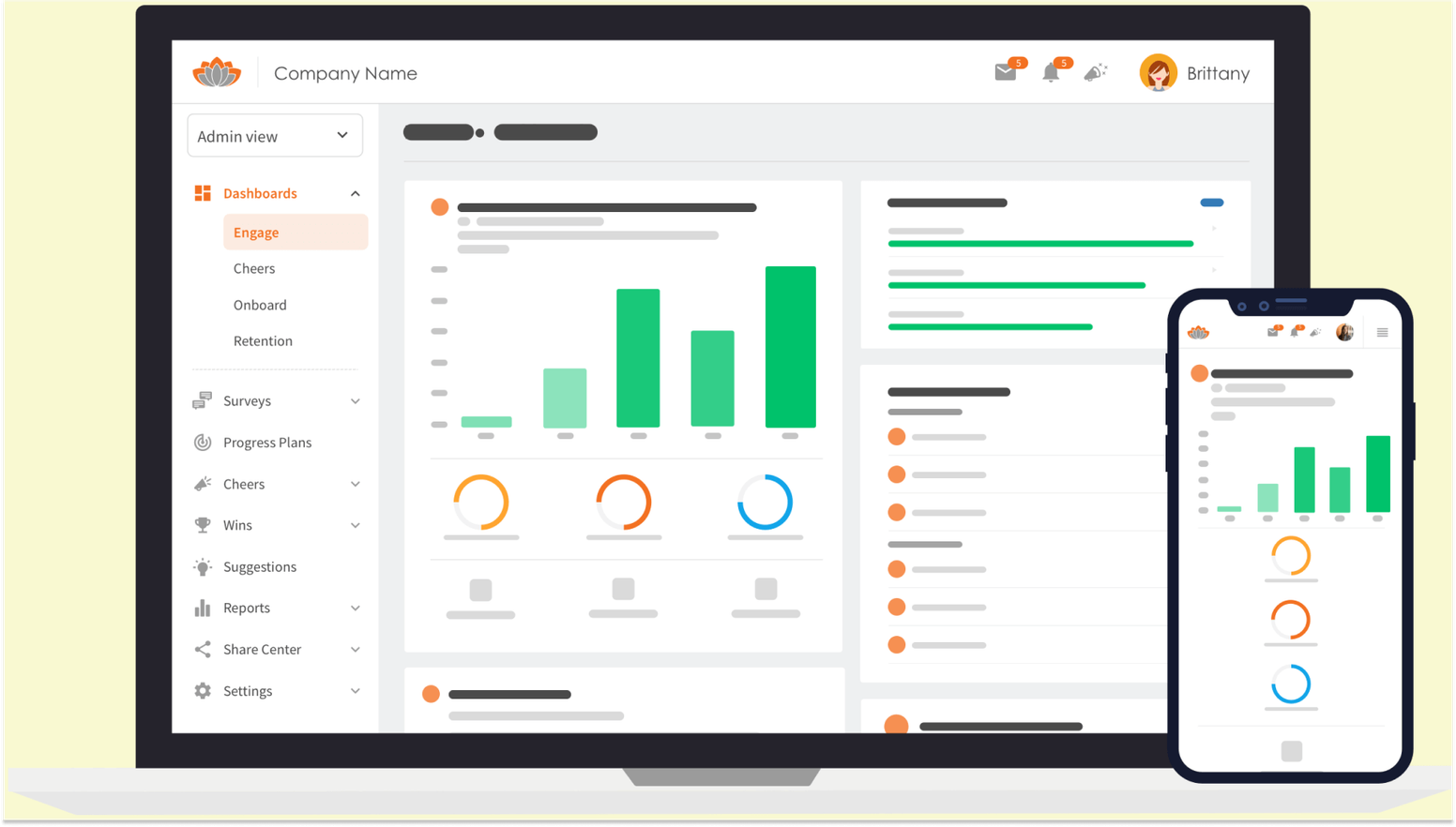
Employee engagement pulse survey tools provide dashboards that display engagement results instantly, enabling leadership teams to:
- Track changes in employee satisfaction week over week
- Monitor the impact of policy changes or leadership decisions immediately
- Identify departments or teams requiring additional support
- Celebrate improvements and recognize positive trends quickly
- Connect employee mood fluctuations to business events or external factors
Identifying workplace trends before they become issues
Prevention is often more effective than remediation in managing workplace challenges. Pulse survey tools excel at uncovering patterns that signal potential problems, from declining morale in specific teams to concerns about communication or resources. By analyzing survey responses over time, organizations can identify subtle shifts in employee sentiment that may indicate larger issues developing beneath the surface, allowing for proactive intervention before situations escalate.
Advanced analytics within these platforms help identify:
- Recurring themes in anonymous feedback that require attention
- Correlations between engagement metrics and business performance
- Team-specific challenges that differ from organization-wide patterns
- Early warning signs of increased turnover risk
- Opportunities to improve employee experience through targeted initiatives
Creating continuous feedback loops for improvement
Sustainable workplace improvement requires ongoing dialogue rather than isolated conversations. Employee recognition and feedback become interconnected when pulse surveys facilitate regular check-ins, making it natural for organizations to collect employee feedback, analyze insights, and communicate actions taken in response. This closed-loop approach demonstrates that leadership values employee input, encouraging greater participation and trust in the process.
Building effective continuous feedback systems involves:
- Establishing regular cadences that employees expect and rely on
- Sharing survey results transparently with teams
- Communicating specific action plans based on feedback received
- Following up on previous concerns to show progress
- Integrating recognition moments when positive changes occur
Key features of top pulse survey tools

Selecting the right employee engagement software necessitates identifying which features provide the greatest value, tailored to your organization's particular requirements. The best pulse survey software combines ease of use with powerful capabilities that transform raw data into actionable insights. These essential features separate effective pulse surveys from basic survey platforms and help drive better employee engagement.
Automation and scheduling capabilities
Automation transforms pulse surveys from manual tasks into seamless, recurring processes that require minimal administrative effort. Leading pulse survey software platforms enable teams to create pulse surveys once and schedule automatic distribution at predetermined intervals, ensuring consistency without constant oversight. This automation includes smart reminders for non-respondents, scheduled reporting for stakeholders, and triggered pulse surveys based on specific employee milestones or events that impact employee engagement.
Key automation features include:
- Recurring pulse survey schedules with customizable frequencies and timing
- Automated reminders that boost employee engagement without manual follow-up
- Event-triggered pulse surveys for onboarding, exits, or project completions
- Self-serve data collection processes that respect employee preferences
- Integration with HRIS systems to target specific employee segments automatically
Analytics and reporting dashboards
Data becomes valuable when transformed into actionable insights through robust analytics. Top survey tools offer intuitive dashboards that visualize employee engagement trends, compare results across departments or time periods, and pinpoint areas that require attention. These real-time analytics capabilities enable leaders to quickly identify patterns in employee engagement, drill down into specific responses for detailed insights, and generate reports that inform strategic decisions about workplace improvements and engagement survey outcomes.
Effective analytics platforms offer:
- Real-time data visualization showing current employee sentiment and engagement
- Trend analysis comparing engagement survey results across multiple survey cycles
- Segmentation capabilities to view responses by team, location, or role
- Regression analysis tools identifying factors most impacting employee engagement
- Customizable survey templates and reports for different stakeholder audiences
Integration with workplace communication platforms
Seamless integration with tools employees already use daily increases participation rates and makes feedback collection feel natural rather than burdensome. The most effective pulse survey platforms connect directly with Slack and Microsoft Teams, allowing employees to receive surveys and provide feedback without leaving their workflow. This integration reduces friction and makes continuous listening an embedded part of company culture rather than an external task.
Integration benefits include:
- Higher response rates through reduced effort and improved accessibility
- Consistent participation across remote, hybrid, and in-office teams
- Instant notifications when new surveys become available
- Unified communication channels that centralize workplace interactions
- Direct links between survey insights and recognition or rewards systems
18 top pulse survey tools comparison
Organizations seeking to enhance employee engagement through regular feedback require pulse surveys that align with their specific size, budget, and technical requirements. This comprehensive comparison examines pulse survey tools across enterprise, mid-market, and small organization categories, enabling you to identify platforms that align with your specific needs while delivering the essential features to gather valuable insights and enhance employee engagement.
6 enterprise-level employee engagement pulse survey tools
Enterprise organizations require robust survey software that can handle thousands of employees across multiple locations, complex organizational structures, and sophisticated analytics needs, supporting employee engagement initiatives. These platforms offer advanced features, including AI-powered analysis, comprehensive reporting, and extensive customization options, which support large-scale employee experience and engagement survey initiatives. The following pulse survey tools represent leading solutions designed for enterprise-level engagement measurement:
1. Matter

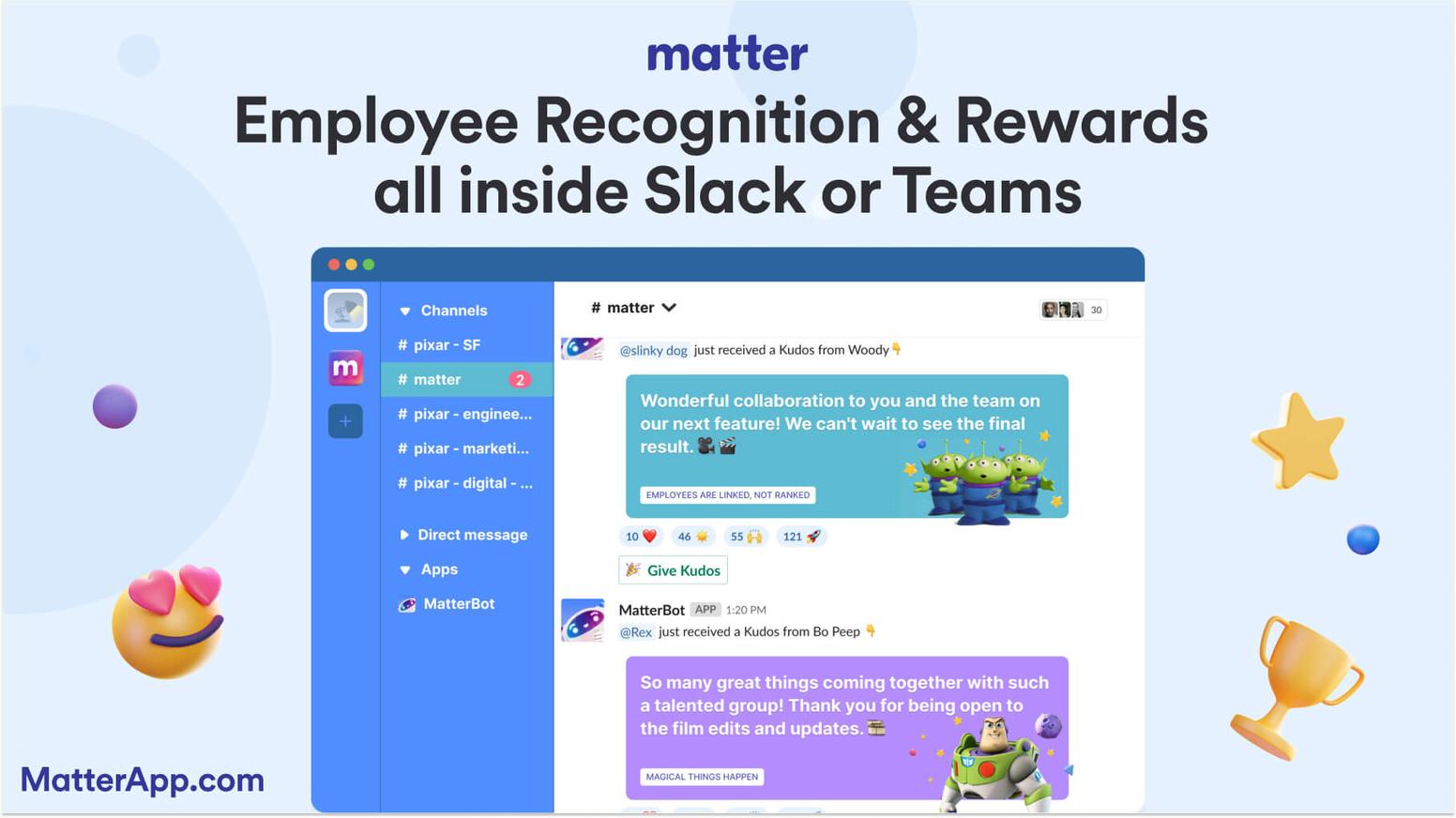
About Matter: Matter stands out in the enterprise space by uniquely combining pulse survey capabilities with an integrated recognition platform, creating a comprehensive solution that addresses both measurement and action. For large organizations managing thousands of employees across global locations, Matter's Slack-first and Teams-first approach ensures pulse surveys reach every team member where they already work, eliminating the friction of separate survey platforms. The platform's custom employee surveys feature allows enterprises to create sophisticated pulse survey workflows tailored to different departments, regions, or employee segments while maintaining centralized analytics and reporting.
What sets Matter apart for enterprise clients is its ability to close the feedback loop immediately through integrated recognition. When pulse surveys reveal engagement wins or exceptional team performance, leaders can respond instantly with kudos and rewards through the same platform, demonstrating that employee voices drive meaningful action. Matter's Pro + Surveys plan provides enterprise-grade survey automation, including scheduled pulse surveys, event-triggered assessments, and customizable question templates that align with organizational objectives. The platform's real-time analytics dashboard provides enterprise leaders with visibility into engagement trends across the entire organization, while enabling drill-down analysis by business unit, location, or demographic segment.
Matter main features:
- Custom employee surveys with advanced automation, scheduling, and templating for enterprise-scale deployment
- Integrated recognition and rewards connecting pulse survey insights directly to appreciation moments
- Slack and Microsoft Teams native integration ensuring maximum participation across distributed workforces
- Real-time analytics dashboards with segmentation capabilities for enterprise-wide and department-level insights
- Automated birthday, work anniversary, and milestone celebrations, reducing administrative burden
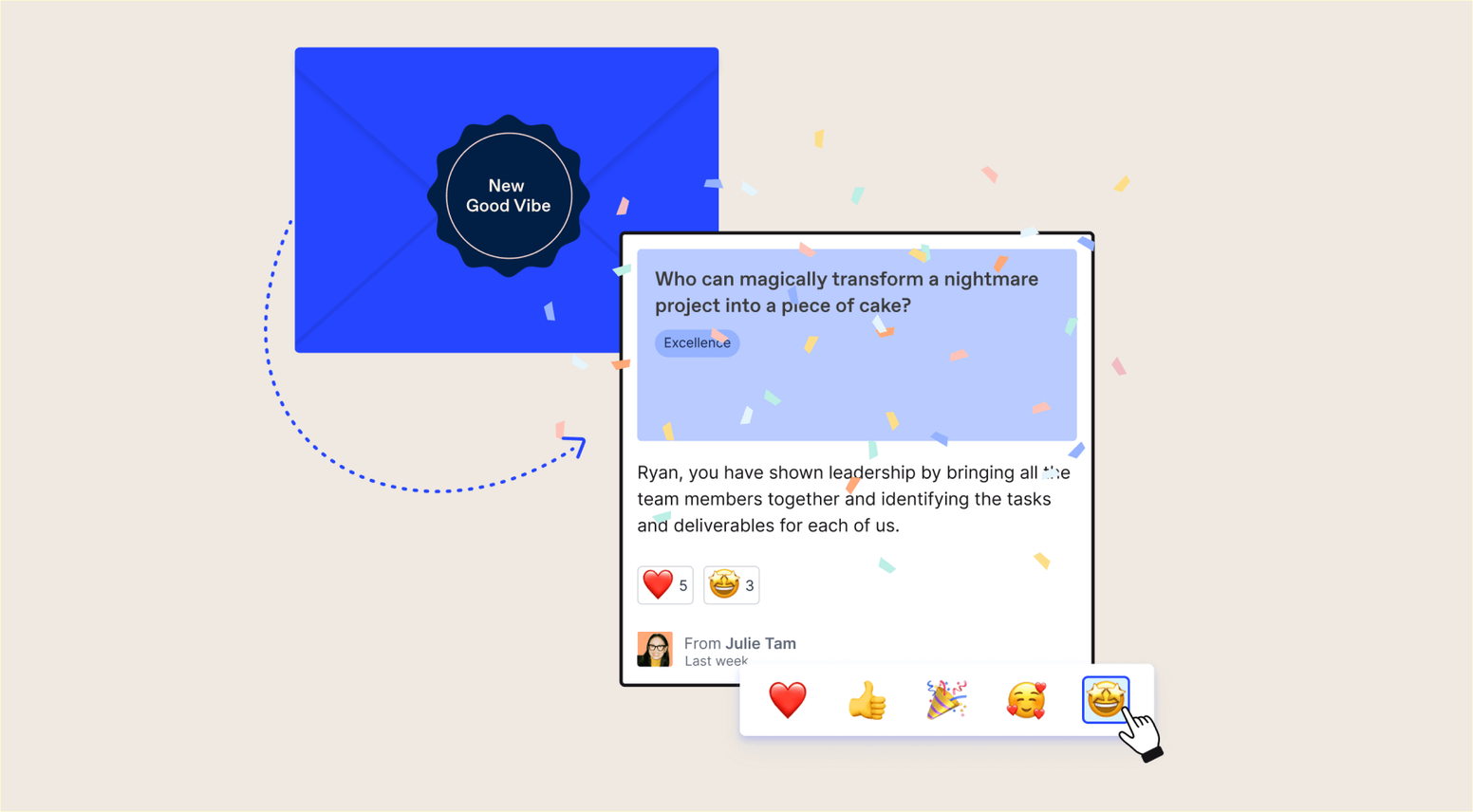
- Beautiful customizable kudos cards aligning recognition with company values and culture
Matter pricing:
- Free Forever: $0/user/month
- Basic: $1/user/month, billed annually
- Pro: $3/user/month, billed annually
- Pro + Surveys: $5/user/month, billed annually
To learn more, view Matter's pricing page.
Matter G2 score: Matter has a G2 score of 4.7/5 based on user reviews.
What Matter customers are saying: "Our brand is less formal, more "joy and yay". Matter allows us to bring our sense of personality to our culture." - Sabrina Roccazzella, Human Resources Business Partner at Cashrewards (Customer Story).
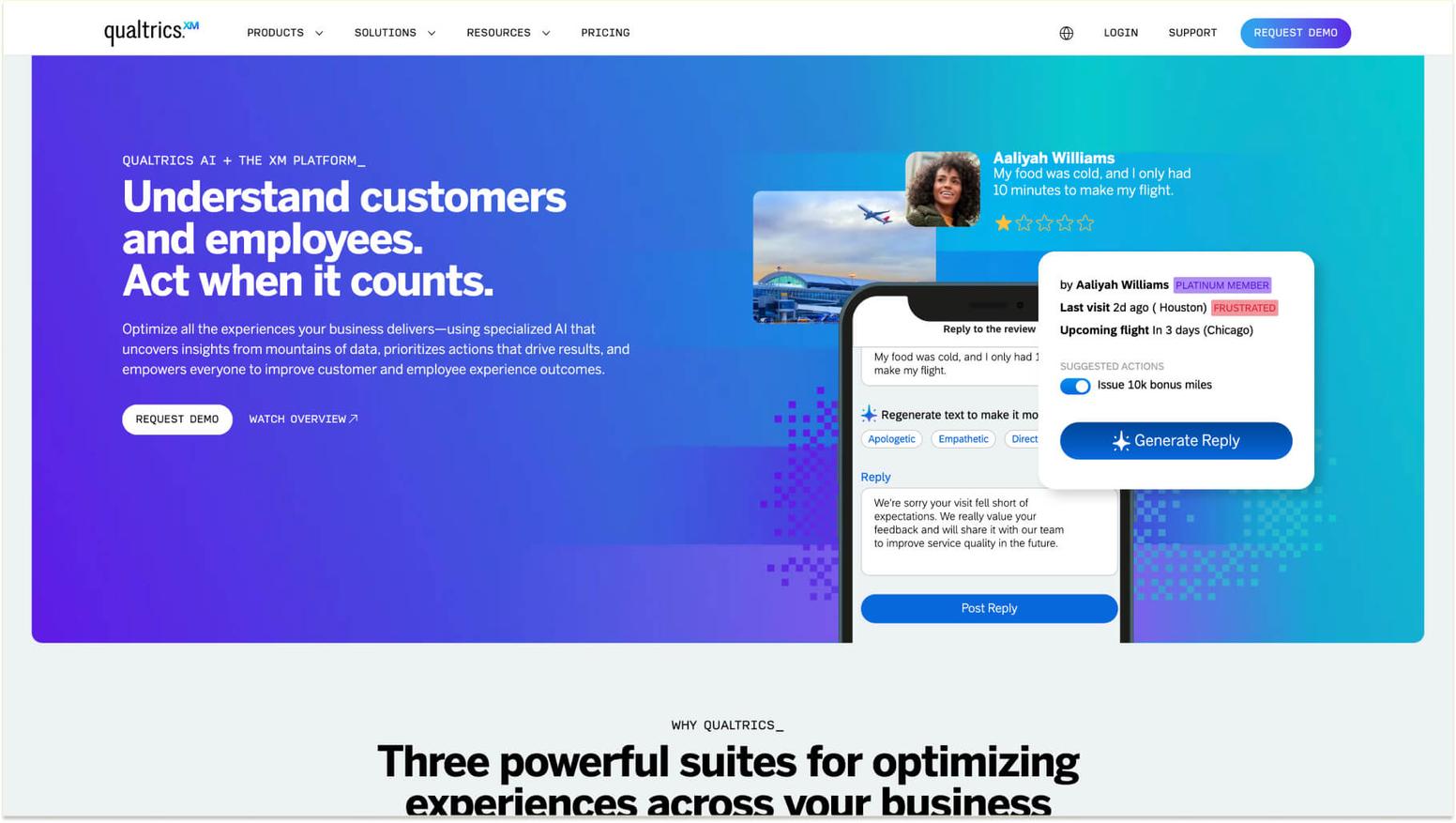
2. Qualtrics EmployeeXM

About Qualtrics EmployeeXM: Qualtrics EmployeeXM offers comprehensive lifecycle surveys covering every stage from recruitment through exit, with advanced analytics that identify predictors of retention and performance. Organizations using this tool benefit from customizable survey templates, integration with major HRIS systems, and consulting support to interpret engagement survey results. The platform excels at connecting employee sentiment with business outcomes through data-driven approaches that link employee engagement metrics to productivity and revenue.
Qualtrics EmployeeXM main features:
- Advanced analytics with AI-powered insights for predicting turnover and engagement trends
- Comprehensive survey templates for pulse surveys, annual engagement, and lifecycle assessments
- Integration with enterprise HRIS systems and workflow automation tools
- Consulting and advisory services to interpret results and develop action plans
Qualtrics EmployeeXM pricing: Pricing is not listed on the website. To learn more about pricing, you'll need to schedule a demo/sales call with Qualtrics EmployeeXM.
Qualtrics EmployeeXM G2 score: Qualtrics EmployeeXM has a G2 score of 4.4/5 based on user reviews.
What Qualtrics EmployeeXM customers are saying on G2: "Preston Donohoo, with Red Pepper, has been fantastic to partner with. He is thorough, excellent at training and his customer support is outstanding. He made our implementation go very smoothly. We have found the Qualtrics engagement survey and 360s tools easy to use, with the ability to dive deep into our results. We would definitely recommend Qualtrics to others." - Kelli G., Global Talent Manager (G2 Review for Qualtrics EmployeeXM).
3. Culture Amp

About Culture Amp: Culture Amp specializes in continuous listening at scale, providing enterprise-grade analytics that process millions of survey responses to uncover insights traditional methods might miss about employee engagement. This solution emphasizes action plans by automatically generating recommendations based on engagement survey results and tracking implementation progress. Leaders appreciate the platform's ability to measure cultural alignment and provide detailed insights into what drives employee retention and engagement across diverse workforce segments.
Culture Amp main features:
- AI-powered analytics that identify patterns across large datasets and benchmark against industry standards
- Automated action planning tools that generate recommendations based on survey results
- Real-time dashboards with customizable views by department, location, and demographics
- Integration with performance management and learning development systems
Culture Amp pricing: Pricing is not listed on the website. To learn more about pricing, you'll need to schedule a demo/sales call with Culture Amp.
Culture Amp G2 score: Culture Amp has a G2 score of 4.5/5 based on user reviews.
What Culture Amp customers are saying on G2: "I've been using this software for a while now, and one of its standout features is how well-organized the system is. Everything is laid out in a clear and intuitive way, making it easy to navigate. Additionally, the punctuality of the communications is exceptional – notifications and updates are always timely, ensuring that I stay on top of tasks and deadlines. It's a reliable tool for those who value efficiency and clear communication. Highly recommended!" - Anna L., SEO Consultant (G2 Review for Culture Amp).
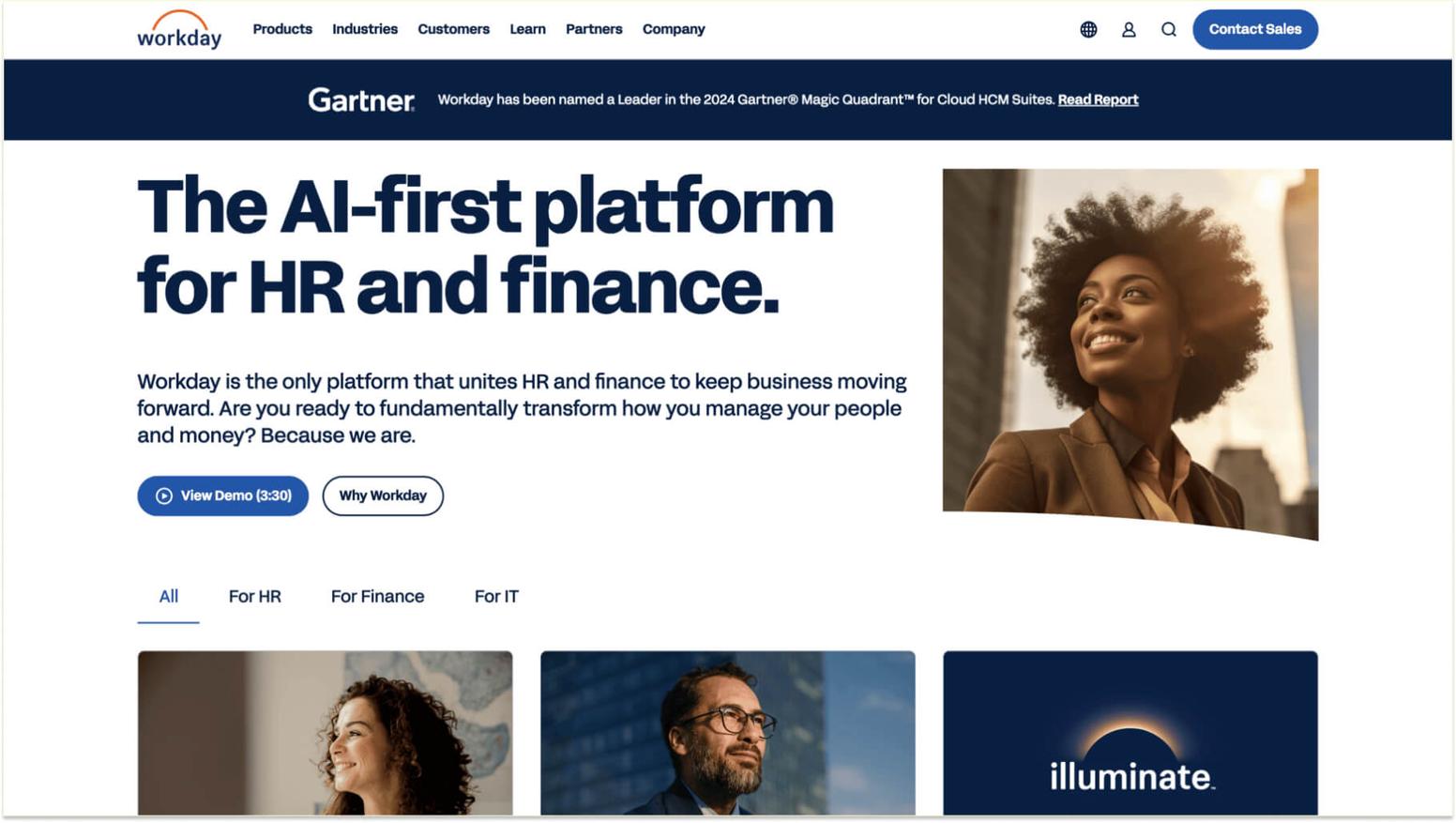
4. Workday

About Workday: Workday combines pulse surveys with comprehensive performance management capabilities, allowing organizations to connect employee engagement data with individual and team performance metrics. The tool's real-time analytics dashboard displays engagement results alongside productivity indicators, helping leaders understand relationships between employee mood, satisfaction levels, and business growth. Advanced segmentation enables analysis of employee engagement by department, location, tenure, and custom attributes.
Workday main features:
- Intelligent listening platform that prioritizes issues requiring immediate attention
- Automated pulse surveys with machine learning that adapts questions based on previous responses
- Integration with Workday HCM for unified employee data and performance tracking
- Multilingual support for global organizations with distributed workforces
Workday pricing:
- $299 Digital-All Access Pass
- Free Digital Essentials Pass
To learn more, view Workday's pricing page.
Workday G2 score: Workday has a G2 score of 4.0/5 based on user reviews.
What Workday customers are saying on G2: "I've found Workday to be a reliable application for handling holiday and HR activities at my company. Its user-friendly interface makes requesting leave and checking balances easy and efficient. Real-time updates ensure I always know my leave status without chasing paperwork. I appreciate the integration with other HR functions, which provides a central hub for important information. While there can be some lag during busy times, overall, Workday simplifies holiday management and enhances transparency for both employees and HR teams." - Saurabh Y., Senior Engineer (G2 Review for Workday).
5. Quantum Workplace

About Quantum Workplace: Quantum Workplace focuses on holistic employee experience measurement, integrating pulse surveys with benefits utilization, career development tracking, and wellness program participation to improve overall employee engagement. This comprehensive approach enables organizations to understand how various aspects of the employee journey influence overall engagement and satisfaction. The platform's predictive analytics utilize historical data to forecast turnover risks and identify high-potential employees who require development support.
Quantum Workplace main features:
- Comprehensive engagement survey tools with customizable templates and automated scheduling
- Goal alignment and performance development features integrated with pulse feedback
- Recognition and rewards platform connected to survey insights and appreciation opportunities
- Advanced reporting with heat maps and trend forecasting for strategic workforce planning
Quantum Workplace pricing:
- Engagement: $2-4/user/month, billed annually
- Performance: $3-5/user/month, billed annually
To learn more, view Quantum Workplace's pricing page.
Quantum Workplace G2 score: Quantum Workplace has a G2 score of 4.4/5 based on user reviews.
What Quantum Workplace customers are saying on G2: "Quantum workplace is very user friendly. The platform is easy to navigate and when you cannot figure something out or have questions their support library and chat features are detailed and quick to use." - Brittney C., Employee Engagement Manager (G2 Review for Quantum Workplace).
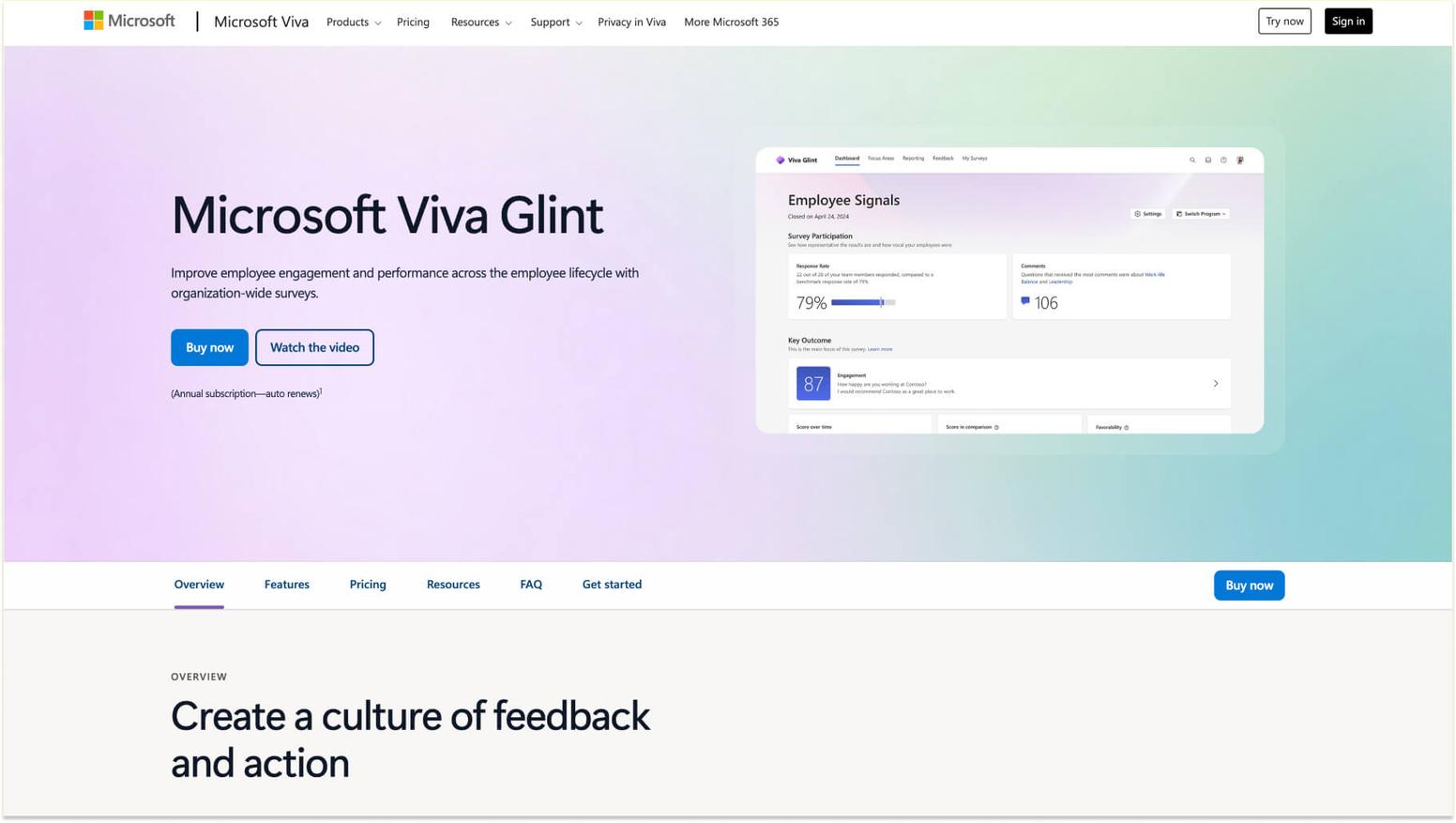
6. Glint

About Glint: Glint delivers AI-powered engagement insights integrated seamlessly within the Microsoft 365 ecosystem, making it ideal for enterprises already using Microsoft tools. The platform offers intelligent pulse surveys that adapt based on organizational trends and individual responses, directing leadership attention to areas that require immediate action. Viva Glint's strength lies in its sophisticated analytics that connect engagement data with productivity metrics, helping enterprise leaders understand how employee sentiment impacts business performance across different teams and regions.
Glint main features:
- AI-driven insights that automatically surface key engagement drivers and recommend specific actions
- Seamless integration with Microsoft Teams, Outlook, and the broader Microsoft 365 suite
- Real-time dashboards with predictive analytics forecasting engagement trends and turnover risks
- Multilingual pulse surveys supporting global enterprises with diverse workforces
- Customizable survey templates aligned with industry benchmarks and best practices
- Action planning tools that help managers translate insights into concrete improvement initiatives
Glint pricing:
- Microsoft Viva Employee: $2.00 user/month (Annual commitment)
- Microsoft Viva Workplace: $6.00 user/month (Annual commitment)
- Microsoft Viva Suite: $12.00 user/month (Annual commitment)
To learn more, view Glint's pricing page.
Glint G2 score: Glint has a G2 score of 4.6/5 based on user reviews.
What Glint customers are saying on G2: "Good depiction of data, easy to view formats with a variety of different cuts of data available. Not super user-friendly, requires too many clicks to filter the data needed." - Anjali A., Human Resources Consultant (G2 Review for Software).
6 mid-market pulse survey tools for growing teams
Growing organizations need pulse survey capabilities that scale with their expanding workforce without enterprise-level complexity or cost. Mid-market tools strike a balance between sophistication and usability, offering essential features for measuring employee satisfaction and engagement while maintaining flexibility as companies evolve. These platforms support organizations navigating growth challenges while building strong workplace cultures and improving employee engagement:
1. Matter

About Matter: Matter addresses the unique challenges facing mid-market organizations by combining affordable, scalable pulse survey capabilities with powerful recognition features that drive engagement without requiring dedicated analytics teams. Growing companies between 100 and 1,000 employees often struggle with survey tools that are either too basic or overwhelmingly complex, but Matter solves this by offering enterprise-grade survey functionality through an intuitive interface that HR teams can master quickly. The platform's Pro + Surveys tier provides comprehensive pulse survey automation, customizable templates, and real-time analytics at a price point that fits growing company budgets. What makes Matter particularly valuable for mid-market organizations is its dual capability as both a pulse survey platform and recognition system—when survey insights reveal team wins or improvement areas, managers can immediately recognize great work or address concerns through the same platform, creating closed-loop feedback that employees see and appreciate without juggling multiple tools or vendors.
Matter main features:
- Affordable pulse survey automation with customizable templates designed for growing teams
- Employee rewards integration, connecting survey insights directly to recognition and appreciation
- Quick setup and intuitive interface requiring minimal training for HR teams and managers
- Slack and Microsoft Teams integration ensuring high participation across hybrid workforces
- Real-time analytics dashboards with filtering by department, location, and team
- Scalable pricing that grows with your organization without forcing platform migrations
Matter pricing:
- Free Forever: $0/user/month
- Basic: $1/user/month, billed annually
- Pro: $3/user/month, billed annually
- Pro + Surveys: $5/user/month, billed annually
To learn more, view Matter's pricing page.
Matter G2 score: Matter has a G2 score of 4.7/5 based on user reviews.
What Matter customers are saying: "People can get so busy with their work, that they become unaware of all the good things happening across the company. Matter allows us to see what others are accomplishing and gives us a platform to congratulate each other for wins big and small." - Gabriela Ruiz, Head of People at Hunty (Customer Story).
2. 15Five

About 15Five: 15Five emphasizes actionable data delivery, transforming survey responses into clear recommendations that teams can implement immediately to enhance employee engagement. The platform's smart algorithms analyze feedback patterns and suggest specific interventions based on successful strategies from similar organizations. This guided approach helps mid-market companies take meaningful action even without extensive experience in engagement survey interpretation or organizational psychology.
15Five main features:
- Weekly pulse check-ins integrated with performance conversations and goal tracking
- AI-powered insights that identify trends and suggest specific action items
- Recognition and praise features built into the survey feedback loop
- OKR tracking connected to engagement metrics for a holistic performance view
15Five pricing:
- Engage: $4/user/month, billed annually
- Perform: $10/user/month, billed annually
- Total Platform: $16/user/month, billed annually
- Transform: on-demand packages starting at $99/month
To learn more, view 15Five's pricing page.
15Five G2 score: 15Five has a G2 score of 4.6/5 based on user reviews.
What 15Five customers are saying on G2: "We have built a company wide OKR tied to our company wide average Pulse score. It is an easy check of how the company is "feeling" from week to week, and over the last 2 years, I have found it to be accurate, important and super easy for the team to adopt and stay consistent in use."- Dan A., Small-Business (G2 Review for 15Five).
3. Lattice

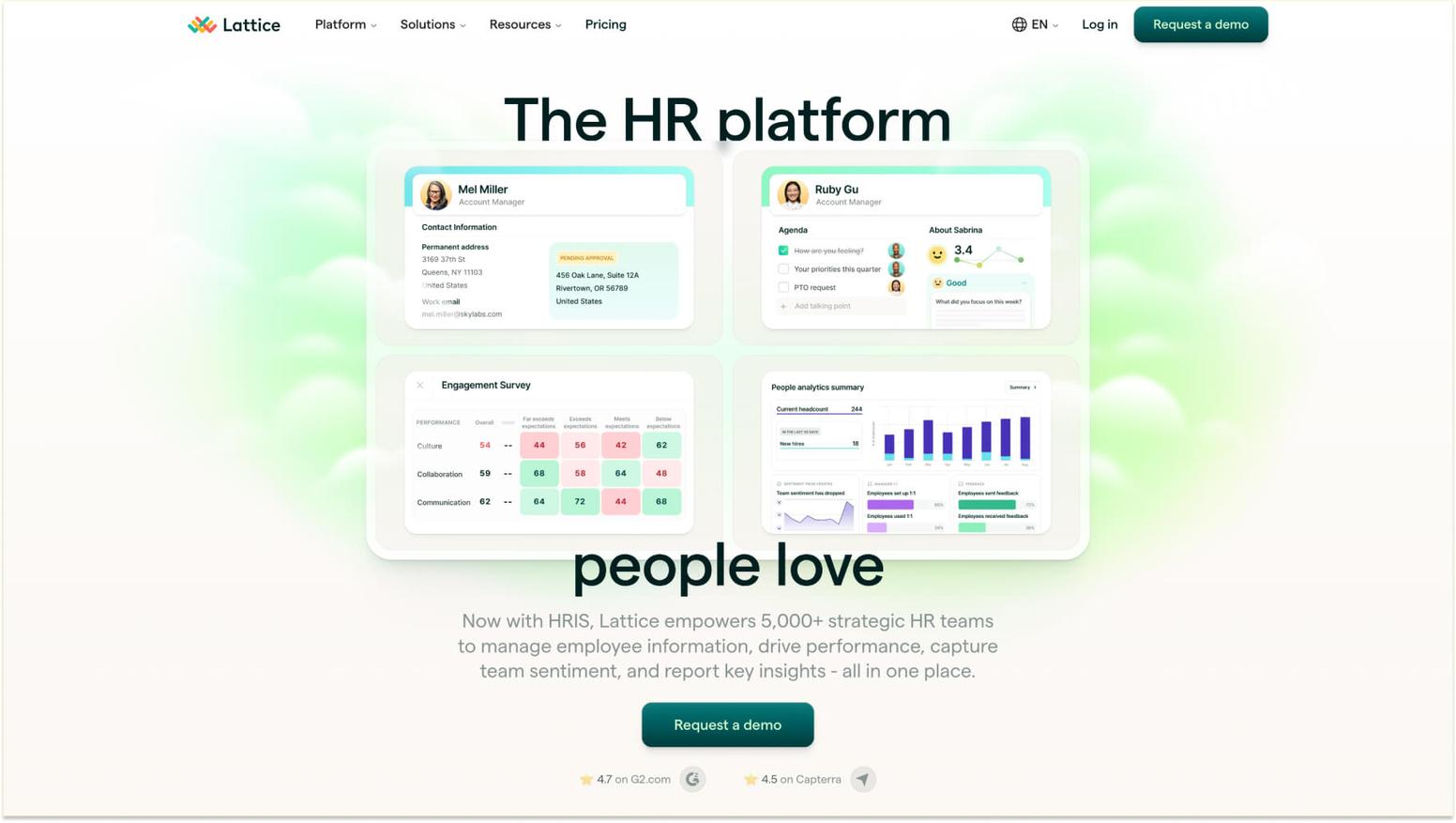
About Lattice: Lattice combines pulse surveys with light performance tracking, enabling managers to correlate employee engagement trends with team productivity and project outcomes. This integration helps growing organizations understand connections between employee sentiment and business success, justifying continued investment in pulse surveys and engagement initiatives. The tool's flexible pricing accommodates rapid headcount growth without requiring frequent contract renegotiations.
Lattice main features:
- Engagement surveys with science-backed questions and automated pulse scheduling
- Performance management and continuous feedback tools integrated with survey data
- Goals and OKRs tracking connected to employee sentiment and engagement trends
- One-on-one meeting templates and conversation starters based on survey responses
Lattice pricing:
- Talent Management: $11/seat/month
- HRIS: $5/seat/month
- Engagement: $4/seat/month
- Grow: $4/seat/month
- Compensation: $6/seat/month
To learn more, view Lattice's pricing page.
Lattice G2 score: Lattice has a G2 score of 4.7/5 based on user reviews.
What Lattice customers are saying on G2: "Ease of use and ease of implementation. The implementation time commitment was hours not weeks. We initially implemented all modules except Grow, Comp, and Engage and manged to configure and test all modules in less than two weeks. The product team is very receptive to feedback and also able to help come up with creative workarounds for functional gaps. The customer support is great and very responsive." - Matthew H., Senior Human Resources Manager (G2 Review for Lattice).
4. Leapsome

About Leapsome: Leapsome specializes in remote and hybrid team engagement, offering features specifically designed for distributed workforces facing unique challenges in maintaining employee engagement. Survey questions address isolation, communication effectiveness, and work-life balance concerns common in flexible work environments. The platform integrates with video conferencing and collaboration tools to reach employees regardless of location or working arrangements.
Leapsome main features:
- Automated pulse surveys with customizable templates for different team situations
- Learning and development tools integrated with engagement feedback and growth areas
- Compensation and review cycles connected to performance and engagement data
- Analytics dashboards showing engagement trends across remote and hybrid teams
Leapsome pricing: Pricing is not listed on the website. To learn more about pricing, you'll need to schedule a demo/sales call with Leapsome.
Leapsome G2 score: Leapsome has a G2 score of 4.9/5 based on user reviews.
What Leapsome customers are saying on G2: "It is step to step process implementation of sales pattern , customer support , and a lot of feature to understand customer need .It also help to ease of interagtion customer mindset and win situation .It have a good dashboard GUI to understand also support avilable in a single call , once again thank you team leapsome because i was a layman and after half an hour training i became super user." - SUMIT KUMAR O., Senior Technical Sales Engineer (G2 Review for Leapsome).
5. Workleap/OfficeVibe

About Workleap/OfficeVibe: Workleap/OfficeVibe focuses on speed and simplicity, enabling organizations to launch pulse surveys in minutes without extensive configuration or training. Pre-configured workflows guide users through the creation, distribution, and analysis of surveys with minimal effort. Growing companies appreciate the platform's quick time-to-value and straightforward approach to gathering real-time insights about employee experience and engagement.
Workleap/OfficeVibe main features:
- Automated weekly pulse surveys with anonymous feedback collection
- Good Vibes recognition system for peer-to-peer appreciation
- Manager coaching tools and conversation guides based on team survey results
- Slack and Microsoft Teams integration for seamless survey distribution
Workleap/OfficeVibe pricing:
- Free: $0/user/month
- Essential: $3.50/person/month
- Pro: $5/person/month
To learn more, view Workleap/OfficeVibe's pricing page.
Workleap/OfficeVibe G2 score: Workleap/OfficeVibe has a G2 score of 4.3/5 based on user reviews.
What Workleap/OfficeVibe customers are saying on G2: "Officevibe provides a regular stream of honest feedback and discussion between managers and employees across our company. GoodVibes has become THE way our employees appreciate and recognize one another. Our management team disucsses the data and anonymous responses on a monthly basis." - Anthony B., President (G2 Review for Workleap).
6. TinyPulse

About TinyPulse: TinyPulse offers intuitive interfaces designed for HR teams to manage feedback without the need for dedicated analytics specialists. The tool simplifies creating pulse surveys through drag-and-drop builders, pre-built question libraries, and templates based on best practices. Growing companies value the platform's ability to collect employee feedback regularly while automating many administrative tasks, freeing HR teams to focus on interpreting results and implementing improvements that boost employee engagement.
TinyPulse main features:
- Weekly pulse questions that measure employee happiness and gather suggestions
- Anonymous messaging for employees to communicate concerns directly to leadership
- Cheers for Peers recognition system integrated with survey feedback
- Manager coaching resources and action plans based on team survey data
TinyPulse pricing: Pricing is not listed on the website. To learn more about pricing, you'll need to schedule a demo/sales call with TinyPulse.
TinyPulse G2 score: TinyPulse has a G2 score of 4.9/5 based on user reviews.
What TinyPulse customers are saying on G2: "Its unfair to the unanonymous effect, its tied through email in our company. so what we think is not known, truly it is by the supervisors. so there isn't anything anonymous." - Kayla S., Clerical Assistant.
6 affordable tools for small organizations
Small organizations and startups need cost-effective solutions that deliver core pulse survey functionality without unnecessary complexity. These tools prove that measuring employee engagement doesn't require large budgets, offering essential features at accessible price points.
Small teams can implement professional feedback processes that support business success while staying within budget constraints:
1. Matter

About Matter: Matter revolutionizes pulse surveys for small businesses and startups by offering enterprise-quality survey capabilities at startup-friendly prices, including a completely free forever plan that provides essential pulse survey features for even the smallest teams. Small organizations with limited HR resources often struggle to implement professional pulse surveys while managing tight budgets and wearing multiple hats, but Matter eliminates these barriers through intuitive tools that any team member can set up in minutes with no specialized training required. What makes Matter uniquely valuable for small organizations is its dual role as both a pulse survey platform and recognition system, eliminating the need for separate tools and vendors—small teams can launch automated pulse surveys to gather feedback, then use the same platform to celebrate wins and recognize great work when survey insights reveal positive contributions. As small companies grow, Matter's pricing scales affordably, with the Pro + Surveys tier providing comprehensive survey automation for just $5 per user per month, ensuring the platform grows alongside the organization without forced migrations or budget shocks.
Matter main features:
- Free Forever plan providing essential pulse survey capabilities for small teams and startups
- Employee rewards programs integrated with survey insights for a unified engagement approach
- Set up in minutes with no training required, perfect for small HR teams or founders managing people functions
- Slack and Microsoft Teams integration, maximizing participation in small distributed teams
- Automated survey scheduling and templating, eliminating administrative burden
- Affordable scaling with transparent pricing that grows predictably as teams expand
Matter pricing:
- Free Forever: $0/user/month
- Basic: $1/user/month, billed annually
- Pro: $3/user/month, billed annually
- Pro + Surveys: $5/user/month, billed annually
To learn more, view Matter's pricing page.
Matter G2 score: Matter has a G2 score of 4.7/5 based on user reviews.
What Matter customers are saying: "Matter helps us connect and interact while showing people what kind of culture we strive for — we want people to be themselves and feel free to play and have fun at work!" - Leah Howse, Head of Staff at BRIO (Customer Story).
2. SurveySparrow

About SurveySparrow: SurveySparrow offers free plans supporting small teams getting started with pulse surveys, providing basic question sets, simple reporting, and essential automation. As organizations grow, scalable paid tiers add advanced features without forcing migration to entirely new systems. This approach makes professional employee engagement measurement accessible to startups and small businesses previously priced out of the market.
SurveySparrow main features:
- Conversational survey interface that improves response rates and engagement
- Email and SMS survey distribution with automated reminders and scheduling
- Real-time reports with filtering and segmentation capabilities
- Integration with widely-used tools such as Slack, Microsoft Teams, and Zapier
SurveySparrow pricing:
- Free Trial: $0/14-day free trial on exclusive features
- Basic: $19/user/month, billed annually
- Starter: $39/user/month, billed annually
- Business: $79/user/month, billed annually
- Professional: $249/user/month, billed annually
To learn more, view SurveySparrow's pricing page.
SurveySparrow G2 score: SurveySparrow has a G2 score of 4.4/5 based on user reviews.
What SurveySparrow customers are saying on G2: "It produces attractive surveys that are a good experience for the participant. The interface is fairly straightforward and attractive on the backend too. There are good reporting features and export formats (e.g. to SPSS, CSV, and Google Sheets). I really like the audio questions, which automatically transcribe the participants answer as they speak. I can see that being very useful in my work. The branching and display logic is good, allowing control for blocks of questions as well as individual questions and answer options within a question. It allows piping. There are options for scheduling emails and reminders. It's easy to create different links that you can use to track the different channels through which you are sharing your survey. After using it for a year in our company of 16 people, we have decided that the features are good enough that we can switch away from Qualtrics, which has become cost prohibitive. I also like that there are options to push the data automatically to Google Sheets. Customer support is also good, with quick answers to questions via the chat." - Claire Q., Senior Research Associate (G2 Review for SurveySparrow).
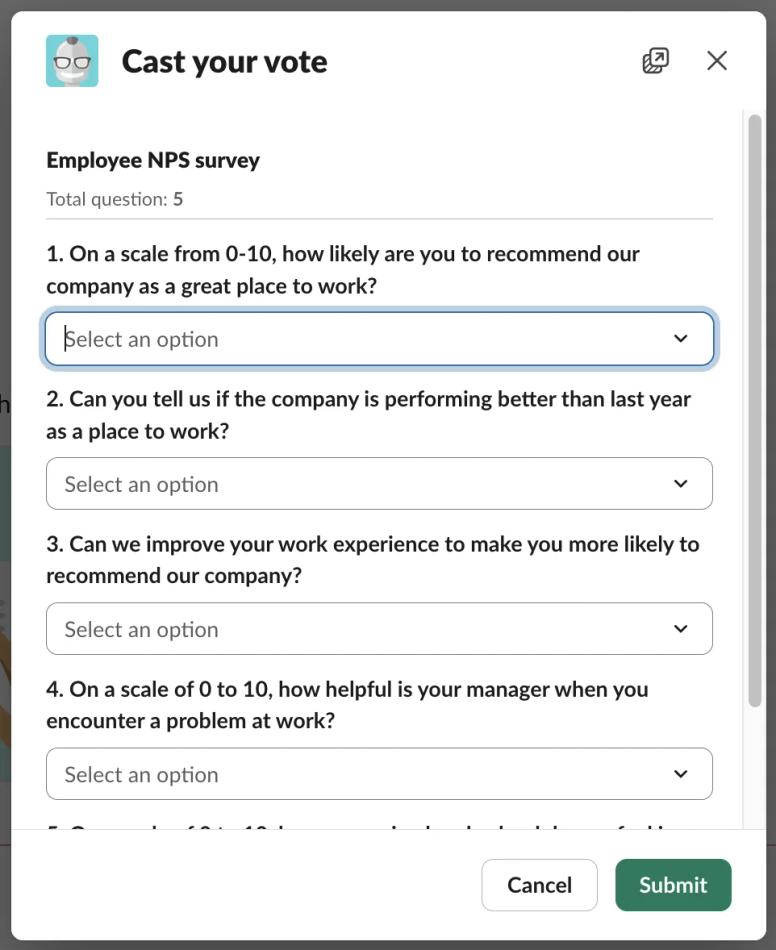
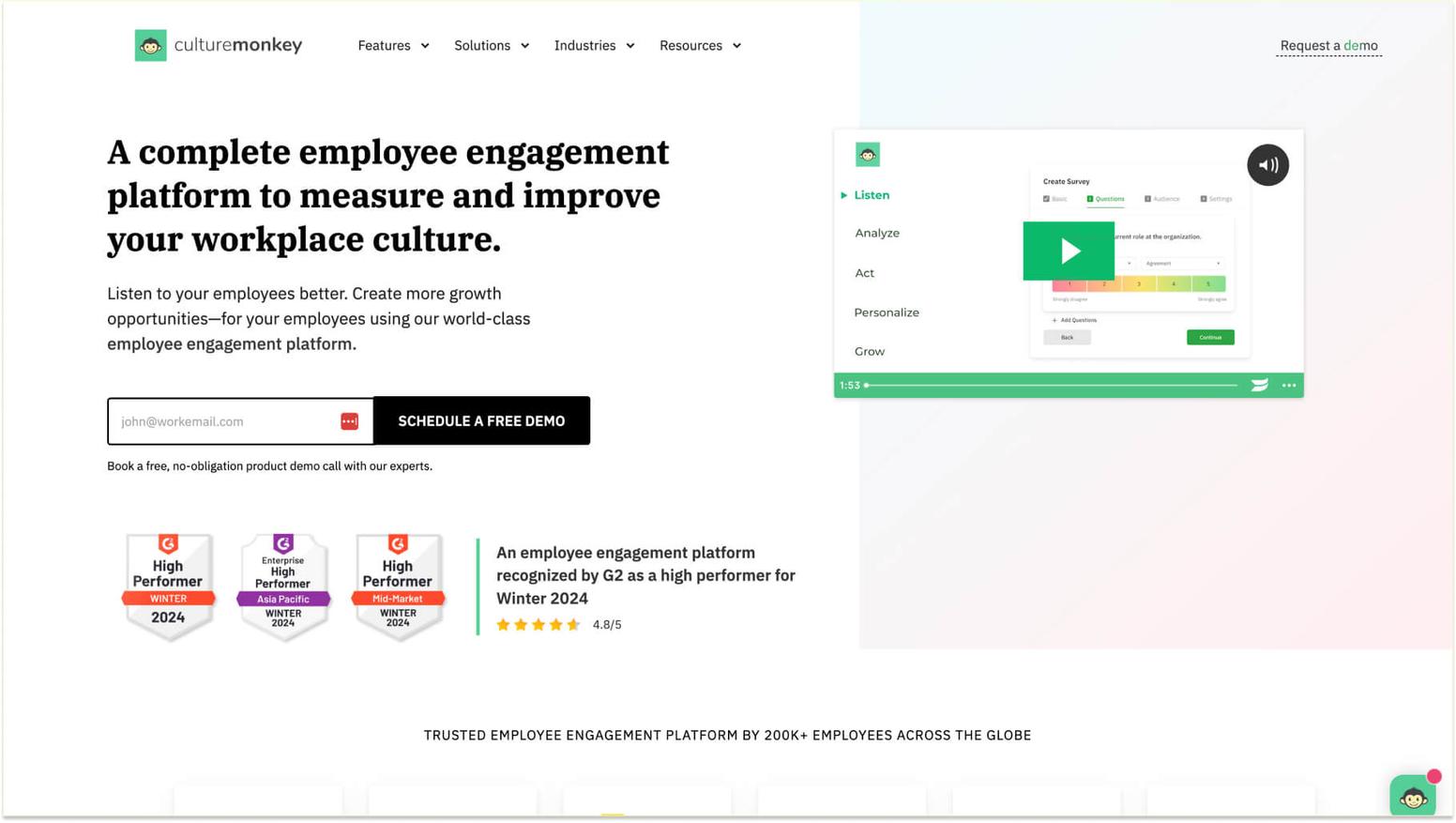
3. CultureMonkey

About CultureMonkey: CultureMonkey specializes in straightforward pulse survey implementations through minimalist interfaces that eliminate overwhelming options. The tool focuses on core functionalities, such as question creation, scheduled distribution, and clear visualization of engagement survey results. Small teams value the platform's simplicity and quick setup, enabling them to start collecting feedback within hours rather than weeks.
CultureMonkey main features:
- Pre-built pulse survey templates designed for small to mid-sized organizations
- Advanced dashboards with manager-level views and customized reports by location and role
- Action planning tools that help stakeholders improve engagement scores
- Multilingual survey support for diverse small business workforces
CultureMonkey pricing: Pricing is not listed on the website. To learn more about pricing, you'll need to schedule a demo/sales call with CultureMonkey.
CultureMonkey G2 score: CultureMonkey has a G2 score of 4.7/5 based on user reviews.
What CultureMonkey customers are saying on G2: "Culture Monkey has the most advanced dashboards that I have come across in a lot of tools that i have evaluated or worked with in the past. There are customized reports and views available, split by manager level, locations, departments and roles. The best feature is the manager-level cuts and the action planning where we can actively involve stakeholders and make them a part of the solution to improve engagement scores across the org." - Pallavi D., Mid-Market (G2 Review for CultureMonkey).
4. Eletive

About Eletive: Eletive is an AI-powered People Success Platform that provides real-time insights through intelligent pulse surveys designed to measure and increase employee engagement and performance. Founded by engineers and psychologists, Eletive combines technology with behavioral science to offer a unique approach that develops organizations and individuals in parallel. The platform's standout feature is its AI-driven personalization, which tailors survey questions based on each individual's previous responses, creating adaptive survey experiences that delve deeper into employee sentiment without requiring manual customization. Eletive covers 11 different areas of employee engagement through pre-made survey packages, ranging from onboarding to diversity and inclusion to offboarding, ensuring comprehensive coverage across the entire employee lifecycle.
Eletive main features:
- AI-powered adaptive surveys that personalize questions based on previous individual responses
- Pre-made survey packages covering 11 engagement categories across employee lifecycle stages
- Machine learning algorithms that ask the right questions at the right time to avoid survey fatigue
- Real-time analytics dashboard with insights and tailored advice based on Organizational Behavior Management theory
- Anonymous feedback features and KIOSK functionality for employees without work phones or email
- Integration with 40+ HRIS systems, including Slack, Microsoft Teams, BambooHR, and Workday
Eletive pricing:
- Essential: contact sales to request for pricing
- Standard: contact sales to request for pricing
- Professional: contact sales to request for pricing
To learn more, view Eletive’s pricing page.
Eletive G2 score: Eletive has a G2 score of 4.6/5 based on user reviews.
What Eletive customers are saying on G2: “They walk the talk (they do what they say and they say what they do). The survey is easy to implement, the plateform is user-friendly and having the results in real time is very helpful! The relationship with our Customer Success Manager and the support we get from her whenever we need it is also making a huge difference for us.” - Karima A., Senior Human Resources Officer (G2 Review for Eletive).
5. Connecteam

About Connecteam: Connecteam provides survey-as-a-service offerings where organizations pay per response rather than per employee, making costs predictable and aligned with actual usage. This model benefits small companies with fluctuating team sizes or seasonal workforces. The platform handles all technical aspects, allowing clients to focus solely on crafting questions and interpreting responses about employee engagement.
Connecteam main features:
- Mobile-first survey platform designed for frontline and deskless workers
- Automated scheduling and reminders for consistent pulse survey participation
- Simple reporting dashboards that highlight key engagement trends
- All-in-one app combining surveys with communication, scheduling, and training
Connecteam pricing:
- Small Business Plan: $0/Free forever
- Basic: $29/month/billed annually
- Advanced: $49/month/billed annually
- Expert: $99/month/billed annually
To learn more, view Connecteam's pricing page.
Connecteam G2 score: Connecteam has a G2 score of 4.6/5 based on user reviews.
What Connecteam customers are saying on G2: "Connecteam does exactly that, it helps my team stay connected. My business team are rarely together at the same time so sharing info remotely is key and connecteam does that for us. It was easy to implement even for the older staff who are not tech savy. We went from a whiteboard and photographs and a whatsapp group to using this app in a single day, we now use this app every day." - Warren W., Business Owner - Telstra shops (G2 Review for Connecteam).
6. Google Forms with Analytics Add-ons

About Google Forms: Google Forms leverages simple free tools enhanced with lightweight analytics add-ons, proving pulse surveys don't always require specialized software. While less sophisticated than dedicated platforms, this approach enables very small organizations to begin measuring employee engagement immediately with zero budget. As needs grow, teams can graduate to full-featured solutions informed by their early pulse survey experiences.
Google Forms main features:
- Free survey creation with unlimited questions and response collection
- Basic analytics and visualization through Google Sheets integration
- Add-ons available for enhanced reporting and automated workflows
- Familiar interface that requires minimal training for small teams
Google Forms pricing:
- Starter: $4.90 user per month
- Standard: 9.80 user per month
- Plus: $15.40 user per month
- Enterprise Plus: Talk to sales for pricing
To learn more, view Google Forms pricing page.
Google Forms G2 score: Google Forms has a G2 score of 4.6/5 based on user reviews.
What Google Forms users are saying on G2: "Honestly, I enjoy using Google Workspace overall, though it can be somewhat challenging when the internet connection is unstable, as most of its tools require being online. Additionally, with so many apps like Docs, Sheets, Drive, and Meet, it can feel a bit overwhelming at first. However, once you become familiar with the platform, everything tends to run very smoothly." - Girishchand B., Test Engineer Level 2 (G2 review for Google Forms).
Best employee pulse survey questions to include in your tools

Crafting effective pulse survey questions directly impacts the quality and usefulness of insights collected about employee engagement. The most valuable questions strike a balance between brevity and depth, targeting specific aspects of the employee experience that organizations can actually influence. Strategic question design transforms simple data collection into powerful pulse surveys that drive workplace improvements and boost employee engagement.
Essential engagement and satisfaction questions
Core engagement questions form the foundation of any effective pulse survey, measuring how connected employees feel to their work, colleagues, and organizational mission. These fundamental queries assess overall satisfaction levels and employee engagement while identifying whether employees find meaning in their contributions. Well-crafted engagement questions provide baseline metrics that organizations track over time to evaluate the success of culture-building initiatives that improve employee engagement.
Effective engagement questions include:
- Rating scales measuring enthusiasm about coming to work each day
- Questions about pride in organizational achievements and reputation
- Assessments of whether work feels meaningful and purposeful for engaged employees
- Inquiries about the likelihood of recommending the organization as a great workplace
- Measures of autonomy and empowerment in daily responsibilities
Leadership and management effectiveness questions
Manager quality significantly impacts employee retention and engagement, making leadership assessment questions critical components of comprehensive pulse surveys. These questions help organizations identify management training needs, recognize exceptional leaders, and address problematic behaviors before they drive turnover. Honest feedback about leadership creates opportunities to improve employee experience through better management practices across all levels.
Key leadership questions address:
- Whether managers provide clear expectations and constructive feedback
- Assessments of communication quality and transparency from leadership
- Evaluations of how well managers support professional development
- Questions about fairness in decision-making and resource allocation
- Measures of psychological safety and openness to employee input
Culture and workplace environment questions
Workplace culture and environment questions examine the less tangible but equally important aspects of employee experience. These queries explore whether company values align with daily behaviors, if teamwork and collaboration thrive, and whether employees feel respected and included. Understanding cultural dynamics helps organizations create environments where diverse employees feel valued and can perform their best work.
Important cultural questions evaluate:
- Alignment between stated company values and actual workplace practices
- Perceptions of inclusivity and psychological safety for all employees
- Quality of peer relationships and team collaboration
- Work-life balance satisfaction and stress management support
- Physical work environment comfort and resource adequacy
Employee pulse survey questions examples for different scenarios
Different organizational situations require targeted survey approaches that address specific contexts and challenges. Kudos employee recognition tied to pulse surveys becomes more effective when questions align with particular scenarios employees experience. Customizing pulse surveys to relevant situations increases response quality and provides insights that directly inform appropriate actions to improve employee engagement.
Onboarding and new hire check-in questions
New employee experiences set the tone for long-term engagement and retention, making onboarding pulse surveys essential for understanding whether early integration processes work effectively. These check-ins occur at strategic intervals throughout the first months, capturing impressions while fresh and identifying friction points in real time. Responsive organizations use this feedback to refine onboarding continuously, ensuring new hires feel supported and confident.
Sample onboarding questions explore:
- Whether training adequately prepares new employees for their responsibilities
- Clarity about role expectations and success metrics
- Comfort level in asking questions and seeking help from colleagues
- Satisfaction with tools and resources provided for job performance
- Overall, a welcome experience and cultural integration progress
Remote work and hybrid team questions
Remote and hybrid arrangements introduce unique challenges requiring specialized pulse survey questions. These assessments help organizations understand whether distributed employees feel connected to teams, have the necessary technology and support, and maintain healthy boundaries between work and personal life. Insights from these surveys guide investments in collaboration tools, communication practices, and remote-friendly policies.
Targeted remote work questions address:
- Effectiveness of virtual collaboration tools and practices
- Feelings of isolation or disconnection from the team and culture
- Home workspace adequacy and ergonomic support needs
- Communication frequency and quality with managers and peers
- Challenges in maintaining work-life boundaries in home environments
Post-project and performance questions
Project completion represents natural moments to gather feedback about team effectiveness, resource allocation, and process improvements. Post-project pulse surveys capture lessons learned while experiences remain fresh, identifying what worked well and where challenges occurred. These insights directly improve future project planning and execution, creating cycles of continuous improvement in how teams work together.
Relevant post-project questions include:
- Assessment of project goal clarity and alignment with organizational priorities
- Evaluation of resource adequacy, including time, budget, and tools
- Team collaboration quality and conflict resolution effectiveness
- Identification of process bottlenecks or inefficiencies encountered
- Recognition of exceptional contributions and lessons for future projects
Employee pulse survey examples that demonstrate tool capabilities

Seeing concrete examples helps organizations visualize how pulse survey tools function in practice. Employee rewards ideas often emerge from analyzing patterns in engagement survey responses and celebration opportunities identified through regular feedback. These examples demonstrate various pulse survey formats, frequencies, and purposes that effective tools support for measuring employee engagement.
Weekly pulse check templates and workflows
Weekly pulse surveys provide the most frequent touchpoints, ideal for monitoring rapidly changing situations or maintaining close connections with employee sentiment. These brief check-ins typically feature minimal questions focused on immediate concerns like workload, blockers, or morale. Organizations can leverage pre-built pulse survey templates to ensure automated workflows that maintain consistent deployment without administrative burden, while aggregated data reveals short-term trends requiring attention.
Example weekly pulse workflows include:
- Monday morning surveys asking about priorities and anticipated challenges for the week
- Mid-week wellness checks gauging stress levels and support needs
- Friday reflection surveys capturing accomplishments and weekend readiness
- Project-specific pulses monitoring team health during intense periods
- Quick single-question polls addressing timely topics or decisions
Monthly engagement assessment examples
Monthly pulse surveys strike a balance between frequency and depth, allowing slightly longer question sets that explore engagement dimensions more thoroughly. These assessments track how engagement metrics evolve over time, providing data points that reveal seasonal patterns or initiative impacts. Monthly rhythms work well for most organizations, offering regular insights without survey fatigue concerns.
Typical monthly engagement surveys cover:
- Overall satisfaction and likelihood to recommend the workplace
- Progress perception toward personal and professional goals
- Recent recognition received and feeling valued for contributions
- Relationships with immediate team members and cross-functional partners
- Confidence in leadership direction and organizational strategy
Event-triggered survey scenarios
Event-triggered surveys respond to specific organizational moments like leadership changes, policy updates, or major announcements. These timely assessments capture reactions and concerns when they matter most, enabling proactive communication and adjustment before negative sentiment solidifies. Smart pulse survey tools automate these deployments based on predefined triggers, ensuring no important feedback opportunity passes.
Common trigger events include:
- Post-training surveys evaluating content relevance and delivery effectiveness
- Return-to-office pulses measuring comfort with workplace safety protocols
- Benefits enrollment feedback about process clarity and option satisfaction
- Reorganization surveys understanding role clarity and reporting structure impacts
- Major announcement reactions gauging message clarity and emotional responses
Employee pulse survey tools weekly implementation strategies
Implementing weekly pulse surveys requires thoughtful planning to maximize participation and insights while avoiding survey fatigue. Team rewards connected to consistent pulse survey engagement help maintain participation rates over time. Strategic approaches to weekly pulse surveys balance the need for frequent feedback with employee capacity and willingness to participate regularly in engagement surveys.
Setting up weekly survey cadences effectively
Successful weekly pulse survey implementations begin with clear purposes and realistic scope definitions. Organizations should identify specific metrics or concerns requiring weekly monitoring rather than attempting comprehensive assessments each week. Establishing consistent timing creates routines where employees anticipate pulse surveys and integrate participation into their normal workflows without disruption.
Best practices for weekly cadence setup:
- Limiting pulse surveys to 2-5 questions maximum to respect employee time
- Choosing consistent days and times for engagement survey distribution each week
- Rotating question themes to prevent repetitive content fatigue
- Communicating the purpose behind the weekly frequency to gain employee buy-in
- Testing different pulse survey cadences with small groups before organization-wide rollout
Balancing frequency with survey fatigue prevention
Survey fatigue represents a real risk when organizations collect feedback too frequently without demonstrating value or action from previous responses. Preventing fatigue requires showing employees that their input matters through visible changes, regular communication about pulse survey insights, and periodic breaks in engagement survey schedules during particularly busy periods. Following pulse survey best practices helps organizations monitor response rates and serves as an early warning system for emerging fatigue.
Strategies to prevent survey fatigue include:
- Sharing engagement survey results and actions taken transparently with all employees
- Alternating between pulse surveys and other feedback methods, like focus groups
- Pausing pulse surveys during known high-stress periods like quarter-end or major launches
- Keeping questions fresh and relevant rather than identical each week
- Celebrating participation and recognizing teams with high engagement rates
Optimizing weekly questions for consistent insights
Weekly pulse survey questions should create longitudinal data that reveals patterns over time rather than isolated data points without context. Maintaining some consistent core questions enables trend tracking in pulse surveys, while rotating additional questions addresses current topics of interest. This hybrid approach balances the stability needed for meaningful engagement survey analysis with flexibility to respond to changing organizational priorities.
Effective weekly question optimization involves:
- Designating specific questions that appear in every weekly pulse survey for trend analysis
- Using simple rating scales that require minimal cognitive effort to answer
- Alternating deep-dive questions on different pulse survey topics across weeks
- Incorporating short text responses occasionally for qualitative insights
- Adjusting question focus based on previous engagement survey responses and emerging themes
How employee pulse surveys drive recognition and rewards

Connecting pulse survey insights with recognition and rewards creates powerful feedback loops that reinforce desired behaviors and strengthen engagement. Employee rewards system integration with engagement survey data helps organizations identify who deserves appreciation while understanding what types of recognition resonate most. This connection transforms passive data collection from pulse surveys into active culture building.
Connecting survey insights to appreciation moments
Survey responses often reveal specific contributions or challenges that merit recognition. When employees share accomplishments in open-ended engagement survey questions or when engagement scores indicate exceptional team performance from pulse surveys, organizations can respond with immediate appreciation. This responsiveness demonstrates that feedback receives attention and leads to positive outcomes, encouraging continued honest participation in future pulse surveys.
Ways to connect surveys and appreciation:
- Reviewing open-ended pulse survey responses for mentioned achievements to recognize publicly
- Celebrating teams or departments showing engagement improvements in surveys
- Using positive sentiment indicators from pulse surveys to trigger automatic recognition nominations
- Highlighting employees who consistently provide thoughtful engagement survey feedback
- Creating recognition categories based on behaviors praised in pulse survey responses
Using feedback to identify recognition opportunities
Systematic analysis of pulse survey data reveals patterns about what employees value most regarding recognition and how different individuals prefer appreciation. Some employees favor public celebration while others appreciate private acknowledgment. Engagement survey insights help organizations tailor recognition approaches to maximize impact and ensure that all employees perceive that they are valued in ways that are personally meaningful to them through pulse surveys.
Feedback-driven recognition strategies include:
- Asking directly about preferred recognition methods and reward types through pulse surveys
- Identifying employees who rarely receive recognition despite positive contributions
- Understanding which forms of appreciation most strongly correlate with employee engagement based on pulse survey data
- Discovering team-specific preferences for how celebrations should occur from engagement surveys
- Using demographic data to ensure recognition reaches all employee segments equitably
Automating rewards based on survey participation
Incentivizing pulse survey participation through automated rewards encourages consistent engagement without creating an administrative burden. Smart platforms can distribute small recognition rewards or entries into larger prize drawings automatically when employees complete pulse surveys, demonstrating appreciation for their time and input. This approach particularly benefits maintaining participation rates for frequent pulse checks, where individual engagement survey importance might seem minimal.
Automated reward approaches include:
- Providing small point awards or digital thank-you notes for each pulse survey completed
- Entering respondents into monthly or quarterly prize drawings automatically
- Tracking participation streaks and rewarding consistent pulse survey engagement
- Offering team-based incentives when department participation in engagement surveys exceeds thresholds
- Creating friendly competition through leaderboards showing pulse survey participation rates by team
Comparing pulse survey tools with employee pulse survey software
Understanding the distinction between basic survey capabilities and comprehensive employee pulse survey software helps organizations select solutions that match their sophistication needs and budget constraints. While terminology sometimes overlaps, recognizing the difference between simple survey capabilities and full-featured platforms prevents mismatched expectations and enables informed decision-making about engagement technology investments.
Understanding the difference between tools and platforms
Basic pulse survey tools typically focus narrowly on questionnaire creation, distribution, and simple reporting. These solutions excel at enabling organizations to collect employee feedback regularly but may lack advanced analytics, integration capabilities, or action planning features. In contrast, comprehensive employee engagement survey platforms function as complete engagement ecosystems, combining pulse survey functionality with performance management, recognition systems, learning tools, and extensive analytics that connect engagement data to business outcomes.
Key distinctions include:
- Tools provide survey functionality while platforms offer holistic engagement ecosystems
- Software often includes consulting support and best practice guidance beyond technology
- Platforms integrate with broader HR systems, creating unified employee experience data
- Tools suit organizations seeking focused survey capabilities at lower price points
- Software supports enterprise needs for comprehensive talent management approaches
When to choose comprehensive software solutions
Organizations benefit from comprehensive software when survey data needs to be connected to other HR processes or when leadership requires sophisticated analytics demonstrating engagement's impact on business metrics. Larger companies with complex organizational structures, multiple locations, or diverse workforce segments often require platform capabilities that basic tools cannot provide. Investment in full software solutions makes sense when engagement represents a strategic priority, receiving significant organizational focus and resources.
Situations favoring comprehensive software:
- Needing to correlate engagement data with performance, retention, or productivity metrics
- Managing large, geographically distributed, or highly diverse workforces
- Requiring advanced security, compliance, or data privacy capabilities
- Seeking extensive customization matching specific organizational needs
- Planning to expand from pulse surveys into broader talent development initiatives
Evaluating standalone tools versus integrated systems
Standalone pulse survey tools offer simplicity and focused functionality that some organizations prefer, particularly when they already use separate systems for other HR functions. Integrated systems provide convenience through unified data and single sign-on, but may create complexity or vendor lock-in concerns. The choice depends on existing technology ecosystems, integration priorities, and whether centralized versus best-of-breed approaches align better with IT strategies and employee preferences.
Evaluation considerations include:
- Current HR technology landscape and willingness to manage multiple systems
- Importance of seamless data flow between engagement and other HR processes
- Employee experience preferences regarding the number of platforms to navigate
- Budget implications of standalone tools versus bundled platform pricing
- Long-term strategy around talent management technology consolidation, or diversification
Best practices for implementing employee engagement pulse survey tools

Successful implementation extends beyond selecting the right technology to include thoughtful planning, effective communication, and ongoing optimization. Peer-to-peer recognition cultures thrive when combined with regular pulse surveys that provide forums for both appreciation and feedback. Following proven best practices increases adoption, improves data quality, and ensures pulse survey investments deliver intended improvements in employee engagement.
Training teams on effective tool utilization
User adoption determines whether pulse survey tools deliver value or become unused investments. Comprehensive training helps employees understand how to access surveys, what participation means for organizational improvement, and how their feedback influences decisions. Equally important is training managers and HR team members on interpreting results, having data-informed conversations with teams, and translating insights into actionable plans that employees can observe.
Essential training components include:
- Clear explanations of the survey purpose and how feedback will be used
- Demonstrations of the tool interface and how to access and complete surveys
- Guidelines for managers on discussing results constructively with teams
- Best practices for crafting meaningful action plans from survey insights, including selecting the right employee engagement survey questions for different scenarios
- Ongoing education as new features or survey approaches get introduced
Creating survey schedules that maximize response rates
Survey timing significantly impacts participation rates and response quality. Deploying surveys during periods of extreme busyness, immediately before holidays, or when major organizational disruptions occur reduces engagement and potentially skews results toward negative sentiment. Thoughtful scheduling considers work patterns, organizational calendars, and employee capacity to provide meaningful feedback when asked.
Scheduling best practices include:
- Avoiding end-of-quarter, fiscal year-end, or other known high-pressure periods
- Distributing surveys early in the workweek when engagement increases
- Providing sufficient response windows without keeping surveys open so long that urgency disappears
- Communicating survey schedules in advance so employees anticipate participation
- Being willing to adjust timing when unexpected events create inappropriate survey moments
Turning data into actionable workplace improvements
Data collection means nothing without analysis and action. Organizations must establish processes for promptly reviewing pulse survey results, identifying priority issues, developing response plans, and communicating actions back to employees. Visible follow-through on survey feedback builds trust that participation matters, encouraging continued honest input in future surveys. Closed-loop feedback processes where employees see their concerns addressed create virtuous cycles of engagement.
Action-oriented approaches include:
- Establishing regular leadership reviews of survey data with specific action assignments
- Creating cross-functional teams to address themes emerging from survey feedback
- Communicating changes made in response to survey insights transparently organization-wide
- Tracking action plan progress and reporting updates in subsequent survey communications
- Celebrating wins when engagement metrics improve following implemented changes
Common challenges with pulse survey tools and solutions
Despite the best intentions, organizations frequently encounter obstacles when implementing pulse survey programs. Employee recognition software, paired with surveys, helps address some of these challenges by providing positive outlets for feedback and celebration. Understanding common pitfalls and proven solutions enables organizations to anticipate and navigate difficulties, maintaining effective feedback processes even when challenges arise.
Overcoming low adoption and participation rates
Low survey participation undermines data reliability and limits the insights organizations can extract from feedback. Causes range from survey fatigue and time constraints to skepticism that feedback leads to change or concerns about anonymity. Reversing declining participation requires diagnosing the root causes through direct employee conversations and then addressing specific barriers that prevent engagement, as identified through surveys.
Solutions for improving participation include:
- Demonstrating through communication how previous feedback led to specific changes
- Simplifying survey access by integrating with tools employees use daily
- Keeping surveys brief and respecting employees' time constraints
- Offering flexibility in when during a response window employees can participate
- Addressing anonymity concerns explicitly and explaining data protection measures
Managing data privacy and employee trust concerns
Employees may be reluctant to offer candid feedback if they doubt the anonymity of the survey or fear repercussions for making critical comments. These concerns intensify in smaller teams where demographic data might enable identification even in nominally anonymous surveys. Building trust requires transparent communication about data handling, clear policies that protect employees from retaliation, and demonstrated leadership that is open to difficult feedback without defensive reactions.
Trust-building strategies include:
- Explaining data aggregation methods that protect individual identity
- Establishing minimum response thresholds before displaying team-level results
- Creating independent channels for reporting concerns about survey retaliation
- Modeling vulnerability by sharing the leadership's own growth areas identified through feedback
- Following through visibly on feedback without attempting to identify specific respondents
Avoiding survey fatigue through strategic timing
Survey fatigue occurs when organizations collect feedback so frequently or through so many mechanisms that employees become overwhelmed and disengaged. Multiple simultaneous survey initiatives from different departments, combined with external research requests, create burdensome feedback loads. Understanding the difference between pulse surveys versus engagement surveys helps organizations coordinate all feedback mechanisms through centralized calendars and respect limits on employee attention, preventing fatigue while maintaining useful feedback flows.
Fatigue prevention strategies include:
- Centralizing survey coordination to prevent overlapping requests to the same employees
- Varying feedback methods between surveys, focus groups, and one-on-one conversations
- Instituting survey-free periods during particularly busy organizational times
- Asking employees directly about survey frequency preferences and adjusting accordingly
- Retiring surveys or feedback mechanisms that no longer serve clear purposes
How Matter can help with employee pulse survey tools

Matter offers a comprehensive solution that combines pulse survey capabilities with integrated recognition and rewards, creating a unified platform for measuring and improving employee engagement. Unlike standalone survey tools, Matter connects feedback collection directly with appreciation moments, enabling organizations to respond to insights immediately through recognition while gathering valuable data about what drives engagement across their unique workforce.
Integrated survey and recognition platform capabilities
Matter is a forward-thinking Slack-first and Teams-first recognition platform designed to simplify and enhance peer-to-peer recognition while providing robust pulse survey functionality. Its customizable kudos cards enable employees to celebrate achievements, express gratitude, and align recognition with company values. These cards can be tailored for specific milestones, company initiatives, or personal moments, creating meaningful connections. Matter's Feedback Friday automation ensures regular recognition, keeping the process consistent without extra effort, while its survey tools gather continuous feedback about employee experience.
Matter goes beyond simple recognition with its unique coin-based reward system, which encourages employees to engage actively in recognition. Coins can be redeemed for rewards like digital gift cards, charitable donations, or branded company swag, catering to diverse preferences. The program also automates birthday and workplace anniversary festivities, making it effortless to honor these important milestones. With its robust integration into Slack and Microsoft Teams, Matter transforms both recognition and feedback collection into natural, engaging parts of daily workflows, fostering a culture of appreciation and continuous improvement across teams.
Matter main features:
- Slack and Microsoft Teams integration for seamless survey deployment and recognition
- Beautiful kudos card images and customizable templates for celebrating achievements
- Automation of gift card rewards delivery, birthdays, work anniversaries, and custom employee surveys
- Pre-built question templates and customizable workflows for various survey scenarios
- Real-time analytics connected to rewards and appreciation opportunities
Pre-built question templates and customizable workflows
Matter simplifies pulse survey creation through extensive libraries of pre-built templates that cover common scenarios, from onboarding check-ins to remote work assessments and post-project retrospectives. These templates incorporate best practice questions refined through organizational psychology research and real-world implementations, enabling organizations to launch effective surveys quickly without extensive experience in survey design. Customization options allow teams to adapt templates to their specific contexts while maintaining question quality.
Workflow automation capabilities include:
- Scheduled recurring surveys are deployed automatically at chosen frequencies
- Event-triggered surveys responding to employee milestones or organizational events
- Automated reminder sequences boosting response rates without manual follow-up
- Customizable response windows matching organizational preferences and needs
- Integration with recognition flows that celebrate positive feedback and accomplishments
Real-time analytics connected to rewards and appreciation
Matter's analytics dashboard provides immediate visibility into engagement trends, sentiment patterns, and areas requiring attention. Unlike tools that require manual correlation between survey insights and recognition opportunities, Matter automatically surfaces appreciation moments based on the feedback received. When survey responses reveal exceptional contributions or team successes, the platform facilitates immediate recognition, closing the loop between listening and appreciation in ways that strengthen engagement.
Connected analytics features include:
- Real-time dashboards displaying current engagement metrics and trends
- Automated alerts when survey responses indicate concerns requiring immediate attention
- Recognition suggestions based on positive feedback and accomplishments mentioned in surveys
- Correlation tracking between recognition frequency and engagement improvements
- Action planning tools helping translate insights into concrete improvement initiatives
Frequently asked questions about pulse survey tools
Q: What are the top pulse survey tools available?
A: Leading platforms include both comprehensive solutions offering advanced analytics, extensive customization, and enterprise features for measuring employee engagement, as well as affordable options designed for small teams. The ideal decision depends on your organization's size, budget, technical requirements, and whether you need standalone pulse survey functionality or integrated engagement platforms connecting feedback with recognition and performance management systems.
Q: How do pulse survey tools differ from annual survey platforms?
A: Pulse surveys prioritize frequency, speed, and agility over comprehensive depth, enabling organizations to collect employee feedback continuously rather than once yearly. They feature shorter questionnaires, faster deployment cycles, real-time analytics, and automation capabilities that make regular feedback sustainable for measuring employee engagement. Annual engagement survey platforms offer comprehensive organizational assessments but lack the responsiveness required to address concerns as they arise in real-time.
Q: What are the best employee pulse survey questions to ask?
A: Effective questions balance engagement fundamentals like overall satisfaction and likelihood to recommend the workplace with specific topics relevant to current organizational situations. Core pulse survey questions address management effectiveness, clarity of expectations, work-life balance, and the feeling of being valued for contributions. Best practices include mixing rating scales with occasional open-ended questions, keeping surveys brief, and rotating topics to prevent repetitive content fatigue while maintaining some consistent trend-tracking questions about employee engagement.
Q: How often should you use pulse survey tools weekly?
A: Weekly pulse surveys work best for specific situations requiring close monitoring, such as rapid organizational change, project-intensive periods, or onboarding new employees. Most organizations find monthly or bi-weekly cadences more sustainable for general engagement measurement, as they strike a balance between insight frequency and survey fatigue prevention. The optimal frequency for pulse surveys depends on your workforce size, organizational pace, and demonstrated ability to act on feedback regularly without overwhelming employees with requests.
Q: Can pulse survey tools integrate with recognition platforms?
A: Yes, leading employee engagement tools increasingly integrate pulse survey capabilities with recognition programs, creating powerful connections between listening and appreciation. These integrations enable organizations to respond to survey insights immediately through recognition, celebrate teams showing engagement improvements, and understand which forms of appreciation most strongly correlate with employee satisfaction and engagement. Platforms like Matter offer native integration, while others connect through APIs or third-party workflow automation tools.
Q: What is the purpose of pulse survey tools in employee engagement?
A: Pulse survey tools serve multiple critical purposes, including measuring employee sentiment continuously, identifying emerging workplace issues before they escalate, tracking the impact of organizational changes in real time, and creating cultures where employees feel heard and valued. They enable data-driven approaches to improving employee experience, connecting survey insights directly to actionable improvements that boost satisfaction, retention, and organizational performance through better employee engagement.
Final thoughts about pulse survey tools
Selecting the right pulse surveys transforms how organizations measure and improve employee engagement, moving from annual snapshots to continuous conversations that drive meaningful workplace improvements. The most effective platforms combine ease of use with powerful analytics, seamless integration with daily workflows, and direct connections to recognition and rewards that reinforce positive behaviors. As companies increasingly recognize that engaged employees directly impact business success, investing in pulse surveys that enable responsive, data-driven engagement strategies becomes essential rather than optional.
The journey from selecting pulse survey software to realizing measurable improvements in workplace culture requires a commitment that extends beyond the implementation of technology. Organizations must establish processes for acting on feedback, train teams on effective tool utilization, and create trust that employee input genuinely influences decisions.
Platforms like employee rewards software that integrate pulse surveys with recognition make this journey smoother by unifying feedback collection and appreciation, ensuring that listening leads naturally to celebrating what makes workplaces great. Success comes not from collecting data but from using insights to create environments where all employees feel recognized, understood, and motivated to deliver their highest quality of work while enhancing overall employee engagement.
Ready to transform your employee engagement with powerful pulse survey tools? Schedule a demo with a Matter expert today to explore how our comprehensive platform can help you quantify engagement, automate surveys, and foster a culture of continuous improvement.