

Launching an employee engagement survey with high hopes, only to receive a fraction of the expected responses, can feel like shouting into a void. At Matter, we understand how frustrating it can be when organizations invest significant time designing thoughtful questions, communicating the importance of feedback, and creating action plans, yet employees don't respond. The disconnect between survey intent and employee participation often stems from unclear communication, survey fatigue, or a lack of trust that responses will drive meaningful change. Learning how to increase employee engagement survey participation transforms this frustrating experience into a reliable system for gathering representative data that actually reflects what your workforce thinks and feels.
Understanding why employee engagement surveys are important helps organizations prioritize them appropriately. Knowing what strategies genuinely encourage employees to participate determines whether you collect actionable data or incomplete feedback that skews results. High survey response rates matter because they ensure every department, tenure level, and role is represented in the data, giving leadership accurate insights into company culture and the work environment. When organizations implement proven approaches to increase employee survey participation and develop consistent survey participation strategies, they create sustainable feedback programs that employees trust and actively engage with. This guide provides 25 actionable tips to increase survey response rates while building the foundation for continuous improvement through transparent feedback mechanisms.
What is an employee engagement survey?
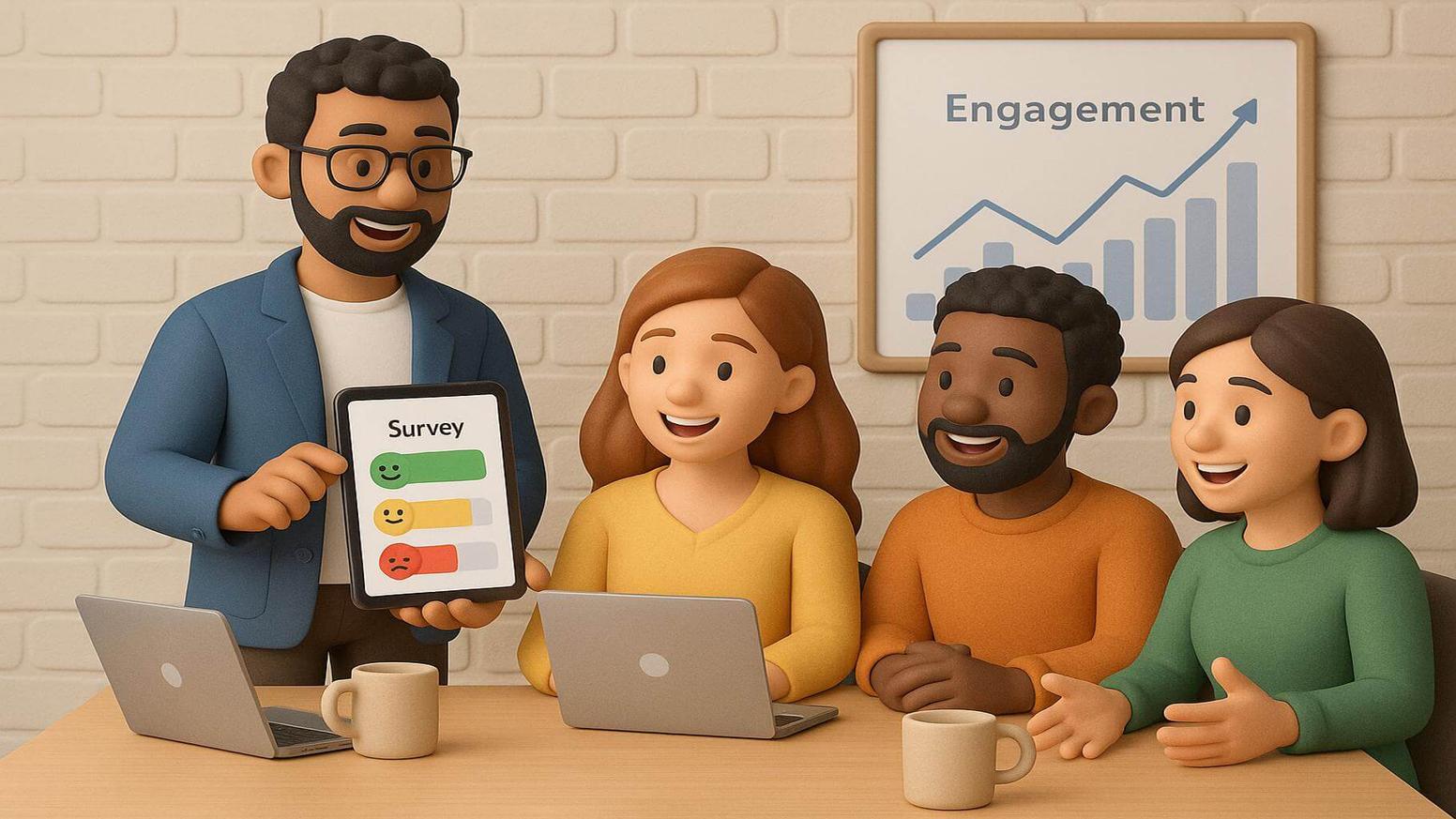
Employee engagement surveys serve as structured feedback tools that measure how connected, motivated, and committed employees feel toward their work and organization. These surveys go beyond simple satisfaction questions to explore deeper dimensions of the employee experience, including psychological safety, career growth opportunities, alignment with company culture, and trust in leadership. Unlike casual check-ins or informal conversations, employee engagement surveys provide quantifiable data that organizations can track over time and compare across various departments. The systematic approach to gathering employee feedback through surveys creates accountability and transparency that informal methods simply cannot match.
Defining employee engagement surveys and their core purpose
At their foundation, employee engagement surveys assess the emotional and cognitive dedication of employees to their organization and its objectives. They capture employee voices across multiple dimensions, including:
- Job satisfaction and alignment with role expectations
- Quality of relationships with direct managers and leadership
- Belief in the company's goals and strategic direction
- Feelings about the work environment and company culture
- Opportunities for growth and development
The primary purpose extends beyond just measuring how employees feel to understanding why they feel that way and what changes would make the biggest impact. Engagement surveys create a formal channel for employee opinions to reach decision-makers who can implement meaningful improvements.
The best employee surveys accomplish several objectives simultaneously. They provide baseline measurements that leadership can track across survey cycles, identify specific areas where the organization excels versus needs improvement, and signal to employees that their feedback matters. When employees see that organizations take survey data seriously and communicate results transparently, participation in future surveys naturally increases.
Key components that make surveys effective feedback tools
Effective engagement surveys share several critical components that distinguish them from poorly designed feedback mechanisms:
- Validated questions that measure what they claim to measure, ensuring survey data accurately reflects employee sentiment
- Anonymity protection that allows employees to provide honest feedback without fear of identification or retaliation
- Accessible survey formats that employees can complete on mobile devices, desktop computers, or other platforms
- Clear communication about how long the survey takes and what happens with the results
- Mixed question types, including quantitative ratings and optional open-ended responses for context
- Logical organization with questions sequenced to maintain momentum throughout completion
- Progress indicators that show employees how much remains
- Immediate confirmation that responses were successfully submitted
These elements work together to create survey experiences that employees find respectful of their time, trustworthy in handling their feedback, and valuable enough to complete despite competing priorities.
How engagement surveys differ from pulse surveys and satisfaction surveys
While engagement surveys provide comprehensive periodic assessments of the overall employee experience, pulse surveys offer frequent, quick check-ins on specific topics or real-time sentiment. Pulse surveys typically contain fewer questions and deploy more frequently, sometimes weekly or monthly, to track engagement levels between longer annual or semi-annual engagement surveys. The relationship between these survey types is complementary rather than competitive, with each serving distinct purposes in a complete feedback strategy.
Satisfaction surveys differ from engagement surveys in their focus and predictive power. While satisfaction measures whether employees are content with current conditions, engagement measures discretionary effort and emotional commitment to organizational success. Employees can be satisfied with their jobs while remaining disengaged from the company's goals, making engagement a more valuable predictor of business performance, retention, and higher productivity. Comprehending these distinctions enables organizations to choose the most appropriate survey format aligned with their particular feedback objectives.
What are the benefits of employee engagement surveys?

Organizations that systematically evaluate and respond to employee feedback attain substantial benefits compared to those dependent on assumptions or anecdotal evidence. Employee engagement surveys transform subjective feelings into objective data that leaders can analyze, discuss, and address systematically. Rather than guessing what employees need or making decisions based on the loudest voices, survey data provides representative insights from across the entire organization. This data-driven approach to understanding the employee experience leads to better decisions, more targeted investments, and stronger outcomes for both employees and the business.
Data-driven insights that identify improvement opportunities
Survey data reveals patterns and trends that would otherwise go unnoticed by leadership. When responses from various departments get aggregated and analyzed, organizations can identify:
- Systemic issues affecting multiple teams versus localized problems requiring targeted interventions
- Specific areas where the organization excels versus needs improvement
- Trends over time show whether culture initiatives are working
- Correlations between engagement scores and business outcomes like turnover or productivity
Survey results might reveal that middle management receives lower trust scores than senior leadership. This identifies a specific development opportunity rather than vague leadership concerns. The specificity of survey data enables focused action planning that addresses root causes rather than symptoms.
Employee engagement survey results also help organizations prioritize where to invest limited resources. Rather than implementing broad initiatives in the hope that something works, survey data shows exactly which areas need attention and which already perform well. This targeted approach to improving employee engagement maximizes return on investment while demonstrating to employees that their feedback directly influences organizational decisions.
Increased employee voice and psychological safety
When organizations implement regular engagement surveys and communicate results transparently, they establish formal channels for employee voices to influence decisions. This matters particularly for employees who might hesitate to speak up in meetings or share concerns directly with managers. Surveys provide a protected space where every employee has an equal opportunity to share employee opinions and contribute feedback, regardless of tenure, role, or comfort with direct confrontation. Over time, this normalizes the expectation that employee feedback shapes organizational direction.
The psychological safety benefits extend beyond the survey itself. When employees see that organizations genuinely want their input and respond to concerns without retaliation, they become more comfortable raising issues through other channels as well. This establishes a virtuous cycle wherein higher survey participation fosters increased trust, which subsequently encourages more candid feedback across all communication channels. Organizations that fail to act on survey results, however, can actually damage psychological safety by signaling that employee voices don't matter.
Better action planning with measurable outcomes
Employee engagement surveys create accountability by establishing baseline measurements that organizations can track over time. Rather than vague goals like "improve culture," surveys enable specific objectives such as "increase manager communication scores by 15 points by next quarter." This measurability transforms culture improvement from an abstract aspiration into a concrete project with defined milestones and success criteria. Recognition programs, process improvements, and policy changes can all be tied back to specific survey findings that prompted the action.
The longitudinal nature of engagement survey data also enables organizations to evaluate whether interventions actually work. If scores improve after implementing a new recognition program, leadership has evidence that the investment paid off. If scores remain flat despite significant effort, organizations can reassess their approach and try different strategies. This feedback loop between survey data and action planning creates continuous improvement rather than one-time initiatives that fade after initial enthusiasm.
Why are employee engagement surveys important for organizational success?

The strategic value of employee engagement surveys extends far beyond human resources concerns into core business performance. Disengaged employees cost organizations through:
- Reduced productivity and lower quality work output
- Increased turnover creates recruitment and training expenses
- Decreased customer satisfaction due to unmotivated service
- Diminished innovation as employees withhold discretionary effort
Conversely, highly engaged workforces consistently outperform competitors across virtually every meaningful business metric. Understanding why employee engagement surveys are important helps leadership prioritize survey initiatives and allocate appropriate resources to gathering and acting on employee feedback.
How surveys create accountability for culture improvement
Without measurement, culture improvement remains an amorphous goal that everyone agrees matters, but nobody can define or track. Employee engagement surveys create the accountability that transforms culture from a vague aspiration into a managed outcome. When engagement scores become regular agenda items in leadership meetings, visible in company communications, and tied to manager performance evaluations, culture improvement becomes a business priority rather than an afterthought. This accountability drives the sustained attention and resource allocation that meaningful change requires.
Surveys also distribute accountability across the organization rather than concentrating it in human resources. When managers receive team-level survey results, they become responsible for addressing concerns specific to their area. This decentralized approach to culture improvement leverages the expertise and relationships that frontline managers have with their teams while maintaining organizational oversight through aggregate reporting. The combination of local ownership and enterprise visibility makes culture improvement both scalable and sustainable.
The connection between engagement data and business performance
Research consistently demonstrates that employee engagement correlates strongly with business outcomes, including higher productivity, profitability, customer satisfaction, and retention. Organizations with high engagement levels experience:
- Lower absenteeism rates
- Fewer safety incidents
- Stronger financial performance
- Higher customer loyalty scores
- Better innovation outcomes
While correlation doesn't prove causation, the consistent relationship across industries, geographies, and time periods suggests that engagement genuinely influences rather than merely reflects business success. Survey data helps organizations understand their position relative to benchmarks and track progress toward higher engagement levels.
Building trust through transparent feedback mechanisms
Trust forms the foundation of high-performing workplaces, and employee engagement surveys can either build or erode that trust depending on how organizations handle them. When leadership commits to:
- Sharing survey results openly with all employees
- Discussing what the data reveals honestly, including difficult findings
- Demonstrating follow-through on promised actions
- Protecting anonymity rigorously
These behaviors transform surveys into trust-building exercises. Employees learn that the organization genuinely values their input and takes their concerns seriously, even when feedback is difficult to hear. This transparency creates the psychological safety necessary for honest feedback in future surveys.
Conversely, organizations that collect survey data but never share results, ignore concerning findings, or punish teams for low scores quickly destroy any trust the survey process might have built. Employee pulse surveys and engagement surveys only work when employees believe their participation matters and their responses won't be used against them. Building and maintaining this trust requires consistent behavior over multiple survey cycles, making transparency a long-term commitment rather than a one-time gesture.
25 tips to increase employee engagement survey participation
Achieving high survey response rates requires an intentional strategy across multiple dimensions, including communication, survey design, timing, and incentives. Organizations that treat surveys as administrative tasks inevitably struggle with low participation. Those that approach surveys as strategic engagement efforts consistently achieve reliable response rates. The following 25 tips address the complete survey process from initial communication through completion. These actionable strategies help organizations of any size encourage participation and gather feedback necessary for meaningful culture improvement.
8 communication and messaging tips for higher response rates
Effective survey communication begins long before the survey launches. Pre-survey awareness campaigns that explain why the survey matters, what questions will be covered, and how results will be used, prepare employees to participate rather than ignore yet another email. When managers personally encourage their teams to complete the survey and explain how feedback from previous cycles led to specific improvements, employees understand that their participation actually influences outcomes. This context transforms the survey from an administrative burden into a meaningful opportunity to shape their work environment.
The channels and cadence of survey communication significantly impact response rates. Organizations achieve higher participation when they meet employees where they already work rather than expecting employees to seek out the survey on their own. This means promoting surveys through:
- Team channels and messaging platform announcements
- Team meetings with dedicated discussion time
- Break room posters and digital signage
- Manager one-on-ones with direct encouragement
- Email invitations with clear calls to action
Strategic reminders sent at optimal times, such as mid-morning Tuesday or after lunch Wednesday, reach employees when they have time and mental bandwidth to participate.
1. Send personalized survey invitations from direct managers: Employee survey response rates increase dramatically when invitations come from direct managers rather than anonymous HR accounts. Personalized messages that include the employee's name, reference their specific team, and come from a manager they know create accountability and relevance that generic communications lack. Managers should explain why their team's feedback matters and how previous survey cycles influenced team-level decisions.
2. Create compelling subject lines that emphasize impact: Subject lines like "Your Voice Shapes Our Workplace" or "Help Improve Our Team Experience" perform better than administrative headers like "Annual Survey Due Friday." Emphasizing the employee's opportunity to influence change rather than the organizational obligation to collect data reframes participation as empowerment rather than compliance.
3. Use multi-channel communication through email, messaging platforms, and posters: Different employees prefer different communication channels, so survey promotions should appear across multiple platforms. Digital channels like email and messaging platforms reach remote workers, while physical posters and announcements reach employees without constant computer access. This multi-channel approach ensures maximum visibility regardless of work arrangements.
4. Share expected completion time upfront, keeping it under 10 minutes: Clearly communicating that surveys require less than 10 minutes addresses the primary objection preventing participation. Employees hesitate to start surveys of unknown length during busy workdays, but knowing the time commitment is minimal removes this barrier. Organizations should time test surveys accurately to avoid eroding trust with underestimated completion times.
5. Explain how previous survey results drove specific changes: Nothing builds confidence in survey value like concrete examples of past feedback leading to real improvements. Share specific examples of feedback-driven changes. For instance, last year's survey revealed insufficient recognition, leading to the implementation of the kudos program. This demonstrates that participation produces tangible results.
6. Schedule pre-survey awareness campaigns one to two weeks before launch: Building awareness before surveys launch prepares employees psychologically to participate. Pre-campaign communications might include:
- Leadership messages about upcoming surveys and their importance
- Reminders to watch for invitations in specific channels
- Teasers about survey topics to build curiosity
- Examples of past survey-driven improvements
This preparation ensures surveys don't arrive as surprises during busy periods.
7. Send strategic reminders at optimal times during the survey window: Reminder timing significantly affects who responds and when. Mid-week reminders during typical working hours reach the most employees when they have time to participate. Organizations should send 2 to 3 reminders spaced throughout the survey window, with messages that acknowledge previous invitations while emphasizing remaining time.
8. Segment messaging for different employee groups based on role and location: Generic communications fail to resonate with employees whose experiences differ significantly from the average. Tailoring messages to acknowledge specific concerns of remote workers, frontline staff, new hires, or other segments increases relevance. For example, messages to remote teams might emphasize the use of surveys to ensure their unique challenges receive attention.
9 survey design tips that maximize completion
Survey design directly impacts whether employees complete surveys or abandon them partway through. Focused surveys that respect employees' time by asking only essential questions achieve significantly higher completion rates than comprehensive questionnaires that try to cover every possible topic. Research suggests that surveys that take more than 10 minutes to complete see sharp declines in completion rates, underscoring the importance of brevity as a design principle. When organizations must gather extensive feedback, breaking content into multiple shorter pulse surveys often outperforms a single lengthy engagement survey.
9. Keep surveys under 15 questions for quick completion: Survey length directly correlates with abandonment rates, with each additional question increasing the likelihood that respondents quit before finishing. Limiting surveys to 10 to 15 questions forces organizations to prioritize truly important topics while respecting employee time. This constraint also improves data quality as respondents give more thoughtful answers to fewer questions rather than rushing through lengthy questionnaires.
10. Use mobile-responsive design for any-device access: Mobile-responsive design has become non-negotiable for high survey participation, particularly for organizations with:
- Deskless workers without regular computer access
- Field staff who work primarily from mobile devices
- Remote employees who complete tasks on various devices
- Global teams across different work environments
Surveys that are poorly optimized for mobile devices or require desktop access exclude significant portions of the workforce and create unnecessary friction for employees willing to participate. Testing surveys on multiple device types before launching ensures consistent experiences regardless of how employees choose to participate.
11. Show progress bars throughout the survey experience: Progress bars showing completion percentage provide essential feedback that motivates continued participation. When respondents can see they're 70% finished, they're motivated to complete the remaining 30% rather than abandoning a survey of unknown length. Progress bars should update frequently enough to show meaningful progress with each question or page, providing regular reinforcement that completion is approaching.
12. Start with engaging questions to build momentum: Question order significantly impacts completion rates, with optimal sequencing building engagement rather than front-loading the most important but potentially tedious questions. Starting with interesting, easy-to-answer questions builds momentum that carries respondents through more challenging content later in the survey. Grouping related questions logically helps respondents understand context and answer more efficiently than surveys that jump randomly between topics.
13. Ensure anonymous response protection with clear communication: When employees trust that individual responses cannot be traced back to them, they provide more honest feedback, including constructive criticism that leadership needs to hear. Clear communication about how data security protects employee confidentiality, combined with technical measures that actually ensure anonymity, builds the trust necessary for candid survey responses. Organizations should avoid any reporting that could identify individuals, even when small team sizes or specific demographic combinations are used.
14. Provide multiple language options for diverse workforces: Organizations with linguistically diverse employees should offer surveys in languages employees speak fluently rather than requiring second-language comprehension. Translation quality matters significantly, and professional translation services ensure accurate meaning rather than literal word-for-word translation. Language accessibility signals that the organization values feedback from all employees, regardless of primary language.
15. Use simplified rating scales like Matter's 5-point Likert system: Complex rating scales with 7, 10, or 11 points create cognitive burden that slows completion and reduces response quality. Matter's 5-point system balances simplicity with sufficient granularity, allowing employees to quickly indicate their level of agreement without overthinking distinctions between similar rating points. Simplified scales also improve mobile usability where space constraints make detailed scales difficult to navigate.
16. Include optional open-ended questions without requiring them: Open-ended questions provide valuable qualitative context that helps interpret quantitative ratings, but requiring written responses significantly increases survey length and abandonment. Making these questions optional allows motivated employees to provide detailed feedback while enabling others to complete surveys quickly. Organizations typically receive enough open-ended responses to gain useful insights without mandating responses from everyone.
17. Test survey flow with a pilot group before launching: Pilot testing with a small employee group identifies:
- Confusing questions that need rewording
- Technical issues with the survey platform or devices
- Completion time mismatches with communicated estimates
- Overall, experience problems before full launch
Pilot participants can provide feedback on question clarity, survey length, and overall experience that prevents problems from affecting participation rates. This testing investment prevents embarrassing mid-survey corrections that damage credibility and trust.
8 timing and incentive tips to boost participation
Survey timing matters more than many organizations realize. Launching surveys during busy periods almost guarantees low participation. Employees prioritize urgent work over feedback during quarter close, benefits enrollment, or holidays. Mid-week launches between Tuesday and Thursday typically outperform Monday or Friday launches, giving employees time to complete the survey during normal work hours when they're most engaged. Setting survey windows of 7 to 14 days provides enough time for everyone to participate without letting the survey drag on indefinitely.
18. Launch surveys mid-week between Tuesday and Thursday: Research consistently shows that mid-week survey launches outperform Monday or Friday launches for most organizations. Tuesday through Thursday launches give employees time to complete employee engagement survey questions during normal work hours when they're most engaged with work-related activities. Morning launches, particularly between 9 and 11 AM, reach employees when they're fresh and before daily demands accumulate.
19. Avoid busy periods like month-end, quarter close, or holidays: Survey timing should account for organizational rhythms that predictably consume employee attention. Common periods to avoid include:
- Month-end closing processes
- Quarterly reporting deadlines
- Annual planning cycles
- Holiday periods with reduced staffing
- Major product launches or company events
Consulting organizational calendars before scheduling surveys prevents poor timing that guarantees low response rates.
20. Offer recognition-based incentives for participation: Recognition-based incentives leverage social and psychological motivators that often prove more effective than monetary rewards. Several recognition approaches make employees feel that their contributions matter. These include public recognition of high-participation teams, personalized thank-you messages from leadership, and visible progress tracking for participation. Recognition incentives work particularly well because they align with the survey's fundamental purpose of valuing employee voice.
21. Create team-based participation competitions: Team-based incentives shift motivation from individual to collective, leveraging peer influence to boost participation across groups. When team rewards depend on overall participation rates, team members actively encourage each other to complete surveys rather than leaving recruitment entirely to managers or HR. This peer motivation often proves more effective than organizational communications because it comes from trusted colleagues rather than distant leadership.
22. Provide immediate feedback confirmation after submission: Immediate confirmation that responses were successfully received reassures employees that their participation counted and wasn't lost to technical problems. Confirmation messages should:
- Thank employees for their participation
- Reiterate confidentiality protections
- Preview when the results will be shared
- Emphasize how feedback will be used
This closure creates a positive final impression that influences willingness to participate in future survey cycles.
23. Set clear deadline expectations and communicate them repeatedly: Ambiguous deadlines create procrastination as employees assume they have more time than actually remains. Clear, specific deadlines communicated repeatedly through reminders create urgency that motivates completion. Countdown messaging showing the days remaining reinforces the deadline's proximity without feeling nagging when framed positively.
24. Host survey completion celebration events: Celebration events that mark survey completion create positive closure to the participation experience and build anticipation for future survey cycles. Whether virtual or in-person, these events thank employees for participation, share initial response rate achievements, and commit to transparent results sharing. The celebration reinforces the organization's value of employee feedback and creates positive associations that encourage participation in subsequent surveys.
25. Give extra recognition to high-participating teams: Recognizing teams that achieve high participation rates creates visible appreciation while motivating other teams to increase their response rates. Recognition might include:
- Featured spotlights in company communications
- Team lunches or social activities
- Additional points for the team to distribute
- Priority consideration for team budget requests
- Visible badges or achievements in communication platforms
This team-level recognition leverages competitive dynamics productively while celebrating participation broadly.
How to increase employee engagement survey participation through strategic communication

Communication strategy represents the single largest opportunity for organizations struggling with low survey participation. Even perfectly designed surveys fail when employees don't know about them, don't understand why they matter, or don't trust that their feedback will be used constructively. Strategic communication addresses all three barriers by building awareness, explaining relevance, and demonstrating follow-through on previous feedback. Organizations that invest as much effort in survey communication as survey design consistently achieve higher response rates and more representative data.
Crafting compelling survey launch announcements that drive action
Survey launch announcements should accomplish several key objectives. They announce the survey, explain why participation matters, address confidentiality concerns, and make it easy to complete. Effective launch communications lead with employee benefits rather than organizational needs. Frame participation as an opportunity to influence workplace improvements, not an obligation. Including specific examples of past changes driven by survey feedback demonstrates that participation actually matters and builds credibility for the current survey cycle.
The most effective survey announcements come from leadership whom employees trust and whose sponsorship signals organizational commitment. Senior leaders should personally explain why employee feedback matters and commit to sharing results and taking action. Employees take surveys more seriously when invitations come from respected leaders rather than anonymous HR accounts. Recognition of teams and individuals who provided valuable feedback in previous surveys reinforces the message that participation is valued and noticed.
Multi-channel communication approaches for maximum reach
Relying solely on email for survey communication means some employees never receive it or see it get lost among hundreds of daily messages. Organizations with high survey participation use multiple channels to ensure every employee encounters survey information multiple times through different mediums. This includes:
- Team channel posts with pinned survey links
- Meeting announcements with dedicated discussion time
- Manager one-on-ones with personal encouragement
- Physical posters in common areas like break rooms
- Integration with existing communication platforms that employees already use daily
For organizations using communication platforms, meeting employees in their primary work environment removes friction that prevents participation. Survey links embedded in channels where employees already spend time require less effort than navigating to external survey platforms. The goal is to make participation so easy that completing the survey requires less effort than ignoring it.
Personalized messaging strategies for different employee segments
Generic survey communications fail to resonate with employees whose experiences, concerns, and priorities differ significantly from each other. Survey communications should acknowledge the specific contexts of different employee groups:
- Remote workers need assurances that their unique challenges will be captured
- Frontline staff need surveys accessible on mobile without lengthy text entry
- New hires need context on what past surveys have accomplished
- Long-tenured employees need evidence that this survey will be different from ignored past efforts
Segmented messaging that acknowledges these differences increases relevance and, consequently, participation. Survey communications should mention issues that specifically affect recipients' work situations. This makes employees feel the survey pertains to them rather than some abstract average employee. Managers can further personalize communications by connecting survey topics to conversations they've had with their teams and explaining how feedback will inform decisions that directly affect their work environment.
Survey incentive ideas that increase survey response rate
While intrinsic motivation to contribute feedback drives some survey participation, well-designed incentives can significantly boost response rates without compromising data quality. Effective incentives make participation feel appreciated and worthwhile without creating pressure that distorts responses. The key distinction is between incentives that reward participation versus those that reward particular responses, with only the former appropriate for maintaining survey integrity. Organizations implementing employee engagement survey tools should consider how recognition features can seamlessly integrate participation incentives into the survey experience.
Recognition-based incentives that celebrate participation
Recognition-based incentives leverage social and psychological motivators that often prove more effective than monetary rewards. Examples include:
- Public acknowledgment of teams that achieve high participation
- Personalized thank-you messages from leadership
- Visible tracking of participation progress on leaderboards
- Featured spotlights in company newsletters or channels
- Recognition points that teams can distribute
Recognition programs that include participation-based appreciation ensure that survey completion becomes part of the broader culture rather than an isolated administrative task. Recognition incentives work particularly well because they align with the survey's fundamental purpose of valuing employee voice. When organizations recognize survey participation, they reinforce the message that employee feedback matters and that taking time to share it is worthy of appreciation. This consistency between the survey's stated purpose and the organizational response builds trust, encouraging honest participation in current and future survey cycles.
Prize drawings and gamification strategies that boost engagement
Prize drawings that enter all participants into random selection for valuable rewards incentivize participation without tying rewards to response content. Common prizes include:
- Gift cards to popular retailers or restaurants
- Extra paid time off or flexible schedule options
- Charitable donations in the winner's name
- Company merchandise or premium items
- Experiences like event tickets or team outings
The key is ensuring prizes are attractive enough to motivate participation while making clear that every completed survey receives an equal chance, regardless of its responses. This preserves data integrity while providing a tangible incentive to participate.
Gamification strategies that make participation visible and competitive can significantly boost response rates, particularly in organizations with strong team cultures. Leaderboards showing department participation percentages, progress trackers counting down to goals, and milestone celebrations when thresholds are reached all leverage social motivation to encourage participation. When teams see competitors approaching higher participation rates, competitive instincts motivate additional effort to recruit remaining non-respondents.
Team-based rewards that leverage collective motivation
Team-based incentives shift motivation from individual to collective, leveraging peer influence to boost participation across groups. When team rewards depend on overall participation rates, team members actively encourage each other to complete surveys rather than leaving recruitment entirely to managers or HR. This peer motivation often proves more effective than organizational communications because it comes from trusted colleagues rather than distant leadership.
Effective team-based incentives might include:
- Team lunches or celebrations for departments reaching 80% or higher participation
- Additional recognition points for the entire team to distribute
- Featured spotlight in company communications for the highest-participating teams
- Priority consideration for team budget requests based on engagement participation
- Extra team-building activities funded by high participation and achievement
- First access to new workplace benefits or program pilots
The competitive element, combined with collective rewards, creates powerful motivation while maintaining a focus on participation rather than specific responses.
Fun ways to encourage survey participation with creative campaigns

Injecting creativity and fun into survey promotion can transform an administrative task into an engaging experience that employees actually look forward to. While the survey content itself may address serious workplace topics, the communication surrounding surveys can use humor, themes, and interactive elements that generate positive associations with participation. Creative campaigns often achieve higher response rates than identical content delivered through routine communications.
Themed survey events that generate excitement
Themed survey campaigns build anticipation and create memorable experiences that stand out from routine workplace communications. Themes might connect to:
- Seasons like "Spring Into Feedback" or "Winter Wellness Check"
- Company events like product launches or anniversaries
- Popular culture moments or trending topics
- Organizational values with creative visual representation
For example, a March Madness-themed survey could include bracket-style team competitions, basketball-related rewards, and tournament-style recognition for participating departments. Themed approaches work because they cut through communication clutter, helping many employees ignore or overlook survey invitations.
When survey promotions look distinctly different from standard work communications, employees notice them even when busy with other priorities. The novelty creates curiosity that drives higher email open rates, more attention to channel posts, and a greater likelihood of completing the survey.
Team-based competitions that leverage social dynamics
Competitions between teams create social dynamics that motivate participation beyond individual considerations. When completing a survey means contributing to team success, employees who might skip individual requests participate to support colleagues. Effective competition structures include:
- Visible scoreboards updated in real-time
- Regular updates on standings throughout the survey window
- Recognition for leaders at multiple checkpoints
- Prizes for top-participating teams
- Friendly trash talk is encouraged in channels
Recognition platform features that track and celebrate team achievements can integrate naturally with survey competitions. Teams that achieve participation milestones can receive immediate recognition through the same channels they use for daily appreciation, making survey participation part of the broader recognition culture rather than a separate administrative process.
Visual countdown campaigns and celebration events
Visual countdown campaigns build urgency and maintain survey visibility throughout the response window. Daily updates showing:
- Days remaining until survey closes
- Participation progress toward goals
- Approaching milestones and achievements
- Team standings in competitions
- Messages from leadership about the importance
These countdowns can appear in common areas, on digital signage, in team channel posts, and in email signatures, creating persistent reminders without repetitive nagging. Celebration events that mark survey completion provide a positive sense of closure to the participation experience and build anticipation for future survey cycles. Whether virtual or in-person, these events thank employees for participation, share initial response rate achievements, and commit to transparent results sharing. The celebration reinforces the organization's value of employee feedback and creates positive associations that encourage participation in subsequent surveys.
How to encourage employee engagement through survey design optimization
Poorly designed surveys create friction that discourages participation even among employees motivated to provide feedback. Survey design encompasses everything from question wording and response options to visual layout and technical functionality, with each element either facilitating or hindering completion. Engagement survey design that prioritizes user experience achieves higher completion rates and yields higher-quality data than surveys designed primarily around organizational information needs. Organizations can reference eNPS benchmarks to understand what response rates and scores indicate healthy feedback programs.
Mobile-responsive surveys that enable anytime access
Mobile responsiveness has evolved from a nice-to-have to an essential for high survey participation. Many employees primarily access work communications on mobile devices, and surveys that display poorly or function unreliably on phones exclude them from participation. Mobile-first design ensures that surveys:
- Look good and work smoothly on the smallest screens
- Automatically scale for larger devices
- Use touch-friendly buttons and interface elements
- Minimize scrolling requirements
- Display rating scales clearly without zooming
Beyond basic functionality, mobile-optimized surveys account for how users interact with phones differently from how they do on computers. Touch-friendly buttons, appropriately sized text, minimal scrolling requirements, and easy-to-tap response options all reduce friction on mobile devices. Organizations should test surveys on multiple device types before launching to ensure consistent experiences regardless of how employees choose to participate.
Question sequencing strategies that maintain momentum
Question order significantly impacts completion rates, with optimal sequencing building engagement rather than front-loading the most important but potentially tedious questions. Effective sequencing includes:
- Starting with interesting, easy-to-answer questions to build momentum
- Grouping related questions logically for context
- Placing challenging questions in the middle when respondents are engaged but not yet fatigued
- Ending with optional open-ended questions for motivated respondents
- Avoiding random jumps between unrelated topics
Recognition questions and other positive topics often work well as survey openers because they invite pleasant reflection rather than critical evaluation. Challenging questions about management, compensation, or organizational problems typically belong in the middle of surveys when respondents are engaged but not yet fatigued. Ending with optional open-ended questions lets motivated respondents expand, while letting others complete quickly.
Progress indicators and estimated completion times
Progress indicators that show percentage complete provide essential feedback that motivates continued participation. When respondents can see they're 70% finished, they're motivated to complete the remaining 30% rather than abandoning a survey of unknown length. Effective progress indicators should:
- Update frequently enough to show meaningful progress with each question
- Provide regular reinforcement that completion is approaching
- Display prominently without cluttering the interface
- Match the actual completion percentage accurately
Estimated completion times set expectations before respondents begin and build trust when actual time matches estimates. Organizations should time test surveys with representative employees and communicate realistic completion times rather than optimistic estimates that frustrate respondents who take longer. When surveys genuinely require less than 10 minutes, prominently communicating this addresses concerns about time commitment that prevent many employees from starting.
Increase employee survey participation with timing and scheduling best practices

Survey timing encompasses both when surveys launch and how frequently they occur, with optimal approaches depending on organizational context, employee schedules, and feedback objectives. Poor timing can undermine otherwise well-designed surveys, while strategic scheduling maximizes participation and data quality. Organizations should consider when their specific employees are most available and receptive to providing feedback.
Optimal days and times for maximum response rates
Research consistently shows that mid-week survey launches outperform Monday or Friday launches for most organizations. Best practices for survey timing include:
- Launch days: Tuesday through Thursday give employees time during normal work hours
- Launch times: 9 to 11 AM reach employees when fresh, before daily demands accumulate
- Survey windows: 7 to 14 days provide enough time without letting surveys drag on
- Reminder schedule: 2 to 3 reminders spaced throughout the window with varying messages
However, organizations with non-standard schedules should adjust timing based on when their specific employees are most available. Retail organizations might avoid weekends when staff are busiest, while healthcare organizations might stagger surveys across shifts to ensure equal access.
Avoiding survey fatigue with strategic frequency planning
Survey fatigue occurs when employees receive so many requests for feedback that they begin to ignore or rush their responses. While regular feedback matters, over-surveying damages both participation rates and data quality. Organizations should:
- Coordinate survey schedules across departments
- Avoid bombarding employees with multiple simultaneous surveys
- Create an organizational survey calendar that spaces requests appropriately
- Alternate between comprehensive engagement surveys and brief pulse checks
- Monitor participation trends to identify fatigue signs
Creating an organizational survey calendar that spaces requests appropriately protects employees from fatigue while ensuring adequate feedback frequency. Recognition tied to survey participation can help maintain engagement even when survey frequency is relatively high. When employees know participation is noticed and appreciated, they're more likely to make time for surveys even during busy periods. However, incentives cannot fully compensate for genuine over-surveying, making thoughtful frequency planning essential for long-term participation rates.
Timezone considerations for global workforces
Organizations with employees across multiple time zones face unique scheduling challenges that affect survey participation. Best practices include:
- Staggered launches timed for local working hours
- Extended survey windows to accommodate varying schedules
- Communications scheduled for local time zones
- Translations that go beyond literal word conversion
- Region-appropriate incentives and recognition
Launching surveys at times that work well for headquarters but poorly for international offices signals that some employees matter less than others. Cultural considerations beyond time zone also affect global survey participation. Some cultures respond differently to feedback requests, rating scales, and communication styles, requiring adaptations for diverse workforces. Recognition system configurations that allow region-appropriate incentives can help equalize participation across geographically distributed teams.
How to encourage participation in the workplace through leadership engagement
Leadership behavior significantly influences survey participation, with visible executive support and manager involvement consistently correlating with higher response rates. When employees see that leaders take surveys seriously, personally encourage participation, and commit to acting on results, they understand that their feedback will actually matter. Survey communications become more effective when supplemented by personal outreach from trusted leaders whom employees know and respect. Organizations can customize pulse survey templates with leader messages to increase relevance and participation.
Executive sponsorship strategies that signal importance
Executive sponsorship transforms surveys from HR initiatives into organizational priorities that command attention and resources. When the CEO, president, or other senior leaders personally communicate about surveys, employees understand that feedback matters at the highest levels. Executive sponsorship should include:
- Personal messages explaining why the survey matters
- Commitments to transparent results sharing
- Pledges to act on what feedback reveals
- Acknowledgment that honest feedback requires courage
- Examples of how leadership has acted on previous survey results
Effective executive sponsorship extends beyond initial communications to visible ongoing engagement. Leaders who publicly discuss survey results, reference employee feedback in decisions, and update the organization on actions taken demonstrate sustained commitment that builds trust over multiple survey cycles. This consistent leadership attention signals that surveys represent genuine organizational priorities rather than perfunctory compliance exercises.
Manager toolkit development for consistent messaging
Frontline managers represent the most influential communication channel for survey participation, yet many feel unprepared to promote surveys effectively. Developing comprehensive manager toolkits that include:
- Sample messages for email, team channels, and meetings
- Talking points for team meetings and one-on-ones
- FAQs addressing common concerns about confidentiality
- Guidance on reinforcing survey importance without pressure
- Data showing why participation matters for their teams
These toolkits equip managers to drive participation effectively. Manager training that explains survey purpose, confidentiality protections, and how results will be used enables managers to answer questions and address concerns authentically. When managers understand the survey well, they can discuss it naturally during one-on-ones, team meetings, and casual conversations rather than simply forwarding corporate communications. This authentic manager engagement significantly influences whether teams view surveys as meaningful or merely obligatory.
Leadership participation modeling that sets the tone
Leaders who visibly participate in surveys and acknowledge their own completion send powerful signals about the importance of surveys. Effective modeling includes:
- Public statements from executives mentioning that they completed the survey
- Leaders shared that they found the survey valuable
- Acknowledgment that providing feedback requires vulnerability
- Validating employees who might hesitate to share honest opinions
- Leaders receiving concerning feedback with curiosity rather than defensiveness
This modeling works particularly effectively when leaders acknowledge that providing feedback requires vulnerability and courage, validating employees who might hesitate to share honest opinions. Leadership modeling also includes demonstrating appropriate response to survey results, particularly when feedback criticizes leadership itself. Leaders should receive concerning scores with curiosity rather than defensiveness. Acknowledging areas for improvement and committing to specific actions demonstrates that honest feedback won't result in negative consequences. This behavior fosters psychological safety, which increases future survey participation and response honesty.
Survey participation strategies using technology and accessibility solutions

Technology choices significantly impact survey participation by either removing or creating barriers to feedback opportunities for employees. Modern survey platforms dramatically increase participation among diverse workforces. Key features include single sign-on, mobile optimization, multi-language support, and accessibility accommodations. Organizations should evaluate survey technology options based on how well they serve their specific employee populations rather than defaulting to platforms designed for different contexts. Understanding the differences between pulse surveys and engagement surveys helps leaders select appropriate tools for different feedback objectives.
Anonymous response protection that builds trust
Anonymity protection forms the foundation of trust necessary for honest survey feedback. Employees who fear their responses can be traced back to them either skip surveys entirely or provide sanitized feedback that obscures real concerns. Robust anonymity requires:
- Technical protections that prevent response tracing
- Clear communication about how those protections work
- Reporting thresholds that prevent identifying small groups
- Data handling procedures that maintain confidentiality
- Transparent explanations in straightforward language
Organizations should explain anonymity mechanisms in straightforward language rather than assuming employees understand technical details. Reporting thresholds that prevent the identification of small groups in filtered results protect anonymity while maintaining useful insights. When teams fall below minimum reporting thresholds, aggregating responses with similar groups preserves confidentiality while allowing some level of analysis. Clearly communicating these thresholds helps employees understand that anonymity isn't compromised even when viewing results by department, location, or other demographic categories.
Multiple device compatibility for convenience
Device compatibility has become essential for inclusive survey participation, particularly as workforces diversify across remote, hybrid, and on-site arrangements. Surveys must work equally well on:
- Desktop computers with various screen sizes
- Laptops with different operating systems
- Tablets with touch interfaces
- Smartphones with limited screen space
Testing across devices, browsers, and operating systems before launching identifies compatibility issues that would otherwise exclude portions of the workforce. Some employees access work-related content only on company computers, while others primarily use personal mobile devices. Survey platforms should support both scenarios without requiring specific hardware or software configurations. Responsive design that seamlessly adjusts to screen dimensions and touch interfaces guarantees uniform experiences across all device selections.
Language translation options for diverse teams
Linguistic diversity requires survey translations that accurately convey meaning rather than providing literal word-for-word conversions. Professional translation services that understand survey research nuances ensure that questions mean the same thing across languages, preventing response differences that reflect translation quality rather than actual sentiment. Best practices include:
- Professional translation services, rather than automated tools
- Native speaker validation before launching surveys
- Cultural adaptation beyond literal word conversion
- Response options that work across cultural contexts
- Region-appropriate examples and terminology
Offering surveys in employees' preferred languages signals inclusion and removes barriers that would otherwise prevent participation. When employees can respond in the language they think in, they provide more nuanced feedback than when forced to translate thoughts before responding. Language accessibility is particularly important for global organizations, where assuming English fluency excludes valuable perspectives from multilingual workforces.
Increase survey response rate through follow-through and visible action
The most powerful driver of future survey participation is visible action on previous survey results. Employees who see their feedback produce concrete improvements become invested in continuing to provide input, while those whose feedback disappears into an organizational void quickly lose motivation to participate. Survey best practices include not just gathering feedback efficiently but demonstrating what organizations do with the data collected. Following pulse survey best practices throughout the entire feedback cycle increases trust and future participation.
Results sharing timelines that demonstrate transparency
Timely results sharing proves that organizations value employee feedback enough to prioritize analysis and communication. Waiting months to share results signals that surveys rank low on organizational priorities, eroding trust and future participation. Organizations should:
- Commit to specific results sharing timelines before surveys launch
- Meet those commitments even when results reveal uncomfortable truths
- Balance transparency with appropriate context
- Explain what scores mean and how they compare to benchmarks
- Preview next steps for addressing concerns
Results communications should balance transparency with appropriate context that helps employees interpret data accurately. Sharing scores without explanation can confuse or alarm employees, while providing too much spin undermines the transparency that builds trust. Effective results sharing acknowledges both strengths and areas needing improvement, explains what scores mean, and previews next steps for addressing concerns.
Action planning communication that shows commitment
Survey results without accompanying action plans suggest that organizations collect feedback to check boxes rather than drive improvement. Action planning communications should:
- Directly connect to specific survey findings
- Explicitly state which survey results prompted each initiative
- Include clear timelines and responsible parties
- Define success metrics for measuring progress
- Balance ambition with realistic scope
This connection demonstrates that employee feedback genuinely influences organizational decisions rather than justifying pre-determined actions. Effective action plans balance ambition with realistic scope, committing to achievable improvements rather than overpromising and underdelivering. Clear timelines, responsible parties, and success metrics make action plans concrete rather than vague aspirations. Regular progress updates on committed actions maintain momentum and build confidence that the organization follows through on feedback-driven commitments.
Progress update cadences that build trust for future surveys
Ongoing communication about progress on survey-driven actions maintains engagement between formal survey cycles. Monthly or quarterly updates that report on:
- Action plan status and completed milestones
- Celebrate completed improvements
- Acknowledge remaining challenges honestly
- Adjust timelines when necessary
- Request additional feedback on implemented changes
These updates keep employee feedback at the forefront of organizational attention and remind employees that their previous participation mattered. Progress communications should acknowledge both successes and setbacks honestly rather than only highlighting wins. When action plans encounter obstacles or take longer than expected, transparent communication about challenges builds more trust than silence or spin. Employees appreciate honesty about difficulties while maintaining confidence that the organization remains committed to improvement.
How to increase employee engagement survey participation for remote and hybrid teams

Remote and hybrid work arrangements create unique survey participation challenges that require adapted approaches. Traditional tactics like break room posters, in-person manager conversations, and spontaneous hallway reminders don't reach employees working from home. Organizations must deliberately translate participation strategies to digital environments while accounting for the specific concerns and experiences of distributed workforces. Survey platforms designed for remote teams include features that address these unique participation barriers. Modern pulse survey tools offer native integration with communication platforms employees already use daily.
Virtual survey launch events that create a connection
Virtual launch events that announce surveys through video calls, team meetings, or company-wide broadcasts create a human connection that email announcements lack. Benefits include:
- Seeing leaders speak directly about why surveys matter
- Hearing authentic enthusiasm for employee feedback
- Observing organizational commitment through dedicated event time
- Real-time question answering that addresses concerns
- Recording for those unable to attend live
Launch events also provide opportunities for real-time question-and-answer sessions that address concerns that prevent participation. When employees can ask about confidentiality, survey length, or how results will be used, they receive immediate reassurance rather than wondering privately whether participation is safe or worthwhile. Recording launch events for those unable to attend live extends reach while maintaining the personal connection that drives engagement.
Communication platform integration for seamless access
Integrating surveys directly into communication platforms employees use daily removes friction that prevents participation. When survey links appear in channels or Teams environments where employees already spend time, completing surveys requires minimal effort compared to navigating to external websites. Platform integration demonstrates how meeting employees where they work drives higher response rates than asking them to go somewhere else.
Platform integration also enables:
- Real-time progress tracking is visible to all employees
- Celebration of participation milestones as they happen
- Social recognition of teams achieving high response rates
- Reminders that appear in natural communication flow
- Immediate confirmation within a familiar interface
This integration transforms surveys from isolated events into organic components of workplace communication. When survey participation becomes visible within daily communication flows, peer influence and social motivation naturally encourage completion.
Flexible timing accommodations for distributed workforces
Remote and hybrid teams often work non-standard hours that don't align with traditional 9-to-5 schedules. Survey windows should account for varied schedules by:
- Remaining open long enough for different time zones and work patterns
- Avoiding language implying surveys must be completed during specific hours
- Acknowledging that employees can participate whenever it fits their schedule
- Ensuring surveys work across various internet connections
- Removing requirements for VPN access or specific browsers
Flexibility extends to survey access methods as well, with remote workers needing surveys that work across various internet connections, devices, and locations. Surveys requiring VPN access, specific browsers, or high bandwidth exclude remote workers without these resources. Testing surveys under conditions matching remote employee realities ensures that participation remains equally accessible regardless of work location.
How Matter can help with increasing employee engagement survey participation
Matter simplifies survey administration while dramatically improving response rates through purpose-built features that address common participation barriers. Unlike traditional survey platforms that require employees to navigate to external websites, Matter delivers surveys directly within Slack and Teams, where employees already spend their workday. This native integration means completing surveys requires no additional logins, no new tools to learn, and no context switching that creates friction. The result is response rates that frequently exceed 80% compared to industry averages of 30 to 50% for traditional survey methods.
Matter's 5-point Likert system that maximizes response rates
Matter uses a research-validated 5-point Likert scale rather than traditional 11-point systems, significantly reducing cognitive burden and improving mobile usability. This simplified approach allows employees to quickly indicate their sentiment without overthinking distinctions between similar rating points. The 5-point scale displays intuitively on mobile devices, where limited screen space makes complex scales difficult to navigate, ensuring consistent experiences regardless of device.
The 5-point Likert system calculates eNPS by categorizing responses into:
- Promoters: Percentage of strongly agree (5's on the scale)
- Passives: Percentage of agrees (4's on the scale)
- Detractors: Percentage of strongly disagrees, disagrees, and neutrals (1-3's on the scale)
This methodology maintains eNPS comparability with industry benchmarks while dramatically improving user experience. Organizations using Matter's simplified system report completion times under 2 minutes for standard engagement surveys, removing time commitment as a barrier to participation. The 5-point eNPS approach balances statistical rigor with practical usability, driving higher completion rates.
Automated reminder workflows that increase completion
Matter's automated reminder system eliminates the manual effort required to track non-respondents and send follow-up communications. The platform automatically identifies employees who haven't completed surveys and sends personalized reminders at optimal times based on response patterns. This automation ensures consistent follow-through that drives participation without consuming administrator time.
Reminder cadence and messaging automatically adapt based on:
- Remaining survey time and urgency level
- Current response rates compared to targets
- Team-level participation patterns
- Individual employee response history
- Optimal timing based on past engagement
Early reminders adopt encouraging tones emphasizing the survey's purpose, while later reminders create gentle urgency by noting approaching deadlines. All reminders maintain the conversational tone that fits naturally within Slack and Teams environments rather than feeling like formal notifications from external systems.
Real-time analytics dashboards for tracking participation
Matter's analytics dashboard provides real-time visibility into survey participation rates, allowing administrators to identify lagging teams and intervene before surveys close. Dashboard features include:
- Department-level breakdowns showing exactly which groups need additional encouragement
- Individual response tracking while maintaining survey anonymity
- Completion patterns showing peak response times
- Device usage data informing future design decisions
- Comparative metrics across survey cycles
This visibility transforms survey administration from hoping for adequate responses to actively managing participation throughout the survey window. The dashboard also reveals completion patterns that inform future survey timing and design decisions. Organizations can see which days and times generate the highest response volumes, whether mobile or desktop completion predominates, and how completion rates correlate with reminder timing. These insights facilitate ongoing enhancement of survey initiatives grounded in observed employee behavior rather than presumptions.
Frequently asked questions about how to increase employee engagement survey participation
Q: What is a good employee engagement survey participation rate?
A: Participation rates of 65 to 85% generally indicate healthy survey programs, with rates above 75% considered excellent. However, participation targets should account for organizational context, with larger organizations typically accepting slightly lower rates than smaller companies. Survey platforms with native app integration often achieve higher rates than traditional methods by reducing participation barriers. Pulse survey apps that work within Slack and Teams remove friction that prevents participation.
Q: How do you increase survey response rate quickly?
A: Quick response rate improvements come from personalized manager outreach, mobile-accessible surveys, and leadership participation modeling. Sending targeted reminders to non-respondents, extending survey deadlines with clear communication, and offering participation incentives can boost rates within days when initial participation falls short of expectations.
Q: What are the best survey incentive ideas for employees?
A: Recognition-based incentives like team celebrations, public acknowledgment, and charitable donations in employees' names often outperform monetary rewards. Prize drawings for gift cards, team-based competitions with rewards for high participation, and extra recognition points for participants all effectively motivate survey completion without compromising response quality.
Q: Why is employee survey participation low?
A: Low participation typically stems from a lack of trust that responses remain anonymous, survey fatigue from too-frequent requests, and the absence of visible action on previous feedback. Poor survey design, inconvenient access methods, and inadequate communication also contribute to participation problems.
Q: How can you encourage participation in the workplace beyond surveys?
A: Building continuous feedback cultures through regular one-on-ones, recognition programs, open-door policies, and transparent decision-making creates environments where formal surveys feel like natural extensions of ongoing dialogue. When employees regularly share feedback through multiple channels, survey participation becomes habitual rather than exceptional.
Q: What are fun ways to encourage survey participation?
A: Themed campaigns, team-based competitions with visible leaderboards, countdown events tracking progress toward participation goals, and celebration events marking survey completion all inject fun into the survey process. Gamification elements like achievement badges, progress tracking, and social recognition transform surveys from obligations into engaging experiences.
Final thoughts about how to increase employee engagement survey participation
Achieving high employee engagement survey participation requires strategic effort across communication, design, timing, and follow-through rather than simply asking employees to complete surveys and hoping for the best. Organizations that treat surveys as continuous feedback systems rather than isolated events build the trust and engagement necessary for consistently high response rates. When employees see their feedback produce visible improvements, understand that their responses remain genuinely anonymous, and experience surveys that respect their time through thoughtful design, participation becomes natural rather than requiring constant cajoling.
The most successful survey programs integrate feedback collection into broader employee engagement strategies that include regular recognition, transparent communication, and authentic leadership commitment to culture improvement. Survey participation serves as both a measure of engagement and a driver of it, with each successful cycle building momentum for future feedback initiatives. Organizations that celebrate participation, share results transparently, and demonstrate follow-through on feedback-driven actions create virtuous cycles where trust enables honest feedback, which drives meaningful improvements, which build more trust for subsequent surveys.
Matter provides a complete solution that transforms survey administration from a labor-intensive challenge into an automated engagement system. By delivering surveys directly within Slack and Teams, using a simplified 5-point Likert scale optimized for quick completion, and automating reminder workflows that drive participation without administrator effort, Matter removes the barriers preventing employees from sharing feedback. Real-time analytics enable proactive participation management, while integration with Matter's recognition features allows organizations to celebrate participation and follow through on survey insights through targeted recognition programs. This comprehensive approach transforms surveys from periodic administrative tasks into continuous engagement systems that build culture through regular feedback and visible action.
Ready to boost your employee engagement survey participation rates? Schedule a demo with a Matter expert today and discover how our platform can help you maximize response rates, gather actionable insights, and create a culture of continuous improvement.

![39+ Employee Engagement Survey Examples [2026 Guide & Ideas]](https://cdn.sanity.io/images/kqqb5xry/production/25935096834238b3bb728390b5af938c53abb7f7-800x600.jpg?w=720&q=75&fit=max&auto=format)
![#1 Guide to Engagement Surveys [2026 Guide & 30+ Examples]](https://cdn.sanity.io/images/kqqb5xry/production/1c846350b789fbdae518fde0925ed5787322cfed-800x600.jpg?w=720&q=75&fit=max&auto=format)
![49+ Employee Engagement Survey Questions [2026 Guide]](https://cdn.sanity.io/images/kqqb5xry/production/4d901490615b37aeb81f024d7f5666a52dc8aa8b-800x600.jpg?w=720&q=75&fit=max&auto=format)